
- Home
- »
- Animal Health
- »
-
Natural & Alternative Veterinary Health Products Market Report, 2033GVR Report cover

Natural & Alternative Veterinary Health Products Market (2026 - 2033)
Size, Share & Trends Analysis Report By Animal (Production Animals, ), By Product (Phytogenics), By Formulation, By Application, By Route of Administration, By Sales Channel, By Region, And Segment Forecasts
Market Size, 2025
$4.0BMarket Estimate, 2026
$4.4BMarket Forecast, 2033
$8.7BCAGR, 2026–2033
10.3%Natural & Alternative Veterinary Health Products Market Summary
The global natural & alternative veterinary health products market size was valued at USD 4.0 billion in 2025 and is projected to grow from USD 4.4 billion in 2026 to USD 8.7 billion by 2033, at a CAGR of 10.3% from 2026 to 2033. North America natural & alternative veterinary health products market held the largest share of 35.2% of the global market in 2025. The market is primarily driven by key factors such as rising demand for preventive and wellness-oriented animal healthcare, increasing adoption of natural feed additives and phytogenic products, growing focus on animal gut health and digestive function, expansion of companion animal ownership and pet humanization.
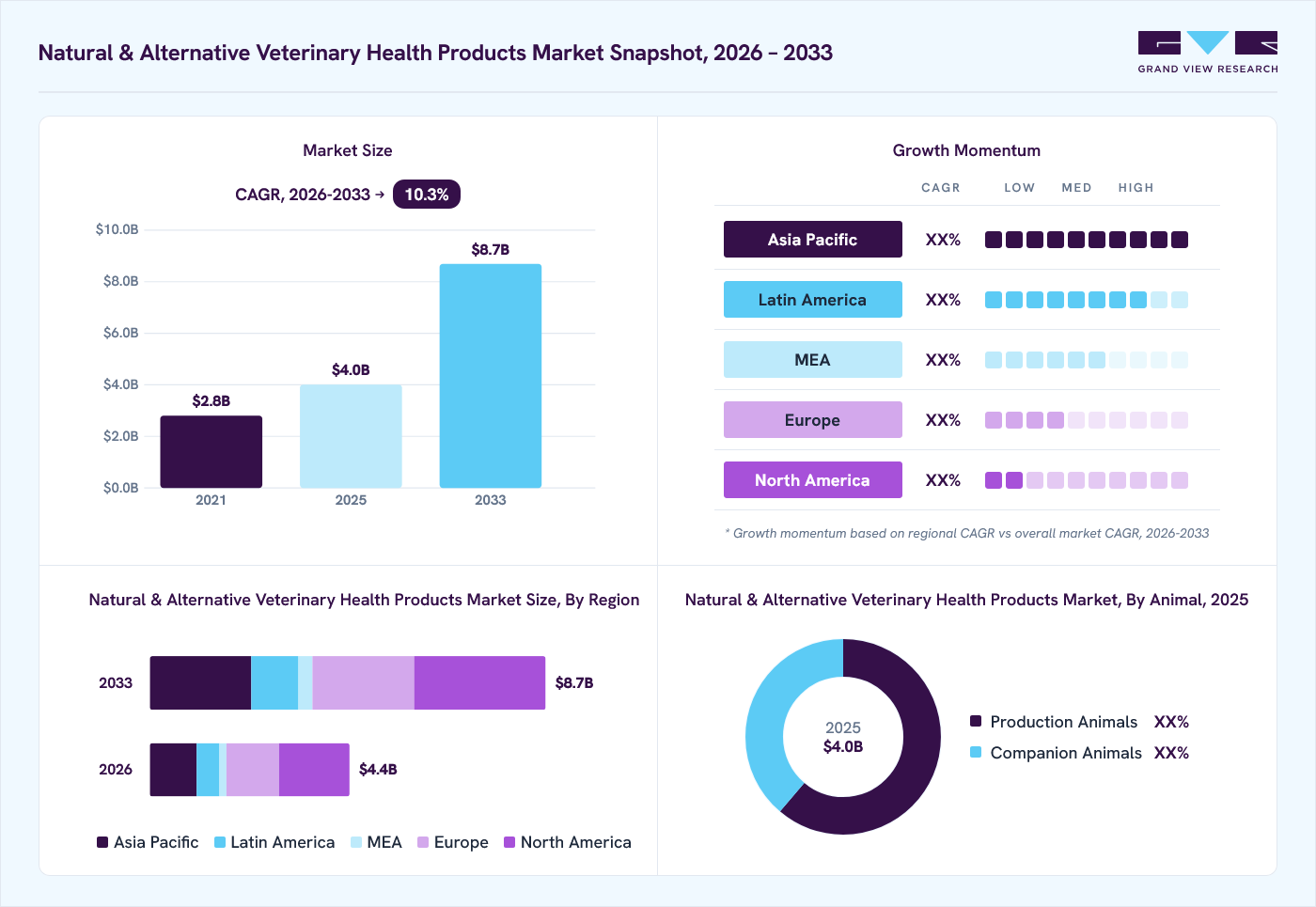 Source: Grand View Research, IR Documents, Primary Interviews, Paid DatabasesTo learn more about this report,
 Download Free Sample Report
Key Market Trends & Insights
- By animal: Production animal segment led the market with the largest revenue share of 61.1% in 2025.
- By product: Vitamins & minerals segment led the market with the largest revenue share of 32.4% in 2025.
- By formulation: Supplements segment is expected to grow at the fastest rate over the forecast period.
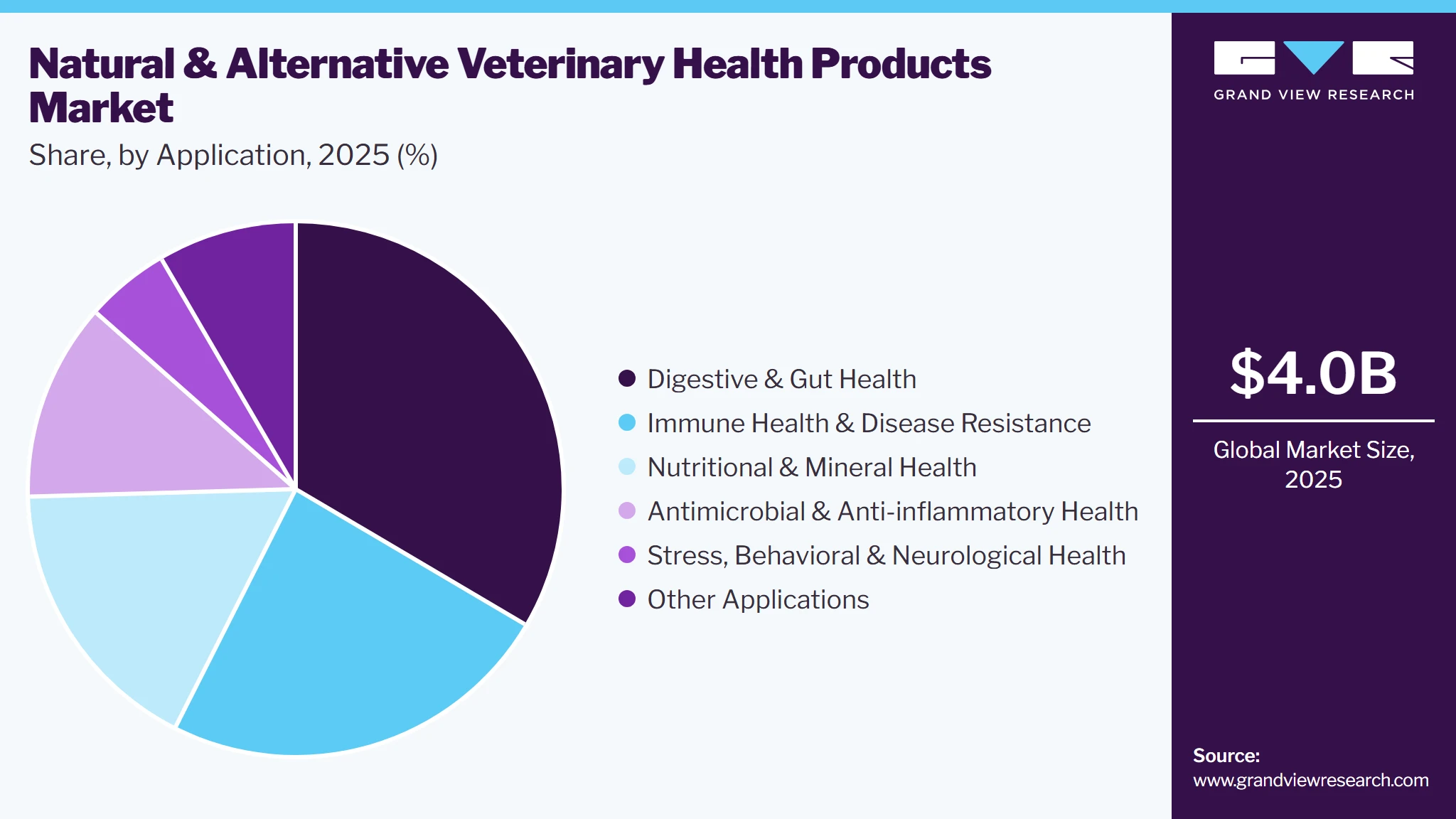
- By application: Digestive & gut health segment led the market with the largest revenue share of 33.5% in 2025.
- By route of administration: Water/liquid segment is expected to grow at the fastest rate over the forecast period.
- By sales channel: E-commerce segment is dominant in terms of revenue share as well as is expected to grow at the fastest rate over the forecast period.
Regional Highlights
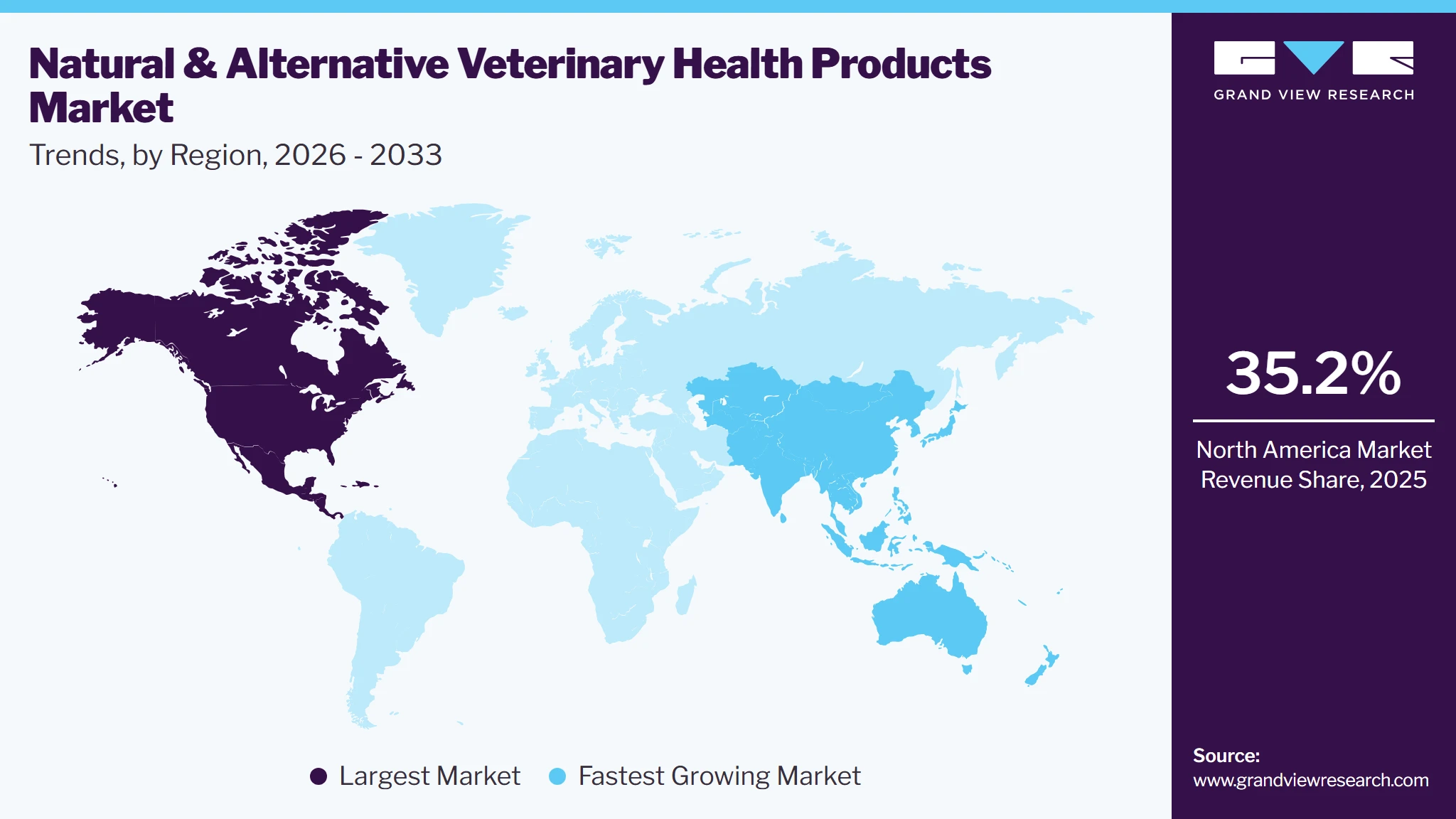
- Largest regional market: North America (35.2% revenue share, 2025)
- Fastest-growing regional market: Asia Pacific (highest CAGR, 2026-2033)
- By country: The U.S. held the largest market in 2025.
Market Size & Forecast
- Market size in 2025: USD 4.0 Billion
- Estimated market size in 2026: USD 4.4 Billion
- Projected market size by 2033: USD 8.7 Billion
- CAGR (2026-2033): 10.3%
Prism AI by Grand View Research Free to tryAsk a question about the natural & alternative veterinary health products marketTry asking✓Every figure cited from GVR research Prefer the report? Download free sample →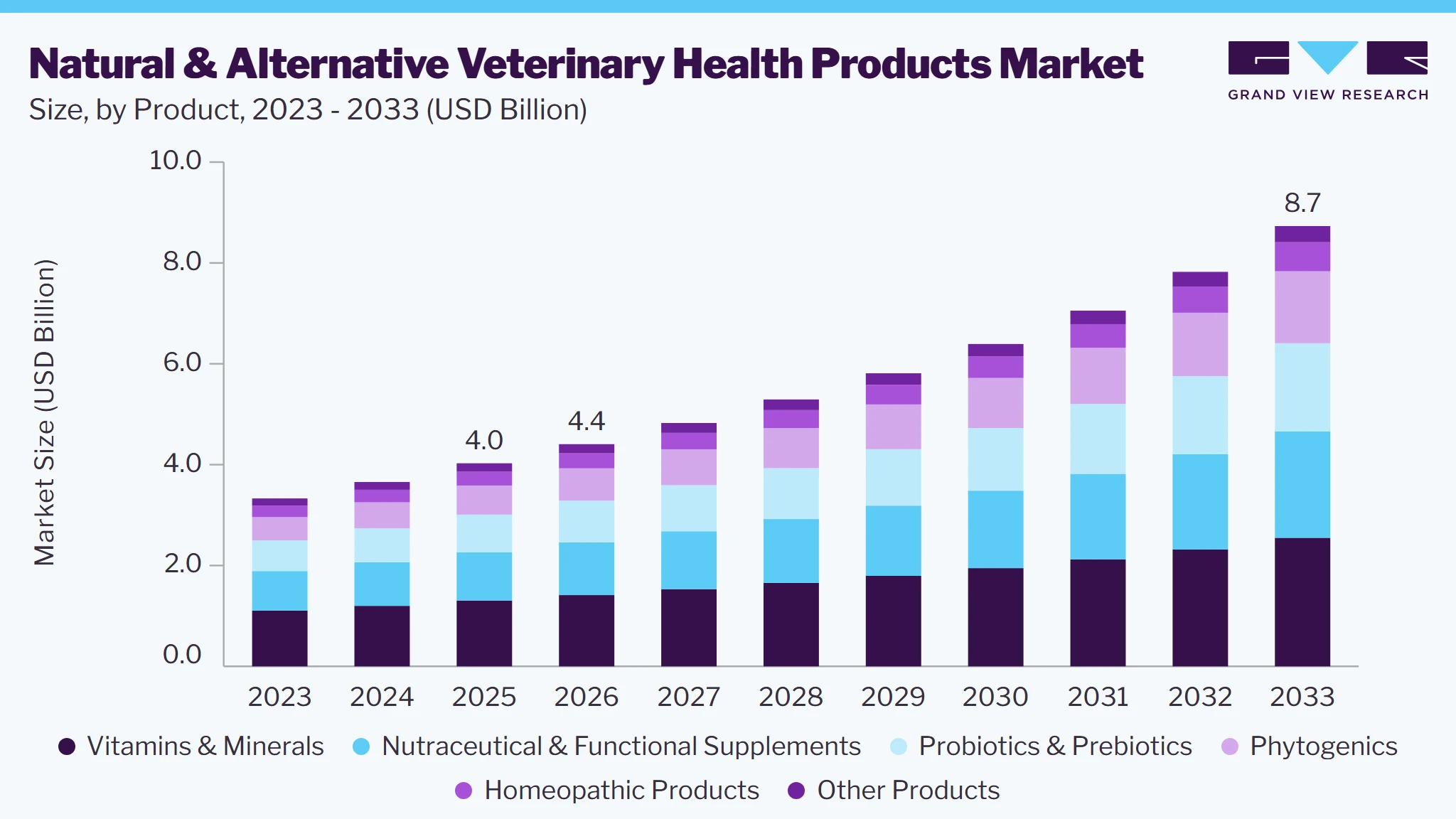 To learn more about this report, Download Free Sample Report
Market Dynamics
The natural & alternative veterinary health products market is evolving as livestock producers and companion-animal owners seek health-support solutions addressing digestive function, immune resilience, nutritional adequacy, and general wellness. Growing attention to antimicrobial stewardship and production efficiency is expanding interest in phytogenics, probiotics, prebiotics, and functional supplements, particularly among organized poultry integrators, commercial dairy operators, and veterinary-led companion-animal care providers. These stakeholders prioritize products that integrate into existing feeding or supplementation practices while delivering measurable health or production outcomes.
Product innovation is consequently shifting toward targeted formulations with defined ingredients and application-specific benefits. However, inconsistent efficacy across animal species, variations in formulation quality, and differences in regulatory classification constrain commercialization. Manufacturers must substantiate product performance and establish clear intended uses to differentiate qualifying natural health products from conventional feed additives and veterinary medicines. This positions scientifically validated formulations for stronger commercial adoption, while products lacking consistent performance evidence face greater barriers to repeat purchasing and geographic expansion.
Growing attention to gastrointestinal health is increasing demand for natural products that support digestion, intestinal integrity, and microbial balance across production and companion animals. Poultry integrators and commercial swine producers prioritize digestive efficiency because intestinal disturbances can affect feed utilization, growth performance, and production consistency. Probiotics, prebiotics, phytogenics, and qualifying natural acidifiers address complementary aspects of gastrointestinal function, enabling manufacturers to develop targeted formulations for routine animal-health management.
In companion animals, digestive supplements provide a route for product differentiation through species-specific formulations and convenient oral dosage forms. Recent scientific assessments of animal nutrition indicate that biotic products can support gastrointestinal and immune functions, although responses vary by species, formulation, and feeding conditions. This creates a commercial advantage for suppliers that demonstrate repeatable outcomes under defined conditions. Manufacturers with validated formulations and clear dosing guidance are positioned to gain adoption among organized livestock producers and veterinary practitioners, while undifferentiated digestive supplements face greater competition for purchasing decisions.
Inconsistent product performance constrains the adoption of natural and alternative veterinary health products because buyers need reliable evidence that formulations deliver the intended health benefits under commercial conditions. Botanical composition, active-compound concentrations, processing methods, dosage, animal species, and feeding conditions can influence outcomes, making results difficult to generalize across products and production systems. Probiotics and prebiotics also produce variable responses according to the microbial strain, host physiology, diet, and existing gastrointestinal conditions.
Commercial poultry integrators and dairy operators therefore face uncertainty when comparing products based on broad digestive-health or performance claims without sufficiently comparable trial data. This limits purchasing confidence and increases the importance of controlled trials, quality assurance, and consistent ingredient specifications. In addition, the cost of generating species-specific efficacy and safety evidence can constrain smaller manufacturers that lack dedicated research infrastructure. Suppliers that cannot demonstrate reproducible outcomes face greater difficulty securing institutional contracts, maintaining repeat orders, and entering regulated markets.
Developing standardized botanical formulations creates an opportunity to address digestive health, immune function, and production efficiency in poultry, swine, and cattle. Commercial livestock operators require products that deliver consistent outcomes across large animal populations without disrupting existing feeding protocols. Manufacturers can address this requirement through defined botanical compositions, standardized active-compound concentrations, species-specific dosing, and controlled trials measuring relevant outcomes such as feed conversion, growth performance, and gastrointestinal function. Research on phytogenic feed additives indicates potential benefits across these applications, although the strength of evidence varies by ingredient, species, and study conditions.
This creates an opportunity for suppliers to differentiate formulations through reproducible performance data rather than general natural-product positioning. Partnerships with feed manufacturers, livestock integrators, and veterinary nutrition specialists can facilitate commercial validation and distribution. Companies that combine botanical expertise with manufacturing consistency and regulatory readiness are positioned to secure adoption in organized production systems, while product developers with limited validation capabilities face greater challenges in converting initial interest into sustained commercial demand.
 To learn more about this report, Download Free Sample Report
Market Concentration & Characteristics
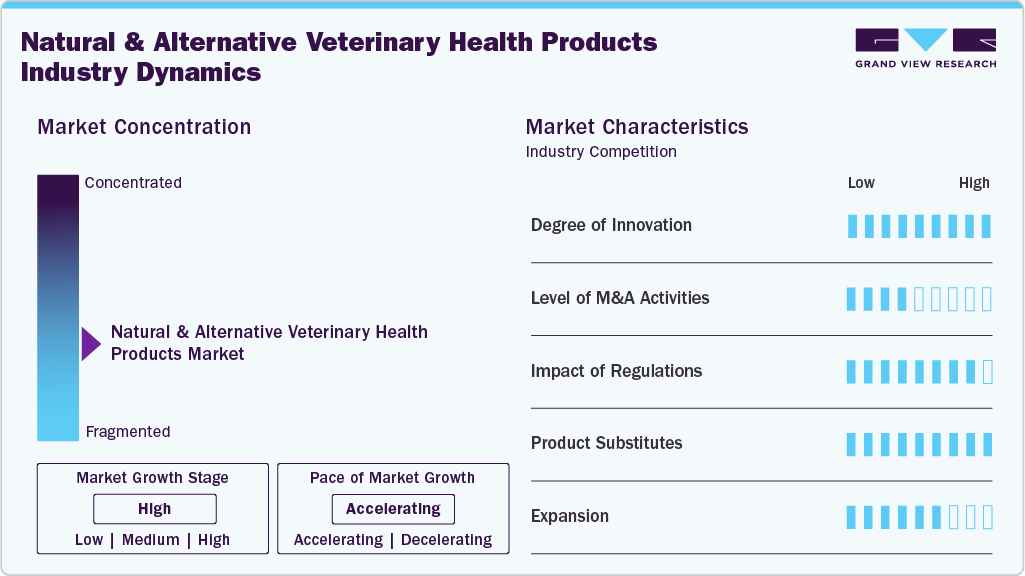
The industry is moderately fragmented, with multinational animal-nutrition companies competing alongside specialized botanical manufacturers, herbal veterinary healthcare providers, and probiotic and functional supplement developers. Competition varies across product categories, animal species, and geographic markets, limiting overall market concentration. Large participants benefit from established distribution networks, broader product portfolios, and regulatory capabilities, while smaller specialists compete through ingredient expertise and targeted formulations. Selective acquisitions and partnerships are gradually consolidating capabilities within specific product categories, although competition remains dispersed across the wider industry.
Innovation degree is expected to be high since it is shifting toward specialized formulations combining botanical ingredients, probiotics, prebiotics, and postbiotics for defined animal-health applications. For instance, in April 2026, IFF launched PureStrong, a probiotic developed for canine digestive health. Moreover, in August 2026, Standard Process introduced GI Soothing, combining probiotic, postbiotic, and botanical ingredients for dogs and cats. These launches create opportunities for differentiated products, while increasing the importance of ingredient standardization and product-specific efficacy evidence.
 To learn more about this report, Download Free Sample Report
M&A activity has a moderate impact, as activity is concentrated among selected participants seeking specialized formulations, botanical sourcing capabilities, and international distribution access. For instance, in February 2026, Zenex Animal Health acquired a majority stake in VievePharm, a Dutch natural animal-nutrition business. These transactions favor established groups seeking to accelerate portfolio expansion, although available evidence does not establish widespread consolidation across the sector.
Regulatory requirements influence product development costs, commercialization timelines, permitted claims, and geographic expansion. For instance, the European Union requires authorization of feed additives following safety and efficacy assessment, with conditions specified for animal species and intended uses. In July 2026, the European Commission authorized specific botanical tinctures for use as feed additives across animal species. This framework favors manufacturers with regulatory expertise and supporting evidence, while product classification and authorization requirements create additional barriers for smaller developers entering new markets.
Conventional veterinary medicines, nutritional additives, and alternative functional formulations compete for overlapping animal-health needs, including digestive function, nutrient utilization, and immune support. These alternatives constrain pricing flexibility and require natural-product manufacturers to establish clear advantages through consistent outcomes, suitable formulations, and practical administration. However, qualifying natural health products cannot replace conventional veterinary medicines in every clinical context. Commercial adoption therefore depends on the intended application, product-specific evidence, and suitability for the animal-health management practices of livestock producers and companion-animal owners.
Expansion is proceeding through ingredient partnerships, acquisitions, international distribution, and manufacturing investment. For instance, in June 2026, ADM opened a premix and feed-additives facility in Brazil. Such investments improve access to production capabilities and regional customers, although broader animal-nutrition capacity should not be attributed entirely to natural and alternative veterinary health products.
Analyst Perspective
The market is transitioning from broad herbal and nutritional formulations toward standardized, function-specific solutions supported by scientific validation. While traditional products focused on general animal wellness, demand is increasingly shifting toward digestive health, immune function, stress resilience, and responsible antimicrobial use. Growing research into non-antibiotic interventions and innovations in seaweed-derived feed technologies are expanding opportunities across botanical, microbiome-based, and marine bioactive ingredients. Key growth areas include advanced phytogenics, essential oils, probiotics, prebiotics, seaweed-derived bioactives, and species-specific formulations targeting heat stress and gut health. Production animals offer opportunities to improve feed utilization and herd or flock performance, while companion animals support demand for specialized oral supplements. Going forward, competitive advantage will depend on proven efficacy, ingredient standardization, clear product positioning, and regulatory compliance, particularly across feed-additive and veterinary-medicine classifications.
Animal Insights
On the basis of animal, the production animals segment accounted for the largest market share of 61.1% in 2025, driven by recurring nutritional requirements across commercial poultry, swine, dairy, and beef production systems. Large animal populations and established feeding programs facilitate the delivery of qualifying phytogenics, probiotics, vitamins, minerals, and other functional products at scale. Organized livestock integrators prioritize digestive health, nutrient utilization, and production consistency because these factors influence operational performance. This creates a broad, recurring revenue base that sustains production animals' leading market position.
The companion animals segment is anticipated to grow at the fastest CAGR over the forecast period as pet owners increasingly seek specialized products for digestive health, immunity, joint function, and general wellness. Greater product differentiation across species and health applications creates opportunities for premium formulations and repeat purchasing. Canine and feline products particularly benefit from convenient oral dosage forms and access through veterinary practices, specialty retailers, and e-commerce. These demand characteristics position companion animals to expand faster than Production Animals, although livestock continues to benefit from greater scale-driven consumption.
Product Insights
On the basis of product, vitamins & minerals segment dominated the market in 2025 with a share of 32.4%. Growth is supported by supported by established nutritional requirements across production and companion animals. Their applications in growth, metabolism, immune function, and physiological maintenance sustain recurring demand among livestock producers and pet owners. Compatibility with established feeding programs and supplement formulations also supports broad commercial availability. This combination of routine use and cross-species applicability gives vitamins & minerals the largest revenue base.
The phytogenics segment is anticipated to grow at the fastest CAGR over the forecast period as manufacturers develop botanical extracts, essential oils, and plant-derived formulations for digestive function, immune support, and other animal-health applications. Commercial livestock operators provide an important demand base because qualifying phytogenic products can be incorporated into existing feeding programs. Product standardization and application-specific efficacy testing will determine how effectively suppliers convert interest into sustained adoption. Manufacturers with consistent formulations and credible performance evidence are positioned to gain traction among organized poultry, swine, and dairy producers seeking differentiated natural health-support solutions.
Formulation Insights
On the basis of formulation, the feed-based products dominated the market with share of over 57.8% in 2025, reflecting their suitability for routine administration across commercial livestock populations. Feed premixes, complete feeds containing qualifying ingredients, and supplemental feeds enable producers to incorporate natural health-support products into established nutritional programs. This approach supports recurring consumption and distribution across large herds and flocks without requiring separate individual administration for every animal. Consequently, feed-based formulations retain a revenue advantage in production-animal applications, where operational scale and compatibility with feeding infrastructure shape purchasing decisions.
The supplements segment is expected to grow with highest CAGR over the forecast period. The demand is expected to expand for targeted formulations addressing digestive, nutritional, joint, immune, and behavioral health. Chewables, soft chews, powders, and liquids provide manufacturers with flexible dosage formats for species-specific applications, particularly in companion animals. Their suitability for differentiated ingredients and health-focused positioning creates opportunities to serve distinct consumer needs. Veterinary recommendations and online distribution further improve product accessibility. These factors position supplements for faster growth than feed-based formulations, although their commercial trajectory will depend on product efficacy, palatability, and repeat purchasing.
Application Insights
On the basis of application, the digestive & gut health segment accounted for the largest market share of 33.5% in 2025. Dominance is driven by recurring requirements for intestinal function, microbial balance, and nutrient utilization. Commercial livestock producers prioritize gastrointestinal performance because digestive disturbances can affect feed conversion, growth, and production consistency. Qualifying probiotics, prebiotics, phytogenics, and natural acidifiers address complementary aspects of digestive support, creating demand across multiple product categories. The breadth of these applications and their relevance to routine animal management sustain the segment's leading position, particularly among poultry, swine, and dairy operators.
 To learn more about this report, Download Free Sample Report
The stress, behavioral & neurological health segment is the fastest-growing, with the highest CAGR over the forecast period. This is owed to product development being increasingly targeted towards addressing calming, behavioral balance, and cognitive support, particularly in companion animals. Pet owners seeking specialized wellness solutions create opportunities for targeted botanical and functional formulations delivered through convenient oral dosage forms. Manufacturers can differentiate products according to animal species, behavioral requirements, and intended use, supporting premium positioning within specialty retail and online channels. Commercial expansion will depend on product-specific evidence, appropriate claims, and repeat purchasing, positioning this application for faster growth than more established nutritional-support categories.
Route of Administration Insights
On the basis of route of administration, the feed segment accounted for the largest market share in 2025 because it enables qualifying natural health-support products to be administered through established feeding systems. Commercial poultry integrators, swine producers, and dairy operators can incorporate suitable formulations into routine nutritional programs, supporting repeated consumption across large animal populations. This delivery route also facilitates distribution through feed manufacturers, premix suppliers, and livestock-nutrition channels. Its operational compatibility and scale advantage sustain its leading revenue position, particularly in production-animal applications where individual oral administration can increase labor and handling requirements.
The water/ liquid segment is the fastest-growing, with the highest CAGR over the forecast period. These soluble formulations offer an alternative delivery route for qualifying products intended for drinking-water administration. Commercial poultry operations are particularly relevant because drinking systems can distribute suitable formulations across large flocks without requiring individual dosing. This creates opportunities for products addressing digestive function, nutritional support, and other eligible health applications. However, adoption depends on formulation stability, water solubility, dosage consistency, and compatibility with existing equipment. Manufacturers addressing these operational requirements are positioned to expand use among intensively managed production-animal populations.
Sales Channel Insights
On the basis of sales channel, the e-commerce segment accounted for the largest market share in 2025 as well as is expected to grow at the fastest rate over the forecast period. Growth is supported by convenient product discovery, broad geographic access, and simplified repeat purchasing. Online platforms allow pet owners to compare specialized supplements, review product information, and purchase formulations without depending exclusively on physical retail availability. Subscription options and direct-to-consumer distribution can further support recurring demand for products used routinely. These characteristics favor digitally accessible companion-animal supplements, particularly in digestive, nutritional, and general wellness applications. E-commerce's leading position reflects its ability to connect specialized product portfolios with geographically dispersed customers.
The veterinary & specialty retail segment is the second-fastest-growing over the forecast period as demand for specialized natural animal-health products increases the importance of professional guidance and product availability. Veterinary and specialty retailers help pet owners identify suitable formulations for digestive health, immunity, nutritional support, and other wellness requirements. Access to product-specific information, ingredient guidance, and species-appropriate formulations strengthens purchasing confidence. This positions specialized retailers to capture greater demand for differentiated supplements, particularly among companion-animal owners seeking targeted health-support solutions.
Regional Insights
North America held the largest revenue share of 35.2% in 2025, driven by established companion-animal healthcare expenditure and commercial livestock production. The U.S. had an estimated 88.9 million dogs and 77.0 million cats in 2026, while Canadian cattle inventories reached 12.1 million head in July 2026, increasing 3.2% year over year. These populations create demand opportunities across companion-animal supplements and qualifying livestock nutrition products, positioning suppliers with species-specific formulations to serve both consumer-oriented and production-focused customers.
 To learn more about this report, Download Free Sample Report
U.S. Natural & Alternative Veterinary Health Products Market Trends
The natural & alternative veterinary health products market in the U.S. held the largest share in the North America region in 2025, driven by extensive pet ownership and established veterinary distribution networks. The 2026 American Veterinary Medical Association data estimate 88.9 million dogs and 77.0 million cats nationwide. This large customer base supports opportunities for qualifying digestive, nutritional, and functional supplements. Manufacturers offering differentiated formulations through veterinary practices, specialty retailers, and e-commerce are positioned to address recurring wellness needs and species-specific purchasing preferences.
Canada natural & alternative veterinary health products market is estimated to grow at the fastest CAGR during the forecast period, driven by livestock production requirements and demand for improved animal-health management. Statistics Canada reported 12.1 million cattle and calves in July 2026, up 3.2% year over year, alongside increases in hog and sheep inventories. These populations create opportunities for qualifying phytogenic, probiotic, and nutritional products. Suppliers offering consistent formulations compatible with commercial feeding systems are positioned to serve dairy, beef, swine, and other livestock operators.
Europe Natural & Alternative Veterinary Health Products Market Trends
Europe natural & alternative veterinary health products market is witnessing steady growth, driven by established animal-health infrastructure, specialized companion-animal care, and regulatory developments concerning botanical feed ingredients. For instance, in March 2026, the European Commission authorized patchouli essential oil as a feed additive for all animal species, followed by authorization of rosemary essential oil in September 2026. These decisions establish specific regulatory pathways for qualifying botanical ingredients. Manufacturers with standardized formulations and appropriate authorization are better positioned to commercialize products across European markets, subject to applicable conditions and national requirements.
The natural & alternative veterinary health products market in UK held the largest share in 2025 fueled by an extensive companion-animal population and access to specialized pet-health products. UK Pet Food estimated 36.5 million pets across 62% of households in 2026. Moreover, in October 2026, Mervue Laboratories introduced its retail pet supplement range through UK distributor The PetFellas, covering nutritional, digestive, immune, and joint-support applications. Such distribution activity expands access to qualifying supplements and creates opportunities for manufacturers targeting repeat purchases through independent pet retailers.
Germany natural & alternative veterinary health products market is expected to grow at the fastest rate over the forecast period. The market is driven by established livestock production and continued development of phytogenic feed formulations. Germany recorded approximately 10.4 million cattle in May 2026, including around 3.6 million dairy cows. Moreover, in July 2026, Germany-based Phytobiotics introduced Sangrovit Extra 4d26, a plant-derived feed additive registered for broiler applications in the European Union. These developments create opportunities for qualifying botanical products among organized poultry and dairy operators seeking digestive-health and production-efficiency benefits.
Asia Pacific Natural & Alternative Veterinary Health Products Market Trends
Asia Pacific is expected to grow at the fastest CAGR over the forecast period, driven by large livestock populations, expanding animal-protein production, and continued development of dairy and poultry infrastructure. China provides substantial production scale, while India has recorded sustained growth in milk, egg, and meat production. These conditions expand the addressable base for qualifying phytogenics, probiotics, and functional nutritional products. Suppliers that develop species-specific formulations and establish commercial access to organized livestock operators are positioned to capture demand, particularly where feed efficiency and routine animal-health management shape purchasing priorities.
The China natural & alternative veterinary health products market held the largest share in Asia Pacific in 2025, driven by the scale of its animal-protein industry and the associated requirements for livestock health management. China's National Bureau of Statistics reported 76.27 million tonnes of pork, beef, mutton, and poultry production during the first three quarters of 2026, up 4.3% year over year. The scale of commercial production creates opportunities for qualifying botanical, microbial, and nutritional products. Suppliers offering consistent formulations suited to intensive livestock systems are positioned to serve large-scale production operators.
India natural & alternative veterinary health products market is estimated to grow at the fastest growth rate over the forecast period, driven by livestock-sector expansion and investment in dairy and animal-health infrastructure. Government data released in 2026 reported milk production of 247.87 million tonnes in 2024-2025. By June 2026, 36,611 new dairy cooperative societies had been organized, while additional milk-chilling and processing capacity had been developed. These initiatives support more organized livestock management and commercial access to qualifying phytogenic, probiotic, and nutritional formulations. Suppliers serving dairy cooperatives and poultry operators are positioned to address recurring animal-health requirements.
Latin America Natural & Alternative Veterinary Health Products Market Trends
Latin America natural & alternative veterinary health products market is expected to grow significantly during the forecast period, driven by export-oriented animal-protein production and the scale of commercial livestock operations. Brazil recorded year-over-year increases in cattle, swine, and chicken slaughter during the first quarter of 2026, while Argentina reported animal-protein exports worth USD 3.464 billion during January-July 2026, up 35% in value. These production and trade conditions increase the commercial importance of feed efficiency and animal-health management, creating opportunities for qualifying natural formulations among organized livestock producers.
Brazil natural & alternative veterinary health products market held the largest share in Latin America in 2025, driven by its extensive cattle, poultry, and swine industries. In the first quarter of 2026, Brazil slaughtered 10.29 million cattle, 15.27 million hogs and pigs, and approximately 1.71 billion chickens, with year-over-year increases across all three categories. This production scale creates opportunities for qualifying phytogenics, probiotics, and functional nutritional products. Suppliers with formulations suited to commercial livestock feeding systems are positioned to serve integrators and producers focused on health management and operational efficiency.
Argentina natural & alternative veterinary health products market is estimated to grow at the fastest growth rate over the forecast period, driven by export-oriented livestock production and growing requirements for animal-health management. For instance, in September 2026, Argentina's government reported animal-protein exports of USD 3.464 billion during the first seven months of the year, representing a 35% year-over-year increase in value. Expansion in internationally traded animal products increases the importance of production consistency, feed efficiency, and livestock health. These priorities create opportunities for qualifying botanical and nutritional formulations among commercial cattle, poultry, and swine operators.
Middle East & Africa Natural & Alternative Veterinary Health Products Market Trends
The Middle East & Africa natural & alternative veterinary health products market is witnessing steady growth, driven by livestock development, food-security priorities, and demand for improved animal-health management. Saudi Arabia reported more than 22 million sheep, 7.6 million goats, 2.2 million camels, and 510,000 cattle in May 2026. In South Africa, a September 2026 agricultural assessment projected chicken-meat production to reach 1.73 million tonnes in 2027. These production systems create opportunities for qualifying nutritional, botanical, and digestive-health products, although distribution infrastructure and purchasing patterns vary across regional markets.
The South Africa natural & alternative veterinary health products market held the largest share in Middle East & Africa in 2025, driven by its established poultry industry and commercial animal-feed infrastructure. For instance, in September 2026, the U.S. Department of Agriculture's agricultural service projected South African chicken-meat production to rise 3% to 1.73 million tonnes in 2027, supported by lower feed prices following recovery of the domestic grain harvest. This production environment creates opportunities for qualifying feed-based natural health products, particularly among commercial poultry operators seeking to manage digestive health and production efficiency.
Saudi Arabia natural & alternative veterinary health products market is estimated to grow at the fastest growth rate over the forecast period, driven by livestock development and food-security priorities. For instance, in May 2026, the Ministry of Environment, Water and Agriculture reported more than 22 million sheep, 7.6 million goats, 2.2 million camels, and 510,000 cattle nationwide. The large, small-ruminant and camel populations create an addressable base for qualifying nutritional, botanical, and feed-based health products. Suppliers with species-appropriate formulations and local distribution capabilities are positioned to serve commercial livestock operations and support domestic production objectives.
Key Natural & Alternative Veterinary Health Products Company Insight
The market is characterized by competition between specialized botanical and herbal product manufacturers, diversified animal-nutrition companies, and veterinary healthcare providers. Participants differentiate through phytogenic formulations, probiotic and prebiotic solutions, functional nutritional supplements, and homeopathic products targeting production and companion animals. Companies are expanding product portfolios through research collaborations, formulation development, and strategic acquisitions, while established distribution networks support access to commercial livestock producers and companion-animal owners. Competitive positioning is shaped by product-specific efficacy evidence, ingredient standardization, regulatory compliance, and the ability to commercialize species-specific formulations across geographic markets.
Key Natural & Alternative Veterinary Health Products Companies
The following key companies have been profiled for this study on the natural & alternative veterinary health products market.
-
Natural Remedies
-
Himalaya Wellness
-
Indian Herbs
-
GreenVet
-
Zenex Animal Health
-
Amorvet
-
Cargill
-
Kemin Industries
-
Nutreco
-
ADM
-
Phibro Animal Health
-
Virbac
-
Bakson Veterinary
Competitive Benchmarking
Category
Operating Strategies
Competitive Edge
Weakness
Established Global Leaders (Cargill (ADM); Nutreco; Virbac)
- Pursue portfolio breadth across animal nutrition and veterinary healthcare, spanning functional feed ingredients, phytogenics, microbiome-based solutions, nutritional supplements, and specialized companion-animal products. Cargill, ADM, and Nutreco integrate ingredient development with feed manufacturing and commercial distribution, while Virbac applies its veterinary-focused portfolio and practitioner relationships to specialized animal-health formulations. Investment in botanical ingredients, probiotics, prebiotics, and postbiotics enables these participants to expand their presence in qualifying natural health categories alongside their broader businesses.
- Established manufacturing infrastructure, technical capabilities, geographic coverage, and relationships with livestock integrators, feed manufacturers, veterinarians, and specialty retailers facilitate commercialization across multiple animal groups. ADM's functional ingredient capabilities and Cargill's access to commercial feeding systems support scalable product development, while Virbac's veterinary channel facilitates access to companion-animal customers. These complementary capabilities enable established players to commercialize qualifying formulations across several applications, giving them a distribution and market-access advantage over narrowly focused suppliers.
- Broad portfolios increase organizational complexity and require companies to allocate resources across multiple product categories with different regulatory and commercial requirements. A substantial share of their overall business may originate from conventional veterinary medicines, commodity nutritional ingredients, or feed additives outside the defined market. This limits the relevance of total company scale as a measure of competitive strength in natural and alternative products. Smaller specialists can compete more directly through botanical expertise, focused formulations, and application-specific product development.
Emerging & Specialized Technology-Focused Players (Natural Remedies; Himalaya Wellness; Indian Herbs; GreenVet; Anfom Animal Health; Kemin Industries; Phibro Animal Health; Biochem; Innovad; Phiro Animal Health)
- Concentrate on specialized product categories, including phytogenics, herbal formulations, probiotics, prebiotics, functional nutritional ingredients, and homeopathic products. Natural Remedies, Indian Herbs, GreenVet, and Anfom develop botanical and complementary animal-health solutions, while Himalaya Wellness applies herbal formulation capabilities across animal-care categories. Biochem Veterinary focuses on homeopathic products, whereas Kemin Industries and Phibro Animal Health develop specialized ingredients and functional nutrition solutions. Zenix Animal Health is expanding through acquisitions and portfolio diversification, creating opportunities to access additional product capabilities and geographic markets.
- Focused technical expertise enables these companies to address specific animal-health applications and develop differentiated formulations for production and companion animals. Botanical specialists benefit from experience in plant-derived ingredients and herbal preparation, while technology-focused participants draw on ingredient science, microbial solutions, and formulation capabilities. Zenix Veterinary has direct alignment with homeopathic products, whereas Kemin Industries gains access to broader formulation capabilities through acquisitions. Category specialization can shorten product-development cycles and support faster responses to emerging customer requirements, particularly in digestive health, phytogenic nutrition, and functional supplements.
- Narrower product portfolios, smaller distribution networks, and uneven geographic coverage can constrain access to large livestock integrators, institutional buyers, and international veterinary channels. Specialized botanical and homeopathic developers also face requirements for product standardization, quality assurance, and credible efficacy evidence. Companies with limited manufacturing or regulatory resources face additional barriers when entering new markets. Diversified competitors retain advantages in distribution scale and customer access, making partnerships, targeted acquisitions, and evidence-led product differentiation important routes to commercial expansion.
Recent Developments
-
In October 2026, Innovad Group acquired a majority stake in Olea Fortius to expand its Mediterranean phytogenic portfolio, combining olive-derived ingredients, essential oils, and scientific validation capabilities. The partnership includes investment in a processing facility in Greece to standardize, validate, and distribute natural botanical ingredients internationally, strengthening Innovad’s position in science-backed animal nutrition solutions.
-
In October 2026, Acadian Animal Wellness launched Tasco optimized feed technology, using Ascophyllum nodosum seaweed-derived bioactives to support gut health, immune function, stress mitigation, and animal productivity. The launch expands the availability of natural, science-backed feed solutions for livestock, equine, pet food, and aquaculture applications, aligning with growing demand for alternative animal-health and nutritional products.
Natural & Alternative Veterinary Health Products Market Report Scope
Report Attribute
Details
Market size value in 2025
USD 4.0 billion
Market size value in 2026
USD 4.4 billion
Revenue forecast in 2033
USD 8.7 billion
Growth Rate
CAGR of 10.3% from 2026 to 2033
Actual Data
2021 - 2025
Forecast period
2026 - 2033
Quantitative units
Revenue in USD Million/billion and CAGR from 2026 to 2033
Report coverage
Revenue forecast, company ranking, competitive landscape, growth factors, and trends
Segments covered
Animal, product, formulation, application, route of administration, sales channel, and region
Regional scope
North America, Europe, Asia Pacific, Latin America, MEA
Country scope
U.S., Canada, Mexico, UK, Germany, France, Italy, Spain, Denmark, Sweden, Norway, Japan, China, India, Thailand, South Korea, Australia, Brazil, Argentina, South Africa, UAE, Saudi Arabia, Kuwait, Qatar, Oman
Key companies profiled
Natural Remedies, Himalaya Wellness, Indian Herbs, GreenVet, Zenex Animal Health, Amorvet, Cargill, Kemin Industries, Nutreco, ADM, Phibro Animal Health, Virbac, and Bakson Veterinary
Customization scope
Free report customization (equivalent up to 8 analysts working days) with purchase. Addition or alteration to country, regional & segment scope.
Pricing and purchase options
Avail customized purchase options to meet your exact research needs. Explore purchase options
Global Natural & Alternative Veterinary Health Products Market Report Segmentation
This report forecasts revenue growth at global, regional, and country levels and provides an analysis of the latest industry trends in each of the sub-segments from 2021 to 2033. For this study, Grand View Research has segmented the global natural & alternative veterinary health products market report based on animal, product, formulation, application, route of administration, sales channel, and region:
-
Animal Outlook (Revenue, USD Million, 2021 - 2033)
-
Production Animals
-
Bovine
-
Swine
-
Poultry
-
Ovine & Caprine
-
Others
-
-
Companion Animals
-
Canine
-
Feline
-
Equine
-
Others
-
-
-
Product Outlook (Revenue, USD Million, 2021 - 2033)
-
Phytogenics
-
Essential Oils
-
Other Phytogenics
-
-
Probiotics & Prebiotics
-
Vitamins & Minerals
-
Nutraceutical & Functional Supplements
-
Homeopathic Products
-
Other Products
-
-
Formulation Outlook (Revenue, USD Million, 2021 - 2033)
-
Feed-based Products
-
Feed Premixes
-
Complete Feed
-
Supplemental & Concentrate Feed
-
Other Feed-based Products
-
-
Supplements
-
Chewables & Soft Chews
-
Tablets & Capsules
-
Powders & Granules
-
Liquids
-
Others Supplements
-
-
-
Application Outlook (Revenue, USD Million, 2021 - 2033)
-
Digestive & Gut Health
-
Immune Health & Disease Resistance
-
Antimicrobial & Anti-inflammatory Health
-
Nutritional & Mineral Health
-
Stress, Behavioral & Neurological Health
-
Other Applications
-
-
Route of Administration Outlook (Revenue, USD Million, 2021 - 2033)
-
Feed
-
Water / Liquid
-
Direct Oral
-
-
Sales Channel Outlook (Revenue, USD Million, 2021 - 2033)
-
Direct & Institutional Sales
-
Veterinary & Specialty Retail
-
E-commerce
-
Other Channels
-
-
Regional Outlook (Revenue, USD Million, 2021 - 2033)
-
North America
-
U.S.
-
Canada
-
Mexico
-
-
Europe
-
UK
-
Germany
-
France
-
Italy
-
Spain
-
Denmark
-
Sweden
-
Norway
-
-
Asia Pacific
-
Japan
-
China
-
India
-
Australia
-
Thailand
-
South Korea
-
-
Latin America
-
Brazil
-
Argentina
-
-
Middle East & Africa
-
South Africa
-
UAE
-
Saudi Arabia
-
Kuwait
-
Qatar
-
Oman
-
-
Research Methodology
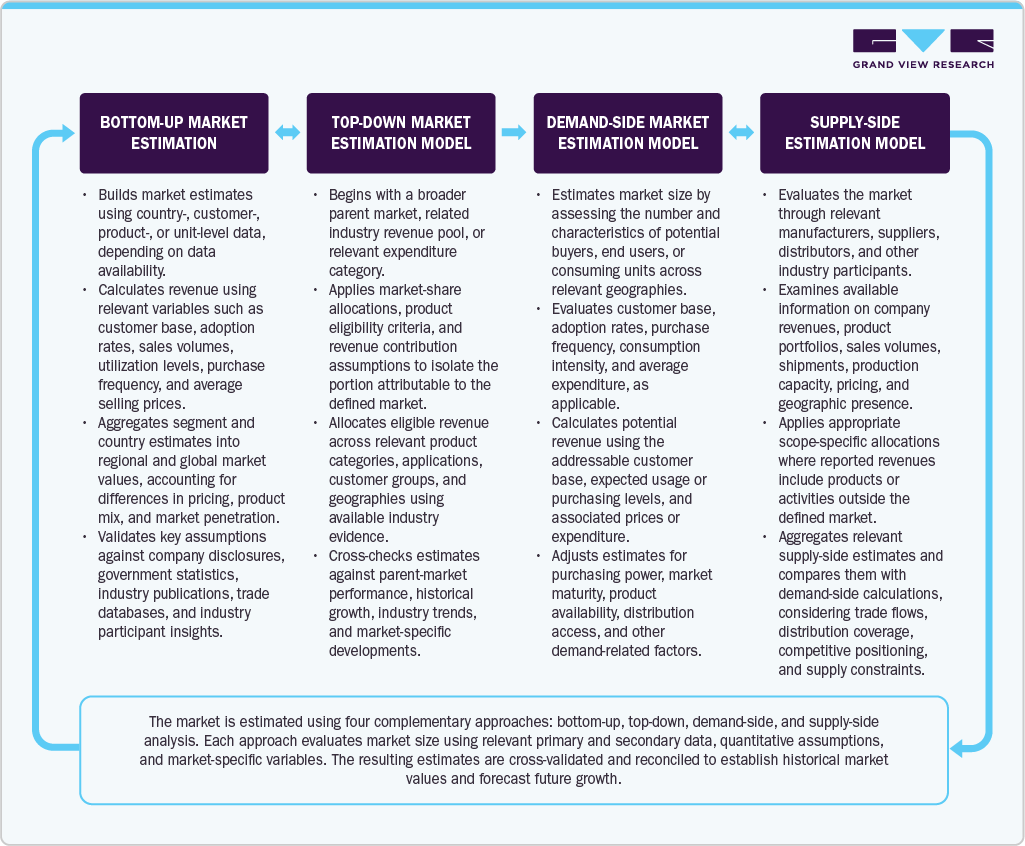
The natural & alternative veterinary health products market figures in this report are based on a proven research process that combines executive interviews with secondary research from proprietary databases, company filings, and recognized regulatory and institutional sources. Market size is built through value-chain sizing - reconciling supply-side and demand-side estimates - and triangulated with bottom-up and top-down approaches. Every estimate passes multiple levels of expert validation before publication, with each natural & alternative veterinary health products segment quantified using the revenue-capture definitions in the table below.
Segment Definition
Market
Definition
Natural & Alternative Veterinary Health Products Market
This market represents revenue generated from natural and alternative animal-health products used to support, maintain, or improve the health and well-being of production and companion animals. The market covers products delivered through feed, drinking water, or directly by oral administration, including nutritional, botanical, microbial, mineral, homeopathic, and other natural or alternative formulations.
Market
Definition
Production Animals
This segment represents revenue generated from natural and alternative animal-health products intended for animals primarily raised for food production, breeding, or other agricultural purposes.
Bovine
This segment represents revenue generated from natural and alternative animal-health products used for cattle raised for dairy, beef, breeding, or other agricultural purposes.
Swine
This segment represents revenue generated from natural and alternative animal-health products used for domesticated pigs raised primarily for pork production, breeding, or commercial farming.
Poultry
This segment represents revenue generated from natural and alternative animal-health products used for domesticated birds raised for meat, eggs, breeding, or other commercial production.
Ovine & Caprine
This segment represents revenue generated from natural and alternative animal-health products used for sheep and goats raised for meat, milk, fiber, breeding, or other agricultural purposes.
Others
This segment represents revenue generated from natural and alternative animal-health products used for commercially raised production animals outside the principal livestock categories.
Companion Animals
This segment represents revenue generated from natural and alternative animal-health products intended for animals primarily kept as household companions, for recreation, personal ownership, or non-food-related purposes.
Canine
This segment represents revenue generated from natural and alternative animal-health products used for domesticated dogs kept primarily as companion or non-production working animals.
Feline
This segment represents revenue generated from natural and alternative animal-health products used for domesticated cats kept primarily as companion animals.
Equine
This segment represents revenue generated from natural and alternative animal-health products used for horses and related equids maintained for companionship, recreation, sport, breeding, or work.
Others
This segment represents revenue generated from natural and alternative animal-health products used for companion animals other than canine, feline, and equine species.
Product
Definition
Phytogenics
This segment represents revenue generated from plant-derived products used to support animal health, immunity, digestion, and overall physiological well-being.
Essential Oils
This segment represents revenue generated from concentrated volatile oils derived from plants and used primarily for antimicrobial, anti-inflammatory, digestive, or other health-supporting purposes.
Other Phytogenics
This segment represents revenue generated from specialized plant-derived animal-health products that do not fall within the defined phytogenic or essential-oil categories.
Probiotics & Prebiotics
This segment represents revenue generated from products formulated to support intestinal microbial balance, digestive function, gut integrity, and immune health.
Vitamins & Minerals
This segment represents revenue generated from nutritional products providing essential vitamins and minerals to support growth, metabolism, immunity, and overall physiological health.
Nutraceutical & Functional Supplements
This segment represents revenue generated from nutritional products that provide functional physiological or health benefits beyond basic nutritional requirements.
Homeopathic Products
This segment represents revenue generated from products prepared according to recognized homeopathic principles and positioned for complementary or alternative animal-health applications.
Other Products
This segment represents revenue generated from natural or alternative animal-health products that cannot be appropriately classified into the defined product categories.
Formulation
Definition
Feed-based - Feed Premixes
This segment represents revenue generated from concentrated natural or alternative animal-health formulations designed to be incorporated into feed at specified inclusion levels.
Complete Feed
This segment represents revenue generated from ready-to-feed diets containing natural or alternative health-supporting ingredients within the complete nutritional formulation.
Supplemental & Concentrate Feed
This segment represents revenue generated from feed products intended to supplement an animal's regular diet with natural, functional, or health-supporting ingredients.
Other Feed-based
This segment represents revenue generated from other natural or alternative health products delivered through feed that do not fall into premixes, complete feeds, or supplemental/concentrate feeds.
Supplements - Chewables & Soft Chews
This segment represents revenue generated from palatable oral supplement products designed to be voluntarily consumed or directly administered to animals.
Tablets & Capsules
This segment represents revenue generated from solid oral dosage forms containing natural, nutritional, or alternative health ingredients for direct administration.
Powders & Granules
This segment represents revenue generated from dry oral formulations intended for direct administration or for dissolution and mixing before oral administration.
Liquids
This segment represents revenue generated from liquid natural, nutritional, or alternative formulations intended for oral administration to animals.
Others
This segment represents revenue generated from specialty oral supplement formulations that do not fit within chewables, tablets/capsules, powders/granules, or liquids.
Application
Definition
Digestive & Gut Health
This segment represents revenue generated from products intended to support gastrointestinal function, digestion, nutrient utilization, gut microbiota balance, and intestinal integrity.
Immune Health & Disease Resistance
This segment represents revenue generated from products intended to support immune-system function and the animal's natural ability to respond to health challenges.
Antimicrobial & Anti-inflammatory Health
This segment represents revenue generated from products intended to support microbial control or healthy inflammatory responses through natural or alternative mechanisms.
Nutritional & Mineral Health
This segment represents revenue generated from products intended to provide nutritional support, maintain mineral balance, address deficiencies, and support related physiological functions.
Stress, Behavioral & Neurological Health
This segment represents revenue generated from products intended to support stress management, behavioral balance, calmness, cognitive function, or neurological well-being in animals.
Other Applications
This segment represents revenue generated from natural or alternative animal-health products addressing specialized applications not covered by the five primary application categories.
Route of Administration
Definition
Feed
This segment represents revenue generated from products administered orally by incorporating them into feed consumed by the animal.
Water / Liquid
This segment represents revenue generated from products administered orally through drinking water or another consumable liquid serving as the primary delivery vehicle.
Direct Oral
This segment represents revenue generated from products administered directly into the animal's mouth without feed or drinking water serving as the primary delivery vehicle.
Sales Channel
Definition
Direct & Institutional Sales
This segment represents revenue generated from products sold directly by manufacturers or suppliers to institutional or large-volume animal-health customers.
Veterinary & Specialty Retail
This segment represents revenue generated from products sold through veterinary practices, pharmacies, specialty animal-health stores, and agricultural or feed retailers.
E-commerce
This segment represents revenue generated from products sold through online platforms and digital purchasing channels directly to consumers or businesses.
Other Channels
This segment represents revenue generated from sales through channels not covered by direct sales, distributors, specialty retail, or e-commerce.
Estimation Model
To learn more about this report, Download Free Sample Report Delivered Customizations
This report has been delivered with the following In-depth customizations
Client Request
Customization Delivered
Value Adds
Market Intelligence & Stakeholder GTM Study: Natural & Alternative Veterinary Health Products Market
Detailed assessment of production-animal and companion-animal stakeholder groups, including poultry integrators, dairy and swine producers, feed manufacturers, veterinary practitioners, pet supplement retailers, distributors, and institutional buyers. Covers purchasing behavior, adoption of phytogenics, probiotics and prebiotics, functional supplements, homeopathic products, and other qualifying natural health formulations. Includes assessment of product preferences, unmet demand, channel accessibility, stakeholder prioritization scoring, and a phased market-entry roadmap across priority regions.
Supports market-entry prioritization by identifying high-potential animal groups, product categories, and customer segments for early engagement. Enables development of targeted commercial strategies based on purchasing behavior, adoption readiness, and distribution access, while identifying opportunities to differentiate natural and alternative health products from conventional veterinary medicines and non-health-focused feed additives.
Regulatory & Product Eligibility Assessment: Natural & Alternative Veterinary Health Products
Detailed assessment of regulatory classification, ingredient authorization, product registration, permitted health claims, labeling requirements, and administration routes across priority markets. Covers phytogenic ingredients, essential oils, probiotics, prebiotics, vitamins and minerals, nutraceuticals, functional supplements, and homeopathic products. Includes country-level regulatory comparison, product-category eligibility assessment, review of applicable safety and efficacy requirements, and identification of regulatory barriers affecting commercialization and geographic expansion.
Enables companies to prioritize product categories and countries according to regulatory feasibility and commercialization requirements. Clarifies the distinction between qualifying natural and alternative animal-health products, conventional veterinary medicines, and non-health-focused feed additives. Supports regulatory risk assessment, product portfolio selection, and market-entry sequencing while reducing the likelihood of investing in formulations or claims that fall outside permitted product classifications.
Competitive Benchmarking: Global Natural & Alternative Veterinary Health Product Suppliers
Comprehensive competitive profiling of Natural Remedies, Himalaya Wellness, Indian Herbs, GreenVet, Zenix Animal Health, Anfom, Kemin Industries, Nutreco, ADM, Phibro Animal Health, Virbac, and Bakson Veterinary. Covers qualifying product portfolios, species focus, phytogenic and microbiome-based innovations, homeopathic formulations, product launches, distribution partnerships, geographic presence, and research capabilities. Includes SWOT analysis, operating-strategy benchmarking, competitive positioning, and identification of product and application-level opportunities across production and companion animals.
Enables clients to assess competitive positioning across botanical, microbial, nutritional, functional, and homeopathic product categories. Identifies portfolio gaps, potential distribution partnerships, differentiated product opportunities, and areas requiring stronger scientific validation. Supports strategic decisions on product development, geographic expansion, and customer targeting by distinguishing specialized natural-product providers from diversified animal-health companies whose broader portfolios include products outside the defined market.
About the Author(s)
Animal Health Research Team
Industry · Animal HealthThis report was authored by the animal health research team at Grand View Research - comprising two research analysts, one senior research analyst, and one industry expert - with specialized expertise in the animal health segment of the industry industry. All findings are based on proprietary industry databases, executive interviews, and regulatory analysis, subject to internal peer review prior to publication.
Last Updated:
Speak to Analyst

Customize this report to your needs - add regions, segments, or data points, with 20% free customization.
Or view our licence options:


ISO 9001:2015 & 27001:2022 Certified
We are GDPR and CCPA compliant! Your transaction & personal information is safe and secure. For more details, please read our privacy policy.


