
- Home
- »
- Petrochemicals
- »
-
Needle Coke Market Size, Share & Trends Report 2026-2033GVR Report cover
![Needle Coke Market (2026 - 2033)Report]()
Needle Coke Market (2026 - 2033)
Size, Share & Trends Analysis Report By Grade (Super-Premium, Premium-Grade, Intermediate Grade), By Application (Electrode, Silicon Metals & Ferroalloys), By Region, And Segment Forecasts
Market Size, 2025
$5.4BMarket Estimate, 2026
$5.9BMarket Forecast, 2033
$13.2BCAGR, 2026–2033
12.3%Needle Coke Market Size & Trends
The global needle coke market size was valued at USD 5.4 billion in 2025 and is projected to grow from USD 5.9 billion in 2026 to USD 13.2 billion by 2033, at a CAGR of 12.3% from 2026 to 2033. Asia Pacific accounted for 63.9% of the global market revenue in 2025. There is increasing demand for needle coke in the production of graphite electrodes, which are essential for electric arc furnaces in the steelmaking process.

Key Market Trends & Insights
- By grade: Super-premium grade segment dominated the market, with a revenue share of 47.2% in 2025.
- By application: Electrode segment held the largest market share of 65.4% in 2025.
Regional Highlights
- Largest regional market: Asia Pacific (63.9% revenue share, 2025)
- By country: China held the largest market share in 2025.
Market Size & Forecast
- Market size in 2025: USD 5.4 Billion
- Estimated market size in 2026: USD 5.9 Billion
- Projected market size by 2033: USD 13.2 Billion
- CAGR (2026-2033): 12.3%
In addition, the increasing demand for lithium-ion batteries in electric vehicles and energy storage systems, contribute to the growth of the market. Furthermore., technological advancements, strategic collaborations, and emerging markets also boost market opportunities. This demand is being fueled by the expansion of the aluminum and steel sectors, driven primarily by infrastructural development, automotive manufacturing, and increased consumer goods demand. In addition, the market is positively impacted by the rise in strategic collaborations and emerging new markets, which act as market drivers and further boost beneficial opportunities for market growth.The Asia-Pacific region, with countries such as China, Japan, South Korea, and India, is a major hub for steel production and electric arc furnace (EAF) steelmaking. Needle coke is a critical raw material for producing graphite electrodes used in EAFs. The expansion of steel production capacity in the Asia-Pacific countries has led to an increased demand for the market. In addition, the push for electric vehicles in the region has resulted in a surge in demand for lithium-ion batteries, which require needle coke-derived graphite as an anode material.

The global demand for products is also driven by the rising demand for graphite electrodes and lithium-ion batteries. Needle coke is a crucial raw material for the production of graphite electrodes used in EAFs and lithium-ion batteries. The increasing adoption of electric vehicles and the demand for clean energy are expected to further drive market growth and have a positive impact on the global market.
Market Dynamics
The needle coke market is experiencing robust growth driven by increasing demand from the electric arc furnace (EAF) steel industry and the rapidly expanding lithium-ion battery value chain. Needle coke serves as a critical raw material for the production of graphite electrodes used in steel manufacturing and synthetic graphite anodes used in electric vehicle (EV) batteries. Growing global steel production through EAF technology, coupled with accelerating investments in EVs, energy storage systems, and battery manufacturing, is strengthening long-term demand for high-quality needle coke. Additionally, ongoing advancements in graphite processing technologies and increasing focus on supply chain security for battery materials are expected to support market growth over the forecast period
The rapid expansion of the electric vehicle industry has emerged as one of the primary growth drivers for the needle coke market. Needle coke is an essential feedstock for the production of synthetic graphite anodes, which are widely used in lithium-ion batteries powering electric vehicles, consumer electronics, and stationary energy storage systems. As governments worldwide implement stricter emission regulations and promote transportation electrification through incentives and policy support, battery production capacities continue to expand significantly. This trend is creating substantial demand for battery-grade needle coke, particularly in regions such as Asia Pacific, North America, and Europe where battery gigafactory investments are accelerating.
Growing deployment of renewable energy infrastructure is increasing the need for large-scale energy storage solutions, further supporting lithium-ion battery demand. Major battery manufacturers are actively securing long-term supplies of high-purity graphite materials to support future production requirements. Since needle coke is a critical precursor for synthetic graphite manufacturing, the growth of the EV and energy storage industries is expected to create sustained demand opportunities for needle coke producers. Companies with access to high-quality feedstocks and advanced processing technologies are likely to benefit from this structural shift in global energy systems.
Feedstock availability and pricing volatility remain significant challenges for the needle coke market. Petroleum-based needle coke production depends heavily on decant oil and other refinery-derived feedstocks, while coal-based needle coke relies on coal tar pitch availability. Fluctuations in crude oil prices, refinery operating rates, and coal processing economics can directly impact raw material supply and production costs. Moreover, evolving refinery configurations and the global transition toward cleaner fuels may affect the long-term availability of suitable feedstocks required for premium needle coke manufacturing.
The production of needle coke is also highly energy-intensive, requiring specialized calcination and processing technologies to achieve the desired crystalline structure and purity levels. Rising electricity prices, environmental compliance costs, and carbon reduction requirements can increase operating expenses for manufacturers. Additionally, stringent quality specifications for battery-grade and ultra-high-power (UHP) graphite electrode applications create significant barriers to entry and increase production complexity. These factors may limit capacity expansion and place pressure on profit margins, particularly during periods of weak demand or unfavorable raw material market conditions.
The ongoing development of global battery material supply chains presents a substantial growth opportunity for the needle coke market. Governments and private investors are increasingly prioritizing domestic battery manufacturing capabilities to reduce dependence on imported materials and strengthen energy security. As a result, significant investments are being directed toward synthetic graphite production facilities, anode material plants, and integrated battery supply chains. Since needle coke serves as a key precursor material in synthetic graphite manufacturing, the expansion of these facilities is expected to create long-term demand growth opportunities.
Increasing efforts to localize critical mineral and battery material supply chains in North America and Europe are driving investments in advanced carbon material production. Battery manufacturers are seeking reliable sources of high-purity needle coke capable of meeting stringent performance and quality requirements. Advances in processing technologies, feedstock optimization, and premium-grade needle coke production are expected to further enhance market opportunities. As electric mobility adoption accelerates globally and energy storage deployment expands, needle coke producers capable of supplying battery-grade materials are likely to benefit from strong demand growth and improved market positioning.
Analyst Perspective
The needle coke market is undergoing a significant transformation driven by the convergence of two high-growth industries: electric arc furnace (EAF) steelmaking and lithium-ion battery manufacturing. While graphite electrodes used in steel production continue to represent the largest demand segment, the fastest-growing opportunity lies within battery-grade needle coke utilized in synthetic graphite anodes for electric vehicles and energy storage systems. As governments and manufacturers accelerate investments in electrification, battery gigafactories, and domestic critical material supply chains, demand for high-purity needle coke is expected to increase substantially.
The competitive landscape is evolving from a traditional commodity-focused carbon materials industry toward a technology-driven market emphasizing product purity, feedstock quality, and battery-grade specifications. Manufacturers with integrated refining operations, advanced carbon processing capabilities, and long-term relationships with graphite electrode and battery producers are expected to capture a disproportionate share of future growth. Going forward, the industry's success will increasingly depend on securing high-quality feedstocks, expanding premium-grade production capacity, and aligning with the rapidly evolving global battery ecosystem.
Grade Insights
The super-premium grade segment accounted for the largest share of the needle coke market, representing 47.2% of total revenue in 2025, primarily driven by its highest purity levels, excellent crystalline structure, and optimal physical properties, such as a low coefficient of thermal expansion (CTE). These qualities make it ideal for high-performance applications such as graphite electrodes for electric arc furnaces in steel production and lithium-ion battery anodes. Furthermore, its low impurity levels ensure superior performance in extreme temperatures, supporting its increasing adoption in advanced technological applications.
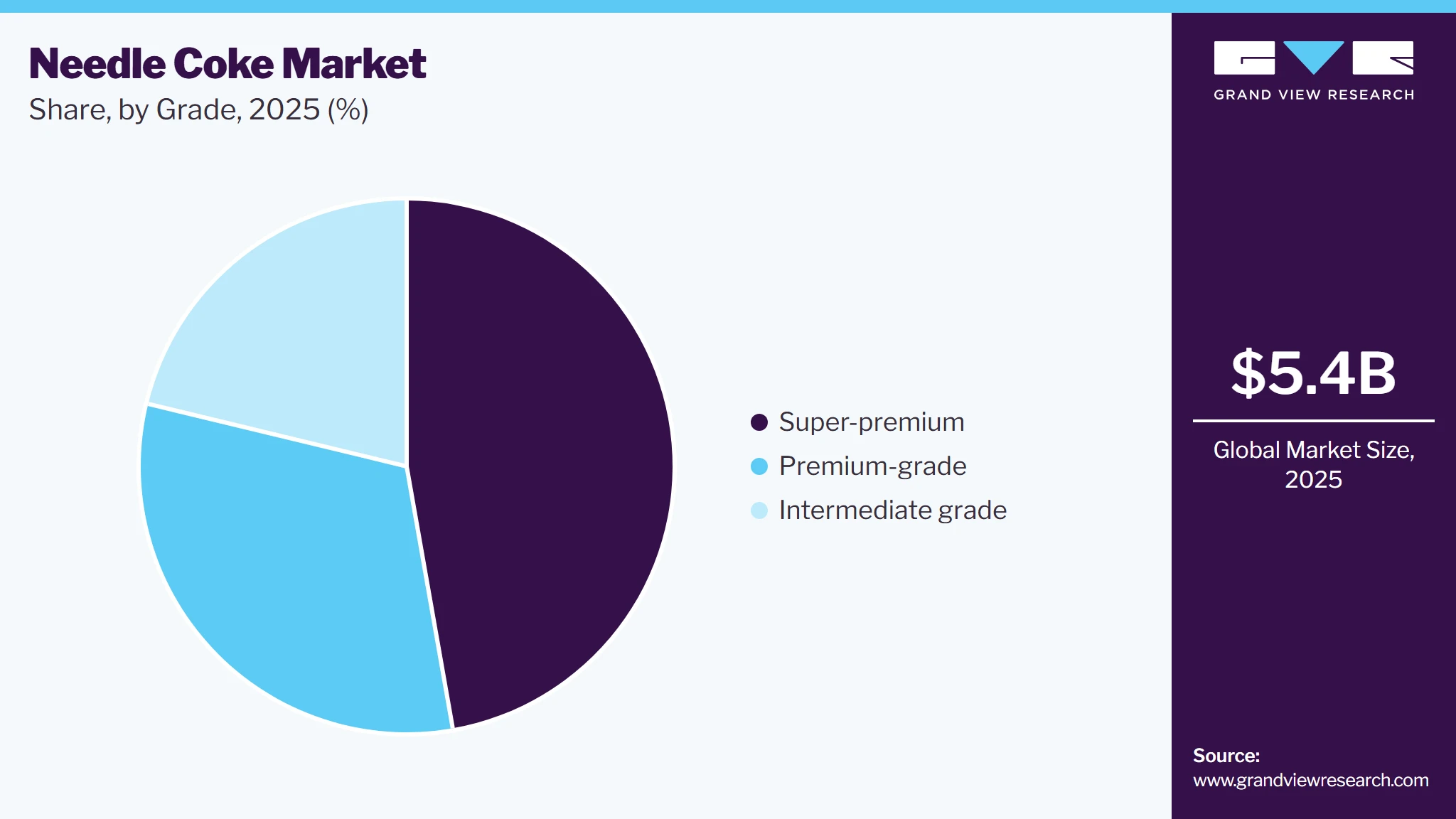
Premium grade segment is expected to grow at a CAGR of 10.9% over the forecast period, owing to its higher quality compared to other grades. It is preferred in the production of high-quality graphite electrodes. Due to its low sulfur content, premium-grade product is commonly preferred in the steel industry. Furthermore, petroleum-based needle coke enhances wear and tear properties, making it suitable for various industrial uses. Moreover, the rising demand from the steel manufacturing industry and steel recycling also propels the market.
Application Insights
The electrode segment accounted for the largest share of the needle coke market, representing 65.4% of total revenue in 2025, primarily driven by the increasing use of electric arc furnaces (EAF) in steel production and the rising demand for energy-efficient steelmaking. In addition, graphite electrodes, crucial for EAFs, rely on needle coke due to its high thermal and electrical conductivity and low impurity levels. Furthermore, infrastructure development and industrialization globally further boost steel production, increasing the demand for high-quality graphite electrodes and, consequently, needle coke.
The Silicon Metals & Ferroalloys is expected to grow at a CAGR of 10.9% from 2026 to 2033, owing to the need for high-quality materials in the manufacturing process. The excellent thermal conductivity and heat resistance of graphite make it a preferred choice for heating elements in electric arc furnaces used in the production of silicon metals and ferroalloys. Furthermore, Needle coke is indispensable in these applications for achieving efficient and cost-effective processes.
Regional Insights
Asia Pacific accounted for 63.9% of the needle coke market revenue in 2025. The Asia-Pacific region, with countries such as China, Japan, South Korea, and India, is a major hub for steel production and electric arc furnace (EAF) steelmaking. Needle coke is a critical raw material for producing graphite electrodes used in EAFs. Furthermore, the need for high-quality coke in manufacturing electrodes for electric arc furnaces and lithium-ion batteries likely further boosts the market. General business expansion and modernization across APAC,

China Needle Coke Market Trends
China maintained a leading position in the Asia Pacific needle coke market, driven by the country's substantial steel production. As a top steel-producing nation, China likely needs a lot of needle coke as a raw material for electrodes in electric steel furnaces. In addition, the country's economic growth, industrialization, and urbanization may have led to an increase in steel production, likely driving the demand for needle coke.
Latin America Needle Coke Market Trends
Latin America needle coke market is expected to grow at a CAGR of 10.6% over the forecast period, owing to the growth of the steel industry. Needle coke is used in the production of graphite electrodes, which are essential for electric arc furnaces used in steel production. In addition, the rising demand for lithium-ion batteries, driven by the growing popularity of electric vehicles and portable electronic devices, is expected to contribute to the demand product in the region.
North America Needle Coke Market Trends
The needle coke market in the North America is expected to grow significantly over the forecast period, driven by factors such as technological advancements, strategic partnerships, and emerging marketplaces. However, challenges such as the high production cost of needle coke and stringent environmental regulations may impact the market.
The U.S. needle coke market dominated the North American market with the highest revenue share in 2024, driven by the increasing demand for lithium-ion batteries, due to EV expansion and renewable energy storage. Needle coke's properties make it important for graphite anodes in these batteries. In addition, the push toward decarbonization and sustainable energy solutions has possibly led to investments in EV production and energy storage technologies, potentially creating strong needle coke demand.
Europe Needle Coke Market Trends
The needle coke market in Europe is expected to be driven by the demand from the steel and automotive sectors. Needle coke is used in the production of graphite electrodes, which are essential for electric arc furnaces used in steel production. The automotive industry also utilizes needle coke in the manufacturing of lithium-ion batteries for electric vehicles. Furthermore, the presence of manufacturing facilities in countries such as Germany indicates the importance of the market in the country.
Key Needle Coke Company Insights
Key players in the needle coke industry include Graphite India Limited (GIL), IOCL, Phillips 66, and China National Petroleum Corporation, among others. These players enhance their market presence through strategies such as partnerships, agreements, and collaborations. In addition, they focus on technological advancements to improve product quality and meet the growing demand from the electric vehicle battery and steel manufacturing sectors.
-
Graphite India Limited (GIL) is a manufacturer of Graphite Electrodes as well as Carbon and Graphite Specialty products. The company's manufacturing facilities are spread across six plants in India, and it also has a 100% owned subsidiary in Nuremberg, Germany, called Graphite COVA GmbH. The company participate in the needle coke market, where needle coke demand is reportedly being driven by its use in lithium-ion batteries.
-
Sumitomo Chemical operaties in different regions, serving customers worldwide and operates in areas such as animal nutrition, crop health solutions, environmental health solutions, and more. Sumitomo Chemical Europe N.V./S.A. conducts business in Belgium and manufactures industrial chemical products. The company is involved in needle coke production, a material used in graphite electrodes for electric arc furnaces.
Key Needle Coke Companies:
The following key companies have been profiled for this study on the needle coke market.
-
Phillips 66
-
Asbury Carbon Inc.
-
Seadrift Coke L.P.
-
Sumitomo Chemical Company
-
Mitsubishi Chemical Corp.
-
JXTG Nippon Oil & Energy Corp.
-
Indian Oil Corporation Limited
-
Graftech International
-
Sojitz Ject Corp.
-
C-Chem Co., Ltd.
-
Baosteel Group
Competitive Benchmarking
Category
Operating Strategies
Competitive Edge
Weakness
Established Players (Phillips 66, Mitsubishi Chemical Corporation, ENEOS Holdings (JXTG Nippon Oil & Energy Corp.), Indian Oil Corporation Limited, GrafTech International, Baosteel Group, Sumitomo Chemical Company)
- Focus on expanding premium-grade needle coke production capacities for graphite electrode and battery applications.
- Invest in advanced calcination technologies and feedstock optimization to improve product quality.
- Strengthen integration across refining, carbon materials, graphite electrodes, and battery material value chains.
- Expand through long-term supply agreements with steel manufacturers and battery producers
- Strong production capabilities and established access to high-quality feedstocks.
- Extensive global customer networks across steel, battery, and industrial sectors.
- Significant technological expertise in carbon materials and graphite manufacturing.
- Strong financial resources supporting capacity expansion and technology upgrades
- High dependence on petroleum and coal feedstock availability.
- Exposure to energy price fluctuations and environmental compliance costs.
- Capital-intensive manufacturing processes with long investment cycles.
- Vulnerability to cyclical fluctuations in steel and battery industries
Category
Operating Strategies
Competitive Edge
Weakness
Emerging / Regional Players (Asbury Carbon Inc., Seadrift Coke L.P., Sojitz JECT Corporation, C-Chem Co., Ltd.)
- Focus on specialty needle coke grades and niche carbon material applications.
- Strengthen regional presence through targeted customer relationships and customized product offerings.
- Expand through strategic partnerships, distribution agreements, and technology collaborations.
- Emphasize operational flexibility and responsiveness to changing market requirements
- Greater agility in serving regional markets and specialty applications.
- Strong customer relationships within specific geographic regions.
- Ability to provide customized grades and technical support.
- Faster adaptation to emerging battery and specialty graphite opportunities
- Smaller production capacities compared to multinational competitors.
- Limited global distribution networks and market reach.
- Lower financial resources for large-scale capacity expansion.
- Higher sensitivity to feedstock and demand volatility within regional markets.
Recent Developments
-
In January 2025, Chevron Lummus Global and TAQAT announced a new license and engineering agreement for the production of needle coke and synthetic materials. This collaboration aims to enhance needle coke production capabilities, which are essential for industries such as steel manufacturing and battery production. The agreement is a significant step toward meeting the growing demand for high-quality needle coke, reinforcing both companies' commitment to advancing technologies in the energy and materials sectors.
-
In November 2023, HEGLTD announced its strategic initiatives to enhance operations in critical sectors, including the needle coke market. The company emphasized its commitment to expanding its influence in high-demand industries such as steel production and energy, where needle coke plays a key role. They detailed ongoing advancements in technology and sustainability efforts aimed at meeting the evolving needs of these markets. HEGLTD’s efforts align with global trends toward increased demand for high-quality materials, especially needle coke, in various applications.
-
In April 2023, GrafTech International Ltd. announced the opening of a new sales office in Dubai as part of its strategic expansion. This move is aimed at strengthening GrafTech's presence in the Middle East and supporting the growing demand for needle coke in the region. The company highlighted its commitment to enhancing customer relationships and providing high-quality needle coke products used in steel production and other critical industries. This expansion is a key step in GrafTech's global growth strategy.
Needle Coke Market Report Scope
Report Attribute
Details
Market size in 2025
USD 5.4 billion
Estimated market size in 2026
USD 5.9 billion
Projected market size by 2033
USD 13.2 billion
Growth rate
CAGR of 12.3% from 2026 to 2033
Base year for estimation
2025
Historical data
2021 - 2024
Forecast period
2026 - 2033
Quantitative units
Volume, Kilotons; Revenue in USD million/billion and CAGR from 2026 to 2033
Report coverage
Volume foreast, Revenue forecast, company ranking, competitive landscape, growth factors, and trends
Segments covered
Grade, application, region
Regional scope
North America; Europe; Asia Pacific; Latin America; MEA
Country scope
U.S.; Canada; Mexico; Germany; UK; Italy; China; India; Japan; Brazil
Key companies profiled
Phillips 66; Asbury Carbon Inc.; Seadrift Coke L.P.; Sumitomo
Chemical Company; Mitsubishi Chemical Corp.; JXTG Nippon Oil &
Energy Corp.; Indian Oil Corporation Limited; Graftech International;
Sojitz Ject Corp.; C-Chem Co., Ltd; Baosteel Group
Customization scope
Free report customization (equivalent up to 8 analysts' working days) with purchase. Addition or alteration to country, regional & segment scope.
Pricing and purchase options
Avail customized purchase options to meet your exact research needs. Explore purchase options
Global Needle Coke Market Report Segmentation
This report forecasts revenue growth at global, regional, and country levels and analyzes the latest industry trends in each sub-segment from 2021 to 2033. For this study, Grand View Research has segmented the global needle coke market report based on grade, application, and region.
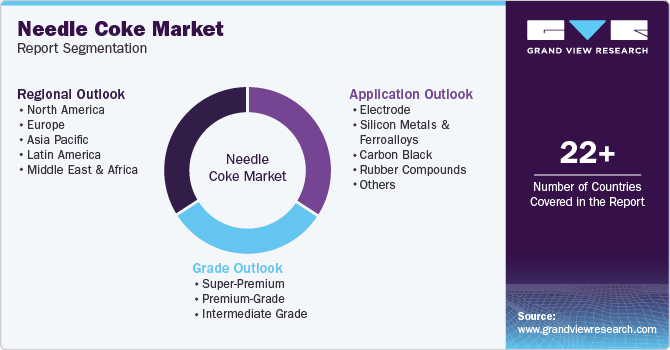
-
Grade Outlook (Volume, Kilotons; Revenue, USD Million, 2021 - 2033)
-
Super-Premium
-
Premium-Grade
-
Intermediate Grade
-
-
Application Outlook (Volume, Kilotons; Revenue, USD Million, 2021 - 2033)
-
Electrode
-
Silicon Metals & Ferroalloys
-
Carbon Black
-
Rubber Compounds
-
Others
-
-
Regional Outlook (Volume, Kilotons; Revenue, USD Million, 2021 - 2033)
-
North America
-
U.S.
-
Canada
-
-
Europe
-
Germany
-
UK
-
Italy
-
-
Asia Pacific
-
China
-
India
-
Japan
-
-
Latin America
-
Brazil
-
Mexico
-
-
Middle East and Africa
-
Research Methodology
Segment Definition
Segment - Product
Revenue capture definition
Super-Premium Grade
Revenue generated from the production and sale of ultra-high-quality needle coke characterized by low coefficient of thermal expansion (CTE), high crystallinity, and superior structural properties. These grades are primarily utilized in the manufacturing of ultra-high-power (UHP) graphite electrodes, synthetic graphite anodes for lithium-ion batteries, and other advanced carbon materials requiring stringent performance specifications
Premium-Grade
Revenue generated from premium-quality needle coke used in high-performance graphite electrodes, specialty graphite products, silicon metal production, and selected battery material applications. Demand is driven by increasing requirements for high-purity carbon materials across steelmaking, metallurgy, and energy storage industries
Intermediate Grade
Revenue generated from intermediate-grade needle coke utilized in standard graphite electrodes, carbon products, metallurgical applications, carbon additives, and various industrial carbon material manufacturing processes. Demand is supported by growth in conventional steel production and industrial processing industries
Segment - Application
Revenue capture definition
Electrode
Revenue generated from needle coke consumption in the production of graphite electrodes used in electric arc furnace (EAF) steelmaking and other metallurgical processes. This represents the largest application segment, driven by growing steel production and increasing adoption of EAF technology globally
Silicon Metals
Revenue generated from needle coke utilized in the production of graphite components, electrodes, and conductive materials used during silicon metal and ferroalloy manufacturing processes. Demand is supported by growth in semiconductor, solar photovoltaic, and specialty alloy industries
Carbon Black
Revenue generated from needle coke consumption in the manufacture of specialty carbon black products, conductive carbon materials, carbon additives, and advanced carbon compounds requiring high-purity carbon feedstocks and enhanced performance characteristics
Rubber Compounds
Revenue generated from needle coke utilization in specialty rubber formulations, conductive rubber products, industrial elastomers, sealing systems, and performance-enhancing carbon additives used across automotive, industrial, and infrastructure applications
Others Applications
Revenue generated from needle coke use in lithium-ion battery anode materials, specialty graphite products, nuclear graphite, carbon fibers, refractory materials, advanced carbon composites, and other industrial applications requiring high-performance carbon feedstocks
Estimation Model
Layer Name
Key Question
Description
End-Use Industry Demand Layer
What forms the demand base?
Identify global demand across major end-use industries including electric arc furnace (EAF) steel production, lithium-ion battery manufacturing, aluminum production, specialty graphite products, and industrial carbon materials. This layer establishes the addressable demand base by evaluating graphite electrode consumption, synthetic graphite anode production, and industrial carbon material requirements
Needle Coke Adoption Layer
Where are needle coke used?
Estimate the penetration of petroleum-based and coal-based needle coke across graphite electrodes, battery anode materials, specialty graphite components, and advanced carbon applications. Assess adoption levels across regions, manufacturing technologies, and downstream industries
Consumption Intensity Layer
How much needle coke is used?
Analyze average needle coke consumption per unit of graphite electrode production, synthetic graphite anode manufacturing, and specialty graphite applications. Consumption intensity is influenced by end-product specifications, production technology, graphite yield rates, and regional manufacturing practices
Revenue Layer
How is market revenue generated?
Market revenue is generated through the sale of petroleum-based and coal-based needle coke to graphite electrode manufacturers, battery material producers, specialty graphite processors, steel producers, and industrial carbon product manufacturers. Revenue is driven by growing demand from EAF steelmaking and lithium-ion battery supply chains
Delivered Customizations
This report has been delivered with the following In-depth customizations
Client Request
Customization Delivered
Value Adds
Regional Segmentation
Detailed regional assessment of needle coke demand across North America, Europe, Asia Pacific, Latin America, and Middle East & Africa, including country-level analysis of production capacity, feedstock availability, graphite electrode manufacturing, battery material investments, trade flows, and end-use industry demand. Additional country-level coverage can be incorporated for key markets such as China, Japan, South Korea, India, Germany, and the U.S.
Enables identification of high-growth regional markets, production hubs, sourcing opportunities, and evolving battery and steel industry dynamics. Supports geographic expansion planning, investment prioritization, and supply chain optimization
Competitive Benchmarking
Comparative evaluation of leading needle coke manufacturers based on production capacity, feedstock integration, product quality, graphite electrode supply relationships, battery material exposure, manufacturing footprint, technology capabilities, sustainability initiatives, and strategic developments
Assists competitive intelligence, supplier assessment, partnership evaluation, and acquisition screening by providing visibility into market positioning, operational strengths, and long-term growth potential
Trade Assessment
Comprehensive assessment of global needle coke trade flows, import-export trends, production concentration, regional supply-demand balances, tariff structures, logistics networks, and key exporting and importing countries. The analysis also evaluates feedstock availability and evolving battery material supply chain dynamics
Supports sourcing decisions, trade risk assessment, localization strategies, and identification of supply chain dependencies. Enables better understanding of global production concentration and regional competitiveness
Opportunity Assessment
Comprehensive assessment of emerging opportunities associated with electric vehicle adoption, lithium-ion battery expansion, synthetic graphite production growth, EAF steelmaking penetration, energy storage systems, and advanced carbon material applications
Helps identify high-growth investment areas, emerging application opportunities, capacity expansion priorities, and long-term market development strategies, supporting sustainable growth and competitive differentiation within the needle coke value chain
Frequently Asked Questions About This Report
The global needle coke market size was estimated at USD 5.4 billion in 2025 and is expected to reach USD 5.9 billion in 2026.
The global needle coke market is expected to grow at a compound annual growth rate of 12.3% from 2026 to 2033 to reach USD 13.2 million by 2033.
Some key players operating in the needle coke market include Phillips 66, Asbury Carbon Inc., Seadrift Coke L.P., Sumitomo Chemical Company, Mitsubishi Chemical Corp., JXTG Nippon Oil & Energy Corp., and Indian Oil Corporation Limited.
Key factors that are driving the market growth include rapid expansion of steel industry in developing economies and rising demand for graphite batteries.
Super-premimum segment dominated the grade segment with a revenue share of 47.2% in 2025.
Super-premium segment is expected to grow the fastest with a CAGR of 10.9% during the forecast period.
Electrode segment dominated the application segment with a revenue share of 65.4% in 2025.
The Silicon Metals & Ferroalloys is expected to grow at a CAGR of 10.9% from 2026 to 2033, owing to the need for high-quality materials in the manufacturing process.
Asia Pacific dominated the needle coke market with a share of 63.9% in 2025. This is attributable to government initiatives to support domestic manufacturing in key countries such as China and India.
About the Author(s)
Petrochemicals Research Team
Bulk Chemicals · PetrochemicalsThis report was authored by the petrochemicals research team at Grand View Research - comprising two research analysts, one senior research analyst, and one industry expert - with specialized expertise in the petrochemicals segment of the bulk chemicals industry. All findings are based on proprietary bulk chemicals databases, executive interviews, and regulatory analysis, subject to internal peer review prior to publication.
Last Updated:
Speak to Analyst

Need a Tailored Report?
Customize this report to your needs — add regions, segments, or data points, with 20% free customization.
Or view our licence options:


ISO 9001:2015 & 27001:2022 Certified
We are GDPR and CCPA compliant! Your transaction & personal information is safe and secure. For more details, please read our privacy policy.












