
- Home
- »
- Sustainable Energy
- »
-
Negative Emission Technologies Market Size Report, 2033GVR Report cover

Negative Emission Technologies Market (2026 - 2033)
Size, Share & Trends Analysis Report By Technology (Biochar, Enhanced Weathering, Carbon Mineralization), By End Use (Energy & Utilities, Oil & Gas, Manufacturing & Industrial), By Region, And Segment Forecasts
Market Size, 2025
$1.0BMarket Estimate, 2026
$1.4BMarket Forecast, 2033
$7.7BCAGR, 2026–2033
27.6%Negative Emission Technologies Market Summary
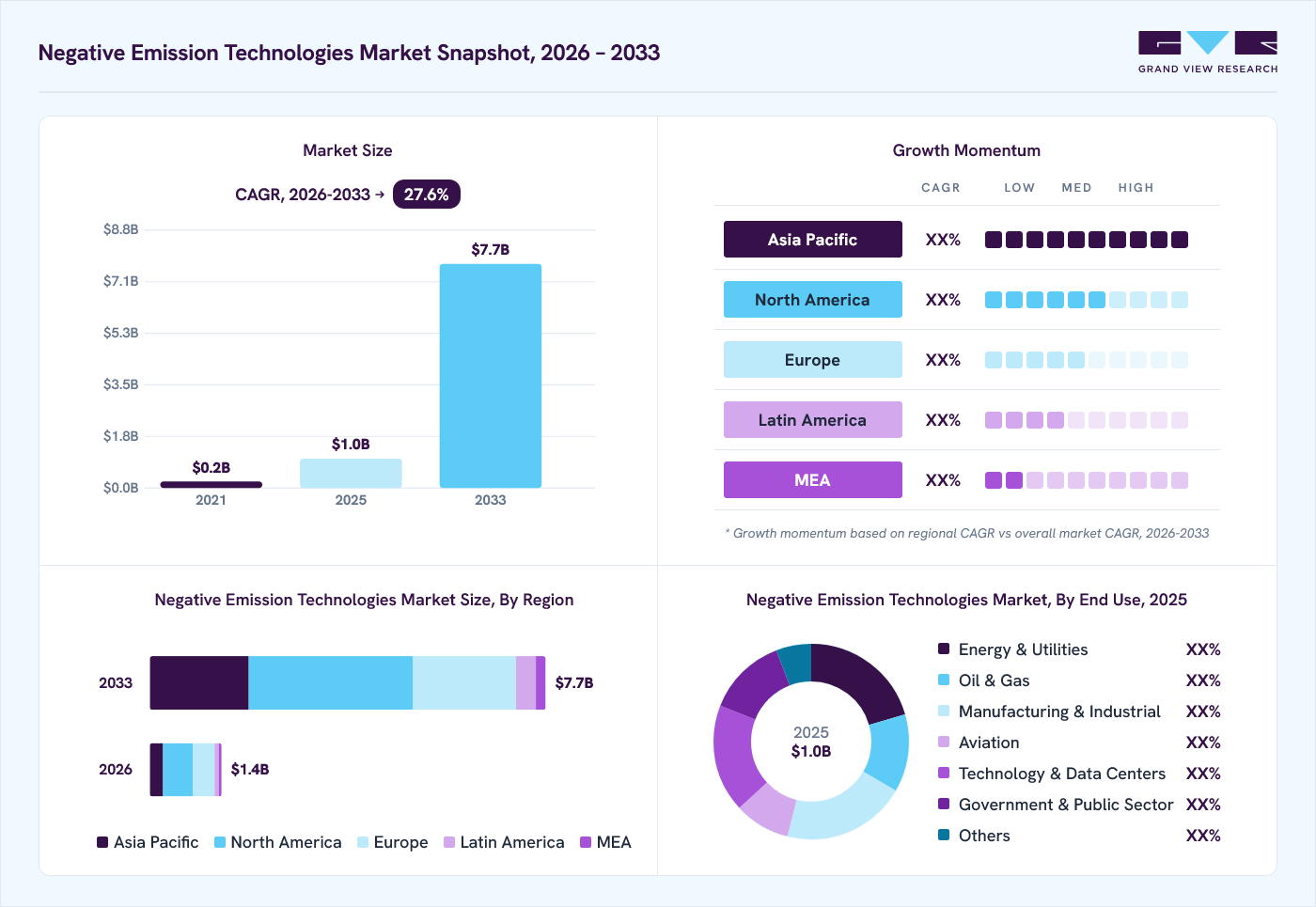
The global negative emission technologies market size was valued at USD 1.0 billion in 2025 and is projected to grow from USD 1.4 billion in 2026 to USD 7.7 billion by 2033, growing at a CAGR of 27.6% from 2026 to 2033. North America dominated the global market, accounting for the largest revenue share of 41.8% in 2025. Negative Emission Technologies are carbon removal solutions that capture and permanently store carbon dioxide (CO₂) from the atmosphere or biogenic sources.
 Source: Grand View Research, IR Documents, Primary Interviews, Paid DatabasesTo learn more about this report,
 Download Free Sample Report
Key Market Trends & Insights
- By technology: Biochar held the highest revenue share of 40.8% in 2025.
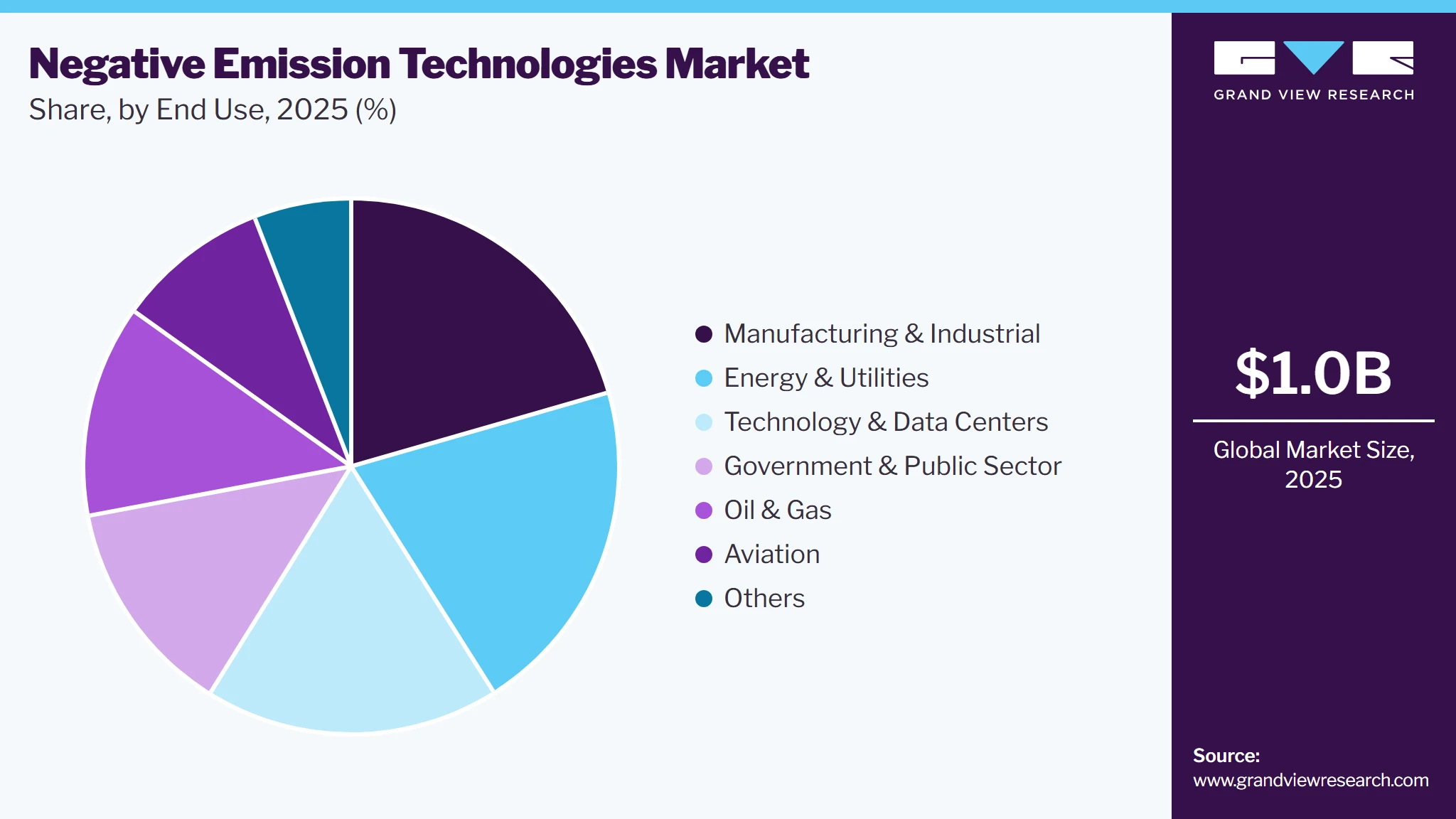
- By end use: The manufacturing & industrial segment held the highest revenue share of 20.5% in 2025.
Regional Highlights
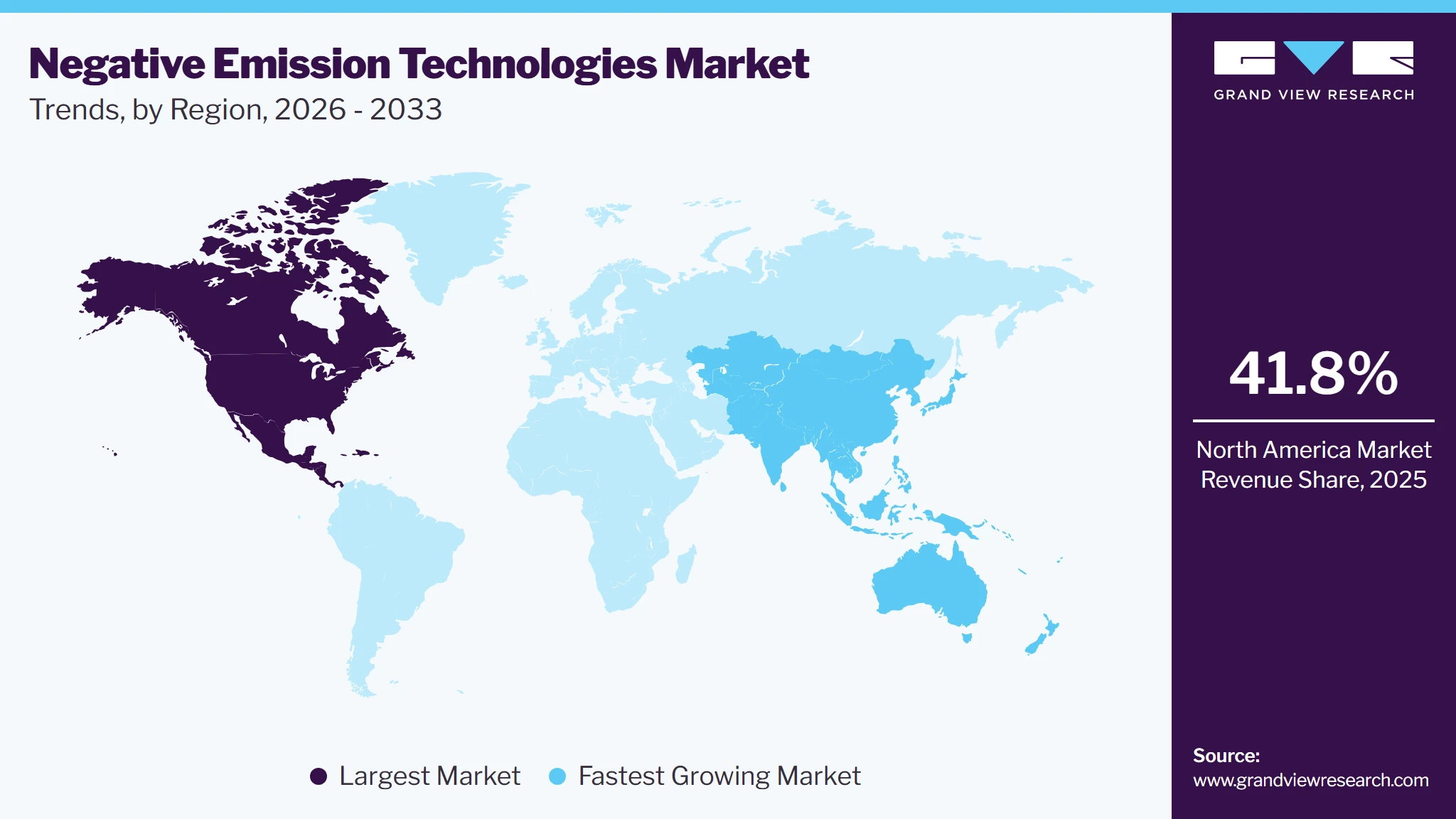
- Largest regional market: North America (41.8% revenue share, 2025)
- Fastest-growing regional market: Asia Pacific (highest CAGR, 2026-2033)
- By country: The U.S. held the largest market share in 2025.
Market Size & Forecast
- 2025 Market Size: USD 1.0 Billion
- Estimated market size in 2026: USD 1.4 Billion
- Projected market size by 2033 : USD 7.7 Billion
- CAGR (2026-2033): 27.6%
Three ways to get this report
Buy it, customize it, or ask a question.Ask an Analyst
Analyst response in 1 business day
- AccessReport author, directly
- Reply timeWithin 1 working day
- No sales callDirect answer only
- FormatEmail reply
- CostFree, no cost
Get the Full Report
What the study covers
- FormatsPDF · Excel · Dashboard
- Timeline2026–2033 annual, 2025 base
- Coverage20+ countries, 5 regions
- Companies10+ key players profiled
Customize the Report
20% free customization
- IncludeCountries, segments, points
- TailorTo your product definition
- ExtendDeeper competitor detail
- OrA fully bespoke study
- Turnaround5–10 working days
 To learn more about this report, Download Free Sample Report
They help achieve net-zero emissions by reducing atmospheric CO₂ concentrations through biological, chemical, or engineered carbon removal processes.Market Dynamics
The Negative Emission Technologies (NETs) market is driven by growing global net-zero commitments, increasing carbon pricing mechanisms, and rising investments in carbon dioxide removal solutions. Government incentives, voluntary carbon markets, and corporate demand for high-quality carbon removal credits are accelerating technology deployment and commercialization. However, high capital costs, technological scalability challenges, and evolving regulatory frameworks continue to restrain market growth. Ongoing advancements in carbon capture, bioenergy with carbon capture and storage, direct air capture, and nature-based solutions are expected to create significant growth opportunities over the coming years.
Countries are adopting stricter net-zero targets and climate policies, increasing the need for technologies that remove carbon dioxide from the atmosphere. While emissions can be reduced significantly, sectors such as aviation, cement, and steel will continue to produce unavoidable emissions. This has made negative emission technologies an important part of long-term decarbonization strategies. Governments and industries are increasing investments in carbon removal solutions.
In March 2026, the European Commission advanced the implementation of the Carbon Removals and Carbon Farming (CRCF) Regulation (EU) 2024/3012, the EU's first voluntary certification framework for permanent carbon removals, carbon farming, and carbon storage in products. The framework establishes standardized certification rules, improving transparency and investor confidence while supporting the large-scale deployment of technologies such as Direct Air Capture (DAC) and Bioenergy with Carbon Capture and Storage (BECCS).
Engineered Negative Emission Technologies, particularly DAC, require significant upfront investment and high operating costs due to their energy-intensive processes and advanced infrastructure needs. The cost of capturing and permanently storing carbon remains substantially higher than conventional emission reduction measures, limiting large-scale adoption. These economic challenges make many projects dependent on government incentives, grants, and long-term carbon purchase agreements, slowing the commercialization of the broader NET market.
Growing demand for high-quality carbon removal credits is creating new revenue opportunities for Negative Emission Technology providers. Companies are securing long-term offtake agreements with corporations seeking to offset hard-to-abate emissions and meet net-zero commitments. Rising participation from technology firms, airlines, and industrial companies is expected to accelerate investment in certified carbon removal projects and expand the voluntary carbon market. In July 2025, 1PointFive signed an agreement with Palo Alto Networks to supply 10,000 tonnes of DAC-based carbon removal credits over five years, highlighting the growing corporate demand for permanent carbon removal solutions.
Analyst Perspective
The Negative Emission Technologies (NETs) market is transitioning from pilot-scale projects to early commercial deployment, driven by tightening climate regulations, corporate net-zero commitments, and growing demand for durable carbon removal. An emerging trend is the rise of long-term carbon removal offtake agreements, enabling developers to secure predictable revenue streams and attract project financing before facilities become operational. Certification standards and MRV (Measurement, Reporting, and Verification) frameworks are becoming key differentiators, increasing buyer confidence and supporting premium pricing for high-integrity carbon removal credits. Over the long term, companies that can reduce capture costs, scale operations, and demonstrate verified permanence are expected to strengthen their market position and capture a larger share of the rapidly evolving carbon removal ecosystem.
Technology Insights
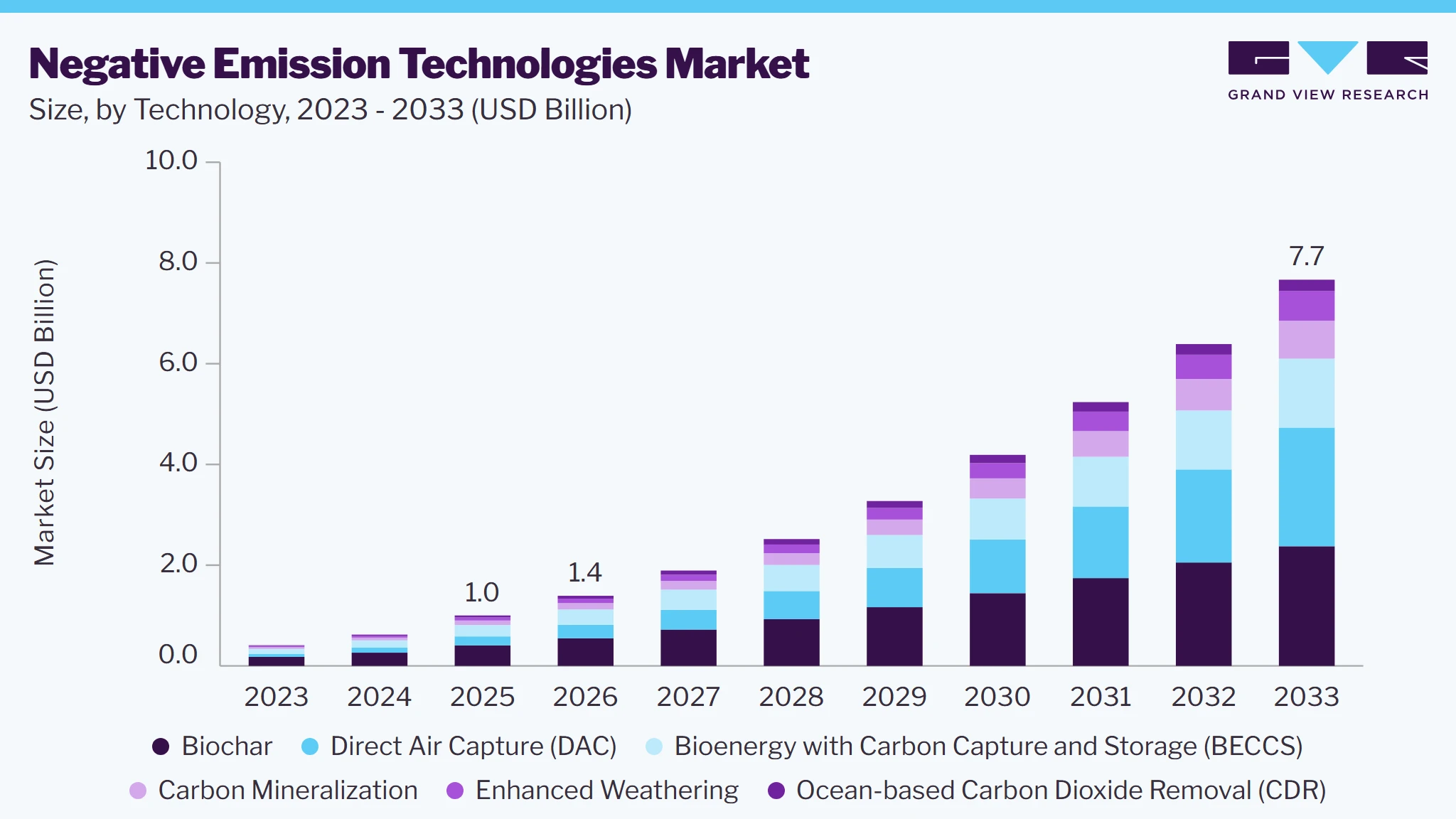
The Biochar segment held the largest revenue share of 40.8% in 2025, driven by increasing investments in large-scale carbon removal projects and growing demand for durable CO₂ removal solutions. Biochar offers a relatively mature and scalable pathway for carbon removal, supported by abundant biomass feedstock and applications across agriculture and soil management. Rising corporate net-zero commitments and increasing carbon removal procurement are further supporting the commercial deployment of biochar projects.
The Direct Air Capture (DAC) segment is expected to register the fastest CAGR of 36.6% from 2026 to 2033, driven by increasing demand for scalable and durable CO₂ removal solutions. DAC enables direct removal of CO₂ from ambient air and offers potential for deployment near suitable storage or utilization infrastructure. Growing demand for durable carbon removal credits, corporate net-zero commitments, and increasing investments in emerging CDR technologies are expected to support segment growth.
End Use Insights
The energy & utilities segment held the largest share of 20.54% in 2025, driven by increasing adoption of carbon dioxide removal solutions across power generation and energy infrastructure. Growing pressure to reduce emissions from energy-intensive operations is encouraging utilities to integrate carbon removal with renewable energy and broader decarbonization initiatives. Rising net-zero commitments and investments in low-carbon energy systems are expected to further support segment growth.
 To learn more about this report, Download Free Sample Report
The technology & data centers segment is anticipated to register the fastest CAGR of 33.5% during the forecast period. Growth is driven by the rapid expansion of data center infrastructure and increasing electricity consumption associated with AI, cloud computing, and digital services. As technology companies and data center operators pursue net-zero targets, demand for high-quality and durable carbon dioxide removal solutions is increasing. Growing corporate commitments to address residual emissions are expected to accelerate the adoption of carbon removal solutions across the segment.
Regional Insights
North America has emerged as a leading market for negative emission technologies, supported by ambitious net-zero targets, federal incentives, and increasing investments in engineered carbon removal projects. The region is witnessing growing commercialization of direct air capture and BECCS, supported by policy mechanisms, carbon removal initiatives, and rising corporate demand for high-quality carbon removal credits. For instance, in 2025, the U.S. Department of Energy continued advancing its Regional Direct Air Capture Hubs, supporting the development and commercialization of large-scale DAC facilities across the country.
 To learn more about this report, Download Free Sample Report
U.S. Negative Emission Technology Market Trends
The U.S. market is witnessing strong growth, driven by supportive federal policies, increasing public and private investments, and rising demand for durable carbon removal solutions. The country benefits from advanced research capabilities, well-developed CO₂ transport and storage infrastructure, and a strong pipeline of commercial-scale projects. Continued government funding, favorable regulatory support, and collaboration between industry and research institutions are expected to accelerate market growth and strengthen the country's leadership in carbon removal.
Europe Negative Emission Technology Market Trends
Europe is a key market for negative emission technologies, driven by strong climate policies, increasing investments, and the development of carbon removal projects. The region has supportive regulatory frameworks, established carbon markets, and growing corporate demand for durable carbon removal solutions, supporting the commercialization of DAC, BECCS, and other CDR technologies. For instance, in 2025, the European Commission advanced its policy framework for permanent carbon removals and carbon farming under the EU Carbon Removal Certification Framework (CRCF), supporting the development and scaling of certified carbon removal activities across Europe.
The UK negative emission technologies market is witnessing steady growth, supported by the country's legally binding net-zero target, strong government commitment to carbon capture and storage, and increasing investments in engineered carbon removal technologies. The UK is developing a robust policy and regulatory framework, including greenhouse gas removal business models and revenue support mechanisms, to encourage private investment and accelerate commercial deployment. These initiatives, combined with expanding carbon storage infrastructure and innovation funding, are strengthening the UK's position as a key market for scalable carbon removal solutions.
Asia Pacific Negative Emission Technology Market Trends
The Asia Pacific market is emerging as a high-growth region, driven by increasing net-zero commitments, rising investments in carbon management, and expanding government support for low-carbon technologies. Countries such as China, Japan, South Korea, and Australia are accelerating carbon removal initiatives through supportive policies and industrial decarbonization efforts. For instance, Japan's Green Innovation Fund, managed by METI and NEDO, provides long-term funding of up to 10 years for projects focused on CO₂ capture, carbon recycling, and carbon absorption technologies, supporting the commercialization of carbon removal solutions across the country.
Latin America Negative Emission Technology Market Trends
The Latin America market is gradually expanding, driven by growing climate commitments, abundant natural carbon sinks, and increasing interest in carbon removal and sustainable land management projects. Countries such as Brazil and Argentina are promoting carbon capture initiatives and nature-based carbon removal through supportive policies and international partnerships. Rising investments in carbon markets and climate finance are expected to accelerate project development and strengthen the region's role in global carbon removal efforts.
Middle East & Africa Negative Emission Technology Market Trends
The Middle East & Africa market is gaining momentum as governments increase investments in carbon management and low-carbon development to support long-term climate goals. Countries such as the UAE and Saudi Arabia are advancing carbon capture projects, supported by national sustainability strategies and growing public-private partnerships. Rising investments in industrial decarbonization, carbon storage infrastructure, and clean energy initiatives are expected to drive market growth across the region.
Key Negative Emission Technologies Company Insights
Some of the key players operating in the global negative emission technologies market include Climeworks and Charm Industrial, among others.
-
Climeworks is a leading company in the negative emission technologies market, specializing in DAC solutions that permanently remove carbon dioxide from the atmosphere. The company designs and operates modular DAC plants that capture atmospheric CO₂ for permanent geological storage or sustainable utilization. Climeworks focuses on technology innovation, scalable deployment, and verified carbon removal services to help businesses and governments achieve net-zero targets. Its commercial-scale projects, strategic partnerships, and global presence position the company as a key participant in the global negative emission technologies market.
-
Charm Industrial is a key player in the negative emission technologies market, specializing in biomass-based carbon removal by converting agricultural and forestry waste into stable bio-oil for permanent underground storage. The company provides durable carbon removal solutions while utilizing low-value biomass that would otherwise release carbon back into the atmosphere. Charm Industrial focuses on scalable operations, long-term carbon storage, and verified carbon removal credits to support corporate decarbonization strategies. Its innovative approach to biomass carbon sequestration and growing portfolio of carbon removal agreements position it as an important participant in the global negative emission technologies market.
Key Negative Emission Technologies Companies
The following key companies have been profiled for this study on the negative emission technologies market:
-
1PointFive
-
Avnos, Inc.
-
Carbfix hf
-
CarbonCapture Inc.
-
Charm Industrial
-
Climeworks
-
Deep Sky
-
Heirloom Carbon Technologies
-
RepAir
-
Skytree
-
Soletair Power
-
Zero Carbon Systems
Competitive Benchmarking
Category
Operating Strategies
Competitive Edge
Weakness
Established Players (Climeworks, 1PointFive, Heirloom Carbon Technologies, CarbonCapture Inc., Deep Sky, Carbfix hf, Charm Industrial)
- Leverage proven carbon removal technologies, commercial-scale projects, and strategic partnerships to accelerate deployment of negative emission solutions across global markets.
- Invest heavily in technology optimization, process improvements, and engineering advancements to reduce carbon removal costs and enhance scalability.
- Expand collaborations with governments, corporations, carbon credit buyers, and infrastructure providers to secure long-term demand and project financing.
- Benefit from strong brand recognition, proven project execution capabilities, and early-mover advantages in the emerging carbon removal industry.
- Possess advanced technological expertise, proprietary processes, and operational experience gained through pilot and commercial-scale deployments.
- Maintain strong investor backing, government support, and corporate partnerships that enable accelerated technology commercialization.
- Face high capital requirements and significant operational costs associated with scaling carbon removal technologies.
- Depend on supportive carbon pricing mechanisms, policy incentives, and corporate climate commitments for market adoption.
- Experience technology-specific challenges related to energy consumption, scalability, and achieving cost-effective carbon removal.
Emerging Players (Zero Carbon Systems, Avnos, Inc., Skytree, RepAir, Soletair Power)
- Focus on developing innovative carbon removal technologies with improved efficiency, lower energy requirements, and reduced deployment costs.
- Utilize pilot projects and demonstration facilities to validate technology performance and attract commercial partnerships.
- Target niche applications and specialized carbon removal pathways to differentiate from established DAC and storage providers.
- Offer innovative approaches that address limitations of existing carbon removal technologies, including energy use and cost challenges.
- Maintain greater technological flexibility and agility to adapt solutions based on evolving market requirements.
- Develop differentiated solutions such as electrochemical DAC, water-positive capture, and decentralized carbon removal systems.
- Limited commercial deployment experience and smaller project portfolios compared with established carbon removal companies.
- Face challenges in securing large-scale funding required for technology validation and market expansion.
- Lack proven operational track records, creating uncertainty among customers and carbon credit buyers.
Recent Developments
-
In May 2025, Climeworks raised USD 162 million in additional equity funding, marking the largest carbon removal investment round globally during the year and bringing the company’s total funding since inception to over USD 1 billion. The funding, led by BigPoint Holding and Partners Group along with existing investors, will support the continued scaling of Climeworks’ DAC technology by improving process efficiency, reducing carbon removal costs, and accelerating commercialization. The investment will further enhance technology advancements demonstrated through its Orca and Mammoth DAC plants, including improved energy efficiency, higher CO₂ capture throughput, and longer filter material lifespan. The funding strengthens Climeworks’ market position as a leading carbon removal solutions provider and supports the expansion of its global carbon removal portfolio.
Negative Emission Technologies Report Scope
Report Attribute
Details
Market Definition
Negative Emission Technologies (NETs) remove CO₂ from the atmosphere through technologies. The market size represents the revenue generated from the commercial sale of carbon removal services by NET project developers and technology operators.
Market size value in 2025
USD 1.0 billion
Market size value in 2026
USD 1.4 billion
Revenue forecast in 2033
USD 7.7 billion
Growth rate
CAGR of 27.6% from 2026 to 2033
Base year for estimation
2025
Historical data
2021 - 2024
Forecast period
2026 - 2033
Quantitative units
Revenue in USD million/billion and CAGR from 2026 to 2033
Report coverage
Revenue forecast, competitive landscape, growth factors, and trends
Segments covered
Technology, end use, region
Regional scope
North America; Europe; Asia Pacific; Latin America; Middle East & Africa
Country scope
U.S.; Canada; Mexico; Germany; UK; France; Italy; Spain; China; India; Japan; South Korea; Australia; Brazil; Argentina; UAE; Saudi Arabia; South Africa
Key companies profiled
1PointFive; Avnos, Inc.; Carbfix hf; CarbonCapture Inc.; Charm Industrial; Climeworks; Deep Sky; Heirloom Carbon Technologies; RepAir; Skytree; Soletair Power; Zero Carbon Systems
Customization scope
Free report customization (equivalent up to 8 analysts working days) with purchase. Addition or alteration to country, regional & segment scope.
Pricing and purchase options
Avail customized purchase options to meet your exact research needs. Explore purchase options
Global Negative Emission Technologies Market Report Segmentation
This report forecasts revenue growth at global, regional, and country levels and provides an analysis of the latest industry trends in each of the sub-segments from 2021 to 2033. For this study, Grand View Research has segmented the global negative emission technologies market report on the basis of technology, end use, and region.
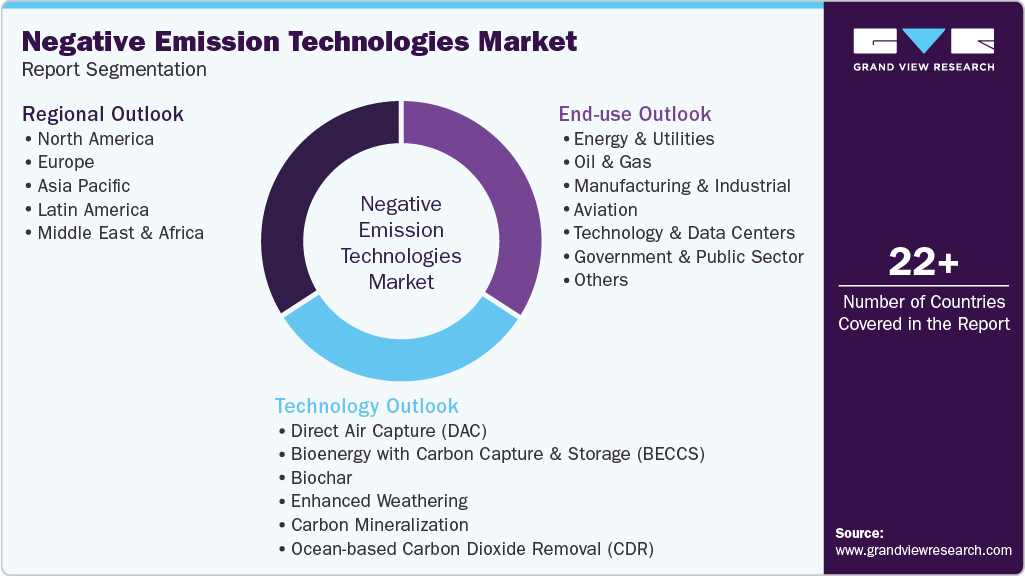 To learn more about this report, Download Free Sample Report
-
Technology Outlook (Revenue, USD Million, 2021 - 2033)
-
Direct Air Capture (DAC)
-
Bioenergy with Carbon Capture and Storage (BECCS)
-
Biochar
-
Enhanced Weathering
-
Carbon Mineralization
-
Ocean-based Carbon Dioxide Removal (CDR)
-
-
End Use Outlook (Revenue, USD Million, 2021 - 2033)
-
Energy & Utilities
-
Oil & Gas
-
Manufacturing & Industrial
-
Aviation
-
Technology & Data Centers
-
Government & Public Sector
-
Others
-
-
Regional Outlook (Revenue, USD Million, 2021 - 2033)
-
North America
-
U.S.
-
Canada
-
Mexico
-
-
Europe
-
Germany
-
UK
-
France
-
Italy
-
Spain
-
-
Asia Pacific
-
China
-
India
-
Japan
-
South Korea
-
Australia
-
-
Latin America
-
Brazil
-
Argentina
-
-
Middle East & Africa
-
Saudi Arabia
-
UAE
-
South Africa
-
-
Research Methodology
The negative emission technologies market figures in this report are based on a proven research process that combines executive interviews with secondary research from proprietary databases, company filings, and recognized regulatory and institutional sources. Market size is built through value-chain sizing-reconciling supply-side and demand-side estimates-and triangulated with bottom-up and top-down approaches. Every estimate passes multiple levels of expert validation before publication, with each negative emission technologies segment quantified using the revenue-capture definitions in the table below.
Segment Definition
Segment - Technology
Revenue capture definition
Direct Air Capture (DAC)
Includes revenue generated from the commercial sale of carbon removal services delivered through DAC technologies, where atmospheric CO₂ is captured, permanently stored, or utilized with durable sequestration.
Bioenergy with Carbon Capture and Storage (BECCS)
Covers revenue from carbon removal services provided through BECCS projects, where CO₂ generated from biomass conversion is captured and permanently stored to achieve net-negative emissions.
Biochar
Represents revenue from carbon removal services delivered through biochar production and long-term carbon sequestration in soils or other durable applications, including associated carbon credit generation.
Enhanced Weathering
Includes revenue generated from carbon removal services using enhanced weathering processes, where reactive minerals accelerate natural CO₂ absorption and enable long-term carbon sequestration.
Carbon Mineralization
Covers revenue from carbon removal services based on carbon mineralization technologies that permanently convert captured CO₂ into stable carbonate minerals for long-term storage.
Ocean-based Carbon Dioxide Removal (CDR)
Includes revenue generated from ocean-based carbon removal services, including direct ocean capture, ocean alkalinity enhancement, seaweed cultivation, and other technologies that enable durable CO₂ sequestration.
Segment - End-use
Revenue capture definition
Energy & Utilities
Includes revenue generated from carbon removal services purchased by energy producers, utilities, renewable energy developers, and power generation companies to offset residual emissions and achieve decarbonization targets.
Oil & Gas
Covers revenue from carbon removal services procured by upstream, midstream, and downstream oil & gas companies to reduce operational emissions and meet net-zero commitments.
Manufacturing & Industrial
Captures revenue from carbon removal services purchased by manufacturing and industrial companies, including cement, steel, chemicals, mining, and other hard-to-abate sectors to compensate for residual emissions.
Aviation
Includes revenue generated from carbon removal services procured by airlines, airports, and sustainable aviation fuel producers to address unavoidable aviation emissions and support decarbonization strategies.
Technology & Data Centers
Covers revenue from carbon removal services purchased by technology companies, cloud service providers, and data center operators to achieve carbon neutrality and corporate climate commitments.
Government & Public Sector
Includes revenue generated from carbon removal services procured by government agencies, public institutions, and municipalities through climate programs, public procurement initiatives, and national carbon removal strategies.
Others
Captures revenue from carbon removal services purchased by other end-use sectors, including agriculture, food & beverage, healthcare, commercial real estate, consumer goods, and other organizations seeking permanent CO₂ removal.
Estimation Model
Layer Name
Key Question
Description
Demand Layer
What factors generate demand for carbon removal services?
Assess market demand based on global net-zero commitments, residual emissions, carbon pricing mechanisms, regulatory compliance, voluntary carbon markets, corporate sustainability targets, and investments in permanent carbon removal solutions.
Technology Layer
Which negative emission technologies meet market demand?
Evaluate adoption of Direct Air Capture (DAC), Bioenergy with Carbon Capture and Storage (BECCS), Biochar, Enhanced Weathering, Carbon Mineralization, and Ocean-based Carbon Dioxide Removal (CDR). Analyze deployment based on carbon removal efficiency, permanence of CO₂ storage, scalability, technology maturity, operating costs, and policy support.
End-Use Layer
Which industries drive technology adoption?
Assess demand across Energy & Utilities, Oil & Gas, Manufacturing & Industrial, Aviation, Technology & Data Centers, Government & Public Sector, and Others. Analyze adoption based on residual emissions, decarbonization requirements, regulatory obligations, carbon neutrality goals, and long-term carbon removal procurement strategies.
Revenue Layer
How is market revenue generated?
Market revenue is quantified through the commercial sale of carbon removal services delivered using DAC, BECCS, Biochar, Enhanced Weathering, Carbon Mineralization, and Ocean-based CDR technologies across end-use industries. Revenue is influenced by contracted CO₂ removal volumes, carbon removal pricing, long-term offtake agreements, carbon credit values, technology deployment scale, and investments in permanent carbon sequestration solutions.
Delivered Customizations
We have successfully delivered the following deep-dive customizations
Client Request
Customization Delivered
Value Adds
Technology Benchmarking Analysis
Comparative assessment was conducted across Direct Air Capture (DAC), Bioenergy with Carbon Capture and Storage (BECCS), Biochar, Enhanced Weathering, Carbon Mineralization, and Ocean-based Carbon Dioxide Removal (CDR) based on carbon removal efficiency, permanence, scalability, technology maturity, cost, and commercial readiness.
Enabled identification of the most commercially viable and scalable NET solutions, supporting technology selection, investment prioritization, and strategic decision-making.
Country-Level Opportunity Assessment
Country-level analysis was performed to evaluate negative emission technology adoption based on net-zero policies, carbon pricing mechanisms, government incentives, geological storage potential, renewable energy availability, biomass resources, and carbon removal investments across key markets.
Identified high-growth countries with favorable regulatory frameworks, strong decarbonization commitments, and significant potential for commercial deployment of carbon removal technologies.
Competitive Benchmarking
Benchmarking was conducted across leading negative emission technology companies based on technology portfolio, commercial project capacity, geographic presence, strategic partnerships, funding, carbon removal agreements, and innovation capabilities.
Delivered competitive intelligence by highlighting market leaders, emerging innovators, strategic positioning, and growth opportunities, enabling informed partnership, investment, and market entry decisions.
Frequently Asked Questions About This Report
The negative emission technologies market size was estimated at USD 1.0 billion in 2025 and is expected to reach USD 1.4 billion in 2026.
The negative emission technologies market is expected to grow at a CAGR of 27.6% from 2026 to 2033 to reach USD 7.7 billion by 2033.
Growing net-zero commitments, supportive carbon removal policies, rising carbon pricing, and increasing demand for permanent CO₂ removal are driving the negative emission technologies market.
The North America region dominated the negative emission technologies market with a revenue share of 41.8% in 2025.
U.S. dominated the North America region market with a revenue share of 87.2% in 2025.
Asia Pacific is anticipated to register the fastest CAGR of 33.2% over the forecast period.
Based on technology, the Biochar segment accounted for largest revenue share of 40.8% in 2025.
Based on end-use, the manufacturing & industrial segment accounted for largest revenue share of 20.5% in 2025.
The key players operating in the negative emission technologies market are 1PointFive, Avnos, Inc., Carbfix hf, CarbonCapture Inc., Charm Industrial, Climeworks, Deep Sky, Heirloom Carbon Technologies, RepAir, Skytree, Soletair Power, Zero Carbon Systems, and others.
About the Author(s)
Sustainable Energy Research Team
Energy & Power · Sustainable EnergyThis report was authored by the sustainable energy research team at Grand View Research - comprising two research analysts, one senior research analyst, and one industry expert - with specialized expertise in the sustainable energy segment of the energy & power industry. All findings are based on proprietary energy & power databases, executive interviews, and regulatory analysis, subject to internal peer review prior to publication.
Last Updated:
Speak to Analyst

Customize this report to your needs - add regions, segments, or data points, with 20% free customization.
Or view our licence options:


ISO 9001:2015 & 27001:2022 Certified
We are GDPR and CCPA compliant! Your transaction & personal information is safe and secure. For more details, please read our privacy policy.


