
- Home
- »
- Advanced Interior Materials
- »
-
Neodymium Market Size, Share & Growth Report, 2026-2033GVR Report cover

Neodymium Market (2026 - 2033)
Size, Share & Trends Analysis Report By Application (Magnets, Catalyst, Ceramic & Glass), By End-use (Automotive, Electrical & Electronics, Wind Energy), By Region, And Segment Forecasts
Market Size, 2025
$5.3BMarket Estimate, 2026
$5.5BMarket Forecast, 2033
$8.4BCAGR, 2026–2033
6.3%Neodymium Market Summary
The global neodymium market size was valued at USD 5.3 billion in 2025 and is projected to grow from USD 5.5 billion in 2026 to USD 8.4 billion by 2033, at a CAGR of 6.3% from 2026 to 2033. Asia Pacific held the largest global revenue share of 91.7% in 2025. The market experienced strong growth momentum in 2025, driven primarily by rising global adoption of electric vehicles (EVs).
 Source: Grand View Research, IR Documents, Primary Interviews, Paid DatabasesTo learn more about this report,
 Download Free Sample Report
 Key Market Trends & Insights
- By application: Magnets held the largest revenue share of 60.6% in 2025.
- By end use: Automotive held the largest market share of 32.9% in 2025.
Regional Highlights
- Largest regional market: Asia Pacific (91.7% revenue share, 2025)
- By country: China held the largest market share in 2025.
Market Size & Forecast
- Market size in 2025: USD 5.3 Billion
- Estimated market size in 2026: USD 5.5 Billion
- Projected market size by 2033: USD 8.4 Billion
- CAGR (2026-2033): 6.3%
Three ways to get this report
Buy it, customize it, or ask a question.Ask an Analyst
Analyst response in 1 business day
- AccessReport author, directly
- Reply timeWithin 1 working day
- No sales callDirect answer only
- FormatEmail reply
- CostFree, no cost
Get the Full Report
What the study covers
- FormatsPDF · Excel · Dashboard
- Timeline2026–2033 annual, 2025 base
- Coverage20+ countries, 5 regions
- Companies10+ key players profiled
Customize the Report
20% free customization
- IncludeCountries, segments, points
- TailorTo your product definition
- ExtendDeeper competitor detail
- OrA fully bespoke study
- Turnaround5–10 working days
Neodymium is a rare earth metal primarily used in the production of neodymium iron boron (NdFeB) permanent magnets, which are among the strongest commercially available magnets. Neodymium is a key raw material used in the production of NdFeB permanent magnets, which are widely used in traction motors for battery-electric and hybrid vehicles. As automakers expanded EV production capacity across major markets, including China, Europe, and North America, the procurement of neodymium-based magnetic materials increased correspondingly.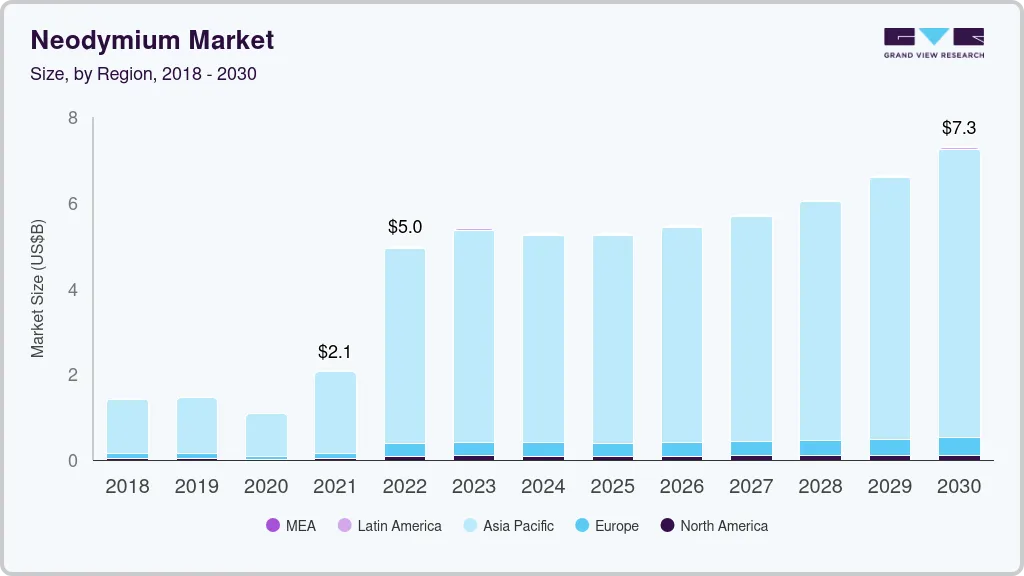 To learn more about this report, Download Free Sample Report
 The continued expansion of the wind energy sector remained another major driver for neodymium demand. Direct-drive offshore and onshore wind turbines require large quantities of rare-earth permanent magnets to improve energy conversion efficiency and reduce maintenance requirements. Several countries accelerated renewable energy deployment in 2025 as part of their decarbonization strategies, leading to increased wind power installations. The growing preference for larger, more efficient turbine designs further elevated neodymium consumption along the renewable energy value chain.
Demand from the consumer electronics industry also supported market growth. Neodymium magnets are widely used in smartphones, wireless earbuds, laptops, hard disk drives, speakers, and various miniaturized electronic components. The increasing penetration of advanced consumer devices, coupled with ongoing technological upgrades and shorter product replacement cycles, has sustained demand for high-strength permanent magnets. Manufacturers continued to prioritize compact, lightweight designs, underscoring the importance of neodymium in modern electronics manufacturing.
Market Dynamics
The rapid growth of EV production is a major driver for the neodymium market, as neodymium is a critical component in high-performance NdFeB permanent magnets used in EV traction motors. These magnets offer superior magnetic strength, efficiency, and power density, making them essential for improving vehicle range and performance. According to the International Energy Agency (IEA), global electric car sales surpassed 20 million units in 2025, accounting for approximately 25% of all new vehicle sales worldwide, up from over 17 million units in 2024. The continued expansion of EV manufacturing in key markets such as China, Europe, and the U.S. is significantly increasing demand for neodymium-based magnets. Furthermore, leading automakers, including BYD, Tesla, and Volkswagen, are scaling up EV production capacities, further strengthening neodymium consumption across the automotive sector.
In addition to rising vehicle sales, the increasing adoption of permanent magnet synchronous motors (PMSMs) in electric vehicles is further accelerating neodymium demand. Most modern EV manufacturers prefer PMSMs because they deliver higher torque, greater energy efficiency, and improved performance compared to alternative motor technologies. A typical battery-electric vehicle can contain between 1 and 2 kilograms of rare-earth permanent magnets, with neodymium accounting for a significant share of the material. As governments worldwide continue to promote vehicle electrification through emissions regulations, fuel-economy standards, and incentive programs, automakers are expanding production of both passenger and commercial EVs. This trend is expected to sustain robust neodymium consumption, reinforcing its strategic importance within the global EV supply chain and supporting the long-term market growth.
High price volatility of rare earth elements remains a significant restraint for the market. Neodymium prices are highly sensitive to supply chain disruptions, export regulations, geopolitical tensions, and fluctuations in mining and processing activities, particularly in China, which dominates global rare earth production and refining. Sudden price increases can raise manufacturing costs for end-use industries such as electric vehicles, wind turbines, and consumer electronics, while sharp price declines may discourage investment in new mining and processing projects. This uncertainty complicates long-term procurement planning for manufacturers and can delay adoption of neodymium-based technologies, thereby limiting overall market growth. Additionally, concerns over supply security and unpredictable raw material costs are encouraging some companies to explore alternative motor technologies and magnet recycling solutions.
The expansion of global aerospace and defense manufacturing is creating significant growth opportunities for the neodymium industry, as the magnets are widely used in aircraft actuators, guidance systems, radar equipment, satellites, electric propulsion systems, and advanced defense technologies. Rising commercial aircraft production is particularly supporting demand for high-performance rare-earth magnets. In 2025, Airbus delivered 793 commercial aircraft worldwide, while Boeing delivered approximately 600 aircraft, reflecting strong activity across the aviation sector and a growing backlog of future aircraft orders. As aerospace manufacturers continue to increase production rates to meet airline demand and governments expand defense modernization programs, the consumption of neodymium in mission-critical components is expected to rise substantially over the coming years.
Analyst Perspective
The neodymium market is entering a strategically important growth phase as global industries accelerate electrification and decarbonization efforts. Demand for neodymium is increasingly tied to high-growth sectors such as electric vehicles, wind energy, advanced electronics, aerospace, and defense, where high-performance NdFeB magnets remain difficult to replace. While strong adoption of EVs and renewable energy systems will continue to support long-term consumption, the market remains highly influenced by supply concentration and price volatility due to the dominance of a limited number of rare-earth-producing countries. Looking ahead, investments in rare earth mining, recycling technologies, and regional supply chain diversification are expected to reshape the competitive landscape. Companies that can secure stable access to raw materials and establish downstream magnet manufacturing capabilities are likely to be best positioned to capitalize on the market’s projected expansion.
Application Insights
The magnets segment dominated the neodymium market, accounting for the largest revenue share of 60.6% in 2025. These magnets are widely utilized in electric vehicles, wind turbines, consumer electronics, industrial automation equipment, robotics, medical devices, and aerospace systems. The accelerating adoption of electric mobility and renewable energy technologies has significantly increased demand for NdFeB magnets, as they are critical components in traction motors, generators, and energy-efficient systems. In addition, ongoing advancements in miniaturized electronic devices and high-performance industrial machinery continue to support the magnet segment's growth, making it the dominant and fastest-growing application area for neodymium globally.
 To learn more about this report, Download Free Sample Report
 The ceramics and glass segment is an important application area where neodymium oxide is primarily used as a coloring and decolorizing agent in specialty glass and ceramic products. Neodymium imparts distinctive violet, pink, and reddish hues to glass, making it valuable in decorative glassware, artistic ceramics, optical filters, and luxury consumer products. In addition, neodymium-containing glass is widely utilized in laser systems, protective eyewear, and precision optical applications due to its ability to absorb specific wavelengths of light selectively.
End Use Insights
The automotive segment dominated the neodymium industry, accounting for a revenue share of 32.9% in 2025. Neodymium is a critical raw material in the production of high-performance NdFeB magnets used in electric traction motors, power steering systems, sensors, actuators, and various electronic components. The shift toward vehicle electrification, driven by stringent emissions regulations and government incentives, has significantly increased demand for neodymium-based permanent magnets due to their superior magnetic properties and energy efficiency.
The wind energy segment is anticipated to grow at the fastest CAGR over the forecast period. The NdFeB magnets enable turbines to generate more electricity with lower maintenance requirements, improved reliability, and enhanced operational efficiency compared to conventional generator systems. The global transition toward renewable energy, supported by government decarbonization targets and investments in clean power infrastructure, has accelerated the installation of both onshore and offshore wind farms, driving demand for neodymium.
Regional Insights
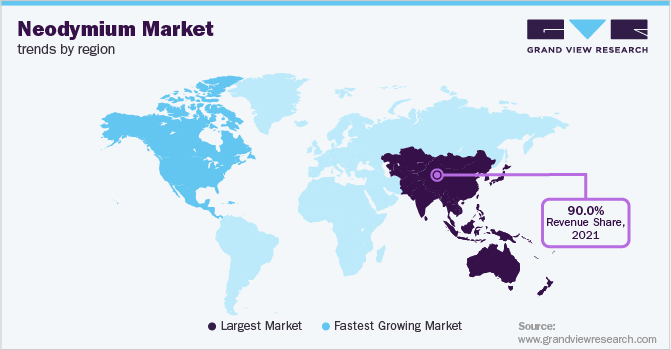
Asia Pacific neodymium industry accounted for the largest revenue share of 91.7% in 2025, driven by the rapid expansion of key industries such as EVs, renewable energy, and consumer electronics. Countries like China, Japan, South Korea, and India are at the forefront of this surge, leveraging their manufacturing capabilities and technological advancements. The increasing demand for high-performance permanent magnets, essential components in EV motors, wind turbines, and various electronic devices, is a significant factor propelling the market forward. Additionally, government initiatives promoting clean energy and sustainable technologies further bolster the adoption of neodymium-based applications across the region.
 To learn more about this report, Download Free Sample Report
 The China neodymium market plays a dominant role in the global demand. According to a magnet-industry consultant, global neodymium magnet production in 2024 was estimated between 220,000 and 240,000 tons, with at least 85% originating from China. Some estimates suggest this share could reach as high as 90%. While countries like Japan and Vietnam also contribute to production, their outputs are relatively minor. Despite the emergence of multiple neodymium magnet projects in the U.S., it is noted that these will not meaningfully reduce China’s overwhelming dominance in the near term. China’s vast rare earth reserves, established refining infrastructure, and aggressive policy support ensure its central role in meeting domestic demand and shaping global supply chains for neodymium-based technologies.
North America Neodymium Market Trends
The North America neodymium industry is experiencing significant growth, primarily driven by the increasing demand for neodymium magnets in EVs, wind energy, and consumer electronics. Due to their high magnetic strength and efficiency, neodymium magnets are essential components in EV motors and wind turbine generators. The rising adoption of EVs and the expansion of renewable energy infrastructure fuel the demand for these magnets. Additionally, the consumer electronics sector, including smartphones, laptops, and audio devices, relies heavily on neodymium magnets for compact and powerful components, further propelling market growth.
The U.S. neodymium industry is growing steadily. The U.S. Department of Defense has labeled rare earths, including neodymium, as essential for national security, prompting initiatives to build a resilient domestic supply chain. Furthermore, the increasing use of neodymium magnets in medical imaging devices, such as MRIs, and in consumer electronics, such as speakers, headphones, and hard drives, reinforces widespread industrial reliance. These diverse and strategic applications are key drivers for sustained market growth outside the EV space.
Europe Neodymium Market Trends
The neodymium industry in Europe is experiencing significant growth, primarily driven by the expansion of renewable energy initiatives. Neodymium magnets are essential in wind turbines, particularly in direct-drive systems, which offer higher efficiency and lower maintenance. As Europe intensifies its commitment to clean energy, the demand for wind turbines and, consequently, neodymium magnets has surged. The European Raw Materials Alliance (ERMA) has identified 14 projects to establish a robust rare earths industry in the EU, with an investment volume of USD 1.92 billion.
Middle East & Africa Neodymium Market Trends
The Middle East and Africa (MEA) neodymium industry is poised for significant growth, driven by the region's increasing focus on renewable energy and strategic investments in mining. Countries like Morocco and Egypt are leading the charge in renewable energy initiatives, with substantial investments in wind and solar power projects. Neodymium magnets, essential components in wind turbine generators, are in high demand due to their efficiency and reliability.
Key Neodymium Company Insights
Some of the key players operating in the market include Arafura Rare Earths.
-
Arafura Rare Earths is an Australian mining company headquartered in Perth, Western Australia. Arafura's primary offering is high-purity NdPr oxide, derived from the Nolans Project. This product is essential for producing Neodymium Iron Boron (NdFeB) magnets, which are integral to electric vehicles, wind turbines, robotics, and consumer electronics. Arafura has secured binding offtake agreements with major companies, including Hyundai, Kia, Siemens Gamesa, and Traxys Europe SA, aiming to supply up to 2,020 tonnes of NdPr oxide annually.
-
China Rare Earth Holdings Limited (CREH) is a Hong Kong-listed investment holding company specializing in producing and selling rare earth and refractory products. CREH offers a range of products, including neodymium oxide and neodymium iron boron (NdFeB) magnets. These materials are essential for various applications such as electric vehicles, wind turbines, and consumer electronics. CREH's neodymium products are known for their high purity and quality, catering to the growing global demand for rare earth elements.
Key Neodymium Companies
The following key companies have been profiled for this study on the neodymium market.
-
Arafura Rare Earths
-
China Rare Earth Holdings Limited
-
Greenland Minerals Ltd.
-
HEFA Rare Earth
-
Lynas Rare Earths Ltd
-
METALL RARE EARTH LIMITED
-
MP MATERIALS
-
Peak Rare Earths
-
Rainbow Rare Earths Limited
-
Texas Mineral Resources Corp.
Competitive Benchmarking
Operating Strategies
Competitive Edge
Considerations
Mature Players: Lynas Rare Earths Ltd; MP Materials; China Rare Earth Holdings Limited; METALL RARE EARTH LIMITED
- Mature participants in the neodymium market primarily focus on securing long-term access to rare earth resources through vertically integrated mining, separation, refining, and magnet production operations.
- These companies emphasize supply chain control to ensure stable production of neodymium oxide, neodymium metal, and NdFeB magnet materials.
- Their strategies include expanding refining capacities, improving extraction efficiencies, and establishing long-term supply agreements with electric vehicle, wind turbine, electronics, and defense manufacturers to secure recurring demand.
- Established participants possess significant competitive advantages through ownership of rare earth mining assets, large-scale processing facilities, and extensive technical expertise in rare earth separation.
- Their vertically integrated operations allow greater control over production costs, quality standards, and supply reliability.
- This integration is particularly important in the neodymium market, where supply security remains a major concern for downstream industries.
- Despite their strong market positions, mature players face challenges associated with high capital requirements, environmental compliance costs, and lengthy project development timelines.
- Rare earth mining and processing operations require significant investments in infrastructure, permitting, and waste management systems, increasing operational complexity and financial risk.
Growing / Specialized Players: Arafura Rare Earths; Peak Rare Earths; Rainbow Rare Earths Limited; Texas Mineral Resources Corp.; Greenland Minerals Ltd.; HEFA Rare Earth
- Emerging participants in the neodymium market are primarily focused on developing new rare earth mining projects, expanding regional processing capabilities, and establishing alternative supply chains outside dominant production centers.
- These companies often prioritize resource development and strategic partnerships with governments, automotive manufacturers, and magnet producers to accelerate commercialization and secure future demand.
- Emerging companies benefit from operational flexibility and the ability to adopt modern extraction and processing technologies from the outset.
- Without legacy infrastructure constraints, these firms can implement more efficient and environmentally sustainable production systems designed to meet current regulatory and customer expectations.
- Their projects are often strategically positioned to support regional supply diversification initiatives.
- Emerging participants face significant challenges related to limited production capacity, project financing requirements, and lengthy development timelines.
- Bringing a rare earth project from exploration to commercial production often requires substantial capital investment, extensive permitting processes, and years of technical validation.
- As a result, many newer companies remain dependent on external funding and strategic partnerships.
Recent Development
-
In March 2025, Heraeus began production at Heraeus Remloy, Europe's largest recycling plant for rare earth neodymium magnets, located in Bitterfeld-Wolfen, Germany. The facility initially produces 600 tons per year of nanocrystalline rare-earth magnetic powders from recycled end-of-life electronic devices, with capacity expandable to 1,200 tons annually. Its unique recycling technology reduces CO₂ emissions by 80% compared to primary magnet production while achieving identical magnet quality.
Neodymium Market Report Scope
Report Attribute
Details
Market definition
The global neodymium market size represents the total revenue generated from the sale of neodymium materials used in magnets, catalysts, glass and ceramics, and other applications.
Market size in 2025
USD 5.3 billion
Estimated market size in 2026
USD 5.5 billion
Projected market size by 2033
USD 8.4 billion
Growth rate
CAGR of 6.3% from 2026 to 2033
Base year for estimation
2025
Historical data
2021 - 2024
Forecast period
2026 - 2033
Quantitative units
Revenue in USD million/billion, volume in tons, and CAGR from 2026 to 2033
Report coverage
Revenue forecast, volume forecast, competitive landscape, growth factors, and trends
Segments covered
Application, end use, region
Regional scope
North America; Europe; Asia Pacific; Latin America; Middle East & Africa
Country scope
U.S.; Canada; Mexico; Germany; UK; France; India; China; Japan; Brazil; South Africa
Key companies profiled
Arafura Rare Earths; China Rare Earth Holdings Limited; Greenland Minerals Ltd.; HEFA Rare Earth; Lynas Rare Earths Ltd; METALL RARE EARTH LIMITED; MP MATERIALS; Peak Rare Earths; Rainbow Rare Earths Limited; Texas Mineral Resources Corp.
Customization scope
Free report customization (equivalent up to 8 analysts working days) with purchase. Addition or alteration to country, regional & segment scope.
Pricing and purchase options
Avail customized purchase options to meet your exact research needs. Explore purchase options
Global Neodymium Market Report Segmentation
This report forecasts volume & revenue growth at the global, regional, and country levels and provides an analysis of the latest industry trends and opportunities in each of the sub-segments from 2021 to 2033. For this study, Grand View Research has segmented the global neodymium market report based on application, end use, and region:
 To learn more about this report, Download Free Sample Report
 -
Application Outlook (Volume, Tons; Revenue, USD Million/Billion, 2021 - 2033)
-
Magnets
-
Catalyst
-
Ceramic & Glass
-
Others
-
-
End Use Outlook (Volume, Tons; Revenue, USD Million/Billion, 2021 - 2033)
-
Automotive
-
Electrical & Electronics
-
Wind Energy
-
Others
-
-
Regional Outlook (Volume, Tons; Revenue, USD Million/Billion, 2021 - 2033)
-
North America
-
U.S.
-
Canada
-
Mexico
-
-
Europe
-
Germany
-
France
-
UK
-
-
Asia Pacific
-
China
-
India
-
Japan
-
-
Latin America
-
Brazil
-
-
Middle East & Africa
-
South Africa
-
-
Research Methodology
Segment Definition
Segment - Application
Revenue capture definition
Magnets
This segment includes neodymium used in the production of high performance permanent magnets, particularly neodymium iron boron (NdFeB) magnets. These magnets are widely utilized in electric vehicles, wind turbines, consumer electronics, industrial motors, and aerospace systems due to their superior magnetic strength and efficiency.
Catalysts
This segment comprises neodymium used as a catalyst component or catalyst promoter in petroleum refining and various chemical processing applications. Neodymium enhances catalytic performance, selectivity, and stability in specific industrial reactions.
Ceramics & glass
Ceramics & glass segment covers neodymium utilized as a coloring, decolorizing, and optical modifying agent in specialty glass, ceramics, and laser materials. It is commonly employed in protective eyewear, optical filters, decorative glass products, and advanced ceramic applications.
Others
Others includes neodymium consumption across applications such as metallurgy, lasers, pigments, electronic components, phosphors, and research materials. These niche applications leverage the unique optical, magnetic, and chemical properties of neodymium for specialized industrial and technological uses.
Segment - End Use
Revenue capture definition
Automotive
This segment includes neodymium used in electric vehicles, hybrid vehicles, conventional automobiles, and automotive components. Neodymium is primarily consumed in permanent magnets for traction motors, power steering systems, sensors, actuators, and other advanced vehicle technologies.
Electrical & electronics
Electrical & electronics comprises neodymium utilized in consumer electronics, industrial electronics, and electrical equipment. Its applications include smartphones, laptops, hard disk drives, speakers, headphones, industrial motors, generators, and various electronic components requiring high performance magnetic materials.
Wind energy
This segment covers neodymium used in the manufacturing of permanent magnet generators for onshore and offshore wind turbines. The material enables higher energy efficiency, improved power output, and reduced maintenance requirements in renewable energy systems.
Others
Others includes neodymium consumption across aerospace, defense, healthcare, industrial machinery, robotics, laser systems, and other specialized applications. Demand in this category is driven by the metal's unique magnetic, optical, and metallurgical properties that support advanced technological and industrial processes.
Estimation Model
Title
Question
Description
Rare Earth Production Layer
Which rare earth supply contributes to neodymium production?
Identify global rare earth mining and refining output, including bastnäsite, monazite, and ion adsorption clay deposits. Estimate Nd-containing rare earth oxide (REO) production by region and producer.
Neodymium Availability Layer
How much neodymium is available for commercial applications?
Apply extraction efficiency, separation yields, purity specifications, recycling contributions, and supply chain losses to determine available neodymium metal and oxide volumes.
End Use Adoption Layer
Which industries consume neodymium-containing products?
Allocate neodymium volumes across key applications such as permanent magnets, catalysts, ceramics & glass, automotive, electrical & electronics, wind energy, and aerospace.
Market Revenue Layer
How much revenue is generated?
Multiply application-wise neodymium consumption volumes by average regional neodymium oxide/metal prices. Incorporate value addition from magnet manufacturing, processing margins, and downstream component production to estimate total market revenue.
Delivered Customizations
This report has been delivered with the following In-depth customizations
Client Request
Customization Delivered
Value Adds
Regional Segmentation
Detailed regional analysis of the neodymium market across North America, Europe, Asia Pacific, Latin America, and Middle East & Africa. Included evaluation of rare earth mining activities, refining capacities, magnet manufacturing investments, EV production trends, wind energy installations, electronics manufacturing output, import dependency, and government policies supporting critical mineral supply chains.
Identified high growth regional demand centers and strategic supply hubs. Enabled market entry planning based on EV manufacturing clusters, renewable energy expansion, and electronics production growth. Supported regional sourcing and investment strategies.
Trade Assessment
Evaluation of global neodymium trade flows, export import trends, refining and processing trade routes, country level import dependency, and supply concentration risks. Included assessment of rare earth concentrate trade, refined neodymium movements, geopolitical influences, and strategic stockpiling initiatives across major consuming countries.
Highlighted supply security risks, trade vulnerabilities, and diversification opportunities. Supported sourcing strategies, supply chain resilience planning, and international expansion decisions.
Opportunity Assessment
Identification of high growth opportunities across permanent magnets, electric vehicles, wind turbines, consumer electronics, robotics, industrial automation, aerospace systems, and defense applications. Assessed future demand potential driven by electrification trends, renewable energy investments, advanced manufacturing growth, and critical mineral security initiatives.
Enabled prioritization of high return investment opportunities and emerging application segments. Supported long term business planning, capacity expansion decisions, and strategic investment allocation aligned with global energy transition trends.
Frequently Asked Questions About This Report
The neodymium market size was estimated at USD 5.3 billion in 2025 and is expected to reach USD 5.5 billion in 2026.
The neodymium market is expected to grow at a compound annual growth rate of 6.3% from 2026 to 2033 to reach USD 8.4 billion by 2033.
Based on end use, automotive accounted for largest revenue share of 32.9% in 2025 of the overall market. Growing utilization of neodymium magnets in various automotive applications, especially electric motors is propelling segment growth.
The key players operating in the neodymium market include Arafura Rare Earths Limited, China Rare Earth Holdings Limited, Lynas Rare Earths Ltd, METALL RARE EARTH LIMITED, MP MATERIALS, Peak Rare Earths, and Rainbow Rare Earths.
The rising demand for neodymium magnets from wind energy and electric vehicle industries are the key growth drivers for the market.
Asia Pacific dominated the market with a revenue share of 91.7% in 2025.
China dominated the Asia Pacific market with a revenue share of 77.7% in 2025.
Asia Pacific is anticipated to register the fastest CAGR of 6.5% over the forecast period.
Based on application, magnets accounted for largest revenue share of 60.6% in 2025, while ceramics & glass is anticipated to register the fastest CAGR over the forecast period.
About the Author(s)
Advanced Interior Materials Research Team
Advanced Materials · Advanced Interior MaterialsThis report was authored by the advanced interior materials research team at Grand View Research - comprising two research analysts, one senior research analyst, and one industry expert - with specialized expertise in the advanced interior materials segment of the advanced materials industry. All findings are based on proprietary advanced materials databases, executive interviews, and regulatory analysis, subject to internal peer review prior to publication.
Last Updated:
Speak to Analyst

Customize this report to your needs - add regions, segments, or data points, with 20% free customization.
Or view our licence options:


ISO 9001:2015 & 27001:2022 Certified
We are GDPR and CCPA compliant! Your transaction & personal information is safe and secure. For more details, please read our privacy policy.


