
- Home
- »
- Bulk Chemicals
- »
-
Neon Gas Market Size, Share & Growth Report, 2026-2033GVR Report cover

Neon Gas Market (2026 - 2033)
Size, Share & Trends Analysis Report By Grade (Standard Purity, High Purity), By Application (Semiconductor & Electronics, Laser Technology), By Region, And Segment Forecasts
Market Size, 2025
$346.7MMarket Estimate, 2026
$365.7MMarket Forecast, 2033
$533.3MCAGR, 2026–2033
5.5%Neon Gas Market Summary
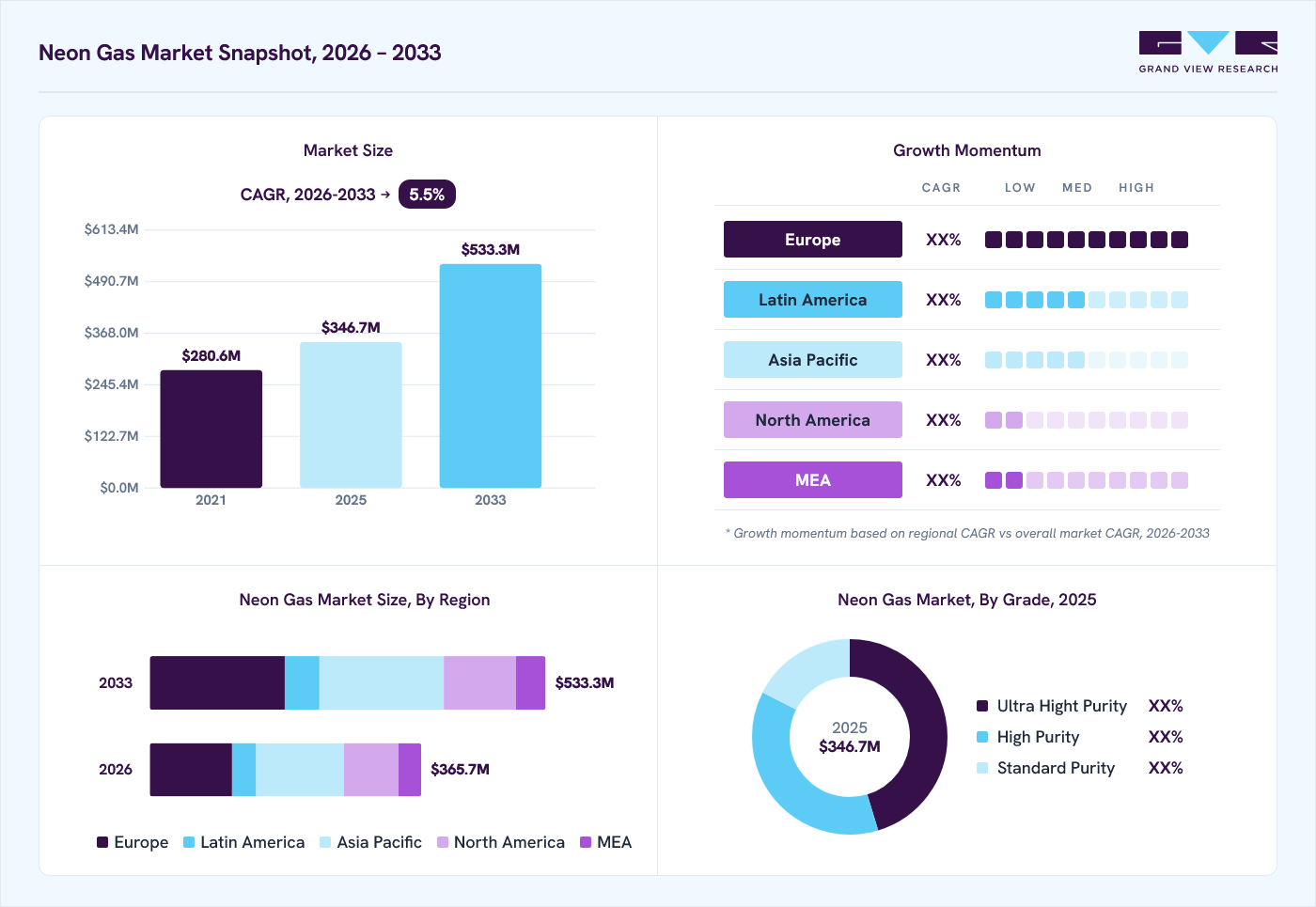
The global neon gas market size was valued at USD 346.7 million in 2025 and is projected to grow from USD 365.7 million in 2026 to USD 533.3 million in 2033, at a CAGR of 5.5% from 2026 to 2033. Asia Pacific dominated the market, accounting for the largest revenue share of 32.5% in 2025. The global neon gas industry is supported by rising semiconductor and advanced electronics production, increasing demand for high-purity neon in excimer-laser lithography, and ongoing investments in regional manufacturing and supply-chain resilience.
 Source: Grand View Research, IR Documents, Primary Interviews, Paid DatabasesTo learn more about this report,
 Download Free Sample Report
Key Market Trends & Insights
- By grade: Ultra-high purity segment held the largest revenue share of 45.3% in 2025.
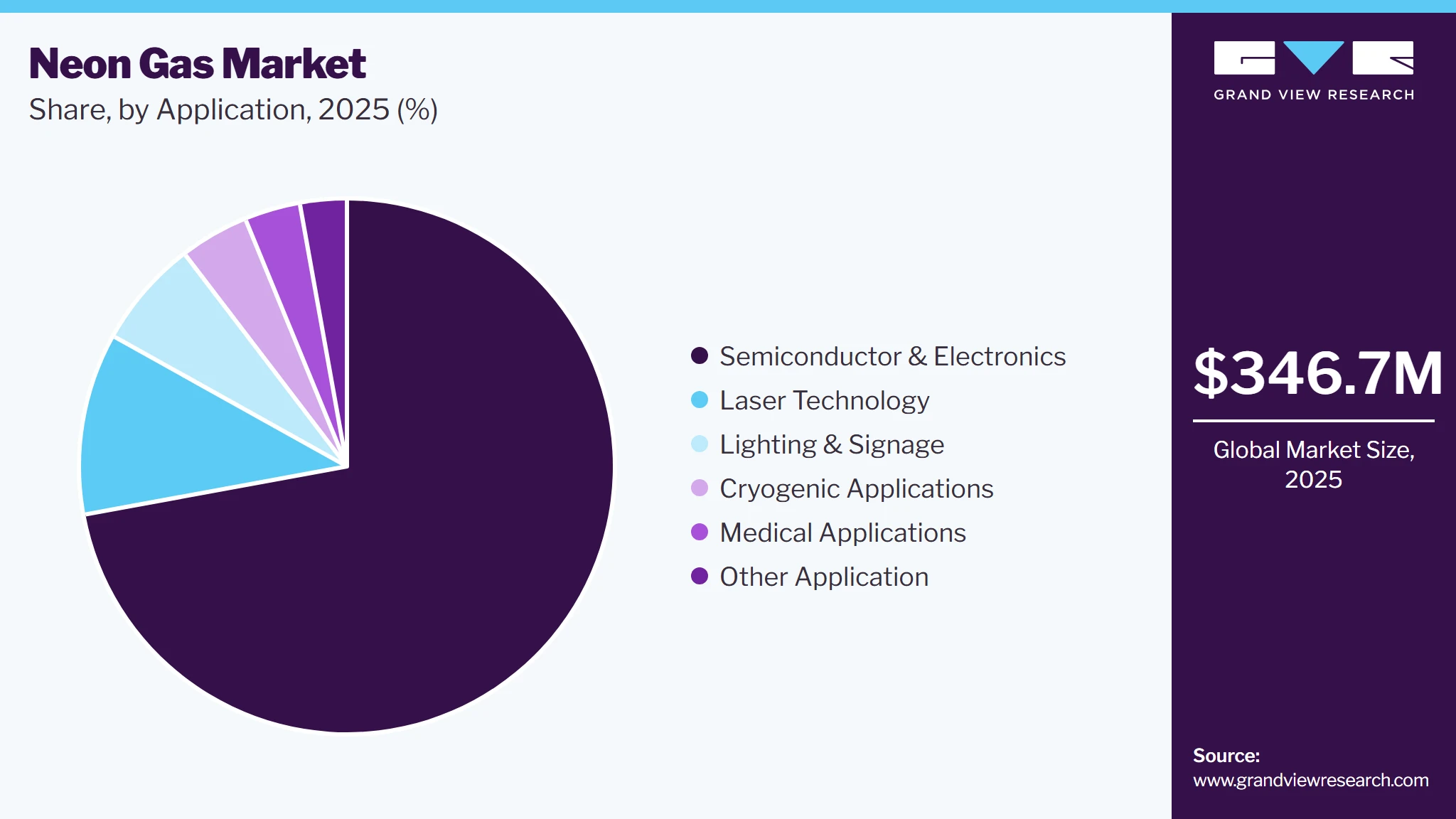
- By application: Semiconductor & electronics segment dominated with a share of 72.1% in 2025.
Regional Highlights
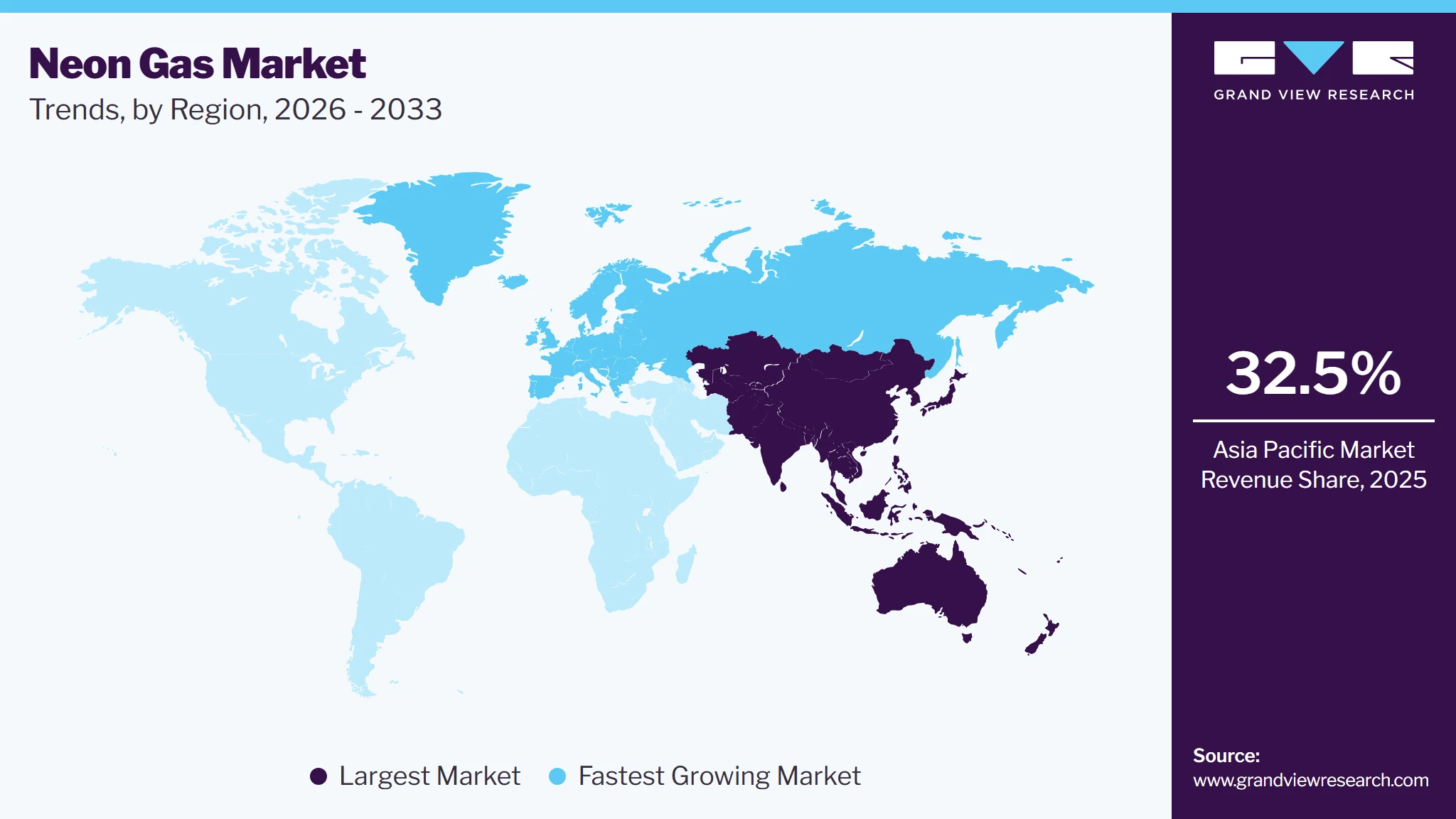
- Largest regional market: Asia Pacific (32.5% revenue share, 2025)
- Fastest-growing regional market: Europe (highest CAGR, 2026-2033)
- By country: China held the largest market share in 2025.
Market Size & Forecast
- Market size in 2025: USD 346.7 Million
- Estimated market size in 2026: USD 365.7 Million
- Projected market size by 2033: USD 533.3 Million
- CAGR (2026-2033): 5.5%
GVR research-powered AIAsk Prism AI about the neon gas marketGet cited answers from GVR research on market growth, segments, regulations and forecasts.Start with✓ Source-linked answers ✓ Market-specific context ✓ Traceable figuresExplore Prism AI ↗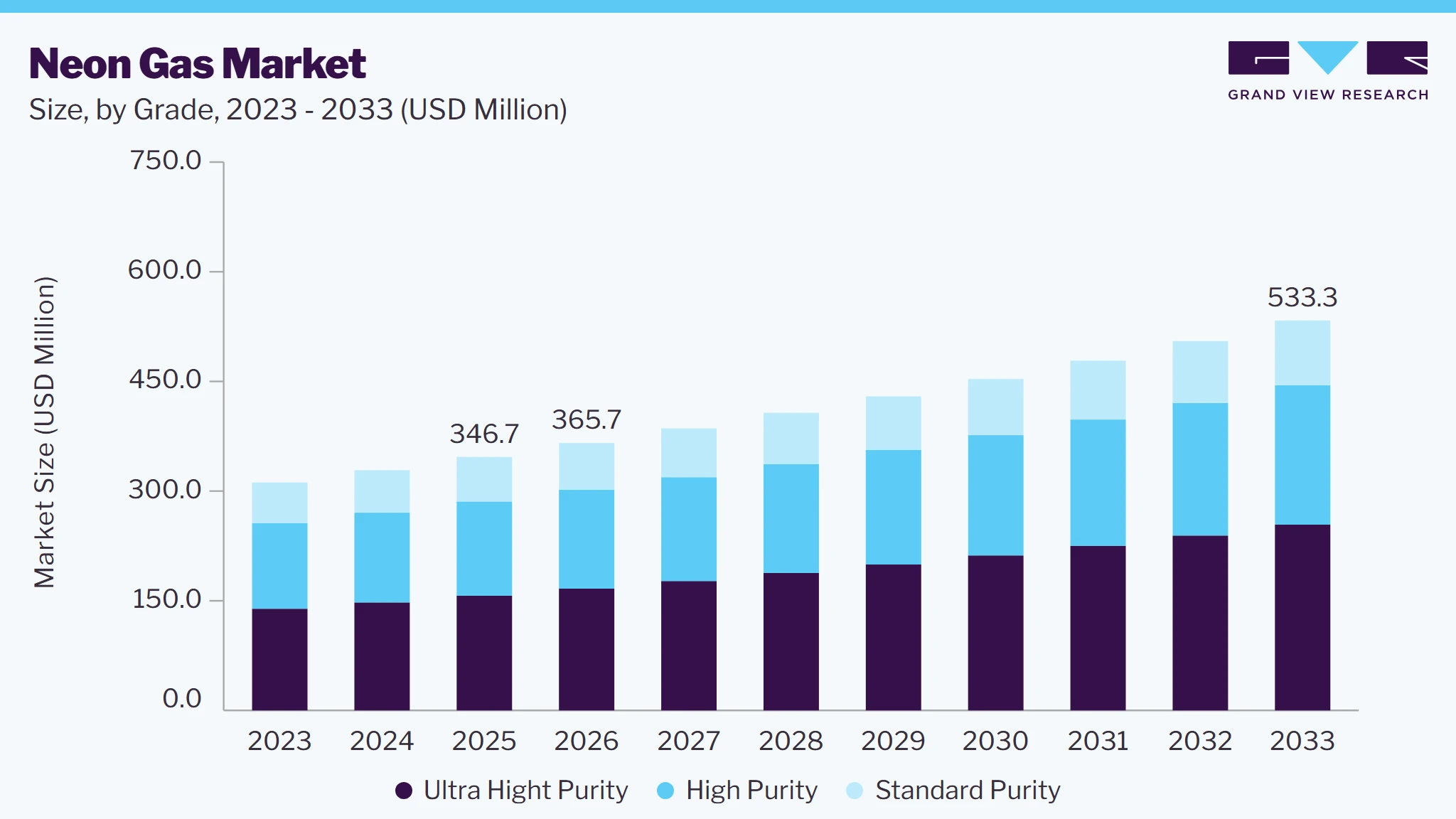 To learn more about this report, Download Free Sample Report
Market Dynamics
The industry is shaped by the interaction of expanding production, highly concentrated chains, stringent purity requirements, and geopolitical risks. Demand is primarily supported by fabrication, where high-purity is essential for laser-based photolithography used in chip manufacturing. Expansion of electronics production, advanced computing, automotive electronics, and new fabrication capacity is consequently strengthening consumption prospects. On the supply side, limited production and purification capacity create vulnerability to disruptions and contributes to price volatility. The Russia-Ukraine conflict demonstrated this exposure, temporarily removing an estimated 40-50% of global supply and triggering substantial price increases. In response, manufacturers and gas suppliers are increasingly emphasizing supplier diversification, strategic inventories, alternative production locations, and improved resource efficiency.
The rapid expansion of manufacturing is a major driver of demand, as high purity is an essential component of excimer laser gas mixtures used in deep-ultraviolet (DUV) lithography. Increasing investments in advanced logic, memory, artificial intelligence, high-performance computing, automotive electronics, and data-center infrastructure are encouraging manufacturers to expand fabrication capacity. The increasing complexity of chip designs also requires greater lithography intensity, supporting demand for specialty gases.
This trend is further reinforced by localization initiatives across major economies. Manufacturers are establishing new fabrication facilities closer to end markets to improve resilience and reduce dependence on concentrated production hubs. For instance, in July 2026, Air Liquide announced an investment exceeding USD 160 million in a new U.S. production facility to supply ultra-high-purity gases to an advanced fab expansion in Arizona. Such investments indicate sustained demand for high-purity gases as capacity expands globally.
A key constraint is the technically complex and capital-intensive nature of extraction, purification, storage, and distribution. Neon occurs only in trace concentrations in atmospheric air, requiring specialized air-separation and downstream purification infrastructure to achieve the ultra-high purity demanded by applications. Neon is extracted through air-separation processes and subsequently requires enrichment and purification using cryogenic technologies, making production and handling challenges. The structure also remains vulnerable because production capacity is concentrated among a limited number of specialized producers and geographic regions. Disruptions to individual purification facilities, energy supplies, transportation networks, or geopolitical conditions can therefore create disproportionate effects on availability and pricing.
The diversification of production represents an opportunity for gas manufacturers, particularly as companies seek more resilient and geographically distributed chains. Historically concentrated production exposed downstream industries to severe disruption; the Russia-Ukraine conflict temporarily affected as much as 40-50% of global supply. Semiconductor manufacturers and gas producers are increasingly pursuing alternative sources, domestic purification capabilities, strategic inventories, and long-term arrangements. This shift is creating opportunities for manufacturers to invest in air-separation units, purification technologies, and localized infrastructure near clusters.
Market Concentration & Characteristics
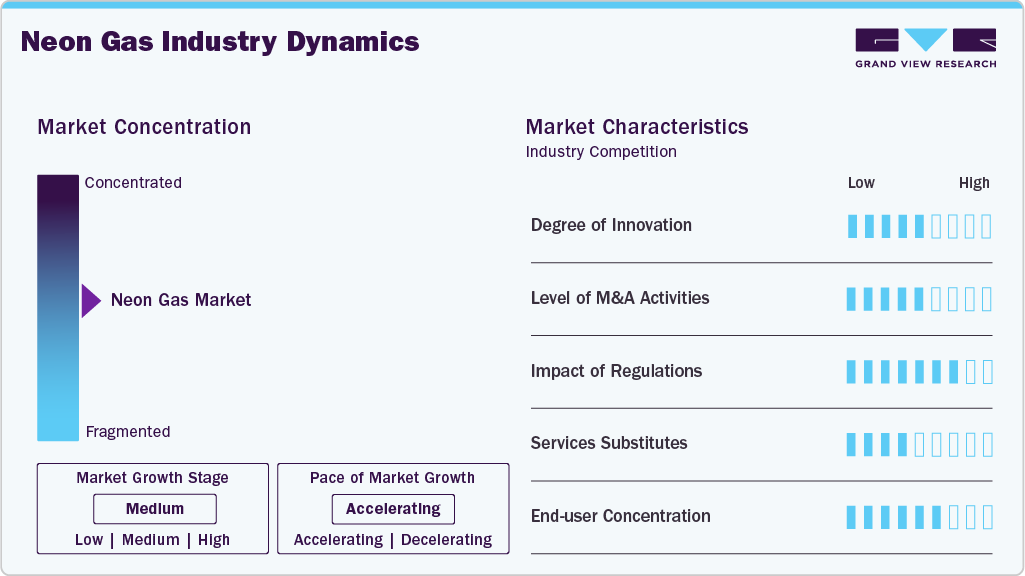
The industry is moderately consolidated, with competition centered on high-purity product quality, purification capabilities, production reliability, technological expertise, and long-term supply agreements with electronics manufacturers. Leading companies are strengthening their positions by expanding high-purity production, improving purification technologies, and developing specialized gas solutions for lithography and other advanced applications. Reliable availability, stringent quality control, scalable production infrastructure, and the ability to consistently meet grade specifications have become important competitive differentiators.
 To learn more about this report, Download Free Sample Report
Participants are also strengthening their market positions through capacity expansions, strategic investments, supply partnerships, and geographic diversification of production infrastructure. Companies are increasingly establishing localized manufacturing and purification facilities near major clusters to improve supply security and reduce exposure to geopolitical and transportation disruptions. Investments in recovery and recycling technologies are also gaining importance as manufacturers seek to reduce consumption and improve resource efficiency. In addition, long-term agreements with producers, development of integrated specialty-gas portfolios, and expansion of technical support capabilities are enabling suppliers to deepen customer relationships. These strategies are allowing established participants to improve supply-chain resilience while positioning themselves to capture demand generated by expanding fabrication capacity and increasingly sophisticated lithography processes.
Analyst Perspective
The industry is evolving toward a more diversified and resilient supply structure as manufacturers seek to reduce dependence on concentrated sources. Growing fabrication capacity should continue supporting demand for high-purity materials, particularly for lithography applications. Supply security is becoming a key purchasing consideration, encouraging greater emphasis on multiple suppliers, strategic inventories, and geographically distributed production. The disruptions following the Russia-Ukraine conflict demonstrated how quickly geopolitical events can affect availability and pricing, although the industry subsequently adapted by sourcing alternatives and reducing consumption.
Grade Insights
The ultra-high purity segment held the largest revenue share of 45.3% in 2025. The segment's leading position is primarily attributed to the stringent gas-quality requirements of fabrication and advanced lithography. Ultra-high-purity is used in excimer-laser systems, where very low impurity levels are important for stable laser performance and process consistency. The expansion of advanced chip manufacturing and increasing lithography intensity are therefore supporting demand for the highest purity grades.
The high purity segment is expected to grow at a CAGR of 5.0% from 2026 to 2033. Growth is supported by increasing use of purified neon in laser technologies, specialized electronics, research equipment, and other applications where controlled impurity levels are required but the most stringent -grade specifications may not be necessary. Broader adoption across specialized industrial and photonics applications is expected to expand the addressable demand base for this grade.
Application Insights
Semiconductor & electronics with reduced carbon processing held the largest revenue share of 72.1% in 2025. The segment's dominance reflects the critical role of high-purity neon in excimer lasers used for deep-ultraviolet lithography during manufacturing. Rising investments in advanced logic and memory fabrication, artificial intelligence chips, high-performance computing, automotive electronics, and data-center infrastructure are increasing semiconductor production capacity and consequently supporting consumption.
 To learn more about this report, Download Free Sample Report
Medical applications are projected to expand at a CAGR of 5.1% from 2026 to 2033. Growth is associated with specialized medical and diagnostic technologies that utilize neon-containing laser systems and other precision equipment. Increasing adoption of laser-based medical procedures and technological advancements in specialized healthcare equipment can support incremental consumption, although this remains a considerably smaller application base than that of semiconductor and electronics.
Regional Insights
The Asia Pacific neon gas industry represented 32.5% of global revenue in 2025, primarily associated with its concentration of global manufacturing, particularly across China, Taiwan, South Korea, and Japan. Large-scale investments in wafer-fabrication facilities, memory production, advanced logic chips, and electronics manufacturing create substantial requirements for high-purity neon used in excimer-laser lithography. The region also has a strong base of industrial-gas producers and purification facilities, strengthening both supply and consumption.
 To learn more about this report, Download Free Sample Report
China Neon Gas Market Trends
China neon gas industry is a significant market owing to its extensive electronics manufacturing base and rapidly expanding production capabilities. Government initiatives supporting domestic self-sufficiency are encouraging investments in wafer fabrication, advanced packaging, and specialty-gas production. Domestic manufacturers are also expanding purification capabilities for rare gases, improving local supply availability. Growing demand for electronics, data infrastructure, and advanced computing further supports consumption.
Europe Neon Gas Market Trends
Europe neon gas industry is supported by its mature industrial-gas infrastructure and established presence of specialty-gas manufacturers and distributors. The region has strong demand from equipment, industrial lasers, scientific research, automotive electronics, and advanced manufacturing. Germany, France, Italy, and the Netherlands contribute significantly through their sophisticated industrial and technology ecosystems. Ongoing efforts to strengthen European semiconductor and critical-material supply chains are also supporting demand for high-purity gases.
Germany neon gas industry represents a major European market due to its strong industrial manufacturing base and advanced engineering capabilities. Its automotive, electronics, laser technology, semiconductor-equipment, and research industries generate demand for specialty and high-purity gases. The country also hosts established industrial-gas production and distribution infrastructure, supporting reliable availability. Increasing investment in manufacturing and advanced electronics is expected to create additional opportunities.
North America Neon Gas Market Trends
North America neon gas industry growth is supported by semiconductor manufacturing, advanced electronics, aerospace and defense, laser technology, and scientific research. The region is experiencing substantial investment in domestic chip-production capacity, particularly in the U.S. New fabrication facilities require dependable supplies of high-purity process gases. Increasing emphasis on supply-chain resilience is also encouraging localized production and purification infrastructure.
The U.S. neon gas industry represents the principal demand center in North America due to its sophisticated, electronics, aerospace, and technology industries. Major investments in domestic fabrication are increasing requirements for high-purity specialty gases. Federal initiatives supporting manufacturing are encouraging new fabrication capacity and associated gas infrastructure. The country's strong research ecosystem and advanced laser applications provide additional sources of demand.
Middle East & Africa Neon Gas Market Trends
The Middle East & Africa neon gas industry is supported primarily by industrial manufacturing, healthcare, research, lighting, and specialized technology applications. Developing industrial infrastructure and economic diversification initiatives are creating opportunities for specialty-gas consumption. Investments in healthcare facilities, laboratories, advanced manufacturing, and technology infrastructure can gradually broaden application demand. Nevertheless, the region's limited manufacturing base keeps overall consumption comparatively modest.
Latin America Neon Gas Market Trends
Latin America neon gas industry represents a smaller consumption base, with demand concentrated in industrial manufacturing, healthcare, electronics, lighting, research, and specialized laser applications. Brazil and Mexico account for significant portions of the region's industrial activity and provide opportunities for specialty-gas suppliers. Mexico's integration with North American manufacturing networks can further support downstream demand. However, limited fabrication capacity constrains large-scale consumption compared with Asia Pacific and North America.
Key Neon Gas Company Insights
Companies are strengthening their market position by investing in regional purification capacity, supply-chain diversification, and long-term partnerships with manufacturers to improve supply reliability and reduce exposure to geopolitical disruptions. They are also adopting neon recovery and recycling technologies, while expanding high-purity capabilities and integrated supply solutions to differentiate their offerings, improve resource efficiency, and deepen customer relationships.
-
Messer SE & Co. KGaA is a major industrial and specialty gases producer with capabilities across rare gases, including high-purity neon for advanced industrial and electronics applications. The company offers high-purity grades and supports applications requiring stringent gas specifications, including manufacturing and laser technologies. Its competitive position is supported by specialized gas purification expertise, established production infrastructure, and a broad geographic presence across Europe, Asia, and the Americas. Messer's focus on quality assurance, reliable supply, and customized gas solutions further strengthens its ability to serve technically demanding customers.
-
Matheson Tri-Gas, Inc., is a prominent supplier of industrial, specialty, and electronic gases, with neon forming part of its high-purity gas portfolio for technically demanding applications. The company provides ultra-high-purity neon and specialty gas solutions designed to meet stringent quality requirements associated with manufacturing, research, and advanced technologies. Its competitive strength is supported by expertise in gas purification, analytical quality control, cylinder packaging, and specialty gas handling. Matheson's established infrastructure and focus on high-purity gas delivery enable it to address specialized customer requirements while supporting reliable supply across advanced industrial applications.
Key Neon Gas Companies
The following key companies have been profiled for the study on the neon gas market.
-
Air Liquide
-
Linde plc
-
Air Products and Chemicals, Inc.
-
Messer SE & Co. KGaA
-
Taiyo Nippon Sanso Corporation
-
Air Water Inc.
-
Iwatani Corporation
-
Matheson Tri-Gas, Inc.
-
Gruppo SIAD
-
Gulf Cryo
Competitive Benchmarking
Operating Strategies
Competitive Edge
Weaknesses
Mature Players: Air Liquide, Linde plc, Air Products and Chemicals, Inc., Messer SE & Co. KGaA, Taiyo Nippon Sanso Corporation, Air Water Inc., Iwatani Corporation, Matheson Tri-Gas, Inc.
- Expanding high-purity production and purification capabilities to meet stringent requirements across semiconductor and electronics applications.
- Developing geographically diversified production and supply networks to improve continuity of supply and reduce exposure to regional disruptions.
- Investing in neon recovery, reclamation, and resource-efficiency technologies to optimize raw-material utilization and strengthen supply resilience.
- Building long-term relationships with semiconductor manufacturers through customized delivery models, technical support, and integrated specialty-gas solutions.
- Extensive global production and distribution infrastructure enables consistent supply across major semiconductor manufacturing regions.
- Advanced purification and quality-control capabilities support ultra-high-purity requirements for lithography applications.
- Established customer relationships and long-term supply agreements create strong entry barriers and improve customer retention.
- Broad portfolios of industrial and specialty gases allow these companies to provide integrated solutions rather than individual gas products.
- Capital-intensive production and purification infrastructure requires substantial investment and lengthy capacity-development periods.
- Large global operating networks can increase exposure to energy costs, transportation disruptions, geopolitical risks, and regulatory changes.
- Dependence on semiconductor manufacturing cycles can expose suppliers to fluctuations in customer production volumes and capital expenditure.
- Extensive organizational structures may limit flexibility when responding to highly customized requirements from smaller customers.
Emerging Players: Gruppo SIAD, Gulf Cryo.
- Focusing on specialized high-purity gas production and purification to address opportunities in semiconductor and electronics applications.
- Developing regional production capabilities to reduce dependence on imported supplies and strengthen proximity to major customers.
- Building partnerships with semiconductor manufacturers and upstream industrial-gas or steel producers to secure feedstock and establish stable supply channels.
- Investing in purification technologies and localized processing infrastructure to capture demand created by supply-chain diversification.
- Greater operational flexibility enables faster adaptation to regional customer requirements and changing supply conditions.
- Localized production can shorten supply chains and reduce customers' dependence on overseas sources.
- Specialized focus on high-purity gases allows emerging participants to target attractive semiconductor applications without maintaining the broad infrastructure of major industrial-gas companies.
- Ability to develop alternative regional supply sources provides strategic value as semiconductor manufacturers increasingly prioritize supply-chain resilience.
- Smaller production capacities can limit their ability to support large multinational semiconductor customers on a scale.
- Limited geographic coverage can increase vulnerability to transportation constraints and regional disruptions.
- High capital requirements for air-separation and purification infrastructure can restrict the pace of capacity expansion.
- Lower brand recognition and shorter operating histories may make it more difficult to secure long-term contracts and complete qualification processes with major semiconductor manufacturers.
Recent Developments
-
In February 2025, Air Liquide announced a new air separation unit in Japan that will produce neon, argon, oxygen, and nitrogen, with operations expected to begin in 2027. The project is strategically important because Japan has limited domestic neon production and relies heavily on imports for semiconductor applications.
-
In September 2025, Jinhong Gas announced a new project in Spain, supporting its international expansion and strengthening its European gas-supply footprint. The development is relevant to the competitive landscape because the company supplies high-purity rare gases, including neon, for semiconductor and electronics applications.
Neon Gas Market Report Scope
Report Attribute
Details
Market size in 2025
USD 346.7 million
Estimated market size in 2026
USD 365.7 million
Projected market size by 2033
USD 533.3 million
Growth rate
CAGR of 5.5% from 2026 to 2033
Base year for estimation
2025
Historical data
2021 - 2024
Forecast period
2026 - 2033
Quantitative units
Revenue in USD million and CAGR from 2026 to 2033
Report coverage
Revenue forecast, volume forecast, company ranking, competitive landscape, growth factors, and trends
Segments covered
Grade, application, region
Regional Scope
North America; Europe; Asia Pacific; Latin America; Middle East & Africa
Country scope
U.S.; Canada; Mexico; Germany; UK; France; Italy; Spain; China; India; Japan; South Korea; Brazil; Argentina; Saudi Arabia; South Africa.
Key companies profiled
Air Liquide; Linde plc; Air Products and Chemicals, Inc.; Messer SE & Co. KGaA; Taiyo Nippon Sanso Corporation; Air Water Inc.; Iwatani Corporation; Matheson Tri-Gas, Inc.; Gruppo SIAD; Gulf Cryo.
Customization scope
Free report customization (equivalent up to 8 analysts’ working days) with purchase. Addition or alteration to country, regional & segment scope.
Pricing and purchase options
Avail customized purchase options to meet your exact research needs. Explore purchase options
Global Neon Gas Market Report Segmentation
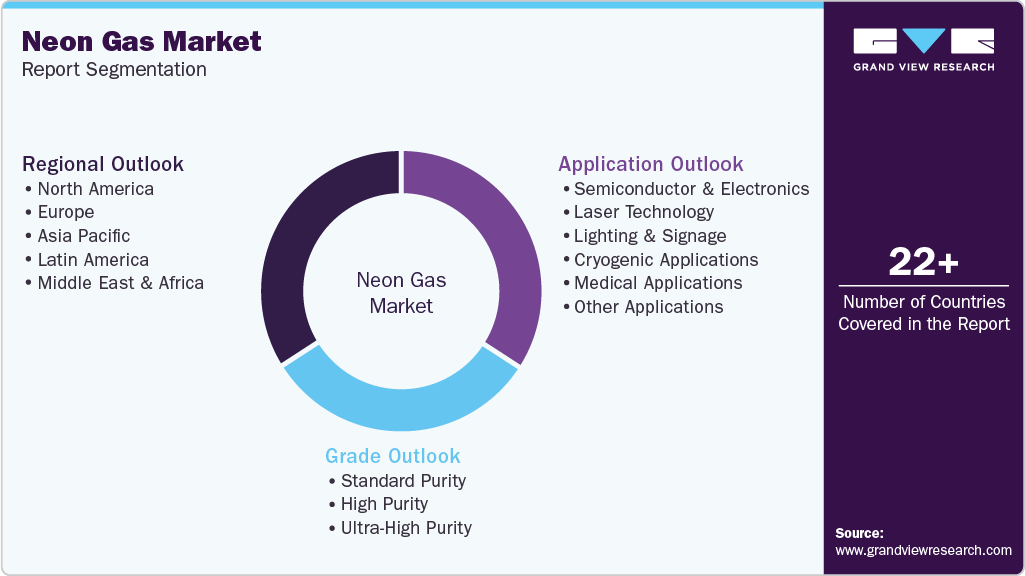
This report forecasts revenue growth at regional and country levels and provides an analysis of the latest industry trends in each of the sub-segments from 2021 to 2033. For this study, Grand View Research has segmented the global neon gas market report based on grade, application, and region:
 To learn more about this report, Download Free Sample Report
-
Grade Outlook (Revenue, USD Million, 2021 - 2033)
-
Standard Purity
-
High Purity
-
Ultra-High Purity
-
-
Application Outlook (Revenue, USD Million, 2021 - 2033)
-
Semiconductor & Electronics
-
DUV Photolithography / Excimer Lasers
-
Other Semiconductor Applications
-
-
Laser Technology
-
Lighting & Signage
-
Cryogenic Applications
-
Medical Applications
-
Other Applications
-
-
Regional Outlook (Revenue, USD Million, 2021 - 2033)
-
North America
-
U.S.
-
Canada
-
Mexico
-
-
Europe
-
UK
-
Germany
-
France
-
Italy
-
Spain
-
-
Asia Pacific
-
China
-
Japan
-
India
-
South Korea
-
-
Latin America
-
Brazil
-
Argentina
-
-
Middle East and Africa (MEA)
-
South Africa
-
Saudi Arabia
-
-
Research Methodology
The neon gas market figures in this report are based on a proven research process that combines executive interviews with secondary research from proprietary databases, company filings, and recognized regulatory and institutional sources. Market size is built through value-chain sizing-reconciling supply-side and demand-side estimates-and triangulated with bottom-up and top-down approaches. Every estimate passes multiple levels of expert validation before publication, with each neon gas segment quantified using the revenue-capture definitions in the table below.
Segment Definition
Segment - Grade
Revenue capture definition
Standard Purity
Commercial demand is generated by neon supplied for lighting, signage, and selected industrial uses, where consistent gas quality and dependable availability support equipment functionality and operating requirements.
High Purity
Market value is supported by purified neon used in laser systems, photonics, and specialized industrial applications that require controlled impurity levels to maintain process stability and equipment performance.
Ultra-High Purity
Value creation is driven by highly purified neon used in semiconductor manufacturing and advanced lithography, where stringent specifications are essential for excimer-laser operation, process consistency, and sophisticated chip fabrication.
Segment - Application
Revenue capture definition
Semiconductor & Electronics
Demand is centered on high- and ultra-high-purity neon used in excimer-laser lithography and semiconductor processes, with consumption closely linked to wafer fabrication capacity, advanced chip production, and semiconductor capital expenditure.
Laser Technology
Market expansion is supported by neon consumption in excimer lasers and specialized laser systems, where its physical properties enable precision applications across industrial, scientific, and photonics equipment.
Lighting & Signage
Commercial activity is driven by neon supplied for illuminated signs, decorative lighting, indicator systems, and other discharge-lighting applications, with usage influenced by commercial installations and replacement requirements.
Cryogenic Applications
Opportunities arise from specialized applications that utilize neon as a cryogenic refrigerant for achieving extremely low temperatures in selected scientific, research, and advanced cooling systems.
Medical Applications
Adoption is associated with specialized healthcare equipment incorporating neon-based laser systems and other precision technologies that require controlled gas characteristics for specific diagnostic or therapeutic applications.
Other Applications
Consumption is supported by research laboratories, aerospace and defense technologies, plasma-related systems, analytical equipment, and other specialized applications that utilize neon's distinctive physical properties.
Estimation Model
Layer No.
Layer Name
Key Question
Description
01
Raw Material & Production Layer
What forms the supply base?
Assess the feedstock and production foundation, including atmospheric air as the primary source of neon recovered through air-separation processes. Examine air-separation capacity, cryogenic extraction, neon enrichment and purification technologies, feed-gas availability, recovery efficiency, production economics, plant capacity, energy requirements, storage infrastructure, and geographic concentration of rare-gas processing facilities.
02
Application Adoption Layer
Where is neon gas utilized?
Evaluate the integration of neon across semiconductor manufacturing, excimer lasers, laser-based equipment, lighting and signage, aerospace and defense technologies, scientific research, and other specialized applications. Adoption is influenced by semiconductor fabrication capacity, lithography requirements, laser-system utilization, technological specifications, purity standards, equipment compatibility, and the availability of alternative gas mixtures or technologies.
03
Consumption Intensity Layer
How extensively is neon gas consumed?
Examine the scale and depth of utilization across semiconductor fabrication, particularly deep-ultraviolet lithography, as well as laser, lighting, and research applications. The analysis considers consumption volumes, purity grades, process requirements, recovery and recycling rates, gas-mixture composition, manufacturing intensity, efficiency improvements, substitution potential, and the influence of technological advances on neon requirements per application.
04
Revenue Layer
How is market revenue generated?
Market value is captured through the production, purification, packaging, and commercialization of neon across standard, high-purity, and ultra-high-purity grades. Revenue growth is influenced by semiconductor capacity additions, investments in purification facilities, regional supply-chain development, long-term supply agreements, specialized gas mixtures, recovery and reclamation systems, pricing dynamics, capacity utilization, and increasing demand for reliable high-purity gas supplies.
Delivered Customizations
This report has been delivered with the following In-depth customizations
Client Request
Customization Delivered
Value Adds
Regional segmentation
The assessment provides country-level market sizing and forecasts, supported by analysis of neon demand across purity grades, production methods, and application segments. It evaluates consumption across semiconductor manufacturing, excimer lasers, lighting and signage, aerospace and defense, scientific research, and other specialized applications. The analysis also covers atmospheric air-separation capacity, neon purification infrastructure, domestic output, import-export patterns, supply availability, logistics networks, regulatory conditions, semiconductor fabrication investments, and competitive activity within individual countries.
Supports geographic expansion, supply-chain diversification, sourcing decisions, production planning, and capital allocation by identifying countries with established purification infrastructure, expanding semiconductor ecosystems, favorable investment conditions, and resilient supply networks.
Opportunity Assessment
Provides an in-depth assessment of growth opportunities arising from semiconductor fabrication expansion, advanced lithography, regional rare-gas production, neon recovery and reclamation, purification technology improvements, and supply-chain localization. The analysis considers semiconductor capital expenditure, technological requirements, production economics, recycling potential, infrastructure availability, geopolitical exposure, and procurement strategies adopted by major downstream users.
Helps organizations identify commercially attractive applications, technologies, and investment areas by evaluating demand growth, supply-chain vulnerabilities, purification economics, and evolving customer requirements. The findings can guide capacity expansion, recovery-system deployment, technology investments, strategic partnerships, sourcing diversification, and market-entry decisions.
Competitive Benchmarking
Compares leading manufacturers based on neon production and purification capabilities, purity grades, manufacturing scale, rare-gas recovery infrastructure, geographic footprint, semiconductor customer relationships, supply reliability, technological expertise, capacity additions, and strategic investments. The assessment also examines production integration, distribution networks, recycling capabilities, long-term contracts, regional expansion initiatives, and the ability to meet stringent requirements for semiconductor-grade material.
Enables companies to assess their competitive standing by identifying strengths in purification, geographic coverage, customer relationships, production capacity, and supply-chain resilience, while highlighting capability gaps and expansion opportunities. The insights support decisions related to capacity development, technology upgrades, partnerships, acquisitions, regional expansion, and long-term positioning.
Frequently Asked Questions About This Report
The neon gas market size was estimated at USD 346.7 million in 2025 and is expected to reach USD 365.7 million in 2026.
The neon gas market is expected to grow at a compound annual growth rate of 5.5% from 2026 to 2033 to reach USD 533.3 million by 2033.
Ultra high purity held the largest revenue share of 45.3% in 2025. The segment's leading position is primarily attributable to the stringent gas-quality requirements of semiconductor fabrication and advanced lithography.
Asia Pacific represented 32.5% of revenue in 2025, primarily associated with its concentration of global semiconductor manufacturing, particularly across China, Taiwan, South Korea, and Japan.
Key factors include stricter carbon-emission regulations, corporate decarbonization targets, and growing demand for renewable and recycled feedstocks across chemical production. Increasing investments in green chemistry, electrification, carbon management, and circular manufacturing are further accelerating the shift toward lower-impact production.
Some of the key players operating in the neon gas market include Air Liquide; Linde plc; Air Products and Chemicals, Inc.; Messer SE & Co. KGaA; Taiyo Nippon Sanso Corporation; Air Water Inc.; Iwatani Corporation; Matheson Tri-Gas, Inc.; Gruppo SIAD; Gulf Cryo.
Semiconductor & electronics held the largest revenue share of 72.1% in 2025. The segment's dominance reflects the critical role of high-purity neon in excimer lasers used for deep-ultraviolet lithography during semiconductor manufacturing.
Europe is the fastest growing region with a CAGR of 7.3% in the forecast period. The region has strong demand from semiconductor equipment, industrial lasers, scientific research, automotive electronics, and advanced manufacturing.
Future growth opportunities include expansion of semiconductor fabrication capacity, regional neon purification infrastructure, and advanced neon recovery and recycling systems, particularly as chipmakers seek more resilient and cost-efficient supply chains.
About the Author(s)
Bulk Chemicals Research Team
Research · Bulk ChemicalsThis report was authored by the bulk chemicals research team at Grand View Research - comprising two research analysts, one senior research analyst, and one industry expert - with specialized expertise in the bulk chemicals segment of the research industry. All findings are based on proprietary research databases, executive interviews, and regulatory analysis, subject to internal peer review prior to publication.
Last Updated:
Speak to Analyst

Customize this report to your needs - add regions, segments, or data points, with 20% free customization.
Or view our licence options:


ISO 9001:2015 & 27001:2022 Certified
We are GDPR and CCPA compliant! Your transaction & personal information is safe and secure. For more details, please read our privacy policy.


