
- Home
- »
- Next Generation Technologies
- »
-
Neuromorphic Spintronics Market Size Report, 2025-2033GVR Report cover

Neuromorphic Spintronics Market (2025 - 2033)
Size, Share & Trends Analysis Report By Application (Neuromorphic Processors, AI Accelerators, Edge Computing Devices), By End Use (Aerospace & Defense, Automotive, Industrial Automation), By Region, And Segment Forecasts
Market Size, 2024
$141.2MMarket Estimate, 2026
$216.8MMarket Forecast, 2033
$1,014.7MCAGR, 2025–2033
24.6%Neuromorphic Spintronics Market Summary
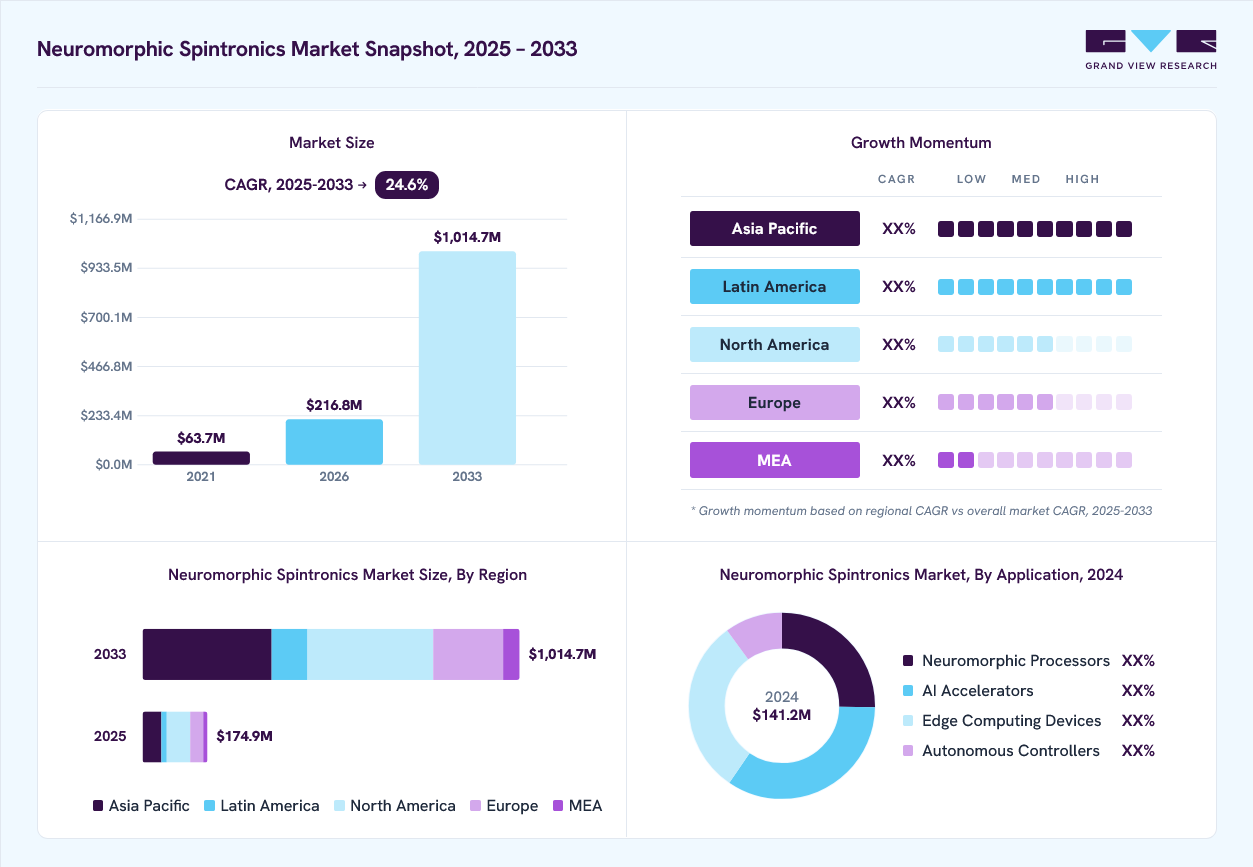
The global neuromorphic spintronics market size was valued at USD 141.2 million in 2024 and is projected to grow from USD 216.8 million in 2026 to USD 1,014.7 million by 2033, at a CAGR of 24.6% from 2025 to 2033. North America dominated the market, accounting for a revenue share of 36.4% in 2024. The market is expanding with the growing demand for brain-inspired computing systems.
 Source: Grand View Research, IR Documents, Primary Interviews, Paid DatabasesTo learn more about this report,
 Download Free Sample Report
 Key Market Trends & Insights
- The neuromorphic spintronics market in the U.S. led the North America market and held the largest revenue share in 2024.
- By Application, AI accelerators segment led the market and held the largest revenue share of 34.2% in 2024.
- By end use, the automotive segment is expected to grow at the fastest CAGR of 26.7% from 2025 to 2033.
Market Size & Forecast
- 2024 Market Size: USD 141.2 Million
- 2033 Projected Market Size: USD 1,014.7 Million
- CAGR (2025-2033): 24.6%
- North America: Largest market in 2024
- Asia Pacific: Fastest market in 2024
Three ways to get this report
Buy it, customize it, or ask a question.Ask an Analyst
Analyst response in 1 business day
- AccessReport author, directly
- Reply timeWithin 1 working day
- No sales callDirect answer only
- FormatEmail reply
- CostFree, no cost
Get the Full Report
What the study covers
- FormatsPDF · Excel · Dashboard
- Timeline2025–2033 annual, 2024 base
- Coverage20+ countries, 5 regions
- Companies10+ key players profiled
Customize the Report
20% free customization
- IncludeCountries, segments, points
- TailorTo your product definition
- ExtendDeeper competitor detail
- OrA fully bespoke study
- Turnaround5–10 working days
Advancements in MRAM and spin-based logic devices are enhancing neuromorphic hardware capabilities. Rising focus on energy-efficient computing solutions is supporting adoption across industries. Continuous research and development are driving technological progress and market growth. The increasing focus on energy-efficient hardware using spintronic components is driving the growth of the neuromorphic spintronics market. Increasing demand for low-power AI systems is encouraging advancements in spin-memristor and spin-based logic technologies. Companies are investing in collaborative R&D to enhance performance and scalability. These innovations are enabling faster, more efficient neuromorphic processors. The shift toward sustainable computing solutions is further strengthening market expansion. For instance, in October 2024, TDK Corporation, an electronics company in Japan, developed a spin-memristor for neuromorphic devices that can reduce AI power consumption by up to 99%. This launch aims to create energy-efficient, brain-inspired computing hardware that addresses the rising power demands of AI applications. The company is collaborating with France’s CEA and Japan’s Tohoku University to advance the technology toward practical semiconductor applications.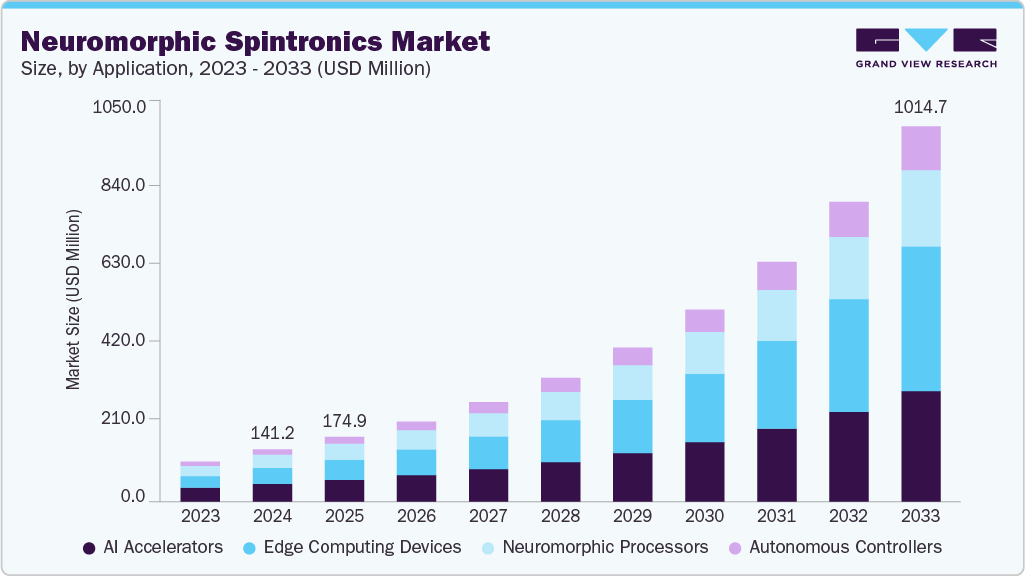 To learn more about this report, Download Free Sample Report
 Advancements in material science are driving rapid innovation within neuromorphic spintronics. Researchers are developing next-generation materials, including two-dimensional magnets, skyrmions, and spin-orbit torque devices, to improve device performance. These materials provide enhanced scalability, stability, and faster switching speeds crucial for neuromorphic architectures. Improved endurance and miniaturization achieved through these materials allow efficient emulation of synaptic and neuronal functions. Such progress reduces energy dissipation while maintaining high-speed data transfer capabilities. Continuous breakthroughs in materials research are expanding opportunities for practical prototyping and commercialization. Collaboration between research institutions and semiconductor companies is accelerating the transition from lab-scale devices to scalable production. This technological advancement is expected to strengthen the competitiveness of neuromorphic hardware in AI and high-performance computing.
Edge AI and IoT expansion is another major factor supporting neuromorphic spintronics growth. The increasing adoption of connected devices and autonomous systems requires hardware capable of low-power, real-time processing. Neuromorphic spintronic chips offer the ability to perform on-device computation, reducing dependence on external servers. Their non-volatility and compact structure make them suitable for portable and energy-sensitive applications. These chips enhance adaptability by enabling learning directly at the edge, improving latency and system responsiveness. Growing use across industrial, automotive, and consumer domains reinforces ongoing investment and innovation in this field. Expanding 5G infrastructure and smart manufacturing initiatives are further boosting the demand for energy-efficient processing solutions. As edge networks evolve, neuromorphic spintronic architectures are expected to become a critical enabler of next-generation intelligent systems.This growing ecosystem is accelerating the commercialization of neuromorphic spintronic hardware across emerging edge computing applications.
Application Insights
The AI Accelerators segment dominated the Neuromorphic Spintronics market in 2024, accounting for a 34.2% share, due to their ability to deliver high computational efficiency for complex neural network operations. These accelerators leverage spintronic architectures to perform parallel processing with minimal power consumption. Their compatibility with machine learning workloads enhances real-time data analysis and decision-making capabilities. Continuous advancements in spin-orbit torque and magnetic tunnel junction technologies further strengthen their performance and scalability. Integration with AI-driven applications in data centers, robotics, and autonomous platforms supports their widespread use. Growing demand for efficient and compact AI hardware continues to reinforce their dominant position in the market.
Edge Computing Devices are growing rapidly within the neuromorphic spintronics market, driven by the rising need for decentralized intelligence. These devices enable localized data processing, reducing latency and dependence on cloud infrastructure. Spintronic components offer the necessary energy efficiency and miniaturization for compact edge architectures. Their ability to operate continuously under low power makes them suitable for industrial automation, smart sensors, and connected infrastructure. The evolution of 5G and IoT ecosystems is accelerating adoption across multiple domains. Increasing research toward integrating neuromorphic spintronics with edge AI platforms is expected to sustain this growth trajectory.
End Use Insights
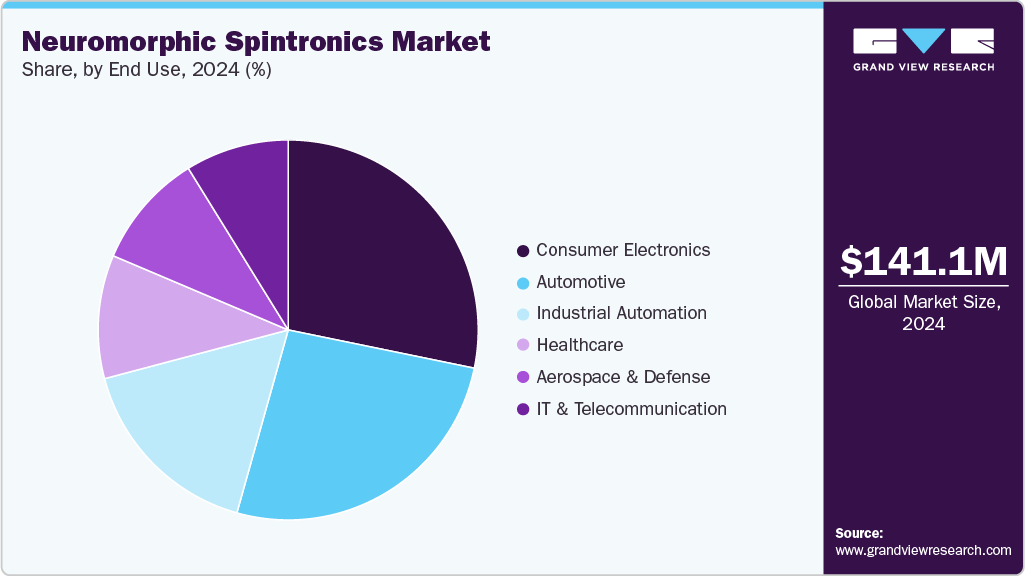
Consumer electronics segment dominated the Neuromorphic Spintronics market in 2024, driven by extensive integration of intelligent and power-efficient chips in smart devices. The demand for real-time data processing, adaptive learning, and low-power performance strengthened their adoption across smartphones, wearables, and smart home applications. Spintronic components enable faster response times, extended battery life, and compact designs suitable for portable electronics. The rise in AI-driven consumer interfaces further supported large-scale deployment in this category. Continuous advancements in spin-orbit torque and magnetic tunnel junction technologies enhanced processing efficiency and user experience. As neuromorphic hardware becomes more accessible, consumer electronics maintain a strong influence on overall market dynamics.
 To learn more about this report, Download Free Sample Report
 Automotive applications are growing steadily, supported by advancements in autonomous driving and vehicle intelligence systems. The integration of neuromorphic spintronic processors enables low-latency decision-making crucial for ADAS and real-time sensor fusion. Their high endurance and non-volatility allow continuous data handling under harsh automotive conditions. Manufacturers are increasingly adopting these systems to improve vehicle safety, energy management, and navigation accuracy. Ongoing developments in electric and connected vehicles are creating new opportunities for deployment. Growing focus on enhancing vehicle autonomy and computational efficiency is accelerating the adoption of neuromorphic spintronic processors across next-generation automotive systems.
Regional Insights
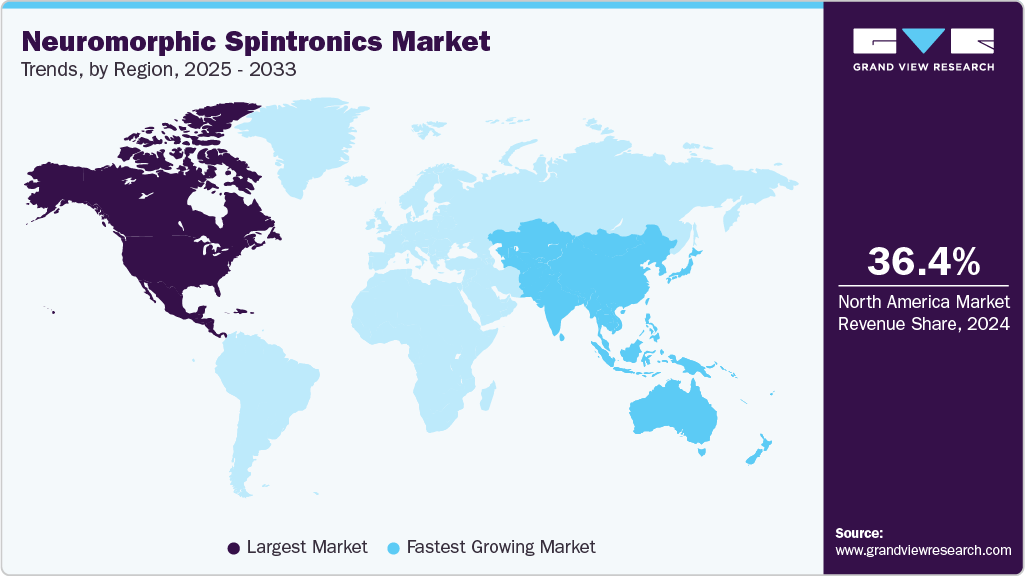
North America neuromorphic spintronics market holds the largest share of 36.4% in 2024. The region benefits from strong research infrastructure and early adoption of advanced computing technologies. Leading semiconductor firms and research institutions are actively investing in spintronic device development. Government funding programs and defense projects further strengthen the market presence. High demand from AI, automotive, and edge computing sectors continues to drive steady regional growth.
 To learn more about this report, Download Free Sample Report
 U.S. Neuromorphic Spintronics Market Trends
The U.S. neuromorphic spintronics market is expanding due to increasing investment in AI-driven hardware innovation. Research collaborations between universities, defense agencies, and chip manufacturers are accelerating material and device advancements. Growing adoption of edge AI and autonomous technologies is fueling demand for energy-efficient neuromorphic processors.
Europe Neuromorphic Spintronics Market Trends
The Europe neuromorphic spintronics market is growing steadily, supported by strong emphasis on sustainable and low-power computing technologies. Collaborative research programs across countries are advancing spintronic materials and neuromorphic architectures. The region’s automotive and industrial sectors are key adopters, focusing on intelligent automation and autonomous mobility.
Asia Pacific Neuromorphic Spintronics Market Trends
The Asia Pacific neuromorphic spintronics market is expanding at the fastest pace, driven by rapid technological adoption and semiconductor advancements. Countries such as Japan, South Korea, and China are investing heavily in spintronic R&D and AI hardware innovation. Growing demand for smart electronics, autonomous systems, and IoT infrastructure supports large-scale deployment. Increasing government initiatives to strengthen domestic chip production and AI capabilities further accelerate regional growth.
Key Neuromorphic Spintronics Company Insights
Some of the key companies in the Neuromorphic Spintronics industry include IBM Corporation, Intel Corporation, Micron Technology, Inc., NVE Corporation, and others. Organizations are focusing on increasing their customer base to gain a competitive edge in the industry. Therefore, key players are taking several strategic initiatives, such as mergers and acquisitions, and partnerships with other major companies.
-
Qualcomm Technologies, Inc. is exploring neuromorphic computing for AI acceleration and energy-efficient processing. Their research focuses on edge AI devices and hardware architectures that mimic neural networks, which can integrate spintronic memory and logic for faster, low-power computation. Qualcomm also collaborates with research institutions to investigate spintronic elements in neuromorphic processors.
-
BrainChip Holdings Ltd. specializes in neuromorphic processors (Akida Neural Processor) designed for event-based computing, mimicking the brain’s architecture. While their current products are primarily CMOS-based, they are actively researching spintronic memory integration to enhance energy efficiency and performance. Their focus is on AI inference at the edge, with low-latency and low-power operation, which aligns with neuromorphic spintronics trends.
Key Neuromorphic Spintronics Companies:
The following are the leading companies in the neuromorphic spintronics market. These companies collectively hold the largest market share and dictate industry trends.
- BrainChip Holdings Ltd.
- Everspin Technologies Inc.
- IBM Corporation
- Innatera Nanosystems BV
- Intel Corporation
- NeuroBlade
- Qualcomm Technologies, Inc.
- Rain Neuromorphics Inc.
- Samsung Electronics
- SynSense AG
- TDK Corporation
Recent Developments
-
In October 2024, Everspin Technologies Inc. announced an expansion of its industrial STT-MRAM product family, a high-density, persistent memory solution. These devices are designed for mission-critical applications by offering high performance, durability, and a wide temperature range.
-
In March 2024, Avalanche Technology has announced the release of two new high-density STT-MRAM products designed for the high-reliability, persistent memory needs of space applications. These devices offer improved performance, reduced power consumption, and a smaller form factor for use in modern aerospace electronic systems.
Neuromorphic Spintronics Market Report Scope
Report Attribute
Details
Market size in 2024
USD 141.2 million
Estimated market size in 2026
USD 216.8 million
Projected market size by 2033
USD 1,014.7 million
Growth rate
CAGR of 24.6% from 2025 to 2033
Base year for estimation
2024
Historical data
2021 - 2023
Forecast period
2025 - 2033
Quantitative units
Revenue in USD Million/Billion and CAGR from 2025 to 2033
Report coverage
Revenue forecast, company ranking, competitive sector, growth factors, and trends
Segment scope
Application, end use, region
Region scope
North America; Europe; Asia Pacific; Latin America; Middle East & Africa
Country scope
U.S.; Canada; Mexico; Germany; UK; France; China; Japan; India; Australia; South Korea; Brazil; KSA; UAE; South Africa
Key companies profiled
BrainChip Holdings Ltd.; Everspin Technologies Inc.; IBM Corporation; Innatera Nanosystems BV; Intel Corporation; NeuroBlade; Qualcomm Technologies; Inc.; Rain Neuromorphics Inc.; Samsung Electronics; SynSense AG; TDK Corporation
Customization scope
Free report customization (equivalent up to 8 analysts’ working days) with purchase. Addition or alteration to country, regional & segment scope
Pricing and purchase options
Avail customized purchase options to meet your exact research needs. Explore purchase options
Global Neuromorphic Spintronics Market Report Segmentation
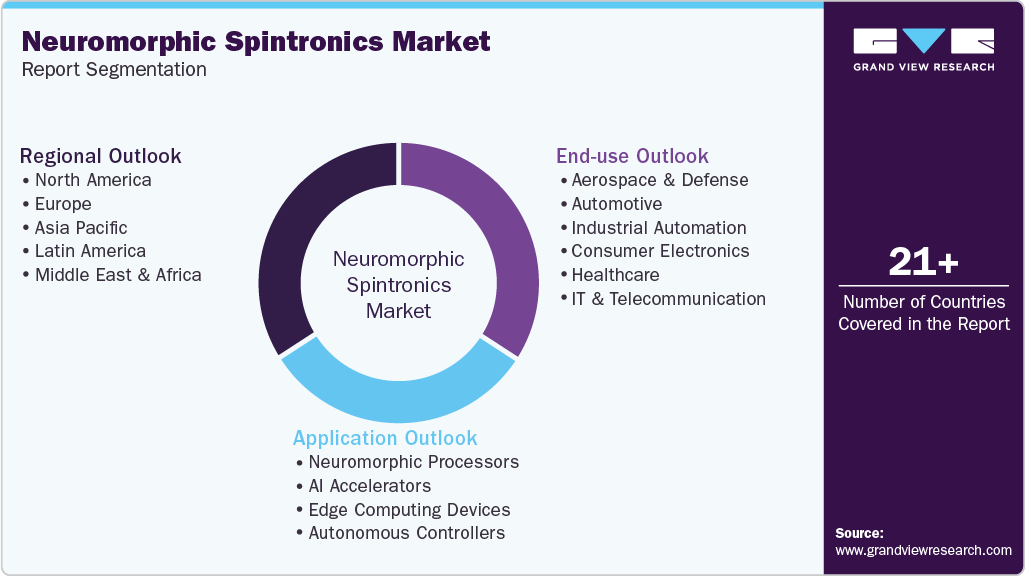
This report forecasts revenue growth at global, regional, and country levels and provides an analysis of the latest industry trends and opportunities in each of the sub-segments from 2021 to 2033. For this study, Grand View Research has segmented the global neuromorphic spintronics market in terms of application, end use, and region.
 To learn more about this report, Download Free Sample Report
 -
Application Outlook (Revenue, USD Million, 2021 - 2033)
-
Neuromorphic Processors
-
AI Accelerators
-
Edge Computing Devices
-
Autonomous Controllers
-
-
End Use Outlook (Revenue, USD Million, 2021 - 2033)
-
Aerospace & Defense
-
Automotive
-
Industrial Automation
-
Consumer Electronics
-
Healthcare
-
IT & Telecommunication
-
-
Regional Outlook (Revenue, USD Million, 2021 - 2033)
-
North America
-
U.S.
-
Canada
-
Mexico
-
-
Europe
-
UK
-
Germany
-
France
-
-
Asia Pacific
-
China
-
Japan
-
India
-
Australia
-
South Korea
-
-
Latin America
-
Brazil
-
-
Middle East & Africa (MEA)
-
KSA
-
UAE
-
South Africa
-
-
Frequently Asked Questions About This Report
The global neuromorphic spintronics market size was valued at USD 141.2 million in 2024 and is estimated at USD 216.8 million for 2026.
The global neuromorphic spintronics market is expected to grow at a CAGR of 24.6% from 2025 to 2033, reaching USD 1,014.7 million by 2033.
North America dominated the neuromorphic spintronics market with a share of 36.4% in 2024. This is attributable to strong R&D investments and early adoption of next-generation computing technologies.
Some key players operating in the neuromorphic spintronics market include Avalanche Technology, Everspin Technologies Inc., Hitachi, Ltd., IBM Corporation, Intel Corporation, Micron Technology, Inc., NVE Corporation, Qualcomm Technologies, Inc., Samsung Electronics, and TDK Corporation
Key factors that are driving the market growth include rising demand for energy-efficient computing, advancements in AI hardware, and increasing adoption of next-generation neuromorphic systems across high-performance applications.
About the Author(s)
Next Generation Technologies Research Team
Technology · Next Generation TechnologiesThis report was authored by the next generation technologies research team at Grand View Research - comprising two research analysts, one senior research analyst, and one industry expert - with specialized expertise in the next generation technologies segment of the technology industry. All findings are based on proprietary technology databases, executive interviews, and regulatory analysis, subject to internal peer review prior to publication.
Last Updated:
Speak to Analyst

Customize this report to your needs - add regions, segments, or data points, with 20% free customization.
Or view our licence options:


ISO 9001:2015 & 27001:2022 Certified
We are GDPR and CCPA compliant! Your transaction & personal information is safe and secure. For more details, please read our privacy policy.


