
- Home
- »
- Advanced Interior Materials
- »
-
Non-thermal Pasteurization Market Size, Share Report, 2030GVR Report cover
![Non-thermal Pasteurization Market Size, Share & Trends Report]()
Non-thermal Pasteurization Market (2024 - 2030) Size, Share & Trends Analysis Report By Technique (High-pressure Processing, Ultrasonic), By Form (Solid, Liquid), By Application (Food, Beverage), By Region, And Segment Forecasts
Non-thermal Pasteurization Market Trends
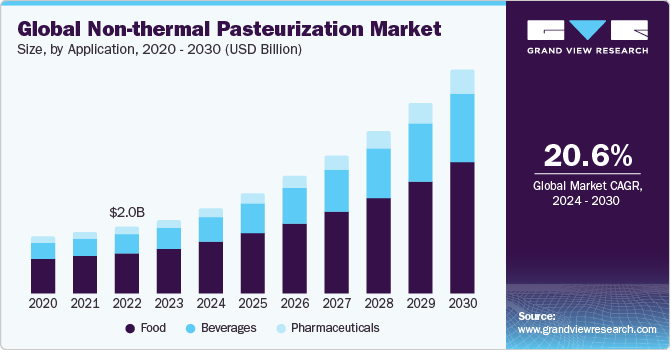
The global non-thermal pasteurization market size was estimated at USD 2.21 billion in 2023 and is projected to grow at a compound annual growth rate (CAGR) of 20.6% from 2024 to 2030. Growth of the market for non-thermal pasteurization is significantly driven by the rise in demand for dairy food, poultry, and meat. This can be attributed to different factors such as urbanization, rising disposable income, and population growth. Consumers prioritizing food quality and safety is further driving the demand for food products that undergo pasteurization to remove and eliminate harmful microorganisms and pathogens while maintaining their nutritional flavor and value.
In the U.S., an important driver for the non-thermal pasteurization market is the rising consumer demand for less processed and high-quality food products. Consumers in the U.S. are becoming more health conscious and preferring foods that contain their natural flavors, nutritional benefits, and texture. Due to this factor, nonthermal pasteurization methods such as high-pressure processing (HPP), and pulse electric field (PEF) are gaining importance. The HPP and PEF offer high microbial safety of food items without the use of heat, thereby helping to preserve the nutritional content of food items such as dairy, juices, and meat.
In addition, food safety regulations and the requirement for the extended shelf life of food items are also considered important parameters for the adoption of non-thermal pasteurization techniques in the U.S. food and beverage industry. With the rising importance of reducing food-borne illnesses and maintaining food item safety, the food & beverage industry players have started using non-thermal methods to meet regulatory requirements while maintaining food quality.
At the global level, the ability of the non-thermal pasteurization methods to extend the shelf life of food items without adding preservatives aligns with customer preference and is considered important factor driving the market growth. The non-thermal pasteurization methods such as HPP, PEF, and microwave volumetric heating use pressure, and microwaves to kill the harmful bacteria. Hence, to extend the shelf life of food items, the use of preservatives is eliminated. This ability to prolong shelf life enhances food safety as well as reduces food waste and meets consumer demand for long-lasting food options.
Market Concentration & Characteristics
The market growth stage is medium, and the pace of the growth is accelerating. The non-thermal pasteurization market is characterized by a moderate degree of competition owing to the various cost-efficient technologies used to preserve food items and pharmaceuticals. As the application of various non-thermal pasteurization techniques varies as per the end-use industry requirements, the market players have been undertaking product development, and customization in their existing non-thermal pasteurization equipment.
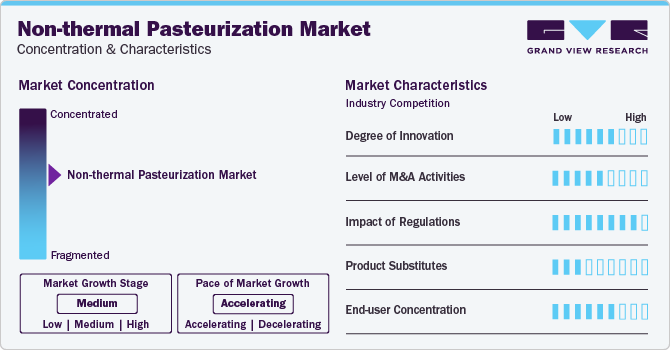
The non-thermal pasteurization industry is also characterized by a high degree of innovation which results in the development of high-quality equipment based on HPP and PEF techniques. The demand for sustainable equipment is increasing, this trend is likely to increase research and development spending by various market players. Sustainability initiative involves developing energy-efficient equipment.
This equipment differs in its approach to eliminating harmful pathogens and bacteria from food products and pharmaceutical components. This equipment does not use heat to eliminate harmful pathogens and bacteria from food items, thereby maintaining the food's texture and nutritional contents. As the technology is new in the market and used by end-use industries to replace the existing thermal pasteurization technique, the role of substitutes impacting the market is anticipated to remain low.
The market for non-thermal pasteurization is moderately fragmented, with a few major players dominating the market and some smaller regional companies competing in the space. Each of the techniques serves a distinct purpose and user group, attracting specialized manufacturers and distributors who cater to specific areas. This creates an advantage for smaller players alongside the giants, boosting innovation and catering to specific regional demands.
Form Insights
The solid segment is likely to dominate the market in 2023, as non-thermal pasteurization equipment allow solid food items to maintain their natural appearance, texture, and taste. Unlike the traditional preservation equipment, the non-thermal pasteurization equipment neither impacts the nutritional content nor alters the texture of the solid food. The HPP non-thermal pasteurization equipment treats the solid form of food, thereby maintaining its sensory attributes.
The liquid segment is anticipated to witness high growth over the forecast period owing to the equipment’s ability to retain the freshness, aroma, and taste of liquid food items. In addition to that, equipment functioning based on HPP & PEV techniques can be used to eliminate harmful pathogens irrespective of the liquid viscosity. Moreover, this equipment helps beverage manufacturers meet stringent food safety regulations and helps to maintain industry standards and regulatory requirements.
Application Insights
The food segment accounted for the largest revenue share in 2023, due to the growing demand for minimally processed and natural food products. The non-thermal pasteurization method allows food manufacturers to meet their demand by preserving the sensory attributes and freshness of food products like vegetables and meat. Hence, with the growth in consumers becoming more health-conscious and prioritizing clean-label foods, the demand for non-thermal pasteurization equipment to treat food items is likely to grow over the forecast period.
The beverage segment is likely to witness a high CAGR over the forecast period, owing to the ability to preserve the freshness of beverages by deterring pathogen and microbial growth without compromising the nutritional content and taste of the beverage. The equipment can be designed to work in diverse applications and treat different types of beverages such as dairy products, juices, tea, and functional drinks.
Technique Insights
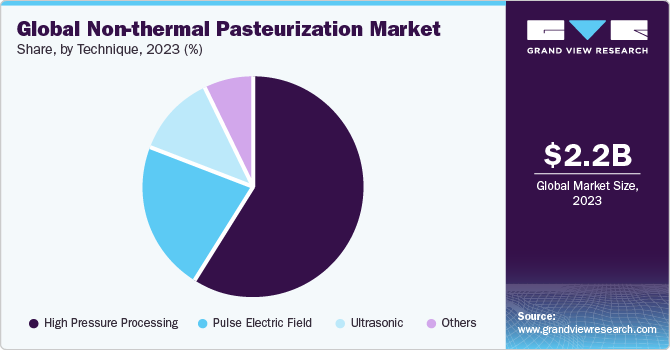
The high-pressure processing (HPP) type segment is dominated with the largest revenue share of 58.7% in 2023, owing to its ability to preserve food items without altering their texture and taste at a comparatively lower cost. The HPP deactivates harmful bacteria & pathogens by using a high level of pressure. This processing technique extends the shelf life of the food products by inhibiting microbial growth and enzymatic reactions that cause spoilage.
Unlike the traditional thermal pasteurization methods that can alter the taste, texture, and appearance of food products. HPP maintains the sensory attributes of the food items. This equipment helps preserve the natural flavor, and color of vegetables, meats, and other products, ensuring high quality and customer satisfaction.
Regional Insights
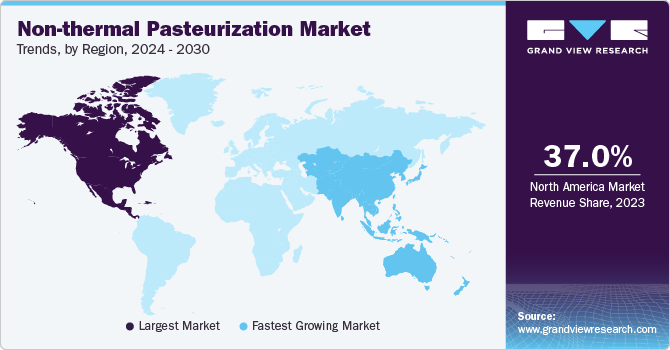
North America dominated the market and accounted for the largest revenue share of over 37.0% in 2023, which is significantly attributed to the strong technological advancements and innovation in developing and commercializing non-thermal pasteurization equipment. In addition, the region has a well-developed food & beverage industry, which is readily adopting this new non-thermal pasteurization equipment. The need for technologically sophisticated equipment to remove harmful bacteria and pathogens in less time is driving the market.
U.S. Non-thermal Pasteurization Market Trends
The non-thermal pasteurization market in the U.S. is anticipated to grow owing to the rise in population and subsequent growth of the food & beverage industry. Furthermore, the change in consumer preference and awareness regarding the impact of artificial food additives on food items is driving the demand for food preservation without altering the composition, which is propelling the market.
Europe Non-thermal Pasteurization Market Trends
Growth of Europe’s non-thermal pasteurization market is driven by the increasing focus on food safety regulations and the need to address foodborne illnesses. Non-thermal pasteurization techniques such as high-pressure processing, pulsed electric fields, ultraviolet light, and irradiation are being increasingly adopted due to their ability to extend the shelf life of food products without compromising their nutritional value or flavor. Changing lifestyles and customer preferences for quick and simple-to-prepare food options are also driving the increase in the market. Many businesses in the food sector are making investments in non-thermal pasteurization techniques to accommodate this need.
The non-thermal pasteurization market in Germany is anticipated to grow owing to the rising demand for clean-label products and the presence of stringent food safety regulations. Germany has rigorous food safety regulations enforced by organizations such as the Federal Office of Consumer Protection and Food Safety (BVL). The equipment used to achieve microbial inactivation while preserving nutritional integrity makes them well-suited to meet the regulatory requirements in the country.
Asia Pacific Non-thermal Pasteurization Market Trends
The Asia Pacific non-thermal pasteurization market is expected to witness the fastest CAGR among all regions during the forecast period. The main factors driving this growth are the increasing demand for safe, fresh, and minimally processed food products, the growing adoption of high-pressure processing (HPP) technology, the emergence of new non-thermal pasteurization techniques, such as pulsed electric fields (PEF) and ultrasonic waves, and the increasing investment and innovation in the non-thermal pasteurization market in Asia pacific.
The non-thermal pasteurization market in China is poised to grow at a lucrative growth attributed to the increasing investment in the food & beverage industry. Further, China’s large population and rapidly expanding urbanization hold significant market opportunities for the development of the non-thermal pasteurization market. Further, the growing pharmaceutical industry in China requires pasteurization equipment.
Central & South America Non-thermal Pasteurization Market Trends
Thenon-thermal pasteurization market in Central & South America growing due to the innovation and investment in the non-thermal pasteurization market in the region. Several companies and research institutions are developing and testing new non-thermal pasteurization technologies and applications in the region. For example, Brazil has established the Center for Research and Development of Food Irradiation, which aims to promote the use of irradiation for food preservation and safety. Argentina has also launched the first commercial high-pressure processing (HPP) facility in the country, which can process up to 5 tons of food products per day.
The non-thermal pasteurization market in Brazil is anticipated to grow owing to the rising agricultural production and demand for improving the shelf life of vegetables, fruits, and meat. According to the report published by Brazilian Farmers in June 2023, Brazilian agricultural exports reached USD 16.6 billion in May 2023. It is a 10% increase when compared to the same period in 2022. In addition to that, the other notable exports include food products such as sugarcane, fresh beef, and fresh chicken meat.
Middle East & Africa Non-thermal Pasteurization Market Trends
The non-thermal pasteurization market in the Middle East & Africa is influenced by increased demand for natural and minimally processed foods, growing concerns about food safety and quality, and the expanding popularity of clean-label items in the region, all contributing to the growth of this market.
The non-thermal pasteurization market in Saudi Arabia is anticipated to grow owing to the rapid urbanization and growing population. As customer awareness regarding packaged food items increases, the demand for additive-free and high-quality products rises. Additionally, this food pasteurization equipment aligns with the government’s effort to ensure consumer protection, making them attractive options for food manufacturers.
Key Non-thermal Pasteurization Company Insights
The market consists mainly of global players, of which a few operate regionally. New product launches, mergers and acquisitions, partnerships, and collaborations are vital strategies that companies adopt for sustained growth. Furthermore, key raw material suppliers and equipment manufacturers have integrated their operations to provide raw materials and manufacture the final product to cut down on raw materials procurement and operation costs. Major market players frequently undertake geographical expansion strategies to enter established and newer markets. New product developments and approvals are also a part of the key initiatives key companies undertake to gain more substantial market penetration.
The market players have been investing to undertake research and development activities to improve their customization abilities. The market players are striving to improve their market offerings to accommodate varying product compositions, packaging formats, and sizes, thereby enhancing their market penetration and customer satisfaction. Moreover, the market players have undertaken marketing strategies to improve their brand recall.
Key Non-thermal Pasteurization Companies:
The following are the leading companies in the non-thermal pasteurization market. These companies collectively hold the largest market share and dictate industry trends.
- ASEPTO RAY TM
- JBT Corporation
- Thyssenkrupp AG
- Pulsemaster
- Nordion
- Hiperbaric
- Lyras
- Syntegon
- American Pasteurization Company
- Stansted Fluid Power Products Ltd
- Elea
- DanTech UK Ltd
Recent Developments
-
In September 2023, Pulsemaster launched a new compact industrial-scale pulsed electric field solution (PEF) for the treatment of vegetables, tubers, and roots at a rate of 10 tons per hour. This new system is designed to cater to the need for small and medium production facilities. With this new product launch, the company is planning to position itself as a compact EPF based equipment manufacturer.
-
In November 2023, JBT Corporation confirmed the non-binding proposal to acquire Marel, whose shares are listed on Nasdaq and Euronext. Marel is the global provider of advanced systems, and processing equipment provider to the meat, fish, and poultry industry. This acquisition is likely to help the JBT corporation to improve its product offering, research, and development capabilities.
Non-thermal Pasteurization Market Report Scope
Report Attribute
Details
Market size value in 2024
USD 2.60 billion
Revenue forecast in 2030
USD 6.82 billion
Growth rate
CAGR of 20.6% from 2024 to 2030
Historical data
2018 - 2023
Forecast period
2024 - 2030
Quantitative units
Revenue in USD million/billion and CAGR from 2024 to 2030
Report coverage
Revenue forecast, company ranking, competitive landscape, growth factors, and trends
Segments covered
Technique, form, application, region
Regional scope
North America; Europe; Asia Pacific; Central & South America; Middle East & Africa
Country scope
U.S.; Canada; Mexico; Germany; UK; France; Italy; Spain; Russia; Japan; China; India; Australia; South Korea; Brazil; Argentina; Saudi Arabia; South Africa; UAE
Key companies profiled
ASEPTO RAY TM; JBT Corporation; Thyssenkrupp AG;
Pulsemaster; Nordion; Hiperbaric; Lyras; Syntegon;
American Pasteurization Company; Stansted Fluid
Power Products Ltd; Elea; DanTech UK Ltd
Customization scope
Free report customization (equivalent up to 8 analysts working days) with purchase. Addition or alteration to country, regional & segment scope.
Pricing and purchase options
Avail customized purchase options to meet your exact research needs. Explore purchase options
Global Non-thermal Pasteurization Market Report Segmentation
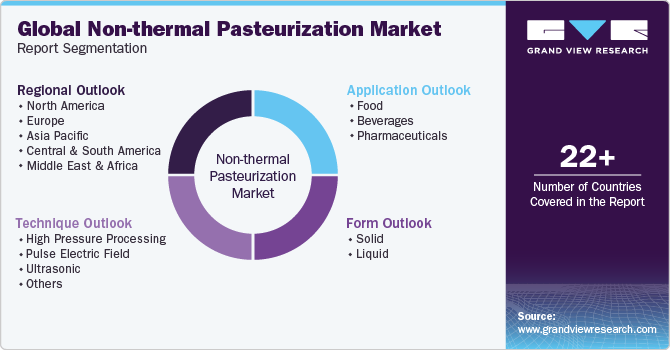
This report forecasts revenue growth at global, regional, and country levels and provides an analysis of the latest industry trends in each of the sub-segments from 2018 to 2030. For this study, Grand View Research has segmented the non-thermal pasteurization market report based on technique, application, form, and region:
-
Technique Outlook (Revenue, USD Million, 2018 - 2030)
-
High Pressure Processing
-
Pulse Electric Field
-
Ultrasonic
-
Others
-
-
Application Outlook (Revenue, USD Million, 2018 - 2030)
-
Food
-
Beverages
-
Pharmaceuticals
-
-
Form Outlook (Revenue, USD Million, 2018 - 2030)
-
Solid
-
Liquid
-
-
Regional Outlook (Revenue, USD Million, 2018 - 2030)
-
North America
-
U.S.
-
Canada
-
Mexico
-
-
Europe
-
Germany
-
France
-
UK
-
Spain
-
Italy
-
Russia
-
-
Asia Pacific
-
China
-
India
-
Japan
-
Australia
-
South Korea
-
-
Central & South America
-
Brazil
-
Argentina
-
-
Middle East & Africa
-
Saudi Arabia
-
South Africa
-
UAE
-
-
Frequently Asked Questions About This Report
The global non-thermal pasteurization market size was estimated at USD 2.21 billion in 2023 and is expected to be USD 2.60 billion in 2024.
The global non-thermal pasteurization market, in terms of revenue, is expected to grow at a compound annual growth rate of 20.6% from 2024 to 2030 to reach USD 6.82 billion by 2030.
North America region dominated the market and accounted for 37.6% share in 2023, due to the growing demand for poultry, dairy, and meat products. In addition to that, the rising consumption of protein-based food products, fruit & vegetables, and frozen meat has been propelling the demand for non-thermal pasteurization market.
Some of the key players operating in the non-thermal pasteurization market include, ASEPTO RAY TM, JBT Corporation, Thyssenkrupp AG, Pulsemaster, Nordion, Hiperbaric , Lyras, Syntegon, American Pasteurization Company, Stansted Fluid Power Products Ltd, Elea, and DanTech UK Ltd.
The key factors that are driving the non-thermal pasteurization market include a need for food & beverage processing companies to treat the food materials without altering its texture. Moreover, the growth in food processing industry is propelling the non-thermal pasteurization equipment demand.
About the Author(s)
Advanced Interior Materials Research Team
Advanced Materials · Advanced Interior MaterialsThis report was authored by the advanced interior materials research team at Grand View Research - comprising two research analysts, one senior research analyst, and one industry expert - with specialized expertise in the advanced interior materials segment of the advanced materials industry. All findings are based on proprietary advanced materials databases, executive interviews, and regulatory analysis, subject to internal peer review prior to publication.
Last Updated:
Speak to Analyst


Customize this report to your needs — add regions, segments, or data points, with 20% free customization.
Or view our licence options:


ISO 9001:2015 & 27001:2022 Certified
We are GDPR and CCPA compliant! Your transaction & personal information is safe and secure. For more details, please read our privacy policy.


