
- Home
- »
- Advanced Interior Materials
- »
-
North America Commercial Split HVAC Systems Market Report, 2033GVR Report cover
![North America Commercial Split HVAC Systems Market Size, Share & Trends Report]()
North America Commercial Split HVAC Systems Market (2025 - 2033) Size, Share & Trends Analysis Report By Installation (New Construction, Retrofit/Replacement), By Equipment Type (Air Conditioners, Heat Pump, Dehumidifiers), By End Use (Retail Shops, Offices, Healthcare Facilities), By Country, And Segment Forecasts
- Report ID: GVR-4-68040-814-7
- Number of Report Pages: 100
- Format: PDF
- Historical Range: 2021 - 2024
- Forecast Period: 2025 - 2033
- Industry: Advanced Materials
- Report Summary
- Table of Contents
- Segmentation
- Methodology
- Download FREE Sample
-
 Download Sample Report
North America Commercial Split HVAC Systems Market Summary
The North America commercial split HVAC systems market size was estimated at USD 2,998.7 million in 2024 and is projected to reach USD 6,487.6 million by 2033, growing at a CAGR of 8.7% from 2025 to 2033. The market is driven by rising commercial construction activity across offices, retail spaces, institutions, and hospitality facilities.
Key Market Trends & Insights
- North America commercial split HVAC systems market in the U.S. is expected to grow at a substantial CAGR of 8.6% from 2025 to 2033.
- By installation, new construction segment is expected to grow at a considerable CAGR of 9.1% from 2025 to 2033 in terms of revenue.
- By equipment type, heat pumps segment dominate the market and accounted for a share of 47.4% in 2024.
- By end use, data centers segment is expected to grow at the fastest CAGR of 12.0% from 2025 to 2033 in terms of revenue.
Market Size & Forecast
- 2024 Market Size: USD 2,998.7 Million
- 2033 Projected Market Size: USD 6,487.6 Million
- CAGR (2025-2033): 8.7%
Businesses are increasingly prioritizing reliable cooling solutions to maintain occupant comfort and operational efficiency. Stricter building codes emphasizing energy-efficient HVAC adoption further support system upgrades.
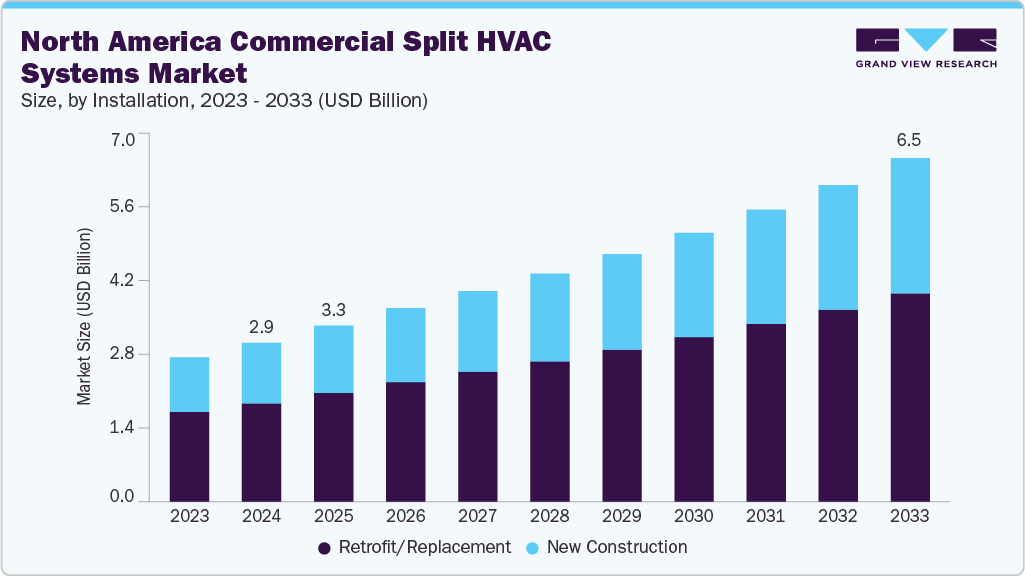
Growing awareness of indoor air quality in workplaces is prompting companies to invest in modern HVAC solutions with improved filtration and ventilation capabilities. Advancements in inverter technology and variable-refrigerant designs are helping reduce electricity consumption, lowering long-term operating costs. The shift toward sustainable infrastructure is also encouraging the replacement of aging units with eco-friendly models. Together, these trends are accelerating market expansion across North America.
Market Concentration & Characteristics
The North America commercial split HVAC systems market is moderately fragmented, with competition spread across several regional and global manufacturers. While major brands hold notable shares due to their extensive distribution networks and advanced product portfolios, a large number of local suppliers continue to compete on pricing, customization, and service capability. Ongoing technology upgrades and energy-efficiency standards are preventing any single player from dominating the space.
The market shows a steady pace of innovation, driven by demand for energy-efficient and smart-enabled split HVAC solutions. Manufacturers are integrating advanced inverter technology, variable-speed compressors, and IoT-based monitoring to enhance system performance. Innovation also focuses on reducing refrigerant emissions and improving indoor air quality. These developments help suppliers differentiate their offerings in a competitive landscape.
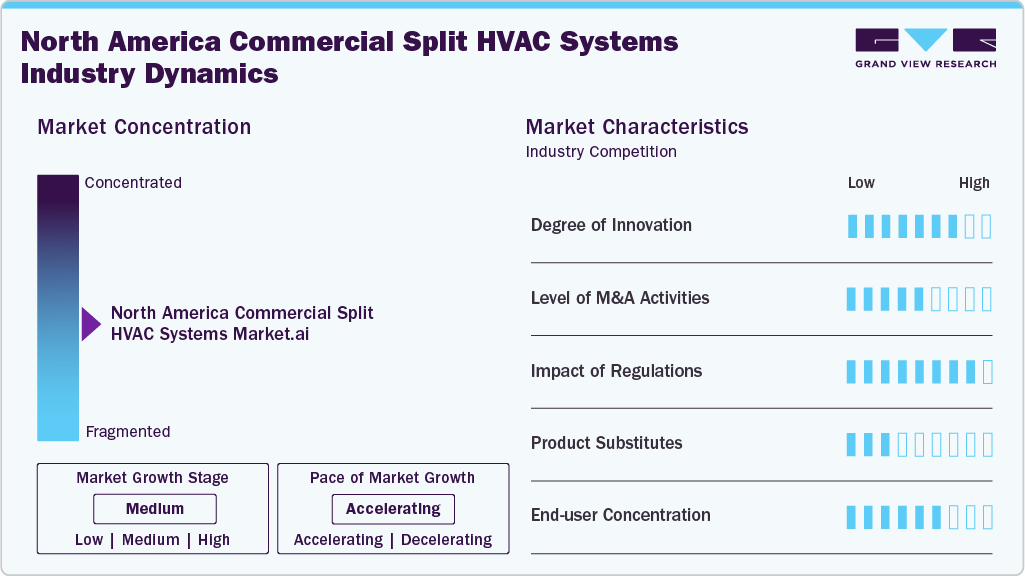
Regulatory standards in North America strongly influence product development and purchasing decisions. Energy-efficiency requirements, refrigerant phase-down policies, and building codes push manufacturers to redesign systems for lower environmental impact. Compliance with AHRI, ASHRAE, and EPA guidelines shapes system performance benchmarks. As a result, regulations serve as both a constraint and a catalyst for market advancement.
The end user base is diverse, spanning offices, retail chains, educational institutions, healthcare, and hospitality sectors. Demand remains stable because split HVAC is a critical operational necessity across most commercial facilities. No single segment dominates the market, reducing reliance on one customer group. This balanced concentration supports consistent sales cycles and mitigates sector-specific volatility.
Drivers, Opportunities & Restraints
Growth is driven by rising commercial construction activity and the need for energy-efficient climate control in offices, retail, and institutional buildings. Tightening building codes and refrigerant transition norms are prompting businesses to adopt modern split systems with higher performance ratings. Expanding adoption of smart thermostats and connected HVAC controls further boosts system replacement. Together, these factors support strong, technology-led market momentum.
Significant opportunity lies in retrofitting aging HVAC infrastructure across North America’s large base of older commercial properties. Demand for low-GWP refrigerant systems and advanced IAQ solutions is opening new product segments for manufacturers. Growth in data centers, healthcare facilities, and mixed-use developments also increases demand for scalable split solutions. Service-focused offerings such as predictive maintenance present added revenue potential.
High upfront installation costs, especially for multi-zone and high-capacity configurations, can slow adoption among smaller businesses. Compliance with evolving environmental regulations increases product redesign expenses for manufacturers. Skilled labor shortages in split HVAC installation and maintenance create project delays and higher service costs. Moreover, variability in commercial construction cycles can temporarily limit system demand.
Installation Insights
The retrofit and replacement segment dominates the North America commercial split HVAC systems market and accounted for a share of 62.0% in 2024 due to the large stock of aging commercial HVAC systems across North America. Many buildings require upgrades to meet new energy-efficiency and refrigerant regulations, driving consistent demand for modern split units. Businesses also prioritize improved indoor air quality and lower operating costs, prompting frequent system replacements. This steady need for performance upgrades keeps the retrofit segment firmly in the lead.
New construction is the fastest-growing segment, supported by expanding commercial spaces such as offices, logistics hubs, healthcare facilities, and retail developments. Developers increasingly prefer split systems for their flexibility, zoning benefits, and improved efficiency levels. Growth in infrastructure investments and urban redevelopment projects further accelerates adoption. As energy codes become stricter, new buildings are increasingly designed around high efficiency split HVAC installations.
Equipment Type Insights
Heat pumps dominate the market and accounted for a share of 47.4% in 2024 as commercial users shift toward systems that offer both heating and cooling with higher energy efficiency. Their ability to lower operational costs and support decarbonization goals makes them a preferred choice for offices, retail chains, and institutional facilities. Regulatory pressure to reduce fossil-fuel-based heating further boosts adoption. Enhanced performance in colder climates is also strengthening their lead across North America.
Dehumidifiers are witnessing significant growth due to rising focus on indoor air quality and moisture control in commercial environments. Facilities such as healthcare centers, data rooms, and hospitality spaces increasingly require precise humidity management to protect equipment and ensure comfort. Climate-related humidity fluctuations across regions also elevate the need for standalone and integrated dehumidification solutions. As awareness of IAQ standards increases, demand for advanced, energy-efficient dehumidifiers continues to accelerate.
End Use Insights
The offices segment dominates the commercial split HVAC systems market and accounted for a share of 24.2% in 2024 as they rely heavily on consistent temperature control to maintain employee comfort and productivity. The large footprint of commercial office buildings across urban centers drives steady demand for efficient split HVAC systems. Frequent retrofits aimed at improving energy performance further strengthen this segment’s lead. Moreover, rising emphasis on indoor air quality keeps HVAC upgrades a priority for facility managers.
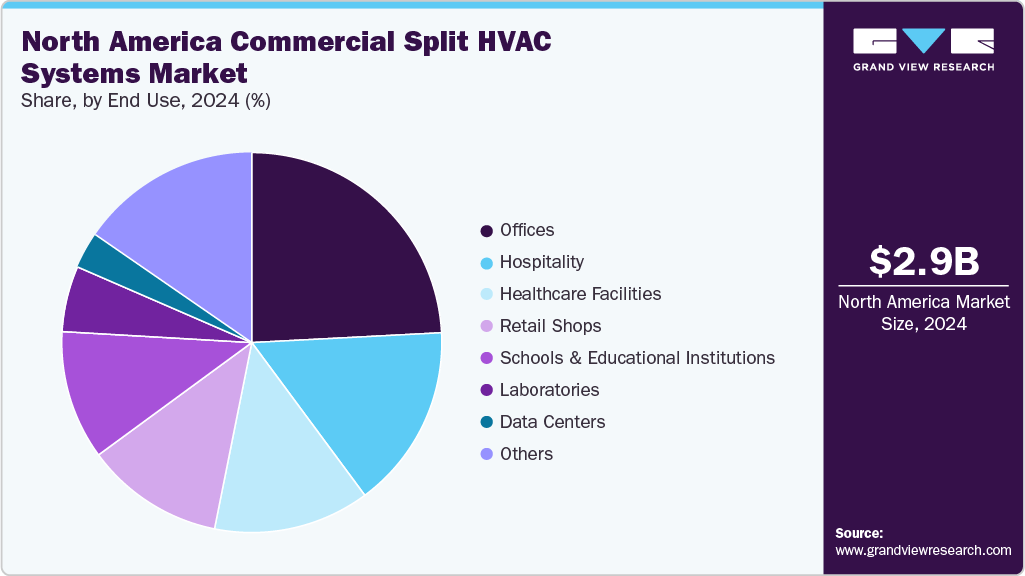
Data centers are the fastest-growing end-use segment due to their critical need for precise cooling and humidity control. Rapid expansion of cloud computing, AI workloads, and digital infrastructure is pushing facilities to adopt high-capacity, reliable split HVAC solutions. These environments require continuous, redundant cooling, accelerating investment in advanced systems. As hyperscale and edge data centers multiply across North America, their HVAC demand is expanding at an exceptional pace.
Country Insights
The U.S. commercial split HVAC systems market dominates the North America and accounted for 75.9% share in 2024, due to its extensive commercial building stock and high rate of system replacements. Strong enforcement of federal and state energy-efficiency regulations drives continuous upgrades to modern split systems. Large investments in offices, retail chains, and institutional facilities further strengthen market demand. The presence of major HVAC manufacturers and robust service networks also supports its leading position.
Commercial split HVAC systems market in Canada is growing rapidly as businesses increasingly adopt energy-efficient and low-emission HVAC technologies to meet national sustainability goals. Expansion in commercial construction, especially in urban centers, is boosting installations of modern split systems. Cold-climate advancements in heat pump technology are also encouraging wider adoption across various sectors. Additionally, government incentives for green building upgrades are accelerating the country’s market growth.
Key North America Commercial Split HVAC Systems Company Insights
Some of the key players operating in the market include Carrier, Johnson Controls, and Trane
-
Carrier is a leader in innovative heating, ventilation, and air conditioning solutions, specializing in energy-efficient commercial and industrial systems. The company focuses on developing advanced split HVAC technologies, including variable refrigerant flow systems and smart controls, to optimize energy consumption. Carrier has a strong portfolio of sustainable solutions that comply with stringent environmental regulations worldwide. Its emphasis on research and development allows it to deliver high-performance systems tailored to diverse commercial applications. The company also provides comprehensive service and maintenance programs to enhance system reliability and longevity.
-
Johnson Controls is a prominent provider of building technologies and split HVAC solutions, with a focus on integrating smart, connected systems for energy management. The company excels in designing high-efficiency commercial split HVAC units, including chillers, air handling systems, and variable refrigerant flow solutions. Its products emphasize sustainability, helping clients meet green building certifications and reduce carbon footprints. Johnson Controls leverages advanced analytics and IoT-enabled monitoring to optimize building performance and operational efficiency. The company also supports large-scale retrofitting and modernization projects, enhancing the longevity and efficiency of existing split HVAC infrastructure.
Key North America Commercial Split HVAC Systems Companies:
- Carrier
- Johnson Controls
- Trane
- LG Electronics
- Haier Group
- Panasonic Corporation
- AAON
- Daikin
- Samsung
- Midea
Recent Developments
-
In August 2025, Carrier has introduced a new modular, reversible heat pump designed to support efficient heating and cooling in commercial buildings. The unit delivers reliable performance even in low outdoor temperatures and can supply high-temperature water suitable for boiler replacement. Its modular architecture allows multiple units to be linked for greater capacity and flexible installation. The system also incorporates advanced controls and low-GWP refrigerant to meet modern building efficiency standards.
-
In November 2024, Oxbox, a Trane Technologies brand, introduced a new line of split-system HVAC products designed for residential and light commercial use with R-454B refrigerant. These systems offer improved environmental performance with lower global warming potential, supporting energy efficiency while meeting evolving regulatory standards.
North America Commercial Split HVAC Systems Market Report Scope
Report Attribute
Details
Market size value in 2025
USD 3,323.8 million
Revenue forecast in 2033
USD 6,487.6 million
Growth rate
CAGR of 8.7% from 2025 to 2033
Actual data
2021 - 2024
Forecast period
2025 - 2033
Quantitative units
Revenue in USD million/billion and CAGR from 2025 to 2033
Report coverage
Revenue forecast, company ranking, competitive landscape, growth factors, and trends
Segments covered
Installation, equipment type, end use, country
Regional scope
North America
Country scope
U.S.; Canada; Mexico
Key companies profiled
Carrier; Johnson Controls; Trane; LG Electronics; Haier Group; Panasonic Corporation; AAON; Daikin; Samsung; Midea
Customization scope
Free report customization (equivalent up to 8 analysts working days) with purchase. Addition or alteration to country, regional & segment scope.
Pricing and purchase options
Avail customized purchase options to meet your exact research needs. Explore purchase options
North America Commercial Split HVAC Systems Market Report Segmentation
This report forecasts revenue growth at North America and country levels and provides an analysis of the latest industry trends in each of the sub-segments from 2021 to 2033. For this study, Grand View Research has segmented the North America commercial split HVAC systems market report based on installation,equipment type, end use, and country:
-
Installation Outlook (Revenue, USD Million, 2021 - 2033)
-
New Construction
-
Retrofit/Replacement
-
-
Equipment Type Outlook (Revenue, USD Million, 2021 - 2033)
-
Air Conditioners
-
Heat Pump
-
Dehumidifiers
-
Others
-
-
End Use Outlook (Revenue, USD Million, 2021 - 2033)
-
Retail Shops
-
Offices
-
Healthcare Facilities
-
Hospitality
-
Schools & Educational Institutions
-
Laboratories
-
Data Centers
-
Others
-
-
Country Outlook (Revenue, USD Million, 2021 - 2033)
-
North America
-
U.S.
-
Canada
-
Mexico
-
-
Frequently Asked Questions About This Report
b. The North America commercial split HVAC systems market size was estimated at USD 2,998.7 million in 2024 and is expected to be USD 3,323.8 million in 2025.
b. The North America commercial split HVAC systems market, in terms of revenue, is expected to grow at a compound annual growth rate of 8.7% from 2025 to 2033 to reach USD 6,487.6 million by 2033.
3. Which segment accounted for the largest North America commercial split HVAC systems market share?b. The U.S. dominates the North America commercial split HVAC systems market and accounted for 75.9% share in 2024, due to its extensive commercial building stock and high rate of system replacements. Strong enforcement of federal and state energy-efficiency regulations drives continuous upgrades to modern split systems.
b. Some of the key players operating in the North America commercial split HVAC systems market include Carrier, Johnson Controls, Trane, LG Electronics, Haier Group, Panasonic Corporation, AAON, Daikin, Samsung, Midea
b. The market is driven by rising demand for energy-efficient cooling and heating solutions across expanding commercial infrastructure. Stricter building codes and refrigerant transition policies are pushing businesses to upgrade to modern split heat pump systems. Growing focus on indoor air quality and smart, connected HVAC controls further strengthens adoption across the region.


Share this report with your colleague or friend.
Need a Tailored Report?
Customize this report to your needs — add regions, segments, or data points, with 20% free customization.


ISO 9001:2015 & 27001:2022 Certified
We are GDPR and CCPA compliant! Your transaction & personal information is safe and secure. For more details, please read our privacy policy.
Trusted market insights - try a free sample
See how our reports are structured and why industry leaders rely on Grand View Research. Get a free sample or ask us to tailor this report to your needs.













