
- Home
- »
- Electronic & Electrical
- »
-
North America Microwave Market Size, Industry Report, 2033GVR Report cover

North America Microwave Market (2026 - 2033) Size, Share & Trends Analysis Report By Type (Countertop, Over-the-Range, Built-In), By Technology (Convection, Traditional), By Price, By Capacity, By Power, By Distribution Channel, By Country, And Segment Forecasts
North America Microwave Market Summary
The North America microwave market size was valued at USD 7.02 billion in 2025 and is projected to reach USD 9.78 billion by 2033, growing at a CAGR of 4.3% from 2026 to 2033. High demand for convenience and time-saving cooking solutions remains a defining force in the industry, shaped by clear shifts in household routines and food consumption patterns.
Key Market Trends & Insights
- The U.S. microwave market accounted for a share of 90.6% in 2025.
- By type, countertop accounted for a market share of 57.2% in 2025.
- By technology, traditional microwave accounted for a market share of 76.2% in 2025.
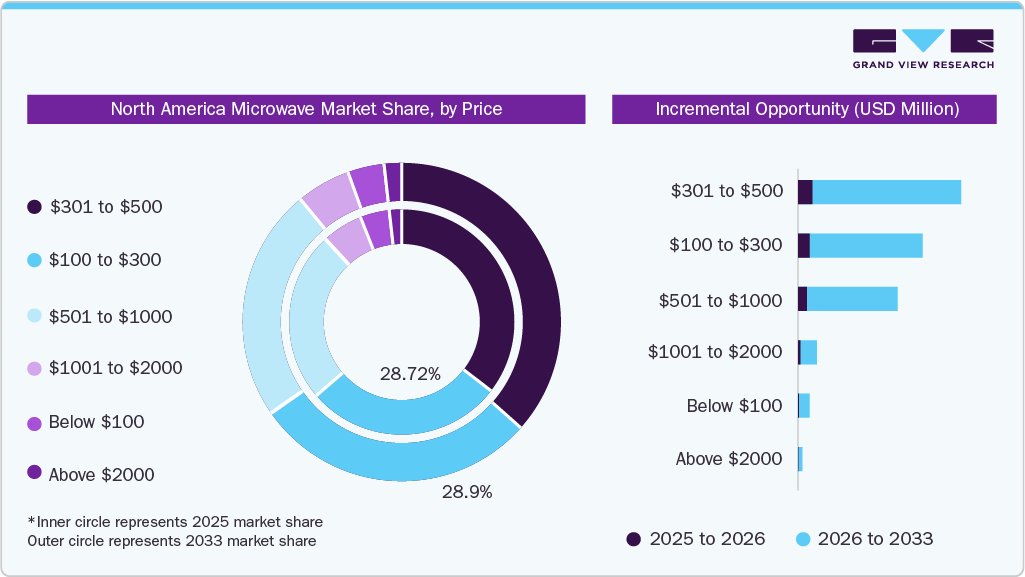
- By price, $301 to $500 accounted for a market share of 35.6% in 2025.
- By capacity, Medium (1.5 to 2.5 cubic feet) accounted for a market share of 67.9% in 2025.
Market Size & Forecast
- 2025 Market Size: USD 7.02 Billion
- 2033 Projected Market Size: USD 9.78 Billion
- CAGR (2026-2033): 4.3%
Prism AI by Grand View Research Free to tryAsk a question about the north america microwave marketTry asking✓Every figure cited from GVR research Prefer the report? Download free sample →
A large share of working professionals and dual-income households operate within tightly scheduled days, limiting the time available for traditional cooking. This has directly increased dependence on appliances that can deliver fast, predictable results with minimal effort. This is further reinforced by the rise in single-person households and students, in which cooking simplicity and speed take priority over elaborate meal preparation, making microwave use a daily necessity rather than an occasional convenience.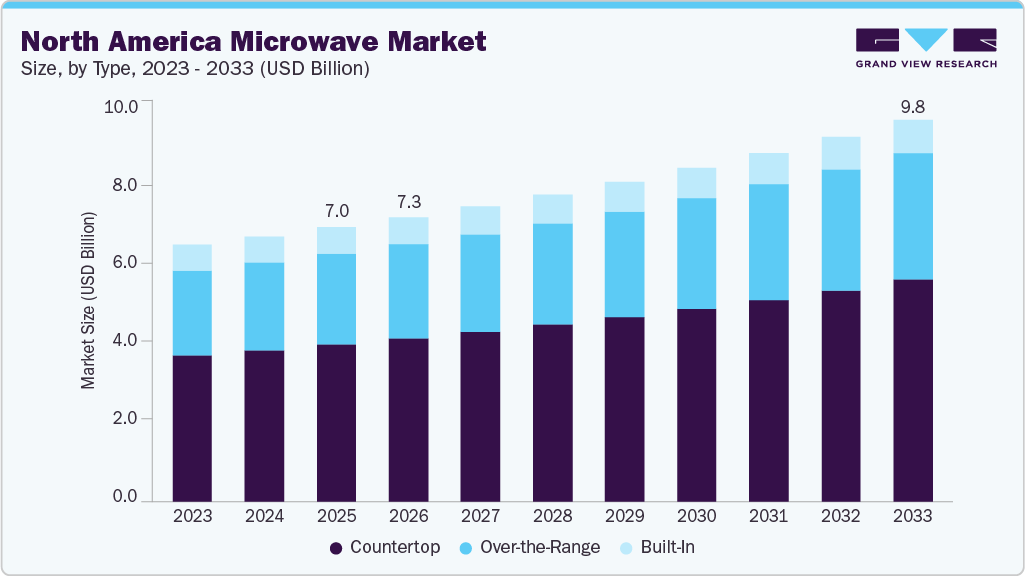 Source: Grand View Research, IR Documents, Primary Interviews, Paid DatabasesTo learn more about this report,
 Download Free Sample Report
The rising adoption of multifunctional and advanced microwaves reflects a structural shift in how consumers evaluate kitchen appliances, with greater emphasis on versatility and space optimization. This trend is particularly evident in urban apartments and smaller homes, where kitchen space is limited, and appliance footprint becomes a key purchase consideration. Multifunctional microwaves with convection, grilling, and combination cooking modes allow users to bake, roast, crisp, and reheat in a single appliance, effectively expanding usage beyond basic heating. As a result, microwaves are transitioning from secondary appliances to primary cooking devices in many households. This shift is also supported by changing cooking preferences, as consumers increasingly experiment with diverse recipes at home while still expecting speed and ease of use.
Technological advancements and the integration of smart features are significantly enhancing product differentiation and influencing replacement demand across the market. Modern microwave ovens now incorporate inverter technology that delivers consistent power levels, eliminating uneven heating and improving food texture, while sensor-based cooking automatically adjusts time and temperature based on the food's moisture levels. These features reduce guesswork and improve reliability, which is particularly important for consumers seeking consistent results without manual intervention. In addition, the integration of smart connectivity, including app-based controls and voice-enabled operation, aligns microwave ovens with broader smart home ecosystems, enabling users to remotely operate appliances, access preset cooking programs, and integrate cooking routines into daily schedules. Reflecting this innovation momentum, Sharp Corporation showcased its Celerity high-speed oven at the Kitchen & Bath Industry Show 2025, demonstrating faster cooking performance while maintaining food quality across both residential and commercial applications. As adoption of connected home devices continues to grow, consumers are increasingly inclined to upgrade to microwaves that offer interoperability, positioning technology as a key driver of both first-time purchases and product upgrades.
Furthermore, growth in home renovation activity and modular kitchen installations is creating sustained replacement demand for built-in and design-integrated microwave ovens. Kitchen upgrades are among the most prioritized home improvement projects across North America, with consumers focusing on improving both functionality and visual appeal. In this context, appliances are no longer treated as standalone units but as integral components of kitchen design. Built-in and over-the-range microwaves are being preferred for their ability to align with cabinetry, free up counter space, and create a streamlined appearance. This trend is particularly strong in suburban housing upgrades and newly developed residential units, where modern kitchen layouts are designed to accommodate integrated appliances from the outset.
In addition, the expansion of e-commerce and omnichannel retail is playing a critical role in improving product accessibility, transparency, and consumer purchase confidence. Online platforms have become a primary research channel, allowing buyers to compare specifications such as capacity, wattage, cooking modes, and energy efficiency across multiple brands within minutes. Detailed product descriptions, customer reviews, and demonstration content reduce information gaps and enable more informed decision-making. At the same time, omnichannel models, such as online ordering with in-store pickup or fast home delivery, are bridging the gap between digital convenience and physical retail assurance. This has expanded the reach of microwave brands beyond traditional appliance stores to a wider consumer base, including smaller towns and remote areas.
Brand Market Share Insights
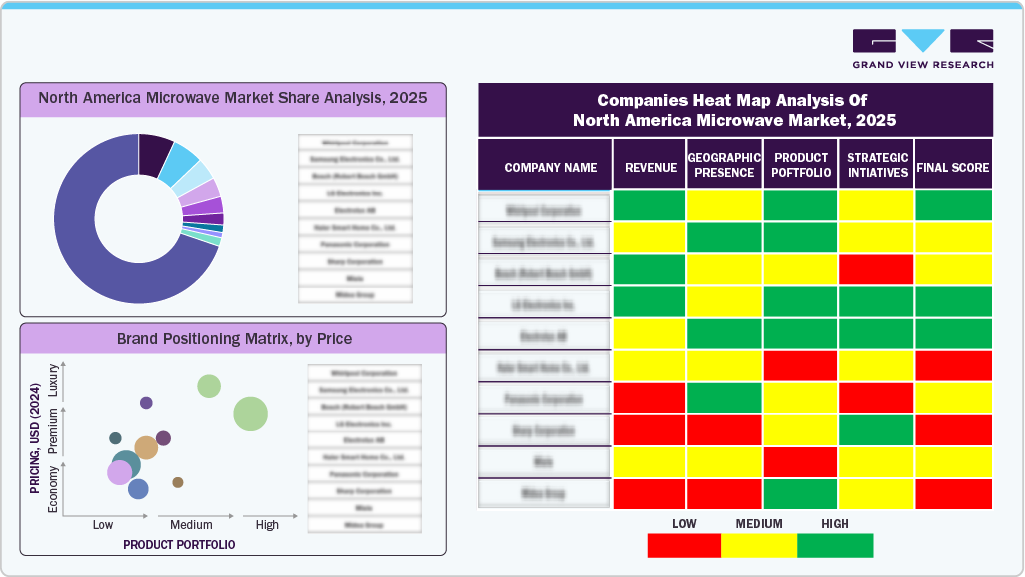
The North America microwave market is driven by a competitive mix of global and regional manufacturers, including LG Electronics, Samsung Electronics, Panasonic Corporation, Whirlpool Corporation, and Sharp Corporation, all focusing on performance, efficiency, and product innovation. Manufacturers are enhancing cooking outcomes through inverter technology, sensor-based cooking, and higher wattage for faster, more consistent heating, while also offering compact, built-in, and over-the-range designs suited to modern kitchen layouts.
 To learn more about this report, Download Free Sample Report
At the same time, smart connectivity is emerging as a key differentiator, with Wi-Fi-enabled controls, mobile apps, and voice-assisted operation enabling remote access, improved convenience, and better energy management, positioning microwave ovens as integrated, multifunctional appliances within the evolving smart home ecosystem.
Consumer Insights
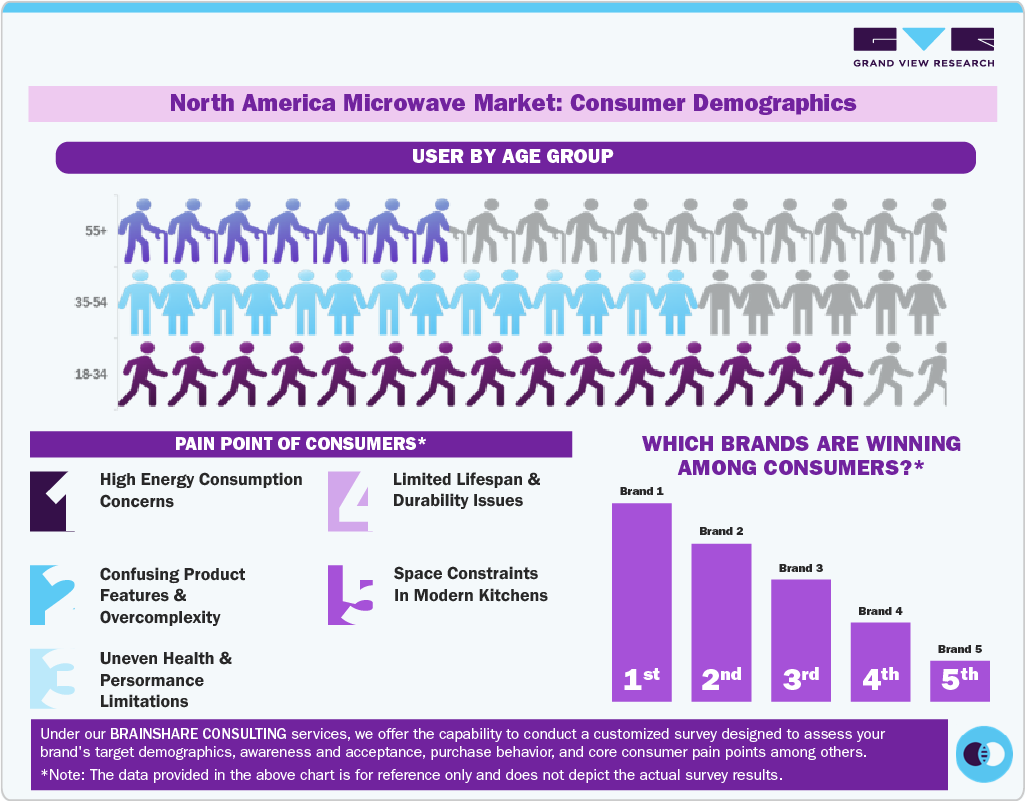
Consumer demand in the North America microwave market is increasingly shaped by hybrid meal-preparation habits, in which households combine packaged, semi-prepared, and fresh ingredients within a single cooking routine. Microwaves are being used not only for reheating but also for defrosting, pre-cooking, and supporting multi-step meal preparation, increasing the need for even heating, moisture retention, and consistent performance across repeated daily use. This has made cooking reliability a key purchase factor, as uneven heating or poor defrosting directly impacts food quality. At the same time, replacement demand is rising as consumers upgrade older units that lack precision, capacity, or efficiency, with decisions increasingly driven by performance gaps rather than product failure.
 To learn more about this report, Download Free Sample Report
Another notable trend is the growing focus on kitchen workflow efficiency and practical usability in purchase decisions. Consumers are evaluating how microwaves fit into daily kitchen movement, considering factors such as placement, accessibility, door design, and ease of control. Built-in and over-the-range models are gaining traction as they improve space utilization while aligning with modern kitchen layouts. In parallel, buyers are becoming more conscious of operational efficiency during frequent use, prioritizing appliances that deliver faster heating while consuming less cumulative energy. This reflects a shift toward usage-driven decision-making, where durability, ease of maintenance, and seamless integration into everyday routines are becoming central to microwave selection across North America.z
Type Insights
The countertop microwave market accounted for a share of over 57.2% of the North America revenues in 2025, driven by its strong alignment with convenience, affordability, and flexible usage across diverse household settings. These models are widely preferred due to their easy installation and portability, making them suitable for apartments, rental homes, and dormitories where permanent fixtures are less practical. Their ability to handle frequent, short-duration tasks such as reheating, defrosting, and quick meal preparation supports high daily usage, particularly among busy households and individuals seeking time-efficient cooking solutions. At the same time, continuous technological improvements are enhancing product appeal, with features such as sensor cooking, inverter technology, and smart connectivity improving precision, ease of use, and overall performance.
The North America over-the-range microwave market is projected to grow at a CAGR of 4.3% from 2026 to 2033. Over-the-range microwaves are designed to save space in the kitchen by combining the functions of a microwave oven and a range hood. With kitchen space often at a premium, especially in smaller homes and apartments, the space-saving design of over-the-range microwaves is a significant driver. Over-the-range microwaves also offer convenience by providing a centralized location for cooking and ventilation. They eliminate the need for separate countertop microwaves and range hoods, streamlining the cooking process and maximizing efficiency in the kitchen.
Technology Insights
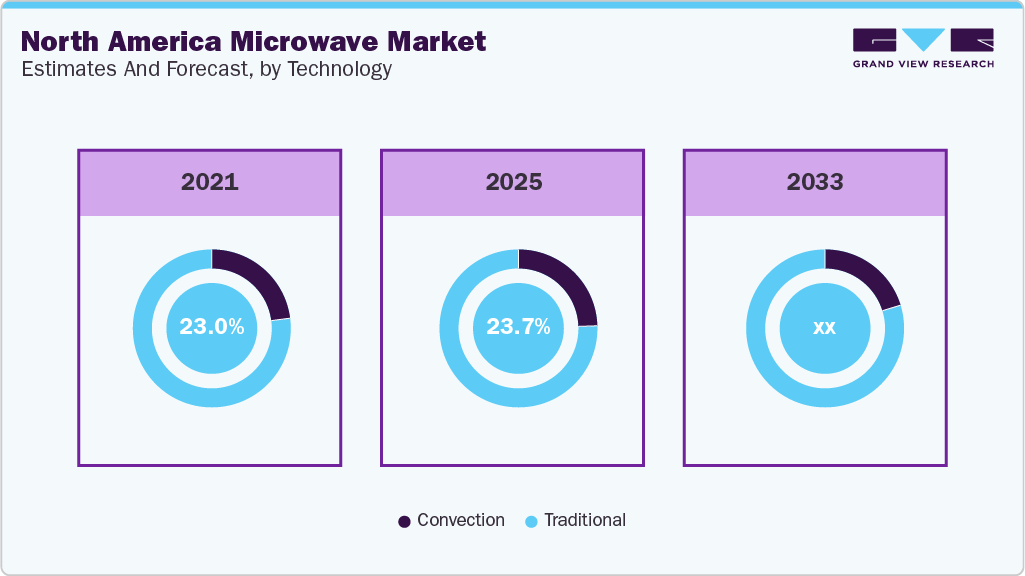
The traditional microwave market accounted for a share of over 76.2% of the North America revenues in 2025, driven by their strong positioning as essential, everyday kitchen appliances focused on simplicity and reliability. These models continue to see widespread adoption due to their straightforward functionality, allowing users to quickly heat, reheat, and defrost food without the complexity of advanced settings or multi-mode operations. This ease of use is particularly valued in households with busy routines, where speed and minimal effort are key priorities in meal preparation. Traditional microwaves also benefit from high consumer familiarity, reducing the learning curve and making them a preferred choice across a broad demographic, including elderly users and first-time buyers.
 To learn more about this report, Download Free Sample Report
The North America convection microwave market is projected to grow at a CAGR of 5.0% from 2026 to 2033, driven by rising demand for appliances that combine speed with enhanced cooking versatility. Convection microwave ovens enable users to bake, roast, and crisp food beyond standard heating functions, allowing households to achieve oven-like results in shorter cooking times and reducing the need for multiple appliances. This is particularly relevant for consumers seeking efficient yet diverse cooking options within limited kitchen spaces. Beyond residential use, these appliances are also gaining traction in commercial settings such as cafés, quick-service restaurants, and small hospitality establishments, where consistent output and fast preparation during peak hours are critical.
Price Insights
Microwaves priced between USD 301 and USD 500 accounted for a share of over 35.6% of the North America revenues in 2025, driven by their ability to offer a strong balance between performance, features, and affordability. This price segment caters to consumers seeking more than basic functionality, with products typically including higher wattage for faster cooking, larger capacity to accommodate family-sized portions, and enhanced features such as sensor cooking, multi-stage programs, and improved control interfaces. These microwaves are well-suited for households that rely on frequent usage and require consistent, efficient performance across a variety of cooking tasks. At the same time, the price point remains accessible for mid-income consumers, making it a practical upgrade from entry-level models without reaching premium price levels.
 To learn more about this report, Download Free Sample Report
Microwaves priced between USD 100 and USD 300 are projected to grow at a CAGR of 4.4% from 2026 to 2033, supported by strong demand from price-sensitive consumers and first-time buyers seeking practical, no-frills appliances. This segment typically offers mid-range capacities, generally between 0.7 and 1.2 cubic feet, which are sufficient for small to medium-sized households and can accommodate standard plates and containers used for daily cooking tasks. These microwaves are widely adopted for routine functions such as reheating, defrosting, and basic meal preparation, making them suitable for students, single-person households, and rental accommodations.
Capacity Insights
Medium (1.5 to 2.5 cubic feet) capacity microwave accounted for a share of over 67.9% of the North America revenues in 2025, driven by their ability to balance capacity with practical kitchen compatibility. This segment is widely preferred as it offers sufficient interior space to accommodate larger cookware, multiple dishes, and family-sized portions, while still fitting comfortably within standard countertop or built-in kitchen layouts. These microwaves support a broader range of cooking tasks, from reheating and defrosting to preparing full meals, making them suitable for households with moderate to high usage frequency. Their versatility allows consumers to handle both individual and family cooking needs without requiring a larger, space-consuming appliance.
The small (Less than 1.5 cubic feet) capacity microwave market is projected to grow at a CAGR of 4.1% from 2026 to 2033, supported by increasing urbanization and the rising prevalence of compact living spaces such as apartments, studios, and condominiums. As household sizes shrink and urban housing density increases, consumers are prioritizing space-efficient appliances that can fit into limited kitchen layouts without compromising essential functionality. Small microwaves address this requirement by offering basic cooking functions such as reheating, defrosting, and quick meal preparation, all within a compact footprint.
Power Insights
Medium power (800 to 1,200 watts) microwave accounted for a share of over 79.0% of the North America revenues in 2025. Medium-power microwaves, ranging from 800 to 1,200 watts, strike a balance between efficiency, versatility, and convenience. Their power range allows for faster cooking times compared to lower-wattage models, catering to individuals and families with busy lifestyles who prioritize quick meal preparation. These microwaves offer a significant improvement in cooking speed without consuming excessive amounts of energy, making them an attractive option for those seeking both efficiency and convenience in their kitchen appliances. According to a February 2024 Gitnux report, approximately 90% of households in the U.S. own a microwave.
High powered microwave market is projected to grow at a CAGR of 4.0% from 2026 to 2033. Microwaves with higher wattage significantly reduce the time needed to cook, making them a suitable choice for both individuals and families who value quick and convenient meal solutions. Whether it's warming up leftovers, thawing frozen goods, or preparing meals from scratch, higher-power microwaves can deliver ready-to-eat meals in considerably less time, suiting the needs of those with hectic schedules. This is anticipated to fuel the segment growth.
Distribution Channel Insights
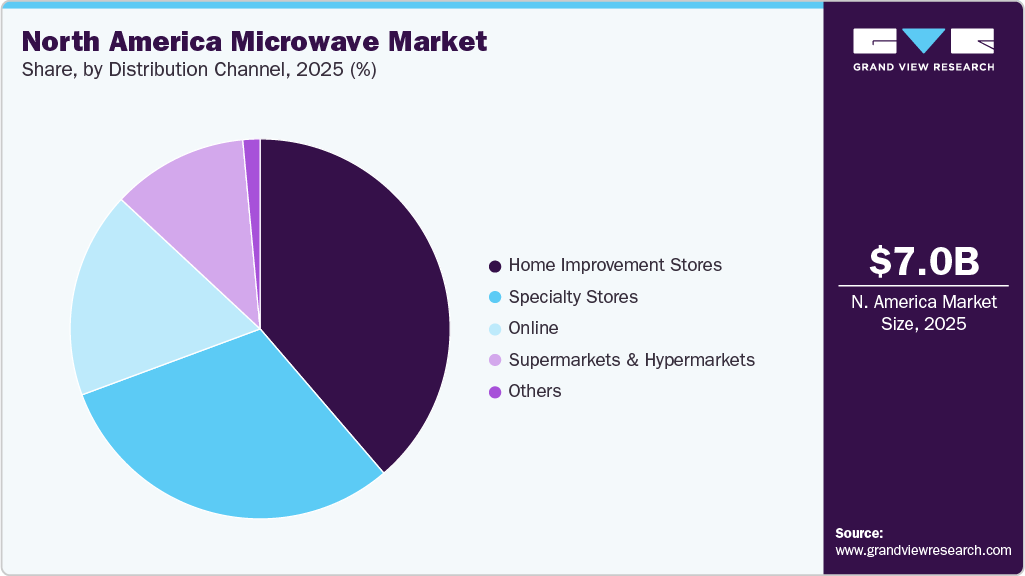
The sales of microwaves through home improvement stores accounted for a share of around 38.7% in 2025. The distribution of microwaves through home improvement stores is driven by several factors that align with the needs and preferences of consumers as well as the characteristics of these stores. Home improvement stores such as Lowe's attract customers who are already engaged in home renovation or improvement projects. Microwaves are often considered essential appliances for kitchen remodeling or upgrades, and home improvement stores offer a convenient one-stop shopping experience for consumers looking to purchase appliances alongside other home improvement materials.
The Home Depot, as a home improvement retailer, offers a variety of microwaves, including over-the-range and built-in models, along with countertop options. It offers products from well-known brands and often has a wide selection to choose from, based on the type, price, brand, and features.
 To learn more about this report, Download Free Sample Report
The sales of microwaves through online distribution channels are projected to grow at a CAGR of 4.6% from 2026 to 2033. A key driver of online distribution channels is convenience. Online channels offer consumers the convenience of browsing and purchasing microwaves from the comfort of their homes, anytime of day or night. This accessibility appeals to busy individuals and families who may not have the time or inclination to visit physical stores, allowing them to effortlessly compare products, read reviews, and make informed purchasing decisions with just a few clicks.
Country Insights
The U.S. microwave industry accounted for a share of more than 90.6% in 2025. Modern microwaves are not just for reheating food; they also offer advanced features such as smart connectivity, grill functions, convection cooking, and voice control. These innovations cater to the increasing consumer demand for smart home appliances, driving market growth. In April 2024, Samsung Electronics America, Inc. launched a new Bespoke Over-the-Range Microwave with edge-to-edge glass controls and a modern look. Available in several colors, it features Auto-Dimming Glass Touch Controls and a large 2.1 cu. ft. capacity to accommodate different cookware sizes.
The microwave industry in Canada is projected to grow at a CAGR of 4.9% from 2026 to 2033. The demand for technologically advanced microwave ovens with features such as smart connectivity and energy efficiency is growing in Canada. Consumers are increasingly seeking innovative, convenient cooking solutions, driving the adoption of advanced microwave oven models. In March 2023, SHARP Canada launched the SMD2443JSC Microwave Drawer Oven. The microwave has a sensor cook and has a classic stainless steel design.
Key North America Microwave Company Insights
The North America microwave market is highly competitive, with a range of companies offering a variety of products. Many big players are increasing their focus on new product launches, partnerships, and market expansion to compete effectively.
Key North America Microwave Companies:
- Whirlpool Corporation
- Samsung Electronics Co. Ltd.
- Robert Bosch GmbH
- LG Electronics Inc.
- Frigidaire (Electrolux Inc.)
- Kenmore (Transform Holdco LLC)
- GE Appliances (a Haier company)
- Panasonic Corporation
- Breville
- Sharp Corporation
Recent Developments
-
In November 2025, Sharp Corporation received recognition for its Drawer-Type Microwave Oven D33 Series, which was selected for the JIDA Design Museum Selection Vol. 27 organized by the Japan Industrial Designers’ Association. The product was acknowledged for its innovative built-in design that saves counter space, along with a handle-less, motion-activated drawer system that enhances usability and creates a seamless kitchen aesthetic. This recognition highlights Sharp’s focus on combining functional convenience with refined, user-centric design in modern kitchen appliances.
-
In March 2025, Panasonic Corporation launched the HomeCHEF Connect 4-in-1 multi-oven, a connected kitchen appliance that combines microwave, air fry, convection bake, and broil functions in a single unit. Integrated with the Panasonic Kitchen+ app powered by Fresco, the product offers guided cooking, recipe support, and real-time appliance control to simplify meal preparation. This launch reflects the company’s focus on smart kitchen innovation, aiming to enhance convenience, reduce cooking time, and deliver a more intuitive, technology-driven home cooking experience.
-
In February 2025, Midea introduced its Easy-to-Install Over-the-Range Microwave at the Kitchen & Bath Industry Show (KBIS) in Las Vegas, featuring a unique “push-and-snap” mechanism that allows single-person installation without professional assistance. The product combines a simplified setup with advanced features, including XpressWave technology for even cooking, a spacious capacity, and an integrated ventilation system. With this launch, the company aims to enhance convenience and affordability for consumers while addressing demand for user-friendly, high-performance kitchen appliances.
North America Microwave Market Report Scope
Report Attribute
Details
Market size value in 2026
USD 7.28 billion
Revenue forecast in 2033
USD 9.78 billion
Growth rate (revenue)
CAGR of 4.3% from 2026 to 2033
Actuals
2021 - 2025
Forecast period
2026 - 2033
Quantitative units
Revenue in USD million/billion and CAGR from 2026 to 2033
Report coverage
Revenue forecast, company ranking, competitive landscape, growth factors, and trends
Segments covered
Type, Technology, Price, Capacity, Power, Distribution Channel, country
Regional scope
North America
Country scope
U.S.; Canada
Key companies profiled
Whirlpool Corporation; Samsung Electronics Co. Ltd.; Robert Bosch GmbH; LG Electronics Inc.; Frigidaire (Electrolux Inc.); Kenmore (Transform Holdco LLC); GE Appliances (a Haier company); Panasonic Corporation; Breville; Sharp Corporation
Customization scope
Free report customization (equivalent up to 8 analysts working days) with purchase. Addition or alteration to country, regional & segment scope. Pricing and purchase options
Avail customized purchase options to meet your exact research needs. Explore purchase options North America Microwave Market Report Segmentation
This report forecasts revenue growth at the regional and country levels and provides an analysis of the latest industry trends and opportunities in each of the sub-segments from 2021 to 2033. For the purpose of this study, Grand View Research has segmented the North America microwave market report on the basis of type, technology, price, capacity, power, distribution channel, and country:
-
Type Outlook (Revenue, USD Million, 2021 - 2033)
-
Countertop
-
Over-the-Range
-
Built-In
-
-
Technology Outlook (Revenue, USD Million, 2021 - 2033)
-
Convection
-
Traditional
-
-
Price Outlook (Revenue, USD Million, 2021 - 2033)
-
Below $100
-
$100 to $ 300
-
$301 to $500
-
$501 to $1,000
-
$1,001 to $2,000
-
Above $2,000
-
-
Capacity Outlook (Revenue, USD Million, 2021 - 2033)
-
Small (Less than 1.5 cubic feet)
-
Medium (1.5 to 2.5 cubic feet)
-
Large (More than 2.5 cubic feet)
-
-
Power Outlook (Revenue, USD Million, 2021 - 2033)
-
Low Power (Less than 800 watts)
-
Medium Power (800 to 1,200 watts)
-
High Power (More than 1,200 watts)
-
-
Distribution Channel Outlook (Revenue, USD Million, 2021 - 2033)
-
Supermarkets & Hypermarkets
-
Specialty Stores
-
Home Improvement Stores
-
Online
-
Others
-
-
Country Outlook (Revenue, USD Million, 2021 - 2033)
-
North America
-
U.S.
-
Canada
-
-
Frequently Asked Questions About This Report
Some key players operating in North America microwave market include Whirlpool Corporation, Samsung Electronics Co. Ltd., Robert Bosch GmbH, LG Electronics Inc., Frigidaire (Electrolux Inc.), Kenmore (Transform Holdco LLC), GE Appliances (a Haier company), Panasonic Corporation, Breville, Sharp Corporation
Key factors that are driving the market growth include continuous advancements in microwave technology, such as smart features, improved energy efficiency, and enhanced cooking capabilities.
North America microwave market is expected to grow at a compound annual growth rate (CAGR) of 4.3% from 2026 to 2033 to reach USD 9.78 billion by 2033.
Countertop microwave market accounted for a share of over 57.2% of the North America revenues in 2025. Countertop microwaves offer quick and easy cooking solutions, catering to busy lifestyles where people seek convenience in meal preparation.
North America microwave market size was valued at USD 7.02 billion in 2025 and is expected to reach USD 7.28 billion in 2026.
About the Author(s)
Electronic & Electrical Research Team
Consumer Goods · Electronic & ElectricalThis report was authored by the electronic & electrical research team at Grand View Research - comprising two research analysts, one senior research analyst, and one industry expert - with specialized expertise in the electronic & electrical segment of the consumer goods industry. All findings are based on proprietary consumer goods databases, executive interviews, and regulatory analysis, subject to internal peer review prior to publication.
Last Updated:
Speak to Analyst

Customize this report to your needs - add regions, segments, or data points, with 20% free customization.
Or view our licence options:


ISO 9001:2015 & 27001:2022 Certified
We are GDPR and CCPA compliant! Your transaction & personal information is safe and secure. For more details, please read our privacy policy.


