
- Home
- »
- Advanced Interior Materials
- »
-
Nut Processing Machine Market Size & Share Report, 2033GVR Report cover

Nut Processing Machine Market (2026 - 2033)
Size, Share & Trends Analysis Report By Operation Mode, By Equipment Type (Shelling & Cracking Equipment, Roasting & Drying Equipment, Sorting), By Nut Type (Almonds, Hazelnuts, Walnuts), By Region, And Segment Forecasts
Market Size, 2025
$2.2BMarket Estimate, 2026
$2.3BMarket Forecast, 2033
$3.2BCAGR, 2026–2033
5.1%Nut Processing Machine Market Summary
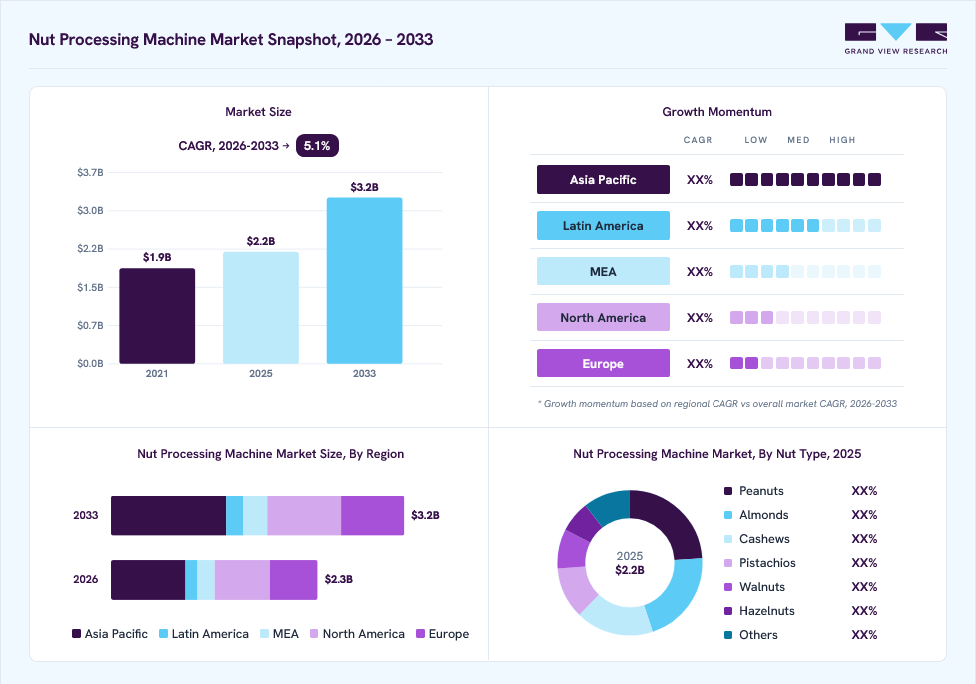
The global nut processing machine market size was valued at USD 2.2 billion in 2025 and is projected to grow from USD 2.3 billion in 2026 to USD 3.2 billion by 2033, at a CAGR of 5.1% from 2026 to 2033. Asia Pacific dominated the global market with a revenue share of 35.5% in 2025. Rising demand for processed and value-added nut products is a major growth driver of the nut processing machine industry.
 Source: Grand View Research, IR Documents, Primary Interviews, Paid DatabasesTo learn more about this report,
 Download Free Sample Report
 Key Market Trends & Insights
- By operation mode: Automatic segment held the largest revenue share of 61.8% in 2025.
- By equipment type: Shelling & cracking equipment segment held the largest share of 26.3% in 2025.
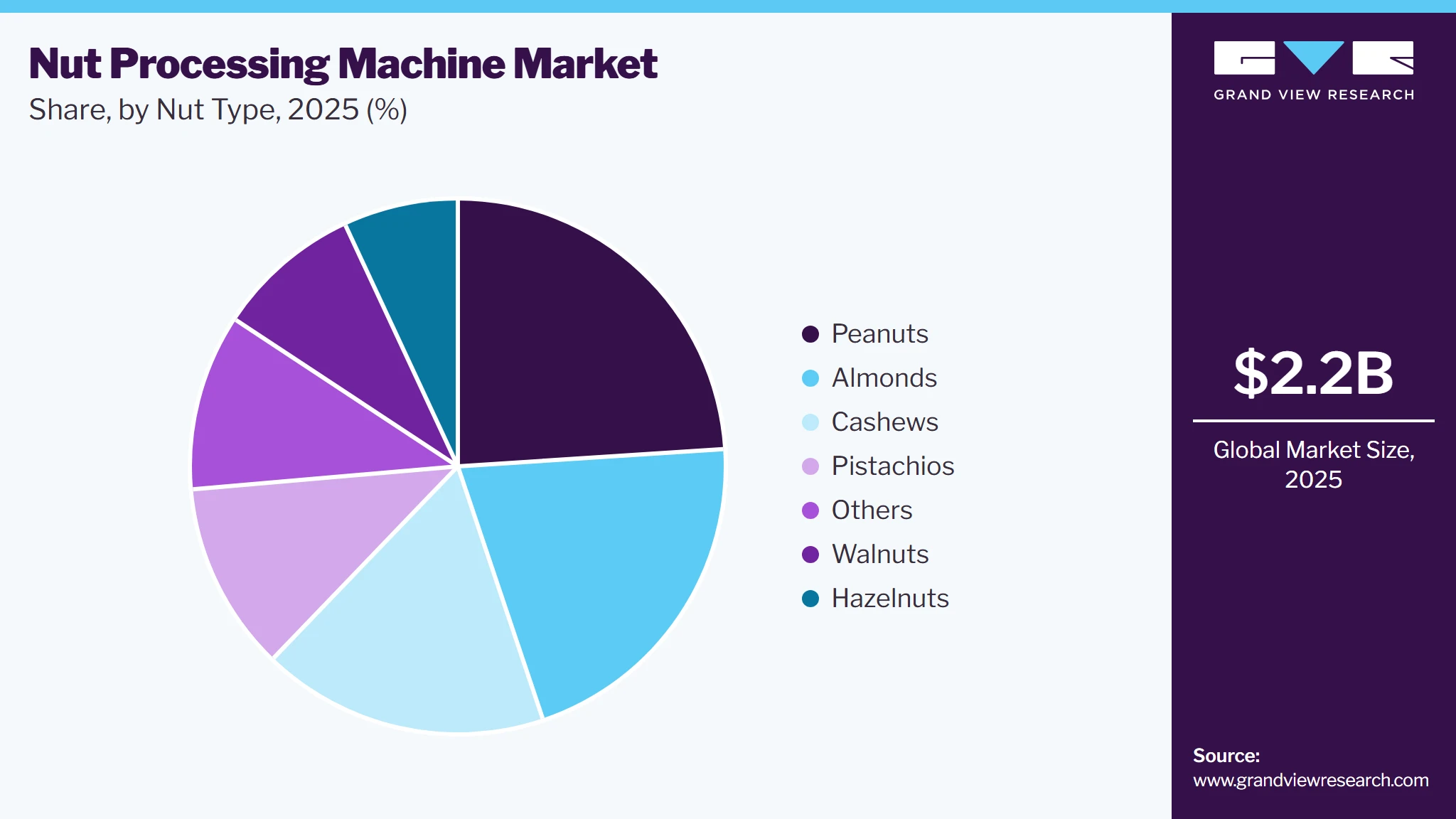
- By nut type: Peanuts segment held the largest revenue share of 24.0% in 2025.
Regional Highlights
- Largest Regional Market: Asia Pacific (35.5% revenue share, 2025)
- By Country: China held the largest market share in 2025.
Market Size & Forecast
- Market Size in 2025: USD 2.2 Billion
- Estimated Market Size in 2026: USD 2.3 Billion
- Projected Market Size by 2033: USD 3.2 Billion
- CAGR (2026-2033): 5.1%
Three ways to get this report
Buy it, customize it, or ask a question.Ask an Analyst
A direct answer, usually in 1 working day
- AccessReport author, directly
- Reply timeWithin 1 working day
- No sales callDirect answer only
- FormatEmail reply
- CostFree, no cost
Get the Full Report
What the study covers
- FormatsPDF · Excel · Dashboard
- Timeline2026–2033 annual, 2025 base
- Coverage20+ countries, 5 regions
- Companies10+ key players profiled
Customize the Report
20% free customization
- IncludeCountries, segments, points
- TailorTo your product definition
- ExtendDeeper competitor detail
- OrA fully bespoke study
- Turnaround5–10 working days
Growing consumption of roasted nuts, flavored snacks, nut butters, nut flour, and other processed products is encouraging food manufacturers and nut processors to expand production capacity and invest in specialized machinery. The increasing use of nuts as ingredients in bakery, confectionery, snack, and plant-based food products is further supporting demand for efficient shelling, roasting, sorting, grinding, and other processing equipment.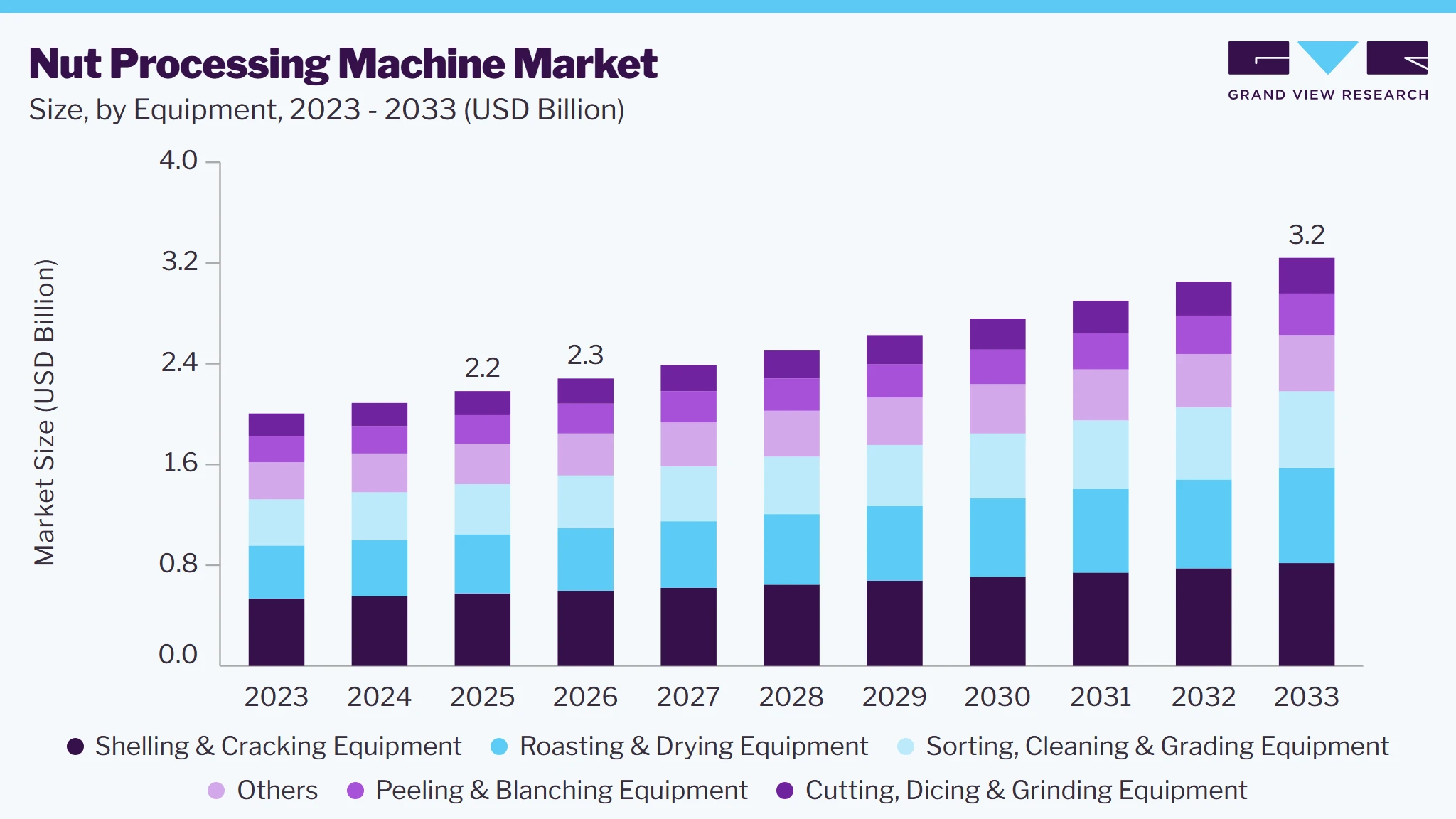 To learn more about this report, Download Free Sample Report
 Increasing automation and mechanization of nut processing operations is another key growth factor. Processors are adopting automated, integrated machinery to increase throughput, reduce reliance on manual labor, improve processing consistency, and minimize product losses. Advances in optical sorting, sensors, automated controls, and integrated processing lines are enabling more precise shelling, grading, sorting, roasting, and quality inspection, while also improving hygiene and operational efficiency.
Market Dynamics
The nut processing machine market is being shaped by rising consumption of processed and value-added nut products, increasing automation of processing operations, and growing investments in modern food-processing facilities. Demand for roasted nuts, nut butters, nut-based snacks, confectionery ingredients, and other processed formats is encouraging processors to adopt equipment that improves throughput, consistency, product quality, and labor efficiency. At the same time, advances in automated sorting, grading, roasting, shelling, and process monitoring are enabling the replacement of conventional equipment with more efficient, integrated systems.
The increasing consumption of processed nuts across snacks, bakery, confectionery, health foods, and plant-based products is driving investment in nut processing machinery. Consumers' growing preference for convenient, nutritious, and protein-rich foods is expanding demand for roasted nuts, nut butters, nut flours, flavored nuts, and other value-added products. As processors expand their product portfolios and production capacities, they require specialized machinery for shelling, cleaning, sorting, roasting, grinding, slicing, and grading, thereby supporting equipment demand.
The shift toward value-added processing is also encouraging processors to modernize existing facilities and install higher-capacity equipment. Automated and integrated machinery enables processors to improve production speed, reduce manual intervention, maintain consistent product quality, and minimize processing losses. This trend is particularly relevant as manufacturers seek to meet growing demand while maintaining efficiency and uniformity across different nut varieties and product formats.
High capital requirements for advanced nut processing machinery remain a key restraint, particularly for small and medium-sized processors. Automated processing lines incorporating shelling, sorting, roasting, grading, and quality-control technologies require substantial investment, while maintenance, spare parts, calibration, and skilled technical support add to ongoing operating costs. These financial requirements can encourage smaller processors in cost-sensitive markets to continue using manual or semi-automatic equipment, limiting the penetration of advanced machinery.
The increasing adoption of automation, optical sorting, machine vision, sensors, and digital monitoring presents a significant opportunity for equipment manufacturers. Smart processing systems can improve defect detection, sorting accuracy, yield, throughput, and process consistency while reducing labor dependency. Growing investment in automated processing facilities and the need for higher-quality, export-grade nut products are expected to create opportunities for suppliers offering integrated and technologically advanced equipment solutions.
Market Concentration & Characteristics
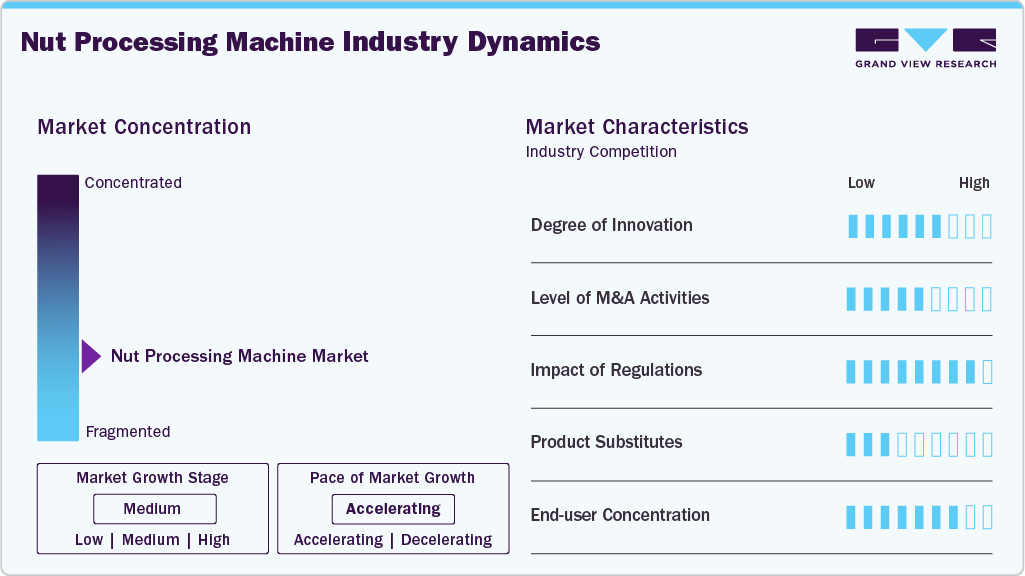
The nut processing machine industry is fragmented, with a mix of large multinational manufacturers, specialized equipment providers, and regional machinery producers competing across different processing stages. While leading manufacturers have strong positions in advanced automated systems, optical sorting, roasting, shelling, and integrated processing lines, numerous small and medium-sized players serve specific applications and regional markets. The presence of diverse suppliers, varying levels of automation, and equipment specialization contributes to a relatively fragmented competitive landscape.
The degree of innovation in the nut processing machine industry is moderate to high, particularly in sorting, grading, automation, and process monitoring. Manufacturers are increasingly integrating optical and AI-based sorting, machine vision, sensors, IoT-enabled monitoring, and automated control systems to improve defect detection, processing accuracy, throughput, and product consistency. While conventional equipment such as shellers, crackers, and roasters is relatively mature, advanced sorting, robotics, and smart processing technologies continue to create opportunities for product differentiation and efficiency improvements.
 To learn more about this report, Download Free Sample Report
 Regulation has a moderate to high impact on the industry because nut processing equipment must support food safety, sanitation, allergen control, and contamination prevention requirements. Regulations encourage the use of hygienic equipment designs, easily cleanable processing surfaces, enclosed systems, and controls that minimize cross-contact and contamination. This is particularly important because peanuts and tree nuts are recognized as major food allergens in major markets, increasing the need for processors to adopt equipment and processing layouts that support effective cleaning and segregation.
Nut typer concentration is relatively low to moderate, as demand comes from a diverse base of nut processors, food manufacturers, snack producers, ingredient manufacturers, confectionery companies, and other food-processing businesses. Large industrial processors account for significant demand for high-capacity automated lines, while small and medium-sized processors continue to purchase standalone or semi-automatic equipment. This diversified customer base reduces dependence on a limited number of buyers, although large processors can have greater purchasing power and influence over equipment specifications and customization.
Analyst Perspective
The nut processing machine market is moving toward greater mechanization and integrated processing as producers focus on improving productivity, product consistency, and processing efficiency. Automation is gaining importance across shelling, cracking, sorting, grading, roasting, drying, peeling, and grinding operations, while advanced technologies such as optical sorting, machine vision, and digital controls are creating opportunities for higher accuracy and reduced processing losses. Demand is also being supported by the expansion of value-added nut products and modernization of processing facilities, particularly across emerging markets in Asia Pacific. However, the relatively high investment required for sophisticated machinery can constrain adoption among smaller processors. Overall, manufacturers that combine automation, energy efficiency, flexible configurations, and application-specific solutions are likely to be well-positioned to capture future market opportunities.
Equipment Type Insights
Shelling & cracking equipment dominated the nut processing machine industry in 2025, owing to its essential role in the primary processing of major nut varieties, including peanuts, almonds, walnuts, pistachios, and cashews. Shell removal is a critical processing stage because efficient cracking and separation directly influence kernel recovery, product quality, and processing yields. The increasing mechanization of high-volume nut processing facilities is further driving demand for advanced shelling and cracking systems that improve throughput while minimizing kernel breakage and material losses.
Roasting & drying equipment is projected to grow at the fastest CAGR of 6.2% during the forecast period, supported by rising demand for roasted, flavored, and other value-added nut products. Roasting improves flavor, aroma, texture, and shelf life, while controlled drying helps achieve the required moisture levels and product stability. Increasing consumption of ready-to-eat nut snacks and investments in energy-efficient roasting systems with precise temperature and process controls are encouraging processors to upgrade their thermal processing capabilities.
Operation Mode Insights
Automatic equipment dominated the nut processing machine market in 2025, owing to the growing adoption of high-capacity, integrated processing systems that improve production efficiency, consistency, and throughput. Automated machines reduce dependence on manual labor, minimize processing errors, and enable precise control across operations such as shelling, sorting, roasting, grading, and grinding. Their ability to support continuous processing and maintain uniform product quality is particularly valuable for large-scale nut processors and food manufacturers.
Semi-automatic equipment is expected to grow moderately at a CGAR of 5.0% over the forecast period, driven by its relatively lower investment requirements, operational flexibility, and suitability for small and medium-sized processors. These systems combine mechanized processing with selective manual intervention, allowing processors to improve productivity without the higher capital commitment associated with fully automated lines. Their flexibility in handling different nut varieties and batch sizes is further supporting adoption, particularly in developing markets where complete automation can remain cost-prohibitive.
Nut Type Insights
Peanuts dominated the nut processing machine industry in 2025, supported by their large-scale production, affordability, and extensive use in snacks, confectionery, spreads, and other food products. Peanut processing requires multiple stages, including cleaning, shelling, grading, roasting, blanching, and grinding, creating demand for a broad range of processing machinery. High consumption volumes across major producing and processing markets further support the need for high-throughput and efficient peanut processing equipment.
 To learn more about this report, Download Free Sample Report
 Pistachios are projected to grow at the fastest CAGR of 6.4% over the forecast period, driven by rising demand for premium snacks and increasing use of pistachios in bakery, confectionery, desserts, and value-added food products. Growing investments in pistachio processing capacity are also creating demand for specialized hulling, drying, sorting, grading, and roasting equipment. The expansion of processing infrastructure and increasing mechanization in major pistachio-producing markets are expected to further support machinery adoption.
Regional Insights
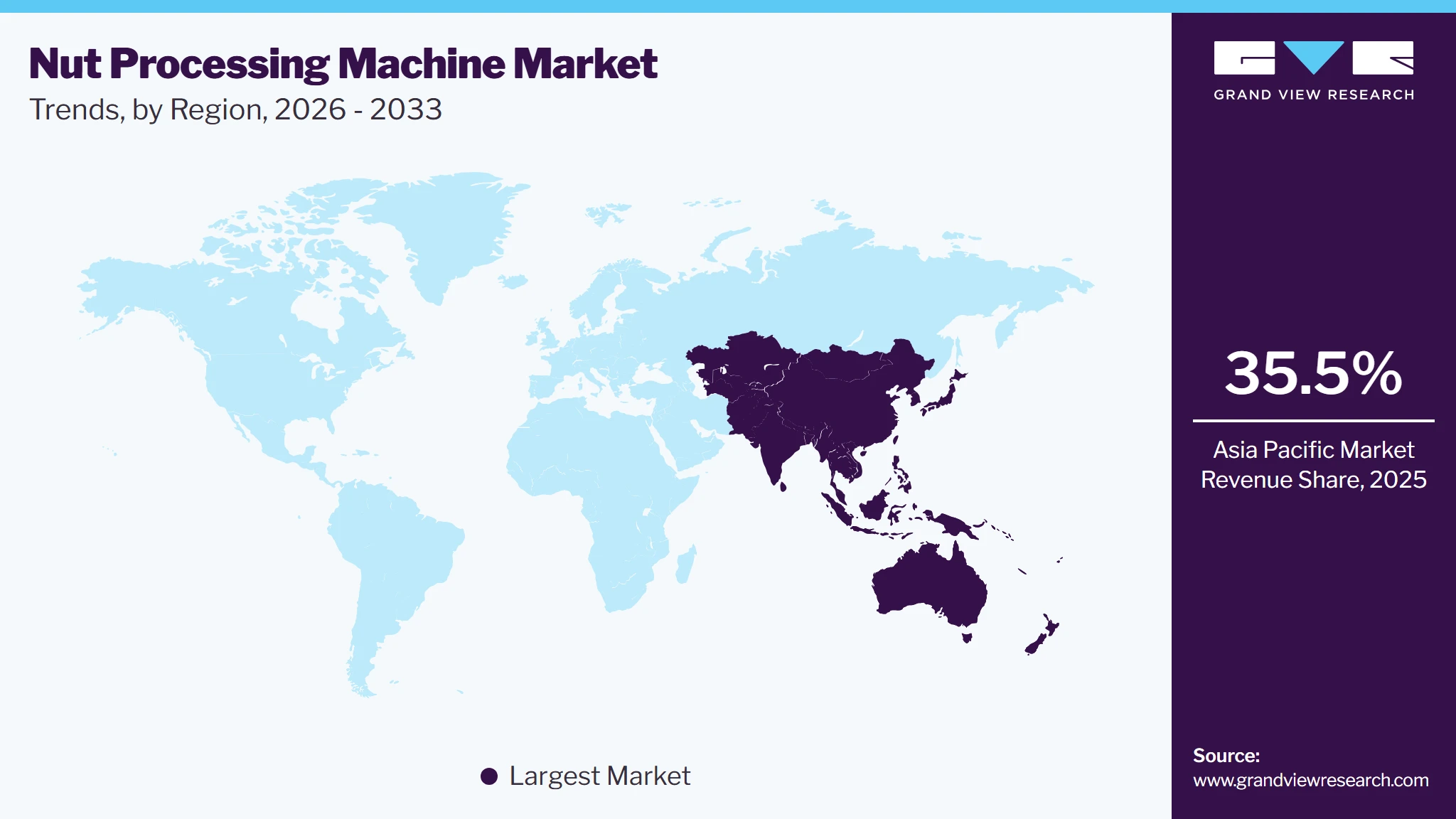
Asia Pacific dominated the nut processing machine market in 2025 with a revenue share of 35.5%, and is projected to grow at the fastest CAGR over the forecast period. The market growth is supported by its large nut-processing base, expanding food-processing industry, and increasing consumption of processed nut products. China and India are major contributors, while growing investments in cashew, peanut, almond, and walnut processing are encouraging the modernization of processing facilities. The shift from labor-intensive operations to automated and semi-automated machinery, particularly in emerging Asian economies, is further driving substantial demand for processing equipment.
 To learn more about this report, Download Free Sample Report
 The China nut processing machine market dominated Asia Pacific in 2025, supported by its large agricultural and food-processing base, extensive nut consumption, and expanding production of processed and value-added food products. The country’s large-scale grain and agricultural production infrastructure provides a strong foundation for demand for food-processing machinery, while the increasing industrialization of food processing is encouraging processors to adopt more efficient cleaning, shelling, sorting, roasting, and grading systems. China’s National Bureau of Statistics reported 714.9 million metric tons of total grain production in 2025, highlighting the scale of its agricultural processing ecosystem.
The nut processing machine market in India is expected to witness strong growth over the forecast period, supported by rising nut production, expanding food processing, and increasing demand for value-added nut products. According to India’s Agricultural and Processed Food Products Export Development Authority (APEDA), cashew production increased from 794,000 metric tons in 2023-24 to 802,000 metric tons in 2024-25, while government data indicate that India produced approximately 322 thousand metric tons of walnuts and 13,940 metric tons of almonds in 2024-25. In addition, India’s overall horticulture production reached 370.7 million metric tons in 2024-25, reflecting the expanding agricultural base for value-added food processing. These trends are driving investment in shelling, peeling, grading, sorting, roasting, and other nut-processing machinery, particularly as processors increasingly shift toward mechanized, higher-capacity operations.
North America Nut Processing Machine Market Trends
North America is expected to witness strong market growth, supported by the region's mature food-processing infrastructure and high consumption of nuts and nut-based products. Processors are increasingly investing in high-capacity machinery for sorting, shelling, roasting, grading, and packaging to improve operational efficiency and product consistency. Demand for advanced equipment is also being supported by the established commercial nut-processing sector and the continued modernization of processing facilities.
U.S. Nut Processing Machine Market Trends
The U.S. nut processing machine industry dominated North America in 2025, supported by its large-scale peanut and tree-nut production and well-established processing infrastructure. According to the USDA, U.S. peanut production reached a record 3.3 million metric tons in the 2025/26 marketing year, up 19% from the 2020-2024 average. In 2025, the U.S. utilized tree-nut production reached approximately 4.1 million metric tons, including 2.2 million metric tons of almonds, 790,000 metric tons of pistachios, and 809,000 metric tons of walnuts. The scale of these crops supports substantial demand for shelling, cracking, sorting, grading, roasting, drying, and other processing machinery, while continued modernization of processing facilities is encouraging adoption of automated and high-capacity equipment.
Europe Nut Processing Machine Market Trends
The Europe nut processing machine industry is projected to experience steady growth during the forecast period, driven by increasing demand for packaged, roasted, flavored, and other value-added nut products. The region's emphasis on food quality, processing efficiency, and modern production technologies is encouraging the adoption of automated machinery across shelling, sorting, roasting, and grading operations. Expansion of industrial-scale processing facilities and investments in energy-efficient equipment are expected to further support regional demand.
The Germany nut processing machine market dominated Europe in 2025, supported by its well-established food-processing sector, advanced industrial infrastructure, and strong manufacturing capabilities. The country’s sophisticated food manufacturing ecosystem creates demand for modern equipment that can improve processing efficiency, product consistency, hygiene, and throughput. Germany’s strong position in European food trade also underscores the need for advanced sorting, grading, shelling, roasting, drying, and other processing technologies, particularly as processors continue to modernize their production facilities.
The nut processing machine market in the UKis expected to witness continued growth over the forecast period, driven by its large and diversified food and beverage manufacturing sector and increasing focus on efficient food production. The UK government identifies food and drink manufacturing as a major component of the national agri-food chain, while the sector continues to emphasize productivity, technology adoption, and innovation. The country's strong food manufacturing base and demand for processed and convenience foods are creating opportunities for modern nut-processing equipment, particularly for sorting, roasting, grinding, and other value-added applications.
Middle East & Africa Nut Processing Machine Market Trends
The Middle East & Africa is anticipated to grow steadily, supported by rising consumption of dried fruits and nuts, improving disposable incomes, and increasing investments in food-processing capabilities. Countries such as Saudi Arabia, South Africa, and the UAE represent important demand centers, while broader development of processing infrastructure is creating opportunities for equipment suppliers. Growing interest in roasted and value-added nut products is expected to encourage the adoption of drying, roasting, sorting, conveying, and other processing machinery.
The South Africa nut processing machine market is expected to remain an important and growing segment in the Middle East & Africa, supported by its established agricultural and agro-processing ecosystem and strong macadamia industry. The country is increasingly focused on developing agro-processing value chains and improving processing infrastructure, creating opportunities for modern shelling, cracking, sorting, grading, drying, and other nut-processing equipment. The expansion of macadamia processing facilities and investments in processing capacity are further supporting machinery demand, particularly as processors seek to improve efficiency and add value to locally produced nuts.
Latin America Nut Processing Machine Market Trends
Latin America is expected to register continued growth over the forecast period, supported by the expansion of agricultural processing and the rising commercialization of nut and nut-based food products. Increasing efforts to improve post-harvest handling, processing efficiency, and product quality are creating opportunities for modern shelling, cleaning, grading, and sorting equipment. Growth in exports and the development of value-added food processing are also encouraging processors to invest in machinery that can improve productivity and product consistency.
The Brazil nut processing machine market is expected to remain a key segment in Latin America, supported by its established agricultural and food-processing base and the importance of Brazil nuts and cashews within its agro-processing ecosystem. The country has an active nut-processing industry that requires equipment for cleaning, drying, shelling, sorting, grading, and value-added processing. Brazil’s Ministry of Agriculture also emphasizes post-harvest processing technologies to reduce losses, improve product quality, and enhance food safety, supporting the adoption of modern processing machinery.
Key Nut Processing Machine Company Insights
Some of the key players operating in the market include Bühler Group; TOMRA Systems ASA; and Key Technology.
-
Bühler Group is a Switzerland-based engineering and technology company serving the food, feed, and advanced materials industries. The company develops machinery and integrated processing solutions for the nut industry, supporting activities such as cleaning, sorting, roasting, drying, pasteurization, and grinding. Its portfolio includes both individual processing equipment and complete production lines designed to improve throughput, product consistency, quality, and operational efficiency. With an extensive international presence, Bühler provides processing technologies and technical services to customers across major food-producing and processing markets.
-
TOMRA Systems ASA is a company that specializes in resource optimization, with operations spanning food processing, recycling, and collection solutions. Through its TOMRA Food division, the company develops sensor-based sorting, grading, peeling, and post-harvest processing technologies for food producers and processors. Its nut-processing portfolio focuses on advanced sorting and grading solutions for products such as almonds, cashews, hazelnuts, macadamias, peanuts, pistachios, and walnuts, using technologies that identify foreign materials, defects, discoloration, and other quality issues. TOMRA states that its Food division has more than 16,100 units installed across food-growing, packing, and processing operations worldwide.
Key Nut Processing Machine Companies
The following key companies have been profiled for this study of the nut processing machine market.
-
Bühler Group
-
TOMRA Systems ASA
-
Key Technology
-
Lewis M. Carter Manufacturing, LLC
-
Heat and Control, Inc.
-
Alvan Blanch Development Company
-
BORRELL
-
J.E.M. Equipment Manufacturing LLC.
-
AC Horn Manufacturing
-
Wizard Manufacturing
-
SKOURAS Inc.
-
Kadioglu Machines
-
Modern Process Equipment Corporation
-
Garratt Industries
-
Oscar Cashew Tech Pvt. Ltd.
Competitive Benchmarking
Category
Operating Strategies
Competitive Edge
Weakness
Established Players (e.g., Bühler Group; TOMRA Systems ASA; Key Technology; Heat and Control, Inc.; Alvan Blanch Development Company
- Focus on integrated and automated nut-processing lines covering shelling, sorting, roasting, grading, and material handling.
- Invest in optical sorting, machine vision, digital controls, and process automation to improve throughput and product consistency.
- Expand processing capabilities through technology development and broader equipment portfolios.
- Strong technological expertise across multiple stages of nut processing.
- Ability to supply high-capacity and integrated solutions for large-scale processing facilities.
- Established technical support and service capabilities across major processing markets.
- Advanced automated systems involve high capital expenditure, which can limit adoption among smaller processors.
- Integrated systems require specialized installation, maintenance, and technical expertise.
- Large-scale solutions may be less suitable for low-volume or highly customized processing requirements.
Emerging & Regional Players (e.g., Lewis M. Carter Manufacturing, LLC; BORRELL; J.E.M. Equipment Manufacturing LLC.; AC Horn Manufacturing; Wizard Manufacturing; SKOURAS Inc.; Kadioglu Machines)
- Concentrate on specialized equipment such as shelling, cracking, roasting, grading, and grinding machinery.
- Offer customized equipment based on local nut varieties, processing capacities, and customer requirements.
- Target small and medium-sized processors with cost-effective and semi-automatic solutions.
- Greater flexibility in customization and adaptation to regional processing requirements.
- Competitive pricing makes their equipment more accessible to smaller processors.
- Strong knowledge of local nut-processing practices and customer needs.
- More limited capabilities in advanced automation, AI-based sorting, and integrated processing systems.
- Smaller geographic reach and service networks compared with larger international suppliers.
- Narrower product portfolios may limit their ability to provide complete end-to-end processing lines.
Recent Developments
-
In September 2025, TOMRA Food introduced the TOMRA 4C optical sorting machine for nut and IQF processing applications, focusing on improved detection, sorting accuracy, efficiency, and operational flexibility. The system combines LUCAi deep learning and traditional machine learning with advanced pulsed LED sensors to identify foreign materials, product defects, and color variations. It is designed for integration into new or existing processing lines and aims to reduce false rejects while improving product quality and yield.
-
In January 2025, Bühler acquired CEREX’s puffing technology to strengthen its processing portfolio for food and snack applications. The technology can be used for nuts and seeds, enabling product diversification while improving processing efficiency and energy performance.
Nut Processing Machine Market Report Scope
Report Attribute
Details
Market size in 2025
USD 2.2 billion
Estimated market size in 2026
USD 2.3 billion
Projected to market size by 2033
USD 3.2 billion
Growth rate
CAGR of 5.1% from 2026 to 2033
Historical data
2021 - 2024
Forecast period
2026 - 2033
Quantitative units
Revenue in USD billion, and CAGR from 2026 to 2033
Report coverage
Revenue forecast, company ranking, competitive landscape, growth factors, and trends
Segments covered
Operation mode, equipment type, nut type, region
Regional scope
North America; Europe; Asia Pacific; Latin America; Middle East & Africa; Africa
Country scope
U.S.; Canada; Mexico; UK; Germany; France; Spain; Italy; China; Japan; India; Australia; South Korea; Brazil; Argentina; Saudi Arabia; UAE; South Africa
Key companies profiled
Bühler Group; TOMRA Systems ASA; Key Technology; Lewis M. Carter Manufacturing, LLC; Heat and Control, Inc.; Alvan Blanch Development Company; BORRELL; J.E.M. Equipment Manufacturing LLC.; AC Horn Manufacturing; Wizard Manufacturing; SKOURAS Inc.; Kadioglu Machines; Modern Process Equipment Corporation; Garratt Industries; Oscar Cashew Tech Pvt. Ltd.
Customization scope
Free report customization (equivalent up to 8 analysts working days) with purchase. Addition or alteration to country, regional & segment scope.
Pricing and purchase options
Avail customized purchase options to meet your exact research needs. Explore purchase options
Global Nut Processing Machine Market Report Segmentation
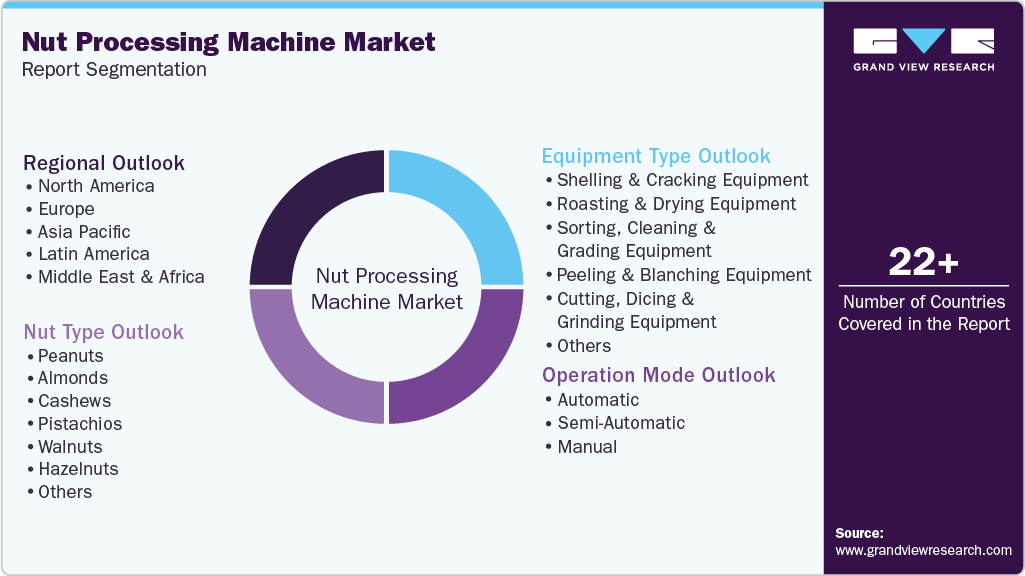
This report forecasts revenue growth at the global, regional & country levels and provides an analysis of the latest industry trends in each of the sub-segments from 2021 to 2033. For this study, Grand View Research has segmented the global nut processing machine market report based on operation mode, equipment type, nut type, and region:
 To learn more about this report, Download Free Sample Report
 -
Operation Mode Outlook (Revenue, USD Billion, 2021 - 2033)
-
Automatic
-
Semi-Automatic
-
Manual
-
-
Equipment Type Outlook (Revenue, USD Billion, 2021 - 2033)
-
Shelling & Cracking Equipment
-
Roasting & Drying Equipment
-
Sorting, Cleaning & Grading Equipment
-
Peeling & Blanching Equipment
-
Cutting, Dicing & Grinding Equipment
-
Others
-
-
Nut Type Outlook (Revenue, USD Billion, 2021 - 2033)
-
Peanuts
-
Almonds
-
Cashews
-
Pistachios
-
Walnuts
-
Hazelnuts
-
Others
-
-
Regional Outlook (Revenue, USD Billion, 2021 - 2033)
-
North America
-
U.S.
-
Canada
-
Mexico
-
-
Europe
-
Germany
-
France
-
Italy
-
Spain
-
UK
-
-
Asia Pacific
-
China
-
India
-
Japan
-
South Korea
-
Australia
-
-
Latin America
-
Brazil
-
Argentina
-
Middle East & Africa
-
Saudi Arabia
-
UAE
-
South Africa
-
-
Research Methodology
The nut processing machine market figures in this report are based on a proven research process that combines executive interviews with secondary research from proprietary databases, company filings, and recognized regulatory and institutional sources. Market size is built through value-chain sizing - reconciling supply-side and demand-side estimates - and triangulated with bottom-up and top-down approaches. Every estimate passes multiple levels of expert validation before publication, with each nut processing machine segment quantified using the revenue-capture definitions in the table below.
Segment Definition
Operation Mode
Revenue Capture Definition
Automatic
Revenue generated from the sale of fully automatic nut processing machines and systems that perform processing operations with minimal manual intervention.
Semi-Automatic
Revenue generated from the sale of semi-automatic nut processing machines and systems that combine automated processing functions with manual intervention.
Manual
Revenue generated from the sale of manually operated or mechanically assisted nut processing machines that require substantial operator involvement.
Equipment Type
Revenue Capture Definition
Shelling & Cracking Equipment
Revenue generated from the sale of nut processing machines used for shelling, cracking, hulling, and separating nut shells from kernels, including shelling and cracking machines for peanuts, almonds, cashews, pistachios, walnuts, hazelnuts, and other nuts.
Roasting & Drying Equipment
Revenue generated from the sale of nut processing machines used for roasting, drying, and heat treatment of nuts, including batch and continuous roasters, dryers, and roasting systems used for peanuts, almonds, cashews, pistachios, walnuts, hazelnuts, and other nuts.
Sorting, Cleaning & Grading Equipment
Revenue generated from the sale of nut processing machines used for cleaning, sorting, sizing, grading, and removing foreign materials, defective nuts, shells, and other impurities from peanuts, almonds, cashews, pistachios, walnuts, hazelnuts, and other nuts.
Peeling & Blanching Equipment
Revenue generated from the sale of nut processing machines used for removing skins, peels, and membranes and for blanching nuts, including equipment used for peanuts, almonds, cashews, hazelnuts, and other nuts.
Cutting, Dicing & Grinding Equipment
Revenue generated from the sale of nut processing machines used for cutting, slicing, dicing, chopping, milling, and grinding nuts into pieces, granules, pastes, or other processed forms, including equipment for peanuts, almonds, cashews, pistachios, walnuts, hazelnuts, and other nuts.
Others
Revenue generated from the sale of nut processing equipment for other processing operations, including feeding, seasoning, coating, among others.
Nut Type
Revenue Capture Definition
Peanuts
Revenue generated from the sale of nut processing machines used for processing peanuts, including equipment for shelling, cracking, cleaning, grading, roasting, blanching, peeling, cutting, dicing, grinding, and other peanut-processing operations.
Almonds
Revenue generated from the sale of nut processing machines used for processing almonds, including equipment for shelling, cracking, cleaning, grading, roasting, blanching, peeling, cutting, dicing, grinding, and other almond-processing operations.
Cashews
Revenue generated from the sale of nut processing machines used for processing cashews, including equipment for shelling, cracking, cleaning, grading, roasting, peeling, cutting, dicing, grinding, and other cashew-processing operations.
Pistachios
Revenue generated from the sale of nut processing machines used for processing pistachios, including equipment for shelling, cracking, cleaning, grading, sorting, roasting, cutting, grinding, and other pistachio-processing operations.
Walnuts
Revenue generated from the sale of nut processing machines used for processing walnuts, including equipment for shelling, cracking, cleaning, grading, sorting, roasting, cutting, dicing, grinding, and other walnut-processing operations.
Hazelnuts
Revenue generated from the sale of nut processing machines used for processing hazelnuts, including equipment for shelling, cracking, cleaning, grading, roasting, blanching, peeling, cutting, grinding, and other hazelnut-processing operations.
Others
Revenue generated from the sale of nut processing machines used for processing other nuts, including pecans, macadamia nuts, Brazil nuts, pine nuts, chestnuts, among others.
Estimation Model
Layer No.
Layer Name
Key Question
Description
01
Market Definition & Segmentation
What is included in the market?
Define the nut processing machine market scope and establish segmentation by operation mode, equipment type, and nut type.
02
Supply-Side Assessment
Who supplies the market and at what scale?
Analyze manufacturers, product portfolios, production capabilities, pricing, regional presence, and competitive positioning to estimate the supply base.
03
Demand-Side Assessment
What drives equipment demand?
Assess nut production and processing volumes, processing capacity, food-processing investments, machinery replacement, automation adoption, and expansion of processing facilities.
04
Market Sizing & Validation
What is the final market value?
Estimate market value using top-down and bottom-up approaches, then validate the results through company-level analysis, regional assessments, secondary research, and industry-level cross-checks.
Delivered Customizations
This report has been delivered with the following In-depth customizations
Client Request
Customization Delivered
Value Adds
Regional Segmentation
The report provides a detailed regional and country-level assessment covering North America, Europe, Asia Pacific, Latin America, and the Middle East & Africa, with additional analysis of key countries such as the U.S., Germany, the UK, China, India, Brazil, and South Africa. Each region is assessed based on market development, processing infrastructure, nut production, automation adoption, and demand for processing equipment.
Provides a clearer understanding of regional growth pockets and country-level demand opportunities, helping identify markets with established processing bases as well as emerging automation potential.
Competitive Benchmarking
The report benchmarks key market participants based on their product portfolios, equipment capabilities, technological positioning, operating strategies, competitive strengths, and limitations. The competitive landscape also distinguishes between established players and emerging/regional manufacturers, while highlighting recent product developments and strategic initiatives.
Enables comparison of technology capabilities, market positioning, specialization, and competitive strategies, helping identify areas of differentiation and potential competitive gaps.
Opportunity Assessment
The report evaluates major growth opportunities arising from increasing automation, demand for value-added nut products, modernization of processing facilities, adoption of optical sorting and smart technologies, and expansion of nut processing capacity across emerging markets. Opportunities are assessed across equipment types, operation modes, nut types, and regional markets.
Provides a structured view of high-potential segments and growth areas, supporting strategic decisions related to market entry, product development, technology investment, and regional expansion.
Frequently Asked Questions About This Report
Asia Pacific was the largest regional market, accounting for 35.5% of global revenue in 2025. The region benefits from a large nut-processing base, expanding food-processing industries, increasing consumption of nut-based products, and growing adoption of mechanized and automated processing technologies.
China held the largest country-level market share in 2025. Its position is supported by its large consumer base, substantial nut-processing activity, expanding food manufacturing sector, and increasing investment in modern processing equipment.
The automatic segment held the largest share, accounting for 61.8% of global market revenue in 2025. Its leading position is supported by the ability of automated systems to handle high-volume production with greater consistency, lower manual intervention, and improved process efficiency.
The shelling & cracking equipment segment dominated the market, accounting for 26.3% of revenue in 2025. These machines represent a fundamental stage in nut processing, as efficient shell removal is essential for maximizing kernel recovery, minimizing breakage, and preparing nuts for subsequent processing operations.
The global nut processing machine market is primarily driven by increasing consumption of processed and value-added nut products, growing adoption of automation, rising labor costs, and the need to improve processing efficiency, product consistency, yield, and hygiene. Increasing investments in modern food-processing facilities and demand for automated sorting, shelling, roasting, grading, and other processing operations are further supporting market growth.
The global nut processing machine market size was estimated at USD 2.2 billion in 2025 and is expected to be USD 2.3 billion in 2026.
The global nut processing machine market, in terms of revenue, is expected to grow at a compound annual growth rate of 5.1% from 2026 to 2033, to reach USD 3.2 billion by 2033.
The peanuts segment led the market with a 24.0% revenue share in 2025. Its dominance is supported by the widespread use of peanuts in snacks, spreads, confectionery, bakery products, and other processed foods, creating demand for equipment across shelling, cleaning, sorting, roasting, and grinding operations.
Some of the key players operating in the global nut processing machine market include Bühler Group; TOMRA Systems ASA; Key Technology; Lewis M. Carter Manufacturing, LLC; Heat and Control, Inc.; Alvan Blanch Development Company; BORRELL; J.E.M. Equipment Manufacturing LLC.; AC Horn Manufacturing; Wizard Manufacturing; SKOURAS Inc.; Kadioglu Machines; Modern Process Equipment Corporation; Garratt Industries; Oscar Cashew Tech Pvt. Ltd.
About the Author(s)
Advanced Interior Materials Research Team
Advanced Materials · Advanced Interior MaterialsThis report was authored by the advanced interior materials research team at Grand View Research - comprising two research analysts, one senior research analyst, and one industry expert - with specialized expertise in the advanced interior materials segment of the advanced materials industry. All findings are based on proprietary advanced materials databases, executive interviews, and regulatory analysis, subject to internal peer review prior to publication.
Last Updated:
Speak to Analyst

Customize this report to your needs - add regions, segments, or data points, with 20% free customization.
Or view our licence options:


ISO 9001:2015 & 27001:2022 Certified
We are GDPR and CCPA compliant! Your transaction & personal information is safe and secure. For more details, please read our privacy policy.


