
- Home
- »
- Next Generation Technologies
- »
-
On-Line Total Organic Carbon Analyzer Market Report, 2033GVR Report cover

On-Line Total Organic Carbon Analyzer Market (2026 - 2033)
Size, Share & Trends Analysis Report By Type (Laboratory, Online, Portable), By Technology, By End Use, By Region, And Segment Forecasts
Market Size, 2025
$830.5MMarket Estimate, 2026
$878.7MMarket Forecast, 2033
$1,300.0MCAGR, 2026–2033
5.8%On-Line Total Organic Carbon Analyzer Market Summary
The global on-line total organic carbon analyzer market size was valued at USD 830.5 million in 2025 and is projected to grow from USD 878.7 million in 2026 to USD 1,300 million in 2033, at a CAGR of 5.8% from 2026 to 2033. Europe dominated with a revenue share of over 37.0% in 2025. The market is capitalizing on increased awareness of water conservation and sustainability worldwide. With water scarcity a pressing global concern, industries and consumers are prioritizing efficient water management.
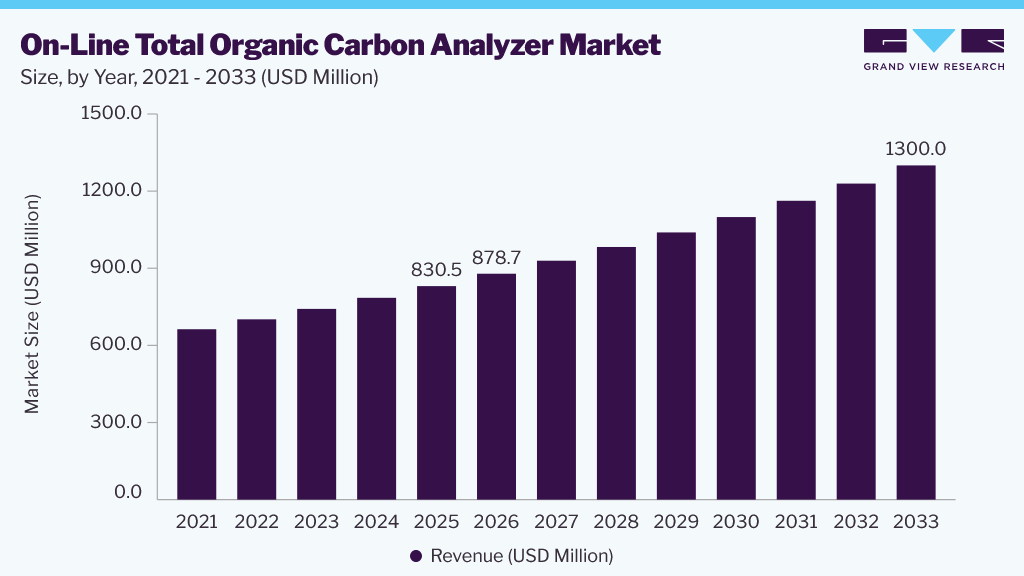 Source: Grand View Research, IR Documents, Primary Interviews, Paid DatabasesTo learn more about this report,
 Download Free Sample Report
Key Market Trends & Insights
- By type: The online segment held the largest market share of approximately 52.0% in 2025.
- By technology: The Ultraviolet (UV) Oxidation segment held the largest market share in 2025.
- By end use: The pharmaceutical segment held the largest market share in 2025.
Regional Highlights
- Largest regional market: Europe (37.0% revenue share, 2025)
- Fastest-growing regional market: Asia Pacific (highest CAGR, 2026-2033)
Market Size & Forecast
- Market size in 2025: USD 830.5 Million
- Estimated market size in 2026: USD 878.7 Million
- Projected market size by 2033: USD 1,300 Million
- CAGR (2026-2033): 5.8%
Three ways to get this report
Buy it, customize it, or ask a question.Ask an Analyst
Analyst response in 1 business day
- AccessReport author, directly
- Reply timeWithin 1 working day
- No sales callDirect answer only
- FormatEmail reply
- CostFree, no cost
Get the Full Report
What the study covers
- FormatsPDF · Excel · Dashboard
- Timeline2026–2033 annual, 2025 base
- Coverage20+ countries, 5 regions
- Companies10+ key players profiled
Customize the Report
20% free customization
- IncludeCountries, segments, points
- TailorTo your product definition
- ExtendDeeper competitor detail
- OrA fully bespoke study
- Turnaround5–10 working days
Online total organic carbon (TOC) analyzers are pivotal in this effort by continuously monitoring water quality, minimizing waste, and supporting recycling initiatives. Their ability to provide real-time data enables proactive responses to contamination events, ensuring water resources are used more efficiently. This resonates with broader sustainability agendas, prompting industries to adopt these technologies to meet stringent environmental regulations and enhance operational efficiency. Moreover, integrating advanced TOC monitoring systems into industrial processes helps mitigate the risks of water pollution, promoting a more environmentally responsible approach to resource management. As such, the market is poised for growth as demand for solutions that support sustainable water management practices globally increases.
The market is experiencing significant growth due to the rising industrial and regulatory demands across various sectors. Industries such as pharmaceuticals, food and beverages, and chemicals are increasingly prioritizing water quality and purity. Regulatory bodies worldwide are imposing stringent guidelines to ensure compliance with environmental and safety standards. These regulations require continuous monitoring of organic carbon levels in water, driving the adoption of advanced TOC analyzers. As industries aim to meet these stringent requirements, the demand for reliable and efficient TOC monitoring systems continues to surge. This trend is further strengthened by the growing awareness of environmental sustainability and the need to reduce pollutants.
Technological advancements and innovation in on-line total organic carbon analyzers are key drivers of market growth. The development of more sophisticated, accurate, and user-friendly TOC analyzers has significantly enhanced their adoption across industries. Innovations such as real-time monitoring, automated calibration, and advanced oxidation methods have improved the efficiency and reliability of TOC analysis. Moreover, the integration of artificial intelligence and machine learning in TOC analyzers is paving the way for predictive maintenance and advanced data analytics. This technological progress not only enhances the functionality of TOC analyzers but also reduces operational costs, making them more attractive to a wider range of industries. Consequently, industries that require precise, continuous monitoring of organic carbon levels are increasingly adopting these advanced TOC analyzers.
Analyst Perspective
The market is experiencing steady growth, driven by sustainability initiatives, stringent regulatory frameworks, and a growing industrial focus on water supply and quality management. As industries seek to optimize water use, ensure compliance, and reduce environmental impact, continuous TOC monitoring has become an essential component of operational strategies. In addition, such systems are especially prevalent in the most heavily regulated industries, including pharmaceuticals, food & beverages, and chemicals, due to their stringent water quality standards. Moreover, ongoing developments in automation and intelligent monitoring enhance the system's value.
Type Insights
The online segment led the market, accounting for over 52.0% of global revenue in 2025. Online TOC analyzers are designed for continuous monitoring directly within industrial processes or water treatment facilities. They provide real-time data without the need for manual sampling and laboratory analysis. This capability is crucial for industries that require immediate feedback to maintain operational efficiency and comply with regulatory standards. Online TOC analyzers are becoming increasingly popular due to advancements in sensor technology and data connectivity. These analyzers can seamlessly integrate with industrial control systems (SCADA) and IoT platforms. This integration enables automated responses to changes in TOC levels, which helps optimize process control and reduce the risk of environmental compliance issues. In March 2026, Shimadzu Corporation introduced enhancements to its online TOC-1000e S Online Analyzer for ultrapure water monitoring in semiconductor manufacturing. The upgraded systems enable operators to continuously monitor organic carbon levels, receive immediate alerts when deviations occur, and maintain compliance with stringent water-quality standards. This development highlights the growing industry preference for online TOC analyzers that support automated process control, digital connectivity, and proactive environmental compliance management, reinforcing the segment’s dominant position in the market.
The portable segment is projected to grow significantly over the forecast period. This growth is driven by the increasing demand for on-the-go water-quality monitoring solutions across various industries, including environmental monitoring, field research, and emergency response. Portable TOC analyzers offer flexibility and convenience, allowing users to conduct on-site measurements quickly and efficiently. Moreover, advancements in portable analyzer technology, including improved accuracy and user-friendly interfaces, are further bolstering market expansion. This growth is also supported by regulatory requirements for portable TOC monitoring in industries such as pharmaceuticals and food and beverage, where maintaining water quality standards is critical. As companies seek more agile and responsive monitoring solutions, portable TOC analyzers are poised to help in meeting these evolving needs.
Technology Insights
The Ultraviolet (UV) Oxidation segment accounted for the largest market revenue share in 2025. Ultraviolet (UV) oxidation technology dominates the Online Total Organic Carbon (TOC) market due to its effectiveness in breaking down organic compounds in water. UV oxidation utilizes ultraviolet light to generate highly reactive hydroxyl radicals, which efficiently oxidize organic molecules into carbon dioxide and water. This process is particularly advantageous because it does not require chemicals, making it environmentally friendly and cost-effective for continuous TOC reduction. Industries such as pharmaceuticals, semiconductor manufacturing, and wastewater treatment facilities favor UV oxidation systems because they effectively handle a wide range of organic contaminants. Moreover, UV oxidation systems can operate continuously and be seamlessly integrated into existing water treatment processes, including online TOC monitoring systems. In 2025, HORIBA highlighted its TOCADERO EVO online TOC analyzer for pharmaceutical, semiconductor, and ultrapure water applications. The system utilizes advanced UV oxidation technology combined with differential conductivity measurements to continuously monitor organic contaminants in real time without chemical reagents. Its ability to provide rapid, continuous TOC analysis, support regulatory compliance, and integrate seamlessly into ultrapure water treatment systems demonstrates the industry's growing preference for UV oxidation technology for online TOC monitoring, particularly in sectors requiring stringent water quality control.
The High Temperature Catalytic/Combustion Oxidation (HTCO) segment is projected to grow significantly over the forecast period. HTCO systems use elevated temperatures and a catalyst to convert organic carbon into carbon dioxide and water vapor. This process ensures thorough oxidation and complete removal of organic contaminants from water, making it suitable for applications where stringent water quality standards must be met. Industries such as power generation, chemical processing, and industrial wastewater treatment increasingly rely on HTCO systems for their robust performance and ability to handle complex organic matrices. These systems are particularly favored for their capability to handle high organic loads and variability in wastewater composition, ensuring reliable and consistent TOC reduction. Moreover, HTCO technology offers advantages such as minimal chemical usage and reduced sludge formation compared to conventional treatment methods.
End Use Insights
Pharmaceuticals accounted for the largest market revenue share in 2025. Pharmaceutical manufacturing processes require ultra-pure water for various critical applications, including drug formulation, cleaning, and quality control. On-line total organic carbon analyzers are essential tools in ensuring the purity and safety of water used in these processes, helping pharmaceutical companies comply with strict regulatory guidelines such as those outlined by the FDA and EMA. Moreover, the pharmaceutical industry's focus on reducing operational costs and improving efficiency drives the adoption of on-line total organic carbon analyzers. These analyzers enable continuous monitoring of water quality, facilitating proactive maintenance and minimizing downtime associated with water quality issues. Advancements in On-Line Total organic carbon analyzer technology, such as improved sensitivity, reliability, and real-time data capabilities, further support their integration into pharmaceutical manufacturing facilities.
The chemical segment is projected to grow significantly over the forecast period. The chemical industry is subject to stringent environmental regulations that mandate monitoring and controlling organic carbon levels in wastewater and process streams. On-line total organic carbon analyzers provide real-time data, enabling chemical manufacturers to comply with these regulations effectively. Chemicals are widely used in various industrial processes in which water quality is critical to product quality and process efficiency. On-line total organic carbon analyzers help monitor and optimize water treatment processes, ensuring that organic contaminants are removed efficiently and consistently. Moreover, as the chemical industry expands globally, particularly in regions such as Asia-Pacific and Latin America, demand for online total organic carbon analyzers is growing. This growth is driven by the need to improve operational efficiency, reduce water treatment costs, and ensure sustainable water management practices.
Continuous advancements in sensor technology and data processing capabilities are transforming on-line total organic carbon analyzers, enhancing their accuracy, reliability, and user-friendliness. These analyzers offer features such as remote monitoring, automated calibration, and advanced data analysis software that significantly simplify TOC monitoring processes. These advancements enable industries to achieve more precise and continuous monitoring of water quality parameters, ensuring compliance with stringent regulatory standards and optimizing operational efficiency. As a result, on-line total organic carbon analyzers are becoming indispensable tools across various sectors, from pharmaceuticals to wastewater treatment, supporting sustainable water management practices and reducing environmental impact.
Regional Insights
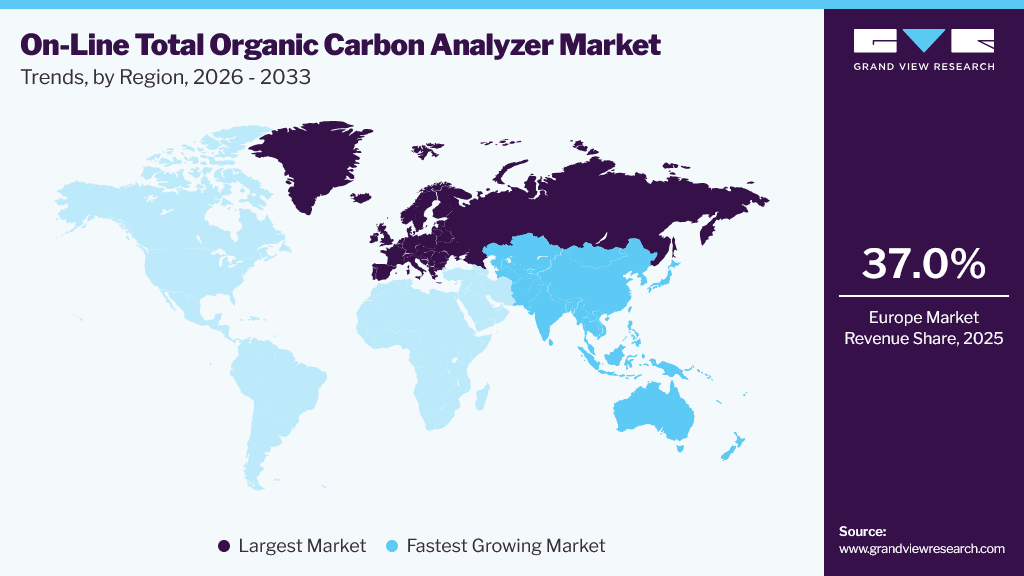
Europe dominated the market, accounting for over 37.0% of the market share in 2025. Europe's strong environmental regulations require strict monitoring of water quality, including organic carbon levels. On-line total organic carbon analyzers help industries comply with these rules effectively. Online Total Organic Carbon Analyzers support this framework by providing continuous, reliable data, enabling industries to meet these stringent standards effectively. Moreover, Europe's proactive approach to sustainability encourages industries to adopt advanced water-monitoring technologies, such as online total organic carbon analyzers. By facilitating compliance with regulatory requirements and promoting sustainable manufacturing practices, these technologies contribute significantly to Europe's efforts in environmental protection and resource conservation.
 To learn more about this report, Download Free Sample Report
In November 2024, the European Parliament formally adopted the revised Urban Wastewater Treatment Directive, introducing stricter monitoring and treatment requirements for wastewater facilities across the European Union. The updated legislation strengthens obligations related to water quality assessment, pollution control, and continuous monitoring of contaminants, driving greater demand for advanced analytical instruments such as on-line Total Organic Carbon (TOC) analyzers. These systems enable industrial and municipal operators to continuously monitor organic pollution levels, support regulatory compliance, and improve environmental performance, reinforcing Europe's leadership in the adoption of advanced water quality monitoring technologies.
U.S. On-Line Total Organic Carbon Analyzer Market Trends
The on-line total organic carbon analyzer market in the U.S. is expected to grow significantly over the forecast period. There is a growing emphasis on operational efficiency and cost reduction across various sectors such as pharmaceuticals, chemicals, and food and beverage. Online total organic carbon analyzers enable real-time monitoring, helping optimize processes, minimize downtime, and reduce operational costs in water treatment and quality control.
Asia Pacific On-Line Total Organic Carbon Analyzer Market Trends
The on-line total organic carbon analyzer market in the Asia Pacific is anticipated to register the fastest CAGR over the forecast period. As economies in the Asia Pacific experience rapid growth, industrial activity and urbanization are accelerating. This translates to a growing demand for clean water and increased wastewater generation. Online total organic carbon analyzers help monitor water quality in industrial processes and wastewater treatment facilities, ensuring compliance with environmental regulations. Water scarcity is a growing concern in many parts of the Asia Pacific. On-line total organic carbon analyzers contribute to sustainable water management by enabling efficient water treatment and minimizing waste. They help industries optimize water use and reduce the need for excessive treatment steps, thereby conserving water.
Key On-Line Total Organic Carbon Analyzer Company Insights
Prominent firms have used product launches and developments, followed by expansions, mergers and acquisitions, contracts, agreements, partnerships, and collaborations as their primary business strategy to increase their market share. The companies have used various techniques to enhance market penetration and boost their position in the competitive industry.
In April 2024, Beckman Colter Life Sciences launched the QbD1200+ Total Organic Carbon (TOC) Analyzer, expanding its portfolio of advanced water quality monitoring solutions for the pharmaceutical and biopharmaceutical industries. The analyzer features enhanced digital infrared sensing technology, automated system diagnostics, simplified validation, and compliance with major global pharmacopeial standards. This product launch reflects the industry's continued focus on innovation, regulatory compliance, and operational efficiency, demonstrating how leading companies are leveraging new product development strategies to strengthen their competitive position and expand market presence in the TOC analyzer market.
Key On-Line Total Organic Carbon Analyzer Companies
The following are the leading companies in the on-line total organic carbon analyzer market. These companies collectively hold the largest market share and dictate industry trends.
-
Analytik Jena GmbH+Co. KG
-
Endress+Hauser Group Services AG
-
Hach
-
HORIBA Tocadero
-
Process Insights, Inc.
-
Shimadzu Corporation
-
Swan Analytische Instrumente AG
-
Teledyne Tekmar
-
Veolia Water Technologies & Solutions (Veolia)
-
Xylem
Recent Developments
-
In May 2024, Beckman Colter Life Sciences, a U.S.-based provider of scientific instruments and solutions for research and healthcare diagnostics, launched the QbD1200+ Total Organic Carbon Analyzer. This advanced instrument uses digital infrared sensors for reliability and is ideal for pharmaceutical and biopharmaceutical applications. It enhances drug analysis with accurate results, regulatory compliance, and easy maintenance.
-
In March 2024, Analytik Jena GmbH+Co. KG, the provider of analytical and optical systems for industrial and scientific applications in Germany, launched the multi-N/C x300 series of TOC/TNb analyzers designed for high-throughput applications in the environmental and pharmaceutical sectors. This new series features robust hardware, intuitive software, and flexible automation options, ensuring reliable performance across a wide range of sample types and conditions.
On-Line Total Organic Carbon Analyzer Market Report Scope
Report Attribute
Details
Market size in 2025
USD 830.5 million
Estimated market size in 2026
USD 878.7 million
Projected market size by 2033
USD 1,300 million
Growth rate
CAGR of 5.8% from 2026 to 2033
Base year for estimation
2025
Historical data
2021 – 2024
Forecast period
2026 – 2033
Quantitative units
Revenue in USD million, and CAGR from 2026 to 2033
Report coverage
Revenue forecast, company ranking, competitive landscape, growth factors, and trends
Segments covered
Type, technology, end use, region
Regional scope
North America; Europe; Asia Pacific; Latin America; MEA
Country scope
U.S.; Canada; Mexico; UK; Germany; France; China; Japan; India; South Korea; Australia; Brazil; KSA; UAE; South Africa
Key companies profiled
Analytik Jena GmbH+Co. KG; Endress+Hauser Group Services AG; Hach; HORIBA Tocadero; Process Insights, Inc.; Shimadzu Corporation; Swan Analytische Instrumente AG; Teledyne Tekmar; Veolia Water Technologies & Solutions (Veolia); Xylem
Customization scope
Free report customization (equivalent up to 8 analysts working days) with purchase. Addition or alteration to country, regional & segment scope.
Pricing and purchase options
Avail of customized purchase options to meet your exact research needs. Explore purchase options
Global On-Line Total Organic Carbon Analyzer Market Report Segmentation
This report forecasts revenue growth at global, regional, and country levels and provides an analysis of the latest industry trends in each of the sub-segments from 2021 to 2033. For this study, Grand View Research has segmented the global on-line total organic carbon analyzer market report based on type, technology, end use, and region.
-
Type Outlook (Revenue, USD Million, 2021 - 2033)
-
Laboratory
-
Online
-
Portable
-
-
Technology Outlook (Revenue, USD Million, 2021 - 2033)
-
High Temperature Catalytic/Combustion Oxidation (HTCO)
-
Ultraviolet (UV) Oxidation
-
Wet-Oxidation Method
-
Others
-
-
End Use Outlook (Revenue, USD Million, 2021 - 2033)
-
Pharmaceutical
-
Food & Beverages
-
Chemicals
-
Oil and Gas
-
Energy and Power
-
Semiconductor
-
Others
-
-
Regional Outlook (Revenue, USD Million, 2021 - 2033)
-
North America
-
U.S.
-
Canada
-
Mexico
-
-
Europe
-
UK
-
Germany
-
France
-
-
Asia Pacific
-
China
-
Japan
-
India
-
South Korea
-
Australia
-
-
Latin America
-
Brazil
-
-
Middle East and Africa (MEA)
-
KSA
-
UAE
-
South Africa
-
-
Frequently Asked Questions About This Report
The global on-line total organic carbon analyzer market size was estimated at USD 764.0 million in 2023 and is expected to reach USD 802.6 million in 2024.
The global on-line total organic carbon analyzer market is expected to grow at a compound annual growth rate of 5.8% from 2024 to 2030 to reach USD 1.12 billion by 2030.
Europe dominated the on-line total organic carbon analyzer market with a share of 37.2% in 2023. This is attributable to the region's stringent data protection regulations, such as the General Data Protection Regulation (GDPR), and its advanced technological infrastructure, including high internet penetration rates and advanced data centers.
Some key players operating in the on-line total organic carbon analyzer market include Analytik Jena GmbH+Co. KG, Endress+Hauser Group Services AG, Hach, HORIBA Tocadero, Process Insights, Inc., Shimadzu Corporation, Swan Analytische Instrumente AG, Teledyne Tekmar, Veolia Water Technologies & Solutions (Veolia), Xylem.
Key factors that are driving the market growth include Key factors driving market growth include stringent data protection regulations, advanced technological infrastructure, increased adoption of automation, growing environmental concerns, and industrial growth.
About the Author(s)
Next Generation Technologies Research Team
Technology · Next Generation TechnologiesThis report was authored by the next generation technologies research team at Grand View Research - comprising two research analysts, one senior research analyst, and one industry expert - with specialized expertise in the next generation technologies segment of the technology industry. All findings are based on proprietary technology databases, executive interviews, and regulatory analysis, subject to internal peer review prior to publication.
Last Updated:
Speak to Analyst

Customize this report to your needs - add regions, segments, or data points, with 20% free customization.
Or view our licence options:


ISO 9001:2015 & 27001:2022 Certified
We are GDPR and CCPA compliant! Your transaction & personal information is safe and secure. For more details, please read our privacy policy.


