
- Home
- »
- Advanced Interior Materials
- »
-
Optical Glass Market Size And Share Report, 2026-2033GVR Report cover

Optical Glass Market (2026 - 2033)
Size, Share & Trends Analysis Report By Product (Crown Glass, Flint Glass, Specialty/High-Performance Glass), By Application (Consumer Optics, Medical Optics), By Region, And Segment Forecasts
Market Size, 2025
$1.7BMarket Estimate, 2026
$1.8BMarket Forecast, 2033
$2.7BCAGR, 2026–2033
5.5%Optical Glass Market Summary
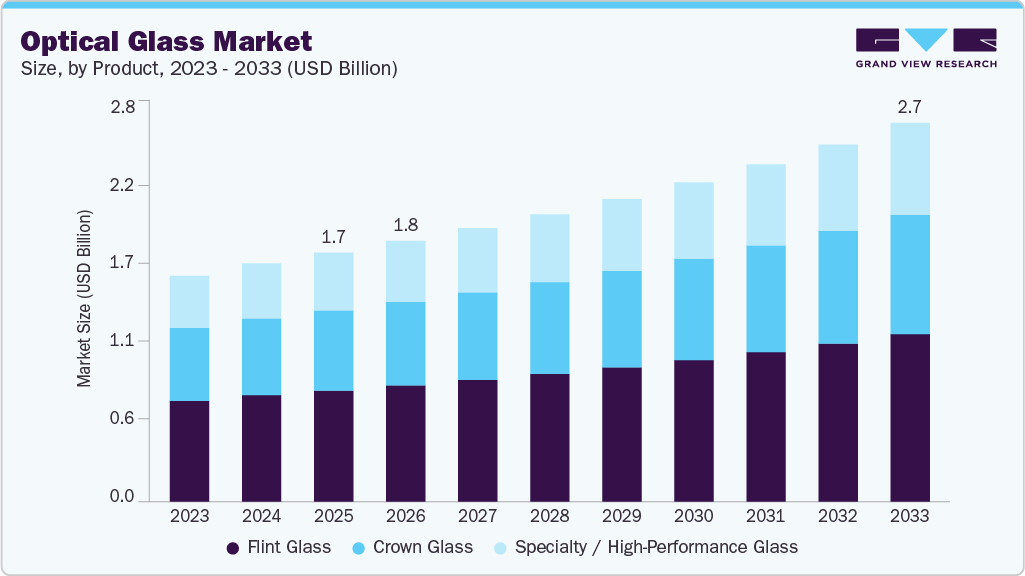
The global optical glass market size was valued at USD 1.7 billion in 2025 and is projected to grow from USD 1.8 billion in 2026 to USD 2.7 billion by 2033, at a CAGR of 5.5% from 2026 to 2033. The market in Asia Pacific dominated with a revenue share of 40.0% in 2025. Optical glass is a high-purity, precisely engineered glass used to transmit and refract light with minimal distortion in lenses, prisms, and other optical components.
 Source: Grand View Research, IR Documents, Primary Interviews, Paid DatabasesTo learn more about this report,
 Download Free Sample Report
 Key Market Trends & Insights
- By product: Flint glass segment held the largest market share of 44.0% in 2025.
- By application: Consumer optics segment held the largest market share of 38.0% in 2025.
Regional Highlights
- Largest regional market: Asia Pacific (40.0% revenue share, 2025)
Market Size & Forecast
- Market size in 2025: USD 1.7 Billion
- Estimated market size in 2026: USD 1.8 Billion
- Projected market size by 2033: USD 2.7 Billion
- CAGR (2026-2033): 5.5%
Three ways to get this report
Buy it, customize it, or ask a question.Ask an Analyst
A direct answer, usually in 1 working day
- AccessReport author, directly
- Reply timeWithin 1 working day
- No sales callDirect answer only
- FormatEmail reply
- CostFree, no cost
Get the Full Report
What the study covers
- FormatsPDF · Excel · Dashboard
- Timeline2026–2033 annual, 2025 base
- Coverage20+ countries, 5 regions
- Companies10+ key players profiled
Customize the Report
20% free customization
- IncludeCountries, segments, points
- TailorTo your product definition
- ExtendDeeper competitor detail
- OrA fully bespoke study
- Turnaround5–10 working days
The growth of the market is strongly driven by rising demand from consumer electronics, particularly smartphones, wearables, and high-resolution camera systems. As mobile devices increasingly adopt multi-lens camera modules, optical zoom, and advanced image stabilization, manufacturers require high-purity optical glass with superior transparency, low dispersion, and high refractive index performance. According to preliminary data from the International Data Corporation (IDC) Worldwide Quarterly Mobile Phone Tracker, global smartphone shipments increased 2.6% year-over-year (YoY) to 322.7 million units in the third quarter of 2025 (3Q25).The telecommunications and data center expansion is also significantly supporting optical glass consumption. Increasing internet penetration, 5G deployment, cloud computing, and AI-driven data processing are boosting the need for high-speed fiber optic networks and optical components. Optical glass is essential for producing high-performance lenses, prisms, filters, and fiber-related components used in transmission equipment, thereby creating consistent long-term demand across global infrastructure projects.
 To learn more about this report, Download Free Sample Report
 Healthcare and scientific instrumentation are further strengthening the market due to rising investments in advanced imaging and diagnostic equipment. Optical glass is widely used in microscopes, endoscopes, ophthalmic lenses, and surgical imaging systems where precision optics are essential. Growth in healthcare spending, increasing focus on early diagnosis, and rising vision-related disorders globally are accelerating the adoption of optical systems, which directly translates into higher demand for specialty optical glass.
Technological advancements in glass manufacturing and coating processes are also acting as a major growth catalyst. Innovations in low-loss glass materials, anti-reflective coatings, and lightweight optical glass designs are enabling better performance in high-end applications such as aerospace optics, defense systems, and precision industrial lasers. For instance, In April 2025 OHARA INC. announced the launch of PBM2R, a new radiation-resistant optical glass designed with a medium refractive index and high dispersion properties that significantly reduce coloration and loss of light transmission under irradiation, making this material suitable for use in optical components operating in intense radiation conditions such as outer space environments.
Drivers, Opportunities & Restraints
Rising demand for high-performance camera modules in smartphones, AR/VR headsets, and wearable devices is increasing the requirement for high-clarity, low-dispersion optical glass. In parallel, the automotive industry is accelerating the adoption of ADAS technologies such as LiDAR, infrared cameras, and head-up displays, all of which rely on precision optical components. In February 2026, Hyundai Mobis announced a strategic alliance with ZEISS, Tesa, and Saint-Gobain Sekurit to develop holographic windshield displays, leveraging high-precision optical glass for enhanced augmented reality experiences.
The major opportunities in the market are emerging from advanced technology applications such as autonomous vehicles, aerospace optics, defense surveillance systems, and high-end medical imaging. Increasing investments in laser-based industrial equipment, semiconductor manufacturing optics, and precision scientific instruments are creating demand for specialized optical glass with enhanced thermal stability and high refractive performance. Additionally, the growing penetration of AR/VR devices and smart optics for next-generation displays is expected to open strong long-term growth potential.
The key restraints impacting the optical glass market include high production costs, complex manufacturing processes, and volatility in raw material availability. Optical glass requires strict purity standards and advanced melting and forming techniques, which raise energy consumption and capital investment requirements.
Product Insights
Flint glass held the revenue share of over 44% in 2025. Flint glass refers to glass types with relatively high refractive indices and strong chromatic dispersion, resulting in a low Abbe number. In February 2025, NovaSklo announced plans to construct Ukraine's first flint glass manufacturing plant in the Kyiv region. These glasses historically contained significant lead oxide to raise density and dispersion, though modern formulations often substitute titanium or zirconium oxides to achieve similar optical performance while reducing environmental hazards. Typical refractive indices range roughly from 1.45 up to about 2.00, and the high dispersion of flint glass makes it a preferred choice for concave lens elements, prisms, and spectrometer components where wavelength separation or compact optical power is required.
Specialty/high-performance glass is anticipated to register the fastest CAGR over the forecast period, driven by the rising demand for advanced imaging and sensing systems across consumer electronics and industrial automation. In September 2025, SCHOTT showcased its high-performance specialty glass portfolio at SEMICON Taiwan 2025 (September 10 to 12, Taipei), featuring glass carrier wafers and panels for 3D IC packaging, wafer thinning, and FO-WLP/FO-PLP, while emphasizing reduced total thickness variation (TTV) to improve precision amid rising AI and high-performance computing demand.
Application Insights
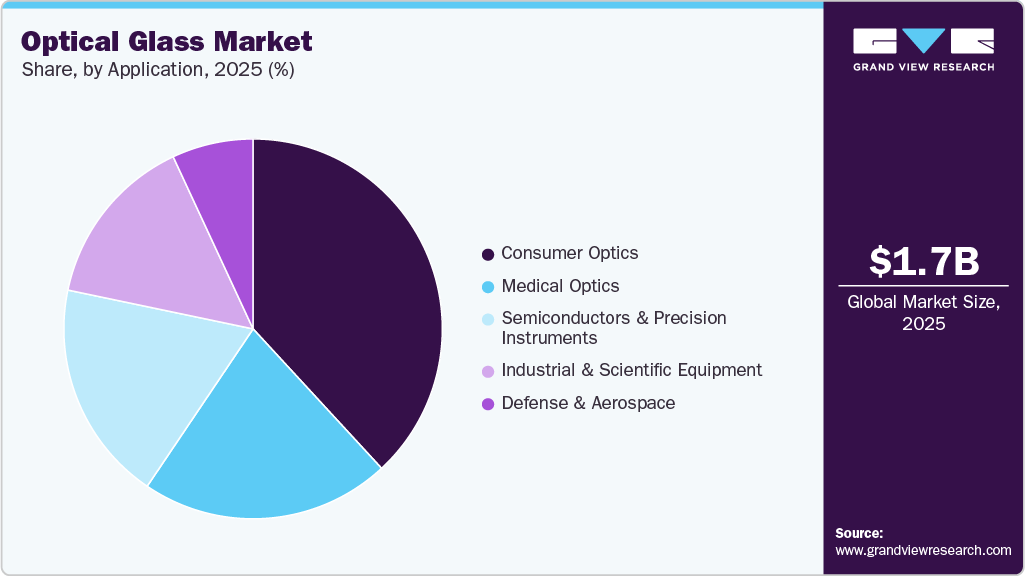
Consumer optics held the revenue share of over 38.0% in 2025. The growth of consumer optics is primarily driven by the rapid expansion of smartphone and wearable electronics production, where advanced camera modules have become a key differentiating feature. Modern smartphones increasingly integrate multi-camera setups, including wide-angle, telephoto, macro, and depth-sensing lenses, significantly increasing optical glass consumption per device. Optical glass is preferred in premium camera systems due to its superior light transmission, high scratch resistance, and better control of distortion compared to plastic optics.
 To learn more about this report, Download Free Sample Report
 The growth of the medical optics segment in the optical glass market is primarily driven by the increasing global demand for advanced diagnostic imaging and minimally invasive surgical procedures. Hospitals and diagnostic centers are investing heavily in high-precision optical systems for endoscopy, microscopy, surgical visualization, and ophthalmic imaging. Optical glass is critical in these devices because it provides high light transmission, superior image clarity, and low distortion, which are essential for accurate diagnosis and surgical precision.
Regional Insights
Asia Pacific Optical Glass Market Trends
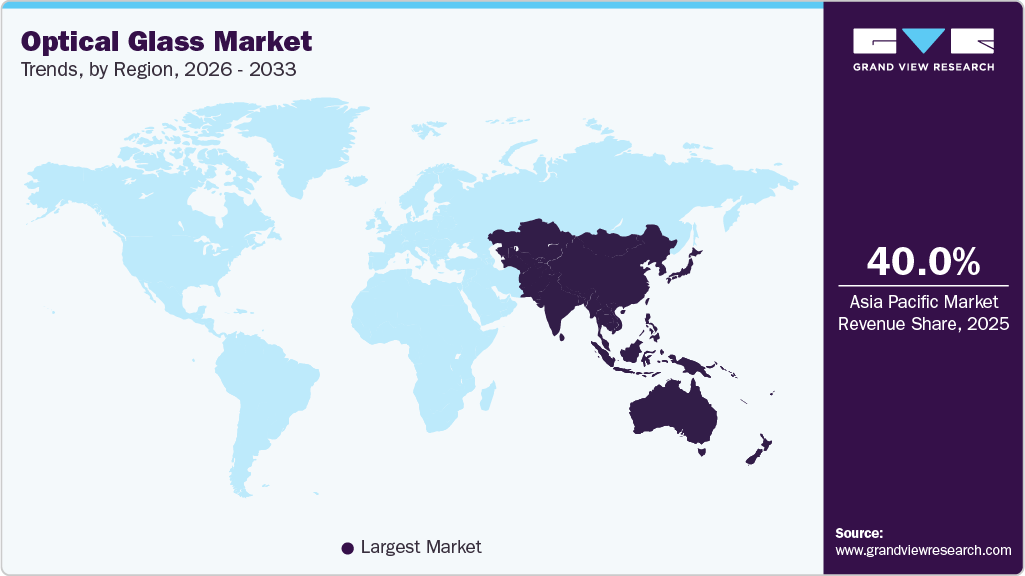
Asia Pacific accounted for the largest market revenue share of over 40.0% in 2025. The market in the Asia Pacific has been propelled by the rapid expansion of electronic and optical devices across consumer and industrial sectors. Rising demand for high-resolution cameras in smartphones, wearables, and automotive applications has fuelled the need for advanced optical components. Growth in sectors such as augmented reality, virtual reality, and smart surveillance systems has heightened the requirement for precision optical glass with superior clarity and refractive properties. Increasing investments in research and development to enhance performance and reduce manufacturing costs have further stimulated market expansion across key regional economies.
 To learn more about this report, Download Free Sample Report
 North America Optical Glass Market Trends
The market in North America is strongly driven by the region’s advanced defense, aerospace, and space technology ecosystem, where high-precision optical glass is essential for imaging, sensing, and navigation systems. For instance, optical glass lenses and prisms are widely used in military-grade night vision devices, infrared imaging systems, and surveillance optics deployed by defense contractors in the U.S. Additionally, NASA-related space exploration programs and private space companies continue to drive demand for radiation-resistant and high-transmission optical glass used in telescopes, satellite cameras, and optical payloads. The growing use of LiDAR and optical sensors in aerospace navigation and missile guidance systems further supports steady consumption of specialty optical glass across North America.
The U.S. optical glass market is significantly propelled by strong demand from the defense and aerospace sectors, where precision optics are critical for high-performance systems. For example, advanced night vision goggles, airborne targeting pods, and spaceborne telescopes all rely on specialized optical glass with high transmission and thermal stability. Projects led by government agencies like NASA and the Department of Defense continue to require custom optical components for satellites, space exploration instruments, and missile guidance systems, sustaining high consumption of silica-based and specialty glasses.
Europe Optical Glass Market Trends
In Europe, the market is driven by strong demand from the automotive and industrial automation sectors, where advanced optical components are crucial for safety and precision systems. For example, German and French automotive manufacturers are increasingly equipping vehicles with advanced driver assistance systems and LiDAR sensors, all of which depend on high-quality optical glass for accurate distance measurement and imaging. Optical glass is also essential in robotics and machine vision systems used in manufacturing hubs across Italy and the UK, where precision optics help improve product inspection, quality control, and automated operations.
Latin America Optical Glass Market Trends
The market in Latin America is gaining momentum as demand for advanced imaging and sensing technologies increases across key industries. For example, growing adoption of high-resolution camera modules in smartphones and consumer electronics in Brazil and Mexico has driven the need for precision optical glass with superior clarity and refractive properties. Surge in surveillance and security installations, particularly in urban centers, has further boosted demand for optical lenses and prisms used in CCTV and monitoring systems. In the industrial sector, machine vision systems used for quality control in manufacturing facilities rely on high-grade optical glass to deliver accurate imaging and measurement capabilities.
Key Optical Glass Company Insights
Some of the key players operating in the market include AGC Inc., Corning Incorporated, and others
-
AGC Inc. is a global materials company with roots extending over a century, recognized as one of the world’s largest glass manufacturers. It operates across the glass, electronics, chemicals, and ceramics segments, supplying products for architectural, automotive, and electronics applications, and maintains a presence in over 30 countries. In the optical glass sector, the company develops and mass-produces precision optical glass materials and lenses used in imaging systems, automotive cameras, optical communication devices, projectors, and sensing equipment.
-
Corning Incorporated is an American multinational technology firm with a legacy spanning more than 170 years, deeply rooted in materials science and glass innovation. The company’s diversified portfolio serves industries including optical communications, mobile electronics, displays, and life sciences. In the optical glass market, it is known for engineered specialty glass and optical fiber technologies, manufacturing high-performance optical fiber and cable connectivity solutions essential to telecommunications and data center infrastructure.
Key Optical Glass Companies:
The following key companies have been profiled for this study on the optical glass market.
- AGC Inc.
- Canon Inc.
- Carl Zeiss AG
- Corning Incorporated
- Edmund Optics Inc.
- HOYA Corporation
- Nikon Corporation
- Ohara Corporation
- SCHOTT AG
- Sumita Optical Glass Inc.
Recent Development
-
In November 2025, SCHOTT launched SCHOTT Solar Glass exos, a high-performance cover optical glass designed for next-generation space solar cells. Developed in partnership with AZUR SPACE Solar Power GmbH and funded by the European Space Agency (ESA), this cerium-doped glass offers superior radiation resistance, UV absorption, and optical stability for silicon to III-V multijunction cells used in satellites across LEO, MEO, and GEO orbits.
Optical Glass Market Report Scope
Report Attribute
Details
Market Definition
Optical glass market size represents the total annual revenue generated from sale of optical glass used for different applications.
Market size in 2025
USD 1.7 billion
Estimated Market size in 2026
USD 1.8 billion
Projected Market size by 2033
USD 2.7 billion
Growth rate
CAGR of 5.5% from 2026 to 2033
Base year for estimation
2025
Historical data
2021 - 2024
Forecast period
2026 - 2033
Quantitative Units
Revenue in USD million/billion, volume in kilotons, and CAGR from 2026 to 2033
Report coverage
Revenue & volume forecast, competitive landscape, growth factors, and trends
Segments covered
Product, application, and region
Regional scope
North America; Europe; Asia Pacific; Latin America; Middle East & Africa
Country scope
U.S.; Canada; Mexico; Germany; Italy; France; Russia; China; India; Japan; Brazil; Saudi Arabia, UAE
Key companies profiled
SCHOTT AG; Corning Incorporated; HOYA Corporation; Ohara Corporation; Sumita Optical Glass Inc.; Nikon Corporation; Canon Inc.; Carl Zeiss AG; AGC Inc.; Edmund Optics Inc.
Customization scope
Free report customization (equivalent up to 8 analysts working days) with purchase. Addition or alteration to country, regional & segment scope.
Pricing and purchase options
Avail customized purchase options to meet your exact research needs. Explore purchase options
Global Optical Glass Market Report Segmentation
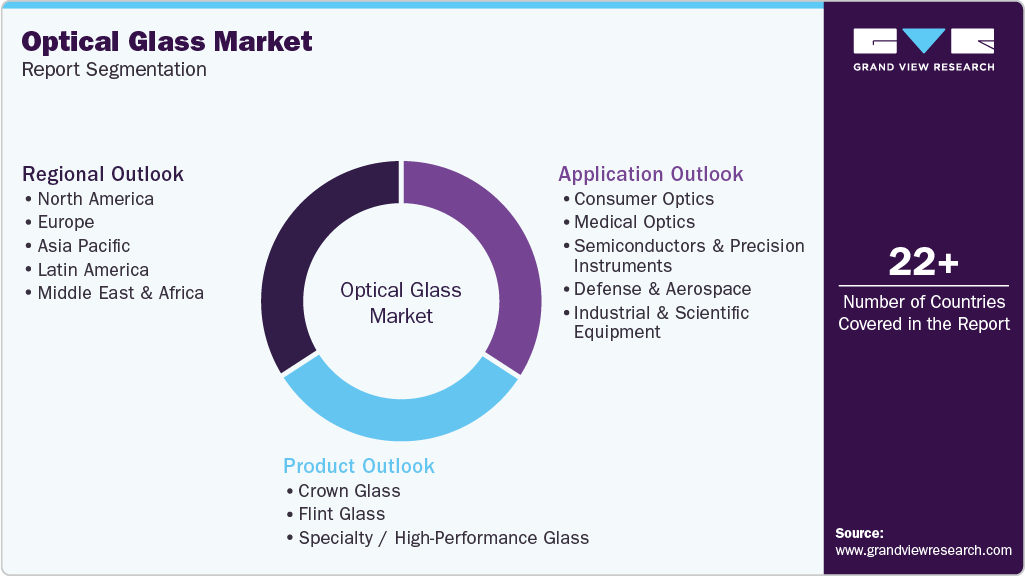
This report forecasts revenue and volume growth at global, regional, and country levels and provides an analysis of the latest industry trends in each of the sub-segments from 2021 to 2033. For the purpose of this study, Grand View Research has segmented the global optical glass market report on the basis of product, application, and region.
 To learn more about this report, Download Free Sample Report
 -
Product Outlook (Revenue, USD Million; Volume, Kilotons; 2021 - 2033)
-
Crown Glass
-
Flint Glass
-
Specialty / High-Performance Glass
-
-
Application Outlook (Revenue, USD Million; Volume, Kilotons; 2021 - 2033)
-
Consumer Optics
-
Medical Optics
-
Semiconductors & Precision Instruments
-
Defense & Aerospace
-
Industrial & Scientific Equipment
-
-
Regional Outlook (Revenue, USD Million; Volume, Kilotons; 2021 - 2033)
-
North America
-
U.S.
-
Canada
-
Mexico
-
-
Europe
-
Germany
-
Italy
-
France
-
Russia
-
-
Asia Pacific
-
China
-
India
-
Japan
-
-
Latin America
-
Brazil
-
-
Middle East & Africa
-
Saudi Arabia
-
UAE
-
-
Frequently Asked Questions About This Report
Flint glass segment led with a 44.0% revenue share in 2025, while specialty/high-performance glass is the fastest-growing segment.
Consumer optics segment held the highest market share of 38.0% in 2025.
The global optical glass market size was estimated at USD 1.7 billion in 2025 and is expected to reach USD 1.8 billion in 2026.
The global optical glass market is expected to grow at a compound annual growth rate of 5.5% from 2026 to 2033 to reach USD 2.7 billion by 2033.
Asia Pacific dominated with a 40.0% revenue share in 2025.
Some of the key players of the global optical glass market are SCHOTT AG, Corning Incorporated, HOYA Corporation, Ohara Corporation, Sumita Optical Glass Inc., Nikon Corporation, Canon Inc., Carl Zeiss AG, AGC Inc., Edmund Optics Inc., and others.
Key factors include the rising demand for high-precision optics in consumer electronics, medical imaging, automotive sensors, and advanced industrial applications.
About the Author(s)
Advanced Interior Materials Research Team
Advanced Materials · Advanced Interior MaterialsThis report was authored by the advanced interior materials research team at Grand View Research - comprising two research analysts, one senior research analyst, and one industry expert - with specialized expertise in the advanced interior materials segment of the advanced materials industry. All findings are based on proprietary advanced materials databases, executive interviews, and regulatory analysis, subject to internal peer review prior to publication.
Last Updated:
Speak to Analyst

Customize this report to your needs - add regions, segments, or data points, with 20% free customization.
Or view our licence options:


ISO 9001:2015 & 27001:2022 Certified
We are GDPR and CCPA compliant! Your transaction & personal information is safe and secure. For more details, please read our privacy policy.


