
- Home
- »
- Advanced Interior Materials
- »
-
Optical Sorter Market Size & Share, Industry Report, 2033GVR Report cover

Optical Sorter Market (2025 - 2033) Size, Share & Trends Analysis Report By Type (Cameras, NIR Sorters, Hyperspectral Cameras & Combined Sorters), By Platform (Freefall, Belt, Hybrid), By Application (Food & Beverages, Waste Recycling, Mining), By Region, And Segment Forecasts
Market Size, 2024
$2,626.7MMarket Estimate, 2026
$3,118.0MMarket Forecast, 2033
$5,726.6MCAGR, 2025–2033
9.1%Optical Sorter Market Summary
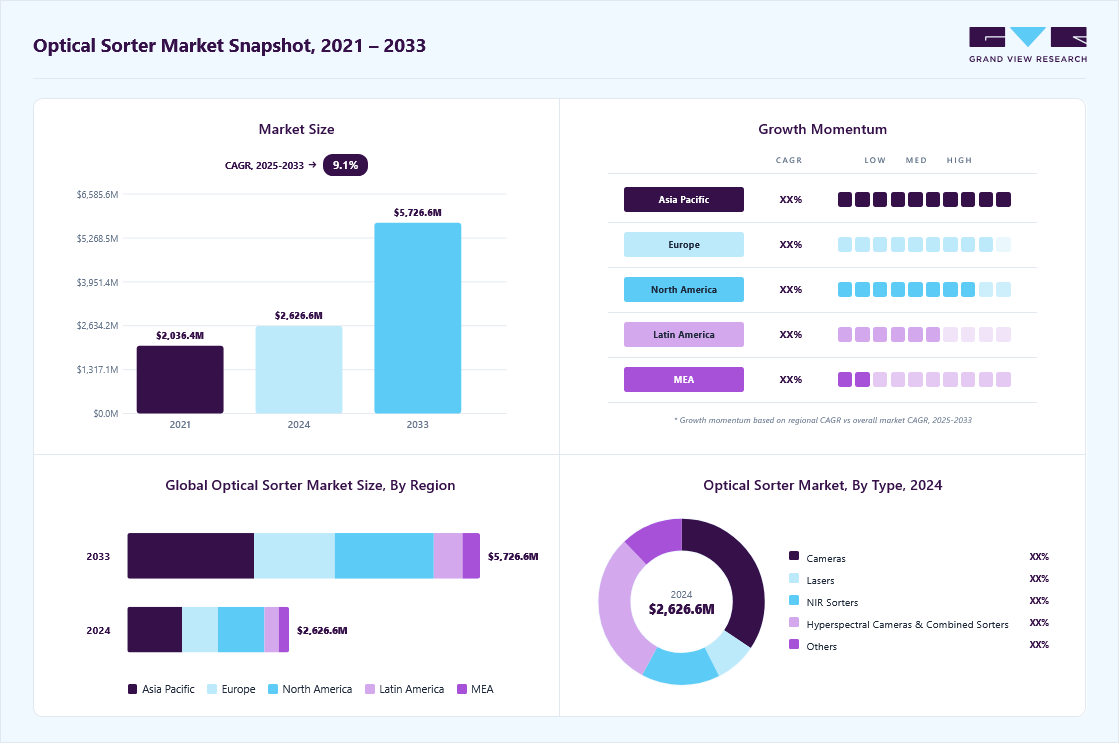
The global optical sorter market size was estimated at USD 2,626.7 million in 2024 and is projected to reach USD 5,726.6 million by 2033, growing at a CAGR of 9.1% from 2025 to 2033. The market growth is primarily driven by the increasing demand for automation and precision in sorting processes across industries such as food, recycling, and mining.
 Source: Grand View Research, IR Documents, Primary Interviews, Paid DatabasesTo learn more about this report,
 Download Free Sample Report
 Key Market Trends & Insights
- Asia Pacific dominated the optical sorter market with the largest revenue share of 33.9% in 2024.
- By type, the hyperspectral cameras & combined sorters segment is expected to grow at a considerable CAGR of 9.7% from 2025 to 2033 in terms of revenue.
- By platform, the hybrid segment is expected to grow at a considerable CAGR of 9.5% from 2025 to 2033 in terms of revenue.
- By application, the waste recycling segment is expected to grow at a considerable CAGR of 9.8% from 2025 to 2033 in terms of revenue.
Market Size & Forecast
- 2024 Market Size: USD 2,626.7 Million
- 2033 Projected Market Size: USD 5,726.6 Million
- CAGR (2025-2033): 9.1%
- Asia Pacific: Largest market in 2024
GVR research-powered AIAsk Prism AI about the optical sorter marketGet cited answers from GVR research on market growth, segments, regulations and forecasts.Start with✓ Source-linked answers ✓ Market-specific context ✓ Traceable figuresExplore Prism AI ↗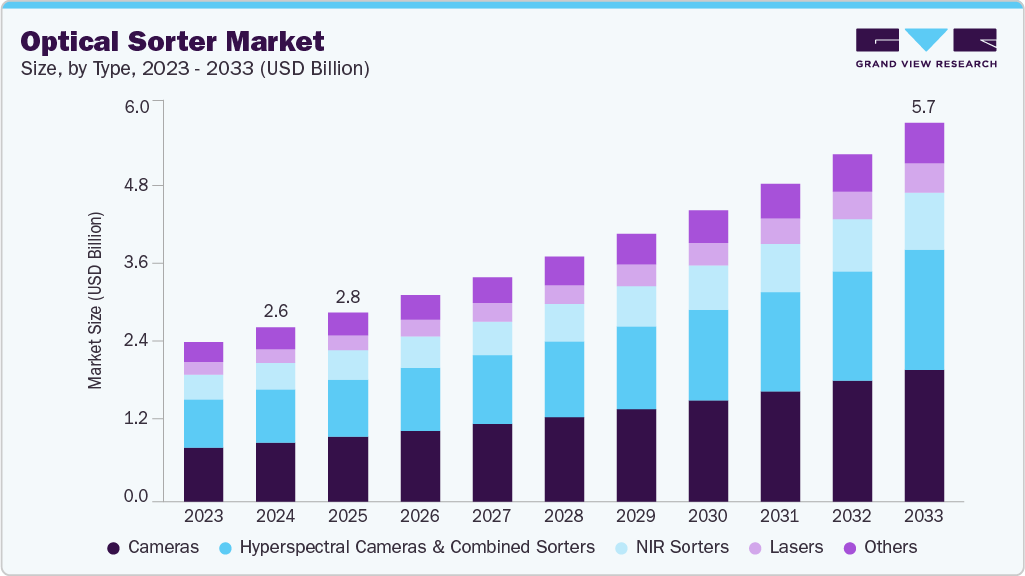 To learn more about this report, Download Free Sample Report
 As companies prioritize efficiency, waste reduction, and product quality, optical sorting systems using cameras, lasers, and sensors offer real-time, high-speed sorting based on color, shape, size, and composition. Technological advancements, including AI-powered sorting and hyperspectral imaging, are enhancing accuracy and expanding application areas. Developing economies are also investing in modernizing infrastructure, boosting market penetration.Additionally, the recycling industry’s shift toward cleaner material recovery is driving strong demand for optical sorters.
Market Dynamics
Increasing concerns regarding food contamination, product consistency, and export-quality standards are significantly driving the adoption of optical sorting systems in the food and beverage industry. Manufacturers are increasingly using advanced camera and sensor-based sorting technologies to identify defective, discolored, damaged, or contaminated food products with high precision. This helps companies comply with stringent food safety regulations, improve brand reputation, and reduce product recalls.
The growing global consumption of processed, packaged, and frozen foods, grains, nuts, and fresh produce is further accelerating demand for automated sorting equipment. Optical sorters improve operational efficiency, minimize manual inspection errors, and enhance throughput in food processing facilities. In developing economies, modernizing food processing infrastructure is also creating significant growth opportunities for the market.
One of the major challenges affecting the growth of the optical sorter market is the high initial investment associated with advanced sorting systems. Technologies such as hyperspectral imaging, NIR sensors, AI-enabled cameras, and laser-based sorting equipment require substantial capital expenditure for installation, integration, and system customization. Small and medium-sized enterprises, particularly in developing regions, often face difficulties in adopting these solutions due to budget limitations.
Market Concentration & Characteristics
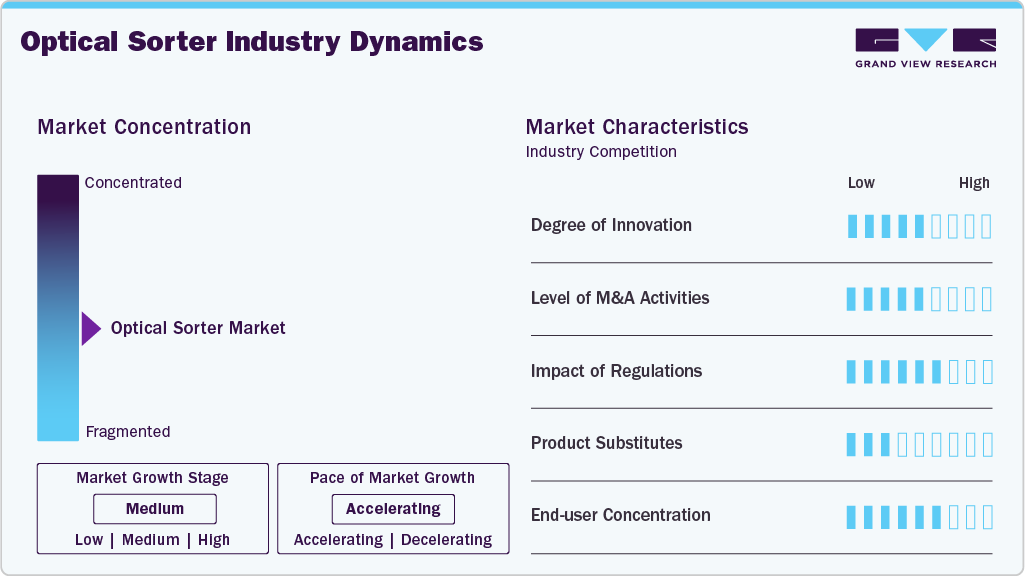
The optical sorter market is moderately fragmented, with several global and regional players competing based on technology, application, and service capabilities. While major companies dominate through innovation and broad distribution networks, smaller firms cater to niche markets with specialized solutions. Continuous technological advancements and evolving industry needs create opportunities for new entrants. However, high initial investment and technical expertise act as barriers, resulting in a market structure where both large corporations and agile regional players maintain a balanced competitive landscape.
The optical sorter industry shows a high degree of innovation, driven by advancements in AI, machine learning, hyperspectral imaging, and robotics. These technologies enhance sorting accuracy, speed, and adaptability across various materials. Continuous R&D investment is expanding application scope, enabling smarter, more efficient systems that meet the evolving demands of industries like food processing, recycling, and mining.
 To learn more about this report, Download Free Sample Report
 Merger and acquisition activities in the market are reshaping the competitive landscape. Leading companies are acquiring regional players and tech startups to expand portfolios, enter new markets, and gain access to advanced technologies. These strategic moves help consolidate market positions, drive innovation, and address growing global demand for efficient, automated sorting solutions across industries.
Regulations emphasizing food safety, recycling efficiency, and environmental compliance are significantly influencing the optical sorter market. Governments worldwide are enforcing strict standards for contamination control and waste reduction, pushing industries to adopt automated sorting solutions. Compliance requirements drive demand for high-precision systems, shaping product development and encouraging faster adoption of advanced optical sorting technologies.
Type Insights
The camera segment led the optical sorter market with a revenue share of 34.3% in 2024, due to their widespread use in food, recycling, and packaging industries. These systems offer accurate color and shape detection, making them ideal for high-speed sorting. Their affordability, reliability, and continual enhancements in image processing drive increased adoption across both developed and emerging markets.
Hyperspectral cameras & combined sorters are emerging as the fastest-growing type, driven by rising demand for precision and material-specific sorting. These systems analyze spectral signatures to detect chemical composition, enabling superior sorting accuracy. They're increasingly used in complex applications like recycling and food safety, where contamination detection and purity are critical, boosting their market penetration.
Platform Insights
The belt segment continues to dominate the optical sorter industry, with the segment accounting for a revenue share of 42.1% in 2024. This can be attributed to their high-speed processing, stable material presentation, and suitability for bulk sorting. Widely used in food and recycling industries, belt sorters support efficient, continuous operations and integrate easily with advanced imaging systems, making them ideal for large-scale, high-throughput applications requiring precision.
The hybrid platform segment is projected to grow rapidly over the forecast period, as industries seek more flexible and accurate sorting solutions. Combining features of different sorting technologies, hybrid systems enhance sorting precision and versatility across various material types. Their adaptability to complex sorting environments, especially in food processing and recycling, makes them a preferred choice for businesses prioritizing efficiency and quality control.
Application Insights
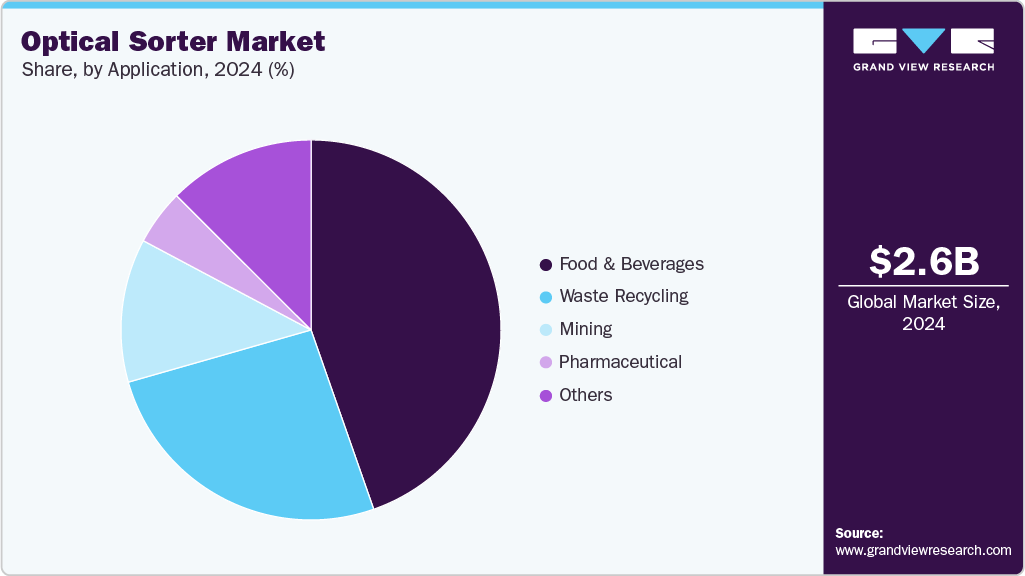
The food and beverages sector dominated the optical sorter market and accounted for a share of 44.6% in 2024, due to rising demand for quality control, food safety, and compliance with strict hygiene regulations. Optical sorters help detect defects, foreign materials, and contaminants, ensuring consistent product quality and reducing waste. Increasing automation in food processing further boosts segment growth.
 To learn more about this report, Download Free Sample Report
 The waste recycling segment is projected to expand rapidly during the forecast period, as global sustainability efforts and strict environmental regulations drive demand for efficient material recovery. Optical sorters enable accurate separation of plastics, metals, glass, and paper, improving recycling rates and reducing landfill use. Growing urbanization and circular economy initiatives are accelerating adoption across municipal and industrial recycling facilities.
Regional Insights
The North America optical sorter market is expected to grow at a significant CAGR of 8.8% over the forecast period, driven by strong automation adoption in food processing, strict food safety regulations, and expanding recycling infrastructure. The U.S. leads in deploying new systems while Canada and Mexico are catching up. Regulatory mandates and labor shortages accelerate demand for high-throughput, AI-enabled sorters.
U.S. Optical Sorter Market Trends
In the U.S., market growth is supported by USDA and FDA regulations, strict food industry quality standards, and growing investment in recycling facilities. Companies are upgrading to advanced sorters with hyperspectral and AI capabilities to meet compliance and efficiency demands. Automation, labor shortages, and sustainability initiatives further push the adoption of optical sorting technologies.
The Mexico optical sorter market is witnessing moderate growth in terms of optical sorter adoption. This growth of the regional market is influenced by modernization in food and agricultural processing, and improvements in waste management. Cross-border trade and regulatory influence from North America are helping raise standards.
Europe Optical Sorter Market Trends
Europe’s optical sorter industry is growing rapidly, fueled by strict environmental policies, circular economy goals, and high food safety standards. EU recycling mandates are driving advanced sorting technology adoption. Countries like Germany, the UK, and France are leading the way, integrating AI and sensor-based sorters to meet both environmental and product quality regulations.
The Germany optical sorter market is expected to grow over the forecast period. Germany is expanding its optical sorter usage across the food and recycling industries, supported by strong environmental regulations and a culture of industrial innovation. The country’s well-established recycling infrastructure and high standards for food quality encourage the adoption of AI-powered and hyperspectral sorting systems. German manufacturers are also innovating for export, strengthening the local market further.
The optical sorter market in the UK is growing as industries respond to stricter food safety laws, recycling regulations, and sustainability goals. Recycling facilities are investing in advanced sorters to meet purity targets. Additionally, the food sector is adopting optical sorters to improve product consistency and reduce labor dependency in the face of workforce shortages.
Asia Pacific Optical Sorter Market Trends
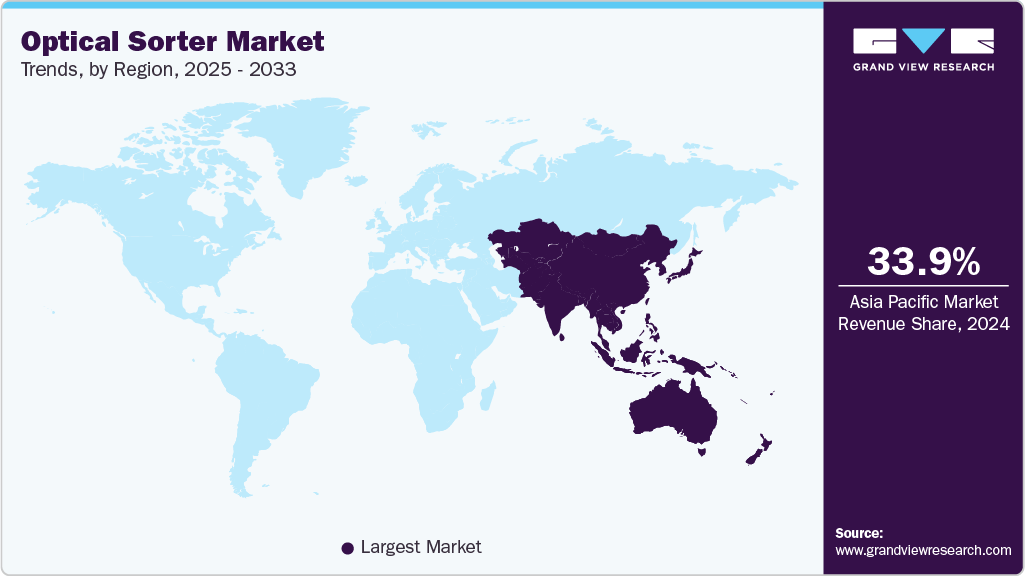
Asia Pacific led the optical sorter industry and accounted for a revenue share of 33.9% in 2024, driven by rapid industrialization, population growth, and increasing focus on waste and food quality management. Countries like China, India, and Japan are leading the adoption. Government initiatives promoting automation and environmental standards are accelerating the use of intelligent, high-speed sorting technologies.
 To learn more about this report, Download Free Sample Report
 China’s optical sorter market is expanding due to strict national recycling targets, industrial automation goals, and rising demand for higher product quality. The government is incentivizing modernization in sorting systems through policies supporting cleaner production. Domestic manufacturers are developing competitive technologies, while adoption grows across recycling, agriculture, and food processing industries.
The optical sorter market in India is experiencing strong growth, driven by expansion in food processing, waste management, and government-backed modernization programs. Increased awareness about product quality and food safety, coupled with a growing middle class, is fueling demand. Domestic industries are gradually adopting optical sorters to reduce waste and improve operational efficiency.
Middle East & Africa Optical Sorter Market Trends
The Middle East and Africa region is an emerging market for optical sorters, with growth supported by increasing urbanization, waste management needs, and industrial diversification. Governments are beginning to invest in food safety and recycling infrastructure. While adoption is still developing, rising awareness and economic diversification efforts are expected to boost future demand.
The Saudi Arabia optical sorter market is leading the Middle East, supported by its Vision 2030 plan focused on sustainability and industrial modernization. Growing investments in food processing and waste management are driving demand for high-efficiency sorters. Environmental goals and a shift toward smart infrastructure are creating new opportunities in sorting technologies.
Latin America Optical Sorter Market Trends
Latin America is seeing steady growth in the optical sorter industry, especially in the food and recycling sectors. Countries like Brazil and Mexico lead regional adoption. Growing environmental awareness, modernization of agricultural processing, and recycling reforms are key drivers. However, challenges like high equipment costs and limited technical skills slightly hinder rapid expansion.
The optical sorter market in Brazil is leading Latin America, especially in food sectors like coffee, fruit, and grains. The country's recycling efforts are also improving, with investments in automated sorting plants. Government support and increased private investment are encouraging adoption, despite challenges related to infrastructure and high capital costs.
Key Optical Sorter Company Insights
Some of the key players operating in the market include Binder+Co, Mesutronic GmbH, and TOMRA Systems ASA.
- Binder+Co is an Austrian company specializing in environmental and processing technology, particularly in the fields of recycling, glass processing, and bulk material handling. It is well-regarded for its advanced optical sorting systems, which use innovative sensor and camera technologies. Binder+Co’s solutions focus on efficiency, precision, and sustainability, making them a preferred choice in waste management and raw material recovery sectors.
- Bühler, headquartered in Switzerland, is a processing technology company, especially for food, feed, and advanced materials. In the optical sorter market, Bühler is renowned for its high-performance sorters used in food safety and quality control. Its SORTEX range uses AI, hyperspectral imaging, and precision sensors to deliver reliable, hygienic, and efficient sorting, helping industries meet strict quality and regulatory standards.
Key Optical Sorter Companies:
The following are the leading companies in the optical sorter market. These companies collectively hold the largest market share and dictate industry trends.
- Binder+Co
- Bühler
- TOMRA Systems ASA
- Cimbria
- Satake Corporation
- Key Technology
- Sesotec GmbH
- STEINERT GmbH
- Allgaier Werke GmbH
- Hefei Meyer Optoelectronic Technology Inc.
- Pellenc ST
- Raytec Vision S.p.A.
- Mesutronic GmbH
- RealTech Machinery Co., Ltd.
- MSS Inc.
Competitive Benchmarking
Operating Strategies
Competitive Edge
Weaknesses
Mature Players: TOMRA Systems ASA, Bühler, Satake Corporation, Key Technology, STEINERT GmbH
- Mature players focus on technological innovation, global expansion, and strategic partnerships.
- They invest in AI-enabled sorting systems, automation, and advanced sensor technologies to strengthen market leadership and improve operational efficiency.
- These companies benefit from strong brand recognition, broad distribution networks, and advanced R&D capabilities.
- Their diversified product portfolios and strong after-sales support provide a competitive advantage across multiple industries.
- High product costs and significant capital requirements can limit adoption among small and medium-sized enterprises.
- Large organizational structures may also reduce flexibility and slow response to changing market conditions.
Emerging Players: Hefei Meyer Optoelectronic Technology Inc., Raytec Vision S.p.A., MSS Inc., RealTech Machinery Co., Ltd.
- Emerging players mainly focus on cost-effective solutions, regional expansion, and customized applications.
- They increasingly adopt AI and smart imaging technologies to improve competitiveness in developing markets.
- These companies benefit from competitive pricing, operational flexibility, and faster adoption of new technologies.
- Their ability to offer customized solutions supports growth in niche and regional markets.
- Emerging players often face limited global presence, lower brand recognition, and smaller R&D budgets.
- Restricted service networks and strong competition from established companies may impact long-term growth.
Recent Developments
-
In September 2025, Tomra Food launched the Tomra 4C, its advanced AI-powered optical sorter, designed for nut and IQF food processors. The system enhances product quality and operational efficiency through precise sorting, using advanced sensors and AI to detect defects and foreign materials.
-
In June 2025, Satake launched the Pellet Sorter II, an advanced optical sorting machine specifically designed for plastic pellets. Developed in Hiroshima, Japan, the sorter offers high-precision detection and removal of defective pellets, improving product quality and efficiency in plastic manufacturing and recycling processes.
Optical Sorter Market Report Scope
Report Attribute
Details
Market size value in 2025
USD 2,861.4 million
Revenue forecast in 2033
USD 5,726.6 million
Growth rate
CAGR of 9.1% from 2025 to 2033
Historical data
2021 - 2023
Forecast period
2025 - 2033
Quantitative units
Revenue in USD million/billion and CAGR from 2025 to 2033
Report coverage
Revenue forecast, company ranking, competitive landscape, growth factors, and trends
Segments covered
Type, platform, application, region
Regional scope
North America; Europe; Asia Pacific; Latin America; Middle East & Africa
Country scope
U.S.; Canada; Mexico; UK; Germany; France; Spain; Italy; China; Japan; India; Australia; South Korea; Brazil; Argentina; Saudi Arabia; South Africa; UAE
Key companies profiled
Binder+Co; Bühler; TOMRA Systems ASA; Cimbria; Satake Corporation; Key Technology; Sesotec GmbH; STEINERT GmbH; Allgaier Werke GmbH; Hefei Meyer Optoelectronic Technology Inc.; Pellenc ST; Raytec Vision S.p.A.; Mesutronic GmbH; RealTech Machinery Co., Ltd.; MSS Inc.
Customization scope
Free report customization (equivalent up to 8 analysts working days) with purchase. Addition or alteration to country, regional & segment scope.
Pricing and purchase options
Avail customized purchase options to meet your exact research needs. Explore purchase options
Global Optical Sorter Market Report Segmentation
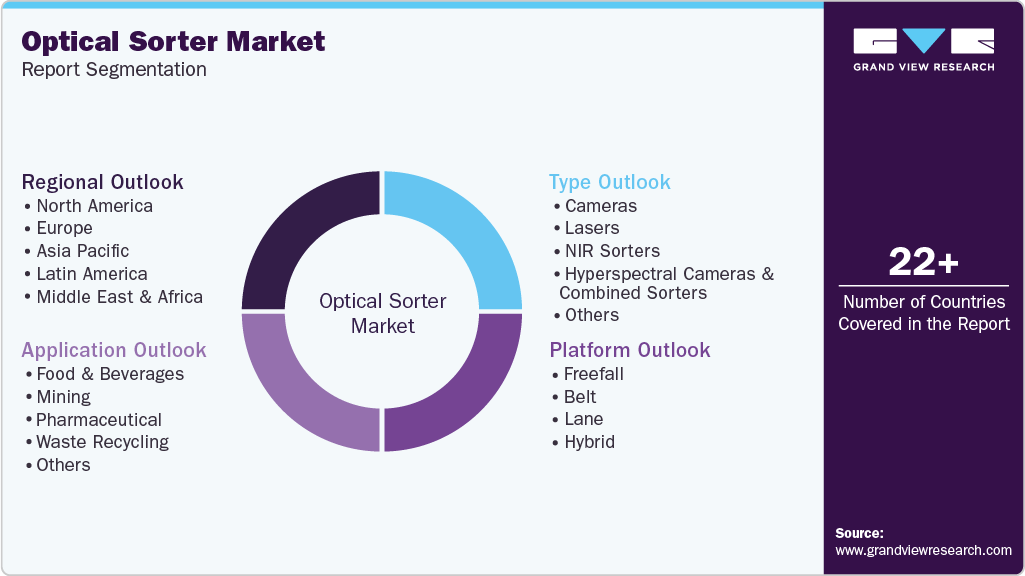
This report forecasts revenue growth at the global, regional, and country levels and provides an analysis of the latest industry trends in each of the sub-segments from 2021 to 2033. For this study, Grand View Research has segmented the global optical sorter market report based on type, platform, application, and region:
 To learn more about this report, Download Free Sample Report
 -
Type Outlook (Revenue, USD Million, 2021 - 2033)
-
Cameras
-
Lasers
-
NIR Sorters
-
Hyperspectral Cameras & Combined Sorters
-
Others
-
-
Platform Outlook (Revenue, USD Million, 2021 - 2033)
-
Freefall
-
Belt
-
Lane
-
Hybrid
-
-
Application Outlook (Revenue, USD Million, 2021 - 2033)
-
Food and Beverages
-
Mining
-
Pharmaceutical
-
Waste Recycling
-
Others
-
-
Regional Outlook (Revenue, USD Million, 2021 - 2033)
-
North America
-
U.S.
-
Canada
-
Mexico
-
-
Europe
-
Germany
-
France
-
Italy
-
Spain
-
UK
-
-
Asia Pacific
-
China
-
India
-
Japan
-
South Korea
-
Australia
-
-
Latin America
-
Brazil
-
Argentina
-
-
Middle East and Africa
-
Saudi Arabia
-
UAE
-
South Africa
-
-
Delivered Customizations
This report has been delivered with the following In-depth customizations
Client Request
Customization Delivered
Value Adds
Regional Segmentation
A detailed regional assessment was developed covering North America, Europe, Asia Pacific, Latin America, and the Middle East & Africa, with insights into country-level demand patterns, growth potential, regulatory environment, technology adoption trends, and competitive intensity within the optical sorter market.
The customized regional insights helped the client identify priority markets for expansion, evaluate regional growth potential, and understand localized industry dynamics, thereby strengthening strategic decision-making.
Opportunity Assessment
An in-depth opportunity analysis was prepared focusing on emerging application areas, evolving automation trends, sustainability initiatives, and increasing adoption of AI- and sensor-based sorting technologies. The study further evaluated high-growth end-use industries, investment hotspots, and future revenue pockets across developed and developing markets.
The assessment enabled the client to recognize attractive business opportunities, prioritize high-growth segments, and align future investments with evolving market demand and technology trends.
Competitive Benchmarking
Detailed benchmarking of leading optical sorter manufacturers based on product portfolio, technology capabilities, positioning, regional presence, automation integration, AI-enabled sorting capabilities, partnerships, and strategic initiatives.
Enable competitive intelligence and strategic differentiation. Support product positioning, partnership identification, and innovation benchmarking. Assist stakeholders in evaluating market leadership and competitive gaps.
Frequently Asked Questions About This Report
The global optical sorter market size was estimated at USD 2,626.7 million in 2024 and is expected to be USD 2,861.4 million in 2025.
The global optical sorter market, in terms of revenue, is expected to grow at a compound annual growth rate of 9.1% from 2025 to 2033 to reach USD 5,726.6 million by 2033.
Food and Beverages segment continues to dominate the market and accounted for a share of 44.6% in 2024, due to rising demand for quality control, food safety, and compliance with strict hygiene regulations. Optical sorters help detect defects, foreign materials, and contaminants, ensuring consistent product quality and reducing waste.
Some of the key players operating in the global optical sorter market include Binder+Co, Bühler, TOMRA Systems ASA, Cimbria, Satake Corporation, Key Technology, Sesotec GmbH, STEINERT GmbH, Allgaier Werke GmbH, Hefei Meyer Optoelectronic Technology Inc., Pellenc ST, Raytec Vision S.p.A., Mesutronic GmbH, RealTech Machinery Co., Ltd., MSS Inc.
Key factors driving the global optical sorter market include rising demand for automation, strict food safety and quality regulations, growth in recycling and waste management, and advancements in AI and sensor technologies enabling faster, more accurate, and efficient sorting across various industries.
About the Author(s)
Advanced Interior Materials Research Team
Advanced Materials · Advanced Interior MaterialsThis report was authored by the advanced interior materials research team at Grand View Research - comprising two research analysts, one senior research analyst, and one industry expert - with specialized expertise in the advanced interior materials segment of the advanced materials industry. All findings are based on proprietary advanced materials databases, executive interviews, and regulatory analysis, subject to internal peer review prior to publication.
Last Updated:
Speak to Analyst

Customize this report to your needs - add regions, segments, or data points, with 20% free customization.
Or view our licence options:


ISO 9001:2015 & 27001:2022 Certified
We are GDPR and CCPA compliant! Your transaction & personal information is safe and secure. For more details, please read our privacy policy.


