
- Home
- »
- Medical Devices
- »
-
Oral Irrigator Market Size, Share & Trends Report, 2026-2033GVR Report cover

Oral Irrigator Market (2026 - 2033)
Size, Share & Trends Analysis Report By Product (Countertop, Cordless / Handheld), By Clinical Indication (Orthodontics, Periodontal care), By Distribution Channel, By Pricing Tier, By Technology Feature, By End Use, By Region, And Segment Forecasts
Market Size, 2025
$1.5BMarket Estimate, 2026
$1.6BMarket Forecast, 2033
$2.5BCAGR, 2026–2033
7.8%Oral Irrigator Market Summary
The global oral irrigator market size was valued at USD 1.5 billion in 2025 and is projected to grow from USD 1.6 billion in 2026 to USD 2.5 billion by 2033, at a CAGR of 7.8% from 2026 to 2033. North America dominated the oral irrigator market, accounting for the largest revenue share of 34.7% in 2025. The prevalence of dental problems is increasing due to factors such as changing dietary and lifestyle habits, congenital conditions, unhealthy eating patterns, and limited access to proper dental care.
 Source: Grand View Research, IR Documents, Primary Interviews, Paid DatabasesTo learn more about this report,
 Download Free Sample Report
Key Market Trends & Insights
- By product: Countertop segment held the largest market share of 42.5% in 2025.
- By clinical indication: General hygiene segment held the largest market share of 50.4% in 2025.
- By distribution channel: E-commerce marketplaces segment held the largest market share of 33.3% in 2025.
- By pricing tier: Mid-range segment held the largest market share of 45.4% in 2025.
Regional Highlights
- Largest regional market: North America (34.7% revenue share, 2025)
- Fastest-growing regional market: Asia Pacific (highest CAGR, 2026-2033)
- By country: The U.S. held the largest market share in 2025
Market Size & Forecast
- Market size in 2025: USD 1.5 Billion
- Estimated market size in 2026: USD 1.6 Billion
- Projected market size by 2033: USD 2.5 Billion
- CAGR (2026-2033): 7.8%
Three ways to get this report
Buy it, customize it, or ask a question.Ask an Analyst
Analyst response in 1 business day
- AccessReport author, directly
- Reply timeWithin 1 working day
- No sales callDirect answer only
- FormatEmail reply
- CostFree, no cost
Get the Full Report
What the study covers
- FormatsPDF · Excel · Dashboard
- Timeline2026–2033 annual, 2025 base
- Coverage20+ countries, 5 regions
- Companies10+ key players profiled
Customize the Report
20% free customization
- IncludeCountries, segments, points
- TailorTo your product definition
- ExtendDeeper competitor detail
- OrA fully bespoke study
- Turnaround5–10 working days
The rising incidence of dental caries and tooth decay, particularly among the pediatric population, is contributing to market growth. In addition, the growing occurrence of congenital abnormalities, such as cleft lip, is driving demand for advanced oral care solutions such as oral irrigators. Furthermore, certain medications, including verapamil and phenytoin, are associated with oral health issues such as gingivitis, further supporting the need for effective dental hygiene products. To learn more about this report, Download Free Sample Report
The rising global burden of oral diseases is a major factor driving the growth of the oral irrigator market, as it increases the need for more effective and advanced oral hygiene solutions. For instance, in March 2025, according to the World Health Organization (WHO), oral diseases affect nearly 3.7 billion people worldwide, highlighting a vast target population in need of effective oral hygiene solutions. The widespread prevalence of dental conditions such as tooth decay, gum disease, and oral infections is a key driver for the growth of the oral irrigator market. As the global burden of oral health issues continues to rise, consumers are gradually seeking advanced and efficient cleaning technologies beyond traditional brushing and flossing. Oral irrigators offer improved plaque removal, better gum care, and enhanced cleaning in hard-to-reach areas, making them particularly suitable for individuals with recurring dental problems.
The high prevalence of severe periodontal (gum) diseases is a significant factor driving the growth of the oral irrigator market, as it increases the demand for effective daily oral care and preventive solutions. For instance, in March 2025, according to the WHO, Severe periodontal (gum) diseases impact over 1 billion cases globally. This high prevalence reflects the increasing burden of advanced gum conditions caused by poor oral hygiene, aging populations, smoking, and rising cases of chronic diseases such as diabetes. As periodontal diseases can lead to tooth loss and other serious health complications if left untreated, there is a growing emphasis on effective daily oral care and early prevention. The increasing awareness of gum health is boosting the adoption of both oral irrigators and dental flossers, as consumers seek more efficient and convenient solutions for plaque removal, interdental cleaning, and long-term periodontal care.
The oral irrigator industry is also growing due to increasing consumer demand for convenient, effective, and user-friendly flossing alternatives. Rising awareness of gum health, coupled with a shift toward preventive oral care, is encouraging consumers to adopt advanced flossing solutions that are easier to use than traditional string floss. For instance, in August 2025, Oclean launched the Oclean A10 Water Flosser, a compact and portable device designed to simplify and enhance daily flossing. The product features AirPump technology using 98% air and 2% water, delivering an effective, gentle, and mess-free cleaning experience with a single-fill reservoir for full-session use. Such innovations directly support the key market driver by simplifying daily flossing and enhancing user experience, thereby encouraging wider consumer uptake of oral irrigators.
Market Dynamics
The oral irrigator market is growing, driven by increasing awareness of advanced oral hygiene practices and a rising preference for effective at-home dental care solutions. Growing concerns about gum disease, plaque buildup, and overall periodontal health are prompting consumers to adopt oral irrigators as a more efficient alternative to traditional flossing methods. The market is further supported by strong recommendations from dental professionals and a broader shift toward preventive dental care. Continuous technological advancements, such as cordless designs, adjustable pressure controls, rechargeable systems, and improved portability, are enhancing product convenience and boosting consumer adoption. In addition, the growing influence of e-commerce platforms is improving product accessibility and availability across diverse regions.
The increasing prevalence of gum diseases, plaque buildup, and periodontal conditions is significantly driving the growth of the oral irrigator market by creating a strong need for more effective and convenient oral hygiene solutions. As a large portion of the population experiences issues such as gingivitis, bleeding gums, and periodontal infections, consumers are becoming more proactive in adopting advanced dental care devices that can reach areas often missed by traditional brushing and flossing. Oral irrigators are gaining preference because they use targeted water pressure to remove food debris and reduce bacterial accumulation along the gum line, thereby improving gum health. This growing health burden, combined with rising awareness about the importance of preventive oral care, is encouraging both patients and dental professionals to recommend oral irrigators as a daily hygiene tool.
“Gum diseases are among the most common health conditions worldwide. They often begin silently, with symptoms such as bleeding gums or persistent bad breath that are easy to ignore,” explains Professor Spyros Vassilopoulos, EFP past president and chair of the federation's communication & engagement committee.
• According to data published by the European Federation of Periodontology in 2026, severe gum disease is a major global health issue affecting more than 1 billion people worldwide. According to the World Health Organization, oral diseases, including periodontitis, affect approximately 3.7 billion people globally.
The high initial cost of oral irrigators relative to traditional oral hygiene products is a key restraint on market growth, limiting adoption among price-sensitive consumers. Many individuals still prefer low-cost alternatives such as toothbrushes, dental floss, and interdental brushes, which are widely accessible and require minimal investment. As oral irrigators are perceived as premium or non-essential devices, the upfront purchase cost often discourages first-time buyers, especially in developing and emerging markets where disposable income levels may be lower. This price barrier slows mass-market penetration and primarily restricts adoption to urban and higher-income populations. In addition, when combined with the availability of cheaper substitutes that already fulfill basic oral hygiene needs, the cost factor further reduces the urgency to switch to advanced oral irrigator devices.
Technological advancement in oral irrigators is creating significant opportunities for market growth by enhancing product efficiency, usability, and consumer appeal. Innovations such as adjustable pressure control, improved pulsation technology, cordless and rechargeable designs, and compact portable formats are making oral irrigators more convenient and effective for daily use. In addition, the integration of smart features, including IoT connectivity, app-based guidance, and usage tracking, is transforming oral irrigators into connected oral care devices that provide personalized feedback and improve user compliance. These advancements are helping manufacturers differentiate their products, target tech-savvy consumers, and expand into premium product segments.
• Waterpik announced the launch of its latest product, the Cordless 1100 water flosser in June 2025. The model is designed to provide effective water flossing benefits at a more affordable price point while retaining key features such as Waterpik PrecisionPulse technology. The device has received the American Dental Association (ADA) Seal of Acceptance for its safety and effectiveness, making it one of the recognized cordless water flossers in the category. The Cordless 1100 is positioned as a compact, user-friendly oral care device, featuring two pressure settings and a Precision Tip that delivers a combination of water pressure and pulsations for effective plaque removal.
Market Concentration & Characteristics
The industry demonstrates a moderate to high level of innovation, primarily driven by improvements in product design, usability, and convenience. Manufacturers are introducing features such as cordless and rechargeable devices, adjustable pressure settings, multiple cleaning modes, and compact, travel-friendly designs. For instance, in August 2024, SLATE launched the world’s first 3-in-1 rechargeable electric flosser, designed to clean teeth, gums, and tongue using supersonic technology. The compact, sustainable device features a patented design with a tongue scraper and Gum Sweeps technology, offering multipurpose oral care and up to two months of use on a single charge. These continuous product advancements and multifunctional innovations are strengthening consumer adoption and sustaining competitive differentiation in the industry.
The level of mergers and acquisitions in the industry is moderate, as companies focus more on organic growth strategies such as product innovation, branding, and geographic expansion. For instance, in May 2023, Philips became a partner sponsor of the British Society of Periodontology and Implant Dentistry to support its strategic goals. The partnership aims to enhance professional and public awareness of periodontology and implant dentistry, aligning with the Society’s vision of improving periodontal health outcomes. This reflects a balanced competitive landscape where companies emphasize partnerships and innovation to strengthen market presence rather than relying heavily on acquisitions.
 To learn more about this report, Download Free Sample Report
Regulatory impact on the market is moderate, as these devices are generally classified under low-to-moderate risk medical or personal care categories. Manufacturers must comply with safety, quality, and performance standards set by regulatory authorities such as the FDA in the U.S. and CE marking in Europe. While these requirements ensure product safety and consumer trust, they are not overly stringent compared to high-risk medical devices. However, regulatory compliance can still increase development timelines and costs, particularly for new entrants.
The industry faces strong competition from a wide range of substitutes, making this a significant limiting factor. Traditional dental floss, interdental brushes, and electric toothbrushes are widely available, affordable, and well-established in consumer routines. Many individuals continue to rely on these conventional methods due to familiarity, lower cost, and ease of use.
The industry has a moderately diversified end-use landscape, with demand primarily driven by household consumers and supported by dental clinics and professional recommendations. The majority of product usage occurs in home care settings, as oral irrigators are marketed as part of daily personal hygiene routines. However, dental professionals also play a key role in influencing adoption, particularly for patients with braces, implants, or gum diseases.
Analyst Perspective
The oral irrigator market is witnessing strong growth driven by increasing awareness of advanced oral hygiene practices and the rising prevalence of gum diseases, plaque accumulation, and periodontal conditions worldwide. Market participants are focusing on technological advancements, product innovation, and user-centric designs to enhance cleaning efficiency and improve overall oral health outcomes. The shift from traditional flossing methods to advanced oral irrigators with features such as adjustable pressure settings, cordless designs, and smart connectivity is expected to support sustained market expansion. In addition, the growing adoption of home-based dental care solutions and the increasing influence of preventive oral healthcare are further strengthening market penetration. Continuous innovation, along with expanding e-commerce distribution channels and rising consumer preference for convenient oral care devices, is likely to create long-term growth opportunities in the market.
Product Insights
Based on product, the countertop segment led the market with a 42.5% revenue share in 2025, and the hybrid (flosser + toothbrush) segment is expected to grow at the fastest CAGR over the forecast period. These devices offer higher water pressure, larger reservoirs, and multiple pressure settings, enabling more effective and customizable cleaning compared to portable alternatives. Consumers seeking thorough plaque removal and improved gum health prefer countertop models, especially for managing conditions such as gingivitis and periodontal issues. In addition, these devices are often recommended by dental professionals for their consistent and clinically effective results. The availability of advanced features such as pulsation modes, multiple nozzle options, and family-use compatibility further supports their adoption.
The hybrid (Flosser + Toothbrush) segment in the oral irrigator market is expected to grow at the fastest rate during the forecast period. This growth is driven by increasing consumer demand for convenience and multi-functionality in personal care devices. These products combine brushing and flossing in a single device, saving time and simplifying daily oral hygiene routines, which strongly appeals to busy lifestyles. For instance, in March 2023, a study published in the Scholars Journal of Dental Sciences highlighted a prototype combining a toothbrush with an oral irrigator to improve oral hygiene outcomes. The research found that the dual-function device offers more effective cleaning than traditional brushing alone. Its flexible design, allowing use as separate tools, may support higher patient acceptance in daily oral care routines.
Clinical Indication Insights
Based on clinical indication, the general hygiene segment led the market, accounting for the largest revenue share of 50.4% in 2025. Manufacturers are focusing on improving device design, portability, and ease of operation to enhance everyday usability. Modern oral irrigators are now more compact, lightweight, and ergonomically designed, allowing consumers to integrate them easily into daily hygiene routines at home or while traveling. Simplified controls, adjustable pressure settings, and cordless functionality have further improved user convenience, making these devices suitable for a wide range of consumers, including first-time users. This ease of use has significantly reduced the barrier to adoption, encouraging routine usage for general oral cleanliness rather than limited clinical or specialized applications.
Pediatric is expected to grow at the fastest CAGR over the forecast period. The rising incidence of dental issues such as cavities and gum problems in children has encouraged the adoption of advanced oral care solutions beyond traditional brushing. Oral irrigators are gaining popularity as they provide gentle and effective cleaning, especially for children with braces or orthodontic appliances. In addition, growing recommendations from dental professionals for incorporating interdental cleaning at an early age further support market growth. For instance, in March 2026, ORACURA Solutions stated that the appropriate age for children to use a water flosser depends on their dental development and ability to use the device responsibly. The company noted that most dental professionals recommend starting at around 6 years of age, with proper parental supervision to ensure safe and effective use.
Distribution Channel Insights
Based on the distribution channel, the e-commerce marketplaces segment led the market, accounting for the largest revenue share of 33.3% in 2025. Online platforms offer a wide range of products, competitive pricing, and easy comparison of features, which help consumers make informed decisions. Also, the availability of detailed product descriptions, customer reviews, and ratings builds trust and influences buying behavior. The growth of digital payment systems and reliable delivery networks has further supported online sales.
Social commerce is expected to grow at the fastest CAGR over the forecast period, due to the increasing influence of digital platforms and changing consumer purchasing behavior. Social media platforms enable brands to directly engage with consumers through targeted advertising, influencer marketing, and interactive content, which enhances product awareness and trust. In addition, the convenience of in-app purchasing, seamless payment options, and personalized recommendations encourages impulse buying and faster decision-making
Pricing Tier Insights
Based on the pricing tier, the mid-range segment led the market, accounting for the largest revenue share of 45.4% in 2025, due to the middle-income consumers who seek a balance between affordability and product functionality. As household disposable income has gradually increased in emerging economies such as India and Southeast Asia, consumers have shifted from basic oral care tools to slightly advanced personal care devices. This segment appeals strongly to urban households where spending on hygiene and wellness products has increased consistently, supported by rising awareness of preventive dental care and routine oral hygiene practices. Mid-range oral irrigators offer multiple pressure settings and improved durability at a reasonable price, making them an attractive choice for cost-conscious yet quality-seeking buyers.
Premium is expected to grow at the fastest CAGR over the forecast period, driven by the shift toward preventive dental care, supported by rising disposable incomes. As individuals become more aware of the long-term costs and health risks associated with untreated oral diseases, there is a growing preference for proactive oral hygiene solutions at home. According to the International Monetary Fund, in 2024, the global purchasing power parity (PPP) was about USD 24.77k, which is like a person having USD 100 for spending power. By 2026, it increased to USD 27.1k, which is the same person now having around USD 109-110. This financial improvement encourages the adoption of premium oral irrigators that offer advanced cleaning efficiency, better durability, and enhanced user comfort compared to standard models.
Technology Feature Insights
Based on technology feature, the multi-pressure modes segment led the market, accounting for the largest revenue share of 52.1% in 2025, and AI-assisted is expected to grow at the fastest CAGR over the forecast period. Pressure-adjustable devices allow users to control water intensity based on their individual gum sensitivity and dental conditions, making them suitable for a wide range of users, including those with braces, implants, and sensitive gums. This flexibility enhances user comfort and reduces the risk of gum irritation, which encourages consistent daily use. Further, pressure modes improve cleaning efficiency by enabling targeted removal of food particles and plaque from hard-to-reach areas, offering better results compared to fixed-pressure devices.
The AI-assisted technology feature segment is expected to grow at the fastest rate during the forecast period, driven by the increasing integration of mobile-enabled health tracking into daily personal care routines. Consumers are becoming more health-conscious and prefer smart devices that provide real-time feedback, personalized insights, and performance monitoring. AI-enabled oral irrigators can track usage patterns, recommend optimal cleaning routines, and improve user compliance through connected mobile applications. According to the International Telecommunication Union (ITU), approximately 6 billion people, or 74% of the global population, were using the internet in 2025, compared to 60% in 2020, indicating that around 1.3 billion new users came online during this period. This widespread connectivity has encouraged consumers to adopt app-linked health devices that provide real-time feedback, usage tracking, and personalized oral hygiene guidance.
End Use Insights
Based on end user, the home care segment led the market, accounting for 82.5% of revenue in 2025 due to the increasing consumer shift toward convenient and cost-effective at-home dental care solutions. Rising awareness about preventive oral hygiene and the high cost of frequent dental visits have encouraged consumers to adopt home-based devices. Further, the growing prevalence of conditions such as gum disease, sensitivity, and orthodontic treatments has increased the need for regular oral cleaning, which can be effectively managed at home using irrigators. Technological advancements, including cordless and portable designs, have further improved usability and accessibility, making these devices suitable for daily use.
 To learn more about this report, Download Free Sample Report
Dental / professional is expected to grow at the fastest CAGR over the forecast period. Dental professionals are incorporating advanced oral hygiene devices into treatment protocols to improve patient outcomes and maintain long-term oral health. The growing number of dental procedures, including orthodontic treatments, implants, and periodontal therapies, has created strong demand for effective cleaning solutions. Moreover, higher patient awareness and trust in dentist-recommended products are encouraging adoption. The expansion of dental clinics and improved access to professional care services, particularly in developing regions, further support segment growth. As a result, the dental/professional segment is witnessing faster adoption compared to other end-user categories.
Regional Insights
North America dominated the oral irrigator market, accounting for the largest revenue share of 34.7% in 2025. Manufacturers in the region are integrating features such as smart connectivity, multiple pressure settings, enhanced pulsation technology, and improved battery efficiency to enhance user experience and clinical effectiveness. The introduction of compact, cordless, and travel-friendly designs has further increased product convenience and adoption. Also, innovations focused on targeted cleaning, gum care modes, and noise reduction have made these devices more appealing to a wider consumer base.
 To learn more about this report, Download Free Sample Report
U.S. Oral Irrigator Market Trends
The oral irrigator market in the U.S. held the largest share in the North America region in 2025. The U.S. oral irrigator market is witnessing significant growth driven by increasing consumer expenditure on oral health. According to the American Dental Association, annual dental spending in the U.S. reached approximately USD 189 billion in 2024, reflecting strong consumer investment in oral care products and services. Dental spending grew by nearly USD 7 billion, marking a 4% increase from 2023, closely aligning with the broader trend in healthcare, where inflation-adjusted overall health spending rose by 4.6%. Dental expenditure accounted for around 3.6% of total national health spending, maintaining a stable share compared to the previous year. This sustained rise in spending indicates a growing emphasis on preventive and routine oral care among consumers.
Europe Oral Irrigator Market Trends
The oral irrigator market in Europe is witnessing strong growth due to the rapid expansion of retail and e-commerce distribution channels. Leading online platforms such as Amazon and regional pharmacy chains have significantly improved product accessibility, allowing consumers to compare features, prices, and reviews before purchase easily. This increased visibility has played a key role in driving awareness and adoption of oral irrigators, particularly among younger and tech-savvy consumers.
The UK oral irrigator market is primarily driven by the rising burden of gum-related diseases and the increasing focus on preventive oral hygiene. In the UK, periodontal conditions are highly prevalent, with around 93% of dentate adults showing signs of gum disease indicators such as bleeding, calculus, or pocketing, reflecting widespread oral health challenges in the population. This creates strong demand for advanced interdental cleaning solutions such as oral irrigators, which are used alongside brushing to improve gum health and reduce plaque buildup.
The oral irrigator market in Italy is driven by the shift toward premium personal care products and acceptance of smart, technology-enabled oral hygiene devices. Italian consumers, particularly in urban and higher-income segments, are showing a strong preference for advanced home-care solutions that offer convenience, effectiveness, and professional-level cleaning results. Oral irrigators are positioned as premium oral care tools compared to traditional flossing, aligning with the broader trend of upgrading personal grooming routines. The expansion of e-commerce and the availability of international dental care brands have further improved product accessibility across major cities such as Milan, Rome, and Turin.
France oral irrigator market is driven by the adoption of preventive self-care routines, supported by France’s strong oral health awareness culture, which is driving the oral irrigator market. In France, preventive dentistry is widely promoted through national health campaigns and a routine dental check-up culture, with a high proportion of the population visiting dentists at least once a year. This strong engagement with preventive care is encouraging consumers to invest in daily-use oral hygiene devices that enhance plaque control and gum health at home.
Asia Pacific Oral Irrigator Market Trends
The oral irrigator market in Asia Pacific is witnessing the fastest growth due to the rapid expansion of online retail and digital distribution platforms. The increasing penetration of smartphones and internet connectivity has enabled consumers to easily access a wide range of oral care devices, including advanced irrigators, through e-commerce platforms. Countries such as China and India are experiencing significant growth in online health and personal care product sales, driven by convenience, competitive pricing, and wider product availability.
China oral irrigator market is driven by the rapid expansion of e-commerce platforms, which have made oral care devices more accessible to a wider consumer base. China is the world’s largest online retail market, generating over USD 2.16 trillion in e-commerce sales in 2024, enabling strong visibility and easy availability of oral irrigators across platforms such as Alibaba’s Tmall, JD.com, and Pinduoduo. This digital ecosystem supports aggressive product promotion, influencer marketing, and consumer reviews, which strongly influence purchase decisions. In addition, flash sales, discounts, and cross-border e-commerce have increased the penetration of both domestic and international brands, especially in lower-tier cities.
Latin America Oral Irrigator Market Trends
The oral irrigator market in Latin America is expected to grow strongly over the forecast period. Governments and dental associations in countries such as Brazil and Mexico are actively promoting oral health campaigns, encouraging regular dental care and the adoption of modern oral hygiene devices. Coupled with a rising middle-class population and higher disposable incomes, more consumers can invest in advanced oral care products, including irrigators.
MEA Oral Irrigator Market Trends
The oral irrigator market in the MEA region is driven by the rising prevalence of periodontal diseases, growing dental awareness, and the adoption of advanced oral care devices. Government initiatives promoting oral health awareness, growth in medical tourism in Gulf countries, and continued investment in modern dental infrastructure are strengthening market penetration. E-commerce platforms are also improving product accessibility across urban centers and extending reach into semi-urban areas, thereby driving sustained demand for oral irrigators across the Middle East and Africa (MEA) region.
Key Oral Irrigator Company Insights
Some of the key companies in the oral irrigator market include Colgate-Palmolive Company, Procter & Gamble, Water Pik, Inc. (Church & Dwight Co., Inc.), Green Lion, Sunstar Suisse S.A., and Koninklijke Philips N.V. Organizations are focusing on increasing their customer base to gain a competitive edge in the industry. Therefore, key players are taking several strategic initiatives, such as mergers and acquisitions, and partnerships with other major companies.
Key Oral Irrigator Companies
The following key companies have been profiled for this study on the oral irrigator market.
-
Colgate-Palmolive Company
-
Procter & Gamble
-
Water Pik, Inc. (Church & Dwight)
-
Green Lion
-
Sunstar Suisse S.A.
-
Koninklijke Philips N.V.
-
Panasonic Holdings Corporation
-
Jetpik Corporation (Nucreatronics Inc)
-
h2ofloss
-
Risun Technology
-
Oracura Solutions Pvt. Ltd.
-
Perfora
-
AGARO (Universal Corporation Ltd.)
Competitive Benchmarking
Category
Operating Strategies
Competitive Edge
Weakness
Established Players (Colgate-Palmolive Company, Procter & Gamble, Water Pik, Inc. (Church & Dwight), Sunstar Suisse S.A., Koninklijke Philips N.V., Panasonic Holdings Corporation)
- Focus on continuous product innovation through advanced water pressure technologies, smart features, and ergonomic designs to strengthen premium market positioning globally.
- Expand distribution across pharmacies, dental clinics, e-commerce platforms, and retail chains while investing in strategic partnerships and regional market expansion.
- Strong brand recognition, extensive product portfolios, and established relationships with dental professionals enhance consumer trust and support consistent long-term market leadership.
- Robust research and development capabilities enable the rapid introduction of technologically advanced oral irrigators worldwide with superior performance, durability, and user-friendly functionality.
- Premium pricing limits adoption among price-sensitive consumers, particularly in emerging markets where affordability remains a significant purchasing consideration and challenge.
- Large organizational structures may slow product development cycles and reduce the ability to respond quickly to changing consumer preferences and competitive innovations.
Emerging Players (Green Lion, Jetpik Corporation (Nucreatronics Inc), h2ofloss, Risun Technology, Oracura Solutions Pvt. Ltd., Perfora, AGARO (Universal Corporation Ltd.))
- Focus on affordable product offerings, online-first sales channels, and targeted digital marketing to build brand awareness and customer acquisition rapidly.
- Invest in product differentiation through portable designs, rechargeable models, and consumer-centric innovations while strategically expanding presence in developing regional markets.
- Competitive pricing and agile product development enable faster responses to evolving consumer preferences and emerging oral healthcare trends across diverse markets.
- Strong e-commerce presence and direct-to-consumer business models improve market reach, customer engagement, and profitability while significantly reducing reliance on traditional distribution.
- Limited brand recognition and lower consumer trust create challenges in competing against established manufacturers with proven product quality and reputation.
- Restricted financial resources constrain research investments, large-scale marketing activities, and global expansion efforts, limiting long-term competitive growth potential.
Recent Developments
-
In January 2026, Colgate-Palmolive announced a multi-year partnership with the WHO Foundation to support global oral health initiatives. The four-year collaboration will focus on expanding education, integrating oral health into national health systems, and strengthening awareness, building on Colgate’s long-standing outreach programs worldwide.
-
In October 2025, Waterpik reported that its Waterpik Water Flosser is significantly more effective than string floss in removing plaque. A study found the device removes 29-33% more plaque across all tooth surfaces, demonstrating superior cleaning performance when used alongside manual toothbrushing.
-
In August 2025, Oracura expanded its water flosser portfolio with new travel-friendly kits designed for portable oral hygiene. The compact devices target growing demand from frequent travelers, combining convenience with advanced cleaning technology to support on-the-go dental care.
-
In July 2025, Oracura launched a new cordless water flosser designed for improved portability and convenience. The product aims to meet the growing demand for on-the-go oral hygiene solutions, offering high-performance cleaning for consumers with fast-paced lifestyles.
-
In June 2025, Waterpik launched the new Cordless 1100 water flosser, expanding its product range with a more affordable option. The device is American Dental Association (ADA) accepted for safety and effectiveness, aiming to improve oral hygiene with advanced water flossing technology.
Oral Irrigator Market Report Scope
Report Attribute
Details
Market size in 2025
USD 1.5 billion
Estimated market size in 2026
USD 1.6 billion
Projected market size by 2033
USD 2.5 billion
Growth rate
CAGR of 7.8% from 2026 to 2033
Historical data
2021 - 2024
Forecast period
2026 - 2033
Quantitative units
Revenue in USD million/billion and CAGR from 2026 to 2033
Report coverage
Revenue forecast, company ranking, competitive landscape, growth factors, and trends
Segments covered
Product, clinical indication, distribution channel, pricing tier, technology feature, end user & region
Regional scope
North America; Europe; Asia Pacific; Latin America; MEA
Country scope
U.S.; Canada; Mexico; Germany; UK; France; Italy; Spain; Norway; Denmark; Sweden; Russia; Iceland; Finland; China; Japan; India; South Korea; Australia; Thailand; Brazil; Argentina; Saudi Arabia; South Africa; UAE; Kuwait
Key companies profiled
Colgate-Palmolive Company, Procter & Gamble, Water Pik, Inc. (Church & Dwight), Green Lion, Sunstar Suisse S.A., Koninklijke Philips N.V., Panasonic Holdings Corporation, Jetpik Corporation (Nucreatronics Inc), h2ofloss, Risun Technology, Oracura Solutions Pvt. Ltd., Perfora, AGARO (Universal Corporation Ltd.), among others
Customization scope
Free report customization (equivalent up to 8 analysts' working days) with purchase. Addition or alteration to country, regional & segment scope.
Pricing and purchase options
Avail customized purchase options to meet your exact research needs. Explore purchase options
Global Oral Irrigator Market Report Segmentation
This report forecasts revenue growth at global, regional & country levels and provides an analysis of the latest industry trends in each of the sub-segments from 2021 to 2033. For this study, Grand View Research has segmented the global oral irrigator market report based on product, clinical indication, distribution channel, pricing tier, technology feature, end use, and region:
-
Product Outlook (Revenue, USD Billion, 2021 - 2033)
-
Countertop
-
Cordless / Handheld
-
Hybrid (Flosser + Toothbrush)
-
Ultra-portable / Travel
-
Replacement tips
-
-
Clinical Indication Outlook (Revenue, USD Billion, 2021 - 2033)
-
Orthodontics
-
Periodontal care
-
Implant maintenance
-
General hygiene
-
Pediatric
-
-
Distribution Channel Outlook (Revenue, USD Billion, 2021 - 2033)
-
E-commerce marketplaces
-
Brand D2C
-
Social commerce
-
Retail stores
-
Pharmacies
-
Dental clinics
-
-
Pricing Tier Outlook (Revenue, USD Billion, 2021 - 2033)
-
Premium
-
Mid-range
-
Economy
-
-
Technology Feature Outlook (Revenue, USD Billion, 2021 - 2033)
-
Smart / Connected
-
AI-assisted
-
Nano-bubble / Ozone
-
Multi-pressure Modes
-
Standard / Basic
-
-
End Use Outlook (Revenue, USD Billion, 2021 - 2033)
-
Home Care
-
Dental / Professional
-
-
Regional Outlook (Revenue, USD Billion, 2021 - 2033)
-
North America
-
U.S.
-
Canada
-
-
Europe
-
UK
-
Germany
-
France
-
Italy
-
Spain
-
Denmark
-
Sweden
-
Norway
-
-
Asia Pacific
-
Japan
-
China
-
India
-
Thailand
-
Australia
-
South Korea
-
-
Latin America
-
Brazil
-
Mexico
-
Argentina
-
Colombia
-
-
Middle East & Africa
-
South Africa
-
Saudi Arabia
-
UAE
-
Kuwait
-
-
Research Methodology
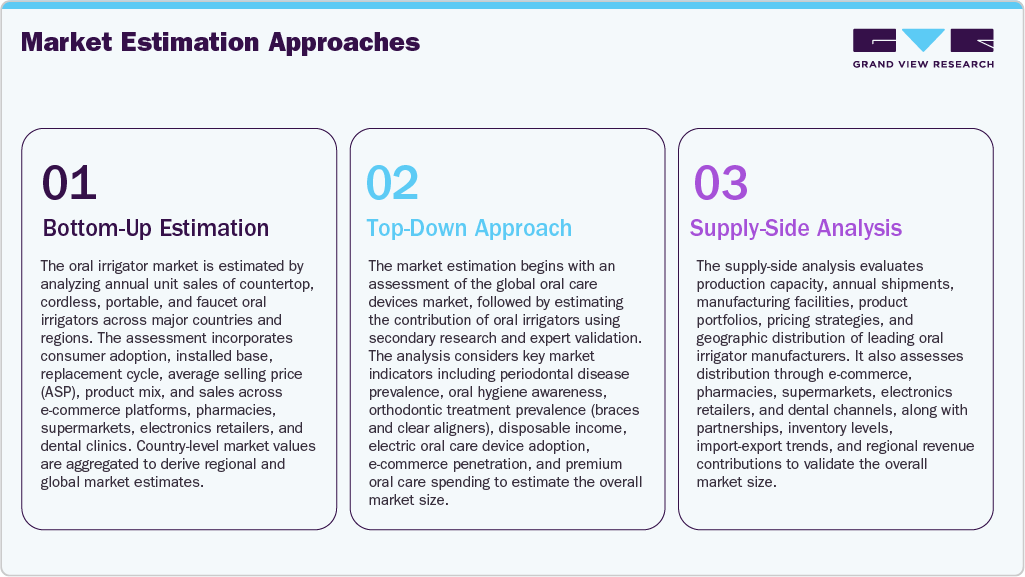
The oral irrigator market figures in this report are based on a proven research process that combines executive interviews with secondary research from proprietary databases, company filings, and recognized regulatory and institutional sources. Market size is built through value-chain sizing-reconciling supply-side and demand-side estimates-and triangulated with bottom-up and top-down approaches. Every estimate passes multiple levels of expert validation before publication, with each oral irrigator segment quantified using the revenue-capture definitions in the table below.
Segment Definition
Segment – Product
Revenue capture definition
Countertop
This segment monitors revenue from heavy-duty, mains-powered water flossers featuring large water reservoirs and multi-tier pressure dials. Financial tracking includes standalone consumer retail purchases, institutional sales to dental clinics, and extended warranty packages, which together represent the primary revenue stream for high-performance, stationary household oral care installations.
Cordless / Handheld
Revenue capture in this category encompasses sales of battery-operated or USB-rechargeable water flossers with integrated, compact fluid reservoirs. It accounts for global direct-to-consumer digital transactions and brick-and-mortar retail sales, driven heavily by working professionals and urban consumers seeking space-saving, cord-free interdental cleaning systems.
Hybrid (Flosser + Toothbrush)
This stream tracks revenue from dual-functioning systems that combine sonic electric toothbrushes with water-flossing mechanics into a single powered base. Valuation comprises complete product bundles, smart-app subscription integrations, and multi-functional dock replacements, appealing directly to the high-end consumer demographic prioritizing streamlined, multi-step dental routines.
Ultra-portable / Travel
This market classification isolates sales of collapsible, pocket-sized, or modular oral irrigators specifically engineered for mobility. Revenue metrics capture global sales from airport duty-free outlets, travel-centric e-commerce platforms, and specialty lifestyle retail, focusing entirely on micro-sized units optimized for transient consumer use.
Replacement tips
This segment generates continuous sales of interchangeable, volume-driven consumables, such as orthodontic, plaque-seeker, and pocket nozzles. It accounts for multi-pack consumer retail purchases, subscription-based replenishment programs, and bulk professional distribution, serving as the primary long-term margin driver for oral irrigator manufacturers.
 To learn more about this report, Download Free Sample Report
Delivered Customizations
This report has been delivered with the following In-depth customizations
Client Request
Customization Delivered
Value Adds
Oral Irrigator Product Portfolio & Technology Analysis
Conducted a comprehensive assessment of the oral irrigator product portfolio, including countertop, cordless/handheld, portable/travel, hybrid (flosser + toothbrush), and faucet oral irrigators along with replacement tips and accessories. Evaluated product differentiation across pressure settings, pulse technology, water reservoir capacity, battery performance, smart-connected features, magnetic charging, nozzle compatibility, and premium versus economy product positioning. The analysis also examined consumer preferences, feature adoption trends, pricing strategies, and innovation pipelines across leading manufacturers.
Helps stakeholders identify high-growth product categories, evaluate emerging technology adoption, benchmark product innovation, understand evolving consumer preferences, optimize product portfolios, refine pricing strategies, and align future product development with changing oral healthcare needs and premium consumer demand.
Clinical Application, End-User Adoption & Distribution Channel Analysis
Analyzed oral irrigator adoption across home care users and dental professionals while assessing utilization for orthodontic treatment (braces and clear aligners), periodontal disease management, implant-supported prosthesis maintenance, gingivitis prevention, general oral hygiene, and pediatric oral care. Evaluated purchasing behavior across e-commerce marketplaces, brand D2C websites, pharmacies, supermarkets, electronics retailers, and dental clinics. The assessment also examined consumer buying preferences, replacement demand, regional adoption patterns, dentist recommendations, and the influence of digital retail channels on market growth.
Enables manufacturers to strengthen commercialization strategies by identifying high-growth clinical applications and end-user segments, optimizing channel partnerships, improving inventory and distribution planning, enhancing customer reach through online and offline channels, and supporting market expansion across developed and emerging economies.
Product Positioning, Pricing Tier & Manufacturer Competitiveness Assessment
Evaluated leading oral irrigator manufacturers based on product portfolio breadth, technological innovation, smart connectivity, manufacturing capabilities, pricing strategies across premium, mid-range and economy segments, geographic presence, regulatory compliance, distribution strength, and brand positioning. The assessment also analyzed average selling price (ASP) benchmarking, product launches, channel pricing strategies, feature enhancements, strategic partnerships, and competitive differentiation within the global oral irrigator market.
Supports competitive benchmarking by evaluating market positioning, pricing strategies, product differentiation, and innovation pipelines of leading manufacturers. Helps companies optimize go-to-market strategies, identify whitespace opportunities, strengthen regional expansion plans, improve ASP optimization, and enhance long-term competitive advantage through portfolio and distribution excellence.
Frequently Asked Questions About This Report
The global oral irrigator market size was estimated at USD 1.5 billion in 2025 and is expected to reach USD 1.6 billion in 2026.
The global oral irrigator market is projected to grow at a CAGR of 7.8% from 2026 to 2033 to reach USD 2.5 billion by 2033.
Based on product type, the countertop segment dominated the market with 42.5% in 2025, driven by its strong performance, reliability, and suitability for everyday home use. These devices offer higher water pressure, larger reservoirs, and multiple pressure settings, enabling more effective, customizable cleaning than portable alternatives.
Key companies in the global oral irrigator market include Colgate-Palmolive Company, Procter & Gamble, Water Pik, Inc. (Church & Dwight), Green Lion, Sunstar Suisse S.A., Koninklijke Philips N.V., Panasonic Holdings Corporation, Jetpik Corporation (Nucreatronics Inc), h2ofloss, Risun Technology, Oracura Solutions Pvt. Ltd., Perfora, AGARO (Universal Corporation Ltd.), among others
The growth of oral irrigators is driven by the factors such as changing dietary and lifestyle habits, congenital conditions, poor eating patterns, and limited access to adequate dental care. In addition, the rising cases of dental caries and tooth decay, especially among children, are further supporting market growth.
North America dominated with a 34.7% revenue share in 2025.
The general hygiene segment held the largest revenue share of 50.4% in 2025, while the pediatric segment is the fastest-growing.
The e-commerce/marketplace segment held the largest revenue share of 33.3% in 2025, while the social commerce segment is the fastest-growing.
The mid-range pricing segment held the largest revenue share of 45.4 in 2025, while the premium pricing segment is the fastest-growing.
The multi-pressure modes segment held the largest share of 52.1% in 2025, while the AI-assisted technology feature segment is the fastest-growing.
About the Author(s)
Medical Devices Research Team
Healthcare · Medical DevicesThis report was authored by the medical devices research team at Grand View Research - comprising two research analysts, one senior research analyst, and one industry expert - with specialized expertise in the medical devices segment of the healthcare industry. All findings are based on proprietary healthcare databases, executive interviews, and regulatory analysis, subject to internal peer review prior to publication.
Last Updated:
Speak to Analyst

Customize this report to your needs - add regions, segments, or data points, with 20% free customization.
Or view our licence options:


ISO 9001:2015 & 27001:2022 Certified
We are GDPR and CCPA compliant! Your transaction & personal information is safe and secure. For more details, please read our privacy policy.


