
- Home
- »
- Consumer F&B
- »
-
Organic Beverages Market Size & Share Report, 2026-2033GVR Report cover

Organic Beverages Market (2026 - 2033)
Size, Share & Analysis Report By Product (Non-dairy Beverages, Fruit Beverages, Coffee & Tea, Beer & Wine), By Distribution Channel (Offline, Online), By Region, And Segment Forecasts
Market Size, 2025
$48.3BMarket Estimate, 2026
$55.2BMarket Forecast, 2033
$132.4BCAGR, 2026–2033
13.3%Organic Beverages Market Summary
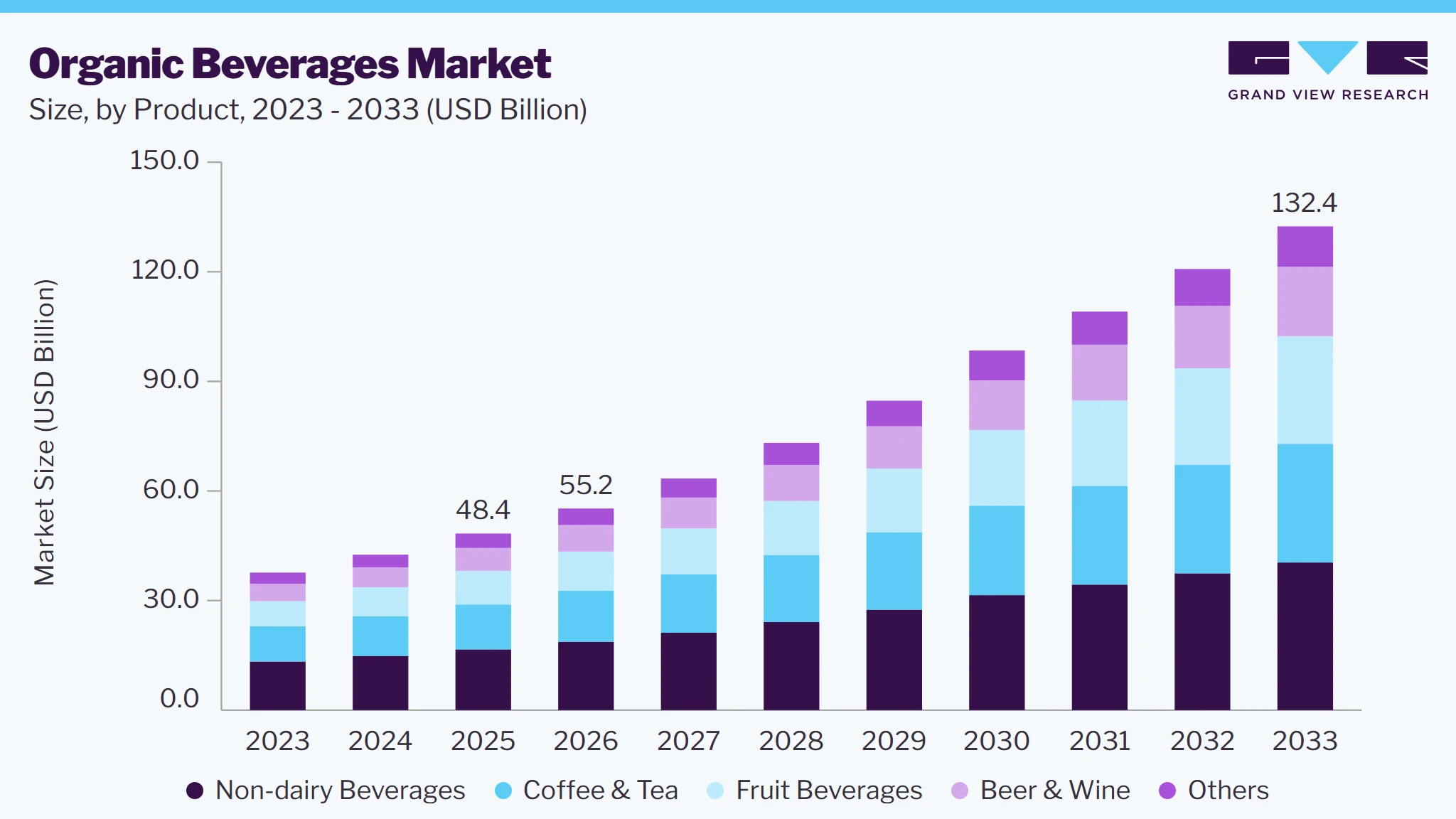
The organic beverages market size was valued at USD 48.3 billion in 2025 and is projected to grow from USD 55.2 billion in 2026 to USD 132.4 billion by 2033, at a CAGR of 13.3% from 2026 to 2033. North America dominated the organic beverages market with the largest revenue share of 48.3% in 2025. Increasing awareness about the health benefits of consuming organic products is expected to drive market growth in the coming years.
 Source: Grand View Research, IR Documents, Primary Interviews, Paid DatabasesTo learn more about this report,
 Download Free Sample Report
Key Market Trends & Insights
- By product: Non-dairy beverages segment held the largest market share of 34.4% in 2025.
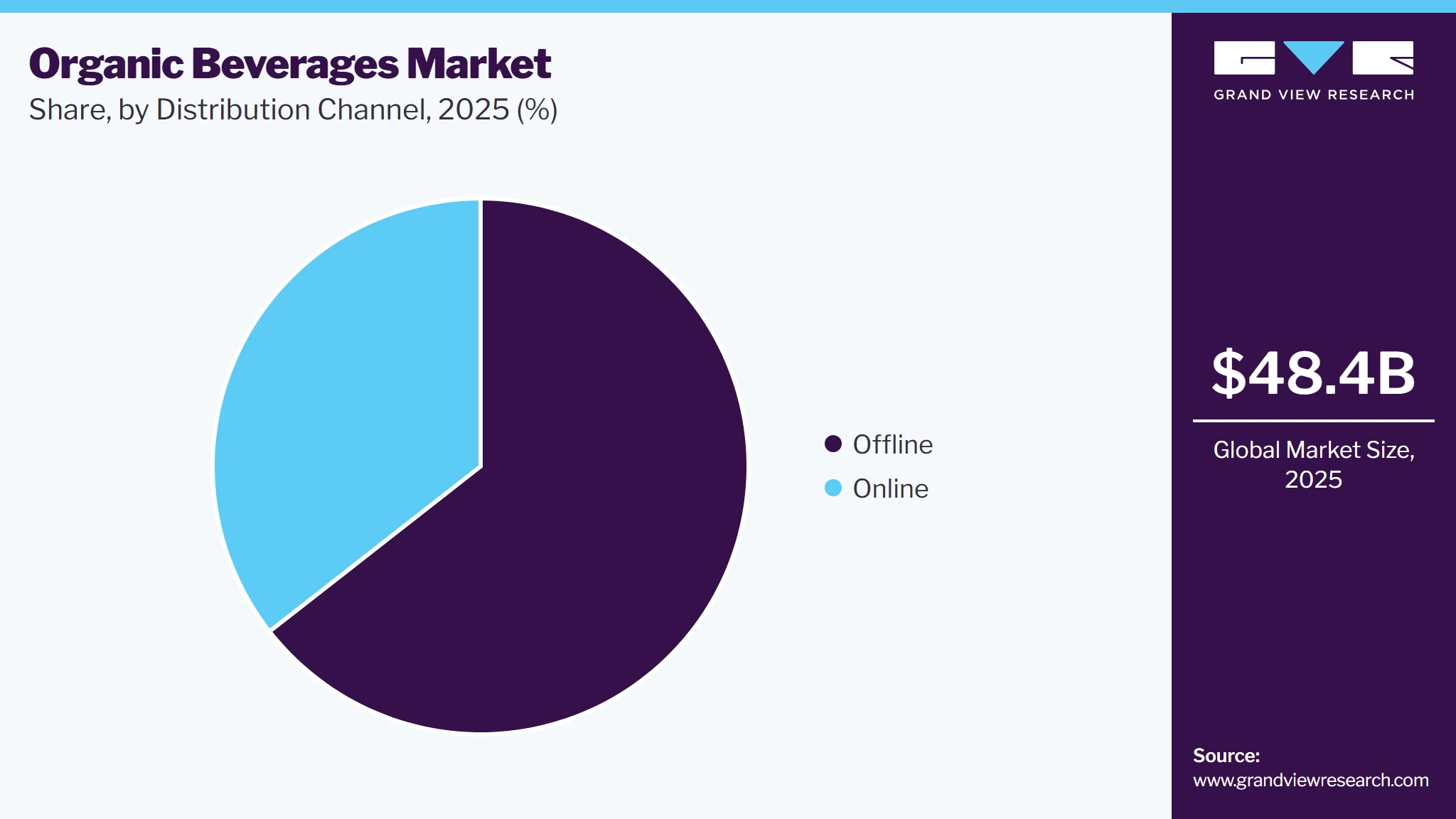
- By distribution channel: Offline segment held the largest market share of 64.4% in 2025.
Regional Highlights
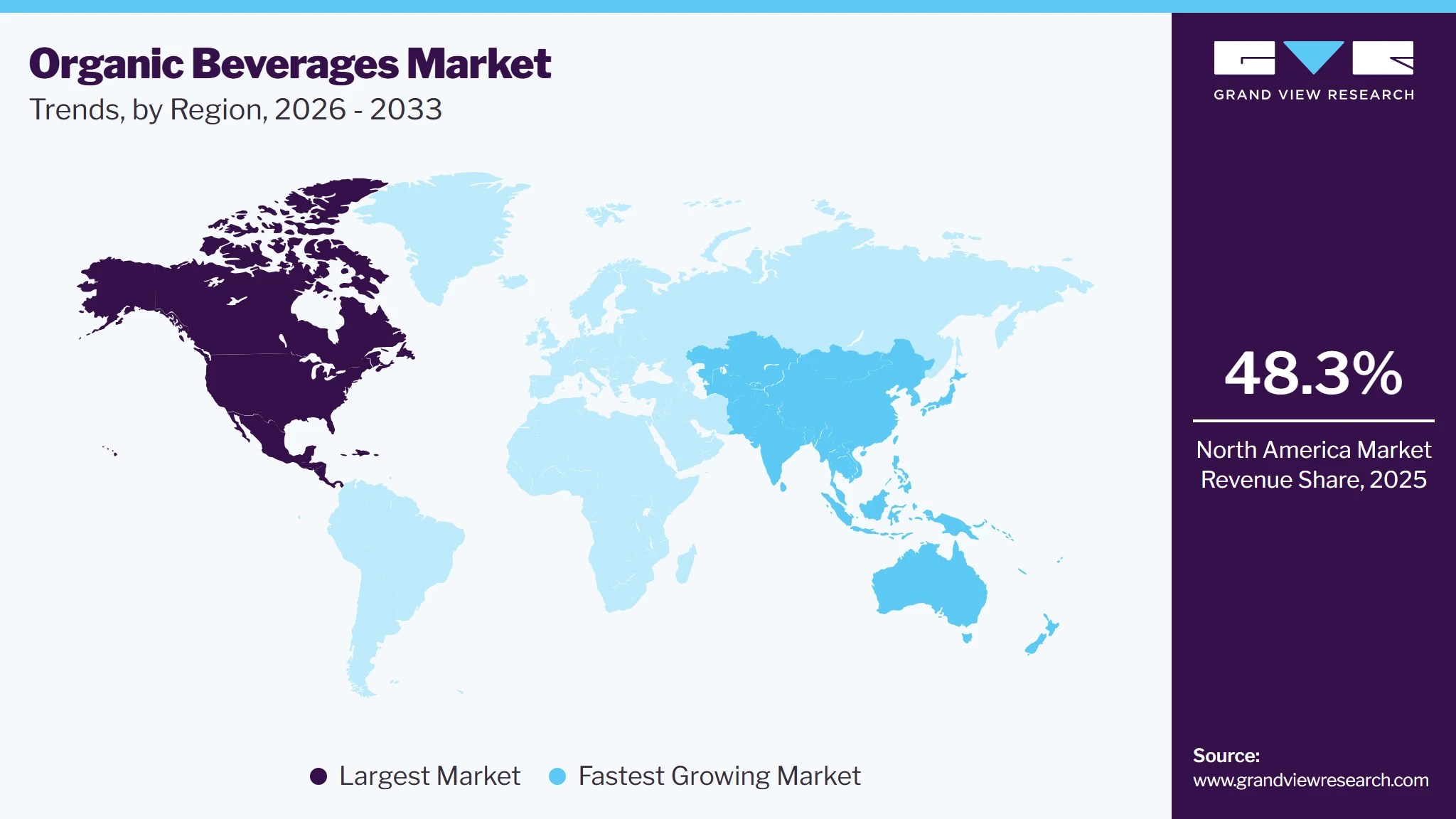
- Largest regional market: North America (30.7% revenue share, 2025)
- Fastest-growing regional market: Asia Pacific (highest CAGR, 2026-2033)
- By country: The U.S. held the largest market share in 2025
Market Size & Forecast
- Market size in 2025: USD 48.3 Billion
- Estimated market size in 2026: USD 55.2 Billion
- Projected market size by 2033: USD 132.4 Billion
- CAGR (2026-2033): 13.3%
Prism AI by Grand View Research Free to tryAsk a question about the organic beverages marketTry asking✓Every figure cited from GVR research Prefer the report? Download free sample →Rising disposable income levels in developing economies are one of the factors boosting market growth. Demand for non-caffeinated, non-sugary drinks is expected to fuel the product demand over the coming years. The availability of products with new flavors and ingredients like turmeric, aloe Vera, and activated charcoal in attractive, easy-to-carry & -store packaging will also fuel the demand.
 To learn more about this report, Download Free Sample Report
In addition, government participation in helping consumers to understand the difference between falsely labeled products and legitimate ones has also contributed toward overall market development. The government in some parts of the globe has also issued certain guidelines barring the use of chemicals, pesticides, growth hormones, and other synthetic chemicals to promote the cultivation of organic products.
The intensification of the traditional farming system has generated a need for organic farming methods to maintain healthy soil in the long run. However, the high cost of production and operations and shorter shelf life are projected to limit the market growth over the forecast years. Moreover, premium pricing of products limiting widespread customer acceptance and limited options to choose from the product assortments are hampering the market expansion. High packaging, logistics, and distribution costs to extend shelf life also restrict market growth.
Market Dynamics
Organic beverages are witnessing strong market momentum due to increasing consumer preference for clean-label, naturally sourced, and chemical-free drink options. These beverages encompass a wide range of products, including organic juices, teas, coffees, dairy-based drinks, and plant-based beverages, catering to the growing demand for health-conscious consumption. Rising awareness regarding sustainable agriculture, nutritional transparency, and preventive wellness is encouraging consumers to shift toward organically certified products. Additionally, continuous product innovation and expanding retail availability are expected to support the sustained growth of the organic beverages market.
The organic beverages market is increasingly benefiting from the expansion of certified organic farming systems and the strengthening of certification standards across agricultural supply chains. Beverage manufacturers rely heavily on organically cultivated fruits, vegetables, tea leaves, coffee beans, oats, herbs, and botanicals to maintain product integrity and regulatory compliance. As certified organic acreage expands and traceable sourcing networks mature, manufacturers are gaining improved access to high-quality raw materials while reducing procurement risks associated with conventional farming practices.
In April 2026, Evolution Fresh expanded its organic beverage portfolio through the launch of a new range of USDA Certified Organic ready-to-drink teas made with organic cold-pressed juice and brewed tea. The launch demonstrates how certified organic ingredient availability is supporting innovation across functional beverage categories.
One of the most significant restraints facing the organic beverages market is the elevated cost structure associated with sourcing, processing, and certifying organic ingredients. Organic beverages depend on certified organic fruits, vegetables, tea leaves, coffee beans, grains, and botanical extracts, which are produced under stringent agricultural standards and often yield lower output compared to conventional farming systems. As a result, manufacturers face higher procurement costs, limited supplier availability, and increased exposure to seasonal crop fluctuations.
A major whitespace opportunity in the organic beverages market is the integration of organic certification with functional health benefits. Traditionally, organic beverages have been positioned around natural sourcing and clean-label attributes; however, consumers are increasingly seeking products that deliver specific wellness benefits such as digestive health, energy support, hydration, cognitive performance, and metabolic wellness. This shift is encouraging manufacturers to move beyond conventional organic juices and teas toward value-added formulations that combine organic ingredients with functional claims.
In February 2026, Sarilla introduced a new range of organic beverages specifically designed to support metabolic health and women's wellness. The launch demonstrates how brands are leveraging the gap between traditional organic beverages and personalized wellness solutions by developing purpose-driven beverage formulations.
Analyst Perspective
The organic beverages market is approaching a point where organic certification alone is no longer a sustainable differentiator. The next competitive advantage will belong to brands that successfully combine organic credentials with functional benefits, ingredient traceability, and consumer-specific health outcomes. As private-label participation increases and organic claims become more commonplace, value creation will shift toward proprietary sourcing networks, farm-to-bottle transparency, and wellness-focused product innovation. The long-term winners are likely to be companies that control certified ingredient supply while simultaneously positioning organic beverages as a daily health solution rather than a premium refreshment category.
Product Insights
Based on product, the non-dairy beverages segment led the market with the largest revenue share of 34.4% in 2025 and is expected to grow at a CAGR of 11.6% over the forecast period. These products are made from sources like legumes, plant materials, nuts, and cereals, and thus, act as functional drinks. Plant-based beverages, such as milk and smoothies, are expected to grow rapidly due to their nutritional properties, health benefits, and the least contribution to the global carbon footprint. These beverages are not only consumed by health-conscious people but also by lactose-intolerant consumers. The increasing trend of veganism is also promoting non-dairy beverages across the globe. According to a research study conducted by the British Nutrition Foundation (BNF) in January 2021, younger consumers aged between 18 and 40 years are more likely to choose a plant-based diet and are the primary promoter of plant-based beverage trends across the globe.
The fruit beverages segment is expected to grow at the fastest CAGR of 17.6% over the forecast period. Increasing consumer awareness about the health benefits of fruit beverages, such as their rich content of vitamins, antioxidants, and other essential nutrients, is a major driver propelling the market growth. The rising trend towards healthier lifestyles and dietary habits has also increased the demand for natural and organic fruit beverages. Furthermore, introducing innovative flavors and product varieties by major market players and better marketing strategies has attracted a broader consumer base.
Distribution Channel Insights
Based on distribution channel, the offline segment led the market with the largest revenue share of 64.4% in 2025. The increasing number of supermarket & hypermarket chains and the altering retail landscape, particularly in developing economies, boost product sales via this channel.
 To learn more about this report, Download Free Sample Report
The online segment is expected to grow at the fastest CAGR over the forecast period. Growing internet penetration and target marketing by companies to reach all customer touchpoints are likely to propel the segment growth. Increasing penetration of online food delivery platforms and online groceries, coupled with the surge in smartphone adoption, is further expected to increase the segment growth in the coming years.
Regional Insights
North America dominated the organic beverages market with the largest revenue share of 48.3% in 2025. This is attributed to the availability of farmlands for organic farming and growing awareness about the benefits of organic products in the region. Additionally, the rise of health-conscious lifestyles and the growing preference for clean-label products have significantly boosted the market. The presence of major market players and their continuous investment in product innovation and marketing campaigns also contribute to the robust growth of the organic beverages industry in North America. Furthermore, expanding retail channels, including online platforms and specialty stores, has made organic beverages more accessible to a wider audience.
 To learn more about this report, Download Free Sample Report
U.S. Organic Beverages Market Trends
The organic beverages market in the U.S. held the largest share in the North America region in 2025. Well-established distribution networks, including hypermarkets, supermarkets, and online channels, ensure that the products are easily accessible to consumers. The growing trend of health and wellness, coupled with the increasing disposable income, has further fueled the market’s expansion in the U.S.
Asia Pacific Organic Beverages Market Trends
The Asia Pacific organic beverages industry was identified as a lucrative region in 2024. The region’s increasing urbanization and population have increased the demand for healthy beverages. Changing dietary preferences and rising disposable incomes have further boosted the consumption of fruit beverages.
Europe Organic Beverage Market Trends
The Europe organic beverages industry is expected to grow at a CAGR of 14.8% over the forecast period. This is attributed to the increasing number of health-conscious consumers across the region. The demand for organic and clean-label fruit beverages is strong as consumers become more aware of the benefits of organic ingredients.
Key Organic Beverage Company Insights
Some key players in the market are Uncle Matt's Organic, Parker’s Organic Juices, Danone S.A., and others. Key factors influencing competition include product innovation, certification standards, and strategic alliances to capture a share of the expanding market driven by increasing consumer demand for organic and sustainable choices.
-
Uncle Matt's Organic is USDA Certified Organic and offers organic juices & teas. Its product portfolio of juices includes 52 oz Organic Juices, 12 oz Organic Juices, 2 oz Organic Juice Shots, 6.75 oz Organic Juice Boxes.
Key Organic Beverage Companies:
The following key companies have been profiled for this study on the organic beverage market.
-
Uncle Matt's Organic, Inc.
-
Boncafe International Pte. Ltd.
-
Parker’s Organic Juices
-
Hain Celestial
-
Bison Organic Beer
-
Belvoir Fruit Farms Ltd.
-
The Whitewave Foods Company.
-
The Coca-Cola Co.
-
PepsiCo, Inc.
-
Danone S.A.
Competitive Benchmarking
Category
Operating Strategies
Competitive Edge
Weakness
Established Players (The Coca-Cola Co.; PepsiCo, Inc.; Danone S.A.; Hain Celestial)
- Expand organic portfolios through acquisitions, brand extensions, and multi-channel distribution networks.
- Strengthen certified ingredient sourcing and invest in functional organic beverage innovation.
- Extensive retail penetration, global supply chain capabilities, and strong brand recognition.
- Greater financial resources to support product development, marketing, and certification compliance.
- Limited agility in responding to niche consumer trends and emerging organic categories.
- Higher exposure to portfolio cannibalization from conventional beverage brands and private labels.
Emerging Players (Uncle Matt's Organic, Inc.; Boncafe International Pte. Ltd.; Parker’s Organic Juices)
- Focus on premium organic formulations, clean-label positioning, and targeted consumer segments.
- Leverage direct sourcing partnerships and specialty retail channels to build brand presence.
- Strong authenticity in organic offerings and ability to address niche wellness preferences.
- Faster innovation cycles and greater flexibility in launching differentiated products.
- Limited distribution reach and lower bargaining power across retail networks.
- Higher dependence on certified organic raw material availability and premium pricing strategies.
Recent Developments
-
In January 2024, Suja Organic announced the launch of its new line of Suja Organic Protein Shakes, marking its entry into the ready-to-drink protein market. These shakes offer 16 grams of plant-based protein derived from rice, pea, and hemp and are available in chocolate, coffee bean, and vanilla cinnamon flavors. Each 200-calorie shake includes almond milk, coconut cream, 3-4 grams of Acacia fiber, and essential vitamins and minerals, providing convenient and nutritious options for consumers.
-
In May 2023, Topo Chico launched a line of fruit-flavored sparkling waters with herbal extracts, available in three bold, unique flavors: lime with mint extract, blueberry with hibiscus extract, and tangerine with ginger extract.
-
In March 2022, Uncle Matt’s Organic launched Matt50 Orange Juice Beverage. The beverage contains half the sugar and calories of regular orange juice and is enriched with 100% DV vitamin C, prebiotics, and probiotics to support gut health and the immune system.
-
In March 2022, Uncle Matt’s Organic launched two new offerings for kids: No Sugar Added Lemonade Juice Box and No Sugar Added Strawberry Lemonade Juice Box. The shelf-stable range contains organic Reb M Stevia with zero calories, eliminating the health concerns associated with artificial sweeteners.
Organic Beverages Market Report Scope
Report Attribute
Details
Market size in 2025
USD 48.3 billion
Estimated market size in 2026
USD 55.2 billion
Projected market size by 2033
USD 132.4 billion
Growth rate
CAGR of 13.3% from 2026 to 2033
Base year for estimation
2025
Historical data
2021 - 2024
Forecast period
2026 - 2033
Quantitative units
Revenue in USD million/billion and CAGR from 2026 to 2033
Report coverage
Revenue forecast, company ranking, competitive landscape, growth factors, and trends
Segments covered
Product, Distribution Channel, Region
Regional scope
North America; Europe; Asia Pacific; Central & South America; MEA
Country scope
U.S.; Canada; Mexico; Germany; UK; France; Italy; Spain; China; Japan; India; South Korea; Australia; Brazil; Saudi Arabia
Key companies profiled
Uncle Matt's Organic, Inc.; Boncafe International Pte. Ltd.; Parker’s Organic Juices; Hain Celestial; Bison Organic Beer; Belvoir Fruit Farms Ltd.; The Whitewave Foods Company.; The Coca-Cola Co.; PepsiCo, Inc; Danone S.A.
Customization scope
Free report customization (equivalent up to 8 analysts' working days) with purchase. Addition or alteration to country, regional & segment scope.
Pricing and purchase options
Avail customized purchase options to meet your exact research needs. Explore purchase options
Global Organic Beverages Market Report Segmentation
This report forecasts revenue growth at global, regional, and country levels and analyzes the latest industry trends in each sub-segment from 2021 to 2033. For this study, Grand View Research has segmented the global organic beverages market report based on product, distribution channel, and region.
 To learn more about this report, Download Free Sample Report
-
Product Outlook (Revenue, USD Billion, 2021 - 2033)
-
Non-dairy Beverages
-
Fruit Beverages
-
Coffee & Tea
-
Beer & Wine
-
Others
-
-
Distribution Channel Outlook (Revenue, USD Billion, 2021 - 2033)
-
Offline
-
Online
-
-
Regional Outlook (Revenue, USD Billion, 2021 - 2033)
-
North America
-
U.S.
-
Canada
-
Mexico
-
-
Europe
-
Germany
-
UK
-
France
-
Italy
-
Spain
-
-
Asia Pacific
-
China
-
Japan
-
India
-
Australia
-
South Korea
-
-
Latin America
-
Brazil
-
-
Middle East and Africa (MEA)
-
Saudi Arabia
-
-
Research Methodology
The organic beverages market figures in this report are based on a proven research process that combines executive interviews with secondary research from proprietary databases, company filings, and recognized regulatory and institutional sources. Market size is built through value-chain sizing - reconciling supply-side and demand-side estimates - and triangulated with bottom-up and top-down approaches. Every estimate passes multiple levels of expert validation before publication, with each organic beverages segment quantified using the revenue-capture definitions in the table below.
Segment Definition
Segment - Type
Revenue capture definition
Non-dairy Beverages
This segment includes the sales of organically certified plant-based beverages derived from ingredients such as oats, almonds, soy, coconut, rice, and other botanical sources. Revenue is generated through retail, foodservice, and online channels catering to consumers seeking dairy-free, vegan, lactose-free, and clean-label beverage alternatives.
Fruit Beverages
This segment includes the sales of organically certified fruit-based beverages such as juices, juice blends, nectars, smoothies, and fruit-infused drinks. Revenue is generated through premium health-focused beverage offerings that emphasize natural ingredients, organic sourcing, and minimal processing.
Coffee & Tea
This segment includes the sales of organically certified coffee and tea products available in ready-to-drink, packaged, and brewed formats. Revenue is generated through consumer demand for sustainably sourced beverages that offer organic certification, specialty flavors, and wellness-oriented attributes.
Beer & Wine
This segment includes the sales of organically certified alcoholic beverages, including beer, wine, and other fermented drinks produced using organically grown agricultural ingredients. Revenue is generated through premium beverage consumption, specialty retail distribution, and increasing consumer preference for natural and sustainably produced alcoholic products.
Others
This segment includes the sales of other organically certified beverages such as functional drinks, kombucha, herbal infusions, energy beverages, probiotic drinks, and flavored water products. Revenue is generated through innovation in health and wellness formulations, convenience-focused consumption, and expanding demand for value-added organic beverage categories.
Segment - Distribution Channel
Revenue capture definition
Offline
This segment includes the sales of organic beverages through supermarkets, hypermarkets, convenience stores, specialty stores, health food outlets, and foodservice establishments. Revenue is generated through direct consumer purchases across organized and traditional retail channels.
Online
This segment includes the sales of organic beverages through e-commerce platforms, brand-owned websites, and digital marketplaces. Revenue is generated through online purchases supported by home delivery, subscription models, and digital promotions.
Estimation Model
Consumer Health &
Wellness LayerOrganic Beverage
Penetration LayerPurchase Frequency
LayerRevenue Realization
LayerWho prefers organic beverage consumption?
Who actively purchases organic beverages?
Who purchases organic beverages regularly?
How much revenue is generated?
Identify the population adopting clean-label, organic, plant-based, and wellness-focused food and beverage products to establish the potential consumer base.
Apply organic beverage consumption rates across categories such as fruit beverages, non-dairy drinks, coffee & tea, and alcoholic beverages to determine the addressable market.
Assess repeat purchase behavior, consumption frequency, premium product adoption, and category-specific buying patterns to estimate active demand.
Multiply active organic beverage consumers by average annual spending across distribution channels and beverage categories to derive market revenue.
Delivered Customizations
This report has been delivered with the following In-depth customizations
CLIENT REQUEST
CUSTOMIZATION DELIVERED
VALUE ADDS
Organic Ingredient Sourcing & Certification Landscape Analysis
Evaluated certified organic ingredient supply chains, farming networks, certification frameworks, traceability systems, and sourcing challenges across key regions.
Supports procurement planning, supply chain risk mitigation, and long-term sourcing strategies for sustainable business growth.
Organic Functional Beverage Demand Assessment
Analyzed demand trends across organic functional beverages, including probiotic drinks, energy beverages, botanical infusions, and wellness-focused formulations.
Helps stakeholders identify high-growth functional categories, optimize innovation pipelines, and evaluate premiumization opportunities.
Organic Beverage Distribution & Channel Performance Analysis
Examined sales performance across supermarkets, specialty stores, health food outlets, e-commerce platforms, and direct-to-consumer channels.
Assists clients in optimizing channel investments, improving market penetration, and enhancing customer acquisition strategies.
Frequently Asked Questions About This Report
The global organic beverages market size was estimated at USD 48.3 billion in 2025 and is expected to reach USD 55.2 billion in 2026.
The global organic beverages market is expected to grow at a compound annual growth rate of 13.3% from 2026 19 to 2033 to reach USD 132.4 billion by 2025.
North America dominated the organic beverages market with a share of 48.3% in 2025. This is attributed to high product demand of organic-label food & beverages in the U.S. as a result of changing lifestyle and increasing health consciousness.
Some key players operating in the organic beverages market include Uncle Matt’s Organic, Inc.; Boncafe International Pte. Ltd.;Parker’s Organic Juices;Hain Celestial; Bison Organic Beer; Belvoir Fruit Farms Ltd.; The Whitewave Foods Company.; The Coca-Cola Co.; and PepsiCo, Inc.
Key factors that are driving the market growth include increasing awareness about the health benefits associated with the consumption of organic products and growing demand for non-sugary, non-caffeinated drinks.
Non-dairy beverages dominated the market with a share of 34.4% in 2025.
Asia Pacific is the fastest growing regional market with a CAGR of 15.3% over the forecast period.
Offline segment dominated the market with a market share of 64.4% in 2025.
About the Author(s)
Consumer F&B Research Team
Consumer Goods · Consumer F&BThis report was authored by the consumer f&b research team at Grand View Research - comprising two research analysts, one senior research analyst, and one industry expert - with specialized expertise in the consumer f&b segment of the consumer goods industry. All findings are based on proprietary consumer goods databases, executive interviews, and regulatory analysis, subject to internal peer review prior to publication.
Last Updated:
Speak to Analyst

Customize this report to your needs - add regions, segments, or data points, with 20% free customization.
Or view our licence options:


ISO 9001:2015 & 27001:2022 Certified
We are GDPR and CCPA compliant! Your transaction & personal information is safe and secure. For more details, please read our privacy policy.


