
- Home
- »
- Electronic Devices
- »
-
Outdoor Solar LED Market Size & Share Report, 2026-2033GVR Report cover

Outdoor Solar LED Market (2026 - 2033)
Size, Share & Trends Analysis Report By Application, By Wattage (less than 39W, 40W to 149W, More than 150W), By End Use (Residential, Commercial, Industrial) By Region, And Segment Forecasts
Market Size, 2025
$10.0BMarket Estimate, 2026
$11.0BMarket Forecast, 2033
$21.3BCAGR, 2026–2033
9.8%Outdoor Solar Led Market Summary
The global outdoor solar LED market size was valued at USD 10.0 billion in 2025 and is projected to grow from USD 11.0 billion in 2026 to USD 21.3 billion by 2033, at a CAGR of 9.8% from 2026 to 2033. Asia Pacific dominated the market, accounting for a revenue share of 47.0% in 2025. This growth is driven by growing investments in smart city and urban infrastructure projects.
 Source: Grand View Research, IR Documents, Primary Interviews, Paid DatabasesTo learn more about this report,
 Download Free Sample Report
 Key Market Trends & Insights
- By wattage: Less than 39W segment dominated the market, with a revenue share of 41.5% in 2025.
- By application: Solar LED street lights segment held the largest market share of 54.2% in 2025.
- By end use: Commercial segment held the largest market share of 55.8% in 2025.
Regional Highlights
- Largest regional market: Asia Pacific (47.0% revenue share, 2025)
- By country: China held the largest market share in 2025.
Market Size & Forecast
- Market size in 2025: USD 10.0 Billion
- Estimated market size in 2026: USD 11.0 Billion
- Projected market size by 2033: USD 21.3 Billion
- CAGR (2026–2033): 9.8%
Three ways to get this report
Buy it, customize it, or ask a question.Ask an Analyst
Analyst response in 1 business day
- AccessReport author, directly
- Reply timeWithin 1 working day
- No sales callDirect answer only
- FormatEmail reply
- CostFree, no cost
Get the Full Report
What the study covers
- FormatsPDF · Excel · Dashboard
- Timeline2026–2033 annual, 2025 base
- Coverage20+ countries, 5 regions
- Companies10+ key players profiled
Customize the Report
20% free customization
- IncludeCountries, segments, points
- TailorTo your product definition
- ExtendDeeper competitor detail
- OrA fully bespoke study
- Turnaround5–10 working days
Enhanced quality and efficiency offered by the outdoor solar LEDs, significant growth in awareness regarding renewable energy, and a rising number of smart city projects with improved infrastructural requirements are expected to add growth opportunities for this market during the forecast period. A significant increase in awareness regarding energy efficiency and the focus of multiple municipal corporations, city councils, state authorities, and government agencies on reducing costs associated with energy consumption has resulted in an inclination towards using renewable energy solutions, such as outdoor solar LEDs. This trend is tethered to replacing existing street light systems with advanced solar street light systems equipped with solar PV modules, batteries, LED lights, mounting structures, and more.
 To learn more about this report, Download Free Sample Report
 For instance, in September 2024, ITI Limited, one of the public sector undertakings operated by the Department of Telecommunication, Ministry of Communications, Government of India, was given an order of nearly USD 35.0 million for the supply and installation process of 1,00,000 units of solar-based street light systems. The order was placed by the government agency of the Indian state, Bihar Renewable Energy Development Authority (BREDA).
Multiple cities and local authorities across various countries have been focusing on installing outdoor solar LEDs and advanced solar lighting systems on streets. These initiatives are often stimulated by cost-saving requirements, an inclination towards renewable energy solutions, and growing awareness regarding the technology's benefits. For instance, in August 2024, San Antonio City and Dalkia Energy Solution signed a contract to install 400 new units of solar-powered LED streetlights across identified areas in San Antonio.
The dependency of outdoor lighting systems on grids and the utilization of high-pressure sodium lights has posed significant challenges for multiple local authorities. The emergence of solar energy applications such as outdoor solar LEDs offered efficient alternatives powered by off-grid power generation. Ease of availability and growing advancements in the solar energy solutions industry have resulted in an increasing inclination towards adopting enhanced solutions based on renewable energy.
Multiple governments and organizations have been adding heavy investments in the renewable energy sector. Favorable regulatory scenarios, tax exemptions, and positive support from the government are also attracting greater investments in this industry. Government initiatives and sustainability and environmental goals set by nations and regions are expected to fuel demand for green energy solutions. For instance, the Netherlands wants to reach 100% sustainable sources-based energy generation by 2050.
Market Dynamics
The outdoor solar LED market is experiencing strong growth as governments, municipalities, commercial establishments, and residential users increasingly seek energy-independent lighting solutions for streets, parks, pathways, parking lots, campuses, and public infrastructure. The combination of solar photovoltaic technology and LED lighting enables significant reductions in electricity consumption and grid dependency while providing reliable illumination in remote and off-grid locations. Growing investments in smart city projects, rural electrification programs, and sustainable infrastructure development are creating substantial demand for solar-powered outdoor lighting systems. Furthermore, advancements in battery storage, solar panel efficiency, and intelligent lighting controls are improving system reliability and extending operational performance, making solar LED solutions increasingly attractive across diverse end-use applications.
The rising demand for sustainable lighting in commercial and industrial facilities is a major driver of the outdoor solar LED market, as businesses increasingly prioritize energy efficiency, environmental responsibility, and long-term operational cost reduction. Commercial complexes, warehouses, manufacturing plants, logistics hubs, parking lots, and industrial campuses consume significant amounts of electricity for outdoor lighting, resulting in substantial operating expenses over time. Outdoor solar LED lighting systems offer an attractive alternative by utilizing renewable solar energy while delivering high illumination efficiency through advanced LED technology. These systems significantly reduce dependence on grid electricity and help organizations lower their energy consumption. As companies continue to pursue sustainability goals and energy optimization strategies, the adoption of outdoor solar LED lighting solutions is accelerating across the commercial and industrial sectors. This growing focus on sustainable infrastructure development is creating strong demand throughout the market.
The high initial installation costs of outdoor solar LED lighting systems are a significant restraint on market growth, particularly compared with conventional outdoor lighting solutions. While traditional lighting systems typically require fixtures, wiring, and grid connectivity, solar LED installations incorporate additional components such as photovoltaic panels, energy storage batteries, charge controllers, smart sensors, mounting structures, and integrated lighting units. These components increase the upfront investment required for deployment, making solar LED systems appear more expensive during the initial purchasing phase. For municipalities, commercial property owners, industrial operators, and residential developers working within strict capital budgets, the higher acquisition cost can delay investment decisions. Although solar LED systems often deliver long-term operational savings, many buyers prioritize short-term expenditure considerations when evaluating infrastructure projects. This financial barrier can slow adoption rates, particularly in price-sensitive markets.
The advancement of Internet of Things (IoT) technologies enhances opportunities within the outdoor solar LED market. Modern adaptive lighting systems can be connected to centralized management platforms that enable remote monitoring, diagnostics, scheduling, and performance optimization. Facility managers and municipal authorities can monitor lighting networks in real time and make adjustments based on usage patterns and environmental conditions. The integration of motion sensing, adaptive controls, and IoT connectivity transforms outdoor lighting from a basic utility into an intelligent infrastructure asset. These capabilities create opportunities for premium products and value-added services within the market. As adoption of connected infrastructure accelerates, demand for smart solar lighting systems is likely to increase significantly.
Analyst Perspective
The outdoor solar LED market is evolving from a niche renewable energy application into a mainstream infrastructure solution driven by economics rather than environmental considerations alone. The most successful market participants are likely to be those that can deliver long-term reliability under varying climatic conditions while minimizing maintenance requirements and lifecycle costs. Unlike conventional outdoor lighting markets, purchasing decisions in this sector are heavily influenced by energy independence, installation flexibility, and the ability to operate in areas where grid expansion is economically impractical. As public authorities and private organizations place greater emphasis on sustainability targets and operating cost reduction, outdoor solar LED systems are expected to become a preferred lighting option for both new infrastructure projects and large-scale retrofit initiatives.
Application Insights
Based on application, the solar LED street lights segment led the market with the largest revenue share of 54.2% in 2025. This is attributed to many projects initiated by local authorities and energy companies. City councils and government agencies are increasingly ordering street light units equipped with mounting systems, LED luminaries, batteries, PV modules, and more. According to the solar technology for street lighting update shared by the City of Los Angeles in September 2024, nearly 350 solar lights have been deployed and installed throughout the city from the financial year 2022/23 to 2023/24. The Bureau of Street Lighting (BSL), City of Los Angeles Public Works initiated the Solar-Powered Lighting Initiative in 2021.
The BSL secured an investment of nearly USD 3.0 million from the Capital and Technology Improvement Expenditure Program (CTIEP) since the launch of the program. For the financial 2024/25, BSL has received additional funding of USD 1.6 million through the Capital and Technology Improvement Expenditure Program (CTIEP).
The solar garden LED lights segment is anticipated to experience the highest CAGR during the forecast period. Growth of this segment is primarily influenced by increasing awareness about the benefits offered by outdoor solar LED lights and the increasing focus of multiple city councils and other local authorities on cost savings and adoption of enhanced energy-efficient solutions. Additionally, increasing demand from residential users is also adding to the growth.
Wattage Insights
Based on wattage, the less than 39W segment led the market with the largest revenue share of 41.5% in 2025. This is attributed to factors such as increasing utilization by residential users, growing availability, and the focus of multiple manufacturers on research and innovation to deliver improved product portfolios. Factors such as affordability, energy efficiency, durability, and ability to address specific requirements of residential users are expected to add lucrative growth opportunities for this segment.
Outdoor solar LEDs with more than 150W capacity are projected to experience the fastest growth during the forecast period. Large commercial spaces, sports arenas, and other commercial sector users often use outdoor solar LEDs with such specifications. These lights are commonly installed in high mounting areas for the desired effect. Solar LEDs with lesser wattage cannot satisfy the continuous requirement for extensive lighting solutions. Therefore, commercial users with such requirements turn to outdoor solar LEDs with more than 150W capacity.
Increasing inclination towards renewable energy and growing investment in complete conversion from traditional grid support for energy consumption to self-sufficient green energy generation capacities is expected to add growth to this segment. For instance, in October 2024, The LLDC Solar Membrane Project work was initiated. This project aims to reduce carbon emissions and dependency on the national grid at the London Stadium by installing nearly 6,500 square meters of solar membrane panels, LED lighting, and kiosk energy-saving devices.
End Use Insights
Based on end use, the commercial segment led the market with the largest revenue share of 55.8% in 2025. The growth of this segment is mainly influenced by the increasing demand for effective green energy solutions that simultaneously reduce energy expenditure and carbon emissions. Awareness of the environmental impact of growing energy consumption and emission of greenhouse gasses linked with certain devices adds to the growth. The rising demand for energy in commercial spaces dependent on machinery, modern technology-driven devices, and uninterrupted electricity supply has stimulated multiple organizations and governments to turn to solar energy.
 To learn more about this report, Download Free Sample Report
 Investments and fund-raises by key participants in the solar energy industry are adding lucrative opportunities for this market. For instance, in December 2024, Solar Landscape, one of the market participants in industrial and commercial rooftop solar development, announced that the company had secured nearly USD 847 million in financing and project investments in 2024. The company also announced that in 2024, it has engaged in contracts for 40 million square feet of industrial and commercial rooftop space to deploy solar projects.
The residential users segment is projected to experience significant growth during the forecast period. The growth of this segment is mainly influenced by the increasing availability of affordable outdoor LED products and ease of accessibility through online portals. Growing utilization by residential users for lighting backyards and garden areas outside houses while also deploying solar LEDs throughout empty outdoor spaces near fences is adding to the growth in demand. Enhanced availability of information regarding benefits associated with solar LEDs and the launch of products with specifications associated with the requirements of residential users is also contributing to the growth.
Regional Insights
Asia Pacific dominated the global outdoor solar LED market with the largest revenue share of 47.0% in 2025. This is attributed to the increasing demand for outdoor solar LEDs driven by the multiple government projects, the rising focus of numerous countries on embracing green energy solutions, and increasing awareness regarding benefits offered by the product such as cost saving, energy efficiency, reduced dependency on the national grid and a significant reduction in carbon emissions. Countries such as India, China, and others have been experiencing heavy investments in the solar energy industry, which is likely to add growth. According to The International Energy Agency (IEA), from 2019 to 2024, China is estimated to hold a 40.0% share of global renewable energy capacity extension.
 To learn more about this report, Download Free Sample Report
 China Outdoor Solar LED Market Trends
The outdoor solar LED market in the China held the largest share in the Asia Pacific region in 2025. This market is mainly influenced by the country's significant participation in the global solar energy industry, growing capacity in manufacturing solar photovoltaic panels, and lower curtailments. China holds a substantial share in global green energy developments and has experienced large investments from domestic and foreign investors. Government support, a competitive market scenario, and the government's focus on embracing advancements in renewable energy at a rapid rate are likely to add lucrative growth for this market during the forecast period.
North America Outdoor Solar LED Market Trends
North America was identified as one of the key global outdoor solar LED industry regions in 2024. This market is primarily driven by the increasing number of conversion projects initiated by local government agencies and city councils for street lights and many investments and funding deployed for public work projects associated with solar lighting. Multiple cities and commercial spaces have been turning to outdoor LEDs to replace existing street and other outdoor lights.
The U.S. held the largest revenue share of the regional industry in 2024. This is attributed to factors such as ease of availability and growing demand from commercial buyers, such as commercial buildings, public welfare projects initiated by municipal authorities, sports arenas, and others. Government investments in the solar energy industry are also anticipated to drive the growth of outdoor solar LED industry during the forecast period.
MEA Outdoor Solar LED Market Trends
The MEA outdoor solar LED market is projected to experience noteworthy growth from 2025 to 2033. This market is primarily driven by increasing awareness regarding benefits offered by the product and the growing availability of products equipped with advanced features and specifications designed according to customer requirements. The focus of multiple government agencies on embracing green energy while reducing dependency on traditional energy solutions is likely to growth opportunities for this market.
The UAE outdoor solar LED market held the largest revenue share of the regional industry in 2024. This is attributed to factors such as the increasing participation of the country in International Solar Alliance activities, the growing focus of authorities on adopting solar energy solutions to reduce carbon emissions and spending on energy, and rising awareness regarding benefits offered by outdoor solar LEDs. In February 2023, India, UAE, and France set up a trilateral cooperation that plans to work on initiatives to endorse collaboration on multiple fronts, such as climate change, energy, and biodiversity protection. Such developments associated with the industry are likely to generate greater growth for this market during the forecast period.
Key Outdoor Solar LED Company Insights
Some key players in the global outdoor solar LED industry include Greenshine New Energy (Oceania International LLC), Wipro Lighting, Signify Holding, Polybrite - SBM NewTech Co., Ltd., and SOKOYO Solar Lighting Co., Ltd. To address the growing demand from public projects and residential buyers worldwide, the key market participants have been embracing strategies such as innovation, product portfolio expansion, collaboration with other organizations, and more.
-
Signify Holding, formerly known as Philips Lighting, is one of the market participants in the advanced LED lights market. Some of its brands include Philips, COLORKINETICS, Philips Dynalite, Cooper Lighting Solutions, Genlyte Solutions, WiZ, and others. Its solar offerings feature SolarForm Gen2 Small, SolarForm Gen2 Large, OptiForm Solar, RoadFocus Plus Solar, and more.
-
SOKOYO Solar Lighting Co., Ltd., a solar street lamp manufacturer, offers various products. These include all-in-one solar street lights, all-in-two solar street lights, split solar street lights, solar garden lights, AC LED street lights, and Internet of Things solar street lights.
Key Outdoor Solar LED Companies
The following key companies have been profiled for this study on the outdoor solar LED market.
-
Greenshine New Energy (Oceania International LLC)
-
Polybrite - SBM NewTech Co., Ltd
-
Signify Holding
-
Wipro Lighting
-
LEADSUN
-
Bridgelux, Inc
-
SEPCO Solar Electric Power Company
-
SOKOYO Solar Lighting Co., Ltd.
-
Brightown
-
Sunna Design
Competitive Benchmarking
Operating Strategies
Competitive Edge
Weaknesses
Established Players (Signify; Sunna Design; Fonroche Lighting; Leadsun; Sol by Sunna Design)
- Mature players in the outdoor solar LED market focus on delivering turnkey lighting solutions for streets, highways, public spaces, and infrastructure projects.
- They integrate solar panels, batteries, LED fixtures, and smart controllers into complete systems. Their strategy emphasizes energy independence, reduced reliance on the grid, and long-term operational savings.
- They also collaborate with municipalities, utilities, and infrastructure developers to secure large-scale projects.
- Mature players benefit from proven project execution capabilities and strong technical expertise in solar lighting systems.
- Their products are designed to operate reliably under varying environmental conditions. Extensive testing and performance validation improve customer confidence in large installations.
- Established distribution and service networks also support long-term maintenance requirements.
- These companies depend heavily on public infrastructure spending and government project approvals.
- Large projects often involve lengthy procurement and tendering processes. Battery replacement and lifecycle management can increase long-term ownership costs.
- Market growth may also be affected by fluctuations in solar component prices.
Emerging Players (SEPCO; Greenshine New Energy; SolarOne Solutions; EnGoPlanet; Clear Blue Technologies)
- Emerging players focus on intelligent, connected solar lighting systems for smart-city and remote-area applications.
- They emphasize remote monitoring, adaptive lighting controls, and modular system designs. Their strategy targets off-grid locations, rural electrification projects, and commercial facilities seeking sustainable lighting.
- Many also offer cloud-based management platforms for performance monitoring and maintenance optimization.
- Emerging players provide flexible solutions that can be deployed quickly without extensive grid infrastructure.
- Their smart monitoring capabilities improve operational visibility and reduce maintenance costs. Strong focus on innovation supports the adoption of IoT-enabled outdoor lighting systems.
- They are also well-positioned to address demand in underserved and remote locations.
- Emerging players often have limited manufacturing scale and international market presence.
- Customer adoption may depend on demonstrating long-term product reliability. Access to large infrastructure contracts can be difficult due to competition from established vendors.
- Financial constraints may also limit expansion into new geographic markets and the development of large project portfolios.
Recent Developments
-
In June 2024, energy saving LED lighting products manufacturer HAICHANG OPTOTECH CO., LIMITED introduced Decorative Lighting IP65 Waterproof and Solar LED Pillar Lights for Outdoor Fence Deck. Polycarbonate (PC)-based lamp bodies, anti-UV lampshade, built-in battery, solar column cap lights are some of the key product features.
-
In May 2023, AGC launched ST57 Solar LED Street Light. The product is made available in six sizes with capacity varying between 10W and 60W. Some of the significant product features include MPPT controller, mono-crystalline solar panels, smart control, 360° adjustable spigot, plug-and-play system and others.
Outdoor Solar LED Market Report Scope
Report Attribute
Details
Market size in 2025
USD 10.0 billion
Estimated market size in 2026
USD 11.0 billion
Projected Market size by 2033
USD 21.3 billion
Growth rate
CAGR of 9.8% from 2026 to 2033
Base year for estimation
2025
Historical data
2021 - 2024
Forecast period
2026 - 2033
Quantitative units
Revenue in USD million/billion and CAGR from 2026 to 2033
Report coverage
Revenue forecast, company market share analysis, competitive landscape, growth factors, and trends
Segments covered
Wattage, application, end use, region
Regional scope
North America; Europe; Asia Pacific; Latin America; MEA
Country scope
U.S.; Canada; Mexico; UK; Germany; France; China; India; Japan; Australia; South Korea; Brazil; UAE; Saudi Arabia; South Africa
Key companies profiled
Greenshine New Energy (Oceania International LLC); Polybrite - SBM NewTech Co., Ltd; Signify Holding; Wipro Lighting; LEADSUN; Bridgelux, Inc; SEPCO; Solar Electric Power Company; SOKOYO Solar Lighting Co., Ltd.; Brightown; Sunna Design
Customization scope
Free report customization (equivalent up to 8 analysts' working days) with purchase. Addition or alteration to country, regional & segment scope.
Pricing and purchase options
Avail customized purchase options to meet your exact research needs. Explore purchase options
Global Outdoor Solar LED Market Segmentation
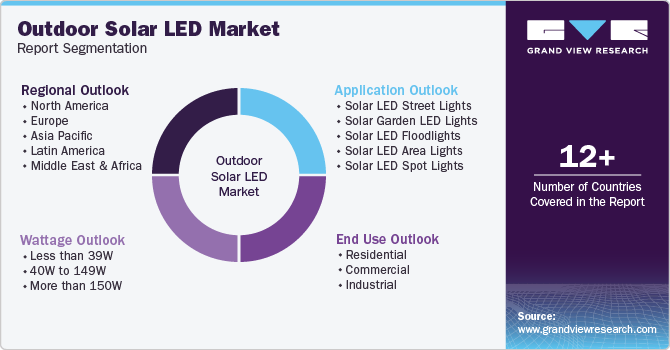
This report forecasts revenue growth at global, regional, and country levels and provides an analysis of the latest industry trends in each of the sub-segments from 2021 to 2033. For this study, Grand View Research has segmented the global outdoor solar LED market report based on application, wattage, end use, and region:
 To learn more about this report, Download Free Sample Report
 -
Application Outlook (Revenue, USD Million, 2021 - 2033)
-
Solar LED Street Lights
-
Solar Garden LED Lights
-
Solar LED Floodlights
-
Solar LED Area Lights
-
Solar LED Spot Lights
-
-
Wattage Outlook (Revenue, USD Million, 2021 - 2033)
-
less than 39W
-
40W to 149W
-
More than 150W
-
-
End Use Outlook (Revenue, USD Million, 2021 - 2033)
-
Residential
-
Commercial
-
Industrial
-
-
Regional Outlook (Revenue, USD Million, 2021 - 2033)
-
North America
-
U.S.
-
Canada
-
Mexico
-
-
Europe
-
UK
-
Germany
-
France
-
-
Asia Pacific
-
China
-
Japan
-
India
-
South Korea
-
Australia
-
-
Latin America
-
Brazil
-
-
MEA
-
UAE
-
Saudi Arabia
-
South Africa
-
-
Research Methodology
The outdoor solar LED market figures in this report are based on a proven research process that combines executive interviews with secondary research from proprietary databases, company filings, and recognized regulatory and institutional sources. Market size is built through value-chain sizing-reconciling supply-side and demand-side estimates-and triangulated with bottom-up and top-down approaches. Every estimate passes multiple levels of expert validation before publication, with each outdoor solar LED segment quantified using the revenue-capture definitions in the table below.
Segment Definition
Segment – Wattage
Revenue capture definition
Less than 39W
Demand is primarily generated by decorative, pathway, landscape, and small-scale security lighting applications where low power consumption and cost-effectiveness are key purchasing considerations. Manufacturers benefit from high-volume sales in residential installations and community-level solar lighting projects.
40W to 149W
This segment represents a balance between illumination performance and energy efficiency, making it suitable for streets, parking areas, campuses, and commercial facilities. Market value is supported by municipal infrastructure upgrades and commercial property developments seeking reliable off-grid lighting solutions.
More than 150W
Premium revenue opportunities arise from large-area illumination projects, including highways, industrial complexes, logistics hubs, ports, and public infrastructure. Suppliers compete by offering enhanced battery capacity, intelligent controls, and high-lumen-output systems capable of operating under demanding conditions.
Segment – Application
Revenue capture definition
Solar LED Street Lights
The largest application segment is supported by government electrification programs, smart city initiatives, and investments in sustainable public infrastructure. Procurement often occurs through large-scale municipal projects, creating substantial opportunities for system integrators and lighting manufacturers.
Solar Garden LED Lights
Market activity is driven by residential landscaping, parks, recreational areas, resorts, and public gardens. Consumer preference for aesthetically appealing, energy-independent lighting solutions contributes to steady demand within this category.
Solar LED Floodlights
Value is captured through installations requiring broad illumination coverage, including sports grounds, construction sites, warehouses, parking lots, and security-sensitive locations. Buyers prioritize brightness, durability, and reliable performance in low-grid-access environments.
Solar LED Area Lights
Demand originates from commercial campuses, public spaces, transportation facilities, and community infrastructure projects where uniform lighting coverage is essential. Suppliers benefit from increasing investments in sustainable outdoor lighting networks.
Solar LED Spot Lights
Commercial opportunities stem from architectural highlighting, signage illumination, monument lighting, landscape enhancement, and targeted security applications. Product differentiation is often achieved through design flexibility, beam control, and aesthetic lighting performance.
Segment – End Use
Revenue capture definition
Residential
Spending is influenced by homeowners seeking energy savings, backup lighting capabilities, and simplified installation without extensive electrical infrastructure. Growth is supported by rising awareness of renewable energy technologies and increasing adoption of smart home outdoor lighting solutions.
Commercial
Businesses, educational institutions, hospitality facilities, retail complexes, and office campuses invest in solar LED lighting to reduce operating expenses and achieve sustainability objectives. Commercial buyers often prioritize lifecycle cost savings, maintenance reduction, and environmental compliance.
Industrial
Industrial facilities deploy solar LED systems for perimeter security, storage yards, manufacturing sites, mining operations, logistics centers, and remote infrastructure. The segment benefits from demand for dependable lighting solutions in locations where grid connectivity is costly, unreliable, or unavailable.
Estimation Model
Layer Name
Key Question
Description
Off-Grid Lighting Need Layer
Where does outdoor solar LED lighting solve infrastructure challenges?
Identify locations where conventional grid-connected lighting is expensive, unavailable, or difficult to maintain. These include streets, highways, parks, parking lots, residential communities, industrial sites, campuses, rural villages, and public spaces. This layer evaluates demand arising from the need for reliable outdoor illumination while reducing dependence on electrical grid infrastructure and minimizing operating costs.
Solar Resource & Installation Viability Layer
What conditions support successful deployment of outdoor solar LED systems?
Assess factors such as solar irradiance levels, geographic location, weather conditions, battery storage requirements, installation economics, and local government support for renewable energy projects. The feasibility of deployment depends on the ability to generate sufficient solar power, ensure battery reliability, and achieve favorable lifecycle economics compared with conventional outdoor lighting alternatives.
Smart Lighting Adoption Layer
How are solar LED systems utilized in outdoor environments?
Analyze the implementation of standalone solar streetlights, solar floodlights, pathway lighting, security lighting, and smart solar lighting networks. Increasing adoption of motion sensors, adaptive brightness controls, remote monitoring platforms, and IoT-enabled management systems enhances energy efficiency, extends battery life, and improves operational performance in diverse outdoor applications.
Infrastructure Savings & Revenue Layer
How is value created across the outdoor solar LED ecosystem?
Evaluate revenue generated through sales of solar panels, LED luminaires, batteries, poles, smart controllers, and integrated lighting systems. Additional income is derived from installation services, maintenance contracts, battery replacements, and smart lighting management platforms. The market's economic value is further strengthened by long-term energy savings, reduced grid infrastructure investments, lower carbon emissions, and government-funded sustainable lighting initiatives that support widespread deployment.
Delivered Customizations
This report has been delivered with the following In-depth customizations
Client Request
Customization Delivered
Value Adds
Off-Grid Outdoor Illumination & Energy Independence Trends
Conducted a focused analysis of solar LED lighting deployment across streets, highways, parks, campuses, public spaces, rural communities, and remote infrastructure projects, focusing on off-grid electrification and energy self-sufficiency requirements.
Helps stakeholders identify high-growth deployment environments, evaluate solar lighting adoption trends, and assess commercialization opportunities in energy-independent outdoor lighting solutions.
Municipal Infrastructure Modernization & Smart Public Lighting Adoption Trends
Evaluated adoption trends for solar-powered streetlights, pathway lighting, security lighting, and public infrastructure illumination systems, including integration with motion sensors, adaptive brightness controls, and remote monitoring technologies.
Provides insights into public infrastructure investment priorities, operational cost reduction opportunities, and commercially attractive smart lighting applications.
Sustainable Urban Development & Renewable Lighting Ecosystem Opportunity Assessment
Assessed demand for integrated solar lighting systems incorporating energy storage, IoT connectivity, smart city platforms, and predictive maintenance capabilities, along with challenges related to battery lifespan, weather dependency, and project financing models.
Supports investment and expansion strategies by identifying sustainable infrastructure opportunities, evaluating technology readiness, and strengthening long-term growth potential in renewable-powered outdoor lighting ecosystems.
Frequently Asked Questions About This Report
The less than 39W segment led with a 41.5% revenue share in 2025, while below 30HP segment is the fastest-growing segment.
The solar LED street lights segment led with an 54.2% revenue share in 2025, while solar garden LED lights segment is the fastest-growing segment.
Key players operating in the outdoor solar LED market include Greenshine New Energy (Oceania International LLC); Polybrite - SBM NewTech Co., Ltd; Signify Holding; Wipro Lighting; LEADSUN; Bridgelux, Inc; SEPCO; Solar Electric Power Company; SOKOYO Solar Lighting Co., Ltd.; Brightown; Sunna Design.
The global outdoor solar LED market size was valued at USD 10.0 billion in 2025 and is estimated at USD 11.0 billion for 2026.
The global outdoor solar LED market is expected to grow at a CAGR of 9.8% from 2025 to 2030, reaching USD 21.3 billion by 2033.
Key factors include growing investments in smart city and urban infrastructure projects, rising demand for sustainable lighting in commercial and industrial facilities, and growing adoption of adaptive and motion-sensing outdoor lighting systems.
Asia Pacific dominated with 47.0% revenue share in 2025.
Commercial segment held the largest market share of 55.8% in 2025.
About the Author(s)
Electronic Devices Research Team
Semiconductors & Electronics · Electronic DevicesThis report was authored by the electronic devices research team at Grand View Research - comprising two research analysts, one senior research analyst, and one industry expert - with specialized expertise in the electronic devices segment of the semiconductors & electronics industry. All findings are based on proprietary semiconductors & electronics databases, executive interviews, and regulatory analysis, subject to internal peer review prior to publication.
Last Updated:
Speak to Analyst

Customize this report to your needs - add regions, segments, or data points, with 20% free customization.
Or view our licence options:


ISO 9001:2015 & 27001:2022 Certified
We are GDPR and CCPA compliant! Your transaction & personal information is safe and secure. For more details, please read our privacy policy.


