
- Home
- »
- Advanced Interior Materials
- »
-
Oxygen Generator Market Size & Share Report, 2026-2033GVR Report cover

Oxygen Generator Market (2026 - 2033) Size, Share & Trends Analysis Report By Type (Portable, Stationary), By Technology (Pressure Swing Adsorption), By End Use (Medical & Healthcare, Water & Wastewater Treatment), By Region, And Segment Forecasts
Market Size, 2025
$6.0BMarket Estimate, 2026
$6.3BMarket Forecast, 2033
$9.9BCAGR, 2026–2033
6.7%Oxygen Generator Market Summary
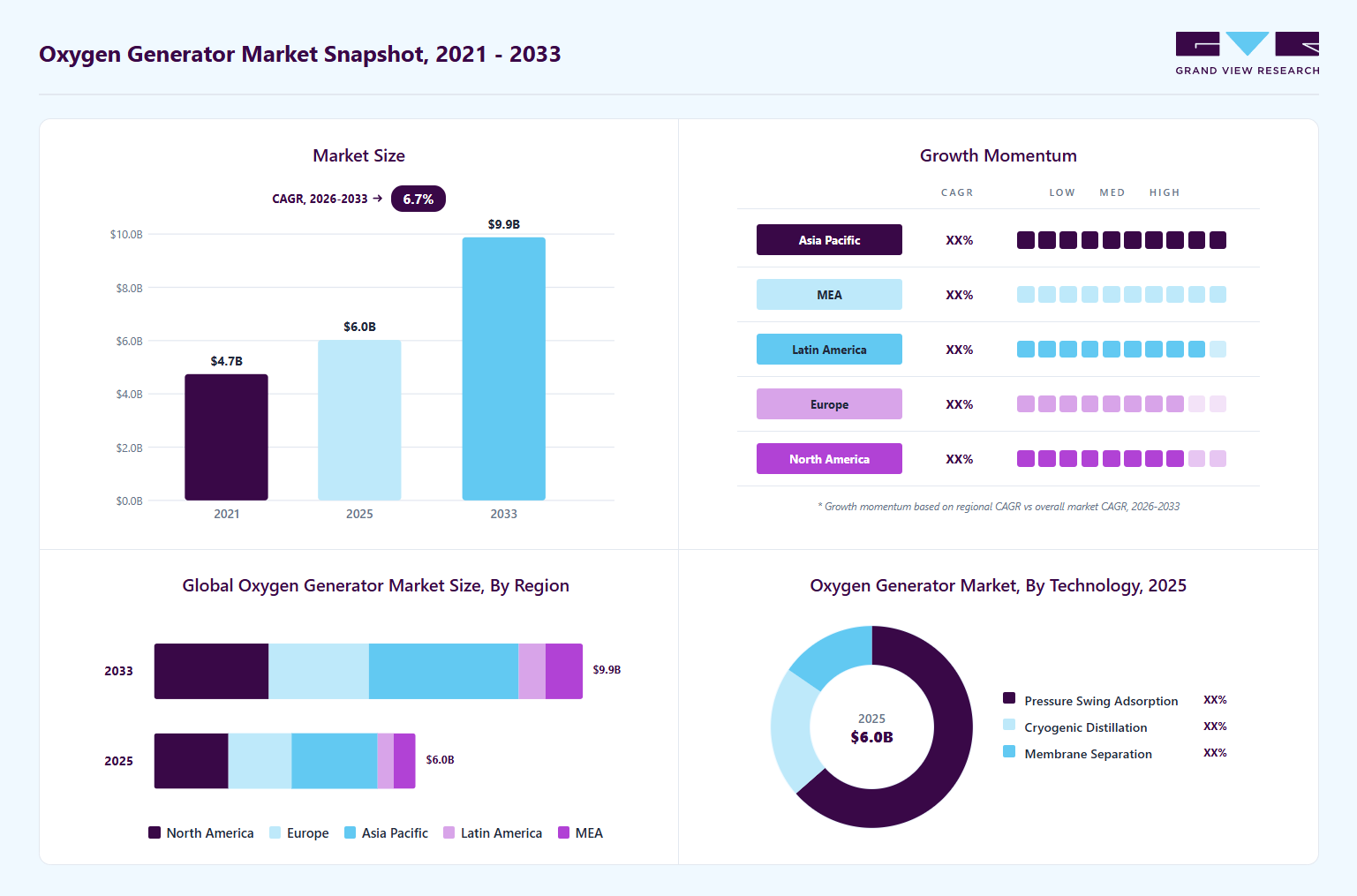
The global oxygen generator market size was valued at USD 6.0 billion in 2025 and is projected to grow from USD 6.3 billion in 2026 to USD 9.9 billion by 2033, at a CAGR of 6.7% from 2026 to 2033. The market in Asia Pacific dominated with a revenue share of 32.9% in 2025. Hospitals and healthcare facilities are increasingly adopting oxygen generators to ensure uninterrupted medical oxygen availability and reduce dependence on external cylinder-based supply systems.
 Source: Grand View Research, IR Documents, Primary Interviews, Paid DatabasesTo learn more about this report,
 Download Free Sample Report
 Key Market Trends & Insights
- By type: Portable segment is projected to grow at 7.4% CAGR during the forecast period.
- By technology: Membrane separation segment is projected to expand at a CAGR of 6.3% from 2026 to 2033.
- By end use: Medical & healthcare segment dominated the market in 2025 accounting for a 33.6% market share.
Regional Highlights
- Largest regional market: Asia Pacific (32.9% revenue share, 2025)
- The oxygen generator industry in the China held the largest revenue share in 2025.
Market Size & Forecast
- Market size in 2025: USD 6.0 Billion
- Estimated market size in 2026: USD 6.3 Billion
- Projected market size by 2033: USD 9.9 Billion
- CAGR (2026-2033): 6.7%
Three ways to get this report
Buy it, customize it, or ask a question.Ask an Analyst
Analyst response in 1 business day
- AccessReport author, directly
- Reply timeWithin 1 working day
- No sales callDirect answer only
- FormatEmail reply
- CostFree, no cost
Get the Full Report
What the study covers
- FormatsPDF · Excel · Dashboard
- Timeline2026–2033 annual, 2025 base
- Coverage20+ countries, 5 regions
- Companies10+ key players profiled
Customize the Report
20% free customization
- IncludeCountries, segments, points
- TailorTo your product definition
- ExtendDeeper competitor detail
- OrA fully bespoke study
- Turnaround5–10 working days
On-site oxygen generation systems provide continuous oxygen production, improving operational reliability during emergencies, high patient inflow, and supply chain disruptions. These systems also help healthcare providers lower transportation, storage, and recurring cylinder replacement costs.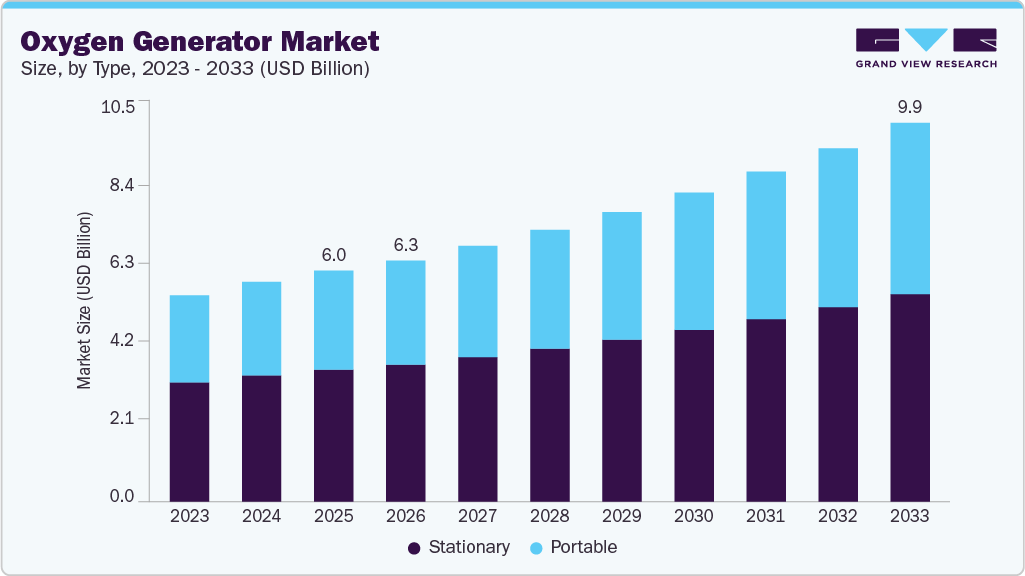 To learn more about this report, Download Free Sample Report
 Growing investment in healthcare infrastructure, particularly in developing countries, is supporting wider adoption of pressure swing adsorption and membrane-based oxygen generation systems. Technological advancements improving energy efficiency, operational reliability, and system compactness are further contributing to market expansion.
Market Dynamics
Increasing demand for reliable and continuous medical oxygen supply is a major driver for the oxygen generators industry. Hospitals, clinics, emergency care centers, and home healthcare providers are increasingly adopting oxygen generators to reduce dependence on oxygen cylinders and centralized supply chains. Oxygen generators provide on-site oxygen production, ensuring uninterrupted availability during emergencies, high patient inflow, and supply chain disruptions. Growing prevalence of respiratory diseases, rising aging population, and increasing healthcare infrastructure investments are further supporting market demand.
Many healthcare facilities are also focusing on improving operational efficiency and reducing long-term oxygen procurement costs through installation of pressure swing adsorption and membrane-based oxygen generation systems. In developing regions, governments and healthcare organizations are expanding access to medical oxygen infrastructure, creating additional growth opportunities. The need for dependable oxygen supply systems in healthcare facilities continues to accelerate adoption of oxygen generators across both developed and emerging markets.
High installation and maintenance costs act as a significant restraint for the market. Setting up oxygen generation systems requires substantial investment in equipment, compressors, filtration units, storage systems, piping infrastructure, and power supply integration. Small hospitals, clinics, and industrial facilities often face financial limitations that restrict adoption of advanced oxygen generation technologies. In addition to installation expenses, regular maintenance, system monitoring, filter replacement, and technical servicing increase operational costs over time.
Maintaining oxygen purity levels and ensuring continuous system performance also require trained personnel and periodic inspections. In developing regions, limited technical expertise and inadequate infrastructure further complicate installation and long-term operation of oxygen generation systems. Power supply instability in certain areas can also affect operational efficiency and increase maintenance requirements. These cost and infrastructure-related challenges can slow adoption, particularly among smaller healthcare providers and cost-sensitive industrial users operating with limited budgets.
Market Concentration & Characteristics
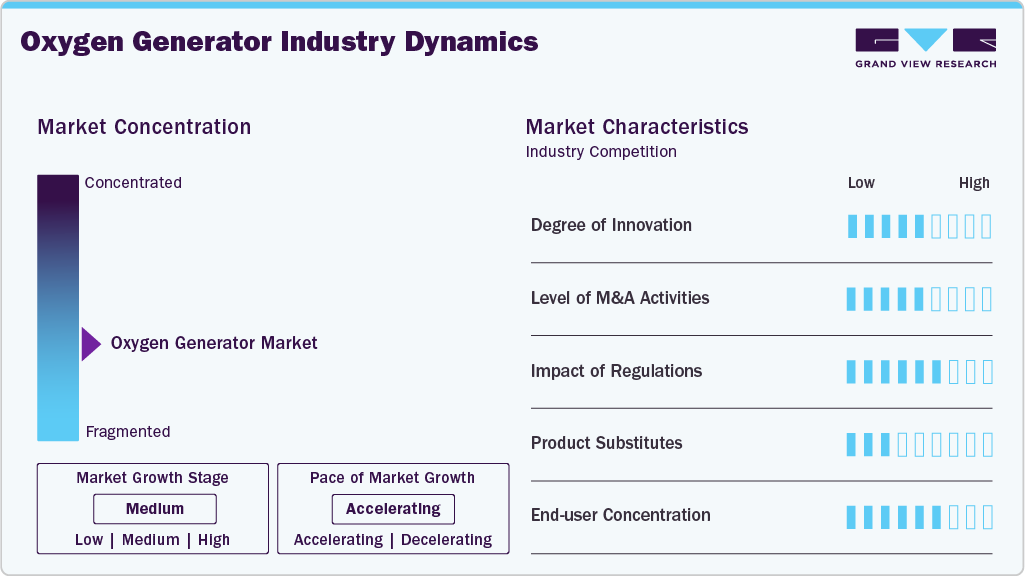
The oxygen generator industry is fragmented due to the presence of numerous international, regional, and local manufacturers serving healthcare, industrial, and wastewater treatment sectors. Companies compete across portable, on-site, and large-capacity oxygen generation systems with varying technologies and pricing structures. Large players focus on advanced systems and global distribution, while regional firms compete through customized solutions and cost advantages. Diverse application requirements and increasing demand across developing economies continue to intensify competition and market fragmentation.
Manufacturers are developing advanced technologies for the PSA oxygen generator market and molecular sieve oxygen generator market to improve oxygen purity, operational reliability, and power efficiency. Companies are also expanding modular oxygen generator and fixed oxygen generator solutions for oxygen generation across healthcare and industrial applications.
 To learn more about this report, Download Free Sample Report
 Merger and acquisition activities in the market are increasing as companies seek to expand technological capabilities, strengthen regional presence, and broaden product portfolios. Larger firms are acquiring specialized medical gas and industrial equipment companies to improve manufacturing capacity and distribution networks. Acquisitions also help companies access advanced oxygen generation technologies and healthcare infrastructure markets. This consolidation trend is supporting competitive positioning and enabling firms to address rising global demand for reliable oxygen generation systems across multiple end-use industries.
Regulations are shaping the market through strict standards related to medical device safety, gas purity, operational reliability, and environmental compliance. Healthcare oxygen generators must meet certification requirements established by regulatory bodies to ensure patient safety and continuous oxygen supply. Industrial regulations also require compliance with safety and emissions standards during oxygen generation and storage operations. In addition, increasing focus on healthcare preparedness and emergency response capabilities is encouraging adoption of certified and high-quality oxygen generation systems globally.
Type Insights
The stationary segment led the market and accounted for 57.2% of the global revenue share in 2025, due to increasing installation of centralized oxygen supply systems in hospitals and industrial facilities. Large healthcare centers require continuous and high-volume oxygen generation for critical care and emergency operations. Industrial sectors such as metal processing and chemical manufacturing also depend on stationary oxygen systems for uninterrupted operations
Rising demand for home healthcare and mobile medical support systems is expected to fuel the demand for portable oxygen generators. Portable oxygen generators provide flexibility, easy transportation, and continuous oxygen supply for patients requiring respiratory support outside hospitals. Increasing prevalence of chronic respiratory diseases and growing aging population are supporting demand for compact oxygen solutions.
Technology Insights
The Pressure Swing Adsorption (PSA) segment dominated the market in 2025 accounting for 63.5% of the market share due to increasing demand for high-purity oxygen generation in healthcare and industrial applications. PSA systems provide reliable on-site oxygen production while reducing dependence on cylinder supply chains. Hospitals, clinics, and manufacturing facilities increasingly prefer these systems for continuous oxygen availability and operational efficiency.
The membrane separation segment is expected to grow over the forecast period, due to increasing demand for compact and energy-efficient oxygen generation systems. Membrane technology offers continuous oxygen production with lower maintenance requirements and simplified operation, making it suitable for industrial and portable applications. Industries such as wastewater treatment, chemical processing, and marine operations are increasingly adopting membrane-based systems for stable oxygen supply.
End Use Insights
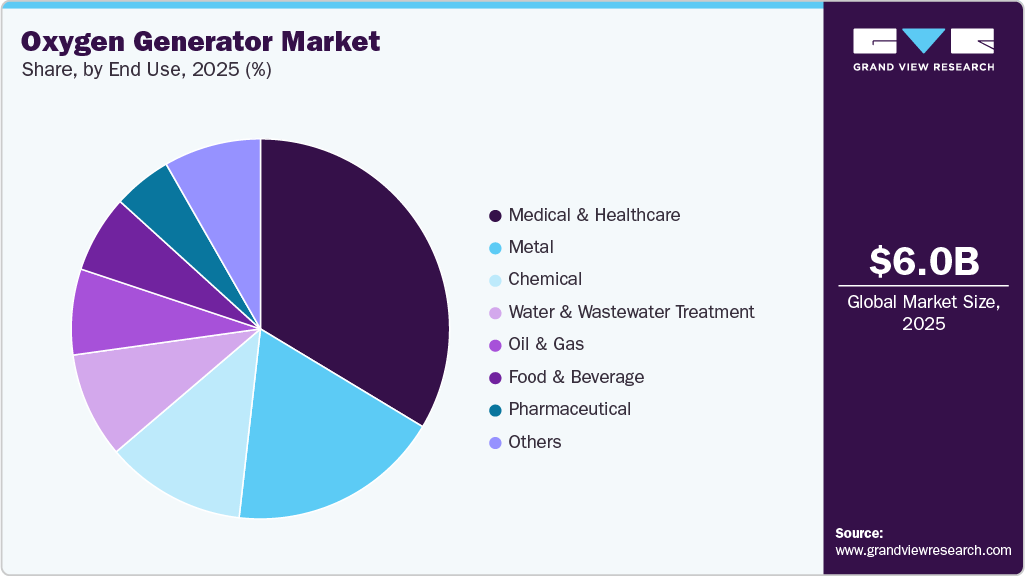
The medical & healthcare segment led the market in 2025 due to increasing demand for continuous oxygen supply in hospitals, clinics, and home healthcare settings. Rising prevalence of respiratory diseases and expanding healthcare infrastructure are increasing adoption of on-site oxygen generation systems. Healthcare providers are increasingly using oxygen generators to reduce dependence on cylinder supply networks and improve operational reliability.
 To learn more about this report, Download Free Sample Report
 The water & wastewater treatment segment is expected to grow at a CAGR of 7.3% during the forecast period, driven by increasing demand for efficient water purification and aeration processes. Oxygen generators are widely used to improve biological treatment efficiency and support oxidation processes in wastewater management facilities. Rising investment in municipal water infrastructure and stricter environmental regulations are encouraging adoption of advanced oxygen generation systems.
Regional Insights
North America Oxygen Generator Market Trends
North America oxygen generator industry is expected to grow significantly over the forecast period, due to increasing healthcare infrastructure investments. Hospitals and healthcare facilities across the region are adopting on-site oxygen generation systems to ensure continuous oxygen availability and reduce dependence on external supply chains. For instance, in March 2025 Ontario began expanding Peel Memorial Hospital as part of its broader plan to strengthen healthcare access. This initiative is among over 50 hospital projects supported by a USD 50 billion investment, aimed at modernizing facilities, enhancing capacity.
U.S. Oxygen Generator Market Trends
The U.S. oxygen generators industry is driven by the increasing prevalence of respiratory disorders and increasing geriatric population, which is encouraging adoption of portable and stationary oxygen generation systems for continuous oxygen support outside hospitals. Healthcare providers are also expanding home-based patient care programs to reduce hospitalization costs and improve treatment accessibility. This increasing focus on decentralized healthcare delivery is driving strong demand for advanced oxygen generators across the country.
The Mexico oxygen generator market is driven by the increasing adoption of oxygen generation systems in hospitals and medical facilities to improve continuous oxygen availability and reduce dependence on imported oxygen cylinders. Government investments in healthcare modernization and increasing demand for emergency medical services are supporting market growth. In addition, rising industrial activities requiring oxygen supply for manufacturing and wastewater treatment operations are contributing to increasing demand for oxygen generation technologies across the country.
Asia Pacific Oxygen Generator Market Trends
Asia Pacific oxygen generator industry is anticipated to be the fastest-growing market over the forecast period, due to rapid healthcare infrastructure development. Countries across the region are increasing investment in hospitals, emergency care centers, and medical oxygen supply systems to improve healthcare accessibility and preparedness. Rising industrialization is also increasing demand for oxygen generation technologies in manufacturing and wastewater treatment operations.
 To learn more about this report, Download Free Sample Report
 The oxygen generator market in China is driven by the expansion of domestic healthcare infrastructure, supported by strong government investments and healthcare modernization initiatives. According to International Trade administration, China’s healthcare market is rapidly expanding. The healthcare industry was valued at over USD 1 trillion in 2024 and projected to exceed USD 1.5 trillion by 2029, supported by strong government spending and policy initiatives such as Healthy China 2030.
The oxygen generators market in India is driven by the increasing investment in healthcare infrastructure fueling the demand for oxygen generators. Hospitals and medical facilities are adopting on-site oxygen generation systems to improve oxygen availability and reduce supply chain dependence. Growing awareness regarding emergency healthcare preparedness and rising prevalence of respiratory diseases are supporting market expansion. Government initiatives to strengthen healthcare capacity and improve access to medical oxygen in rural and urban areas are further driving demand for oxygen generation technologies across the country.
Europe Oxygen Generator Market Trends
Europe oxygen generator industry is expected to grow at a significant CAGR during the forecast period, due to increasing adoption of energy-efficient medical technologies. Healthcare facilities across the region are investing in advanced oxygen generation systems to improve operational efficiency and ensure reliable oxygen supply for patient care. Rising focus on healthcare preparedness and modernization of hospital infrastructure is supporting market expansion.
The German oxygen generator market is driven by the strong healthcare infrastructure expansion. Hospitals and medical facilities are increasingly installing on-site oxygen generation systems to improve supply reliability and reduce operational dependence on external gas distribution networks. Rising demand for advanced healthcare technologies and critical care support is encouraging adoption of high-efficiency oxygen generators.
The UK oxygen generator market is driven by the rising prevalence of respiratory diseases and expanding elderly population, which is encouraging greater adoption of portable and stationary oxygen generators for long-term patient care. Healthcare providers are increasingly focusing on decentralized treatment and remote patient support to improve healthcare accessibility and reduce hospital burden. This growing shift toward home-based respiratory care is supporting continuous demand for oxygen generation systems across the UK healthcare sector.
Middle East & Africa Oxygen Generator Market Trends
Middle East & Africa oxygen generator industry is expected to grow at 7.2% CAGR during the forecast period. Governments and healthcare providers are investing in medical facilities and oxygen supply systems to improve emergency preparedness and patient care capabilities. Rising demand for reliable oxygen availability in hospitals and clinics is encouraging adoption of on-site oxygen generation technologies. In addition, industrial sectors including wastewater treatment and energy operations are increasingly using oxygen generators, supporting broader market growth across the Middle East & Africa.
Expansion of healthcare infrastructure under Vision 2030 initiatives is driving the oxygen generator market. Hospitals and healthcare facilities are increasing adoption of oxygen generation systems to improve medical oxygen availability and strengthen emergency healthcare capabilities. Rising investment in healthcare modernization and growing focus on operational efficiency are supporting demand for on-site oxygen production technologies. Increasing industrial development and wastewater treatment activities are also contributing to higher demand for oxygen generators across the country.
Latin America Oxygen Generator Market Trends
The Latin America oxygen generator industry is driven by the increasing healthcare modernization efforts. Hospitals and healthcare centers are adopting oxygen generation systems to improve continuous oxygen supply and reduce dependence on imported oxygen cylinders. Rising awareness regarding emergency healthcare preparedness and increasing demand for respiratory care solutions are supporting market growth.
Brazil oxygen generator market is driven by the increasing healthcare investments. Hospitals and medical facilities are expanding installation of oxygen generation systems to improve oxygen availability and support critical care operations. According to a report published by International Trade Administration in December 2023, Brazil has one of the largest healthcare markets in Latin America, spending approximately 9.47% of its GDP toward the healthcare sector, which amounts to USD 161 billion.
Key Oxygen Generator Company Insights
Some of the key players operating in the market include Air Products, AirSep Corporation, among others.
-
Air Products is a global industrial gases company specializing in oxygen, nitrogen, hydrogen, and related gas generation technologies for healthcare, industrial, energy, and manufacturing applications. The company provides on-site oxygen generation systems, gas processing solutions, and pressure swing adsorption technologies designed for reliable and continuous oxygen supply. Air Products serves industries including healthcare, chemicals, metals, electronics, and wastewater treatment.
-
AirSep Corporation, a subsidiary of Chart Industries, specializes in oxygen concentrators and oxygen generation systems for medical, industrial, and commercial applications. The company is known for portable and stationary oxygen generators using pressure swing adsorption technology to deliver high-purity oxygen efficiently. AirSep serves healthcare facilities, home healthcare providers, military operations, and industrial customers requiring reliable oxygen supply solutions.
Key Oxygen Generator Companies:
The following key companies have been profiled for this study on the oxygen generators market.
- Air Products
- AirSep Corporation
- Oxymat A/S
- Oxair Gas Systems Pty Ltd
- Atlas Copco
- Delta P S.r.l.
- Oxygen Generating Systems Intl. (OGSI)
- INMATEC GaseTechnologie GmbH & Co. KG
- Omega Air
- Essex Industries
- NOVAIR USA Corp.
- BERG GaseTech GmbH
- Sumer A.Ş.
- GENERON
- Ingersoll Rand (Oxywise)
Competitive Benchmarking
Category
Operating Strategies
Competitive Edge
Weakness
Established Players (e.g., Air Products and Chemicals, Atlas Copco, Ingersoll Rand (Oxywise), AirSep Corporation, GENERON, Oxymat A/S)
- Focus on large-scale industrial, healthcare, and on-site oxygen generation projects through extensive global distribution networks.
- Invest heavily in R&D, product innovation, and strategic partnerships to strengthen market presence and expand application areas.
- Strong brand reputation, broad product portfolios, and established customer relationships across multiple industries.
- Advanced technological capabilities and extensive after-sales service infrastructure enabling reliable long-term operations.
- Higher manufacturing and operating costs compared to regional competitors, resulting in premium pricing.
- Complex organizational structures can slow decision-making and responsiveness to niche market requirements.
Emerging & Regional Players (e.g., Oxygen Generating Systems Intl. (OGSI), INMATEC GaseTechnologie GmbH & Co. KG, NOVAIR USA Corp., BERG GaseTech GmbH, Omega Air, Oxair Gas Systems Pty Ltd)
- Concentrate on niche applications, customized oxygen generation systems, and region-specific customer requirements.
- Compete through cost-effective solutions, flexible production capabilities, and strong local distributor partnerships.
- Greater agility in product customization and faster response to changing customer demands.
- Competitive pricing strategies that appeal to small and medium-sized enterprises and developing markets.
- Limited global footprint and lower brand recognition compared to multinational industry leaders.
- Smaller financial and R&D resources, restricting large-scale expansion and advanced technology development.
Recent Developments
-
In February 2026, Unitaid and PATH launched the four-year INNOVATE initiative to pilot advanced oxygen technologies, including a NASA-developed oxygen generator, across low-resource countries such as India, Kenya, and Nigeria. The program aims to improve affordable and reliable medical oxygen access, supporting healthcare infrastructure development and increasing adoption of innovative oxygen generation systems in underserved regions.
-
In December 2025, Luoming unveiled modular oxygen generators designed to provide scalable and flexible oxygen supply solutions for regional healthcare networks. The systems support efficient oxygen production across hospitals and medical facilities with varying capacity requirements.
-
In June 2024, Novair and American Oxygen announced a strategic partnership to develop and commercialize ionic oxygen generators. The collaboration focuses on advancing oxygen generation technology with improved efficiency and reliability.
Oxygen Generator Market Report Scope
Report Attribute
Details
Market size in 2025
USD 6.0 billion
Estimated market size in 2026
USD 6.3 billion
Projected market size by 2033
USD 9.9 billion
Growth rate
CAGR of 6.7% from 2026 to 2033
Base year for estimation
2025
Historical data
2021 - 2024
Forecast period
2026 - 2033
Quantitative units
Revenue in USD million and CAGR from 2026 to 2033
Report coverage
Revenue forecast, company market position analysis, competitive landscape, growth factors, and trends
Segments covered
Type, technology, end use, region
Regional scope
North America; Europe; Asia Pacific; Latin America; Middle East & Africa
Country Scope
U.S.; Canada; Mexico; Germany; UK; Italy; Spain; France; China; Japan; India; Australia; South Korea; Brazil; Argentina; Saudi Arabia; UAE; South Africa
Key companies profiled
Air Products; AirSep Corporation; Oxymat A/S; Oxair Gas Systems Pty Ltd; Atlas Copco; Delta P S.r.l.; Oxygen Generating Systems Intl. (OGSI); INMATEC GaseTechnologie GmbH & Co. KG; Omega Air; Essex Industries; NOVAIR USA Corp.; BERG GaseTech GmbH; Sumer A.Ş.; GENERON; Ingersoll Rand (Oxywise)
Customization scope
Free report customization (equivalent up to 8 analysts working days) with purchase. Addition or alteration to country, regional & segment scope.
Pricing and purchase options
Avail customized purchase options to meet your exact research needs. Explore purchase options
Global Oxygen Generator Market Report Segmentation
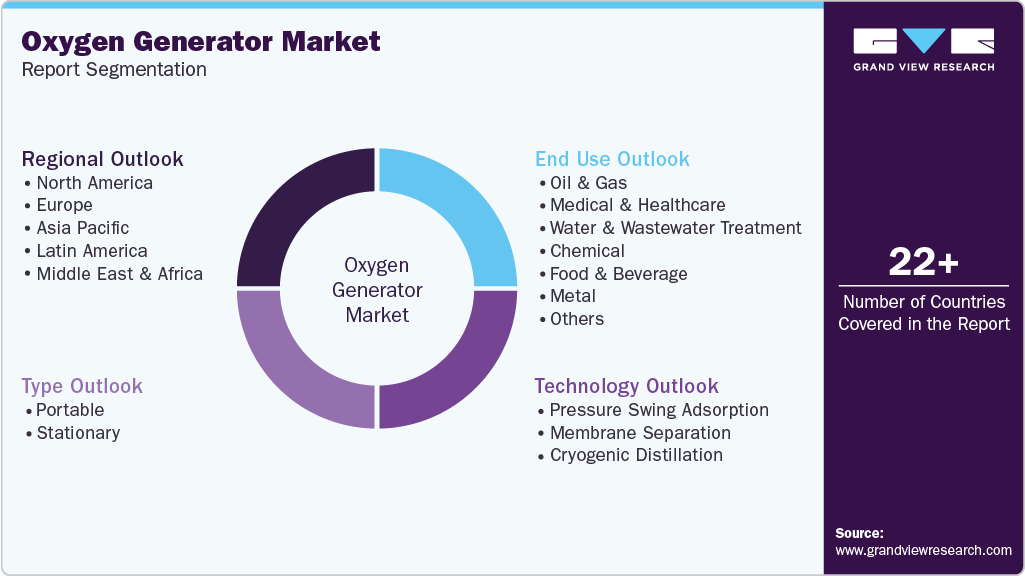
This report forecasts revenue growth at global, regional & country levels and provides an analysis on the industry trends in each of the sub-segments from 2021 to 2033. For this study, Grand View Research has segmented the global oxygen generator market report based on type, technology, end use, and region:
 To learn more about this report, Download Free Sample Report
 -
Type Outlook (Revenue, USD Million, 2021 - 2033)
-
Portable
-
Stationary
-
-
Technology Outlook (Revenue, USD Million, 2021 - 2033)
-
Pressure Swing Adsorption
-
Membrane Separation
-
Cryogenic Distillation
-
-
End Use Outlook (Revenue, USD Million, 2021 - 2033)
-
Oil & Gas
-
Medical & Healthcare
-
Water & Wastewater Treatment
-
Chemical
-
Food & Beverage
-
Metal
-
Pharmaceutical
-
Others
-
-
Regional Outlook (Revenue, USD Million, 2021 - 2033)
-
North America
-
U.S.
-
Canada
-
Mexico
-
-
Europe
-
Germany
-
France
-
UK
-
Spain
-
Italy
-
-
Asia Pacific
-
China
-
India
-
Japan
-
South Korea
-
Australia
-
-
Latin America
-
Brazil
-
Argentina
-
-
Middle East & Africa
-
Saudi Arabia
-
UAE
-
South Africa
-
-
Delivered Customizations
This report has been delivered with the following In-depth customizations
CLIENT REQUEST
CUSTOMIZATION DELIVERED
VALUE ADDS
Regional Segmentation
Delivered detailed oxygen generator market analysis across North America, Europe, Asia-Pacific, Latin America, and Middle East & Africa, including market size estimates, growth trends, demand drivers, regulatory environment, and end-user adoption patterns for each region.
Enabled identification of high-growth regional markets, investment hotspots, supply-demand dynamics, and region-specific expansion opportunities for stakeholders.
Competitive Benchmarking
Provided comprehensive benchmarking of key market participants based on product portfolio, technology focus (PSA, membrane, cryogenic), end-use presence, geographic reach, strategic initiatives, and market positioning, along with categorization of established and emerging players.
Offered clear visibility into competitive intensity, market leadership positions, differentiation strategies, and potential partnership/acquisition targets.
Opportunity Assessment
Delivered in-depth assessment of growth opportunities across medical & healthcare, water treatment, pharmaceuticals, food & beverage, and industrial applications, including emerging demand trends, technology adoption outlook, and untapped regional opportunities.
Helped prioritize high-return investment areas, identify underserved customer segments, evaluate future revenue pockets, and support strategic market entry decisions.
Frequently Asked Questions About This Report
The global oxygen generator market size was valued at USD 6.0 billion in 2025 and is estimated at USD 6.3 billion for 2026.
Medical & healthcare held the largest revenue share in 2025 and is the fastest-growing segment.
Key factors include increasing demand for continuous medical oxygen supply, expanding healthcare infrastructure, rising prevalence of respiratory diseases, and growing adoption of on-site oxygen generation systems. Increasing industrial oxygen demand and focus on operational efficiency are also supporting market growth globally.
Key players include Air Products, AirSep Corporation, Oxymat A/S, Oxair Gas Systems Pty Ltd, Atlas Copco, Delta P S.r.l., Oxygen Generating Systems Intl. (OGSI), INMATEC GaseTechnologie GmbH & Co. KG, Omega Air, Essex Industries , NOVAIR USA Corp., BERG GaseTech GmbH, Sumer A.Ş., GENERON, Ingersoll Rand (Oxywise).
The global oxygen generator market is expected to grow at a CAGR of 6.7% from 2026 to 2033, reaching USD 9.9 billion.
Asia Pacific dominated with a 32.9% revenue share in 2025.
The stationary segment led with a 57.2% revenue share in 2025, while portable is the fastest-growing segment.
Pressure Swing Adsorption (PSA) held the largest share (over 63%) in 2025 and is the fastest-growing technology.
About the Author(s)
Advanced Interior Materials Research Team
Advanced Materials · Advanced Interior MaterialsThis report was authored by the advanced interior materials research team at Grand View Research - comprising two research analysts, one senior research analyst, and one industry expert - with specialized expertise in the advanced interior materials segment of the advanced materials industry. All findings are based on proprietary advanced materials databases, executive interviews, and regulatory analysis, subject to internal peer review prior to publication.
Last Updated:
Speak to Analyst

Customize this report to your needs - add regions, segments, or data points, with 20% free customization.
Or view our licence options:


ISO 9001:2015 & 27001:2022 Certified
We are GDPR and CCPA compliant! Your transaction & personal information is safe and secure. For more details, please read our privacy policy.


