
- Home
- »
- Advanced Interior Materials
- »
-
Package Boilers Market Size And Share Report 2026-2033GVR Report cover

Package Boilers Market (2026 - 2033)
Size, Share & Trends Analysis Report By Type (Water-Tube Boilers, Electric Boilers, Hybrid Boilers), By Design (D-Type, A-Type), By Fuel Type (Oil, Gas, Coal ), By Application, By Region, And Segment Forecasts
Market Size, 2025
$10.2BMarket Estimate, 2026
$10.5BMarket Forecast, 2033
$14.0BCAGR, 2026–2033
4.2%Package Boilers Market Summary
The global package boilers market size was valued at USD 10.2 billion in 2025 and is projected to grow from USD 10.5 billion in 2026 to USD 14.0 billion by 2033, at a CAGR of 4.2% from 2026 to 2033. Asia Pacific dominated the market, accounting for a revenue share of 41.8% in 2025. The market is steadily expanding, driven by rising industrial demand for efficient steam generation systems across food processing, chemicals, pharmaceuticals, and energy sectors.
 Source: Grand View Research, IR Documents, Primary Interviews, Paid DatabasesTo learn more about this report,
 Download Free Sample Report
Key Market Trends & Insights
- By boiler type: Fire-tube boilers segment led the market with the largest revenue share of 44.8% in 2025.
- By fuel type: Natural gas segment led the market with the largest revenue share of 44.2% in 2025.
- By application: Food & beverage segment led the market with the largest revenue share of 23.0% in 2025.
Regional Highlights
- Largest regional market: Asia Pacific (41.8% revenue share, 2025)
- By country: China held the largest market share in 2025.
Market Size & Forecast
- Market size in 2025: USD 10.2 Billion
- Estimated market size in 2026: USD 10.5 Billion
- Projected market size by 2033: USD 14.0 Billion
- CAGR (2026-2033): 4.2%
Prism AI by Grand View Research Free to tryAsk a question about the package boilers marketTry asking✓Every figure cited from GVR research Prefer the report? Download free sample →
These boilers, pre-assembled and factory-tested, offer advantages such as quick installation, compact design, and minimal on-site construction, making them particularly attractive for facilities with space constraints or time-sensitive project requirements. To learn more about this report, Download Free Sample Report
The shift toward automation and smart monitoring has also increased the adoption of advanced package boilers equipped with IoT-enabled sensors for real-time performance tracking and predictive maintenance. Environmental regulations are another key driver shaping the market, pushing industries to replace older, inefficient boilers with low-emission and energy-efficient models. As a result, there is growing interest in gas-fired and biomass-fueled package boilers that align with global decarbonization goals. Emerging markets in Asia Pacific and Latin America are seeing heightened demand due to rapid industrialization, while developed regions like North America and Europe focus on retrofitting and upgrading legacy systems. This combination of sustainability priorities, regulatory compliance, and process efficiency continues to drive innovation and investment in the market globally.
Market Dynamics
The package boilers market is witnessing steady growth due to rising industrialization, increasing demand for energy-efficient steam generation systems, and stricter environmental regulations across manufacturing sectors. Industries such as food & beverage, chemicals, pharmaceuticals, paper & pulp, and oil & gas are replacing conventional boiler systems with compact, factory-assembled package boilers that offer faster installation, lower operational costs, and improved thermal efficiency. The growing adoption of cleaner fuels such as natural gas, biomass, and electricity, along with advancements in digital monitoring and automation, is further supporting market expansion.
Industries worldwide are under increasing pressure to reduce fuel consumption and greenhouse gas emissions while maintaining high production efficiency. Package boilers are designed with advanced combustion technologies, improved heat recovery systems, and automated controls that help minimize energy losses and improve fuel efficiency. Their compact, pre-engineered design also reduces installation time and overall lifecycle costs, making them an attractive choice for both new industrial facilities and retrofit projects.
In addition, governments are implementing stricter emission standards and promoting cleaner industrial operations through environmental regulations and incentive programs. As manufacturers invest in modernizing aging boiler infrastructure, demand is increasing for high-efficiency package boilers capable of operating on natural gas, biomass, and hybrid fuel systems. This trend is expected to remain a major driver of market growth throughout the forecast period.
Although package boilers offer long-term operational savings, their initial purchase, installation, and integration costs can be significant, particularly for small and medium-sized enterprises. Upgrading existing steam infrastructure often requires additional investments in piping, control systems, fuel supply modifications, and safety equipment, which may delay purchasing decisions. In cost-sensitive industries and developing regions, many applicationrs continue operating conventional boilers rather than investing in new package boiler systems.
The global transition toward decarbonization presents significant opportunities for manufacturers of package boilers. Industries are increasingly investing in biomass-fired, electric, and hybrid boiler systems to meet sustainability goals, reduce carbon emissions, and comply with evolving environmental regulations. Continuous innovation in smart controls, IoT-enabled monitoring, and fuel-flexible boiler designs is enabling manufacturers to offer cleaner, more efficient steam generation solutions. As renewable energy integration and industrial electrification accelerate, demand for next-generation package boilers is expected to create substantial growth opportunities across both developed and emerging markets.
Market Concentration & Characteristics
The global package boilers industry is moderately fragmented, marked by a combination of major industrial equipment manufacturers and a wide array of regional players catering to localized and industry-specific requirements. While leading multinational companies dominate high-capacity and technically advanced segments, regional firms often provide cost-effective or customized boiler systems, especially in developing markets. Design differentiation in the sector hinges on thermal efficiency, operational reliability under demanding industrial conditions, and compliance with international safety and emissions standards. Manufacturers are increasingly channeling investments into R&D to create smarter, more fuel-efficient boilers integrated with automation and control systems to optimize process performance and reduce operating costs.
Regulatory frameworks governing emissions, energy efficiency, and workplace safety, enforced by agencies such as the U.S. Environmental Protection Agency (EPA), European Environment Agency, and local energy authorities, play a central role in shaping product development and competitive dynamics. The global push toward decarbonization and cleaner industrial processes is accelerating the shift from traditional coal-fired systems to gas-fired, biomass-fueled, and hybrid boilers. This transition is particularly visible in sectors such as food and beverage, petrochemicals, and pharmaceuticals, where compliance with environmental and energy regulations is critical to market access and operational sustainability.
 To learn more about this report, Download Free Sample Report
The package boilers industry is poised for growth, particularly in emerging regions like Asia Pacific, Latin America, and the Middle East, driven by rapid industrialization and infrastructure expansion. However, the market faces challenges from alternative thermal energy systems and the rising preference for decentralized energy solutions, which reduce reliance on centralized steam generation. To stay competitive, manufacturers focus on modular, plug-and-play designs that offer greater fuel flexibility, mobility, and ease of integration, aligning with industry demands for lower total cost of ownership and minimal infrastructure requirements.
To stay competitive in this evolving landscape, boiler manufacturers must prioritize advancements in materials engineering, low-emission combustion technologies, and digital integration, such as IoT-enabled diagnostics, remote monitoring, and predictive maintenance features. A strong emphasis on sustainability, regulatory compliance, and adaptability to varied fuel sources will be key to securing market share in a global environment progressively demanding energy-efficient and environmentally responsible boiler solutions.
Analyst Perspective
The package boilers market is expected to witness steady growth over the forecast period, supported by rising industrialization, increasing investments in manufacturing facilities, and the growing need for efficient steam generation systems across process industries. Demand is shifting toward compact, factory-assembled boiler solutions that offer faster installation, higher thermal efficiency, and lower emissions. In addition, the adoption of natural gas-, biomass-, electric-, and hybrid-fired package boilers is accelerating as industries pursue sustainability goals and comply with stricter environmental regulations. Manufacturers are also integrating digital monitoring, automation, and predictive maintenance capabilities to improve operational efficiency and reduce downtime. As industrial modernization and clean energy initiatives continue to expand globally, the package boilers market is well positioned for sustained long-term growth driven by technology innovation and replacement of aging boiler infrastructure.
Drivers, Opportunities & Restraints
The package boilers industry is primarily driven by rapid industrialization across emerging economies, rising demand for efficient and compact steam generation systems, and stricter environmental regulations promoting cleaner energy sources. Industries such as food processing, chemicals, pharmaceuticals, and power generation are increasingly adopting package boilers due to their space-saving design, faster installation, and low operational costs. The growing shift toward natural gas and biomass as fuel sources also supports the adoption of high-efficiency, low-emission boiler technologies.
Despite strong growth potential, the market faces restraints such as high initial capital investment and limited flexibility for scale adjustments post-installation. In addition, stringent regulatory approval processes and operational challenges in retrofitting old systems with modern package boilers can slow adoption. The rise of alternative decentralized heating technologies and integrated energy systems also presents competitive challenges, particularly in regions with advanced energy infrastructure.
Significant opportunities lie in integrating smart technologies such as IoT-based performance monitoring, remote diagnostics, and predictive maintenance, which enhance efficiency and reduce downtime. Growing investments in green manufacturing and energy-efficient infrastructure, especially in Asia Pacific, the Middle East, and Africa, create favorable conditions for expansion. Moreover, the increasing preference for modular and hybrid fuel boiler systems offers new avenues for innovation and market penetration, especially in off-grid or energy-sensitive environments.
Type Insights
Based on boiler type, the fire-tube boilers segment led the market with the largest revenue share of 44.8% in 2025. Fire-tube boilers hold a strong position in the market due to their robust design and suitability for operations requiring lower-pressure steam and consistent load profiles. They are especially favored in food processing, textile manufacturing, and small-scale chemical production sectors, where compact footprint and simplified maintenance are critical.
Electric boilers are emerging as a niche yet rapidly growing segment within the market, driven by increasing regulatory pressure to decarbonize industrial operations and the rising availability of renewable electricity. These boilers are particularly attractive in facilities with strict emission controls or limited fossil fuel infrastructure, such as pharmaceutical cleanrooms, high-tech manufacturing environments, and urban district heating systems.
D-type design segment dominated the market in 2024. D-Type package boilers are favored in industries requiring high steam output and efficient fuel utilization within a compact footprint. Their design, characterized by a central furnace with water walls and a D-shaped configuration of tubes, offers superior thermal efficiency and high-pressure capabilities. This makes them ideal for continuous, demanding operations in petrochemicals, refineries, and large-scale power generation sectors.
A-Type package boilers are designed for applications where space constraints and high-capacity steam generation coexist, particularly in marine, offshore, and remote industrial installations. Their vertically aligned, twin-drum structure provides excellent circulation and balanced heat distribution, allowing for efficient operation even in compact or mobile environments. The primary driver for A-Type boiler adoption is their structural stability and adaptability to rugged conditions, making them well-suited for modular and skid-mounted systems.
Fuel Type Insights
Based on fuel type, the natural gas segment led the market with the largest revenue share of 44.2% in 2025. Gas-fired package boilers represent a dominant segment in the market due to their high thermal efficiency, lower emissions, and ease of integration into existing industrial infrastructure. Natural gas and, increasingly, biogas are favored for their clean combustion characteristics, which align with global decarbonization goals and stringent emissions regulations.
Biomass-fired package boilers are gaining traction as industries seek low-carbon alternatives to traditional fossil fuels. These boilers utilize organic materials such as wood chips, agricultural residues, and pelletized waste, offering a renewable and often locally sourced fuel option. Their appeal lies in reducing greenhouse gas emissions while supporting circular economy practices by repurposing waste streams.
Application Insights
Based on application, food & beverage segment led the market with the largest revenue share of 23.0% in 2025. In the chemical & petrochemical sector, package boilers play a vital role in providing consistent and high-pressure steam for distillation, reaction heating, and other critical processes. These industries often operate under extreme conditions, requiring boilers that offer robust performance, corrosion resistance, and adaptability to fluctuating load demands.
 To learn more about this report, Download Free Sample Report
In the food and beverage industry, package boilers are essential for cooking, sterilization, pasteurization, and cleaning-in-place (CIP) operations. The sector demands highly reliable steam generation systems with precise temperature control and compliance with sanitary standards. Package boilers offer a compact, energy-efficient solution that can be rapidly deployed in facilities with space limitations.
Regional Insights
Asia Pacific dominated the package boilers market with the largest revenue share of 41.8% in 2025. The market is rapidly expanding, driven by industrialization, urbanization, and increasing power needs in emerging economies. Countries are investing heavily in infrastructure, manufacturing, and energy sectors. Despite some challenges related to environmental concerns, the market growth is supported by adoption of efficient boilers and government initiatives promoting cleaner energy.
 To learn more about this report, Download Free Sample Report
China Package Boilers Market Trends
The package boilers market in China held the largest share in the Asia Pacific region in 2025. The package boilers market in China dominates the Asia Pacific with its vast industrial base and growing energy demands. Rapid urbanization, expanding power plants, and infrastructure projects fuel demand for package boilers. The government’s push for emission control and energy efficiency accelerates the adoption of advanced technologies, making China one of the fastest-growing markets globally.
India package boilers market is witnessing strong growth due to increasing industrial activity and rising energy requirements. The expanding manufacturing sector drives boiler demand, especially in textiles, chemicals, and food processing. Government initiatives promoting energy efficiency and cleaner technologies are gradually encouraging the replacement of outdated boilers with modern package units.
North America Package Boilers Market Trends
The package boilers market in North America is driven by industrial growth and increasing energy demand in sectors such as manufacturing, oil & gas, and power generation. Advanced technologies and stringent environmental regulations have encouraged the adoption of efficient and low-emission boilers. The region's focus on reducing carbon footprints and upgrading aging infrastructure fuels market growth.
The U.S. package boilers market is supported by strong industrial and commercial sectors requiring reliable steam and hot water generation. Infrastructure modernization investments and regulatory mandates for emissions reduction are pushing companies to replace old boilers with efficient package units. The growing emphasis on energy efficiency and sustainable solutions further boosts market prospects.
Europe Package Boilers Market Trends
The package boilers market in Europe is characterized by increasing emphasis on sustainability, driven by stringent regulations such as the EU’s Green Deal and decarbonization goals. Industrial sectors in the region are upgrading to more efficient and eco-friendly boilers. The market is competitive with a strong presence of innovative technologies focusing on reducing fuel consumption and emissions.
Germany package boilers market leads Europe due to its robust industrial and manufacturing sectors. The country’s stringent energy efficiency standards and environmental regulations prompt widespread adoption of high-efficiency package boilers. Germany's focus on renewable energy integration and carbon neutrality also influences boiler technologies and applications.
The package boilers market in the UK is growing due to the demand for package boilers, which is propelled by ongoing infrastructure developments and the modernization of aging industrial equipment. Energy efficiency mandates and climate change policies encourage the replacement of conventional boilers with advanced, energy-saving package units. The market also sees growth in commercial applications such as hospitals and universities.
Latin America Package Boilers Market Trends
The package boilers market in Latin America is growing steadily, supported by increasing industrialization and energy infrastructure development. Countries are upgrading facilities to improve efficiency and comply with environmental standards. The market faces challenges like economic volatility, but investments in sectors such as oil & gas and manufacturing maintain steady demand.
Brazil package boilers market is bolstered by its extensive industrial base and energy sector growth. The demand is driven by bioenergy, pulp and paper, and chemical industries requiring reliable steam generation. Environmental regulations and a focus on sustainable energy solutions encourage the adoption of efficient package boilers to reduce operational costs and emissions.
Middle East & Africa Package Boilers Market Trends
The package boilers market in the Middle East & Africa is growing with the region’s expanding industrial and power generation activities. Oil & gas remains a key driver, alongside infrastructure development and water treatment projects. Increasing awareness about energy efficiency and emission controls is pushing the adoption of modern package boilers, although market growth varies significantly between countries.
Saudi Arabia package boilers market is primarily driven by its large oil & gas industry and increasing industrial diversification efforts. Government initiatives under Vision 2030 promote modernization and energy efficiency in industrial processes. The demand for reliable and efficient package boilers is growing to support power generation, petrochemicals, and water desalination projects.
Key Package Boilers Company Insights
Some of the key players operating in the market include Babcock & Wilcox Enterprises, Inc. and Bosch Industriekessel GmbH.
-
Established in 1867, Babcock & Wilcox Enterprises, Inc. (B&W) is a U.S.-based company headquartered in Akron, Ohio. Renowned for pioneering the water-tube boiler, B&W has a rich history of innovation in steam generation technology. The company offers diverse products and services, including advanced steam generation systems, environmental solutions, and digital transformation tools. Their global presence spans approximately 30 countries, serving various industries such as power generation, waste management, and municipal utilities.
-
Bosch Industriekessel GmbH, a division of Bosch Thermotechnik GmbH, has been a leading manufacturer of industrial boiler systems for over 150 years. Headquartered in Gunzenhausen, Germany, the company specializes in producing customized steam, hot water, and heating boilers ranging from 175 kg/h to 55,000 kg/h. With manufacturing facilities in Germany and Austria, Bosch Industriekessel serves customers in more than 140 countries, offering solutions for various sectors, including manufacturing, energy supply, and public facilities.
Key Package Boilers Companies
The following key companies have been profiled for this study on the package boilers market.
-
Indeck Power Equipment Company
-
Babcock & Wilcox Enterprises, Inc
-
Cleaver-Brooks
-
Rentech Boiler Systems, Inc.
-
Bosch Industriekessel GmbH
-
Clayton Industries
-
IHI Corporation
-
Hurst Boiler & Welding Co, Inc.
-
Johnston Boiler
-
Isgec Heavy Engineering Ltd.
-
Kawasaki Thermal Engineering Co., Ltd.
-
Danstoker A/S
-
astebo gmbh
-
Babcock Wanson
-
Sussman Electric Boilers
Competitive Benchmarking
Operating Strategies
Competitive Edge
Weaknesses
Established Players (e.g., Babcock & Wilcox Enterprises, Inc., Cleaver-Brooks, Bosch Industriekessel GmbH, IHI Corporation, Babcock Wanson, Hurst Boiler & Welding Co., Inc.)
- Invest in high-efficiency, low-emission package boiler technologies.
- Expand global sales, service, and distribution networks.
- Develop smart boilers with automation, remote monitoring, and fuel-flexible capabilities.
- Strong global brand recognition and long-standing customer relationships.
- Broad product portfolio serving multiple industries and steam capacities.
- Advanced engineering expertise with compliance to international efficiency and emission standards.
- Higher equipment and installation costs than regional manufacturers.
- Longer lead times for large industrial projects.
- Less flexibility in offering highly customized solutions for niche applications.
Emerging & Regional Players (e.g., Indeck Power Equipment Company, Rentech Boiler Systems, Inc., Clayton Industries, Danstoker A/S, Isgec Heavy Engineering Ltd., Sussman Electric Boilers)
- Focus on customized package boiler solutions for specific industrial applications.
- Strengthen presence in regional markets through local partnerships and distributors.
- Offer competitively priced, energy-efficient boiler systems to attract mid-sized industries.
- Greater flexibility in product customization and project execution.
- Faster response times and competitive pricing in regional markets.
- Strong expertise in specialized applications such as electric, biomass, and compact package boilers.
- Limited international market presence and brand visibility.
- Smaller manufacturing capacity and R&D investments than global competitors.
- Dependence on regional demand and distribution networks for business growth.
Recent Developments
-
In February 2025, Cleaver-Brooks introduced myBoilerRoom, a cutting-edge digital solution to improve boiler efficiency, boost reliability, and reduce facility costs. This platform leverages data-driven asset management to help facilities precisely and effectively optimize their boiler operations.
-
In September 2023, Babcock Wanson launched the LV-Pack, a low-voltage industrial electric boiler with steam capacities ranging from 600 kg/h to 8,400 kg/h and a design pressure of up to 18 barg. This product was developed to help meet Europe’s energy efficiency standards and greenhouse gas reduction targets.
Package Boilers Market Report Scope
Report Attribute
Details
Market size in 2025
USD 10.2 billion
Estimated market size in 2026
USD 10.5 billion
Projected market size by 2033
USD 14.0 billion
Growth rate
CAGR of 4.2% from 2026 to 2033
Base year for estimation
2025
Historical data
2021 - 2024
Forecast period
2026 - 2033
Quantitative units
Revenue in USD billion and CAGR from 2026 to 2033
Report coverage
Revenue forecast, company ranking, competitive landscape, growth factors, and trends
Segments covered
Boiler type, fuel type, application, region.
Regional scope
North America; Europe; Asia Pacific; Latin America; Middle East & Africa
Country scope
U.S.; Canada; Mexico; UK; Germany; France; Spain; Italy; China; India; Japan; Australia; South Korea; Brazil; Argentina; Saudi Arabia; UAE; South Africa
Key companies profiled
Indeck Power Equipment Company, Rentech Boiler Systems, Inc., Clayton Industries, Hurst Boiler & Welding Co., Inc., Johnston Boiler
Danstoker A/S, astebo gmbh, Babcock Wanson, Sussman Electric Boilers, Babcock & Wilcox Enterprises, Inc., Cleaver-Brooks (Miura Co., Ltd), Bosch Industriekessel GmbH, Thermax Limited
Isgec Heavy Engineering Ltd., Kawasaki Thermal Engineering Co., Ltd.
Customization scope
Free report customization (equivalent up to 8 analysts' working days) with purchase. Addition or alteration to country, regional & segment scope.
Pricing and purchase options
Avail customized purchase options to meet your exact research needs. Explore purchase options
 To learn more about this report, Download Free Sample Report
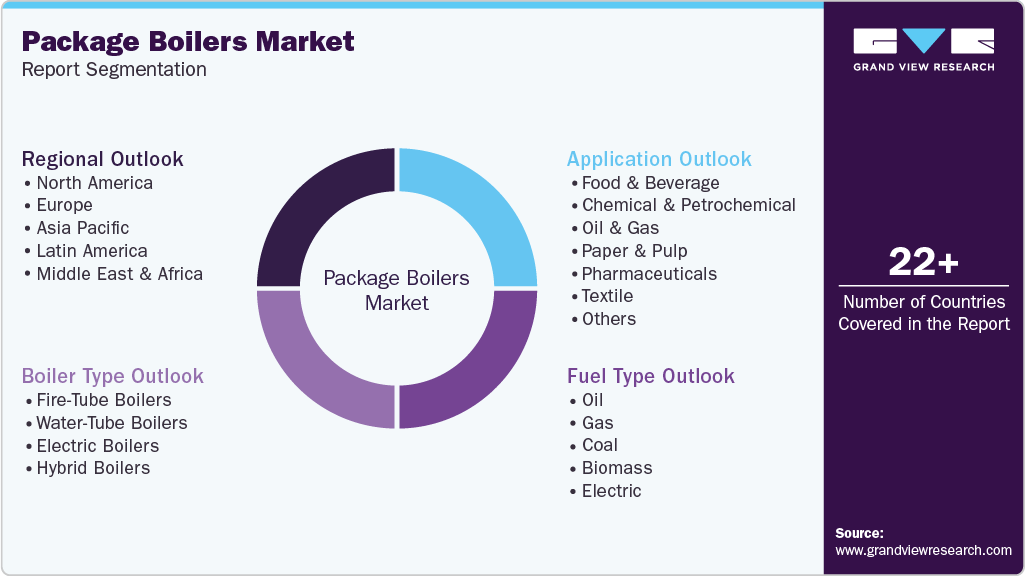
Global Package Boilers Market Report Segmentation
This report forecasts revenue growth at the global, regional & country levels and provides an analysis on the industry trends in each of the sub-segments from 2018 to 2030. For this study, Grand View Research, Inc. has segmented the global package boilers market report based on type, fuel type, design, end use, and region:
-
Type Outlook (Revenue, USD Billion, 2021 - 2033)
-
Fire-Tube Boilers
-
Water-Tube Boilers
-
D-Type
-
A-Type
-
O-Type
-
-
Electric Boilers
-
Hybrid Boilers
-
-
Fuel Type Outlook (Revenue, USD Billion, 2021 - 2033)
-
Oil
-
Gas
-
Coal
-
Biomass
-
Electric
-
-
Application Outlook (Revenue, USD Billion, 2021 - 2033)
-
Food & Beverage
-
Chemical & Petrochemical
-
Oil & Gas
-
Paper & Pulp
-
Pharmaceuticals
-
Textile
-
Others
-
-
Regional Outlook (Revenue, USD Billion, 2021 - 2033)
-
North America
-
U.S.
-
Canada
-
Mexico
-
-
Europe
-
Germany
-
France
-
Spain
-
Italy
-
UK
-
-
Asia Pacific
-
China
-
India
-
Japan
-
South Korea
-
Australia
-
-
Latin America
-
Brazil
-
Argentina
-
-
Middle East & Africa
-
Saudi Arabia
-
UAE
-
South Africa
-
-
Research Methodology
The package boilers market figures in this report are based on a proven research process that combines executive interviews with secondary research from proprietary databases, company filings, and recognized regulatory and institutional sources. Market size is built through value-chain sizing-reconciling supply-side and demand-side estimates-and triangulated with bottom-up and top-down approaches. Every estimate passes multiple levels of expert validation before publication, with each package boilers segment quantified using the revenue-capture definitions in the table below.
Segment Definition
Boiler Type
Revenue Capture Definition
Fire-Tube Boilers
Revenue is generated from the sale of fire-tube package boilers designed for low- to medium-pressure steam generation in commercial buildings and small to medium-sized industrial facilities. This includes standard packaged units, integrated control systems, burners, and factory-assembled boiler packages.
Water-Tube Boilers
Revenue is generated from the sale of water-tube package boilers used for high-pressure and high-capacity steam generation in process industries. Revenue includes complete packaged boiler systems equipped with advanced combustion technology, automation, and heat recovery components.
Electric Boilers
Revenue is generated from the sale of electric package boilers that produce steam without fuel combustion. The segment includes compact electric boiler units with integrated control panels for industries requiring clean and low-emission steam generation.
Hybrid Boilers
Revenue is generated from the sale of hybrid package boilers capable of operating on multiple energy sources, including gas, electricity, and renewable fuels. Revenue includes advanced fuel-flexible boiler systems designed to improve energy efficiency and operational reliability.
Fuel
Revenue Capture Definition
Oil
Revenue is generated from the sale of package boilers designed to operate on diesel, furnace oil, and heavy fuel oil. The segment includes complete boiler systems equipped with oil burners, fuel management systems, and emission control technologies.
Natural Gas
Revenue is generated from the sale of package boilers designed to operate on natural gas and other gaseous fuels. The segment includes complete boiler systems equipped with gas burners, fuel management systems, combustion controls, and emission control technologies.
Coal
Revenue is generated from the sale of coal-fired package boilers used in industries requiring continuous high-volume steam production. The segment includes boiler units designed with fuel feeding, ash handling, and combustion systems.
Biomass
Revenue is generated from the sale of biomass-fired package boilers utilizing renewable fuels such as wood chips, pellets, and agricultural residues. Revenue includes combustion systems designed to improve fuel efficiency while reducing carbon emissions.
Electric
Revenue is generated from the sale of fully electric package boilers used in facilities prioritizing clean energy and zero on-site emissions. The segment includes electrically heated steam generators with automated control and monitoring systems.
Application
Revenue Capture Definition
Food & Beverage
Revenue is generated from the sale of package boilers used for cooking, sterilization, pasteurization, cleaning, drying, and other food processing operations. Revenue includes steam generation systems installed in food and beverage manufacturing facilities.
Chemical & Petrochemical
Revenue is generated from the sale of package boilers supporting process heating, distillation, chemical reactions, utility steam generation, and other petrochemical production processes. The segment includes high-capacity industrial boiler systems designed for continuous operation.
Oil & Gas
Revenue is generated from the sale of package boilers used in refineries, upstream production facilities, and petrochemical plants for process heating, crude oil treatment, utility steam generation, and enhanced oil recovery applications.
Paper & Pulp
Revenue is generated from the sale of package boilers supplying steam for pulping, bleaching, paper drying, and other paper manufacturing operations. Revenue includes industrial boiler systems designed for continuous process efficiency.
Pharmaceuticals
Revenue is generated from the sale of package boilers that provide clean steam for sterilization, equipment cleaning, formulation, and pharmaceutical manufacturing. The segment includes high-purity steam generation systems that meet strict regulatory requirements.
Textile
Revenue is generated from the sale of package boilers used in dyeing, bleaching, washing, drying, fabric finishing, and other textile production processes. Revenue includes industrial steam systems designed to improve production efficiency and product quality.
Others
Revenue is generated from the sale of package boilers used across industries such as automotive, mining, power generation, rubber, plastics, construction materials, and general manufacturing for process heating, steam generation, and industrial utility applications.
Estimation Model
Layer Name
Key Question
Description
Industrial Demand Assessment
Which industries generate demand for package boilers?
Estimates the annual demand for package boilers across end-use industries such as food & beverage, chemical & petrochemical, oil & gas, pharmaceuticals, paper & pulp, textile, and other manufacturing sectors.
Product & Technology Penetration
What types of package boilers are being adopted?
Evaluates adoption by boiler type (fire-tube, water-tube, electric, hybrid), fuel type, and design configuration based on industrial process requirements, energy efficiency, and emission regulations.
Regional & Supplier Analysis
Where is demand concentrated and who supplies the market?
Assesses regional demand, industrial capacity expansion, replacement of existing boiler systems, and the market presence of leading OEMs and regional manufacturers to estimate annual package boiler deployments.
Revenue Estimation
What is the total revenue generated by the package boilers market?
Calculates market revenue based on the sales of package boilers across different types, fuel categories, designs, end-use industries, and regional markets, validated through manufacturer revenues, distributor sales, EPC projects, and industry trends.
Delivered Customizations
This report has been delivered with the following In-depth customizations
Client Request
Customization Delivered
Value Adds
Regional Segmentation
Delivered a comprehensive regional analysis covering North America, Europe, Asia Pacific, Latin America, and Middle East & Africa, including market size, growth trends, key demand drivers, regulatory landscape, industrial development, and country-level insights for major markets.
Enabled the client to identify high-growth regions, prioritize expansion strategies, evaluate regional demand patterns, and support investment and market entry decisions with country-specific intelligence.
Competitive Benchmarking
Delivered detailed competitive profiling of leading package boiler manufacturers, including product portfolio analysis, business overview, strategic developments, product benchmarking, market participant categorization, competitive positioning, operating strategies, strengths, and market presence.
Provided clear visibility into competitor capabilities, technology focus, product differentiation, and strategic positioning, helping the client benchmark against industry leaders and identify competitive gaps.
Opportunity Assessment
Delivered an in-depth assessment of current and future growth opportunities across boiler types, fuel technologies, industrial applications, and emerging markets, supported by market drivers, restraints, technology trends, regulatory developments, and investment outlook.
Helped the client identify attractive growth segments, evaluate future demand potential, align product development with market trends, and formulate long-term business and investment strategies.
Frequently Asked Questions About This Report
The food & beverage segment accounted for the largest revenue share of 23.0% in 2025, supported by strong demand for steam in food processing, sterilization, and cleaning operations.
Some of the key players operating in the market are Indeck Power Equipment Company, Babcock & Wilcox Enterprises, Inc, Cleaver-Brooks, Rentech Boiler Systems, Inc., Bosch Industriekessel GmbH, Clayton Industries, IHI Corporation, Hurst Boiler & Welding Co, Inc., Johnston Boiler, Isgec Heavy Engineering Ltd, Kawasaki Thermal Engineering Co., Ltd., Danstoker A/S, astebo gmbh, Babcock Wanson, Sussman Electric Boilers.
The fire-tube boilers segment held the largest market share, accounting for 44.8% of the global package boilers market revenue in 2025.
The natural gas segment dominated the market with a 44.2% revenue share in 2025, driven by its high efficiency and lower emissions compared to conventional fuels.
Key factors driving the package boilers market include rapid industrialization, growing demand for efficient steam generation in sectors like food processing, chemicals, and power, and the need for compact, easy-to-install boiler systems. Additionally, rising energy efficiency regulations and the shift toward cleaner fuels are boosting adoption.
The global package boilers market size was estimated at USD 10.2 billion in 2025 and is projected to grow from USD 10.5 billion in 2026.
The package boilers market, in terms of revenue, is expected to grow at a compound annual growth rate of 4.2% from 2026 to 2033 to reach USD 14.0 billion by 2033.
Asia Pacific dominated the global package boilers market, accounting for 41.8% of the total market revenue in 2025, driven by rapid industrialization and expanding manufacturing activities.
About the Author(s)
Advanced Interior Materials Research Team
Advanced Materials · Advanced Interior MaterialsThis report was authored by the advanced interior materials research team at Grand View Research - comprising two research analysts, one senior research analyst, and one industry expert - with specialized expertise in the advanced interior materials segment of the advanced materials industry. All findings are based on proprietary advanced materials databases, executive interviews, and regulatory analysis, subject to internal peer review prior to publication.
Last Updated:
Speak to Analyst

Customize this report to your needs - add regions, segments, or data points, with 20% free customization.
Or view our licence options:


ISO 9001:2015 & 27001:2022 Certified
We are GDPR and CCPA compliant! Your transaction & personal information is safe and secure. For more details, please read our privacy policy.


