
- Home
- »
- Consumer F&B
- »
-
Packaged Burgers Market Size And Share Report 2026 - 2033GVR Report cover
![Packaged Burgers Market (2026 - 2033)Report]()
Packaged Burgers Market (2026 - 2033)
Size, Share & Trends Analysis Report By Product (Frozen, Fresh), By Patty (Veg, Non-veg), By Distribution Channel (Supermarkets & Hypermarkets, Convenience Stores, Online), By Region, And Segment Forecasts
Market Size, 2025
$4.8BMarket Estimate, 2026
$5.1BMarket Forecast, 2033
$8.8BCAGR, 2026–2033
7.9%Packaged Burgers Market Summary
The global packaged burgers market size was valued at USD 4.8 billion in 2025 and is projected to grow from USD 5.1 billion in 2026 to USD 8.8 billion by 2033, at a CAGR of 7.9% from 2026 to 2033. Europe dominated the market with the largest revenue share of 42.2% in 2025. This expansion is primarily driven by changing consumer preferences that favor convenience and ready-to-eat meals.

Key Market Trends & Insights
- By product: Frozen segment dominated the market, with a revenue share of 83.5% in 2025.
- By patty: Veg segment held the largest market share of 58.4% in 2025.
- By distribution channel: Supermarkets & Hypermarkets held the largest market share of 53.0% in 2025.
Regional Highlights
- Largest regional market: Europe (42.2% revenue share, 2025)
- Fastest-growing regional market: Asia Pacific (highest CAGR, 2026-2033)
- By country: The Germany held the largest market share in 2025.
Market Size & Forecast
- Market size in 2025: USD 4.8 Billion
- Estimated market size in 2026: USD 5.1 Billion
- Projected market size by 2033: USD 8.8 Billion
- CAGR (2026-2033): 7.9%
Three ways to get this report
Buy it, customize it, or ask a question.Ask an Analyst
A direct answer, usually in 1 working day
- AccessReport author, directly
- Reply timeWithin 1 working day
- No sales callDirect answer only
- FormatEmail reply
- CostFree, no cost
Get the Full Report
What the study covers
- FormatsPDF · Excel · Dashboard
- Timeline2026–2033 annual, 2025 base
- Coverage20+ countries, 5 regions
- Companies10+ key players profiled
Customize the Report
20% free customization
- IncludeCountries, segments, points
- TailorTo your product definition
- ExtendDeeper competitor detail
- OrA fully bespoke study
- Turnaround5–10 working days
As lifestyles become busier, the demand for quick meal solutions, such as packaged burgers, is increasing. These are also becoming a popular option among consumers seeking taste and convenience. Companies are introducing burgers made from plant proteins to cater to health-conscious consumers and those seeking sustainable food options. For instance, Beyond Meat has gained considerable traction by offering products that closely resemble traditional meat while appealing to vegetarians and flexitarians. This shift supports market expansion and aligns with the growing trend toward healthier eating habits. Ongoing innovations in the food industry and rising popularity of plant-based alternatives are expected to propel the growth of the packaged burgers industry.
The packaged burgers industry also benefits from technological advancements and food processing techniques. Innovations in packaging have improved product shelf life and convenience, making it easier for consumers to purchase and store these items. In addition, the expansion of online grocery shopping and food delivery services has made packaged burgers more accessible. As a result, consumers can buy their favorite products with just a few clicks, which is further expected to drive the growth of the packaged burgers industry.
Market Dynamics
The packaged burgers market benefits from strong consumer preference for convenient meal solutions, broad product availability, and expanding retail accessibility. Product diversification across meat-based, plant-based, frozen, and premium categories continues to support market development. Demand is also supported by changing food consumption patterns and the availability of packaged burgers through supermarkets, hypermarkets, convenience stores, and online channels.
Busy lifestyles and limited time for meal preparation have strengthened consumer preference for packaged food products, including burgers. Packaged burgers provide ease of storage, consistent quality, and quick preparation, making them suitable for households, students, and working professionals. The availability of multiple product formats and flavor options has further expanded their appeal across different consumer groups. In addition, strong distribution networks and wider shelf presence in retail outlets contribute to market growth.
Consumer concerns related to the nutritional profile of packaged burgers remain a key challenge for the market. Many packaged burger products contain preservatives, additives, sodium, and saturated fats that may not align with the dietary preferences of health-conscious consumers. As awareness of balanced nutrition and healthy eating habits becomes more prominent, some consumers carefully evaluate ingredient lists and nutritional information before making purchasing decisions. This can affect demand for conventional packaged burger products, particularly among consumers seeking fresh or minimally processed food options.
In addition, stringent food safety regulations and labeling requirements across various countries place additional compliance responsibilities on manufacturers. Companies must ensure transparency regarding ingredients, allergens, nutritional content, and product claims while maintaining product quality and shelf stability. Any concerns related to food quality, ingredient sourcing, or product recalls can influence consumer confidence and brand reputation. These factors collectively present challenges for manufacturers operating in the packaged burgers market.
Premium packaged burgers featuring high-quality ingredients, clean-label formulations, and specialty recipes present significant opportunities for manufacturers. The adoption of vegetarian, vegan, and flexitarian dietary preferences has encouraged the introduction of plant-based burger alternatives. Product innovation focused on taste, texture, nutritional value, and sustainable sourcing is creating new avenues for market expansion. Additionally, online grocery platforms and direct-to-consumer sales channels provide manufacturers with broader access to diverse consumer groups.
Analyst Perspective
The packaged burgers market benefits from a combination of convenience-focused consumption patterns, broad retail penetration, and continuous product innovation across both meat-based and plant-based categories. The most durable growth opportunities are expected to emerge from brands that can balance affordability, product quality, and menu variety while maintaining efficient cold-chain distribution and strong retailer relationships. The key competitive advantage, however, will belong to companies that build diversified portfolios spanning frozen, fresh, vegetarian, and non-vegetarian burgers within a single brand ecosystem, transforming a routine meal purchase into a recurring consumption habit that supports long-term customer retention and sustained revenue generation.
Product Insights
Based on product, the frozen segment led the market with the largest revenue share of 83.5% in 2025 and is expected to grow at the fastest CAGR over the forecast period, primarily due to its convenience and longer shelf life. Consumers increasingly prefer frozen burgers as they can be stored for months, making them an ideal choice for busy lifestyles. In addition, advancements in freezing technology have improved the quality and taste of these products, enhancing consumer satisfaction. The ease of preparation with minimal cooking time further drives demand, as many people seek quick meal solutions without compromising taste or nutrition.
The fresh segment is expected to grow at a significant CAGR over the forecast period due to increasing consumer demand for healthier and more natural food options. As consumers become more health-conscious, there is a notable shift toward fresh products that are perceived as less processed and more nutritious. This trend is further supported by the growing popularity of clean eating and organic ingredients, which encourage consumers to seek out fresh burgers over frozen alternatives. For instance, many retailers are now offering fresh burger options that highlight locally sourced ingredients, appealing to consumers' desire for transparency in food sourcing.
Patty Insights
Based on patty, the veg segment led the market with the largest revenue share of 58.4% in 2025, driven by the increasing consumer shift toward healthier and more sustainable food options. As awareness regarding health issues, environmental concerns, and animal welfare grows, many consumers opt for plant-based alternatives that offer lower fat content and fewer calories than traditional meat products. This trend is particularly evident among those who primarily follow plant-based diets and seek satisfying yet healthier meals. The surging popularity of these products in mainstream retail and fast-food chains further increases the dominance of the veg segment, responding effectively to the rising demand for convenient and nutritious meal solutions.
The non-veg segment is expected to grow at a significant CAGR over the forecast period due to the persistent popularity of meat-based products among consumers. As traditional meat burgers remain a staple in many diets, the demand for high-quality, flavorful options continues to rise. This growth is further fueled by the expansion of quick-service restaurants (QSRs) that offer diverse options in non-veg burgers, catering to consumers' cravings for convenience and taste. For instance, major fast-food chains such as McDonald's frequently introduce limited-time offers featuring gourmet beef burgers, which attract customers looking for premium food experiences. In addition, innovations in meat processing and flavor enhancement enable manufacturers to create more appealing products that meet consumer expectations of specific quality and taste.
Distribution Channel Insights
Based on distribution channel, the supermarkets & hypermarkets led the market with the largest revenue share of 53.0% in 2025 due to their extensive reach and convenience. These retail formats offer various packaged burger options, including meat and plant-based choices, allowing shoppers to easily compare products and make informed decisions. The availability of multiple brands and variants under one roof enhances the consumer experience and encourages impulse purchases. For instance, Walmart, Tesco, and other major chains stock a range of packaged burgers, from budget-friendly to premium products, catering to diverse consumer preferences. In addition, the ability to purchase groceries in bulk at supermarkets allows consumers to stock up on their favorite items, further driving sales in this segment.

The online segment is expected to grow at the fastest CAGR over the forecast period due to the increasing consumer preference for convenience and the rise of e-commerce platforms. As more consumers turn to online channels for purchasing groceries, the accessibility and variety of packaged burgers available through these channels are expanding significantly. This shift is driven by busy lifestyles that make traditional shopping less feasible, prompting consumers to seek quick and efficient alternatives. In addition, promotional discounts and subscription services provided by online platforms further incentivize consumers to purchase packaged burgers online, enhancing the growth potential of this segment.
Regional Insights
Europe dominated the packaged burgers market with the largest revenue share of 42.4% in 2025, driven by strong consumer demand for convenience and a diverse range of product offerings. European consumers increasingly favor ready-to-eat meals due to busy lifestyles, leading to higher sales of packaged burgers in supermarkets and through online platforms. The growing trend toward healthier eating has prompted many companies to innovate by introducing gourmet and plant-based burger options, appealing to health-conscious consumers. For instance, brands such as Quorn have successfully launched meat-free burgers that cater to the rising vegan population in countries such as the UK and Germany. The established fast-food culture in Europe and expansion of quick-service restaurants also continue to contribute to the market growth.

Germany Packaged Burgers Market Trends
The packaged burgers market in Germany held the largest share in the Europe region in 2025, driven by a strong consumer preference for convenience and a robust fast-food culture. As busy lifestyles become increasingly common, many consumers are opting for packaged burgers as a quick and satisfying meal option. This trend is further supported by the growing popularity of both traditional and plant-based burgers, catering to diverse dietary preferences. For instance, brands such as Rügenwalder Mühle have successfully launched a range of vegetarian and vegan burger options that appeal to health-conscious consumers while still delivering on taste.
North America Packaged Burgers Market Trends
North America dominated second the largest revenue share of 35.5% in 2025. The North America packaged burgers market is expected to grow significantly over the forecast period due to the increasing demand for convenient meal solutions and the expansion of fast-food chains. As lifestyles become busier, consumers seek quick and easy meal options that do not compromise taste or quality. This trend is further supported by the proliferation of quick-service restaurants (QSRs) that offer a variety of packaged burger options, catering to diverse consumer preferences. In addition, the rising health consciousness among consumers has led to a growing interest in high-quality, sustainable ingredients, prompting manufacturers to introduce healthier packaged burger options.
The packaged burgers market in the U.S. held the largest share in the North America region in 2025, driven by the increasing demand for convenience foods, as busy lifestyles prompt consumers to seek quick meal solutions that require minimal preparation time. Packaged burgers offer a ready-to-eat option that aligns with this need, making them popular among American consumers. In addition, the strong presence of fast-food chains and the expansion of retail outlets provide easy access to a variety of packaged burger options, further fueling market growth. For instance, brands such as Impossible Foods have introduced innovative plant-based patties that appeal to health-conscious individuals and meat lovers alike, enhancing the product range in stores.
Asia Pacific Packaged Burgers Market Trends
The Asia Pacific packaged burgers market is expected to grow at the fastest CAGR of 9.8% over the forecast period, driven by rapid urbanization and a burgeoning middle class that is increasingly seeking convenient meal options. As urban areas expand, more consumers are adopting fast-paced lifestyles, leading to a higher demand for ready-to-eat foods such as packaged burgers. This trend is further fueled by the growing popularity of fast-food chains that offer diverse burger options tailored to local tastes. For instance, in countries such as India, McDonald's, an international brand, has successfully introduced localized menu items, including the McAloo Tikki burger, which caters to vegetarian preferences. The rise of online food delivery services has further enhanced accessibility, allowing consumers to conveniently order packaged burgers from their homes.
The China packaged burgers market dominated Asia Pacific in 2024 with the largest revenue share, driven by rapid urbanization and a growing middle class that increasingly seeks convenient meal solutions. As more consumers move to urban areas, their busy lifestyles create a demand for ready-to-eat foods, including packaged burgers, which are quick to prepare and consume. In addition, the expansion of fast-food chains and quick-service restaurants (QSRs) in China has introduced a wider variety of burgers tailored to local tastes, further enhancing market growth. For instance, KFC has successfully launched chicken burgers that resonate with preferences of Chinese consumers.
Key Packaged Burgers Company Insights
Some key players in the packaged burgers market are The Campbell's Company, The Kraft Heinz Company, WK Kellogg Co, and BUBBA foods, LLC. These companies in the packaged burgers market are engaging in innovative strategies to strengthen their position in the market. They focus on developing a diverse range of products that cater to evolving consumer preferences for convenience and quality. Many players are adopting eco-friendly practices in sourcing ingredients and packaging.
-
Beyond Meat is renowned for its innovative approach to plant-based products that cater to health-conscious consumers. By utilizing advanced food technology, the company develops burgers that closely mimic the taste and texture of traditional meat, appealing to both vegetarians and meat-eaters. Beyond Meat emphasizes sustainability through eco-friendly sourcing and production processes, aligning with the growing consumer demand for environmentally responsible food options.
-
The Kraft Heinz Company leverages its extensive portfolio of well-known brands to cater to diverse consumer preferences. The company focuses on product innovation, introducing various burger options that include meat-based, frozen, and plant-based alternatives. With a commitment to quality and convenience, Kraft Heinz aims to meet the increasing demand for quick meal solutions while maintaining high standards of taste and nutrition.
Key Packaged Burgers Companies:
The following key companies have been profiled for this study on the packaged burgers market.
-
BUBBA foods, LLC
-
Dr. Praeger’s Sensible Foods.
-
Drink Eat Well, LLC.
-
WK Kellogg Co
-
Monde Nissin
-
Paragon Quality Foods & Paragon Foodservice
-
The Kraft Heinz Company.
-
Amy's Kitchen, Inc.
-
Beyond Meat Inc.
-
The Campbell's Company
Competitive Benchmarking
Category
Operating Strategies
Competitive Edge
Weakness
Established Players (The Kraft Heinz Company, Tyson Foods, Inc., Conagra Brands, Inc., Monde Nissin Corporation, Maple Leaf Foods Inc.)
Expand packaged burger portfolios through product line extensions, premium formulations, and alternative-protein offerings. Strengthen shelf presence in supermarkets and hypermarkets while investing in production capacity, cold-storage infrastructure, and brand promotion activities.
Strong relationships with retail chains, extensive manufacturing capabilities, and established brand equity. Broad distribution networks enable consistent product availability across multiple regions and sales channels.
Significant dependence on raw material sourcing and cold-chain operations. Complex organizational structures can reduce responsiveness to rapidly changing consumer preferences and emerging niche segments.
Emerging Players (Beyond Meat, Inc., Impossible Foods Inc., BUBBA foods, LLC, Dr. Praeger's Sensible Foods, Amy's Kitchen, Inc.)
Focus on specialized packaged burger offerings, including plant-based, organic, clean-label, and health-oriented products. Utilize digital marketing, direct-to-consumer channels, and strategic retail partnerships to strengthen market penetration. Leverage social media marketing, community-led engagement, and freemium pricing strategies
Strong differentiation through innovative ingredients, specialized formulations, and targeted consumer positioning. Greater flexibility in product development allows faster adaptation to dietary and lifestyle trends.
Limited distribution coverage and production scale relative to multinational competitors. Higher manufacturing costs and narrower brand recognition can affect expansion into mainstream retail markets.
Recent Developments
-
In April 2024, Beyond Meat, Inc. announced the launch of its fourth generation of the Beyond Burger and Beyond Beef, marking a significant advancement in plant-based meat products. These are known to be healthy offerings, with 21 grams of plant-based protein per serving and 2 grams of saturated fat derived from avocado oil.
-
In March 2024, Bubba Burger announced the introduction of a new protein option to its frozen burger, the Chicken Bubba Burger. Unveiled at the Annual Meat Conference in Nashville, this burger is said to be crafted from 100% all-natural chicken and has a quick preparation time of 12 minutes or less. This new ground chicken offering complements Bubba Burger's existing lineup, which includes various beef burgers and turkey options.
Packaged Burgers Market Report Scope
Report Attribute
Details
Market size in 2025
USD 4.8 billion
Estimated market size in 2026
USD 5.1 billion
Projected market size by 2033
USD 8.8 billion
Growth rate
CAGR of 7.9% from 2026 to 2033
Base year for estimation
2025
Historical data
2021 - 2024
Forecast period
2026 - 2033
Quantitative units
Revenue in USD million/billion and CAGR from 2026 to 2033
Report coverage
Revenue forecast, company ranking, competitive landscape, growth factors, and trends
Segments covered
Product, patty, distribution channel, region
Regional scope
North America; Europe; Asia Pacific; Latin America; MEA
Country scope
U.S.; Canada; Mexico; Germany; UK; France; Italy; Spain; Rest of Europe; China; Japan; India; South Korea; Australia; Rest of Asia Pacific; Brazil; Rest of Latin America; South Africa; Rest of Middle East & Africa
Key companies profiled
BUBBA foods, LLC; Dr. Praeger’s Sensible Foods.; Drink Eat Well, LLC.; WK Kellogg Co; Monde Nissin; Paragon Quality Foods & Paragon Foodservice; The Kraft Heinz Company.; Amy's Kitchen, Inc.; Beyond Meat Inc.; The Campbell's Company
Customization scope
Free report customization (equivalent up to 8 analysts' working days) with purchase. Addition or alteration to country, regional & segment scope.
Pricing and purchase options
Avail customized purchase options to meet your exact research needs. Explore purchase options
Global Packaged Burgers Market Report Segmentation
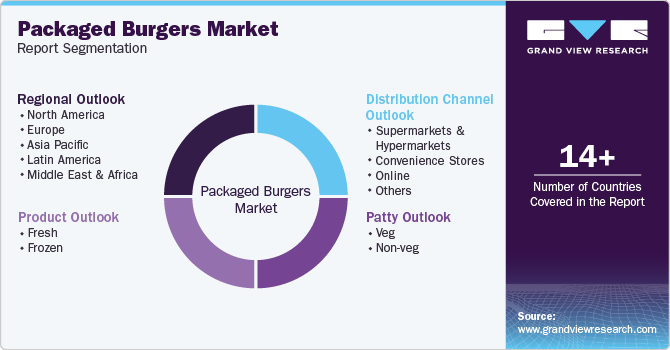
This report forecasts revenue growth at global, regional, and country levels and provides an analysis of the latest industry trends in each of the sub-segments from 2021 to 2033. For this study, Grand View Research has segmented the global packaged burgers market report based on product, patty, distribution channel, and region:
-
Product Outlook (Revenue, USD Million, 2021 - 2033)
-
Frozen
-
Fresh
-
-
Patty Outlook (Revenue, USD Million, 2021 - 2033)
-
Veg
-
Non-veg
-
-
Distribution Channel Outlook (Revenue, USD Million, 2021 - 2033)
-
Supermarkets & Hypermarkets
-
Convenience Stores
-
Online
-
Others
-
-
Regional Outlook (Revenue, USD Million, 2021 - 2033)
-
North America
-
U.S.
-
Canada
-
Mexico
-
-
Europe
-
Germany
-
UK
-
France
-
Italy
-
Spain
-
-
Asia Pacific
-
China
-
Japan
-
India
-
Australia
-
South Korea
-
-
Latin America
-
Brazil
-
-
Middle East and Africa (MEA)
-
South Africa
-
-
Research Methodology
Segment Definition
Segment -Product
Revenue capture definition
Frozen
This segment includes the sales of frozen packaged burgers that are stored at low temperatures to maintain product quality and extend shelf life. Revenue is generated through retail and foodservice demand for convenient meal solutions that can be prepared quickly while offering consistent taste and texture.
Fresh
This segment includes the sales of refrigerated packaged burgers marketed for immediate consumption or short-term storage. Revenue is derived from consumer preference for minimally processed products and freshly prepared meal options available through grocery and specialty food outlets.
Segment -Patty
Revenue capture definition
Veg
This segment includes the sales of plant-based and vegetarian burger patties made from ingredients such as soy, pea protein, vegetables, grains, and legumes. Revenue is generated from consumers seeking meat-free alternatives that align with dietary, environmental, and lifestyle preferences.
Non-Veg
This segment includes the sales of burger patties made from meat sources such as beef, chicken, pork, and other animal proteins. Revenue is supported by consumer demand for traditional burger products across retail stores, quick-service restaurants, and foodservice establishments.
Segment - Distribution Channel
Revenue capture definition
Supermarkets & Hypermarkets
This segment includes the sales of packaged burgers through large-format retail chains offering extensive frozen and refrigerated food selections. Revenue is generated from high product visibility, bulk purchasing options, and widespread consumer access.
Convenience Stores
This segment includes the sales of packaged burgers through neighborhood stores and small-format retail outlets. Revenue is derived from consumers seeking quick and accessible meal purchases for immediate or short-term consumption.
Online
This segment includes the sales of packaged burgers through e-commerce platforms, grocery delivery services, and direct-to-consumer websites. Revenue is generated from digital purchasing channels that provide product variety, home delivery, and subscription-based ordering options.
Others
This segment includes the sales of packaged burgers through specialty food stores, warehouse clubs, independent retailers, and foodservice distributors. Revenue is supported by niche consumer segments, institutional buyers, and alternative retail formats.
Estimation Model
Layer Title
Guiding Question
Description
Consumption Universe Layer
Who consumes packaged burgers?
Identify global urban consumers engaging with fast food and ready-to-eat packaged burger products to define the base demand pool.
Retail Access Layer
Who can access packaged burgers?
Assess supermarket penetration, online grocery reach, and cold-chain availability to determine the accessible consumer base.
Behavioural Layer
Who actually buys packaged burgers?
Evaluate substitution from QSR (Quick Service Restaurant) burgers to frozen packaged variants based on convenience, taste, and price sensitivity.
Monetisation Layer
How much revenue is generated?
Estimate revenue by multiplying active buyers, purchase frequency, and average packaged burger price across retail channels annually.
Delivered Customizations
This report has been delivered with the following In-depth customizations
Client Request
Customization Delivered
Value Adds
Packaged Burger Consumption & Demand Trends
Analyzed demand patterns for frozen and ready-to-eat burger products across urban households, focusing on fast-food substitution, snacking behavior, and convenience meal adoption trends.
Helps stakeholders identify high-potential consumption segments and understand evolving preferences toward convenient protein-based meal options.
Retail Distribution & Accessibility Expansion Trends
Assessed retail penetration of packaged burgers across supermarkets, convenience stores, and online grocery platforms, including cold-chain availability and private-label expansion.
Enables identification of scalable distribution channels and supports expansion strategies in organized retail and quick-commerce ecosystems.
Brand Adoption & Consumer Behavior Insights
Evaluated consumer adoption of packaged burgers based on taste acceptance, pricing sensitivity, brand trust, and shift from QSR consumption to at-home convenience meals.
Provides insights into product positioning, repeat purchase drivers, and opportunities to improve conversion from trial to habitual consumption.
Frequently Asked Questions About This Report
The global packaged burgers market size was estimated at USD 4.8 billion in 2025 and is expected to reach USD 5.1 billion in 2026.
Asia Pacific is the fastest-growing region over the forecast period.
Europe dominated with a 42.4% revenue share in 2025.
The frozen segment led with a 83.5% revenue share in 2025, while fresh is the fast-growing segment.
Veg segment held the largest market share of 58.4% in 2025, driven by the increasing consumer shift toward healthier and more sustainable food options.
Supermarkets & Hypermarkets held the largest market share of 53.0% in 2025 and online is the fastest-growing channel.
Key players include BUBBA foods, LLC; Dr. Praeger’s Sensible Foods.; Drink Eat Well, LLC.; WK Kellogg Co; Monde Nissin; Paragon Quality Foods & Paragon Foodservice; The Kraft Heinz Company.; Amy's Kitchen, Inc.; Beyond Meat Inc.; The Campbell's Company
The global packaged burgers market is expected to grow at a CAGR of 7.9% from 2026 to 2033, reaching USD 8.8 billion.
Key factors that are driving the market growth include increasing demand for convenience food, rapid urbanization, changing lifestyles, shifting food consumption behavior, and the hectic schedules of consumers.
About the Author(s)
Consumer F&B Research Team
Consumer Goods · Consumer F&BThis report was authored by the consumer f&b research team at Grand View Research - comprising two research analysts, one senior research analyst, and one industry expert - with specialized expertise in the consumer f&b segment of the consumer goods industry. All findings are based on proprietary consumer goods databases, executive interviews, and regulatory analysis, subject to internal peer review prior to publication.
Last Updated:
Speak to Analyst


Customize this report to your needs - add regions, segments, or data points, with 20% free customization.
Or view our licence options:


ISO 9001:2015 & 27001:2022 Certified
We are GDPR and CCPA compliant! Your transaction & personal information is safe and secure. For more details, please read our privacy policy.


