
- Home
- »
- Advanced Interior Materials
- »
-
Packaging Strapping Materials Market Report, 2026-2033GVR Report cover

Packaging Strapping Materials Market (2026 - 2033)
Size, Share & Trends Analysis Report By Source (Virgin Packaging Strapping Materials, Recycled Packaging Strapping Materials), By Product, By Application (Wood Industry, Transportation & Logistics, Construction), By Region, And Segment Forecasts
Market Size, 2025
$9.8BMarket Estimate, 2026
$10.4BMarket Forecast, 2033
$15.7BCAGR, 2026–2033
6.0%Packaging Strapping Materials Market Summary
The global packaging strapping materials market size was valued at USD 9.8 billion in 2025 and is projected to grow from USD 10.4 billion in 2026 to USD 15.7 billion by 2033, at a CAGR of 6.0% from 2026 to 2033. Asia Pacific dominated the market, accounting for a revenue share of 35.5% in 2025. The demand for packaging strapping materials is rising steadily due to the rapid expansion of global logistics, e-commerce, and industrial shipping activities.
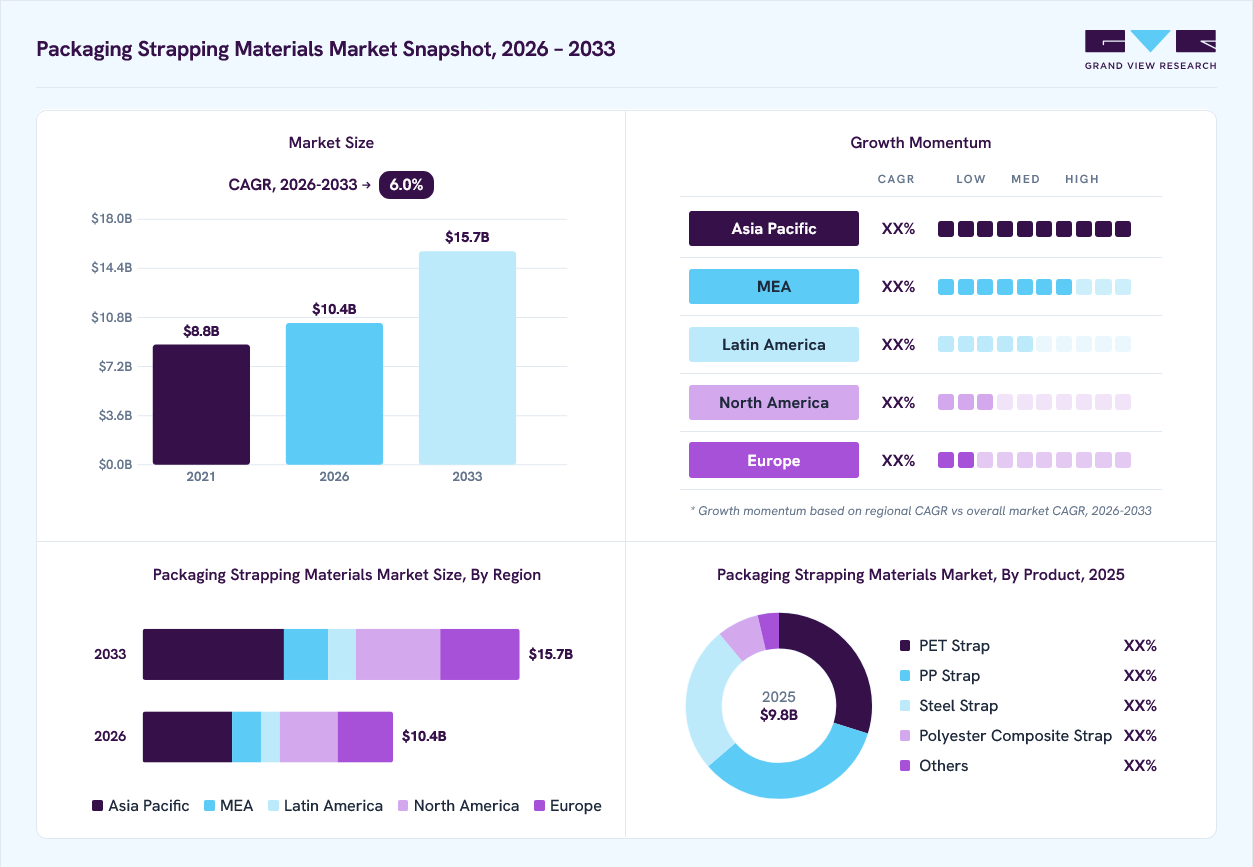 Source: Grand View Research, IR Documents, Primary Interviews, Paid DatabasesTo learn more about this report,
 Download Free Sample Report
 Key Market Trends & Insights
- By source: Virgin strapping materials segment held the largest market share in 2025.
- By product: PP strap segment held the largest market share in 2025.
- By application: Transportation & logistics segment held the largest market share of 34.4% in 2025.
Regional Highlights
- Largest regional market: Asia Pacific (35.5% revenue share, 2025)
- By country: China held the largest market share in 2025
Market Size & Forecast
- Market size in 2025: USD 9.8 Billion
- Estimated market size in 2026: USD 10.4 Billion
- Projected market size by 2033: USD 15.7 Billion
- CAGR (2026-2033): 6.0%
Three ways to get this report
Buy it, customize it, or ask a question.Ask an Analyst
A direct answer, usually in 1 working day
- AccessReport author, directly
- Reply timeWithin 1 working day
- No sales callDirect answer only
- FormatEmail reply
- CostFree, no cost
Get the Full Report
What the study covers
- FormatsPDF · Excel · Dashboard
- Timeline2026–2033 annual, 2025 base
- Coverage20+ countries, 5 regions
- Companies10+ key players profiled
Customize the Report
20% free customization
- IncludeCountries, segments, points
- TailorTo your product definition
- ExtendDeeper competitor detail
- OrA fully bespoke study
- Turnaround5–10 working days
As businesses increasingly rely on safe and secure transportation of goods, the need for effective load stabilization solutions has intensified. Growth in sectors such as food & beverages, construction, and consumer goods is further boosting demand. Additionally, increasing cross-border trade and export activities are driving the adoption of high-strength strapping materials. The rise in palletized shipping and containerization has also significantly contributed to market growth. Sustainable packaging trends are pushing manufacturers toward recyclable and eco-friendly strapping solutions.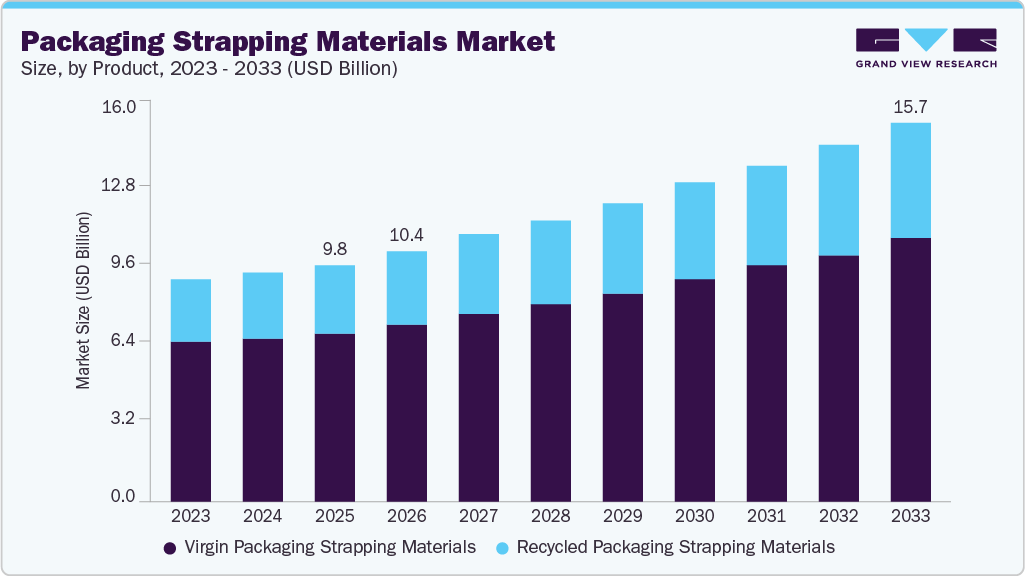 To learn more about this report, Download Free Sample Report
 Key drivers include the growth of e-commerce platforms, which require durable and cost-effective packaging solutions for bulk shipments. Industrialization in emerging economies is driving increased use of strapping materials in manufacturing and logistics. The rising demand for lightweight yet high-tensile materials such as PET and polypropylene is also fueling growth. Automation in packaging lines is encouraging the adoption of machine-grade strapping materials. Cost efficiency and improved load stability compared to traditional fastening methods are further driving adoption. Additionally, the expansion of the construction industry is increasing the use of steel strapping for heavy-duty applications. Growing awareness regarding supply chain efficiency is another major factor supporting demand.
The market is witnessing a shift toward sustainable and recyclable materials such as PET strapping, replacing traditional steel strapping in many applications. Technological advancements in automated strapping machines are improving operational efficiency and reducing labor costs. Smart packaging solutions, including tamper-evident and traceable strapping, are gaining traction. Manufacturers are focusing on developing high-performance materials with improved tensile strength and flexibility. The integration of Industry 4.0 technologies in packaging operations is also driving innovation. Lightweight and corrosion-resistant materials are becoming increasingly popular across industries. Additionally, customization of strapping solutions based on industry-specific needs is emerging as a key trend.
Market Concentration & Characteristics
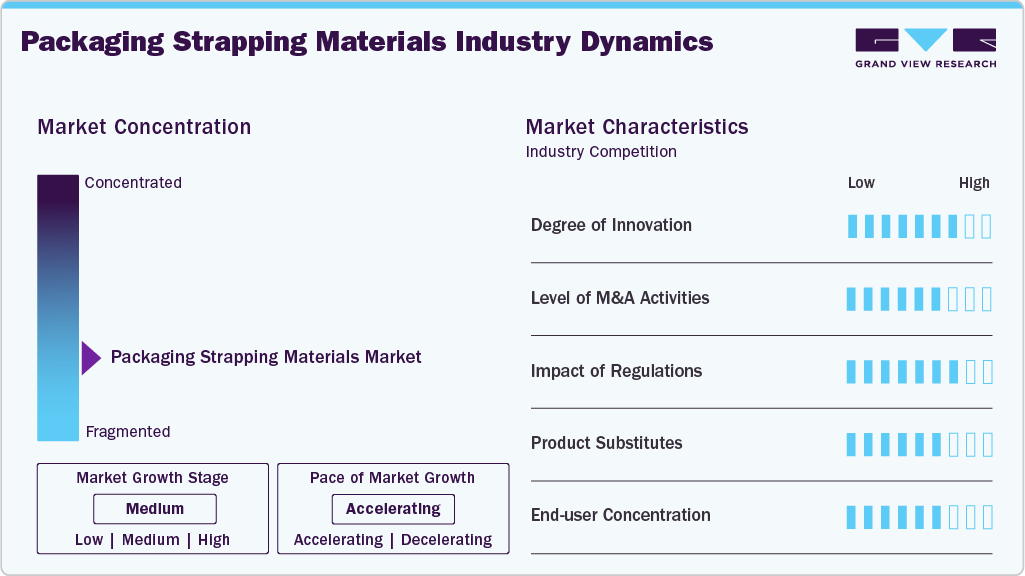
The packaging strapping materials market is moderately fragmented, with the presence of several global and regional players competing on price, quality, and innovation. Large multinational companies dominate the premium segment, offering advanced and sustainable solutions, while regional players cater to cost-sensitive markets. Strategic partnerships, mergers, and acquisitions are common as companies aim to expand their geographic presence and product portfolios. The market also sees strong competition in terms of technological advancements and automation capabilities. Entry barriers are moderate due to the need for manufacturing expertise and capital investment. However, the availability of raw materials and local production capabilities allows smaller players to compete effectively.
 To learn more about this report, Download Free Sample Report
 The threat of substitutes in the packaging strapping materials market is moderate. Alternatives such as stretch films, shrink wraps, adhesives, and ropes are used in certain applications but may not provide the same level of load stability and strength. Stretch and shrink films are widely used for lightweight packaging but are less effective for heavy-duty applications. Adhesive solutions offer convenience but lack reusability and durability. Steel wires and ropes can serve as substitutes in heavy industries but are less efficient and more cumbersome. The choice of substitute often depends on cost, application type, and load requirements. Despite the presence of alternatives, strapping materials remain a preferred solution due to their reliability and cost-effectiveness. Continuous innovation is helping reduce substitution risks.
Source Insights
Based on source, virgin strapping materials dominate the source segment primarily because they offer superior strength, consistency, and reliability compared with recycled alternatives. Strapping is widely used for securing heavy or high-value loads such as pallets, cartons, construction materials, metal products, timber, consumer goods, and industrial shipments during storage and transportation. In these applications, performance failure can result in damaged goods, safety risks, and financial losses. Virgin raw materials such as polypropylene, polyester, or steel provide more predictable tensile strength, elongation control, and break resistance, making them the preferred choice for manufacturers and end users who prioritize secure load containment.
Recycled strapping materials are the fastest-growing source segment with a CAGR of 6.5% over the forecast period. This is primarily attributed to industries across the world are placing greater emphasis on sustainability, waste reduction, and circular economy practices. Companies in logistics, manufacturing, food & beverage, retail, and e-commerce are under increasing pressure from customers, regulators, and investors to lower the environmental footprint of their packaging operations. As a result, many businesses are actively replacing virgin-based strapping with recycled-content alternatives made from reclaimed polypropylene, recycled PET flakes, or recovered steel. This shift allows companies to reduce dependence on virgin raw materials while demonstrating measurable progress toward ESG and sustainability targets.
Product Insights
On the basis of product, PP strap, or polypropylene strapping, dominates the product segment primarily because it offers the best balance of affordability, versatility, and operational efficiency for a wide range of packaging applications. Compared with alternatives such as polyester or steel strapping, PP strap is generally more cost-effective, making it highly attractive for businesses that consume large packaging volumes on a daily basis. Industries such as logistics, e-commerce, food & beverage, corrugated packaging, newspapers, consumer goods, and retail distribution rely heavily on economical strapping solutions to secure cartons, bundles, and palletized shipments. Because polypropylene strap provides dependable performance at a competitive price point, it has become the most widely used product category in the market.
Polyester Composite Strap is projected to register the highest CAGR of 6.9% in the strapping materials market primarily because it combines high tensile strength with improved safety and handling advantages compared with traditional steel strapping. Composite straps are typically made from high-tenacity polyester yarns embedded within a polymer coating, creating a product that is strong, flexible, and highly resistant to snapping recoil. Industries that secure heavy loads such as timber, steel products, bricks, machinery, pipes, and export cargo increasingly prefer polyester composite strap because it delivers strong load containment while reducing the injury risks associated with sharp-edged steel straps. As workplace safety becomes a greater priority globally, demand for safer high-performance strapping solutions is accelerating.
Application Insights
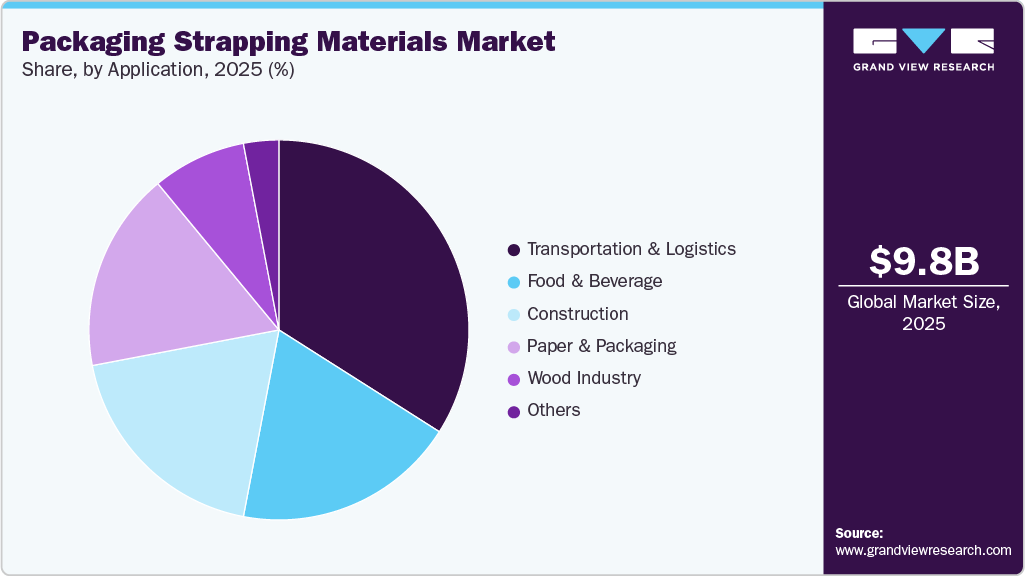
Transportation & Logistics dominates the end-use segment with the highest revenue share of 34.4% in 2025. This is as strapping is an essential load-securing solution used throughout the movement, storage, and distribution of goods. Every day, large volumes of cartons, pallets, containers, bundles, and industrial products are transported through warehouses, ports, freight terminals, fulfillment centers, and retail supply chains. Strapping materials are widely used to stabilize pallet loads, secure stacked boxes, bundle products together, and prevent shifting during transit. Since transportation and logistics operations involve continuous product movement across domestic and international networks, they generate the highest recurring demand for strapping materials compared with many other end-use sectors.
 To learn more about this report, Download Free Sample Report
 Construction is also one of the fastest-growing end-use segments in the strapping materials market primarily because of rising infrastructure development, urbanization, and industrial expansion across both developed and emerging economies. Governments and private investors are increasing spending on residential housing, commercial buildings, transportation networks, renewable energy projects, warehouses, factories, and public infrastructure. These projects require the large-scale movement and storage of materials such as bricks, cement products, timber, steel bars, pipes, tiles, insulation panels, glass, cables, and fabricated components. Strapping materials are widely used to bundle, stabilize, and secure these heavy or bulky items during transportation and on-site handling, directly driving demand from the construction sector.
Regional Insights
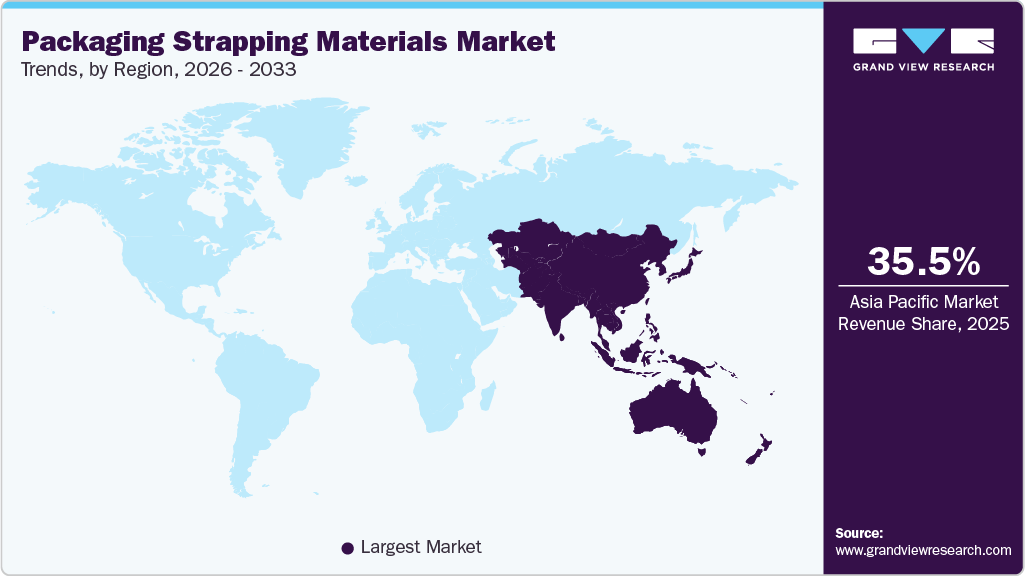
Asia Pacific dominated the global packaging strapping materials market and accounted for the largest revenue share of 35.5% in 2025, due to rapid industrialization, urbanization, and the strong presence of manufacturing hubs in countries like China and India. The region’s expanding e-commerce sector significantly contributes to demand. Growth in export-oriented industries and logistics infrastructure further boosts adoption. Increasing investments in packaging automation are enhancing efficiency. The availability of low-cost raw materials and labor supports large-scale production. Rising awareness regarding sustainable packaging is also influencing market trends.
 To learn more about this report, Download Free Sample Report
 China Packaging Strapping Materials Market Trends
China is a major contributor due to its strong manufacturing base and export-driven economy. High demand from the construction, electronics, and consumer goods sectors supports market growth. The country is witnessing increased adoption of PET strapping due to sustainability concerns. Government policies promoting green packaging are influencing product innovation. Automation in packaging processes is also gaining traction. Local manufacturers play a significant role in supplying cost-effective solutions. China continues to be a key production and consumption hub.
North America Packaging Strapping Materials Market Trends
North America is characterized by advanced logistics infrastructure and high adoption of automated packaging solutions. The region shows strong demand for high-performance and sustainable strapping materials. Growth in e-commerce and retail sectors is a key driver. Companies are focusing on innovation and product differentiation. Regulatory standards related to packaging safety and sustainability are strict. The presence of major market players enhances competitiveness. Demand for recyclable materials is increasing steadily.
U.S. Packaging Strapping Materials Market Trends
The U.S. market is driven by strong demand from the logistics, food & beverage, and construction industries. High adoption of machine-grade strapping materials supports efficiency. Sustainability initiatives are encouraging the use of recyclable PET strapping. Technological advancements in packaging automation are prominent. The presence of large distribution networks boosts demand. Innovation and R&D investments are significant.
Europe Packaging Strapping Materials Market Trends
Europe focuses heavily on sustainability and regulatory compliance in packaging materials. The demand for eco-friendly and recyclable strapping solutions is high. Strict environmental regulations are shaping product development. The region has a well-established logistics and manufacturing sector. Automation in packaging processes is widely adopted. Market players are investing in innovation to meet sustainability goals. Growth remains steady across industries.
Germany Packaging Strapping Materials Market Trends
Germany is a key market driven by its strong industrial and automotive sectors. High demand for durable and high-strength strapping materials is observed. The country emphasizes sustainable and recyclable packaging solutions. Advanced manufacturing capabilities support innovation. Automation and Industry 4.0 adoption are prominent. Export-oriented industries contribute significantly to demand. Germany remains a leading market in Europe.
Central and South America Packaging Strapping Materials Market Trends
Central and South America is witnessing moderate growth driven by expanding industrial and agricultural sectors. Increasing trade activities are supporting demand for packaging solutions. Cost-effective strapping materials are preferred in the region. Infrastructure development is gradually improving logistics efficiency. Local manufacturers play a key role in market supply. Adoption of advanced materials is still in early stages.
Middle East & Africa Packaging Strapping Materials Market Trends
The Middle East & Africa region is experiencing steady growth due to increasing construction and industrial activities. Investments in infrastructure and logistics are boosting demand. The oil & gas sector also contributes to the use of heavy-duty strapping materials. Cost sensitivity influences product choices in the region. Adoption of sustainable materials is gradually increasing. Import dependence remains relatively high.
Key Packaging Strapping Materials Company Insights
Some of the key players operating in the market include Mosca GmbH and Signode Construction Group.
-
Mosca GmbH is a Germany-based company specializing in end-of-line packaging and strapping solutions, including strapping machines and PP/PET strapping materials. In the packaging strapping market, it is known for providing automated, high-efficiency systems used in logistics, manufacturing, and industrial packaging.
-
Signode Construction Group is a global leader in transit packaging solutions, with a strong presence in the recycled packaging strapping materials market. The company manufactures high-performance polyester straps made largely from post-consumer materials, supporting sustainable packaging applications.
Furus Packaging Pvt. Ltd and Fromm Packaging Systems are some of the emerging market participants in the packaging strapping materials market.
-
The FROMM Group is a Switzerland-based global packaging company specializing in strapping systems, stretch wrapping solutions, and protective packaging equipment. In the packaging strapping materials market, it offers a complete range of manual, semi-automatic, and fully automated strapping tools along with PP and PET strapping consumables.
-
Furus Packaging Pvt. Ltd. is an India-based manufacturer specializing in recycled PET (rPET) strapping materials, produced using post-consumer plastic waste such as PET bottles.
Key Packaging Strapping Materials Companies:
The following key companies have been profiled for this study on the packaging strapping materials market.
- Mosca GmbH
- Fromm Packaging Systems
- Signode Construction Group
- Grip Strapping Technologies Private Limited
- American Strapping Company
- X-PAK GLOBAL
- Opal Packaging
- Furus Packaging Pvt. Ltd
Recent Developments
-
In January 2026, Signode Construction Group launched next-generation embossed PP strapping, improving performance and reducing environmental footprint.
-
In October 2025, Mosca GmbH introduced SoniXs MCB-3 inline strapping system, featuring high-speed automation and real-time data integration for packaging lines.
Packaging Strapping Materials Report Scope
Report Attribute
Details
Market size in 2025
USD 9.8 billion
Estimated market size in 2026
USD 10.4 billion
Projected market size by 2033
USD 15.7 billion
Growth Rate
CAGR of 6.0% from 2026 to 2033
Base year for estimation
2024
Actual estimates/Historical data
2021 - 2025
Forecast period
2026 - 2033
Quantitative units
Revenue in USD billion/million and CAGR from 2023 to 2033
Report coverage
Revenue forecast, company ranking, competitive landscape, growth factors, and trends
Segments covered
Source, product, application, and region.
Regional scope
Global
Country scope
U.S., Canada, Mexico, Germany, UK, France, Italy, Spain, Austria, Poland, Romania, Turkey, Netherlands, Belgium, Hungary, Czech Republic, China, Japan, India, Australia, South Korea, Brazil, Argentina, Saudi Arabia, UAE, South Africa
Key companies profiled
Mosca GmbH, Fromm Packaging Systems, Signode Industrial Group, Grip Strapping Technologies Private Limited, American Strapping Company, X-PAK GLOBAL, Opal Packaging, Furus Packaging Pvt. Ltd,
Customization scope
Free report customization (equivalent up to 8 analysts working days) with purchase. Addition or alteration to country, regional & segment scope.
Pricing and purchase options
Avail customized purchase options to meet your exact research needs. Explore purchase options
Global Packaging Strapping Materials Market Report Segmentation
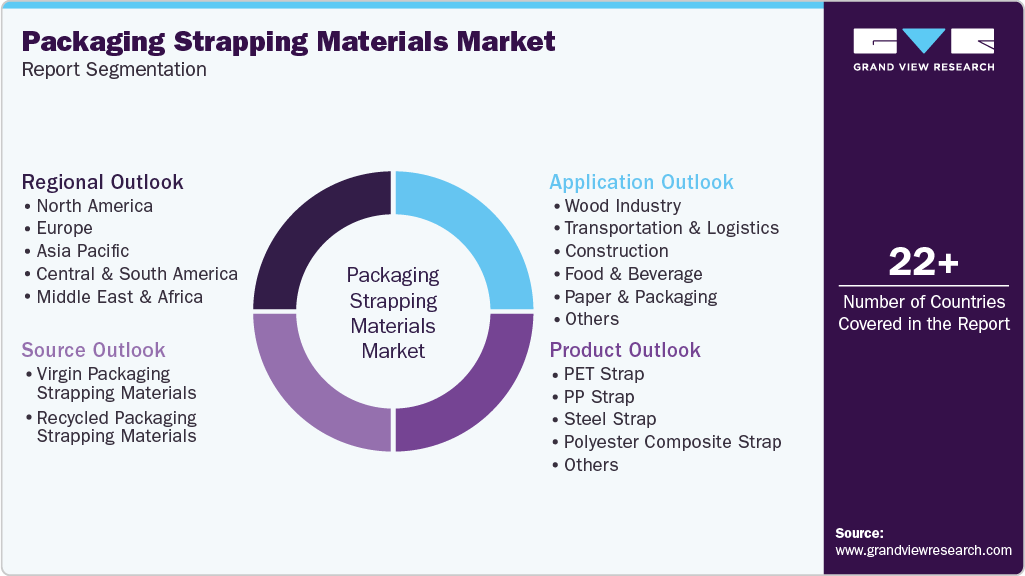
This report forecasts revenue growth at regional & country levels and provides an analysis on the industry trends in each of the sub-segments from 2021 to 2033. For the purpose of this study, Grand View Research has segmented the packaging strapping materials market on the basis of source, product, application, and region:
 To learn more about this report, Download Free Sample Report
 -
Source Outlook (Volume, Kiloton; Revenue, USD Billion; 2021 - 2033)
-
Virgin Packaging Strapping Materials
-
Recycled Packaging Strapping Materials
-
-
Product Outlook (Volume, Kiloton; Revenue, USD Billion; 2021 - 2033)
-
PET Strap
-
PP Strap
-
Steel Strap
-
Polyester Composite Strap
-
Others
-
-
Application Outlook (Volume, Kiloton; Revenue, USD Billion; 2021 - 2033)
-
Wood Industry
-
Transportation & Logistics
-
Construction
-
Food & Beverage
-
Paper & Packaging
-
Others
-
-
Regional Outlook (Volume, Kiloton; Revenue, USD Billion; 2021 - 2033)
-
North America
-
U.S.
-
Canada
-
Mexico
-
-
Europe
-
Germany
-
UK
-
France
-
Italy
-
Spain
-
Austria
-
Poland
-
Romania
-
Turkey
-
Netherlands
-
Belgium
-
Hungary
-
Czech Republic
-
-
Asia Pacific
-
China
-
India
-
Japan
-
South Korea
-
Australia
-
-
Central and South America
-
Brazil
-
Argentina
-
-
Middle East and Africa
-
Saudi Arabia
-
UAE
-
South Africa
-
-
Frequently Asked Questions About This Report
The global packaging strapping materials market size was estimated at USD 9.8 billion in 2025 and is expected to reach USD 10.4 billion in 2026.
Increasing cross-border trade and export activities are driving the adoption of high-strength strapping materials. The rise in palletized shipping and containerization has also significantly contributed to market growth.
The global packaging strapping materials market is expected to grow at a compound annual growth rate of 6.0% from 2026 to 2033 to reach USD 15.7 billion by 2033.
Asia Pacific region accounted for the largest revenue share of 35.5% in 2025, due to rapid industrialization, urbanization, and the strong presence of manufacturing hubs in countries like China and India.
Some key players in the packaging strapping materials market include Mosca GmbH, Fromm Packaging Systems, Signode Industrial Group, Grip Strapping Technologies Private Limited, American Strapping Company, X-PAK GLOBAL, Opal Packaging, and Furus Packaging Pvt. Ltd.
About the Author(s)
Advanced Interior Materials Research Team
Advanced Materials · Advanced Interior MaterialsThis report was authored by the advanced interior materials research team at Grand View Research - comprising two research analysts, one senior research analyst, and one industry expert - with specialized expertise in the advanced interior materials segment of the advanced materials industry. All findings are based on proprietary advanced materials databases, executive interviews, and regulatory analysis, subject to internal peer review prior to publication.
Last Updated:
Speak to Analyst

Customize this report to your needs - add regions, segments, or data points, with 20% free customization.
Or view our licence options:


ISO 9001:2015 & 27001:2022 Certified
We are GDPR and CCPA compliant! Your transaction & personal information is safe and secure. For more details, please read our privacy policy.


