
- Home
- »
- Performance Chemicals
- »
-
Paint Removers Market Size & Share Report, 2026-2033GVR Report cover

Paint Removers Market (2026 - 2033)
Size, Share & Trends Analysis Report By Product (Solvent-based Removers, Bio-based Removers), By Form (Liquid, Gel), By Application (Residential DIY, Commercial Building Maintenance), By Region, And Segment Forecasts
Market Size, 2025
$1.5BMarket Estimate, 2026
$1.6BMarket Forecast, 2033
$2.3BCAGR, 2026–2033
5.6%Paint Removers Market Summary
The global paint removers market size was valued at USD 1.5 billion in 2025 and is projected to grow from USD 1.6 billion in 2026 to USD 2.3 billion by 2033, at a CAGR of 5.6% from 2026 to 2033. Asia Pacific dominated the market, accounting for a revenue share of 45.2% in 2025. The market growth is driven by increasing renovation and refurbishment activities, rising automotive refinishing demand, and expanding industrial maintenance requirements.
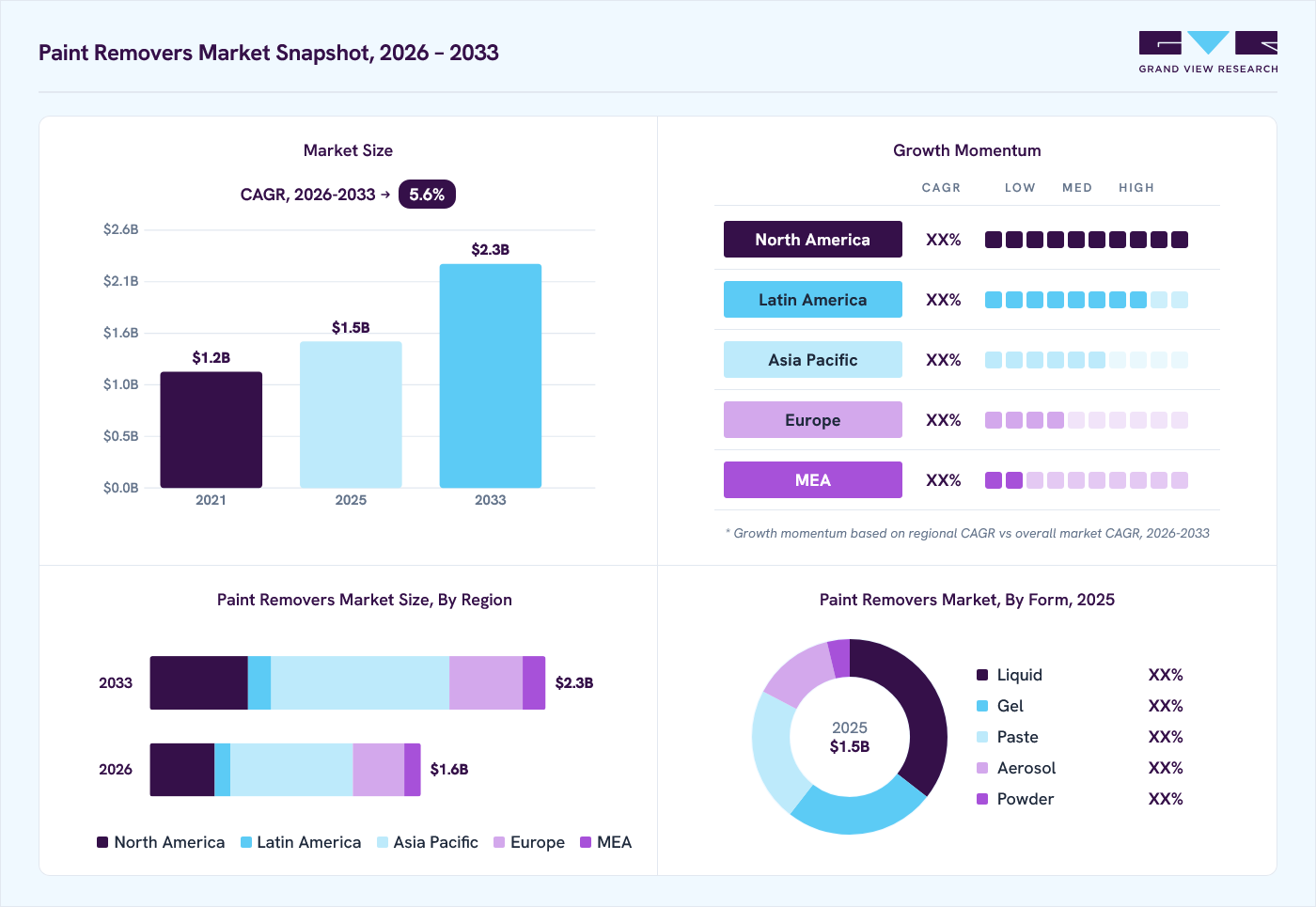 Source: Grand View Research, IR Documents, Primary Interviews, Paid DatabasesTo learn more about this report,
 Download Free Sample Report
 Key Market Trends & Insights
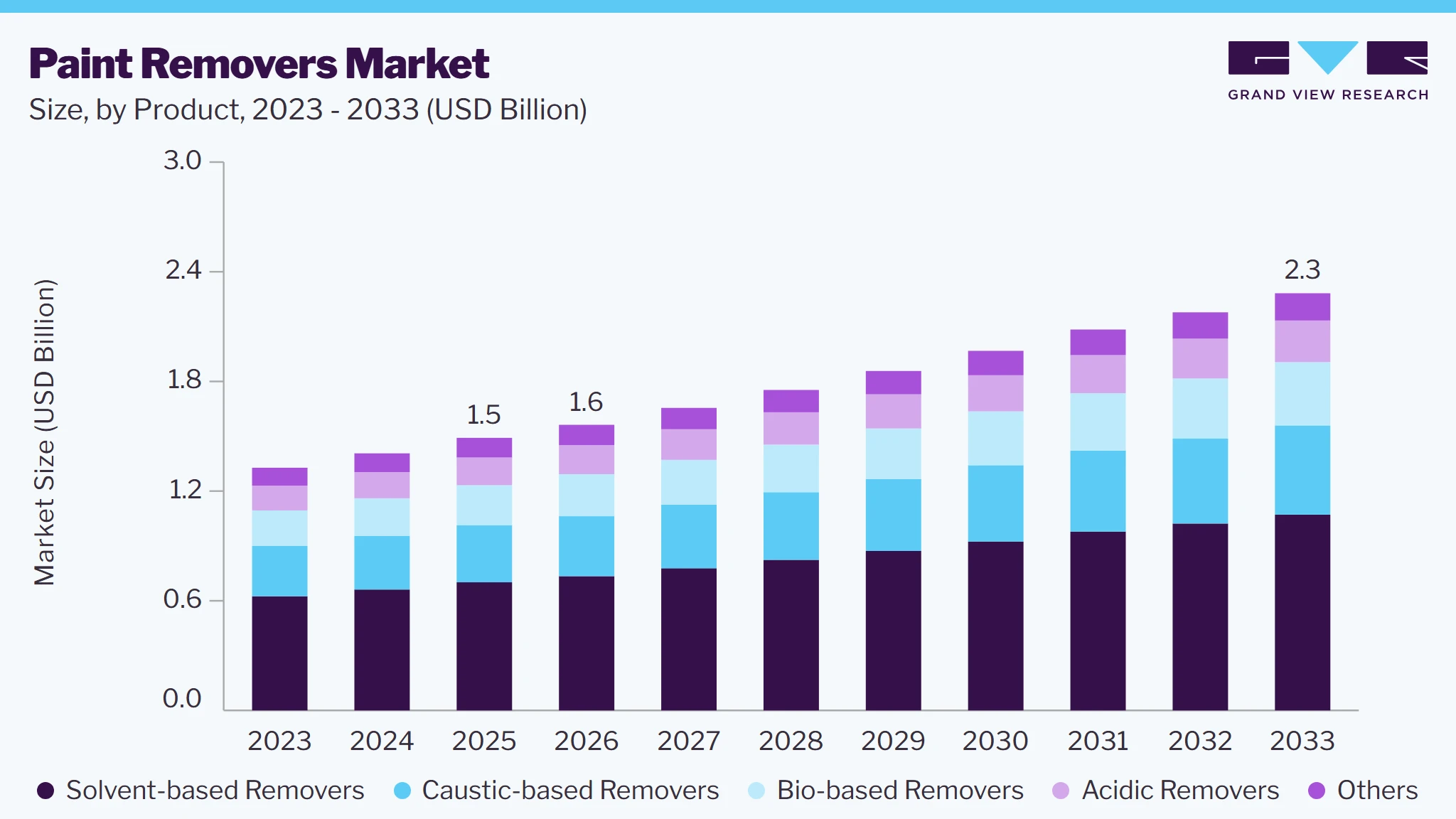
- By product, solvent-based removers held the largest revenue share of 47.0% in 2025.
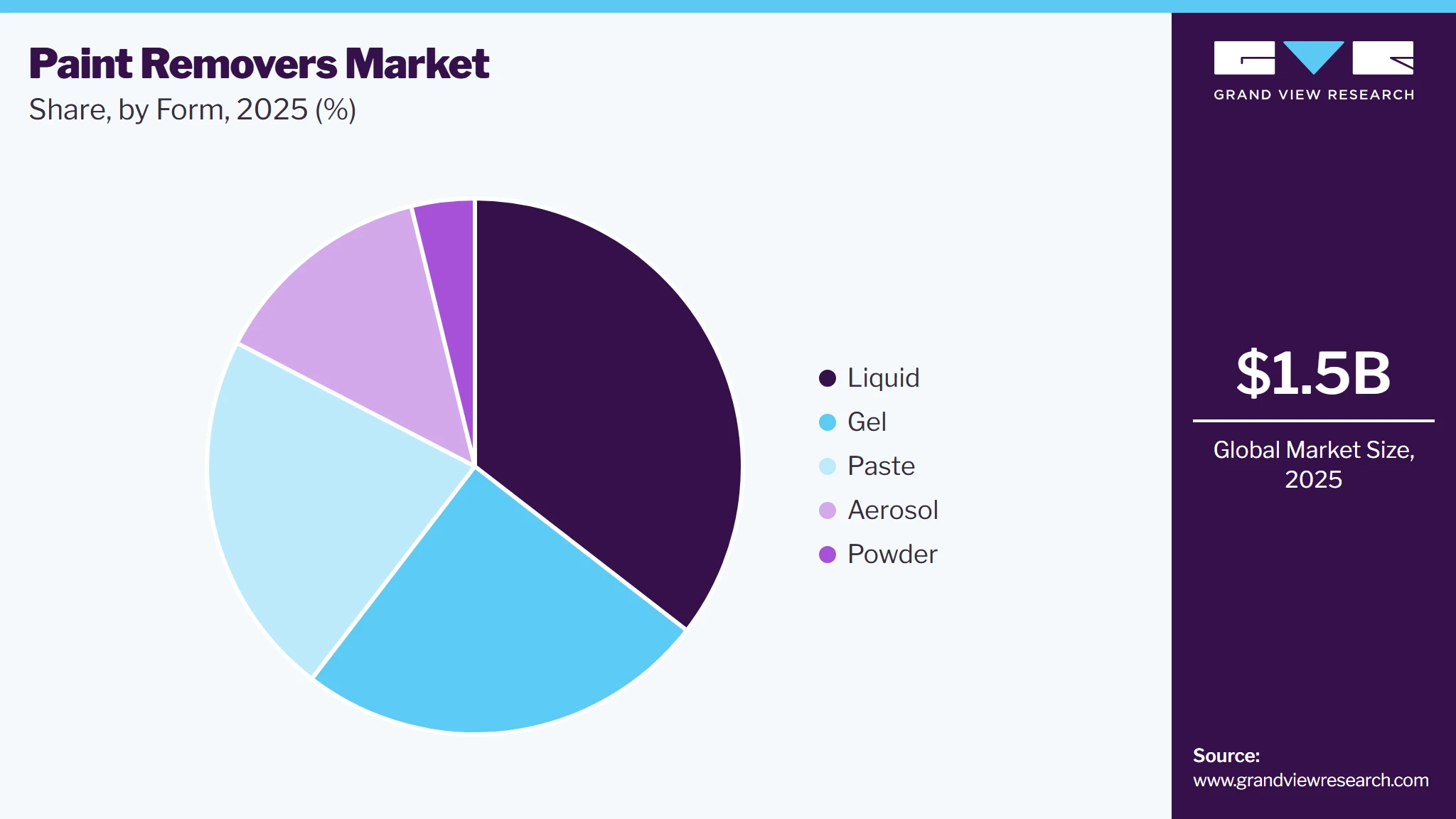
- Liquid segment, by form, dominated the market with a revenue share of 35.5% in 2025.
- Automotive refinish, by application, is expected to grow the fastest CAGR of 6.0% from 2026 to 2033.
Regional Highlights
- Largest regional market: Asia Pacific (45.2%, revenue share, 2025)
- Fastest-growing regional market: North America (fastest CAGR, 2026-2033)
Market Size & Forecast
- Market size in 2025: USD 1.5 Billion
- Estimated market size in 2026: USD 1.6 Billion
- Projected market size by 2033: USD 2.3 Billion
- CAGR (2026-2033): 5.6%
Three ways to get this report
Buy it, customize it, or ask a question.Ask an Analyst
A direct answer, usually in 1 working day
- AccessReport author, directly
- Reply timeWithin 1 working day
- No sales callDirect answer only
- FormatEmail reply
- CostFree, no cost
Get the Full Report
What the study covers
- FormatsPDF · Excel · Dashboard
- Timeline2026–2033 annual, 2025 base
- Coverage20+ countries, 5 regions
- Companies10+ key players profiled
Customize the Report
20% free customization
- IncludeCountries, segments, points
- TailorTo your product definition
- ExtendDeeper competitor detail
- OrA fully bespoke study
- Turnaround5–10 working days
 To learn more about this report, Download Free Sample Report
Growth in the paint removers industry is supported by increasing demand for efficient coating removal across renovation, repainting, automotive refinishing, industrial maintenance, furniture restoration, and equipment refurbishment. Paint removers are used to strip aged, damaged, or unwanted coatings from metal, wood, concrete, and other substrates before repainting, repair, or surface treatment. Increasing maintenance and refurbishment activities across residential, commercial, automotive, and industrial assets are creating sustained requirements for coating removal solutions. At the same time, manufacturers are developing formulations with improved stripping performance, lower toxicity, reduced odor, and better substrate compatibility as end users increasingly seek safer and more environmentally responsible alternatives to conventional high-hazard stripping chemicals.Market Dynamics
The paint removers market is shaped by construction and renovation activity, automotive refinishing volumes, industrial maintenance requirements, furniture restoration, infrastructure refurbishment, regulatory conditions, coating technologies, and the availability of different chemical and mechanical removal methods. Demand varies according to substrate type, coating chemistry, form method, and removal requirements, with solvent-based, caustic, acidic, and other specialized formulations serving different end-use conditions.
Adoption is also influenced by stripping speed, coating thickness, dwell time, temperature, substrate sensitivity, form technique, ventilation requirements, and post-treatment requirements. Formulation developments are enabling manufacturers to improve paint penetration, reduce form time, minimize substrate damage, and address increasingly diverse coating systems. The development of lower-hazard and more user-friendly products is also influencing product selection as professional and industrial users balance removal performance with worker safety and regulatory compliance.
Expansion of renovation, remodeling, and repainting activities across residential and commercial properties is generating consistent demand for paint removal products. Older buildings, deteriorated coatings, color changes, and surface restoration requirements often necessitate the removal of existing paint before the form of new coating systems. Growth in property refurbishment and maintenance spending is therefore expanding the use of paint removers beyond new construction-related applications.
Paint removers facilitate surface preparation by softening, dissolving, or loosening existing coatings, allowing users to remove multiple paint layers before sanding, recoating, or repairing the underlying substrate. Their form across doors, windows, furniture, walls, metal structures, and architectural components supports demand from contractors, maintenance professionals, restoration specialists, and do-it-yourself users. Increased refurbishment of aging residential and commercial assets is consequently providing a recurring form base for paint-removal products.
Stringent regulations concerning hazardous solvents and worker exposure can constrain the use of certain conventional paint-removal formulations. Some high-performance stripping chemicals have been associated with concerns about toxicity, volatile emissions, skin contact, inhalation exposure, flammability, or environmental persistence, thereby increasing compliance requirements for manufacturers and professional users.
Restrictions on specific chemical ingredients can require suppliers to reformulate established products, conduct additional performance testing, and invest in alternative raw materials. End users may also require improved ventilation, personal protective equipment, controlled form procedures, and specialized handling practices when using certain formulations. These requirements can increase operating costs and complicate product selection, particularly in industrial and professional applications where large quantities of paint removers are used.
Growing demand for safer and more environmentally responsible coating-removal solutions is creating opportunities for manufacturers to develop bio-based, low-VOC, biodegradable, and lower-toxicity paint remover formulations. End users are increasingly evaluating products not only on stripping effectiveness but also on odor, worker exposure, waste generation, flammability, and environmental characteristics.
Advances in solvent chemistry and formulation technology are enabling suppliers to develop alternatives that can remove conventional and advanced coating systems while reducing reliance on highly hazardous ingredients. Products designed around renewable raw materials, safer solvent systems, and reduced emissions can gain adoption in applications where indoor use, occupational exposure, environmental requirements, or sustainability objectives influence purchasing decisions. This trend provides manufacturers with opportunities to differentiate products through improved safety profiles while maintaining the removal performance required for professional applications.
Market Concentration & Characteristics
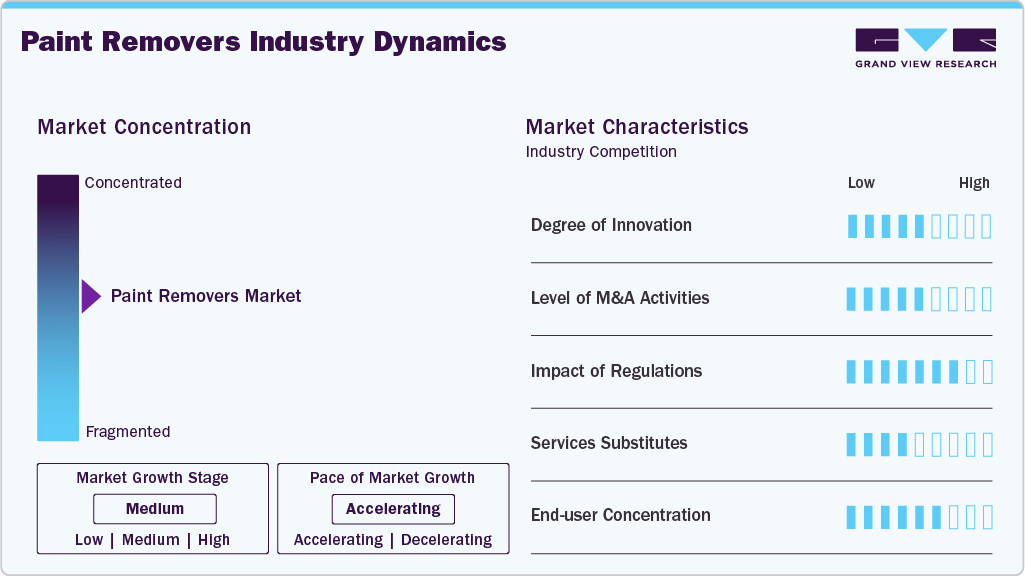
The paint removers market consists of multinational specialty chemical manufacturers, coatings companies, industrial chemical suppliers, and regional formulation producers. Leading participants generally compete through formulation performance, substrate compatibility, product safety, distribution networks, and form expertise, while smaller manufacturers can differentiate through specialized products for automotive refinishing, furniture restoration, industrial equipment, architectural surfaces, or other niche applications. The competitive environment is characterized by formulation differentiation, with products selected based on coating type, substrate, removal speed, form conditions, and safety requirements. Key selection criteria include stripping effectiveness, form time, substrate protection, formulation stability, ease of form, odor, VOC characteristics, handling requirements, and overall process economics. Manufacturers with strong formulation capabilities can develop products optimized for difficult coating systems, multilayer paints, powder coatings, varnishes, adhesives, and other surface treatments. Technical documentation, form guidance, regulatory compliance, and consistent product quality also influence supplier selection, particularly among professional and industrial customers.
 To learn more about this report, Download Free Sample Report
 Leading companies are strengthening their positions in the paint removers industry through formulation development, safer solvent technologies, form-specific products, and expansion of technical support capabilities. Manufacturers are focusing on developing paint removers with faster stripping action, improved coating penetration, lower VOC emissions, reduced odor, and greater compatibility with different substrates and coating chemistries. Companies are also strengthening relationships with contractors, automotive refinishing operators, industrial maintenance providers, and surface-treatment professionals to conduct form testing, optimize product use, and develop solutions tailored to specific requirements, such as architectural repainting, automotive refinishing, furniture restoration, industrial equipment maintenance, and the removal of multilayer or highly resistant coatings.
Analyst Perspective
The paint removers market is expected to maintain a growth trajectory, supported by increasing paper and packaging production, rising utilization of recycled fiber, and growing adoption of enzyme-based processing technologies. Demand is expected to remain strong across applications such as bleaching, deinking, refining, fiber modification, pitch control, and wastewater treatment, as pulp and paper manufacturers seek to improve process performance and meet evolving production requirements. From a competitive perspective, enzyme activity, formulation stability, dosage efficiency, process compatibility, and technical support are becoming important differentiators, encouraging manufacturers to invest in enzyme development, form-specific formulations, and collaboration with pulp and paper mills to optimize process performance.
Product Insights
The solvent-based removers dominated the paint removers market, accounting for 47.0% of total revenue in 2025. The segment benefits from the strong stripping capability of solvent formulations, which can effectively soften and dissolve multiple types of paints, varnishes, lacquers, and protective coatings. Their established use across industrial, automotive, construction, and restoration activities, combined with compatibility with a wide range of coating systems, supports their continued revenue contribution.
The bio-based removers segment is expected to grow at a CAGR of 6.0% during the forecast period. Growth is supported by increasing interest in formulations derived from renewable or naturally sourced ingredients, particularly among users seeking alternatives to conventional high-hazard stripping chemicals. Demand is also being supported by greater attention to worker exposure, indoor application conditions, VOC reduction, and environmentally preferable product formulations, encouraging manufacturers to expand bio-based and lower-impact alternatives.
Form Insights
The liquid segment dominated the paint removers market, accounting for 35.5% of total revenue in 2025. Liquid formulations benefit from their versatility and ability to be applied through conventional methods such as brushing, rolling, spraying, and immersion. Their suitability for treating relatively large surface areas and their availability across different chemical formulations make liquid removers widely applicable in building refurbishment, industrial coating treatment, automotive work, and general maintenance operations.
 To learn more about this report, Download Free Sample Report
 The paste segment is expected to grow at the fastest CAGR of 6.0% during the forecast period. The increasing use of thick-consistency removers for detailed, localized treatment is supporting segment expansion. Paste formulations can remain concentrated at the application site for longer periods, making them suitable for intricate components, vertical surfaces, furniture, architectural details, and restoration projects where controlled product placement is important.
Application Insights
The residential DIY segment dominated the paint removers industry, accounting for a revenue share of 31.9% in 2025. Demand within this segment is supported by homeowners undertaking repainting, furniture refurbishment, decorative restoration, and other small-scale improvement projects. The availability of ready-to-use products in consumer-friendly packaging and the growing accessibility of home renovation information are helping individuals undertake coating-removal activities without relying entirely on professional services.
Automotive refinish is expected to grow at a CAGR of 6.0% during the forecast period. Expansion is associated with increasing vehicle repair and restoration requirements, including the removal of damaged, deteriorated, or incompatible coatings before refinishing. Paint removers are particularly relevant in restoration and specialized repair work where existing finishes need to be stripped from vehicle panels or components before subsequent coating applications.
Regional Insights
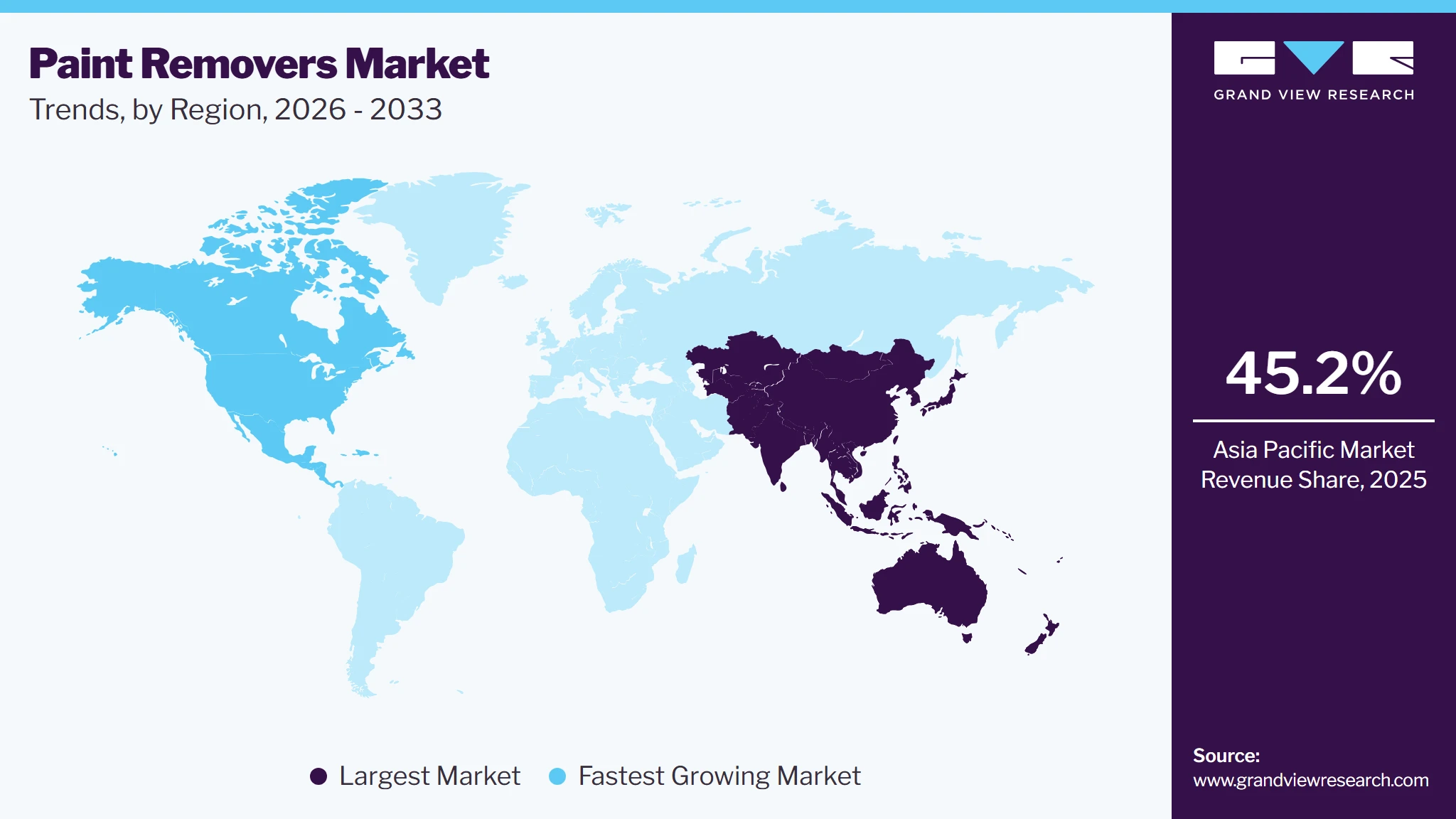
The Asia Pacific paint removers market dominated with the largest revenue share of 45.2% in 2025. The region’s leading share is supported by its extensive manufacturing and industrial base, particularly across China, India, Japan, South Korea, and Southeast Asia. High production volumes of machinery, automotive components, fabricated metal products, and industrial equipment create continuous requirements for coating removal during rework, maintenance, refurbishment, and surface preparation. The availability of local chemical manufacturers and established industrial supply chains further supports regional product adoption.
 To learn more about this report, Download Free Sample Report
 The paint removers market in China holds a significant revenue share, supported by its large-scale automotive, machinery, shipbuilding, construction, and metal-processing industries. The country’s extensive manufacturing infrastructure generates demand for coating-removal products during equipment reconditioning, production rework, component treatment, and repainting operations. Growth in industrial refurbishment and maintenance activities creates opportunities for both conventional stripping formulations and specialized products designed for demanding coating systems.
North America Paint Removers Market Trends
The North America paint removers industry is expected to grow at the fastest CAGR of 6.1% during the forecast period. Market expansion is being supported by strong demand from automotive refinishing, residential improvement, commercial property upkeep, and industrial asset restoration. Product development in the region is increasingly focused on formulations that enable effective coating removal while meeting stricter requirements for worker exposure, volatile emissions, and the use of hazardous chemicals. This shift is encouraging the commercialization of alternative solvent systems and lower-hazard stripping products.
U.S. Paint Removers Market Trends
The U.S. is the principal market for paint removers in North America, supported by its extensive automotive repair sector, established home-improvement market, and large industrial asset base. Consumer demand is generated through furniture refinishing, household repainting, and restoration projects, while professional consumption comes from vehicle repair, equipment servicing, and industrial coating maintenance. Regulatory requirements governing hazardous chemicals are also influencing purchasing patterns and encouraging manufacturers to replace certain conventional stripping ingredients with safer alternatives.
Europe Paint Removers Market Trends
Europe has a well-established paint removers industry, with demand influenced by the region’s extensive building renovation and restoration activities. Older residential structures, historical properties, commercial buildings, and architectural components frequently require the removal of existing finishes before restoration or recoat. The market is also shaped by stringent chemical and environmental requirements, prompting manufacturers to improve formulation safety, reduce emissions, and introduce products based on alternative solvent technologies. These developments are increasing the importance of product compliance and substrate protection in supplier selection.
Latin America Paint Removers Market Trends
Latin America is witnessing demand for paint removers from automotive repair, furniture refurbishment, construction, and industrial processing activities. Brazil and Mexico represent important consumption centers due to their manufacturing and automotive industries, while expanding commercial and residential development is supporting additional applications. Furniture restoration and refinishing activities provide additional demand, particularly for products capable of removing multiple layers of decorative coatings and finishes from wood and other substrates.
Middle East & Africa Paint Removers Market Trends
The Middle East & Africa market is supported by industrial maintenance, infrastructure projects, marine applications, and the refurbishment of commercial and residential assets. In the Middle East, oil and gas facilities, metal structures, transportation infrastructure, and large commercial developments require the removal of deteriorated protective coatings before maintenance and recoating. African markets are gaining demand from urban construction, industrial development, and equipment refurbishment, creating opportunities for suppliers offering products suited to heavy-duty coating removal and demanding operating environments.
Key Paint Removers Company Insights
Companies operating in the paint removers market are strengthening their competitive positions through product portfolio expansion, formulation development, application-specific product development, strategic collaborations, and investments in safer and more efficient coating-removal technologies. Leading manufacturers focus on improving stripping effectiveness, coating penetration, application speed, substrate compatibility, formulation stability, and safety performance, while expanding their solutions across architectural repainting, automotive refinishing, furniture restoration, industrial maintenance, infrastructure refurbishment, and specialized coating removal applications. Growing demand for efficient and environmentally responsible surface preparation is also encouraging companies to work closely with contractors, industrial users, refinishing professionals, and restoration specialists to conduct application trials, optimize product usage, and develop customized paint removal solutions suited to specific coating types and substrate conditions.
-
Dumond is a participant in the paint removers industry, specializing in environmentally responsible paint and coating removal solutions for residential, commercial, industrial, and restoration applications. The company offers products designed to remove multiple layers of paints, coatings, varnishes, and other surface finishes while supporting safer surface-preparation processes. Its portfolio includes solutions suited to different substrates and coating-removal requirements, with an emphasis on effective stripping performance, reduced reliance on highly hazardous chemicals, and ease of application. Dumond's focus on safer formulation technologies and application-specific paint removal products supports its competitive position across renovation, restoration, maintenance, and surface-refinishing activities.
-
Radhe Krishna Industries is a participant in the paint removers market, offering chemical solutions for removing paints, coatings, and other surface finishes across industrial and maintenance applications. The company focuses on developing and supplying paint stripping formulations that support efficient coating removal and surface preparation before repainting, repair, or further treatment. Its ability to serve application-specific requirements and provide formulations suited to different coating and substrate conditions enables it to address diverse industrial paint-removal needs. The company's formulation capabilities, product flexibility, and focus on industrial customers support its competitive position in the market.
Key Paint Removers Market Companies
The following key companies have been profiled for the study on the paint removers market
-
Dumond
-
Radhe Krishna Industries
-
Vitarag Chemicals
-
Asian Paints Ltd
-
3M
-
Henkel AG & Co. KGaA
-
RPM International Inc.
-
Cosmos Paints India
-
Chemetall GmbH
-
Ree Atharva Lifescience Pvt. Ltd
-
Kleanstrip
Competitive Benchmarking
Operating Strategies
Competitive Edge
Weaknesses
Mature Players: 3M; Henkel AG & Co. KGaA; RPM International Inc.; Asian Paints Ltd.; Chemetall GmbH; Klean-Strip
- · Expand paint and coating removal portfolios across industrial maintenance, automotive refinishing, architectural renovation, surface preparation, and specialized restoration applications.
- · Invest in formulation development to improve stripping efficiency, application speed, substrate compatibility, and user safety.
- · Develop lower-VOC, reduced-hazard, and environmentally responsible formulations in response to changing chemical regulations and customer preferences.
- · Strengthen distribution and technical-support networks across major construction, automotive, industrial, and maintenance markets.
- · Leverage broader coatings, adhesives, abrasives, surface-treatment, and specialty-chemical portfolios to offer complementary solutions around the coating-removal process.
- · Established brands and long-standing relationships with professional, industrial, automotive, and construction customers support market credibility.
- · Broad product portfolios allow participation across multiple surface preparation and coating-treatment requirements.
- · Strong formulation and materials-science capabilities support development of products for different coating chemistries and substrates.
- · Extensive distribution networks provide access to professional users as well as retail and maintenance channels.
- · Strong financial and organizational resources enable continued investment in product development, regulatory compliance, and commercialization.
- · Large multinational structures can result in longer product-development and commercialization cycles for highly customized applications.
- · Compliance with increasingly stringent chemical regulations can increase reformulation, testing, and certification costs.
- · Broad product portfolios require substantial resources for maintaining application expertise across different coating systems and end-use industries.
- · Established brands may have higher cost structures than smaller regional formulators competing primarily on price.
Emerging Players: Dumond; Radhe Krishna Industries; Vitarag Chemicals; Cosmos Paints India; Ree Atharva Lifescience Pvt. Ltd.
- · Expand specialized paint-remover portfolios targeting architectural coatings, automotive finishes, industrial equipment, furniture, and restoration applications.
- · Focus on customized formulations designed around specific paint types, substrate materials, coating thicknesses, and application conditions.
- · Develop safer and lower-hazard alternatives to conventional stripping formulations to address changing customer and regulatory requirements.
- · Strengthen regional distribution networks and relationships with industrial users, contractors, automotive refinishing businesses, and surface-treatment specialists.
- · Increase application testing and technical support to demonstrate stripping performance and improve product adoption among professional users.
- · Greater formulation flexibility enables faster adaptation to specific customer and application requirements.
- · Specialized product portfolios allow companies to focus resources on selected coating-removal applications and underserved customer segments.
- · Regional presence can facilitate closer relationships with contractors, industrial customers, distributors, and maintenance providers.
- · Leaner organizational structures can support quicker product modifications and commercial decisions.
- · Competitive pricing can help smaller suppliers penetrate markets where customers are seeking alternatives to established multinational brands.
- · Smaller manufacturing and distribution networks can restrict their ability to serve large multinational customers across multiple geographic markets.
- · More limited R&D resources can constrain development of advanced low-hazard or highly specialized formulations.
- · Lower brand recognition can make qualification and product adoption more difficult among large industrial and automotive customers.
- · Limited technical-service infrastructure may restrict on-site trials, application optimization, and customer support in distant markets.
- · Greater dependence on regional demand can increase exposure to fluctuations in construction, renovation, and industrial maintenance activity.
Recent Developments
- In March 2026, Cortec Corporation launched EcoLine Surface Reveal, a next-generation industrial paint remover containing 77% USDA-certified biobased content. The formulation is free of methylene chloride and NMP and is designed to remove acrylic and alkyd coatings from metal surfaces such as tanks, pipes, and industrial equipment within 15-30 minutes, depending on conditions. The product also offers improved odor characteristics, non-tarnishing performance on ferrous and non-ferrous metals, and flash-corrosion prevention after cleaning.
Paint Removers Market Report Scope
Report Attribute
Details
Market Definition
The paint removers market comprises specialized biological enzymes, including xylanases, cellulases, amylases, lipases, laccases, and pectinases, used to optimize pulp and paper manufacturing processes.
These enzymes are applied across bleaching, deinking, fiber modification, refining, pitch and stickies control, drainage, and starch processing for the production of various paper and paperboard grades.Market size in 2025
USD 1.5 billion
Estimated market size in 2026
USD 1.6 billion
Projected market size by 2033
USD 2.3 billion
Growth rate
CAGR of 5.6% from 2026 to 2033
Base year for estimation
2025
Historical data
2021 - 2024
Forecast period
2026 - 2033
Quantitative units
Volume in kilotons, revenue in USD million/billion, and CAGR from 2026 to 2033
Report coverage
Revenue forecast, volume forecast, company ranking, competitive landscape, growth factors, and trends
Segments covered
Product, form, application, and region
Regional scope
North America; Europe; Asia Pacific; Latin America; Middle East & Africa
Country scope
U.S.; Canada; Mexico; Germany; UK; France; Italy; Spain; China; India; Japan; South Korea; Brazil; Argentina; Saudi Arabia; South Africa
Key companies profiled
Dumond; Radhe Krishna Industries; Vitarag Chemicals; Asian Paints Ltd; 3M; Henkel AG & Co. KGaA; RPM International Inc.; Cosmos Paints India; Chemetall GmbH; Ree Atharva Lifescience Pvt. Ltd; Kleanstrip
Customization scope
Free report customization (equivalent up to 8 analysts’ working days) with purchase. Addition or alteration to country, regional & segment scope.
Pricing and purchase options
Avail customized purchase options to meet your exact research needs. Explore purchase options
Global Paint Removers Market Report Segmentation
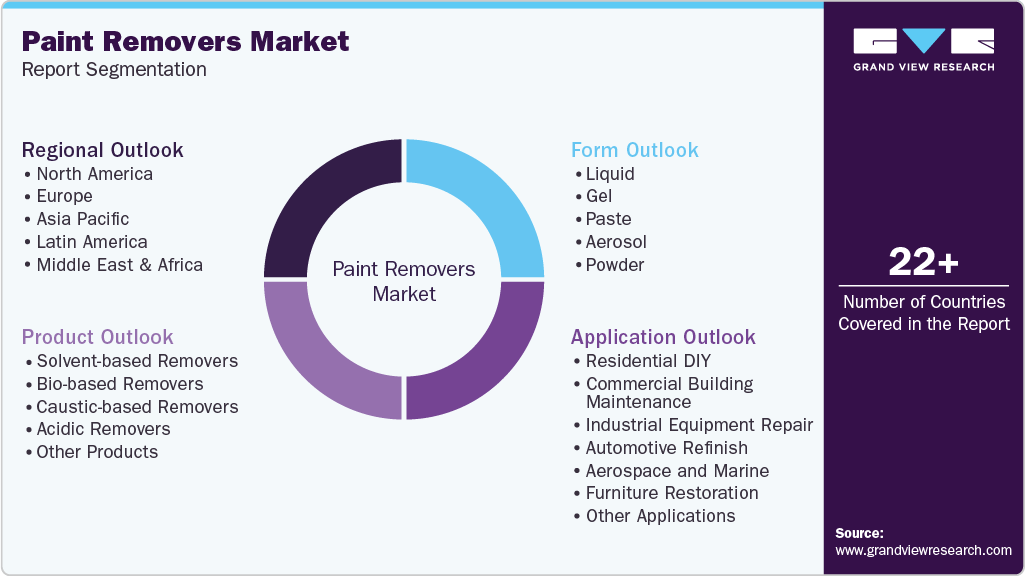
This report forecasts revenue & volume growth at the global, regional & country levels and provides an analysis of the latest industry trends in each of the sub-segments from 2021 to 2033. For this study, Grand View Research has segmented the paint removers market report based on product, form, application, and region:
 To learn more about this report, Download Free Sample Report
 -
Product Outlook (Volume, Kilotons; Revenue, USD Million/Billion, 2021 - 2033)
-
Solvent-based Removers
-
Bio-based Removers
-
Caustic-based Removers
-
Acidic Removers
-
Other Products
-
-
Form Outlook (Volume, Kilotons; Revenue, USD Million/Billion, 2021 - 2033)
-
Liquid
-
Gel
-
Paste
-
Aerosol
-
Powder
-
-
Application Outlook (Volume, Kilotons; Revenue, USD Million/Billion, 2021 - 2033)
-
Residential DIY
-
Commercial Building Maintenance
-
Industrial Equipment Repair
-
Automotive Refinish
-
Aerospace and Marine
-
Furniture Restoration
-
Other Applications
-
-
Regional Outlook (Volume, Kilotons; Revenue, USD Million/Billion, 2021 - 2033)
-
North America
-
U.S.
-
Canada
-
Mexico
-
-
Europe
-
Germany
-
UK
-
France
-
Italy
-
Spain
-
-
Asia Pacific
-
China
-
India
-
Japan
-
South Korea
-
-
Latin America
-
Brazil
-
Argentina
-
-
Middle East & Africa
-
Saudi Arabia
-
South Africa
-
-
Research Methodology
The paint removers market figures in this report are based on a proven research process that combines executive interviews with secondary research from proprietary databases, company filings, and recognized regulatory and institutional sources. Market size is built through value-chain sizing-reconciling supply-side and demand-side estimates-and triangulated with bottom-up and top-down approaches. Every estimate passes multiple levels of expert validation before publication, with each paint removers segment quantified using the revenue-capture definitions in the table below.
Segment Definition
Segment - Product
Revenue capture definition
Solvent-based Removers
Revenue is generated from solvent-based formulations that penetrate and dissolve paint films, making them suitable for removing multiple or tightly bonded coating layers. Demand is supported by their effectiveness against conventional paints, varnishes, lacquers, and other resistant finishes.
Bio-based Removers
Market revenues arise from removers incorporating renewable or naturally derived ingredients as alternatives to conventional chemical stripping systems. Adoption is influenced by environmental objectives, lower-toxicity requirements, and demand for products with improved user and environmental profiles.
Caustic-based Removers
Revenue is captured from alkaline formulations that chemically break down compatible coating structures. These products are primarily utilized where strong stripping action is required for durable industrial finishes, heavy-duty coatings, and selected metal or equipment applications.
Acidic Removers
Sales are generated from acid-based formulations used to loosen specific coatings and chemically attack compatible residues or finishes. Demand is concentrated in specialized applications where acidic chemistry provides the required treatment intensity or cleaning characteristics.
Other Products
Revenue is derived from specialty paint-removal systems, including emulsions and proprietary chemical blends developed for particular coating chemistries or substrate requirements. Demand depends on specialized performance requirements that cannot be adequately addressed by conventional remover categories.
Segment - Form
Revenue capture definition
Liquid
Sales are generated from free-flowing formulations supplied for direct application over coated surfaces. Their revenue potential is supported by broad applicability and compatibility with brushing, rolling, spraying, and other conventional dispensing methods.
Gel
Market revenues arise from thickened formulations that adhere to vertical, curved, or uneven surfaces during treatment. Demand is supported by their ability to provide controlled coverage and extended contact without rapidly running from the application area.
Paste
Revenue is captured from highly viscous products intended for localized or detailed stripping work. Their use is supported by applications requiring precise placement and prolonged treatment, particularly on intricate components and restoration projects.
Aerosol
Sales are generated from pressurized formulations packaged for ready-to-use dispensing. Demand is influenced by portability, targeted application, and convenience in small-area repair and touch-up activities.
Powder
Revenue is derived from dry formulations or concentrates that are prepared into usable stripping solutions before application. Demand is supported by formulation concentration, storage efficiency, and suitability for selected industrial processing requirements.
Segment - Application
Revenue capture definition
Residential DIY
Revenue is generated from consumer purchases for removing old decorative finishes from household items, doors, windows, walls, and other home surfaces. Market demand is influenced by do-it-yourself remodeling and refurbishment activity.
Commercial Building Maintenance
Market revenues arise from products used by facility managers, contractors, and property operators to renew painted architectural elements in offices, retail spaces, hotels, institutions, and other commercial premises. Purchasing is linked to scheduled property upkeep and repainting cycles.
Industrial Equipment Repair
Revenue is captured from removers used on machinery, tanks, pipes, tools, and production assets when existing coatings need to be stripped before inspection, repair, or application of replacement finishes. Demand is tied to equipment servicing and asset refurbishment programs.
Automotive Refinish
Sales are generated from products used to strip automotive paint and finishes during vehicle repair, restoration, and refinishing. Demand is influenced by collision repair volumes, vehicle restoration, and replacement of deteriorated or incompatible coating systems.
Aerospace and Marine
Revenue is derived from specialized removers used on aircraft, vessels, and associated components where existing protective or decorative coatings must be removed during overhaul. Product selection is influenced by substrate sensitivity, coating specifications, and stringent maintenance requirements.
Furniture Restoration
Sales are generated from removers used to eliminate aged paints, varnishes, stains, and finishes from wooden and other furniture components. Demand is supported by restoration of vintage pieces, refinishing services, and refurbishment of existing furniture.
Other Application
Revenue is generated from paint removers used in specialized applications such as artwork restoration, signage refurbishment, tool restoration, laboratory equipment, and other niche coating-removal requirements. Demand varies according to substrate characteristics, coating composition, and the degree of precision required during treatment.
Estimation Model
Layer Name
Key Question
Description
Raw Material & Production Layer
What forms is the supply base?
Examine the production of paint removers using key raw materials such as organic solvents, bio-based solvents, caustic agents, acids, surfactants, corrosion inhibitors, thickeners, and other formulation additives. The assessment covers raw-material sourcing, blending and formulation processes, chemical compatibility, product stabilization, quality control, manufacturing capacity, production technology, storage, and distribution. It also evaluates raw-material availability, input costs, regulatory requirements, energy consumption, formulation complexity, and capacity expansion that influence product consistency, stripping performance, manufacturing economics, and supply reliability.
Form Adoption Layer
Where is paint removers utilized?
Evaluate the adoption of paint removers across residential DIY, commercial building maintenance, industrial equipment repair, automotive refinishing, aerospace and marine applications, furniture restoration, infrastructure refurbishment, metal fabrication, and other specialized uses. The analysis considers how solvent-based, bio-based, caustic-based, acidic, and other formulations are selected according to coating chemistry, substrate material, application environment, required stripping intensity, and user safety requirements.
Consumption Intensity Layer
How much paint removers is consumed?
Assess paint-remover consumption according to treated surface area, coating thickness, number of coating layers, product dosage, application frequency, dwell time, and removal requirements. The analysis considers consumption differences among residential, commercial, automotive, industrial, marine, and restoration applications, as well as the influence of substrate type, coating composition, remover concentration, application method, and refurbishment frequency on product requirements.
Revenue Layer
How is market revenue generated?
Market revenue is generated through the production and sale of solvent-based, bio-based, caustic-based, acidic, and other paint-removal formulations supplied in liquid, gel, paste, aerosol, powder, and other forms. Revenue realization is influenced by formulation performance, raw-material costs, product concentration, packaging format, application complexity, safety characteristics, customization requirements, distribution channels, customer specifications, and regional pricing conditions. Specialized low-hazard, bio-based, or high-performance formulations can achieve higher revenue realization than standardized paint-removal products because of their differentiated performance and formulation characteristics.
Delivered Customizations
This report has been delivered with the following In-depth customizations
Client Request
Customization Delivered
Value Adds
Cross-segmentation
The assessment provides detailed cross-segmentation of the paint removers market across product, form, and application. The analysis covers solvent-based, bio-based, caustic-based, acidic, and other removers, with further assessment across liquid, gel, paste, aerosol, and powder forms and applications including residential DIY, commercial building maintenance, industrial equipment repair, automotive refinishing, aerospace and marine, furniture restoration, infrastructure, and other specialized uses.
Enables identification of high-potential opportunities across specific product-form-application combinations. Supports product positioning, formulation planning, application targeting, and market-entry strategies by highlighting differences in coating requirements, substrate compatibility, product formats, consumption patterns, and demand potential.
Opportunity Assessment
Detailed evaluation of growth opportunities arising from increasing renovation and refurbishment activity, automotive refinishing, industrial asset maintenance, infrastructure rehabilitation, furniture restoration, and the growing demand for safer and environmentally responsible coating-removal solutions. The assessment also covers opportunities associated with bio-based formulations, low-VOC products, specialized removers for difficult coatings, and application-specific product development.
Enables identification of attractive opportunities across the paint removers value chain, from raw material and formulation development to end-use deployment. Supports decisions related to product innovation, R&D investment, safer-chemistry development, application expansion, regional market entry, distribution partnerships, and customer targeting by identifying areas with changing coating requirements and unmet performance needs.
Competitive Benchmarking
Comparative assessment of leading paint-remover manufacturers based on product portfolios, formulation technologies, product-form coverage, coating compatibility, substrate applications, manufacturing footprint, geographic presence, R&D capabilities, technical expertise, distribution networks, brand strength, and strategic initiatives. The benchmarking evaluates stripping performance, safety characteristics, formulation specialization, application coverage, and market positioning across major end-use industries.
Supports benchmarking against key paint-remover suppliers while identifying opportunities to strengthen product differentiation, formulation performance, safety profiles, application coverage, technical capabilities, distribution reach, and customer relationships. The analysis assists strategic decisions concerning product development, low-hazard formulation investment, portfolio diversification, regional expansion, technical collaborations, and long-term competitive positioning.
About the Author(s)
Performance Chemicals Research Team
Specialty & Fine Chemicals · Performance ChemicalsThis report was authored by the performance chemicals research team at Grand View Research - comprising two research analysts, one senior research analyst, and one industry expert - with specialized expertise in the performance chemicals segment of the specialty & fine chemicals industry. All findings are based on proprietary specialty & fine chemicals databases, executive interviews, and regulatory analysis, subject to internal peer review prior to publication.
Last Updated:
Speak to Analyst

Customize this report to your needs - add regions, segments, or data points, with 20% free customization.
Or view our licence options:


ISO 9001:2015 & 27001:2022 Certified
We are GDPR and CCPA compliant! Your transaction & personal information is safe and secure. For more details, please read our privacy policy.


