
- Home
- »
- Advanced Interior Materials
- »
-
Pallet Handling Equipment Market Size Report, 2025-2033GVR Report cover

Pallet Handling Equipment Market (2025 - 2033)
Size, Share & Trends Analysis Report By Product Type (Pallet Jacks, Pallet Trucks, Pallet Stackers, Pallet Conveyors), By Automation Level (Automatic, Semi-automatic, Manual), By End Use, By Region, And Segment Forecasts
Market Size, 2024
$47.7BMarket Estimate, 2026
$52.4BMarket Forecast, 2033
$73.0BCAGR, 2025–2033
4.9%Pallet Handling Equipment Market Summary
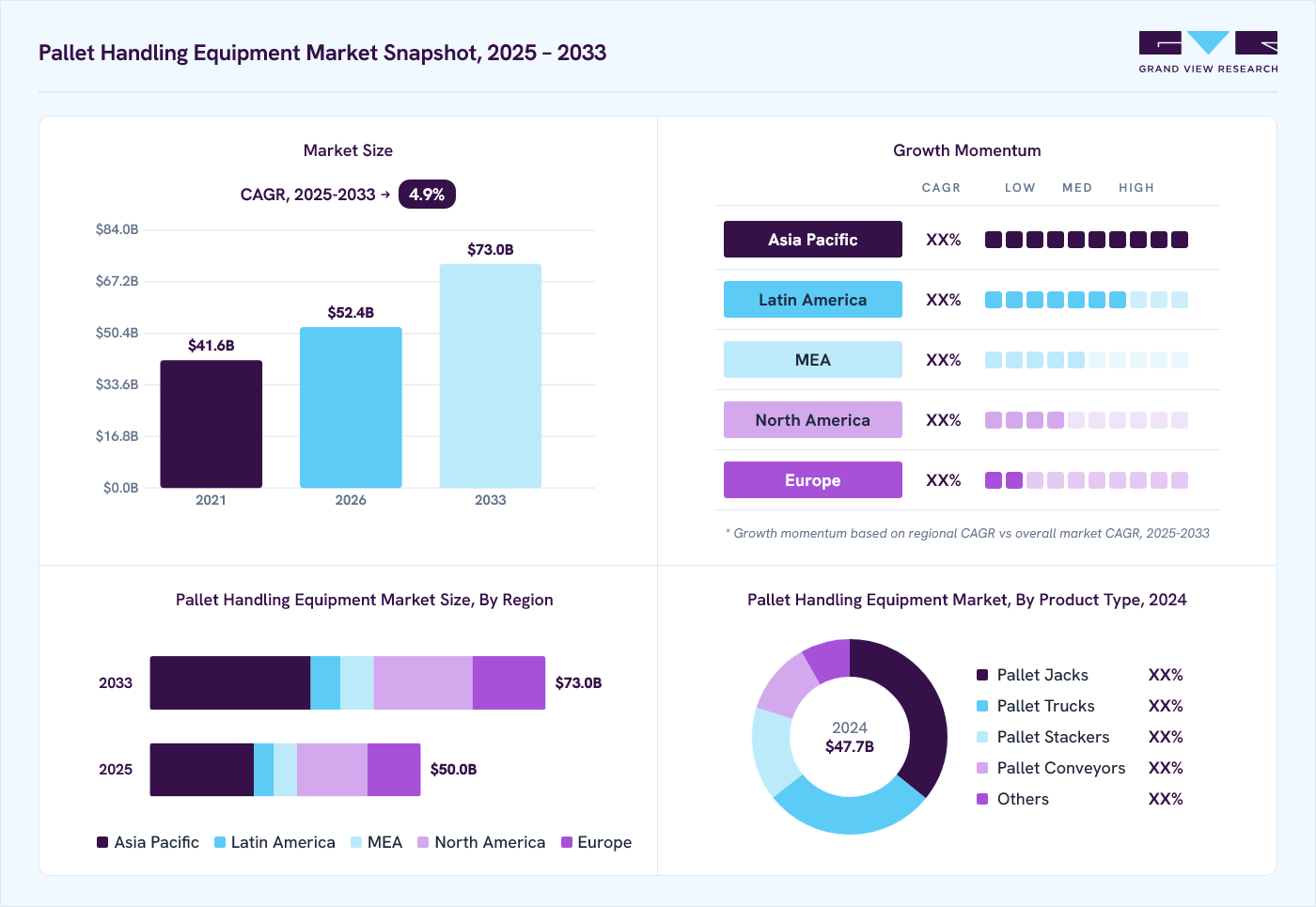
The global pallet handling equipment market size was valued at USD 47.7 billion in 2024 and is projected to grow from USD 52.4 billion in 2026 to USD 73.0 billion by 2033, at a CAGR of 4.9% from 2025 to 2033. Asia Pacific dominated the market, accounting for a revenue share of 38.2% in 2024. The global pallet handling equipment market is primarily driven by the rapid growth of e-commerce and retail sectors, which demand efficient storage, retrieval, and movement of goods.
 Source: Grand View Research, IR Documents, Primary Interviews, Paid DatabasesTo learn more about this report,
 Download Free Sample Report
 Key Market Trends & Insights
- The China pallet handling equipment market dominates the Asia Pacific pallet handling equipment market.
- By product type, pallet jacks hold the dominant share in the pallet handling equipment market and accounted for a share of 35.8% in 2024.
- By automation level, manual pallet handling equipment continues to dominate the market and accounted for a share of 52.7% in 2024.
- By end use, the logistics and warehousing sector dominates the pallet handling equipment market and accounted for a share of 35.9% in 2024.
Market Size & Forecast
- 2024 Market Size: USD 47.7 Billion
- 2033 Projected Market Size: USD 73.0 Billion
- CAGR (2025-2033): 4.9%
- Asia Pacific: Largest market in 2024
Three ways to get this report
Buy it, customize it, or ask a question.Ask an Analyst
Analyst response in 1 business day
- AccessReport author, directly
- Reply timeWithin 1 working day
- No sales callDirect answer only
- FormatEmail reply
- CostFree, no cost
Get the Full Report
What the study covers
- FormatsPDF · Excel · Dashboard
- Timeline2025–2033 annual, 2024 base
- Coverage20+ countries, 5 regions
- Companies10+ key players profiled
Customize the Report
20% free customization
- IncludeCountries, segments, points
- TailorTo your product definition
- ExtendDeeper competitor detail
- OrA fully bespoke study
- Turnaround5–10 working days
Increasing warehouse automation initiatives and the need to optimize material flow are pushing industries toward advanced pallet conveyors, stackers, and automated storage systems. Another major driver is the expansion of manufacturing and logistics hubs across emerging economies, particularly in the Asia Pacific and Latin America. Industries such as food & beverage, pharmaceuticals, and automotive require efficient material handling to ensure safety, traceability, and compliance with global standards. Government investments in infrastructure, coupled with the rising demand for cold chain logistics, are also boosting equipment sales. Additionally, sustainability goals are prompting companies to adopt energy-efficient and electric pallet handling equipment, creating new growth opportunities worldwide.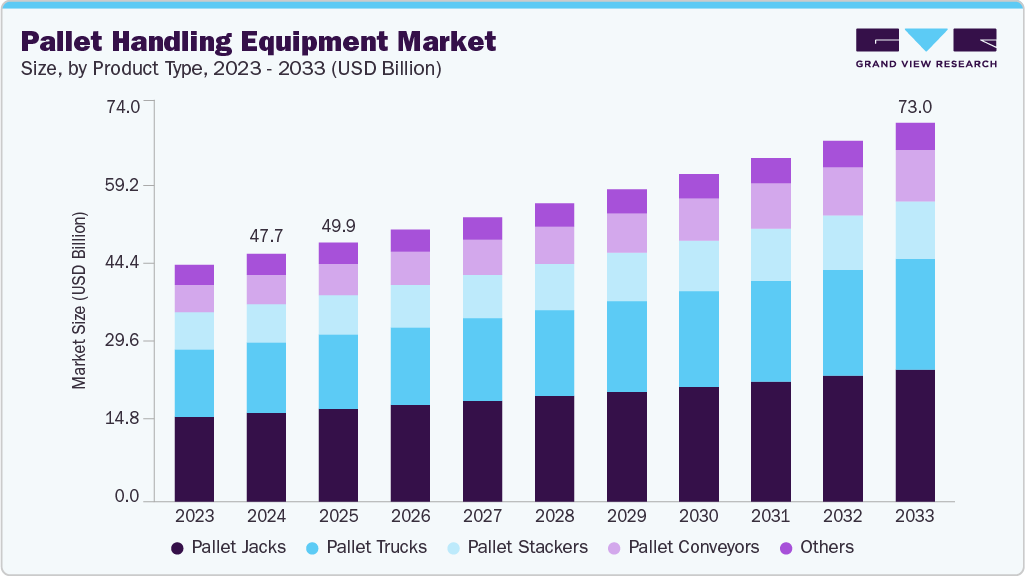 To learn more about this report, Download Free Sample Report
 Market Concentration & Characteristics
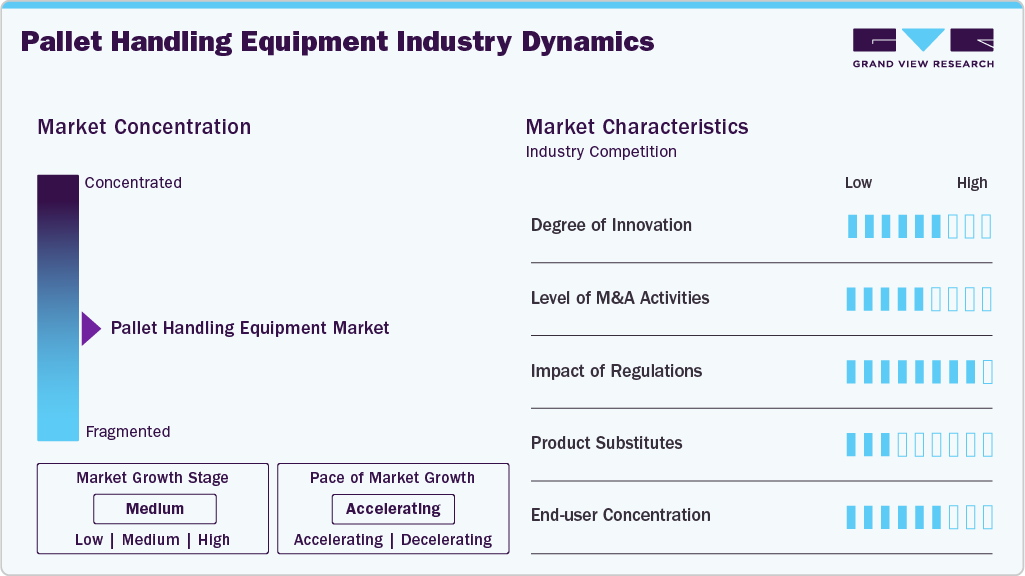
The global pallet handling equipment market is moderately fragmented, with a mix of global leaders and numerous regional players competing for market share. Large multinational companies dominate with advanced automation technologies, strong distribution networks, and wide product portfolios. At the same time, several small and mid-sized firms cater to niche demands, offering cost-effective or customized solutions. This competitive landscape fosters innovation but also creates pricing pressures across different regional markets.
The pallet handling equipment market shows a high degree of innovation, driven by the rise of automation and smart logistics. Companies are integrating IoT, robotics, and AI to improve efficiency, reduce downtime, and enable predictive maintenance. Energy-efficient electric systems are increasingly replacing traditional hydraulic units. Innovations are also focused on modular and customizable designs to meet diverse industry needs.
 To learn more about this report, Download Free Sample Report
 The market experiences a steady level of mergers and acquisitions as global players look to expand portfolios and strengthen geographic presence. Larger firms are acquiring niche technology providers to enhance automation capabilities. Regional consolidations are also common, helping companies improve supply chain networks. These activities aim to achieve economies of scale and stay competitive in a cost-sensitive market.
Regulations significantly influence the design and deployment of pallet handling equipment worldwide. Safety standards set by OSHA, ISO, and EU directives push manufacturers to adopt user-friendly and secure designs. Environmental rules encourage the shift toward electric and energy-efficient equipment over fossil fuel-based systems. Compliance with regional policies also impacts product certification and market accessibility.
Drivers, Opportunities & Restraints
The global pallet handling equipment market is driven by the expansion of warehousing and logistics operations worldwide. Growth in e-commerce, retail, and manufacturing sectors fuels demand for automated pallet movers, conveyors, and storage systems. Rising labor costs and workforce shortages are pushing companies toward automation. Additionally, the need for faster, safer, and more efficient material flow supports continuous equipment adoption.
Emerging economies present strong opportunities due to rapid industrialization and rising investments in logistics infrastructure. The push for sustainable operations creates demand for electric and energy-efficient pallet handling systems. Integration of IoT and robotics offers new avenues for smart, automated warehouses. Moreover, increasing cold chain demand in food and pharmaceuticals opens niche opportunities for specialized pallet solutions.
High upfront costs of advanced pallet handling equipment act as a key barrier for small and mid-sized enterprises. Integration challenges with existing warehouse systems further limit adoption in some regions. Fluctuations in raw material prices can increase production costs and impact margins. Additionally, economic slowdowns and trade disruptions may delay capital investments in warehouse automation.
Product Type Insights
Pallet jacks hold the dominant share in the pallet handling equipment market and accounted for a share of 35.8% in 2024, due to their low cost, ease of use, and wide applicability across warehouses and retail outlets. They are a preferred choice for short-distance material handling and smaller-scale operations. Manual and electric variants cater to both small businesses and large distribution centers. Their affordability and reliability continue to make them the most widely adopted equipment type.
Pallet conveyors are emerging as the fastest-growing product type, fueled by the rising demand for automation in large-scale warehouses and manufacturing plants. They enable seamless, continuous movement of goods, reducing manual intervention and boosting efficiency. Integration with robotics and IoT systems further enhances their appeal in smart logistics. The increasing focus on high-speed operations in e-commerce and industrial supply chains is accelerating their adoption.
Automation Level Insights
Manual pallet handling equipment continues to dominate the market and accounted for a share of 52.7% in 2024, due to its simplicity, low cost, and ease of operation. Small and medium-sized warehouses often prefer manual solutions for short-distance transport and low-volume operations. Minimal maintenance requirements and quick deployment make them practical for businesses with limited budgets. Their widespread availability and reliability contribute to their continued dominance.
Automatic pallet handling systems are the fastest-growing segment, driven by the increasing adoption of warehouse automation and smart logistics. These systems improve efficiency, reduce labor dependency, and enable 24/7 operations with minimal human intervention. Integration with robotics, IoT, and warehouse management software enhances operational accuracy. Rising e-commerce demand and large-scale industrial applications are accelerating the shift toward automated solutions.
End Use Insights
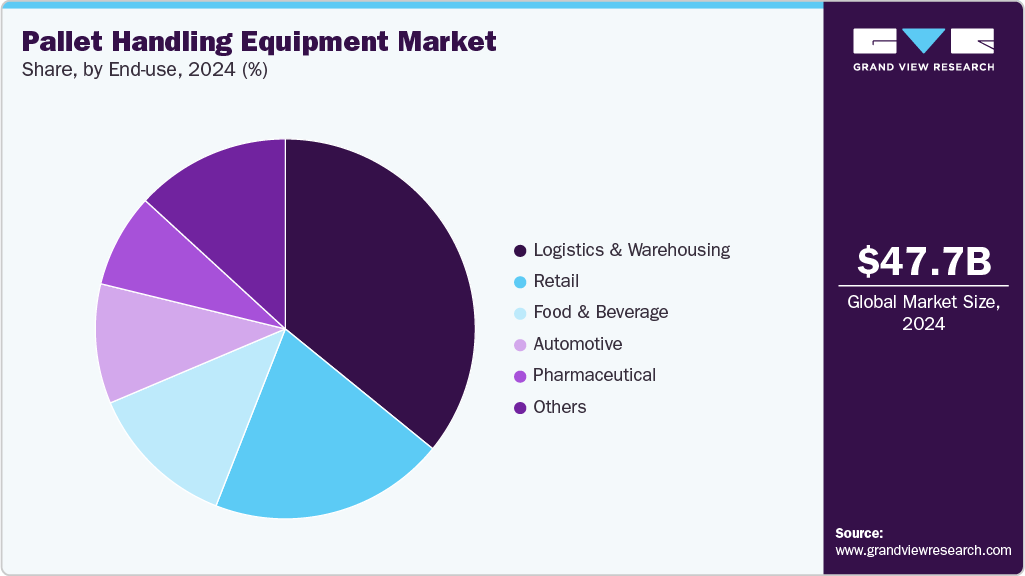
The retail segment is expected to grow at a significant CAGR of 5.2% from 2025 to 2033 in terms of revenue. The logistics and warehousing sector dominates the pallet handling equipment market and accounted for a share of 35.9% in 2024, due to the large volume of goods that need efficient storage and movement. High demand for automated storage and retrieval systems in distribution centers supports continued adoption. The focus on reducing turnaround time and labor costs drives investments in conveyors, stackers, and pallet jacks. Growing global trade and e-commerce further strengthen this sector’s leading position.
 To learn more about this report, Download Free Sample Report
 The retail sector is experiencing significant growth in pallet handling equipment adoption, driven by expanding store networks and omnichannel fulfillment requirements. Efficient in-store material movement and quick replenishment are key factors boosting demand. Smaller, electric, and automated systems are increasingly preferred to optimize labor and enhance safety. The rise of e-commerce-linked retail operations is accelerating the need for advanced pallet solutions in this sector.
Regional Insights
North America is growing at significant CAGR of 4.4% in the pallet handling equipment market due to advanced warehouse automation and robust e-commerce expansion. Companies are investing in robotics, conveyors, and automated storage systems to optimize supply chains. High labor costs and stringent safety regulations encourage the adoption of automated solutions. Continuous innovation in smart logistics solutions is enhancing operational efficiency across the region.
U.S. Pallet Handling Equipment Market Trends
The U.S. dominates the North American pallet handling equipment market due to its advanced logistics infrastructure and high e-commerce penetration. Large-scale warehouses and distribution centers drive demand for automated conveyors, stackers, and pallet jacks. Rising labor costs encourage the adoption of automation solutions to improve efficiency. Technological innovations and integration of IoT and robotics further strengthen the market position.
The Canada pallet handling equipment market is experiencing steady growth in pallet handling equipment, fueled by increasing investments in modern warehouses and industrial facilities. The retail and manufacturing sectors are adopting automated solutions to optimize material flow and reduce labor dependency. E-commerce expansion also boosts demand for efficient storage and retrieval systems. Government support for infrastructure development accelerates the adoption of advanced pallet handling technologies.
Europe Pallet Handling Equipment Market Trends
Europe’s market growth is driven by the modernization of warehouses and the adoption of energy-efficient and automated pallet handling systems. Strong emphasis on sustainability and regulatory compliance influences equipment design and deployment. Retail and manufacturing sectors increasingly rely on automation to meet demand fluctuations. Technological advancements and investments in Industry 4.0 solutions further accelerate market adoption.
The Germany pallet handling equipment market dominates the European pallet handling equipment market due to its strong industrial base and advanced logistics infrastructure. High demand from automotive, manufacturing, and e-commerce sectors drives investments in automated and manual pallet systems. Emphasis on efficiency, safety, and sustainability encourages adoption of energy-efficient and smart solutions. Continuous technological advancements support Germany’s leading position in the region.
The pallet handling equipment market in France is witnessing growth in pallet handling equipment, fueled by warehouse modernization and expanding retail and e-commerce operations. Companies are increasingly adopting automation to improve material flow and reduce labor costs. Focus on regulatory compliance and sustainability influences equipment selection. Rising investments in distribution centers and industrial facilities accelerate market adoption across the country.
Asia Pacific Pallet Handling Equipment Market Trends
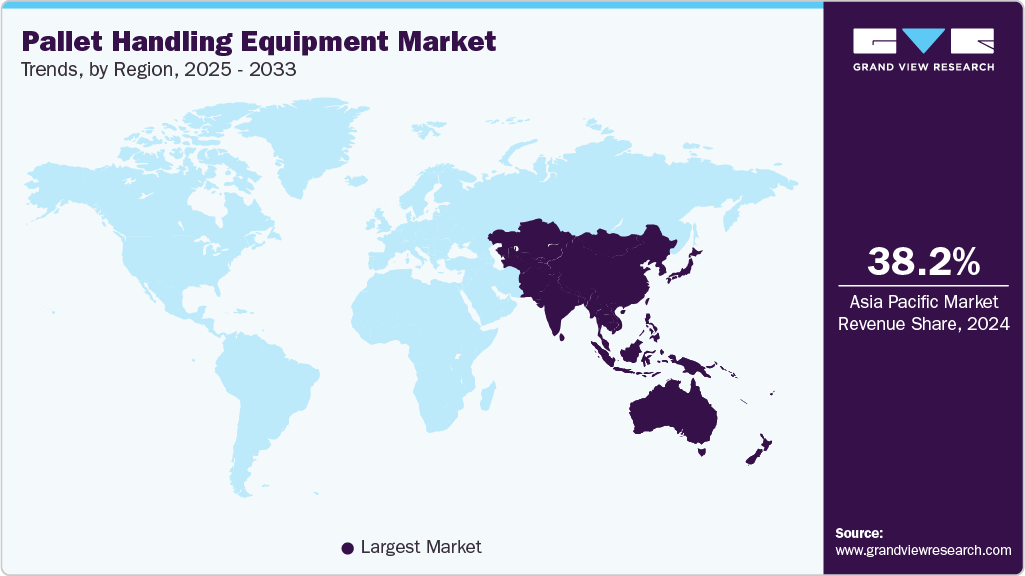
Asia Pacific is a dominant market and accounted for the 38.2% share, owing to rapid industrialization, expanding manufacturing hubs, and growing e-commerce activities. Rising investments in modern warehouses and logistics infrastructure further support market growth. Countries like China, India, and Japan are adopting automation to improve efficiency and reduce labor dependency. The large population base and increasing consumer demand also drive the need for advanced pallet solutions.
 To learn more about this report, Download Free Sample Report
 The China pallet handling equipment market dominates the Asia Pacific pallet handling equipment market due to its large manufacturing sector and rapidly expanding e-commerce industry. High demand for automated warehouses and logistics solutions drives the adoption of conveyors, stackers, and pallet jacks. Government initiatives supporting industrial modernization further boost market growth. Rising labor costs and focus on operational efficiency accelerate the shift toward automated systems.
The pallet handling equipment market in India is experiencing significant growth in pallet handling equipment, driven by expanding warehousing and logistics infrastructure. The rise of e-commerce and organized retail sectors increases demand for efficient material handling solutions. Companies are gradually adopting automated and semi-automated systems to optimize operations. Investments in industrial parks and supply chain modernization further support market expansion.
Middle East & Africa Pallet Handling Equipment Market Trends
The Middle East and Africa market is growing steadily with rising investments in logistics, warehousing, and industrial infrastructure. Expansion of e-commerce and retail distribution networks is increasing demand for pallet handling equipment. Automation adoption is gradually rising to improve operational efficiency and reduce labor dependency. Government initiatives to enhance trade and industrial hubs further support market growth in the region.
The Saudi Arabia pallet handling equipment market is witnessing growth in pallet handling equipment due to expanding logistics and warehousing infrastructure across the country. Investments in industrial zones and e-commerce distribution centers are driving demand for automated and manual systems. Rising focus on efficiency, safety, and reducing labor dependency supports adoption. Government initiatives to modernize supply chains further accelerate market growth in the region.
Latin America Pallet Handling Equipment Market Trends
Latin America is experiencing growth in pallet handling equipment due to rising industrialization and the expansion of logistics and distribution centers. E-commerce penetration and increasing warehouse modernization projects boost demand for automated and manual systems. Growing retail and manufacturing activities are driving the need for efficient material handling. Regional investments in infrastructure development also support market expansion.
The Brazil pallet handling equipment market is experiencing growth in pallet handling equipment due to the expansion of warehousing and logistics networks across key industrial regions. Increasing e-commerce penetration and retail distribution demand efficient material handling solutions. Companies are adopting both manual and automated systems to improve operational efficiency. Investments in infrastructure development and modernization of supply chains further drive market adoption.
Key Pallet Handling Equipment Company Insights
Some of the key players operating in the market include KION Group AG, Toyota Industries Corporation, Jungheinrich AG.
-
KION Group AG specializes in advanced industrial trucks, warehouse automation, and supply chain solutions, focusing on pallet handling and intralogistics. Its portfolio includes forklifts, automated guided vehicles, and pallet shuttle systems designed for high efficiency and scalability. The company emphasizes modular plug-and-play solutions to optimize warehouse operations. Strategic partnerships, such as with Eurofork, strengthen its presence in EMEA and support innovative automation adoption.
-
Toyota Industries Corporation offers a wide range of pallet handling equipment, including electric forklifts, pallet jacks, and automated warehouse solutions. The company focuses on energy-efficient, eco-friendly models that improve operational efficiency and reduce environmental impact. Advanced electric and pneumatic forklifts cater to both light and heavy-duty applications. Toyota continually integrates smart technologies to enhance safety, uptime, and warehouse productivity worldwide.
Key Pallet Handling Equipment Companies:
The following are the leading companies in the pallet handling equipment market. These companies collectively hold the largest market share and dictate industry trends.
- KION Group AG
- Toyota Industries Corporation
- Jungheinrich AG
- Crown Equipment Corporation
- Hyster-Yale Materials Handling, Inc.
- Mitsubishi Logisnext Co., Ltd.
- Komatsu Ltd.
- Doosan Corporation
- Clark Material Handling Company
- Hangcha Group Co., Ltd.
- Anhui Heli Co., Ltd.
- Godrej & Boyce Manufacturing Company Limited
- Hyundai Heavy Industries Co., Ltd.
- NACCO Industries, Inc.
- Raymond Corporation
Recent Developments
-
In January 2025, Toyota Material Handling has expanded its pallet handling portfolio with eco-friendly electric forklifts, including upgraded Core Electric models and mid-to-large electric pneumatic forklifts. These models enhance operational efficiency, support sustainability, and handle heavy loads efficiently. Their adoption reflects the growing trend of automation and energy-efficient solutions in warehouses and logistics. This development highlights Toyota’s focus on innovation in the global pallet handling equipment market.
-
In May 2024, KION Group has partnered with Eurofork S.p.A. to distribute the E4CUBE pallet shuttle system across the EMEA region. The modular plug-and-play system can be deployed quickly and improves warehouse automation. It enhances safety, ensures traceability, and supports high throughput. This solution caters to a variety of warehouse operations efficiently.
Pallet Handling Equipment Market Report Scope
Report Attribute
Details
Market size in 2024
USD 47.7 billion
Estimated Market size in 2026
USD 52.4 billion
Projected Market size by 2033
USD 73.0 billion
Growth rate
CAGR of 4.9% from 2025 to 2033
Historical data
2021 - 2023
Forecast period
2025 - 2033
Quantitative units
Revenue in USD million and CAGR from 2025 to 2033
Report coverage
Revenue forecast, company ranking, competitive landscape, growth factors, and trends
Segments covered
Product type, automation level, end use, region.
Regional scope
North America; Europe; Asia Pacific; Latin America; Middle East & Africa
Country scope
U.S.; Canada; Mexico; UK; Germany; France; Spain; Italy; China; Japan; India; Australia; South Korea; Brazil; Argentina; Saudi Arabia; South Africa; UAE
Key companies profiled
KION Group AG; Toyota Industries Corporation; Jungheinrich AG; Crown Equipment Corporation; Hyster-Yale Materials Handling, Inc.; Mitsubishi Logisnext Co., Ltd.; Komatsu Ltd.; Doosan Corporation; Clark Material Handling Company; Hangcha Group Co., Ltd.; Anhui Heli Co., Ltd.; Godrej & Boyce Manufacturing Company Limited; Hyundai Heavy Industries Co., Ltd.; NACCO Industries, Inc.; Raymond Corporation
Customization scope
Free report customization (equivalent up to 8 analysts working days) with purchase. Addition or alteration to country, regional & segment scope.
Pricing and purchase options
Avail customized purchase options to meet your exact research needs. Explore purchase options
Global Pallet Handling Equipment Market Report Segmentation
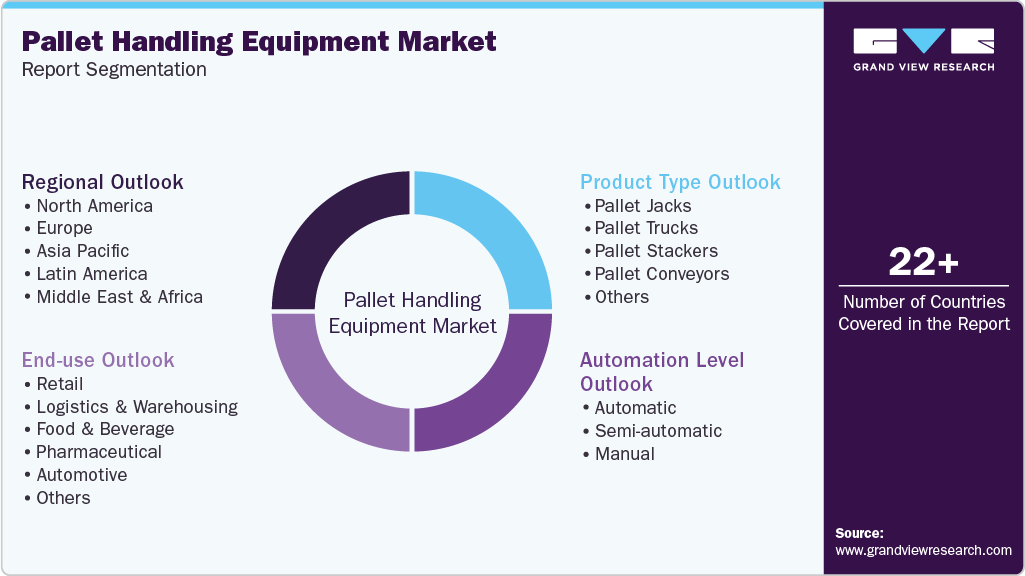
This report forecasts revenue growth at global, regional, and country levels and provides an analysis of the latest industry trends in each of the sub-segments from 2021 to 2033. For this study, Grand View Research has segmented the global pallet handling equipment market report based on product type,automation level, end use and region.
 To learn more about this report, Download Free Sample Report
 -
Product Type Outlook (Revenue, USD Million, 2021 - 2033)
-
Pallet Jacks
-
Pallet Trucks
-
Pallet Stackers
-
Pallet Conveyors
-
Others
-
-
Automation Level Outlook (Revenue, USD Million, 2021 - 2033)
-
Automatic
-
Semi-automatic
-
Manual
-
-
End Use Outlook (Revenue, USD Million, 2021 - 2033)
-
Retail
-
Logistics & Warehousing
-
Food & Beverage
-
Pharmaceutical
-
Automotive
-
Others
-
-
Regional Outlook (Revenue, USD Million, 2021 - 2033)
-
North America
-
U.S.
-
Canada
-
Mexico
-
-
Europe
-
Germany
-
France
-
Italy
-
Spain
-
UK
-
-
Asia Pacific
-
China
-
India
-
Japan
-
South Korea
-
Australia
-
-
Latin America
-
Brazil
-
Argentina
-
-
Middle East and Africa
-
Saudi Arabia
-
UAE
-
South Africa
-
-
Frequently Asked Questions About This Report
The global pallet handling equipment market size was valued at USD 47.7 billion in 2024 and is estimated at USD 52.4 billion for 2026.
The global pallet handling equipment market is expected to grow at a CAGR of 4.9% from 2025 to 2030, reaching USD 73.0 billion by 2033.
Manual pallet handling equipment continues to dominate the market and accounted for a share of 52.7% in 2024, due to its simplicity, low cost, and ease of operation. Small and medium-sized warehouses often prefer manual solutions for short-distance transport and low-volume operations. Minimal maintenance requirements and quick deployment make them practical for businesses with limited budgets.
Some of the key players operating in the global pallet handling equipment market include KION Group AG, Toyota Industries Corporation, Jungheinrich AG, Crown Equipment Corporation, Hyster-Yale Materials Handling, Inc., Mitsubishi Logisnext Co., Ltd., Komatsu Ltd., Doosan Corporation, Clark Material Handling Company, Hangcha Group Co., Ltd., Anhui Heli Co., Ltd., Godrej & Boyce Manufacturing Company Limited, Hyundai Heavy Industries Co., Ltd., NACCO Industries, Inc., Raymond Corporation.
The global pallet handling equipment market is driven by the rapid growth of e-commerce, which increases demand for efficient warehousing and distribution. Advances in automation and robotics improve efficiency and reduce labor costs. Greater focus on workplace safety and ergonomics also supports adoption of modern pallet handling solutions.
About the Author(s)
Advanced Interior Materials Research Team
Advanced Materials · Advanced Interior MaterialsThis report was authored by the advanced interior materials research team at Grand View Research - comprising two research analysts, one senior research analyst, and one industry expert - with specialized expertise in the advanced interior materials segment of the advanced materials industry. All findings are based on proprietary advanced materials databases, executive interviews, and regulatory analysis, subject to internal peer review prior to publication.
Last Updated:
Speak to Analyst

Customize this report to your needs - add regions, segments, or data points, with 20% free customization.
Or view our licence options:


ISO 9001:2015 & 27001:2022 Certified
We are GDPR and CCPA compliant! Your transaction & personal information is safe and secure. For more details, please read our privacy policy.


