
- Home
- »
- Advanced Interior Materials
- »
-
Paramagnet Market Size, Share & Trends Report, 2026-2033GVR Report cover
![Paramagnet Market (2026 - 2033)Report]()
Paramagnet Market (2026 - 2033)
Size, Share & Trends Analysis Report By End Use (Medical & Healthcare, Research & Laboratory, Electronics & Sensors, Chemical & Industrial), By Material (Gadolinium, Manganese, Copper), By Region, And Segment Forecasts
Market Size, 2025
$3.3BMarket Estimate, 2026
$3.5BMarket Forecast, 2033
$5.3BCAGR, 2026–2033
6.2%Paramagnet Market Summary
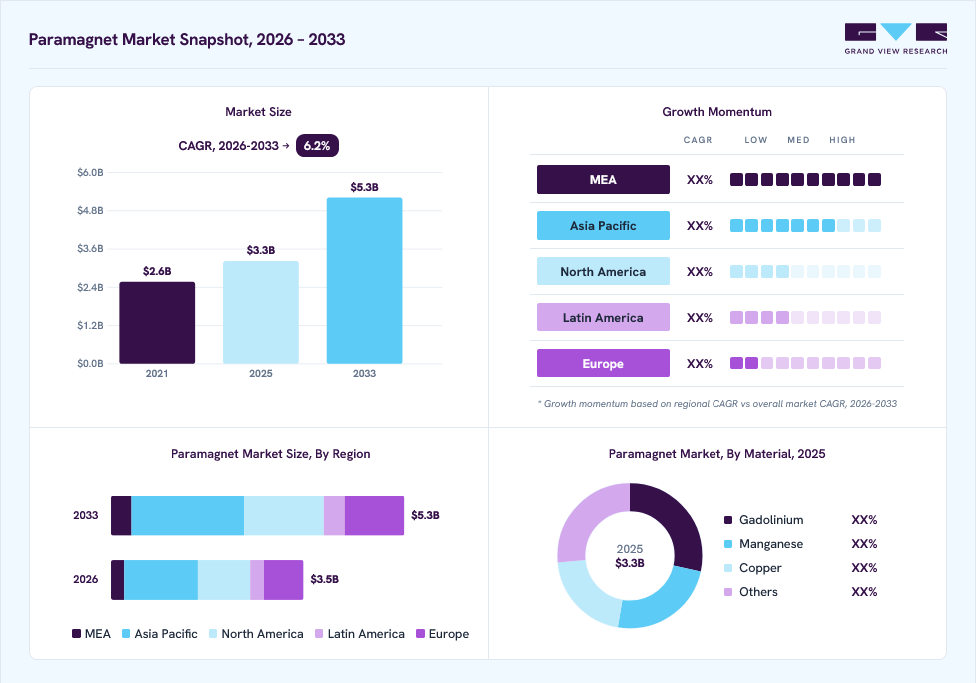
The global paramagnet market size was valued at USD 3.3 billion in 2025 and is projected to grow from USD 3.5 billion in 2026 to USD 5.3 billion by 2033, at a CAGR of 6.2% from 2026 to 2033. Asia Pacific dominated the market, accounting for the largest revenue share of 38.2% in 2025. The growing demand for MRI procedures is driving the use of paramagnetic materials, particularly gadolinium-based contrast agents, which enhance image quality to support the diagnosis of neurological, cardiovascular, and oncological conditions across healthcare facilities.
Key Market Trends & Insights
- By end use: The medical & healthcare segment accounted for the largest market revenue share of 36.5% in 2025.
- By material: The gadolinium segment accounted for the largest market revenue share of 28.4% in 2025.
Regional Highlights
- Largest regional market: Asia Pacific (38.2% revenue share, 2025)
- Fastest-growing regional market: Middle East & Africa (highest CAGR, 2026-2033)
- By country: South Korea held the largest market share in 2025.
Market Size & Forecast
- Market size in 2025: USD 3.3 Billion
- Estimated market size in 2026: USD 3.5 Billion
- Projected market size by 2033: USD 5.3 Billion
- CAGR (2026-2033): 6.2%
The expansion of advanced diagnostic technologies is further supporting market growth as healthcare providers increasingly focus on early disease detection and accurate imaging. Paramagnetic compounds are being developed for enhanced contrast, targeted imaging, and specialized diagnostic applications, driving additional demand.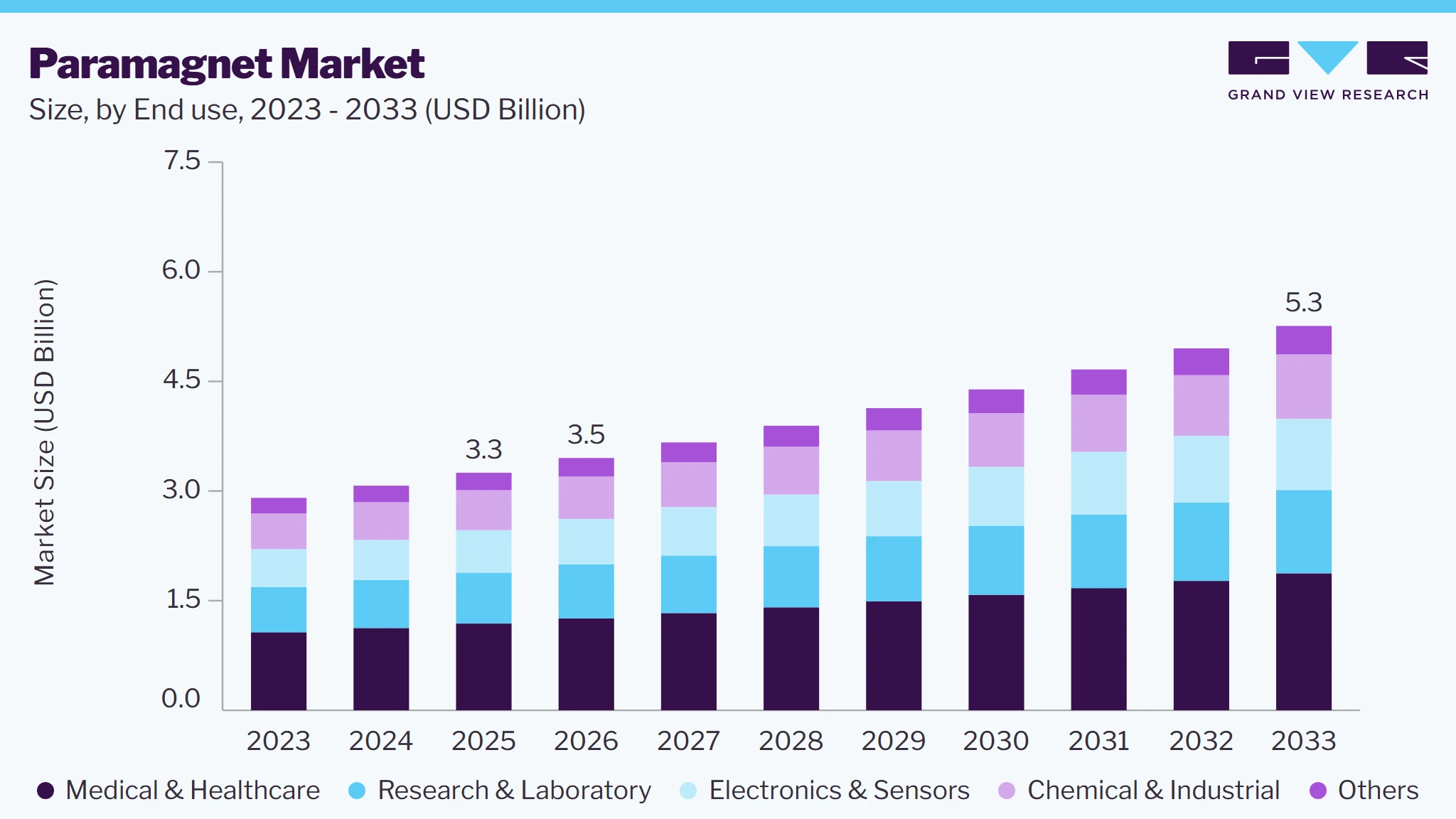
Increasing adoption of sensors and advanced electronic technologies is creating opportunities for paramagnetic materials in specialized applications. Their magnetic properties enable their use in magnetic field sensing, chemical detection, oxygen sensing, and other technologies, supporting demand from electronics and industrial sectors.
Rising research and development activities across materials science, chemistry, biotechnology, and magnetic resonance are contributing to market expansion. Paramagnetic materials are widely used in electron paramagnetic resonance studies, spin labeling, magnetic characterization, and the development of advanced functional materials.
Continuous development of advanced paramagnetic compounds and nanomaterials is expanding their application potential. Improvements in magnetic performance, stability, sensitivity, and biocompatibility are enabling their use across medical imaging, laboratory research, sensing, and specialized industrial applications.
Market Dynamics
The increasing use of paramagnetic materials in medical imaging is driving market growth, particularly through their application in MRI contrast agents and specialized diagnostic technologies. Rising healthcare expenditure, increasing demand for advanced diagnostic procedures, and expansion of imaging infrastructure are supporting the consumption of paramagnetic materials such as gadolinium-based compounds.
Growing applications in electronics, sensors, research instruments, and chemical processing are further supporting demand. Paramagnetic materials offer distinctive magnetic properties that enable their use in magnetic sensors, scientific equipment, catalysts, and specialized electronic components. Continued development of advanced materials and increasing research activities are expected to broaden their application base.
The market faces challenges due to the high costs of extracting, processing, and purifying certain rare-earth-based materials. Regulatory and environmental requirements related to mining and chemical processing can further increase production costs. Concerns about the safe use and disposal of certain paramagnetic compounds, particularly in medical applications, may also limit adoption in some segments.
The growing adoption of advanced MRI technologies, magnetic sensors, analytical instruments, and research applications presents significant opportunities for the paramagnet market. Increasing investment in healthcare infrastructure and scientific research is encouraging the development of high purity and application specific paramagnetic materials. Advances in material engineering and safer formulations can further expand their use across medical, electronic, and industrial applications.
Analyst Perspective
The paramagnet market is expected to see steady growth as demand for materials with controlled magnetic properties increases across medical imaging, electronics, sensors, research, and specialized industrial applications. Gadolinium-, manganese-, and copper-based paramagnetic materials are gaining attention for their useful magnetic behavior, thermal properties, and suitability for advanced material applications. Growing investment in MRI systems, magnetic sensing technologies, electronic components, scientific research, and high-performance materials is creating new opportunities for market expansion.
End Use Insights
The medical & healthcare segment held the revenue share of 36.5% in 2025. Paramagnetic substances such as gadolinium compounds are widely used in MRI contrast agents to improve image clarity and support the detection of tumors, vascular abnormalities, and other conditions. Growing demand for advanced diagnostic imaging, rising healthcare expenditure, increasing availability of MRI systems, and greater emphasis on early disease detection are driving the consumption of paramagnetic materials.
The electronics and sensors segment is expected to see strong growth in the market, driven by rising demand for advanced sensing, data storage, magnetic detection, and electronic components. Paramagnetic materials are used in specialized sensors and electronic devices where their magnetic susceptibility and response to external magnetic fields enable precise detection and measurement. The growing adoption of automation, Internet of Things devices, industrial monitoring systems, and advanced electronics is creating demand for high-sensitivity magnetic sensing technologies.
Material Insights
The gadolinium segment held the revenue share of 28.4% in 2025 due to its high magnetic susceptibility and distinctive paramagnetic properties, which make it valuable across medical imaging, research, electronics, and specialized industrial applications. Gadolinium compounds are widely used in MRI contrast agents to enhance image quality, while gadolinium based materials are increasingly studied for magnetic sensors, magnetocaloric technologies, and advanced functional materials.
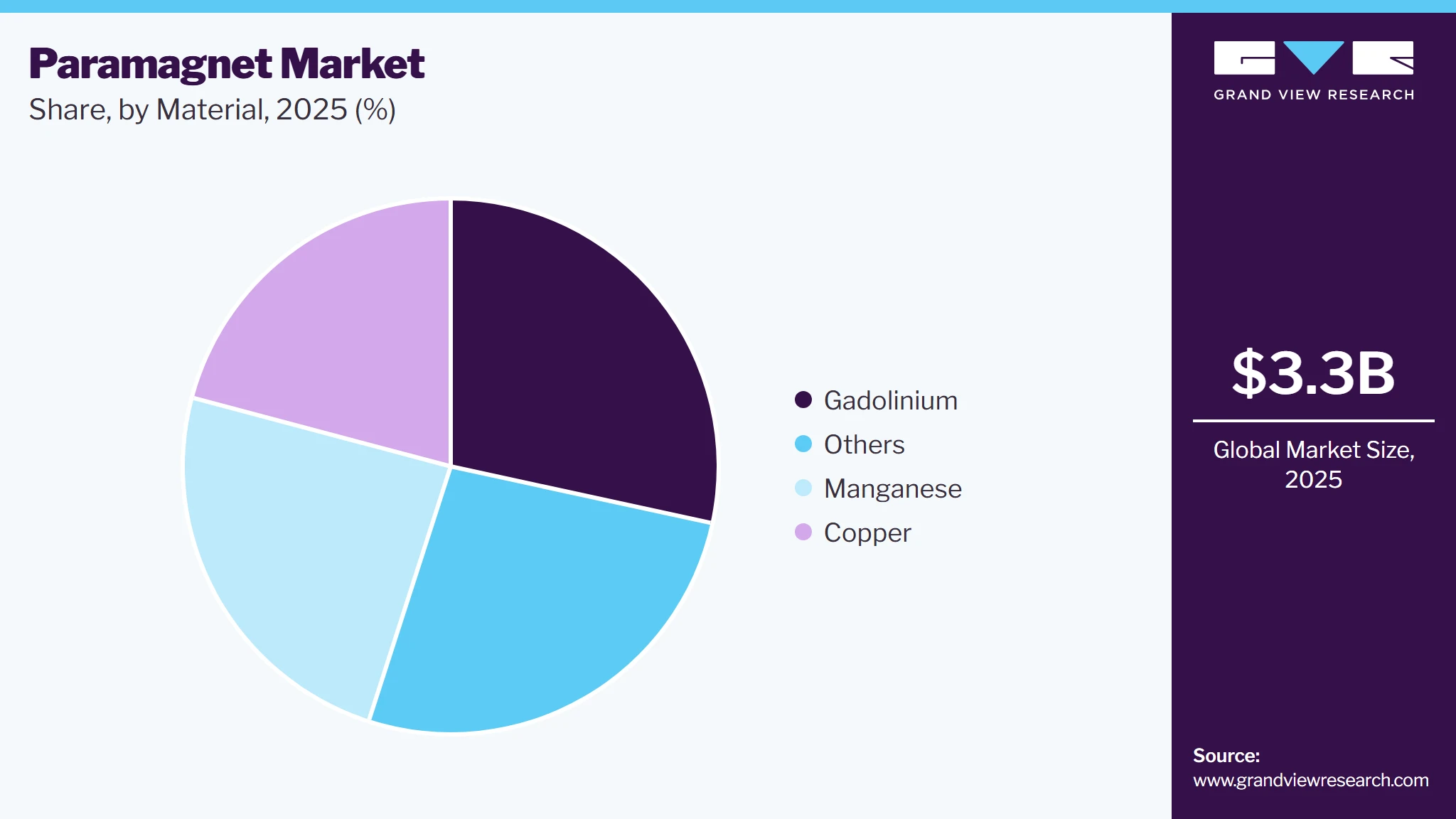
The copper segment is expected to see steady growth in the market, driven by the use of copper and copper-based compounds in electronics, sensors, chemical processing, and research applications. Copper exhibits paramagnetic behavior in certain forms and oxidation states, while copper-based materials can provide useful magnetic, electrical, and chemical properties for specialized applications.
Regional Insights
Asia Pacific accounted for the largest market revenue share of 38.2% in 2025. China, Japan, South Korea, and India are major markets for paramagnetic materials such as gadolinium, manganese, and copper compounds, which are used in medical imaging, sensors, analytical instruments, catalysts, and advanced materials. China benefits from its extensive rare earth processing and electronics manufacturing capabilities, while Japan and South Korea have strong demand from precision electronics, sensors, and research applications. India is witnessing increasing adoption due to investments in medical imaging infrastructure, pharmaceuticals, laboratories, and advanced manufacturing.

China Paramagnet Market Trends
China represents a major market for these materials due to its strong rare earth processing capabilities, large electronics industry, and expanding healthcare infrastructure. Gadolinium-based materials are widely used in MRI contrast applications, while manganese- and copper-based paramagnetic materials support applications in electronics, sensors, catalysts, research, and specialty chemicals.
Europe Paramagnet Market Trends
Europe is a technologically advanced market, supported by established medical imaging, pharmaceutical, electronics, chemical, and research industries. Germany, France, the UK, Italy, and the Nordic countries contribute significantly to demand through applications involving MRI contrast agents, sensors, analytical instruments, catalysts, and specialty materials.
North America Paramagnet Market Trends
North America is witnessing steady growth in the market due to strong demand from medical imaging, healthcare, electronics, research laboratories, and specialty chemical industries. The U.S. accounts for a major share of regional consumption because of its extensive MRI infrastructure, advanced research facilities, and established technology sector. Paramagnetic materials are used in MRI contrast applications, sensors, analytical instruments, chemical processes, and advanced material research.
The U.S. paramagnetic market is the largest market for paramagnetic materials in North America, driven by its advanced healthcare infrastructure, extensive MRI installations, electronics industry, and strong research ecosystem. Gadolinium-based materials are particularly important for medical imaging applications, while manganese- and copper-based materials are used in sensors, electronics, chemical processing, and laboratory research.
Middle East & Africa Paramagnet Market Trends
The Middle East & Africa market is developing gradually, supported by healthcare modernization, increasing adoption of diagnostic imaging, and expanding research and industrial capabilities. Saudi Arabia and the UAE are investing in advanced hospitals and diagnostic infrastructure, increasing demand for MRI-related paramagnetic materials. South Africa contributes through its established healthcare, research, mining, and industrial sectors.
Key Paramagnet Company Insights
Some of the key players operating in the market include American Elements, Eastmen Chemicals, and others
-
American Elements is a global manufacturer and supplier of advanced materials, specialty chemicals, and high-purity elemental materials serving research, industrial, electronics, and other technology-intensive applications. In the paramagnetic market, the company offers a broad portfolio of paramagnetic elements and related compounds, including gadolinium, manganese, copper, cobalt, iron, and various rare earth materials in forms such as powders, pellets, granules, sheets, plates, single crystals, and other specialized formats.
-
Eastmen Chemicals is an India-based manufacturer and exporter of high-purity metallic salts, established in 1971, with manufacturing facilities in Tarapur, Maharashtra. The company specializes in high-purity salts of cobalt, copper, iron, manganese, nickel, and zinc and exports its products to more than 25 countries. In the paramagnetic market, its offerings are primarily relevant to manganese, copper, cobalt, and iron-based compounds.
Key Paramagnet Companies:
The following key companies have been profiled for this study on the paramagnet market.
-
American Elements
-
Eastmen Chemicals
-
Ereztech
-
Goodfellow
-
Merck
-
Mitsuya Co., Ltd.
-
Stanford Advanced Materials
-
Strem Chemicals
-
Thermo Fisher Scientific
-
Tokyo Chemical Industry
Competitive Benchmarking
Category
Operating Strategies
Competitive Edge
Weakness
Established Players (e.g. Thermo Fisher Scientific, Merck)
- Mature participants in the paramagnet market primarily focus on the production and supply of high purity paramagnetic materials, compounds, powders, and specialty formulations for medical and healthcare, electronics and sensors, research and laboratory, and chemical and industrial applications.
- Established players possess significant competitive advantages through advanced materials science expertise, established purification infrastructure, and extensive experience in producing high purity paramagnetic materials.
- Despite their strong market positions, mature players face challenges related to fluctuations in rare earth and specialty metal prices, energy costs, and the availability of high purity feedstock.
- Production of specialized paramagnetic materials often requires complex purification, controlled processing, and rigorous quality testing, increasing manufacturing costs.
Emerging & Regional Players (e.g., Ereztech, Eastmen Chemicals)
- Emerging participants in the paramagnet market generally focus on specialized high purity materials, customized formulations, and innovative applications in medical technology, electronics and sensors, research, magnetic technologies, and advanced industrial materials.
- Many emerging companies are investing in advanced purification, nanomaterial production, precision synthesis, surface modification, and digital material characterization technologies.
- Strategic collaborations with universities, research laboratories, medical technology companies, and electronics manufacturers help accelerate product development and market validation.
- Emerging companies benefit from operational flexibility and shorter product development cycles, allowing them to respond quickly to specialized customer requirements.
- Their relatively streamlined structures enable rapid development of customized paramagnetic materials with specific purity levels, particle characteristics, magnetic properties, and application performance.
Recent Development
-
In April 2025, Qruise announced the launch of Resonance, a simulation and control software platform designed to enhance magnetic resonance systems, including MRI, NMR, and electron paramagnetic resonance. The platform combines physics-based model learning, digital twins, and advanced optimization algorithms to improve pulse design, system performance, and robustness against magnetic field fluctuations and hardware imperfections.
Paramagnet Market Report Scope
Report Attribute
Details
Market Definition
Market size estimation represents the total revenue generated from the sale of paramagnetic materials for various end uses.
Market size in 2025
USD 3.3 billion
Estimated market size in 2026
USD 3.5 billion
Projected market size by 2033
USD 5.3 billion
Growth rate
CAGR of 6.2% from 2026 to 2033
Base year for estimation
2025
Historical data
2021 - 2024
Forecast period
2026 - 2033
Quantitative Units
Revenue in USD million/billion and CAGR from 2026 to 2033
Report coverage
Revenue forecast, competitive landscape, growth factors, and trends
Segments covered
End use, material, region
Regional scope
North America; Europe; Asia Pacific; Latin America; Middle East & Africa
Country scope
U.S.; Canada; Mexico; Germany; UK; France; Italy; China; India; Japan; South Korea; Brazil
Key companies profiled
Thermo Fisher Scientific; Merck; American Elements; Goodfellow; Tokyo Chemical Industry; Stanford Advanced Materials; Strem Chemicals; Ereztech; Eastmen Chemicals; Mitsuya Co., Ltd.
Customization scope
Free report customization (equivalent up to 8 analysts working days) with purchase. Addition or alteration to country, regional & segment scope.
Pricing and purchase options
Avail customized purchase options to meet your exact research needs. Explore purchase options
Global Paramagnet Market Report Segmentation
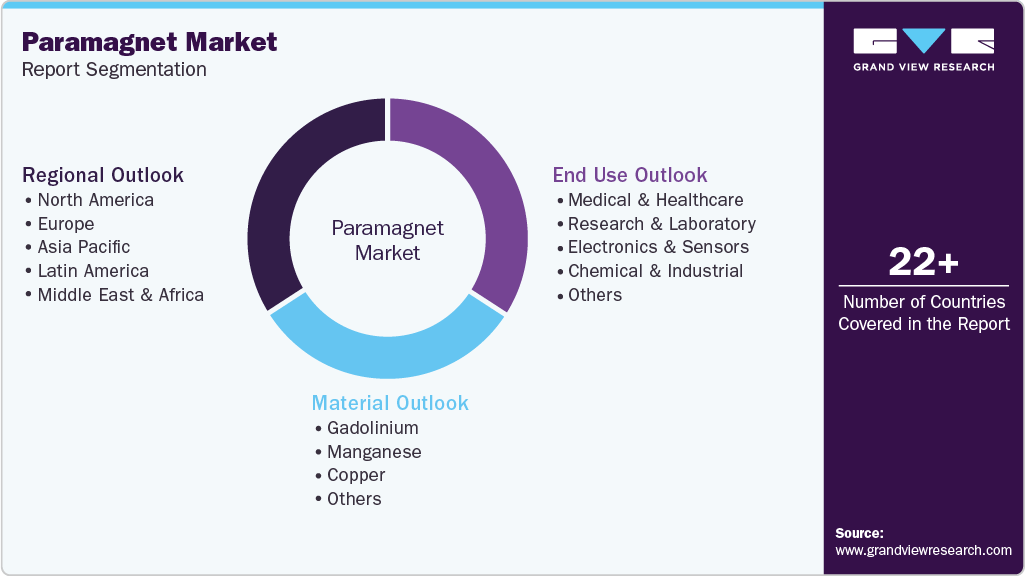
This report forecasts revenue growth at global, regional, and country levels and provides an analysis of the latest industry trends in each of the sub-segments from 2021 to 2033. For the purpose of this study, Grand View Research has segmented the global paramagnet market report on the basis of end use, material, and region.
-
End Use Outlook (Revenue, USD Billion, 2021 - 2033)
-
Medical & Healthcare
-
Research & Laboratory
-
Electronics & Sensors
-
Chemical & Industrial
-
Others
-
-
Material Outlook (Revenue, USD Billion, 2021 - 2033)
-
Gadolinium
-
Manganese
-
Copper
-
Others
-
-
Regional Outlook (Revenue, USD Billion, 2021 - 2033)
-
North America
-
U.S.
-
Canada
-
Mexico
-
-
Europe
-
Germany
-
UK
-
France
-
Italy
-
-
Asia Pacific
-
China
-
India
-
Japan
-
South Korea
-
-
Latin America
-
Brazil
-
-
Middle East & Africa
-
Research Methodology
The paramagnet market figures in this report are based on a proven research process that combines executive interviews with secondary research from proprietary databases, company filings, and recognized regulatory and institutional sources. Market size is built through value-chain sizing-reconciling supply-side and demand-side estimates-and triangulated with bottom-up and top-down approaches. Every estimate passes multiple levels of expert validation before publication, with each paramagnet segment quantified using the revenue-capture definitions in the table below.
Segment Definition
End Use
Revenue Capture Definition
Medical & Healthcare
The medical and healthcare segment captures revenue generated from paramagnetic materials and compounds used in MRI contrast agents, diagnostic technologies, biomedical research, and specialized medical devices.
Research & Laboratory
The research and laboratory segment represents revenue generated from paramagnetic materials used in spectroscopy, magnetic resonance studies, analytical instruments, chemical research, and laboratory experiments.
Electronics & Sensors
The electronics and sensors segment includes revenue generated from paramagnetic materials used in magnetic sensors, electronic components, spin based devices, signal detection systems, and specialized semiconductor applications.
Chemical & Industrial
The chemical and industrial segment captures revenue generated from paramagnetic materials used in catalysts, specialty chemicals, industrial formulations, magnetic separation, alloys, and material processing applications.
Others
The others segment represents revenue generated from paramagnetic materials used in applications such as aerospace, energy, environmental technologies, education, defense, and specialized manufacturing.
Material
Revenue Capture Definition
Gadolinium
The gadolinium segment captures revenue generated from gadolinium and its compounds used in paramagnetic applications, particularly MRI contrast agents, magnetic refrigeration, research materials, and specialized alloys.
Manganese
The manganese segment represents revenue generated from manganese based compounds and materials used in paramagnetic applications, including magnetic materials, research chemicals, sensors, catalysts, and specialized industrial products.
Copper
The copper segment includes revenue generated from copper and copper based compounds utilized in paramagnetic research, specialty chemicals, catalysts, sensors, and advanced material applications.
Others
The others segment captures revenue generated from other paramagnetic materials and compounds, including iron based materials, chromium, nickel compounds, rare earth elements, and specialty coordination compounds.
Estimation Model
Layer Name
Key Question
Description
Medical & Advanced Materials Demand Base Layer
What forms the demand base?
Identify global demand from major paramagnetic material consuming industries including medical & healthcare, research & laboratory, electronics & sensors, chemical processing, and advanced materials. Assess MRI and diagnostic imaging activity, scientific instrument production, sensor manufacturing, and industrial applications to establish the total addressable demand for paramagnetic materials.
Paramagnetic Material Application Penetration Layer
Where are paramagnetic materials utilized?
Estimate the penetration of paramagnetic materials across key applications including MRI contrast agents, magnetic resonance research, sensors, electronic components, magnetic separation, chemical processing, catalysts, and specialty materials. Analyze the adoption of gadolinium, manganese, copper, and other paramagnetic materials across end use industries and regions.
Paramagnetic Consumption Intensity Layer
How much paramagnetic material is consumed?
Analyze consumption intensity based on MRI procedure volumes, contrast agent requirements, research instrument production, sensor manufacturing, electronic component output, and industrial processing capacity. Evaluate material usage according to paramagnetic properties, concentration, purity, application requirements, and product specifications. Consumption intensity varies according to medical imaging activity, technological adoption, material composition, and performance requirements.
Revenue Layer
How is market revenue generated?
Market revenue is quantified through the sale of paramagnetic metals, compounds, materials, and specialized products. Revenue generation is driven by demand from medical & healthcare, research & laboratory, electronics & sensors, and chemical & industrial applications. Market value is influenced by raw material prices, material purity, processing costs, application specific formulations, production volumes, technological development, and regional supply demand dynamics.
Delivered Customizations
This report has been delivered with the following In-depth customizations
Client Request
Customization Delivered
Value Adds
Regional Segmentation
Detailed regional analysis of the paramagnet market across North America, Europe, Asia Pacific, Latin America, and Middle East & Africa. Included evaluation of paramagnetic material production, medical imaging infrastructure, research and laboratory activities, electronics and sensor manufacturing, chemical processing, specialty material production, and investments in advanced magnetic technologies.
Identified major production hubs, high growth consumption markets, and emerging application centers. Enabled strategic expansion planning based on medical imaging, electronics, research, and specialty material demand. Supported regional demand forecasting and supply chain optimization.
Opportunity Assessment
Identification of high growth opportunities across medical imaging, MRI related applications, magnetic sensors, electronics, scientific research, laboratory equipment, chemical processing, advanced materials, and specialty industrial applications.
Enabled prioritization of high return growth segments and emerging regional opportunities. Supported long term capacity expansion, product innovation, downstream integration, strategic partnerships, and business development initiatives aligned with healthcare, electronics, research, and advanced material applications.
Cross Segmentation
Comprehensive cross segmentation analysis by material, application, end use, and region, including gadolinium, manganese, copper, and other paramagnetic materials across medical and healthcare, electronics and sensors, research and laboratory, chemical and industrial, and other applications. Evaluated regional consumption patterns, magnetic properties, purity requirements, application specific specifications, technology adoption, and end use demand trends.
Enabled identification of the most attractive material and application combinations and high growth customer segments. Supported product portfolio optimization, customer targeting, capacity planning, and investment prioritization strategies.
Frequently Asked Questions About This Report
The global paramagnet market size was estimated at USD 3.3 billion in 2025 and is expected to reach USD 3.5 billion in 2026.
The global paramagnet market is expected to grow at a compound annual growth rate of 6.2% from 2026 to 2033 to reach USD 5.3 billion by 2033.
Asia Pacific dominated the market with revenue share of 38.2% in 2025.
Based on end use, medical & healthcare accounted for largest revenue share of 36.5% in 2025.
Gadolinium accounted for largest revenue share of 28.4% in 2025.
Some of the key players of the global paramagnet market are Thermo Fisher Scientific, Merck, American Elements, Goodfellow, Tokyo Chemical Industry, Stanford Advanced Materials, Strem Chemicals, Ereztech, Eastmen Chemicals, Mitsuya Co., Ltd., and others.
The key driver of growth in the global paramagnet market is the rising demand for paramagnetic materials in medical imaging, research, electronics, and industrial applications.
About the Author(s)
Advanced Interior Materials Research Team
Advanced Materials · Advanced Interior MaterialsThis report was authored by the advanced interior materials research team at Grand View Research - comprising two research analysts, one senior research analyst, and one industry expert - with specialized expertise in the advanced interior materials segment of the advanced materials industry. All findings are based on proprietary advanced materials databases, executive interviews, and regulatory analysis, subject to internal peer review prior to publication.
Last Updated:
Speak to Analyst


Customize this report to your needs — add regions, segments, or data points, with 20% free customization.
Or view our licence options:


ISO 9001:2015 & 27001:2022 Certified
We are GDPR and CCPA compliant! Your transaction & personal information is safe and secure. For more details, please read our privacy policy.


