
- Home
- »
- IT Services & Applications
- »
-
Partner Relationship Management Market Report, 2026-2033GVR Report cover
![Partner Relationship Management Market (2026 - 2033)Report]()
Partner Relationship Management Market (2026 - 2033)
Size, Share & Trends Analysis Report By Component (Software, Services), By Deployment (On-Premise, Cloud), By Organization Size, By Application, By Region, And Segment Forecasts
Market Size, 2025
$104.1BMarket Estimate, 2026
$116.2BMarket Forecast, 2033
$303.5BCAGR, 2026–2033
14.7%Partner Relationship Management Market Summary
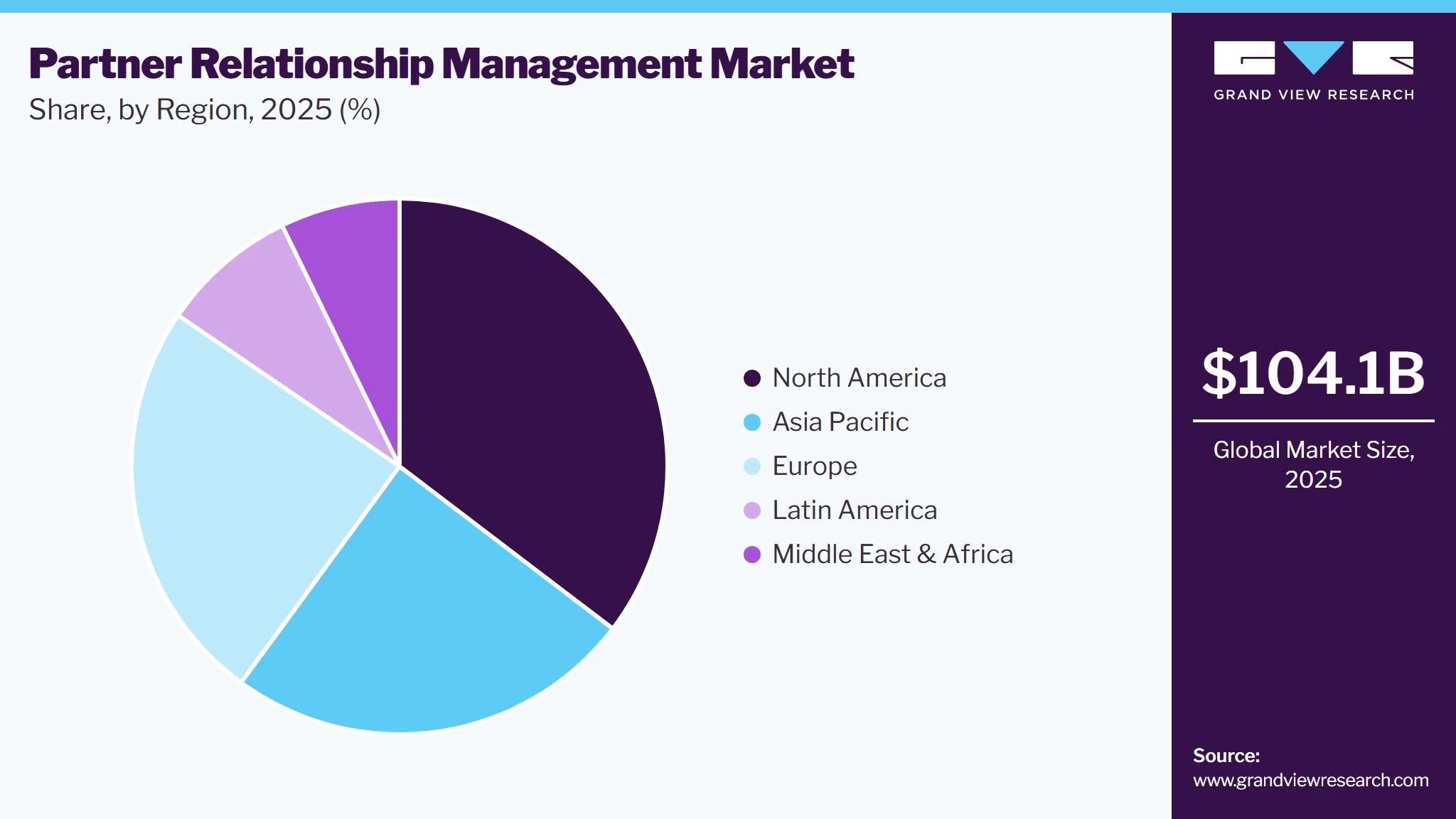
The global partner relationship management market size was valued at USD 104.1 billion in 2025 and is projected to grow from USD 116.2 billion in 2026 to USD 303.5 billion by 2033, at a CAGR of 14.7% from 2026 to 2033. The market in North America dominated with a revenue share of 35.4% in 2025. This growth is driven by increasing focus on channel partner engagement and indirect sales optimization.

Key Market Trends & Insights
- By component: Software segment dominated the market, with a revenue share of 60.7% in 2025
- By deployment: Cloud segment held the largest market share of 71.2% in 2025
- By organization size: Large enterprise segment held the largest market share of 63.9% in 2025
- By application: IT & telecom segment held the largest revenue share in 2025
Regional Highlights
- Largest regional market: North America (35.4% revenue share, 2025)
- Fastest-growing regional market: Asia Pacific (highest CAGR, 2026-2033)
- By country: The U.S. held the largest market share in 2025.
Market Size & Forecast
- Market size in 2025: USD 104.1 Billion
- Estimated market size in 2026: USD 116.2 Billion
- Projected market size by 2033: USD 303.5 Billion
- CAGR (2026-2033): 14.7%
Factors such as the growing emphasis on enhancing partner communications, controlling channel management costs, and improving operational efficiency contribute to market growth. In addition, the rise of digital transformation initiatives across various industries has led to heightened demand for innovative software solutions that facilitate collaboration and streamline processes between businesses and their partners.
The integration of advanced technologies, such as artificial intelligence (AI), machine learning, and big data analytics, enables organizations to optimize partner engagement and gain valuable insights into performance metrics. Furthermore, the increasing adoption of cloud-based solutions allows for greater flexibility and scalability, making it easier for businesses to implement effective partner relationship management (PRM) strategies. As companies prioritize data-driven decision-making, the demand for sophisticated tools that enhance partner collaboration is likely to rise. For instance, Oracle PRM offers a partner portal that enables channel managers and partners to collaborate effectively which allows users to manage leads, register deals, and create quotes seamlessly.
In addition, the ongoing shift toward remote and hybrid work environments have underscored the importance of maintaining strong relationships with partners in a digital landscape. Organizations leverage partner relationship management solutions to ensure seamless communication and collaboration among stakeholders, regardless of location. This trend is further supported by the growing recognition of the value of strategic partnerships in driving revenue growth and expanding market reach. As businesses navigate these evolving dynamics, the partner relationship management industry is positioned for continued expansion in the coming years.
Market Dynamics
The partner relationship management market is witnessing substantial growth as organizations increasingly focus on strengthening channel partner ecosystems, improving collaboration, and optimizing indirect sales performance. Companies across industries are adopting PRM platforms to streamline partner onboarding, training, lead management, incentive programs, deal registration, channel marketing, and performance tracking while enhancing communication with distributors, resellers, agents, and strategic partners. The growing shift toward channel-driven sales models, rising adoption of cloud-based business applications, increasing demand for partner engagement automation, and the integration of AI-driven analytics and collaboration tools are expected to continue driving market growth globally.
The increasing focus on channel partner engagement and indirect sales optimization is a significant driver of the partner relationship management market, as organizations seek to improve partner productivity, accelerate revenue generation, and strengthen collaboration across complex distribution networks. Businesses are deploying advanced PRM solutions that provide centralized partner portals, automated deal registration, partner training and certification, marketing development fund (MDF) management, incentive tracking, and AI-powered performance analytics. These capabilities help organizations improve partner satisfaction, increase channel visibility, reduce sales conflicts, and enhance overall operational efficiency. In addition, the growing adoption of data-driven partner engagement strategies enables companies to personalize partner experiences and optimize channel performance. As enterprises continue expanding their indirect sales channels across global markets, demand for intelligent PRM solutions is expected to increase significantly.
Integration complexity and partner adoption challenges represent a significant restraint in the Partner Relationship Management market because PRM platforms often need to integrate with existing enterprise systems such as customer relationship management (CRM), enterprise resource planning (ERP), marketing automation, and sales enablement platforms. Many organizations face difficulties in aligning workflows, synchronizing partner data, and ensuring seamless interoperability across multiple systems and partner networks. In addition, channel partners may resist adopting new PRM solutions due to training requirements, process changes, or concerns regarding usability and data transparency. These implementation and adoption challenges can lead to extended deployment timelines, increased operational costs, and slower return on investment, particularly for organizations managing large and geographically dispersed partner ecosystems.
The rapid expansion of AI-enabled cloud-based PRM platforms presents a significant opportunity for the Partner Relationship Management market, as enterprises increasingly seek scalable, data-driven, and collaborative partner ecosystem management solutions. Modern cloud-based PRM platforms provide real-time partner insights, predictive analytics, automated lead distribution, intelligent recommendations, and personalized partner engagement capabilities while supporting remote collaboration across global channel networks. The integration of AI and automation technologies enables organizations to improve partner recruitment, optimize sales forecasting, automate partner support, and enhance channel marketing effectiveness. Furthermore, cloud deployment models offer greater scalability, lower infrastructure costs, and faster implementation, making PRM solutions more accessible to small and medium-sized enterprises. As businesses continue accelerating digital transformation initiatives and expanding indirect sales strategies, demand for cloud-native AI-powered PRM solutions is expected to grow considerably.
Analyst Perspective
The partner relationship management market sits at the intersection of expanding indirect sales ecosystems, accelerating digital transformation, and increasing demand for data-driven partner engagement strategies. The central competitive moat, however, will belong to vendors that seamlessly integrate partner onboarding, channel collaboration, deal registration, incentive management, partner enablement, AI-driven analytics, and cloud-based ecosystem management into a unified partner engagement platform. By transforming partner interactions and channel data into actionable business insights, these providers can improve partner productivity, strengthen channel relationships, accelerate revenue generation, optimize sales performance, and deliver personalized partner experiences across the entire partner lifecycle.
Component Insights
Based on component, the software segment led the market with the largest revenue share of 60.7% in 2025. The segment growth is driven by the increasing demand for centralized, cloud-based platforms that enable organizations to efficiently manage complex partner ecosystems, indirect sales channels, and distributor networks. Enterprises are increasingly adopting PRM software solutions to automate partner onboarding, deal registration, lead distribution, channel marketing, incentive management, training, and performance tracking while improving collaboration with resellers, distributors, and strategic partners.
The services segment is anticipated to grow at the highest CAGR during the forecast period due to the increasing demand for consulting, implementation, integration, customization, training, and managed support services that help organizations successfully deploy and optimize PRM platforms. As enterprises adopt advanced cloud-based and AI-enabled PRM solutions, many require specialized expertise to integrate these platforms with existing CRM, ERP, marketing automation, and sales enablement systems while aligning workflows with complex channel operations.
Service Insights
The training & consultation segment dominated the market with a share of 45.6% in 2024, reflecting the critical role these services play in enhancing partner effectiveness. Organizations are increasingly investing in tailored training programs and strategic consultations to ensure their partners are well-equipped to meet business objectives. This focus on education and support improves partner performance and fosters stronger relationships, ultimately contributing to the overall success of the partner ecosystem. The growing complexity of partner networks necessitates ongoing training to keep partners informed about new products, services, and market trends, further solidifying this segment's importance in driving revenue growth.
The managed services segment is projected to grow at a significant CAGR during the forecast period, driven by rising demand for ongoing support and maintenance of partner relationship management systems. As organizations expand their partner networks, many seek to outsource operational responsibilities to specialized service providers. This approach allows companies to focus on their core business functions while ensuring their partner management platforms operate efficiently. In addition, managed services offer scalability and flexibility, enabling organizations to adapt quickly to changing market conditions and partner needs. The increasing complexity of managing diverse partner relationships further emphasizes the need for robust managed services to enhance collaboration and streamline communication within the partner relationship management industry.
Deployment Insights
Based on deployment, the cloud segment led the market with the largest revenue share of 71.2% in 2025 due to its flexibility and scalability. Cloud-based solutions enable organizations to implement systems that can easily adapt to changing business needs and accommodate varying user access levels. This adaptability is particularly valuable in today’s fast-paced business environment, where remote work and global partnerships are increasingly common. Moreover, cloud solutions facilitate real-time data sharing and collaboration among partners, which enhances decision-making processes and improves overall efficiency.
The on-premise segment is projected to grow at a significant CAGR during the forecast period as some organizations prefer maintaining control over their data and infrastructure. This preference is driven by concerns related to data security, compliance, and customization capabilities that on-premise solutions can provide. Companies that require stringent data governance measures may opt for on-premise systems, ensuring they have direct oversight of their partner relationship management processes while benefiting from advanced features. In addition, as regulatory requirements become more stringent across various industries, organizations may find it necessary to invest in on-premise solutions that allow for greater control over sensitive information.
Organization Size Insights
Based on organization size, the large enterprise segment led the market with the largest revenue share of 63.9% in 2025, owing to major corporations' extensive adoption of partner relationship management solutions. These organizations have complex partner ecosystems that necessitate robust management tools to coordinate activities across various channels effectively. The scale and resources available to large enterprises enable them to invest significantly in advanced technologies that enhance their ability to manage relationships with multiple partners simultaneously. Furthermore, as these enterprises expand into new markets and regions, they increasingly rely on sophisticated PRM solutions to ensure consistent communication and collaboration with their global partners.
The SME segment is expected to grow at the highest CAGR over the forecast period as more SMEs recognize the value of effective partner management. As these businesses seek growth opportunities through partnerships, they increasingly adopt partner relationship management solutions tailored to their specific needs. The accessibility of cloud-based platforms has made it easier for SMEs to implement these tools, allowing them to compete more effectively in their respective markets. For instance, PartnerPortal.io is a user-friendly, plug-and-play platform specifically designed for managing partnerships, making it ideal for small or early-stage growth companies.
Application Insights
Based on application, the IT & telecom segment led the market with the largest revenue share of 28.8% in 2025 owing to the industry’s heavy reliance on indirect sales channels, reseller ecosystems, managed service providers, system integrators, and technology alliance partners to expand market reach and accelerate revenue generation. IT and telecom companies increasingly deploy PRM platforms to streamline partner onboarding, automate deal registration, manage channel incentives, deliver partner training, and improve collaboration across geographically distributed partner networks.
The healthcare segment is anticipated to grow at the highest CAGR during the forecast period due to the increasing reliance of healthcare providers, pharmaceutical companies, medical device manufacturers, and healthcare technology firms on extensive partner ecosystems that include distributors, research collaborators, channel partners, healthcare consultants, and third-party service providers. PRM platforms help healthcare organizations streamline partner onboarding, manage compliance-driven workflows, automate training and certification programs, track distributor performance, and improve communication across highly regulated partner networks.
Regional Insights
North America dominated the global partner relationship management market with the largest revenue share of 35.4% in 2025, owing to the region’s strong technological infrastructure and major industry players. Companies such as Salesforce and Oracle are headquartered in this region, driving innovation and adoption of partner relationship management solutions. The increasing demand for efficient partner collaboration and enhanced communication tools has led to the widespread implementation of PRM software across various sectors.
U.S. Partner Relationship Management Market Trends
The partner relationship management market in the U.S. held the largest share in the North America region in 2025 due to its advanced technological landscape and high adoption rates among businesses. The emphasis on improving partner engagement and optimizing channel management costs have prompted organizations to invest heavily in PRM technologies. As businesses prioritize digital solutions for enhancing operational efficiency, the U.S. remains a focal point for developments within the partner relationship management industry.
Asia Pacific Partner Relationship Management Market Trends
The Asia Pacific partner relationship management market is expected to grow at the highest CAGR from 2025 to 2030, driven by rapid urbanization and increasing digitalization across the region. Countries such as India and China are witnessing a surge in tech-savvy populations and a growing number of IT companies, contributing to the rising demand for effective partner management solutions. As businesses expand their operations and seek to establish strategic partnerships, robust PRM systems are essential. This growth trend reflects a broader recognition of the importance of managing partner relationships effectively within Asia Pacific’s rapidly evolving business landscape.
China partner relationship management market dominated the Asia Pacific region in 2024, fueled by its robust economic growth and significant investments in technology infrastructure. The Chinese government’s focus on digital transformation has led to increasing adoption of PRM solutions among enterprises seeking to enhance their competitive edge. In addition, as more companies engage in international trade and collaboration, effective partner management becomes crucial for navigating complex relationships across borders.
Europe Partner Relationship Management Market Trends
Europe partner relationship management market is expected to grow at the highest CAGR from 2025 to 2030, driven by increasing regulatory requirements and a focus on enhancing customer experience through partnerships. European organizations are recognizing the need for effective PRM solutions to comply with stringent data protection laws while managing complex partner networks. As businesses strive to improve collaboration with their partners, investing in advanced PRM technologies becomes essential for maintaining compliance and optimizing performance. The emphasis on sustainability and ethical business practices further supports growth within the European partner relationship management industry.
Key Partner Relationship Management Company Insights
The partner relationship management market features several key players that shape its landscape. Allbound, Inc. enhances partner engagement with onboarding and collaboration tools, while Channeltivity, LLC. offers solutions for managing partner relationships through training and performance tracking. Oracle provides cloud-based PRM solutions integrated with its enterprise software, and Salesforce, Inc. utilizes its CRM capabilities to improve communication between partners and internal teams. These companies play a significant role in shaping the partner relationship management industry.
-
Oracle is a global technology company that provides a comprehensive suite of software solutions, including its Partner Relationship Management (PRM) offerings. Oracle's PRM solutions are designed to help businesses manage their partner ecosystems effectively by providing tools for onboarding, deal registration, lead management, and performance tracking. The platform includes a branded partner portal that facilitates collaboration between channel managers and partners, enabling them to share resources and streamline workflows.
-
Salesforce, Inc. is a CRM platform offering robust partner relationship management solutions. Through its Salesforce Partner Community, the company provides tools that enable organizations to manage partner relationships effectively by facilitating communication, collaboration, and performance tracking. Salesforce's PRM capabilities allow businesses to onboard new partners, manage leads and opportunities, and access marketing resources seamlessly.
Key Partner Relationship Management Companies:
The following are the leading companies in the partner relationship management market.
-
Allbound, Inc
-
Channeltivity, LLC.
-
Impartner Inc.
-
Oracle
-
The Learning Network
-
Salesforce, Inc.
-
Magentrix Corporation
-
Zinfi Technologies Inc.
-
Zift Solutions
-
Mindmatrix Inc.
Competitive Benchmarking
Category
Operating Strategies
Competitive Edge
Weakness
Established Players (Oracle, Salesforce, Inc., Impartner Inc., Zift Solutions, Mindmatrix Inc.)
- Established players in the PRM market focus on delivering comprehensive partner ecosystem management platforms that integrate partner onboarding, deal registration, channel marketing automation, training & certification, incentive management, analytics, and CRM integration capabilities.
- These companies increasingly incorporate AI-driven insights, cloud-native architectures, workflow automation, and omnichannel partner collaboration tools into their PRM offerings.
- Established players benefit from strong global enterprise customer bases, extensive partner ecosystems, robust integration capabilities, and comprehensive product portfolios.
- Their advanced analytics, AI-enabled channel insights, automation capabilities, and seamless integration with CRM, ERP, and sales enablement platforms improve partner engagement and channel sales performance. Strong brand recognition and global support infrastructure further strengthen their market position.
- Large enterprise-focused operational models can reduce flexibility and increase implementation complexity for smaller customers.
- Integration and customization across legacy enterprise environments may require significant deployment time and investment. Higher pricing structures and complex licensing models can also limit adoption among small and medium-sized enterprises.
Emerging Players (Allbound, Inc., Zinfi Technologies Inc., Magentrix Corporation, Channeltivity, LLC.)
- Emerging players focus on cloud-based PRM platforms, partner engagement automation, channel collaboration tools, and simplified partner experience management solutions.
- Many emphasize flexible SaaS deployment models, intuitive user interfaces, faster implementation cycles, AI-enabled partner analytics, and industry-specific channel management capabilities to strengthen market positioning.
- Emerging players offer greater agility, faster deployment, and more customizable PRM solutions for organizations seeking flexible partner ecosystem management platforms.
- Their leaner operational structures enable rapid innovation, personalized customer support, and competitive pricing. Many also specialize in improving partner engagement, user experience, and ease of integration with modern cloud applications.
- Emerging players generally have smaller global footprints, limited enterprise-scale deployments, and lower brand visibility compared to established vendors. Their relatively smaller partner ecosystems and support infrastructure may restrict their ability to manage highly complex multinational channel operations.
- Dependence on niche markets or specific industry verticals can also increase long-term business risks.
Recent Development
-
In July 2024, Acre Security announced the launch of its new PRM platform. This partner portal is a comprehensive, centralized resource designed to enhance the partner experience by providing streamlined access to support, marketing, sales, and training materials. By integrating these essential functions into a single interactive system, the platform facilitates efficient communication among partners and empowers them to operate more effectively.
-
In July 2022, Allbound Inc. announced that it had successfully secured USD 43 million in a majority investment from Invictus Growth Partners. This funding was expected to boost sales and marketing efforts and further develop its partner relationship management (PRM) platform. Allbound aimed to leverage this capital to enhance its offerings and assist businesses in effectively optimizing their partner ecosystems.
Partner Relationship Management Market Report Scope
Report Attribute
Details
Market size in 2025
USD 104.1 billion
Estimated market size in 2026
USD 116.2 billion
Projected market size by 2033
USD 303.5 billion
Growth rate
CAGR of 14.7% from 2026 to 2033
Base year for estimation
2025
Historical data
2021 - 2024
Forecast period
2026 - 2033
Quantitative units
Revenue in USD million/billion and CAGR from 2026 to 2033
Report coverage
Revenue forecast, company market share analysis, competitive landscape, growth factors, and trends
Segments covered
Component, deployment, organization size, application, region
Regional scope
North America; Europe; Asia Pacific; Latin America; MEA
Country scope
U.S.; Canada; Mexico; Germany; UK; France; China; Japan; India; South Korea; Australia; Brazil; Saudi Arabia; South Africa; UAE
Key companies profiled
Allbound, Inc; Channeltivity, LLC.; Impartner Inc.; Oracle; The Learning Network; Salesforce, Inc.; Magentrix Corporation; Zinfi Technologies Inc.; Zift Solutions; Mindmatrix Inc.
Customization scope
Free report customization (equivalent up to 8 analysts' working days) with purchase. Addition or alteration to country, regional & segment scope.
Pricing and purchase options
Avail customized purchase options to meet your exact research needs. Explore purchase options
Global Partner Relationship Management Market Report Segmentation
This report forecasts revenue growth at global, regional, and country levels and provides an analysis of the latest industry trends in each of the sub-segments from 2021 to 2033. For this study, Grand View Research has segmented the global partner relationship management market report based on service, deployment, organization size, application, and region:
-
Partner Relationship Management Component Outlook (Revenue, USD Billion, 2021 - 2033)
-
Software
-
Services
-
Managed Services
-
Training & Consultation
-
Others
-
-
-
Partner Relationship Management Deployment Outlook (Revenue, USD Billion, 2021 - 2033)
-
Cloud
-
On-premise
-
-
Partner Relationship Management Organization Size Outlook (Revenue, USD Billion, 2021 - 2033)
-
Small & Medium Enterprises
-
Large Enterprise
-
-
Partner Relationship Management Application Outlook (Revenue, USD Billion, 2021 - 2033)
-
BFSI
-
IT & Telecom
-
Retail & Consumer Goods
-
Manufacturing
-
Healthcare
-
Others
-
-
Partner Relationship Management Regional Outlook (Revenue, USD Billion, 2021 - 2033)
-
North America
-
U.S.
-
Canada
-
Mexico
-
-
Europe
-
U.K.
-
Germany
-
France
-
-
Asia Pacific
-
China
-
India
-
Japan
-
South Korea
-
Australia
-
-
Latin America
-
Brazil
-
-
Middle East & Africa
-
UAE
-
Saudi Arabia
-
South Africa
-
-
Research Methodology
The partner relationship management market figures in this report are based on a proven research process that combines executive interviews with secondary research from proprietary databases, company filings, and recognized regulatory and institutional sources. Market size is built through value-chain sizing - reconciling supply-side and demand-side estimates - and triangulated with bottom-up and top-down approaches. Every estimate passes multiple levels of expert validation before publication, with each partner relationship management segment quantified using the revenue-capture definitions in the table below.
Segment Definition
Segment - Component
Revenue capture definition
Software
The value is captured through licensing, subscription, and usage-based revenues generated from Partner Relationship Management (PRM) software platforms that enable partner onboarding, channel sales management, deal registration, partner collaboration, training, incentive management, analytics, and partner performance tracking. Revenue is generated through SaaS subscriptions, annual licensing contracts, cloud-based platform fees, and enterprise PRM deployments.
Services
The value is captured through professional and managed services associated with PRM platform implementation, consulting, customization, integration, training, technical support, and maintenance services. Revenue is generated from system integration projects, managed partner enablement services, and recurring support agreements.
Segment - Deployment
Revenue capture definition
Cloud
Revenue is captured from cloud-based PRM platforms delivered through subscription-based or pay-as-you-go pricing models. These platforms provide scalability, remote accessibility, automated updates, AI-driven analytics, and lower infrastructure costs for managing partner ecosystems across distributed networks.
On-premise
Revenue is captured from on-premise PRM deployments where organizations install and manage the software within their own IT infrastructure. Revenue includes perpetual licensing fees, customization, integration, hardware-related implementation services, and ongoing maintenance contracts.
Segment - Organization Size
Revenue capture definition
Large Enterprises
The large enterprises segment, with respect to the number of employees, typically comprises organizations employing more than 1,000 employees for multinational corporations.
Small Enterprises
The SMEs segment, with respect to the number of employees, generally includes organizations employing between 10 and 999 employees.
Segment - Application
Revenue capture definition
BFSI
Revenue is generated from PRM solutions used by banking, financial services, and insurance organizations to manage broker networks, financial advisors, channel partners, and third-party sales agents while ensuring compliance and partner performance visibility.
IT & Telecom
Revenue is captured from telecom operators, software vendors, cloud service providers, and IT solution companies utilizing PRM platforms to manage distributors, resellers, system integrators, and managed service partners.
Retail & Consumer Goods
Revenue is generated from PRM deployments supporting distributor management, dealer engagement, retail partner collaboration, and channel marketing operations across consumer goods and retail networks.
Manufacturing
Revenue is captured from manufacturers utilizing PRM platforms to streamline dealer management, supplier collaboration, channel sales operations, warranty management, and partner enablement across industrial distribution ecosystems.
Healthcare
Revenue is generated from healthcare organizations, pharmaceutical companies, and medical device manufacturers using PRM solutions to manage distributors, healthcare partners, sales representatives, and compliance-driven channel operations.
Others
This segment includes industries such as energy & utilities, education, travel & hospitality, media & entertainment, and logistics that utilize PRM solutions to improve partner collaboration, indirect sales management, and channel ecosystem performance.
Estimation Model
Layer
Question
Analysis
Partner Ecosystem Opportunity Layer
Who can benefit from partner relationship management (PRM) solutions?
Identify enterprises across IT & telecom, BFSI, manufacturing, healthcare, retail, consumer goods, and other industries that rely on indirect sales channels, distributors, resellers, agents, franchise networks, and strategic alliances that can benefit from centralized partner relationship management and channel collaboration platforms.
Channel Digitalization Readiness Layer
Who can access PRM solutions?
Evaluate organizations based on channel network complexity, digital transformation maturity, cloud infrastructure adoption, CRM and ERP integration capabilities, partner engagement strategies, and readiness to automate partner lifecycle management processes to determine the addressable market.
Adoption & Utilization Layer
Who actively uses PRM solutions?
Analyze adoption of partner onboarding platforms, deal registration systems, partner portals, channel incentive management, training & certification modules, partner analytics, co-marketing tools, and AI-enabled channel engagement solutions to identify active users of PRM platforms.
Monetization Layer
How much revenue is generated?
Assess revenue generation by analyzing enterprise spending on PRM software subscriptions, cloud-based partner management platforms, implementation and integration services, consulting, partner enablement solutions, AI-powered analytics tools, and recurring support and maintenance contracts, while incorporating revenues from SaaS licensing, managed services, and enterprise deployment agreements.
Delivered Customizations
This report has been delivered with the following In-depth customizations
CLIENT REQUEST
CUSTOMIZATION DELIVERED
VALUE ADDS
Partner Ecosystem Management & Channel Sales Optimization Trends
Conducted a focused analysis of Partner Relationship Management (PRM) solutions covering partner onboarding, deal registration, channel sales management, partner collaboration, incentive management, partner enablement, and channel marketing automation across key industries.
Helps stakeholders identify high-growth PRM segments, evaluate evolving channel engagement trends, and assess revenue opportunities across indirect sales and partner ecosystems.
Partner Onboarding, Training & Certification Management Trends
Conducted an in-depth assessment of digital partner onboarding workflows, partner training platforms, certification management systems, and self-service partner enablement tools across enterprise channel ecosystems.
Helps organizations improve partner readiness, reduce onboarding timelines, increase partner engagement, and strengthen channel productivity through structured enablement programs.
Cloud Migration & Digital Transformation Impact on PRM Adoption
Conducted a focused analysis of how enterprise cloud migration strategies, digital transformation initiatives, and hybrid workforce models are influencing PRM platform adoption globally.
Assists stakeholders in identifying future growth opportunities, cloud investment priorities, and evolving enterprise requirements within the PRM market.
Frequently Asked Questions About This Report
The global partner relationship management market size was estimated at USD 104.1 billion in 2025 and is expected to reach USD 116.2 billion in 2026.
The global partner relationship management market is expected to grow at a compound annual growth rate of 14.7% from 2026 to 2033 to reach USD 303.5 billion by 2033.
Key factors include the increasing focus on channel partner engagement and indirect sales optimization.
North America dominated with 35.4% revenue share in 2025.
Asia Pacific is the fastest-growing region over the forecast period.
The software segment led with a 60.7% revenue share in 2025, while the services segment is the fastest-growing segment.
The cloud segment led with a 71.2% revenue share in 2025, while the on-premise segment is the fastest-growing segment.
The large enterprise segment held the largest share (over 63.0%) in 2025, while the SMEs segment is the fastest-growing segment.
Key players operating in the partner relationship management market include Allbound, Inc; Channeltivity, LLC.; Impartner Inc.; Oracle; The Learning Network; Salesforce, Inc.; Magentrix Corporation; Zinfi Technologies Inc.; Zift Solutions; Mindmatrix Inc.
About the Author(s)
IT Services & Applications Research Team
Technology · IT Services & ApplicationsThis report was authored by the it services & applications research team at Grand View Research - comprising two research analysts, one senior research analyst, and one industry expert - with specialized expertise in the it services & applications segment of the technology industry. All findings are based on proprietary technology databases, executive interviews, and regulatory analysis, subject to internal peer review prior to publication.
Last Updated:
Speak to Analyst


Customize this report to your needs — add regions, segments, or data points, with 20% free customization.
Or view our licence options:


ISO 9001:2015 & 27001:2022 Certified
We are GDPR and CCPA compliant! Your transaction & personal information is safe and secure. For more details, please read our privacy policy.


