Passenger Car Motor Oil Market Summary
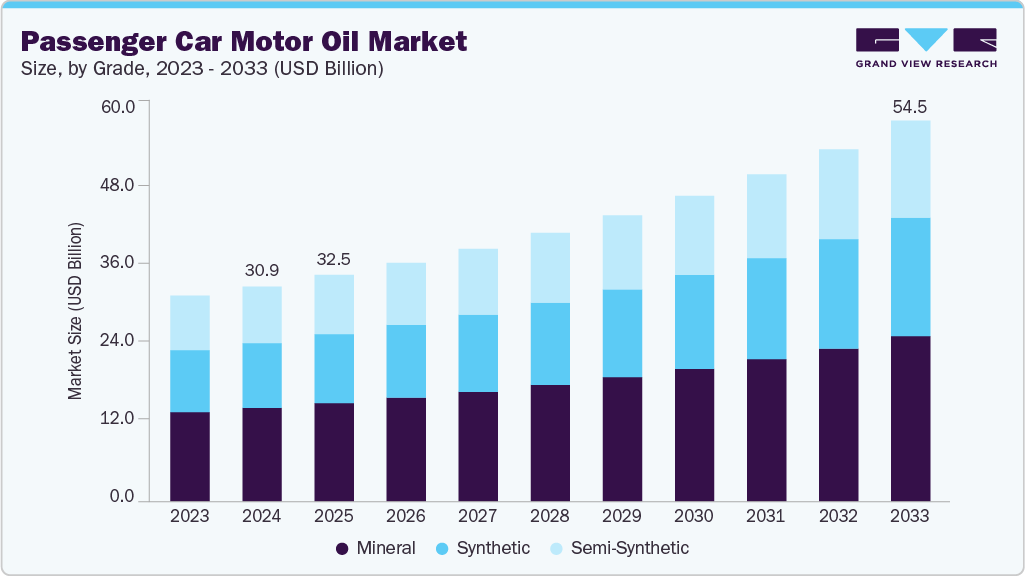
The global passenger car motor oil market size was estimated at USD 30.9 billion in 2024 and is projected to reach USD 54.5 billion by 2033, growing at a CAGR of 6.7% from 2025 to 2033. The global passenger-car fleet continues to expand, particularly in emerging economies, leading to increased demand for routine engine maintenance and lubrication.
Key Market Trends & Insights
- Asia Pacific is expected to grow fastest with a CAGR of 7.0% from 2025 to 2033.
- Mineral segment dominated the market and accounted for the largest revenue share of 43.4% in 2024.
- Hybrid (Gasoline + Electric) segment is expected to grow fastest with a CAGR of 7.9% from 2025 to 2033
Market Size & Forecast
- 2024 Market Size: USD 30.9 Billion
- 2033 Projected Market Size: USD 54.5 Billion
- CAGR (2025-2033): 6.7%
Increased vehicle usage, longer average vehicle lifespan, and growing ownership rates directly boost the consumption of passenger car motor oil (PCMO) products across both OEM and aftermarket channels.
Automakers’ focus on fuel efficiency, lower emissions, and advanced engine technologies (turbocharged, GDI, hybrid engines) is driving a strong transition toward premium synthetic and semi-synthetic motor oils. These formulations deliver extended drain intervals, improved thermal stability, and enhanced engine protection, thereby accelerating the growth of PCMO market value.
Rapid growth of independent service stations, quick-lube centers, and local distributors in Asia, Africa, and Latin America is creating strong opportunities for PCMO suppliers to expand market penetration. As vehicle ownership increases and consumers seek cost-effective maintenance options, lubricant brands can expand their distribution networks, introduce localized product lines, and capture a larger share of the aftermarket sales.
Market Concentration & Characteristics
The PCMO market is moderately concentrated, with global leaders such as ExxonMobil, Shell, BP (Castrol), Chevron, TotalEnergies, and major Asian producers holding significant share due to strong branding, advanced formulations, and extensive distribution networks. While these multinational companies dominate premium and synthetic segments, regional brands remain competitive in cost-sensitive markets, creating a balanced mix of global and local players.
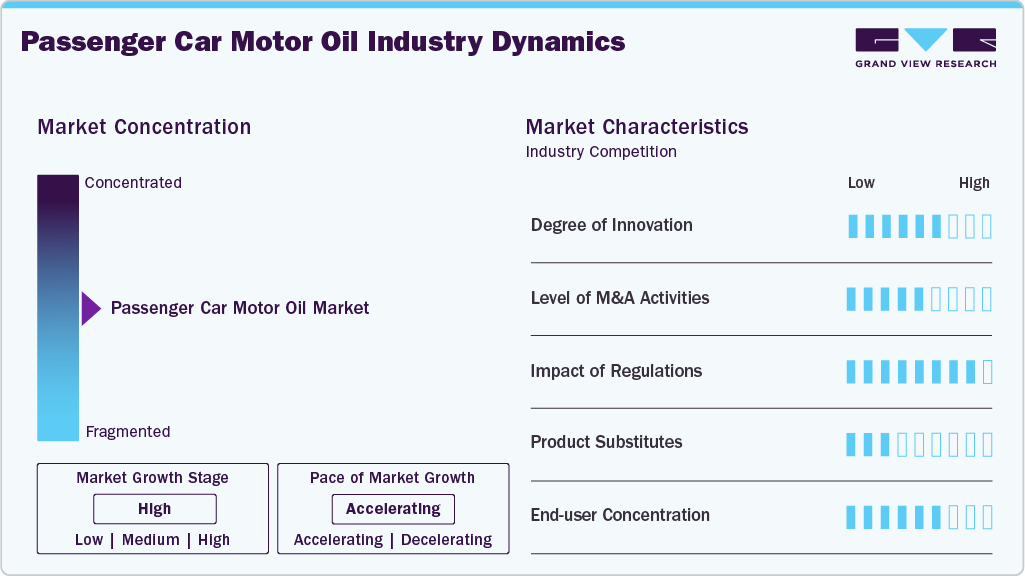
The market is shaped by strict OEM specifications, rising demand for synthetic low-viscosity oils, and ongoing regulatory pressure for cleaner and more efficient engines. PCMO demand is largely driven by the replacement aftermarket and the expanding passenger vehicle fleet in emerging economies. Innovation, product quality, and channel reach are key differentiators, while digital retailing and quick-lube expansion continue to influence purchasing behavior.
Grade Insights
The mineral segment, dominated the source segment with a revenue share of 43.4% in 2024. Mineral oils continue to dominate due to their significantly lower price point, making them the preferred choice for mass-market consumers and fleet operators. Their affordability supports widespread adoption in emerging economies where maintenance costs strongly influence purchasing decisions. This cost advantage sustains high-volume demand across aftermarket channels.
The semi-synthetic segment is the fastest-growing segment with a CAGR of 7.1% during the forecast period. Semi-synthetic oils are gaining traction as consumers seek enhanced engine protection and longer drain intervals without the premium cost of full synthetics. Their balanced value proposition appeals to both mid-income buyers and service centers aiming to upgrade customers from basic mineral oils. This performance-price equilibrium is driving rapid adoption.
Engine Type Insights
The gasoline engine type dominated the market, with a revenue share of 66.5% in 2024. driving substantial recurring demand for PCMO. Their higher engine oil replacement frequency compared to diesel or hybrid models further reinforces segment dominance. This broad installed base ensures a stable and consistent revenue stream.
The hybrid (Gasoline + Electric) segment is the fastest-growing segment with a CAGR of 7.9% during the forecast period. Tighter emission standards and rising consumer interest in fuel-efficient mobility are accelerating hybrid vehicle adoption. These engines require specialized low-viscosity PCMO formulations to support frequent start-stop cycles. This shift is rapidly expanding demand for advanced, hybrid-compatible lubricants.
Viscosity Grade Insights
Medium Viscosity Grades (5W-30, 10W-30) dominated the product segment with a revenue share of 46.8% in 2024, due to their widespread suitability across legacy and mid-range gasoline and diesel vehicles. With billions of such cars on the road, aftermarket consumption remains consistently high. This entrenched vehicle base supports stable, high-volume demand.
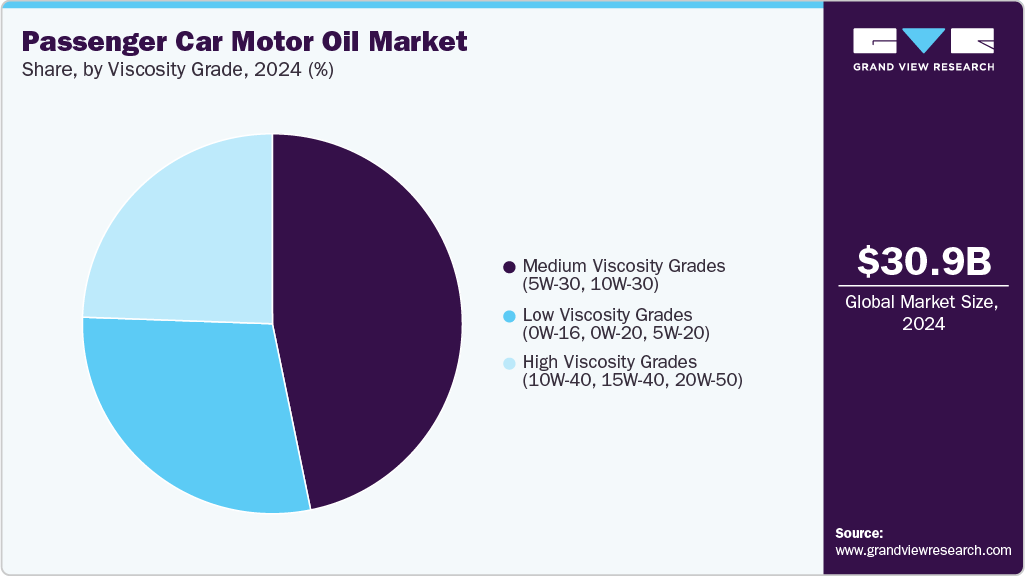
The Low Viscosity Grades (0W-16, 0W-20, 5W-20) segment is expected to grow the fastest with a CAGR of 7.1%, during the forecast period. Automakers are increasingly specifying low-viscosity oils to improve fuel efficiency and meet stringent CO₂ and emission standards. These formulations reduce internal friction and support optimized engine performance in modern vehicles. As OEM recommendations shift, demand for 0W-16, 0W-20, and 5W-20 grades is rapidly accelerating.
Distribution Channel Insights
Retail dominated the market with a revenue share of 41.8% in 2024. Due to its widespread presence across service stations, auto-parts stores, and e-commerce platforms, it ensures effortless access for end consumers and drives consistent sales volumes.
The OEM segment is the fastest-growing segment with a CAGR of 7.1% during the forecast period, as automakers increasingly endorse specific PCMO brands, leveraging vehicle sales and service networks to enhance brand credibility and adoption.
Regional Insights
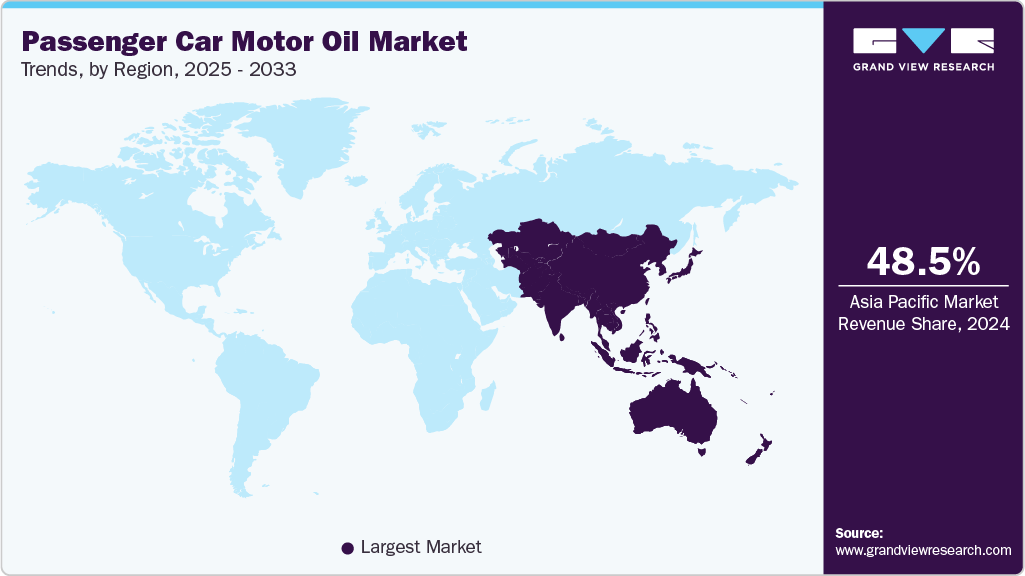
The Asia Pacific dominated the market with the largest revenue share of 48.5% in 2024. The market due to significant growth in passenger car ownership, fueled by rising disposable incomes, rapid urbanization. This increasing vehicle base drives consistent demand for motor oils across both retail and OEM channels. Manufacturers are capitalizing on this growth by strengthening distribution networks in key urban and semi-urban centers.
China Passenger Car Motor Oil Market Trends
China registered highest CAGR of 7.2% during the review period. China’s market demand driven by both new vehicle sales and aftermarket servicing. Strong production growth, especially in passenger cars, ensures continuous lubricant consumption. Companies are scaling up distribution networks to meet urban and semi-urban demand efficiently.
North America Passenger Car Motor Oil Market Trends
North America’s culture of long-distance driving and frequent vehicle usage sustains regular PCMO replacement cycles. This ensures a stable and recurring demand for both synthetic and conventional oils. Market players leverage this trend by offering performance-grade products tailored for high-mileage vehicles.
The U.S. passenger car motor oil market benefits from a high number of vehicles per household, driving recurring PCMO consumption. Regular maintenance schedules and long-distance travel culture sustain strong demand across retail and OEM channels. Companies leverage this pattern by offering specialized and performance-oriented oils.
Europe Passenger Car Motor Oil Market Trends
European PCMO demand is strongly influenced by government-mandated emission standards and environmental policies that require high-performance, low-viscosity oils. Compliance-driven adoption of advanced lubricants ensures higher-quality product penetration. This regulatory environment encourages innovation in synthetic and fuel-efficient oil formulations.
The Germany passenger car motor oil market is positioned as a leading automotive manufacturing hub drives substantial domestic and export-oriented PCMO demand. OEM endorsements for lubricants during vehicle assembly and servicing enhance market penetration. This provides companies with opportunities to strengthen brand positioning among premium consumers.
Latin America Passenger Car Motor Oil Market Trends
Increasing passenger car sales across Latin American countries drive higher PCMO consumption. Expansion in urban transport and rising vehicle usage support demand growth in retail and OEM channels. Companies are leveraging this trend by broadening distribution and marketing initiatives in key cities.
Middle East & Africa Passenger Car Motor Oil Market Trends
Extreme heat, dust, and sand in the region increase demand for high-performance PCMO that protects engines and maintains efficiency. Fleet operators and individual consumers prioritize lubricants that ensure durability under challenging conditions. This drives adoption of specialized, high-quality oils.
Key Passenger Car Motor Oil Company Insights
ExxonMobil and Shell plc dominate the PCMO market due to their extensive global distribution networks, strong brand recognition, and integrated upstream-to-downstream operations. Their continuous investment in R&D and premium product offerings ensures high market penetration and customer loyalty.
-
ExxonMobil is a major player in the PCMO market, leveraging its extensive distribution channels to ensure wide product availability across retail and OEM segments. The company’s strong brand portfolio, including Mobil 1, drives premium product adoption and customer loyalty. Continuous investment in lubricant R&D enables high-performance formulations that meet evolving engine requirements. Strategic partnerships with automakers and service providers further strengthen its market dominance and influence.
-
Shell plc maintains a dominant position in the PCMO market through its robust global supply chain and strong presence in both retail and OEM channels. Its focus on advanced lubricants, including fully synthetic offerings, supports performance and efficiency across passenger vehicles. Continuous innovation and technical expertise allow Shell to meet stringent regulatory and consumer requirements. Strategic collaborations and marketing initiatives enhance brand visibility and reinforce customer trust globally.
Key Passenger Car Motor Oil Companies:
The following are the leading companies in the passenger car motor oil market. These companies collectively hold the largest market share and dictate industry trends.
- ExxonMobil
- Shell plc
- Chemicea Limited
- BP plc (Castrol)
- Chevron Corporation
- TotalEnergies
- Sinopec
- PetroChina
- Valvoline Inc.
- FUCHS
- Petronas Lubricants International
Recent Developments
-
In March 2023, ExxonMobil announced a major investment to build a new lubricant-manufacturing plant in Raigad, India, strengthening the PCMO market by expanding local production capacity. This facility will ensure a reliable supply for both retail and OEM channels, support growth in premium and synthetic oils, and enable the company to capture increasing passenger car motor oil demand across the region.
Passenger Car Motor Oil Market Report Scope
|
Report Attribute
|
Details
|
|
Market size value in 2025
|
USD 32.5 billion
|
|
Revenue forecast in 2033
|
USD 54.5 billion
|
|
Growth rate
|
CAGR of 6.7% from 2025 to 2033
|
|
Base year for estimation
|
2024
|
|
Historical data
|
2018 - 2023
|
|
Forecast period
|
2025 - 2033
|
|
Quantitative units
|
Volume in kilotons, Revenue in USD billion, and CAGR from 2025 to 2033
|
|
Report coverage
|
Revenue forecast, volume forecast, competitive landscape, growth factors, and trends
|
|
Segments covered
|
Grade, engine type, viscosity grade, distribution channel, region
|
|
Regional scope
|
North America; Europe; Asia Pacific; Latin America; Middle East & Africa
|
|
Country scope
|
U.S.; Canada; Mexico; Germany; UK; France; Italy; Spain; China; India; Japan; South Korea; Brazil; Argentina; Saudi Arabia; South Africa
|
|
Key companies profiled
|
ExxonMobil; Shell plc; Chemicea Limited; BP plc (Castrol); Chevron Corporation; TotalEnergies; Sinopec; PetroChina; Valvoline Inc.; FUCHS; Petronas Lubricants International
|
|
Customization scope
|
Free report customization (equivalent up to 8 analyst’s working days) with purchase. Addition or alteration to country, regional, and segment scope.
|
|
Pricing and purchase options
|
Avail customized purchase options to meet your exact research needs. Explore purchase options
|
Global Passenger Car Motor Oil Market Report Segmentation
This report forecasts revenue growth at global, regional, and country levels and provides an analysis of the latest industry trends in each of the sub-segments from 2018 to 2033. For this study, Grand View Research has segmented the global passenger car motor oil market report based on product, end use, and region:
-
Grade Outlook (Revenue, USD Billion; Volume, Kilotons; 2021 - 2033)
-
Mineral
-
Synthetic
-
Semi-Synthetic
-
Engine Type Outlook (Revenue, USD Billion; Volume, Kilotons; 2018 - 2033)
-
Viscosity Grade Outlook (Revenue, USD Billion; Volume, Kilotons; 2018 - 2033)
-
Low Viscosity Grades (0W-16, 0W-20, 5W-20)
-
Medium Viscosity Grades (5W-30, 10W-30)
-
High Viscosity Grades (10W-40, 15W-40, 20W-50)
-
Distribution Channel Outlook (Revenue, USD Billion; Volume, Kilotons; 2018 - 2033)
-
Retail
-
OEM
-
Service Centers
-
Others
-
Regional Outlook (Revenue, USD Billion; Volume, Kilotons; 2018 - 2033)
-
North America
-
Europe
-
Germany
-
UK
-
Italy
-
Spain
-
France
-
Asia Pacific
-
China
-
Japan
-
South Korea
-
India
-
Latin America
-
Middle East & Africa
-
Saudi Arabia
-
South Africa
Frequently Asked Questions About This Report
b. The global passenger car motor oil market size was estimated at USD 30.9 billion in 2024 and is expected to reach USD 32.5 billion in 2025.
b. The global passenger car motor oil market is expected to grow at a compound annual growth rate of 6.7% from 2025 to 2033 to reach USD 54.5 billion by 2033.
b. The Asia-Pacific dominated the market with largest revenue share of 48.5% in 2024. The market due to significant growth in passenger car ownership, fueled by rising disposable incomes, rapid urbanization.
b. Some key players operating in the passenger car motor oil market include ExxonMobil, Chemicea Limited, BP plc (Castrol), Chevron Corporation, TotalEnergies, Sinopec, PetroChina, Valvoline Inc., FUCHS, Petronas Lubricants International.
b. The global passenger-car fleet continues to expand, especially across emerging economies, resulting in higher demand for routine engine maintenance and lubrication. Increased vehicle usage, longer average vehicle lifespan, and growing ownership rates directly boost the consumption of PCMO products across both OEM and aftermarket channels.

 Download Sample Report
















