
- Home
- »
- Plastics, Polymers & Resins
- »
-
PE And PP Compounding Market Size Report, 2026-2033GVR Report cover

PE And PP Compounding Market (2026 - 2033)
Size, Share & Trends Analysis Report By Type (PE Compounding, PP Compounding), By Polymer Type, By Compound Type, By Application, By Region (North America, Europe, Asia Pacific, CSA, MEA), And Segment Forecasts
Market Size, 2025
$129.0BMarket Estimate, 2026
$136.1BMarket Forecast, 2033
$200.9BCAGR, 2026–2033
5.7%PE And PP Compounding Market Summary
The global PE and PP compounding market size was valued at USD 129.0 billion in 2025 and is projected to grow from USD 136.1 billion in 2026 to USD 200.9 billion by 2033, at a CAGR of 5.7% from 2026 to 2033. The market in Asia Pacific dominated with a revenue share of 44.2% in 2025. Increasing demand from the electrical and electronics industry is supporting the growth of the PE and PP compounding market.
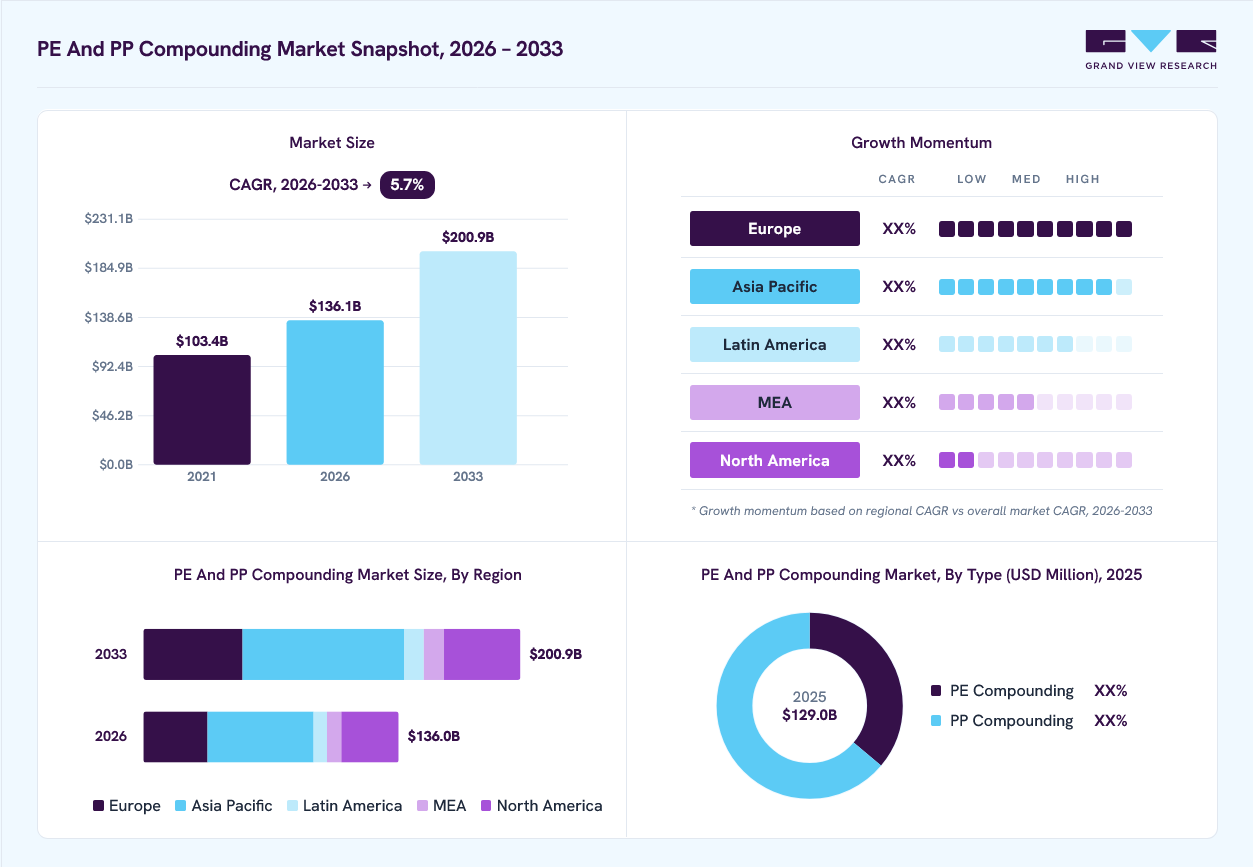 Source: Grand View Research, IR Documents, Primary Interviews, Paid DatabasesTo learn more about this report,
 Download Free Sample Report
 Key Market Trends & Insights
- By type: PP segment held the largest market share of 63.9% in 2025.
- By PP polymer type: Homopolymer PP segment held the largest market share of 73.1% in 2025.
- By PE polymer type: HDPE segment held the largest market share of 37.9% in 2025.
- By PP application: Automotive segment held the largest market share of 36.4% in 2025.
- By PE application: Packaging segment held the largest market share of 34.6% in 2025.
Regional Highlights
- Largest regional market: Asia Pacific (44.2% revenue share, 2025)
- By country: China held the largest market share in 2025
Market Size & Forecast
- Market size in 2025: USD 129.0 Billion
- Estimated market size in 2026: USD 136.1 Billion
- Projected market size by 2033: USD 200.9 Billion
- CAGR (2026-2033): 5.7%
Three ways to get this report
Buy it, customize it, or ask a question.Ask an Analyst
Analyst response in 1 business day
- AccessReport author, directly
- Reply timeWithin 1 working day
- No sales callDirect answer only
- FormatEmail reply
- CostFree, no cost
Get the Full Report
What the study covers
- FormatsPDF · Excel · Dashboard
- Timeline2026–2033 annual, 2025 base
- Coverage20+ countries, 5 regions
- Companies10+ key players profiled
Customize the Report
20% free customization
- IncludeCountries, segments, points
- TailorTo your product definition
- ExtendDeeper competitor detail
- OrA fully bespoke study
- Turnaround5–10 working days
These compounds are widely used in cable insulation, appliance housings, connectors, and electronic components due to their good electrical properties, processability, and cost efficiency. The industry is witnessing a strong shift toward sustainable and application-specific polyolefin compounds with higher recycled content and enhanced functional performance. Compounders are increasingly developing PE and PP formulations with flame retardancy, UV stability, impact resistance, and lightweight characteristics for automotive, electrical, and packaging applications. Demand for customized compounds compatible with injection molding, blow molding, and extrusion processes is also increasing. In addition, circular economy regulations are accelerating the use of post-consumer recycled PE and PP in packaging and consumer goods applications, particularly across Europe and the Asia Pacific.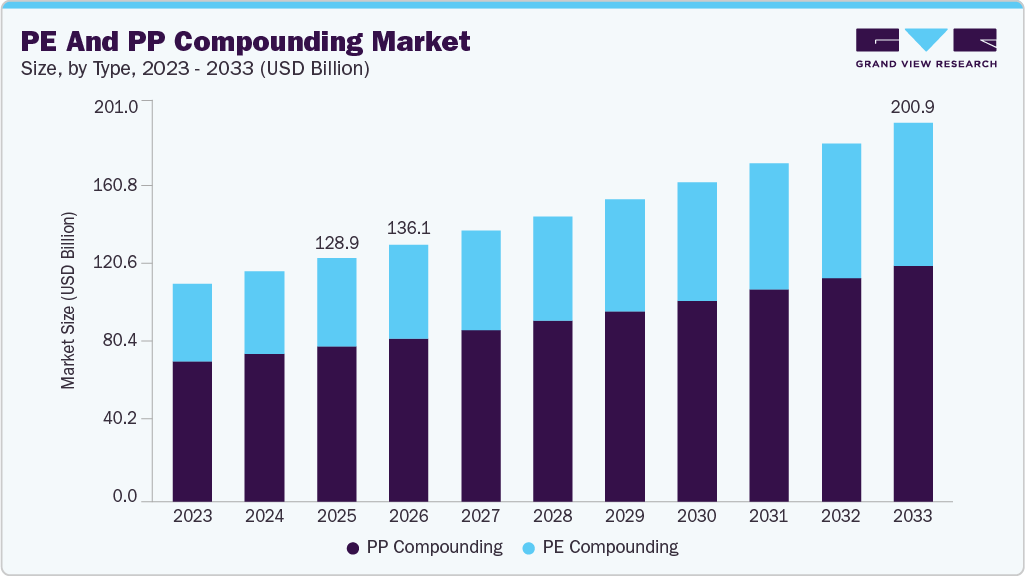 To learn more about this report, Download Free Sample Report
 Drivers, Opportunities & Restraints
Growth in automotive lightweighting and flexible packaging demand is a major driver for the PE & PP compounding industry. Polypropylene compounds are increasingly replacing metal and engineering materials in vehicle interiors, under-the-hood components, battery housings, and exterior trims due to their favorable strength-to-weight ratio and cost efficiency. Polyethylene compounds continue to witness strong adoption in rigid and flexible packaging formats because of their durability, chemical resistance, and processing flexibility. Rising electric vehicle production and expanding e-commerce packaging demand are further supporting compound consumption globally.
A significant opportunity exists in the development of recycled-content and high-performance compounds for electric vehicles, infrastructure, and advanced packaging applications. Manufacturers are increasingly seeking PE and PP compounds with improved thermal stability, dimensional strength, flame retardancy, and compatibility with recycled feedstocks. Demand is also rising for mineral-filled and glass fiber reinforced PP compounds in automotive and electrical applications where lightweighting and durability are critical. In addition, tightening sustainability targets are creating opportunities for compounders offering circular-grade materials with consistent mechanical properties and regulatory compliance.
Volatility in polymer feedstock prices and increasing regulatory pressure on conventional plastics remain major restraints for the industry. Price fluctuations in crude oil, naphtha, and virgin polyolefins directly impact production costs and margin stability for compounders. At the same time, stricter regulations related to plastic waste reduction, recycling mandates, and single-use plastic restrictions are increasing compliance costs and forcing investments in recycling infrastructure and material reformulation. Competition from engineering plastics, biopolymers, and alternative lightweight materials also limits market penetration in high-performance applications.
Market Concentration & Characteristics
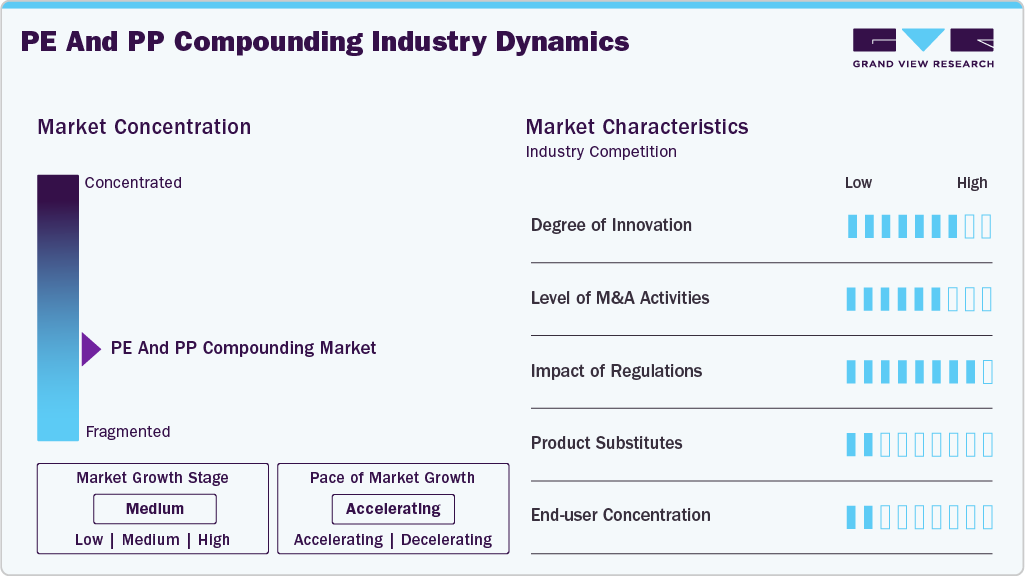
The industry growth stage is medium, and growth is accelerating. The industry exhibits fragmentation, with key players dominating the industry landscape. Major companies such as LyondellBasell Industries, SABIC, Borealis AG, ExxonMobil Chemical, Dow Inc., INEOS Group Limited, Chevron Phillips Chemical Company, Ravago Group, Mitsui Chemicals, HDC HYUNDAI EP COMPANY, Avient Corporation, RTP Company, SILON s.r.o., Borouge International, Kingfa, and others play a significant role in shaping the market dynamics. These leading players often drive innovation in the market by introducing new products, technologies, and materials to meet the industry's evolving demands.
The industry is witnessing strong innovation focused on recyclability, lightweighting, and performance enhancement. Manufacturers are developing mono-material PE and PP compounds with improved impact strength, thermal stability, flame retardancy, and barrier properties to meet evolving packaging and automotive requirements. Advanced compounding technologies are also enabling higher incorporation of post-consumer recycled content without significantly affecting mechanical performance. In flexible packaging, innovation is increasingly centered on replacing multi-layer structures with recyclable mono-PP and mono-PE solutions to align with circular economy targets and improve material recovery rates.
 To learn more about this report, Download Free Sample Report
 Regulatory frameworks related to packaging recyclability, recycled content usage, and plastic waste reduction are significantly influencing the industry. The European Union Packaging and Packaging Waste Regulation requires recyclable packaging designs and mandates minimum recycled plastic content targets beginning from 2030, increasing pressure on compounders to develop compliant formulations. Similar regulatory developments in India and Canada are accelerating investments in recycled polyolefin compounds for packaging applications. These regulations are also increasing demand for food-contact compliant recycled materials, traceability systems, and design-for-recycling compound solutions across consumer goods and industrial sectors.
Type Insights
The PP segment dominated the industry in terms of revenue, accounting for 63.94% market share in 2025, and is forecast to grow at a 5.4% CAGR from 2026 to 2033. The PP segment is primarily driven by rising demand for lightweight and recyclable materials across automotive, rigid packaging, and consumer goods applications. Polypropylene compounds offer a favorable balance of stiffness, impact resistance, chemical durability, and processability, making them suitable for high-volume injection molding and thermoforming operations. Increasing electric vehicle production is further accelerating consumption of reinforced and mineral-filled PP compounds in battery housings, interior trims, and structural parts. In packaging, the shift toward mono-material recyclable formats and clarified PP grades is strengthening adoption in food containers, caps, closures, and microwaveable packaging applications.
The PE segment is expected to expand at a 6.3% CAGR over the forecast period. Growth in the PE segment is being supported by strong demand from flexible packaging, infrastructure piping, and industrial film applications. Polyethylene compounds are widely preferred due to their toughness, moisture resistance, sealability, and compatibility with recyclable mono-material packaging structures. Increasing regulatory focus on circular packaging design is encouraging the use of PE-based films and pouches that simplify mechanical recycling processes. In parallel, investments in water distribution, gas transportation, and agricultural irrigation infrastructure are increasing demand for HDPE compounds with enhanced pressure resistance and long service life characteristics.
PE Polymer Type Insights
In terms of PE polymer, HDPE accounted for the largest revenue share of 37.85% in 2025. The demand is driven by the rising need for durable and chemically resistant materials in infrastructure and industrial applications.
The LLDPE segment is expected to grow at 6.9% CAGR over the forecast period, due to rising demand for high-performance flexible films in industrial and consumer packaging applications.
PP Polymer Type Insights
In terms of PP polymer, the homopolymer PP segment accounted for the largest revenue share of 73.06% in 2025. The segment is primarily driven by increasing usage in rigid packaging and thin-wall injection molding applications.
The terpolymer PP segment is expected to grow at 7.4% CAGR over the forecast period. Demand for terpolymer PP compounds is increasing in medical, food packaging, and transparent consumer product applications where impact resistance and clarity are critical.
PE Compounding Type Insights
Based on PE compounding type, the HDPE pipe compound segment accounted for the largest revenue share of 34.80% of the overall market in 2025. Demand for HDPE pipe compounds is increasing due to expanding investments in water management, irrigation, and gas pipeline infrastructure projects. HDPE pipe compounds provide high crack resistance, flexibility, and durability under harsh environmental conditions, making them suitable for long-term underground applications.
The cross-linkable PE (XLPE) segment is expected to grow at 7.5% CAGR over the forecast period, driven by increasing investments in power transmission, renewable energy infrastructure, and electric vehicle charging networks.
PP Compounding Type Insights
Based on the PP compounding type, the mineral-filled segment accounted for the largest revenue share of 32.89% in 2025. The segment growth is driven by the increasing demand for lightweight and cost-efficient materials in automotive and appliance manufacturing.
The glass-filled segment is expected to grow at 5.9% CAGR over the forecast period. Growth in the segment is closely linked to the rising substitution of metal and engineering plastics in structural automotive and industrial components.
PE Application Insights
In terms of PE application, the packaging segment accounted for the largest revenue share of 34.55% of the overall market in 2025. Packaging remains a key application area for PE compounds due to the rapid shift toward recyclable flexible packaging and high-performance film structures.
The wire & cable segment is expected to grow at 7.4% CAGR over the forecast period, due to increasing investments in telecommunications, data centers, and renewable energy transmission infrastructure.
PP Application Insights
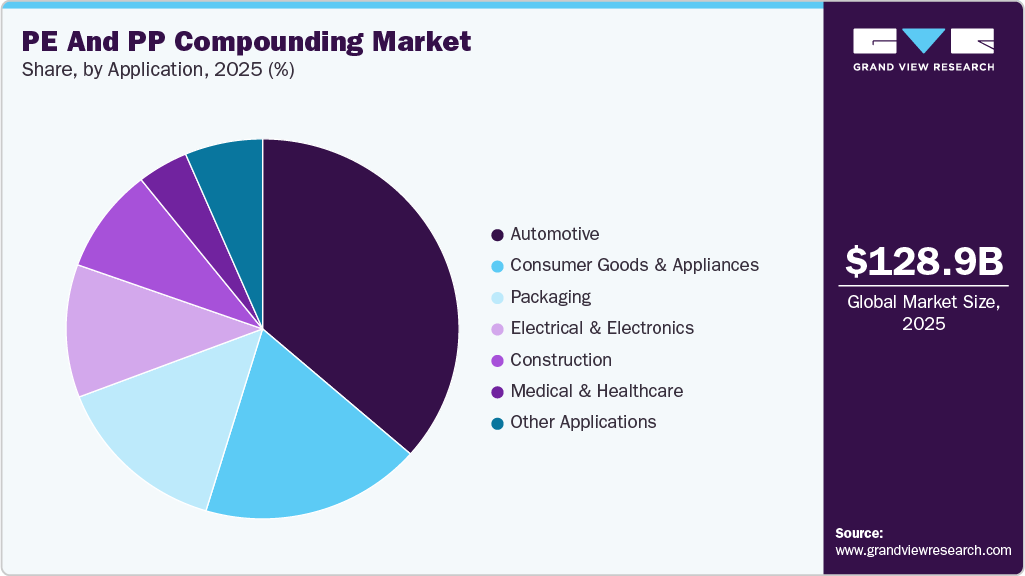
In terms of PP compounding application, the automotive segment accounted for the largest revenue share of 36.43% of the overall market in 2025. The automotive segment is driving strong demand for PP compounds as vehicle manufacturers focus on lightweighting and cost optimization strategies.
 To learn more about this report, Download Free Sample Report
 The packaging segment is expected to grow at a CAGR of 5.9% over the forecast period, driven by the increasing demand for recyclable and cost-effective packaging solutions across the food, beverage, personal care, and consumer goods industries. Polypropylene (PP) is widely used in food containers, thin-wall packaging, caps, and closures due to its durability, lightweight properties, and excellent processability. Growing emphasis on sustainable packaging and the transition toward recyclable mono-material packaging formats are further supporting the adoption of PP in packaging applications.
Regional Insights & Trends
Asia Pacific held the largest revenue share of 41.90% in the PE compounding market and 41.12% in the PP compounding market in 2025. The region is expected to grow at a CAGR of 6.8% and 5.9%, respectively, over the forecast period. Rapid industrialization, urban infrastructure development, and expanding packaging consumption are major growth drivers for the Asia Pacific PE and PP compounding market. Countries across the region are increasing investments in transportation, water distribution, consumer electronics, and industrial manufacturing, creating sustained demand for polyolefin compounds. Flexible packaging production continues to expand due to rising e-commerce activity and food delivery demand. In addition, cost-competitive manufacturing ecosystems and strong polymer production capacity are encouraging multinational companies to establish compounding and downstream processing facilities across the region.
 To learn more about this report, Download Free Sample Report
 China PE And PP Compounding Market Trends
China PE and PP compounding market leads the region due to its large-scale automotive, electronics, appliance, and packaging manufacturing base. The rapid growth of domestic electric vehicle production is increasing the consumption of mineral-filled and reinforced PP compounds used in lightweight vehicle components and battery-related applications. The country is also advancing investments in high-speed infrastructure, renewable energy, and industrial automation, which is supporting demand for durable PE compounds in pipes, cables, and industrial systems. Expanding local polymer integration and compounding capacity further strengthens China’s position in the regional value chain.
North America PE And PP Compounding Market Trends
The PE and PP compounding market in North America is primarily driven by rising demand for lightweight polymer compounds across the automotive, electrical, and construction industries. Increasing investments in electric vehicle manufacturing and localized automotive supply chains are supporting higher consumption of reinforced PP and specialty PE compounds. In parallel, infrastructure modernization projects related to water systems, renewable energy, and utility networks are increasing demand for HDPE pipe compounds. Regional manufacturers are also expanding compounding capacity to strengthen domestic supply reliability and reduce dependence on imported engineered materials.
The PE and PP compounding market in the U.S. is strongly supported by reshoring trends and the expansion of domestic manufacturing activities. Automotive OEMs and Tier suppliers are increasingly sourcing locally produced polypropylene compounds to improve supply chain resilience and reduce logistics risks. The country is also witnessing higher demand for advanced compounds in EV battery systems, wire and cable, healthcare packaging, and consumer appliances. In addition, federal infrastructure investments are accelerating the use of PE compounds in construction, utility piping, and industrial applications requiring durability and long service life.
Europe PE And PP Compounding Market Trends
The PE and PP compounding market in Europe is driven by strict sustainability regulations and growing adoption of recyclable material systems across the automotive and packaging sectors. Regional manufacturers are increasingly developing recycled-content and mono-material polyolefin compounds to comply with circular economy and packaging waste regulations. Automotive producers are also accelerating the use of lightweight PP compounds to improve vehicle efficiency and support emission reduction targets. In addition, investments in renewable energy infrastructure, electric mobility, and advanced recycling technologies are creating demand for high-performance and sustainable PE and PP compound formulations across industrial applications.
Key PE And PP Compounding Company Insights
The PE and PP compounding industry is highly competitive, with several key players dominating the landscape. The industry is characterized by a competitive landscape with several key players driving innovation and market growth. Major companies in this sector are investing heavily in research and development to enhance the performance, cost-effectiveness, and sustainability of their products.
Key PE And PP Compounding Companies:
The following key companies have been profiled for this study on the PE and PP compounding market.
- LyondellBasell Industries
- SABIC
- Borealis AG
- ExxonMobil Chemical
- Dow Inc.
- INEOS Group Limited
- Chevron Phillips Chemical Company
- Ravago Group
- Mitsui Chemicals
- HDC HYUNDAI EP COMPANY
- Avient Corporation
- RTP Company
- SILON s.r.o.
- Borouge International
- Kingfa
Recent Developments
-
In December 2025, Borealis and Borouge launched Recleo, a global brand for cost-effective mechanically recycled solutions. The portfolio covers polyolefin recyclates and compounds for a broad range of applications, strengthening the supply of circular PE and PP materials across end-use markets.
-
In September 2025, Borealis announced more than EUR 100 million to expand and upgrade its PP compounding facilities in Schwechat, Austria. The new line is scheduled to start in the second half of 2026 and will raise the supply of advanced PP compounds for consumer products, mobility, and infrastructure.
PE And PP Compounding Market Report Scope
Report Attribute
Details
Market size in 2025
USD 129.0 billion
Estimated market size in 2026
USD 136.1 billion
Projected market size by 2033
USD 200.9 billion
Growth rate
CAGR of 5.7% from 2026 to 2033
Historical data
2021 - 2024
Forecast period
2026 - 2033
Quantitative units
Volume in kilotons; revenue in USD million/billion, and CAGR from 2026 to 2033
Report coverage
Revenue & volume forecast, competitive landscape, growth factors, and trends
Segments covered
Type, polymer type, compound type, application, region
Regional scope
North America; Europe; Asia Pacific; Central & South America; Middle East & Africa
Country scope
U.S.; Canada; Mexico; Europe; Germany; UK; France; Italy; Spain; The Netherlands; Belgium; Poland; China; India; Japan; South Korea; Australia; Brazil; Argentina; Saud Arabia; UAE; South Africa
Key companies profiled
LyondellBasell Industries; SABIC; Borealis AG; ExxonMobil Chemical; Dow Inc.; INEOS Group Limited; Chevron Phillips Chemical Company; Ravago Group; Mitsui Chemicals; HDC HYUNDAI EP COMPANY; Avient Corporation; RTP Company; SILON s.r.o.; Borouge International; Kingfa
Customization scope
Free report customization (equivalent to up to 8 analyst working days) with purchase. Addition or alteration to country, regional & segment scope
Pricing and purchase options
Avail customized purchase options to meet your exact research needs. Explore purchase options
Global PE And PP Compounding Market Report Segmentation
This report forecasts volume & revenue growth at the global, regional, and country levels and provides an analysis of the latest industry trends across sub-segments from 2021 to 2033. For this study, Grand View Research has segmented the global PE and PP compounding market report based on type, polymer type, compound type, application, and region:
-
Type Outlook (Volume, Kilotons; Revenue, USD Million, 2021 - 2033)
-
PE
-
PP
-
-
Polymer Type Outlook (Volume, Kilotons; Revenue, USD Million, 2021 - 2033)
-
PE
-
LLDPE
-
LDPE
-
MDPE
-
HDPE
-
-
PP
-
Homopolymer PP
-
Copolymer PP
-
Terpolymer PP
-
-
-
Compound Type Outlook (Volume, Kilotons; Revenue, USD Million, 2021 - 2033)
-
PE
-
HDPE pipe compound
-
LDPE/LLDPE modified
-
Cross-linkable PE (XLPE)
-
Carbon-black-filled PE
-
Conductive PE
-
-
PP
-
Talc-filled
-
Glass-filled
-
Mineral-filled
-
Impact-modified
-
Thermoplastic Polyolefin (TPO)
-
Flame-Retardant (FR) PP
-
Conductive PP
-
-
-
Application Outlook (Volume, Kilotons; Revenue, USD Million, 2021 - 2033)
-
PE
-
Pipe & Infrastructure
-
Gas distribution pipes (PE80, PE100)
-
Drinking water pressure pipes
-
Sewer & drainage pipes
-
Cable protection ducts
-
Irrigation pipes
-
-
Wire & Cable
-
Power cable insulation (XLPE)
-
Medium & high voltage insulation
-
Telecom cable sheathing
-
Flame-retardant cable jacketing
-
Semiconductive cable layers
-
-
Packaging
-
Milk & beverage bottles
-
Detergent bottles
-
Jerry cans & drums
-
Chemical storage containers
-
Food-grade bottles
-
-
Automotive
-
Fuel tanks
-
Fuel lines
-
Washer fluid reservoirs
-
Coolant tanks
-
Underbody shields
-
-
Construction
-
Geomembranes (landfill liners)
-
Waterproof membranes
-
Damp proof sheets
-
Protective construction films
-
-
Other applications
-
-
PP
-
Automotive
-
Bumpers
-
Instrument panels
-
Door trims
-
Battery housings (EV)
-
Air intake manifolds
-
Front-end modules
-
-
Electrical & Electronics
-
Switch housings
-
Circuit breaker casings
-
Distribution boxes
-
Cable trucking
-
EV fuse housings
-
-
Packaging
-
Thin-wall food containers
-
Dairy cups
-
Microwave trays
-
Caps & closures
-
Reusable crates
-
-
Construction
-
PP-R plumbing pipes
-
Hot & cold-water fittings
-
Roofing membranes (TPO)
-
Structural profiles
-
-
Consumer Goods & Appliances
-
Washing machine components
-
Refrigerator liners
-
Furniture parts
-
Storage bins
-
-
Medical & Healthcare
-
Syringes
-
IV components
-
Lab containers
-
Diagnostic trays
-
-
Other applications
-
-
-
Regional Outlook (Volume, Kilotons; Revenue, USD Million, 2021 - 2033)
-
North America
-
U.S.
-
Canada
-
Mexico
-
-
Europe
-
Germany
-
UK
-
France
-
Italy
-
Spain
-
The Netherlands
-
Belgium
-
Poland
-
-
Asia Pacific
-
China
-
India
-
Japan
-
South Korea
-
Australia
-
-
Central & South America
-
Brazil
-
Argentina
-
-
Middle East & Africa
-
Saudi Arabia
-
UAE
-
South Africa
-
-
Frequently Asked Questions About This Report
The global PE and PP compounding market size was valued at USD 129.0 billion in 2025 and is estimated at USD 136.1 billion for 2026.
The global PE and PP compounding market is expected to grow at a CAGR of 5.7% from 2026 to 2033, reaching USD 200.9 billion by 2033.
The PP Compounding segment led the PE and PP compounding market by type in revenue terms, holding a 63.9% share in 2025. It is expected to expand at a CAGR of 5.9% from 2026 to 2033. The PP segment is primarily driven by rising demand for lightweight and recyclable materials across automotive, rigid packaging, and consumer goods applications. Polypropylene compounds offer a favorable balance of stiffness, impact resistance, chemical durability, and processability, making them suitable for high-volume injection molding and thermoforming operations.
Key players include LyondellBasell Industries; SABIC; Borealis AG; ExxonMobil Chemical; Dow Inc.; INEOS Group Limited; Chevron Phillips Chemical Company; Ravago Group; Mitsui Chemicals; HDC HYUNDAI EP COMPANY; Avient Corporation; RTP Company; SILON s.r.o.; Borouge International; Kingfa.
Increasing demand from the electrical and electronics industry is supporting the growth of the PE and PP compounding market. These compounds are widely used in cable insulation, appliance housings, connectors, and electronic components due to their good electrical properties, processability, and cost efficiency.
Asia Pacific dominated with a 44.2% revenue share in 2025.
The homopolymer PP segment led with a 73.1% revenue share in 2025.
The HDPE segment accounted for the largest revenue share of 37.9% in 2025.
Automotive segment held the largest share (over 36.0%) in 2025.
Packaging segment dominated the market and accounted for the largest revenue share 34.6% in 2025.
About the Author(s)
Plastics, Polymers & Resins Research Team
Bulk Chemicals · Plastics, Polymers & ResinsThis report was authored by the plastics, polymers & resins research team at Grand View Research - comprising two research analysts, one senior research analyst, and one industry expert - with specialized expertise in the plastics, polymers & resins segment of the bulk chemicals industry. All findings are based on proprietary bulk chemicals databases, executive interviews, and regulatory analysis, subject to internal peer review prior to publication.
Last Updated:
Speak to Analyst

Customize this report to your needs - add regions, segments, or data points, with 20% free customization.
Or view our licence options:


ISO 9001:2015 & 27001:2022 Certified
We are GDPR and CCPA compliant! Your transaction & personal information is safe and secure. For more details, please read our privacy policy.


