
- Home
- »
- Animal Health
- »
-
Pet Hospice Services Market Size, Share Report, 2026-2033GVR Report cover

Pet Hospice Services Market (2026 - 2033)
Size, Share & Trends Analysis Report By Service (At-home Hospice, At-institution Hospice), By Pet (Dogs, Cats), By Provider (Veterinary Clinical Institutions, Specialized Providers), By Region, And Segment Forecasts
Market Size, 2025
$699.9MMarket Estimate, 2026
$800.0MMarket Forecast, 2033
$1,500.0MCAGR, 2026–2033
10.3%Pet Hospice Services Market Summary
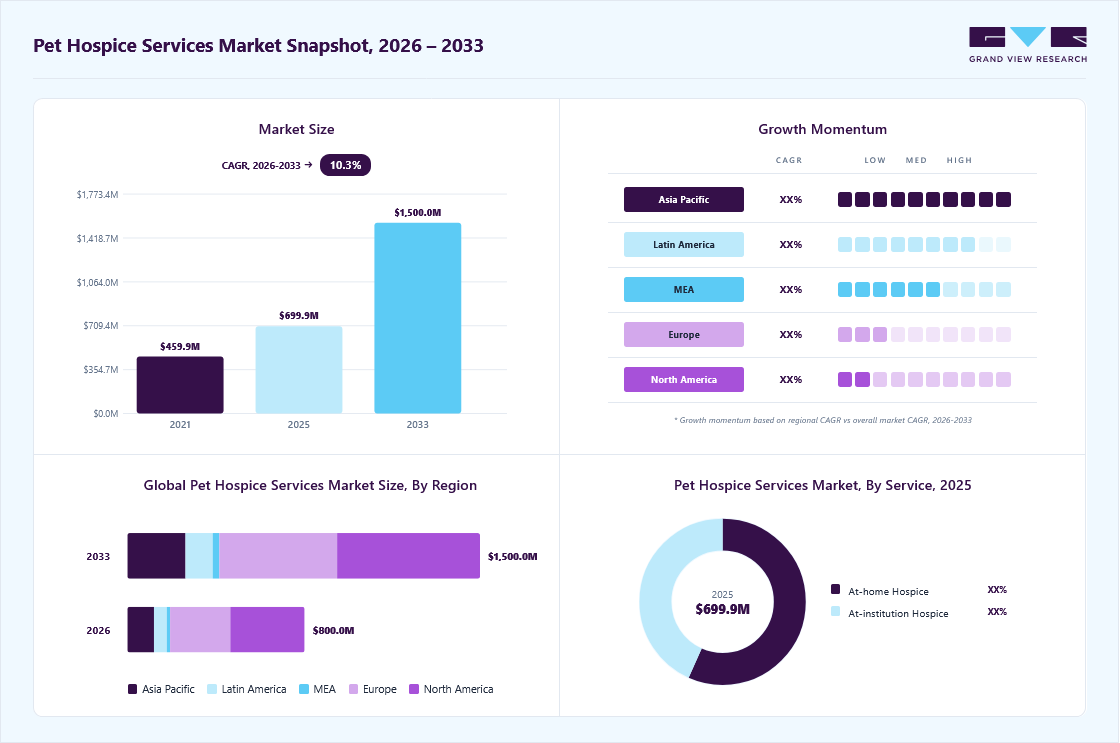
The global pet hospice services market size was valued at USD 699.9 million in 2025 and is projected to grow from USD 800 million in 2026 to USD 1500 million by 2033, at a CAGR of 10.3% from 2026 to 2033. The North America market held the largest share of 42.4% of the global market in 2025. The market is primarily driven by factors such as surging demand for at-home pet hospice services, a rising geriatric and terminally ill pet population, accelerating palliative care uptake, efforts to standardize animal hospice protocols, and growing awareness initiatives normalizing pet hospice conversations.
 Source: Grand View Research, IR Documents, Primary Interviews, Paid DatabasesTo learn more about this report,
 Download Free Sample Report
 Key Market Trends & Insights
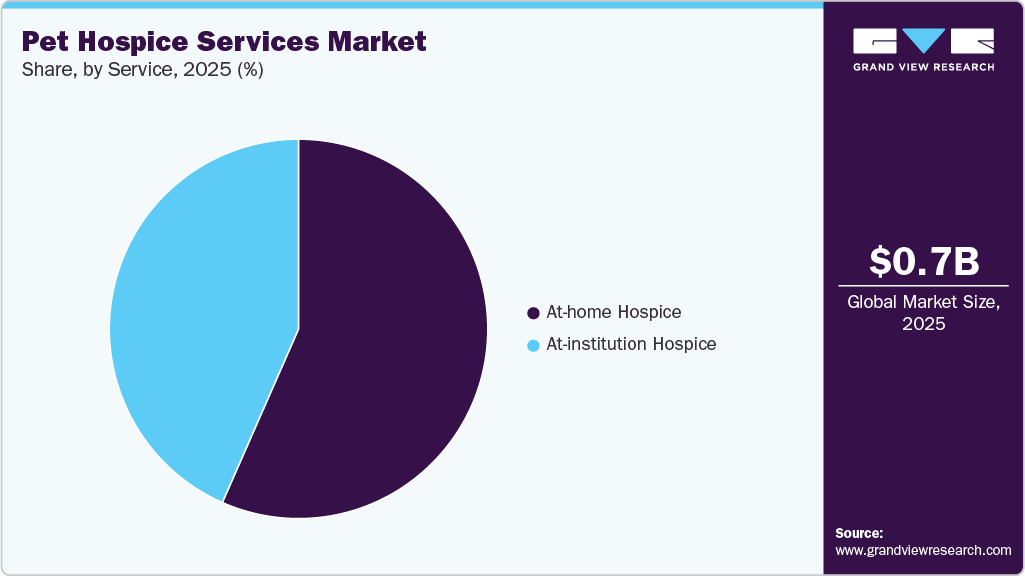
- By service: The at-home hospice segment led the market with the largest revenue share of 56.6% in 2025.
- By pet: The dogs segment accounted for the largest market revenue share in 2025.
Regional Highlights
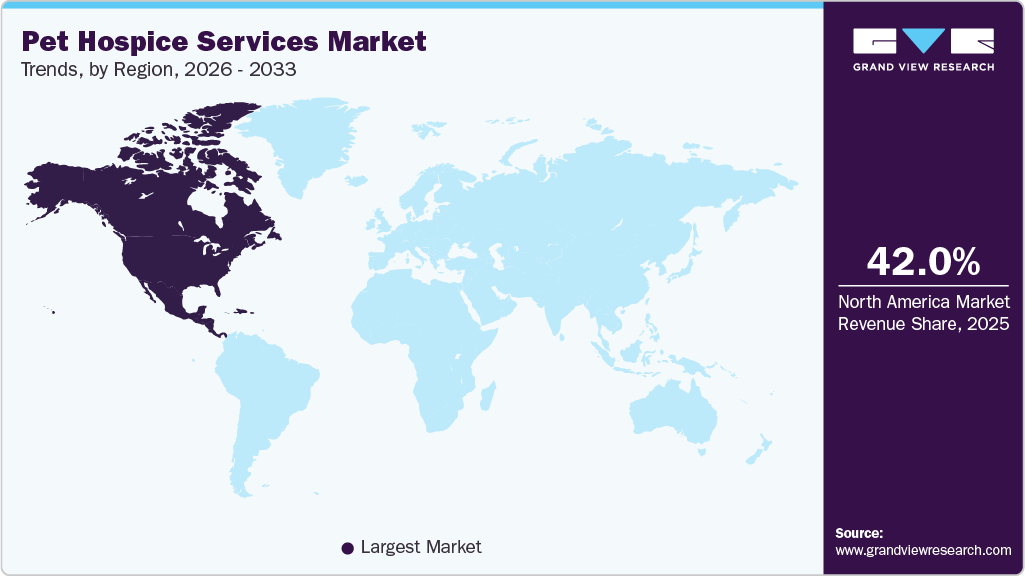
- Largest regional market: North America (42.4% revenue share, 2025)
- Fastest-growing regional market: Asia Pacific (highest CAGR, 2026-2033)
- By country: The U.S. held the largest market share in 2025.
Market Size & Forecast
- Market size in 2025: USD 699.9 Million
- Estimated market size in 2026: USD 800 Million
- Projected market size by 2033: USD 1500 Million
- CAGR (2026-2033): 10.3%
Three ways to get this report
Buy it, customize it, or ask a question.Ask an Analyst
Analyst response in 1 business day
- AccessReport author, directly
- Reply timeWithin 1 working day
- No sales callDirect answer only
- FormatEmail reply
- CostFree, no cost
Get the Full Report
What the study covers
- FormatsPDF · Excel · Dashboard
- Timeline2026–2033 annual, 2025 base
- Coverage20+ countries, 5 regions
- Companies10+ key players profiled
Customize the Report
20% free customization
- IncludeCountries, segments, points
- TailorTo your product definition
- ExtendDeeper competitor detail
- OrA fully bespoke study
- Turnaround5–10 working days
The global companion animal population is aging, expanding the addressable base for pet hospice services. Improved routine veterinary care, advances in nutrition, and wider access to diagnostics have extended average pet lifespans over the past two decades, producing a structurally larger cohort of geriatric animals requiring sustained end-of-life management. This demographic shift is particularly pronounced among dogs and cats, the two species that account for the dominant share of pet hospice demand, where the incidence of chronic, age-associated terminal conditions has risen in tandem with longer lifespans.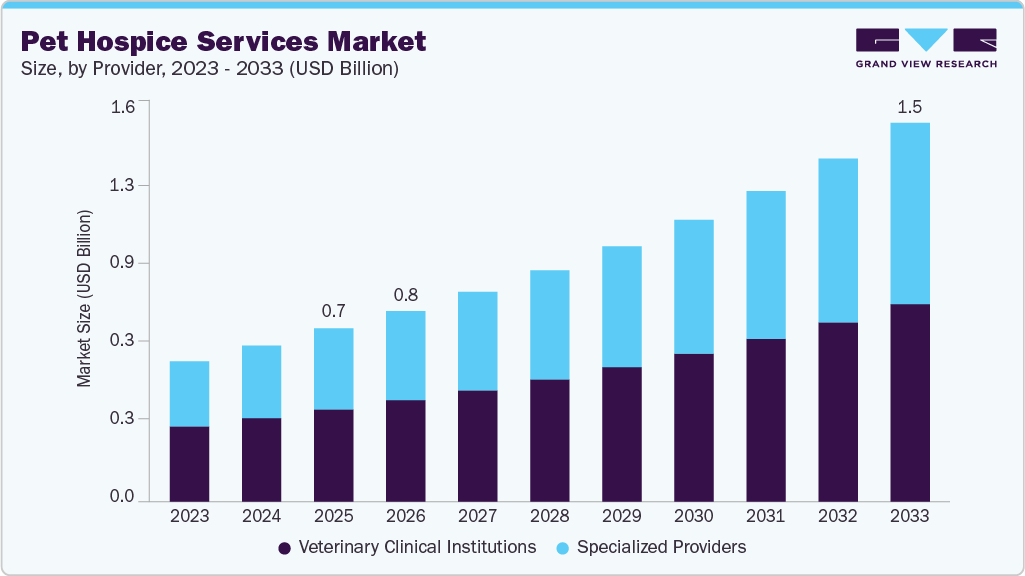 To learn more about this report, Download Free Sample Report
 Cancer represents the most clinically significant terminal condition driving hospice referrals. According to a December 2025 publication by PetMD, approximately 25%, i.e., around 1 in 4, of dogs will develop some form of cancer during their lifetime, with that figure rising to nearly 50% among dogs over 10 years of age. Certain breeds carry disproportionate oncological risk. For instance, as per a March 2026 publication by ImpriMed, 60% of Golden Retrievers are estimated to die of cancer-related causes, with the breed accounting for 9.25% of all diagnosed canine lymphoma and leukemia cases.
The four most prevalent malignancies, namely lymphoma, hemangiosarcoma, osteosarcoma, and mast cell tumors, collectively account for approximately 80% of cancer-related fatalities in this breed alone. Since curative outcomes remain limited across most of these diagnoses, a substantial proportion of affected animals transition into palliative or hospice care frameworks focused on comfort and quality-of-life management rather than disease reversal.
Beyond oncology, the geriatric pet cohort presents with multi-morbidity patterns, including concurrent renal insufficiency, cardiac disease, degenerative joint conditions, and neurological decline, that further fuel demand for structured hospice protocols. Academic institutions have recognized this clinical imperative; NC State's Omega Transitional Care Service and similar programs at veterinary colleges are operationalizing structured hospice pathways precisely in response to rising caseloads of terminally ill companion animals.
Furthermore, as pets are increasingly viewed as family members, owners are more willing to invest in palliative care interventions that prioritize dignified, managed decline over aggressive curative treatment, converting what was previously an unaddressed clinical gap into an active, growing service category.
 To learn more about this report, Download Free Sample Report
 Market Characteristics & Concentration
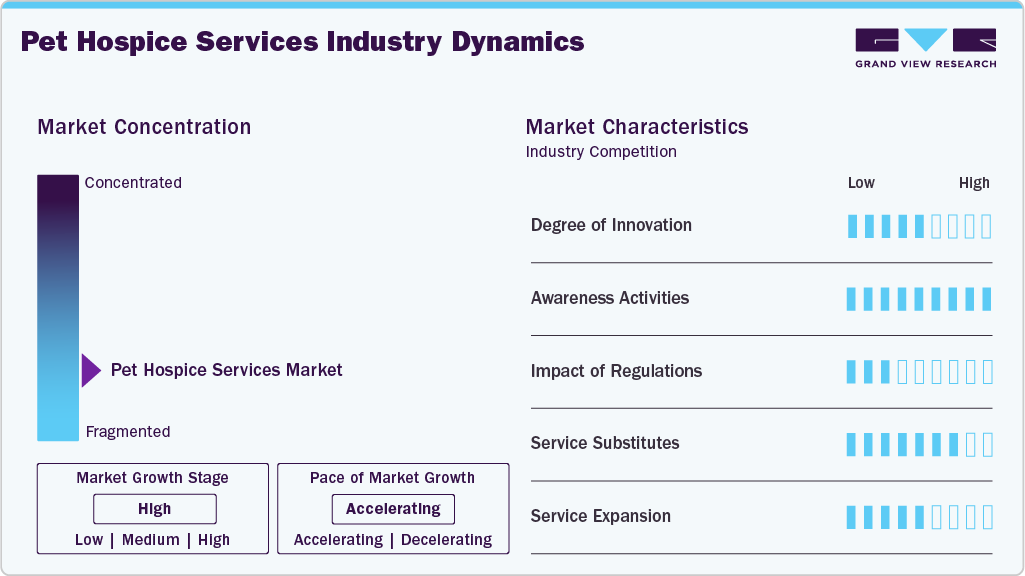
The global pet hospice services industry remains highly fragmented, with no single provider commanding a dominant share across geographies. The competitive landscape is bifurcated between large, multi-specialty veterinary hospital networks, which incorporate hospice and palliative care as an ancillary service line within broader clinical offerings, and dedicated specialized providers operating exclusively within the end-of-life care space. Only a handful of players, notably VCA Animal Hospitals, AniCura, and IVC Evidensia, maintain a meaningful multinational footprint, primarily through network acquisitions across North America and Europe. The majority of the market participants, including dedicated hospice-focused operators, remain regionally or locally concentrated, with consolidation activity and cross-border service standardization still at an early stage globally.
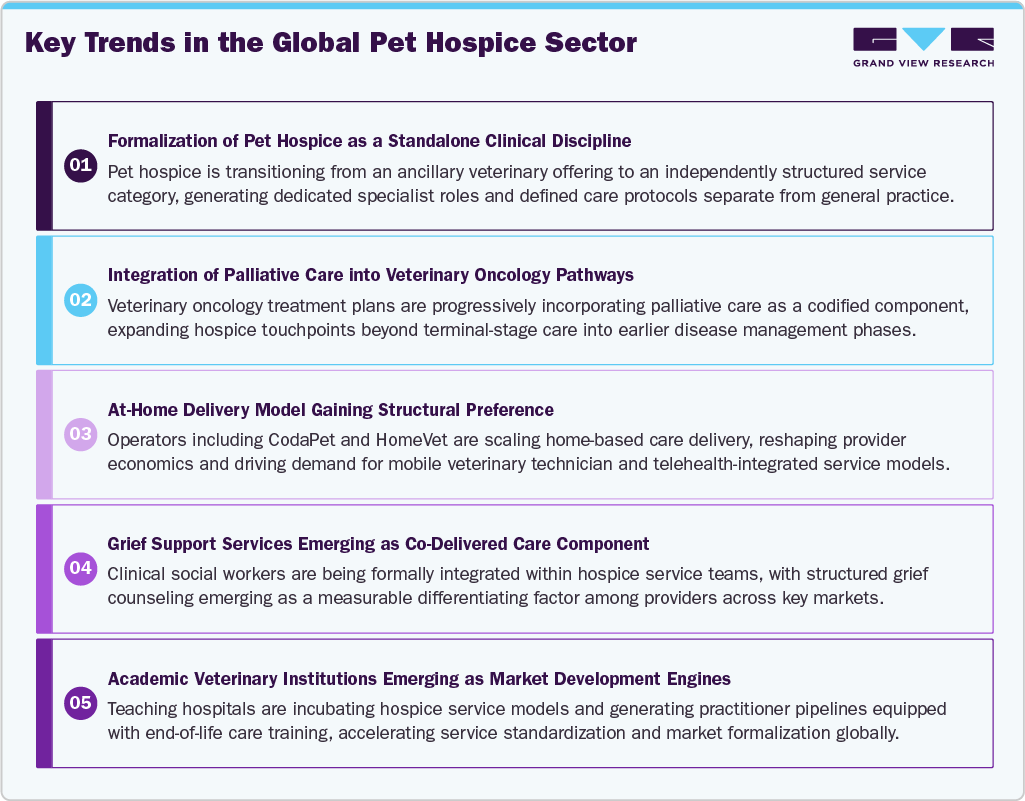
Innovation within the pet hospice services industry remains incremental rather than transformative. The most tangible advancements are concentrated in at-home service delivery models, where platforms such as CodaPet have operationalized technology-assisted provider-to-client matching for in-home end-of-life care. Teleconsultation integration is gaining traction, enabling remote quality-of-life assessments between pet owners and hospice-trained veterinarians. In addition, structured pain-scoring tools and standardized palliative care protocols, advances largely driven by IAAHPC guidelines, are increasingly being adopted across provider categories. However, purpose-built technology infrastructure specifically designed for veterinary hospice workflows remains limited across most geographies.
 To learn more about this report, Download Free Sample Report
 Awareness around pet hospice and palliative care as a distinct clinical discipline, separate from euthanasia, is gaining momentum. The International Association for Animal Hospice and Palliative Care (IAAHPC) remains the most influential body driving provider education, disseminating clinical guidelines, and raising public awareness globally. Academic veterinary institutions are making meaningful contributions; NC State's Omega Transitional Care Service actively positions pet hospice as a defined care pathway rather than an afterthought to curative treatment. Furthermore, veterinary publications are increasingly covering hospice care as a standalone practice area, lending clinical legitimacy to the field among practicing veterinarians.
Veterinary hospice services operate within existing veterinary practice regulations across most jurisdictions, with no dedicated regulatory framework governing pet hospice or palliative care as a standalone discipline. This absence of hospice-specific legislation creates operational inconsistencies across geographies, particularly regarding the scope of practice for non-veterinarian hospice caregivers and at-home service protocols. Controlled substance access for pain management, a critical component of palliative care delivery, remains subject to jurisdiction-specific narcotics regulations, directly constraining the quality and consistency of hospice care that providers can deliver across markets.
The primary alternative to structured pet hospice care is owner-managed home care, in which pet owners independently administer comfort measures without formal veterinary hospice oversight. General practice veterinarians providing ad-hoc palliative consultations outside any structured hospice framework represent an additional substitution pathway. Euthanasia, while categorically distinct from hospice care, functions as a substitute in areas where hospice awareness and accessibility remain limited, with owners opting for immediate end-of-life intervention over a managed palliative care period. The availability and relatively lower cost of these alternatives moderate willingness to pay for dedicated hospice services, particularly across price-sensitive and emerging markets.
The pet hospice services industry is witnessing gradual but measurable service expansion across both delivery formats and geographies. At-home hospice, historically concentrated in North America and select Western European markets, is extending into Australia and select Asia Pacific urban centers, driven by rising pet humanization and owner preference for familiar, low-stress end-of-life environments. Institutionally, specialized veterinary hospitals are increasingly formalizing dedicated palliative care units within existing clinical infrastructure. Moreover, species coverage is expanding beyond dogs and cats, with IAAHPC guidelines acknowledging the applicability of palliative care across a wider range of pet species.
Service Insights
The at-home hospice segment led the market with the largest revenue share of 56.6% in 2025 and is expected to grow at the fastest CAGR over the forecast period. The segment's dominance is attributable to strong, consistent owner preference for delivering end-of-life care in familiar home environments, which minimizes patient stress and preserves the human-animal bond during terminal decline. At-home hospice eliminates the logistical and psychological burden of repeated clinical visits for both the pet and owner. Furthermore, the scalable, low-overhead operational model adopted by dedicated providers such as CodaPet and HomeVet has accelerated geographic penetration, making at-home hospice care more accessible across suburban and semi-urban markets than institution-based alternatives.
 To learn more about this report, Download Free Sample Report
 The at-institution hospice segment is showcasing lucrative growth. The growth is driven by the increasing availability of advanced pain management infrastructure, multidisciplinary clinical teams, and diagnostic capabilities within specialized veterinary facilities, which cannot be replicated in home settings. Terminally ill pets with complex, multi-morbidity presentations requiring continuous monitoring benefit directly from institution-based care. In addition, the progressive formalization of dedicated palliative care units within large veterinary hospital networks, such as VCA Animal Hospitals and BluePearl Holdings LLC, is expanding institutional hospice capacity. Academic veterinary programs are further contributing structured, protocol-driven hospice pathways, lending clinical credibility to the segment.
Pet Insights
The dogs segment accounted for the largest market revenue share in 2025, driven by disproportionately high incidence of terminal illness within the canine population, particularly cancer and age-associated chronic conditions, which generate a structurally significant hospice-eligible patient base. In addition, dogs typically require more resource-intensive palliative care protocols than other pet categories, given their size, pain management complexity, and longer average hospice duration, resulting in higher per-patient revenue. The comparatively higher per-pet healthcare expenditure associated with dogs, supported by greater pet insurance penetration in this category, further consolidates their leadership in revenue share within this segment.
The cats segment is anticipated to grow at the fastest CAGR over the forecast period, due to rising recognition of feline-specific palliative care needs, an area historically underdeveloped relative to canine hospice. Cats present with distinct terminal illness profiles, including chronic renal disease, hyperthyroidism, and feline lymphoma, conditions whose prevalence is rising within an increasingly aging domestic cat population. Furthermore, the development of feline-specific hospice and palliative care guidelines by IAAHPC has provided clinical practitioners with structured protocols tailored to feline physiology and behavior, directly expanding the provider base equipped to manage feline hospice cases. Growing cat ownership across urban markets, particularly across the Asia Pacific and Europe, is also broadening the addressable patient population for this segment.
Regional Insights
North America dominated the global pet hospice services market with the largest revenue share of 42% in 2025. The region's leading position is attributable to a high density of specialized veterinary institutions, advanced pet humanization trends, and an established regulatory environment. IAAHPC's presence within the region has accelerated clinical protocol development and provider training. Large networks, including VCA Animal Hospitals and BluePearl Holdings LLC, have progressively expanded palliative care service lines, while dedicated operators continue to expand their geographic footprints across the region.
 To learn more about this report, Download Free Sample Report
 U.S. Pet Hospice Services Market Trends
The pet hospice services market in the U.S. accounted for the largest market share in North America in 2025, owing to the concentrated presence of both large veterinary hospital networks and dedicated hospice-specific operators that provide extensive service coverage across urban and suburban geographies. The country's comparatively higher per-pet healthcare expenditure, growing pet insurance penetration, and deeply entrenched pet humanization culture collectively sustain demand for structured hospice services. In addition, IAAHPC's clinical guideline infrastructure and the emergence of academic hospice programs such as NC State's Omega Transitional Care Service further position the U.S. as the region's most developed pet hospice market.
The Mexico pet hospice services marketis expected to grow at the fastest CAGR during the forecast period, advancing from a nascent base. Rising pet ownership rates across urban centers, combined with a growing middle-class demographic increasingly willing to invest in companion animal healthcare, are gradually expanding the sector. Progressive exposure to North American pet care trends, facilitated by geographic proximity and cross-border cultural influence, is accelerating Mexican pet owners' awareness of structured end-of-life care options. Furthermore, increasing veterinary infrastructure development within metropolitan areas such as Mexico City and Guadalajara is creating foundational capacity for hospice service delivery, positioning the market for accelerated, albeit early-stage, expansion over the forecast period.
Europe Pet Hospice Services Market Trends
The pet hospice services market in Europe is growing steadily, as the region is a mature geography characterized by a well-established veterinary healthcare infrastructure and increasingly deepening pet humanization trends across Western and Northern Europe. The region benefits from the operational presence of large multi-specialty veterinary networks, such as AniCura and IVC Evidensia, that are incrementally formalizing palliative care as a structured service line. Pet insurance adoption across several European markets is comparatively advanced relative to global averages, supporting owner capacity to finance end-of-life care. Furthermore, growing veterinary oncology capabilities across the region are generating higher volumes of terminal diagnoses transitioning into hospice pathways. Awareness of pet hospice as a distinct clinical discipline, separate from euthanasia, is gradually broadening beyond established markets into previously underserved European territories.
The UK pet hospice services market held a significant share in Europe in 2025. This dominance can be attributed to a combination of high pet ownership rates, an established veterinary infrastructure, and growing owner awareness around end-of-life care options. Furthermore, the presence of organized veterinary bodies such as the RCVS, alongside increasing specialist palliative care training, has accelerated service formalization. Moreover, a strong human-animal bond culture and relatively higher per-capita veterinary spending position the U.K. ahead of its continental peers in the adoption of structured hospice services.
The pet hospice services market is expected to grow rapidly over the forecast period, driven by the country's advanced integration of "One Health" principles into veterinary practice, which has organically elevated palliative care to a clinical standard rather than an optional service. Swedish veterinary academic institutions have progressively incorporated end-of-life care curricula, generating a pipeline of practitioners equipped to deliver structured hospice services. In addition, Sweden's well-developed home healthcare delivery infrastructure, already mature in the human medical sector, is being adapted for at-home pet hospice models, significantly reducing deployment barriers.
Asia Pacific Pet Hospice Services Market Trends
The pet hospice services market in the Asia Pacific is projected to register at the fastest CAGR over the forecast period. China's aging pet population is driving demand for geriatric comfort care, while Japan's declining euthanasia rates indicate a cultural shift favoring hospice utilization. India is witnessing early-stage market formalization through infrastructure investments and the emergence of pioneering palliative care practitioners. Australia contributes incremental volume through expanding at-home care models. Overall, the regional dynamics position Asia Pacific as the most growth-intensive market.
The China pet hospice services market held the largest revenue share in the Asia Pacific in 2025. The growth is attributable to the sheer scale of its companion animal population, which has aged considerably following the pet ownership surge of the early 2010s. This demographic shift has created a substantial base of geriatric pets requiring terminal and comfort care management. Furthermore, rising disposable incomes among urban pet owners have increased their willingness to invest in quality-of-life-focused veterinary services beyond conventional treatment, directly expanding the addressable hospice services market.
The pet hospice services market in India is anticipated to grow significantly during the forecast period. The growth is driven by the emergence of dedicated veterinary multispecialty infrastructure, as evidenced by facilities such as the SuperPets hospital in Mumbai, incorporating advanced critical care capabilities. Moreover, pioneering practitioners are actively formalizing palliative care protocols within Indian veterinary practice. For instance, the Animal Comfort Care Centre founded by Dr. Anupam Sharma, which focuses on comprehensive palliative care for pets. In addition, institutional recognition is advancing, with Kerala developing its second dedicated animal hospice center, signaling a broader shift toward hospice as a structured, standalone veterinary service category.
Latin America Pet Hospice Services Market Trends
The pet hospice services market in Latin America is gaining traction, driven by Brazil's advancing veterinary research, as documented in published palliative care protocols specifically addressing the management of companion animal suffering. Brazil's academic veterinary institutions have been instrumental in developing region-specific palliative frameworks. Moreover, Argentina's relatively mature small animal veterinary practice culture is progressively integrating comfort-focused end-of-life care as a formalized service offering within established clinical settings.
The Brazil pet hospice services marketis gaining momentum, supported by growing veterinary oncology research output and by published literature specifically addressing practical palliative care principles for companion animals. Brazilian veterinary academia has been instrumental in developing regionally applicable end-of-life care protocols, translating clinical research into practice-level frameworks. Furthermore, Brazil's comparatively advanced small-animal veterinary sector in Latin America provides an existing institutional foundation for the progressive development of structured hospice service delivery.
Middle East & Africa Pet Hospice Services Market Trends
The pet hospice services market in the Middle East & Africa is supported by the gradual professionalization of veterinary practice across the African region and GCC countries, where rising standards of companion animal care are beginning to extend to end-of-life service considerations. South Africa's relatively developed veterinary clinical infrastructure within the African continent provides a foundational base for early hospice service adoption. In addition, increasing urbanization across select MEA markets is fostering closer human-animal bonds, incrementally shifting owner expectations toward comfort-oriented terminal care options.
The South Africa pet hospice services marketis expanding, fueled by comparatively advanced veterinary clinical infrastructure relative to regional peers, which provides an existing institutional framework for integrating structured palliative care services. The presence of established small animal veterinary practices in urban centers such as Johannesburg and Cape Town is facilitating the gradual incorporation of hospice-oriented service lines. Furthermore, growing awareness among South African pet owners regarding quality-of-life management for terminally ill companion animals is incrementally shaping demand for formalized end-of-life care.
The pet hospice services market in the UAE is expected to register at a significant CAGRover the forecast period. The country is driven by a rapidly modernizing veterinary healthcare ecosystem and a notably high concentration of expatriate pet owners accustomed to advanced standards of companion animal care in their countries of origin. Dubai and Abu Dhabi have witnessed progressive investments in multi-specialty veterinary facilities, creating an institutional platform conducive to hospice service integration. Moreover, the UAE's regulatory environment has shown increasing receptivity to specialized veterinary services, accelerating formal market development.
Key Pet Hospice Services Company Insights
The global pet hospice services industry remains fragmented, with no single operator commanding a dominant share. VCA Animal Hospitals and BluePearl Holdings LLC lead among institutional providers in North America, leveraging established multispecialty networks. AniCura and IVC Evidensia have a strong presence across European markets. Specialized providers, including CodaPet, HomeVet, and Creature Comfort Clinic LLC, are gaining traction through at-home service models. Dignipets Ltd and Evergreen Veterinary represent emerging dedicated hospice operators globally.
Key Pet Hospice Services Companies:
The following key companies have been profiled for this study on the pet hospice services market.
- VCA Animal Hospitals
- AniCura
- IVC Evidensia
- Creature Comfort Clinic LLC
- HomeVet
- BluePearl Holdings LLC
- Vetessential Healthcare Sdn Bhd.
- Evergreen Veterinary
- CodaPet
- Dignipets Ltd
Recent Developments
-
In March 2026, CVS launched its Collaborative Cancer Care service, which integrates teleoncology, advanced diagnostics, and pathology with explicit palliative care considerations within oncology treatment plans. This signals progressive mainstreaming of palliative care within institutional veterinary oncology pathways, directly broadening service penetration.
-
In January 2026, Ireland launched its first dedicated pet palliative service, marking a significant milestone in European market formalization, indicating that hospice care for companion animals is transitioning from an ancillary veterinary offering to a recognized standalone service category across previously underpenetrated markets.
-
In April 2025, NC State Veterinary Hospital launched its Omega Transitional Care service, offering outpatient palliative care for terminally ill dogs and cats through hospital, telemedicine, and home visit appointment formats, integrating quality-of-life assessments, pain management, and owner counseling. This institutionalization of dedicated transitional care within a major veterinary teaching hospital signals accelerating academic-level formalization of hospice as a distinct clinical discipline, with direct implications for practitioner pipeline development and long-term service penetration.
Pet Hospice Services Market Report Scope
Report Attribute
Details
Market size in 2025
USD 699.9 million
Estimated market size in 2026
USD 800 million
Projected market size by 2033
USD 1500 million
Growth rate
CAGR of 10.3% from 2026 to 2033
Base year for estimation
2025
Historical data
2021 - 2024
Forecast period
2026 - 2033
Quantitative units
Revenue in USD million/billion, and CAGR from 2026 to 2033
Report coverage
Revenue forecast, company ranking, competitive landscape, growth factors, and trends
Segments covered
Service, pet, provider, region
Regional scope
North America; Europe; Asia Pacific; Latin America; MEA
Country scope
U.S.; Canada; Mexico; UK; Germany; France; Italy; Spain; Denmark; Sweden; Norway; Japan; China; India; Thailand; South Korea; Australia; Brazil; Argentina; South Africa; UAE; Saudi Arabia; Kuwait; Qatar; Oman
Key companies profiled
VCA Animal Hospitals; AniCura; IVC Evidensia; Creature Comfort Clinic LLC; HomeVet; BluePearl Holdings LLC; Vetessential Healthcare Sdn Bhd.; Evergreen Veterinary; CodaPet; Dignipets Ltd
Customization scope
Free report customization (equivalent up to 8 analysts working days) with purchase. Addition or alteration to country, regional & segment scope.
Pricing and purchase options
Avail customized purchase options to meet your exact research needs. Explore purchase options
Global Pet Hospice Services Market Report Segmentation
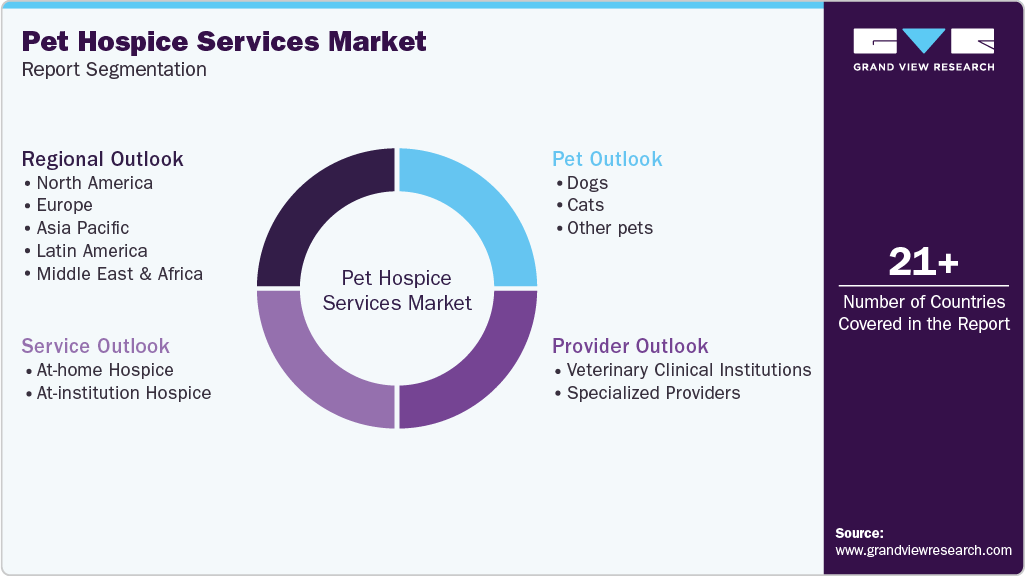
This report forecasts revenue growth at global, regional, and country levels and provides an analysis of the latest industry trends in each of the sub-segments from 2021 to 2033. For this study, Grand View Research has segmented the global pet hospice services market report based on service, pet, provider, and region:
 To learn more about this report, Download Free Sample Report
 -
Service Outlook (Revenue, USD Million, 2021 - 2033)
-
At-home Hospice
-
At-institution Hospice
-
-
Pet Outlook (Revenue, USD Million, 2021 - 2033)
-
Dogs
-
Cats
-
Other pets
-
-
Provider Outlook (Revenue, USD Million, 2021 - 2033)
-
Veterinary Clinical Institutions
-
Specialized Providers
-
-
Region Outlook (Revenue, USD Million, 2021 - 2033)
-
North America
-
U.S.
-
Canada
-
Mexico
-
-
Europe
-
UK
-
Germany
-
France
-
Italy
-
Spain
-
Denmark
-
Sweden
-
Norway
-
-
Asia Pacific
-
Japan
-
China
-
India
-
Australia
-
Thailand
-
South Korea
-
-
Latin America
-
Brazil
-
Argentina
-
-
Middle East & Africa
-
South Africa
-
UAE
-
Saudi Arabia
-
Kuwait
-
Qatar
-
Oman
-
-
Frequently Asked Questions About This Report
North America dominated with a 42.0% revenue share in 2025.
Asia Pacific is the fastest-growing region over the forecast period.
The dogs segment held the largest revenue share in 2025, while the cats segment is the fastest-growing.
At-home hospice dominated the service segment, accounting for a share of over 56.0% in 2025 and is expected to grow at the fastest rate over the forecast period. The segment's dominance is attributable to strong and consistent owner preference for delivering end-of-life care within familiar home environments, which minimizes patient stress and preserves the human-animal bond during terminal decline.
The global pet hospice services market size was estimated at USD 699.9 million in 2025 and is expected to reach USD 800 million in 2026.
The global pet hospice services market is expected to grow at a compound annual growth rate of 10.3% from 2026 to 2033 to reach USD 1,500 million by 2033.
Some key players operating in the pet hospice services market include VCA Animal Hospitals, AniCura, IVC Evidensia, Creature Comfort Clinic LLC, HomeVet, BluePearl Holdings LLC, Vetessential Healthcare Sdn Bhd., Evergreen Veterinary, CodaPet, and Dignipets Ltd
Key factors that are driving the market growth include surging demand for at-home pet hospice services, rising geriatric and terminally ill pet population accelerating palliative care uptake, efforts towards clinical standardization of animal hospice protocols, and growing awareness initiatives normalizing pet hospice conversations.
About the Author(s)
Animal Health Research Team
Healthcare · Animal HealthThis report was authored by the animal health research team at Grand View Research - comprising two research analysts, one senior research analyst, and one industry expert - with specialized expertise in the animal health segment of the healthcare industry. All findings are based on proprietary healthcare databases, executive interviews, and regulatory analysis, subject to internal peer review prior to publication.
Last Updated:
Speak to Analyst

Customize this report to your needs - add regions, segments, or data points, with 20% free customization.
Or view our licence options:


ISO 9001:2015 & 27001:2022 Certified
We are GDPR and CCPA compliant! Your transaction & personal information is safe and secure. For more details, please read our privacy policy.


