
- Home
- »
- Medical Devices
- »
-
Picosecond Lasers Market Size & Share Report, 2026-2033GVR Report cover

Picosecond Lasers Market (2026 - 2033)
Size, Share & Trends Analysis Report By Technology (ND: YAG, Alexandrite), By Application (Tattoo Removal, Melasma, Skin Rejuvenation, Pigmented Lesions), By End-use (Dermatology Clinics, Others), By Region, And Segment Forecasts
Market Size, 2025
$1.1BMarket Estimate, 2026
$1.2BMarket Forecast, 2033
$2.2BCAGR, 2026–2033
9.7%Picosecond Lasers Market Summary
The global picosecond lasers market was valued at USD 1.1 billion in 2025 and is projected to grow from USD 1.2 billion in 2026 to USD 2.2 billion in 2033, at a CAGR of 9.7% from 2026 to 2033. North America dominated the market, accounting for a revenue share of 42.7% in 2025. The market is expected to witness growth due to several factors such as an increase in procedures for tattoo removal, recognition of picosecond lasers as a treatment for various dermatological ailments such as melasma & solar lentigines, and growing awareness and adoption of non-invasive aesthetic treatment.
Key Market Trends & Insights
- By technology: The ND: YAG segment held the largest market share of around 63.0% in 2025.
- By application: The tattoo removal segment held the largest market share of over 41.0% in 2025.
- By end-use: The picosecond laser segment held the largest market share of over 56.0% in 2025.
Regional Insights
- Largest regional market: North America (47.0% revenue share, 2025)
- Fastest-growing regional market: Asia Pacific (highest CAGR, 2026-2033)
Market Size & Forecast
- Market size in 2025: USD 1.1 Billion
- Estimated market size in 2026: USD 1.2 Billion
- Projected market size by 2033: USD 2.2 Billion
- CAGR (2026-2033): 9.7%
Three ways to get this report
Buy it, customize it, or ask a question.Ask an Analyst
A direct answer, usually in 1 working day
- AccessReport author, directly
- Reply timeWithin 1 working day
- No sales callDirect answer only
- FormatEmail reply
- CostFree, no cost
Get the Full Report
What the study covers
- FormatsPDF · Excel · Dashboard
- Timeline2026–2033 annual, 2025 base
- Coverage20+ countries, 5 regions
- Companies10+ key players profiled
Customize the Report
20% free customization
- IncludeCountries, segments, points
- TailorTo your product definition
- ExtendDeeper competitor detail
- OrA fully bespoke study
- Turnaround5–10 working days
Picosecond laser belongs to the category of ultrafast lasers, which emit optical pulses between 1 picosecond to some tens of picoseconds. In addition, compared to traditional lasers, picosecond lasers offer shorter pulse durations, which minimize heat buildup in the skin and reduce the risk of adverse effects. It allows patients to undergo treatments with less downtime and discomfort.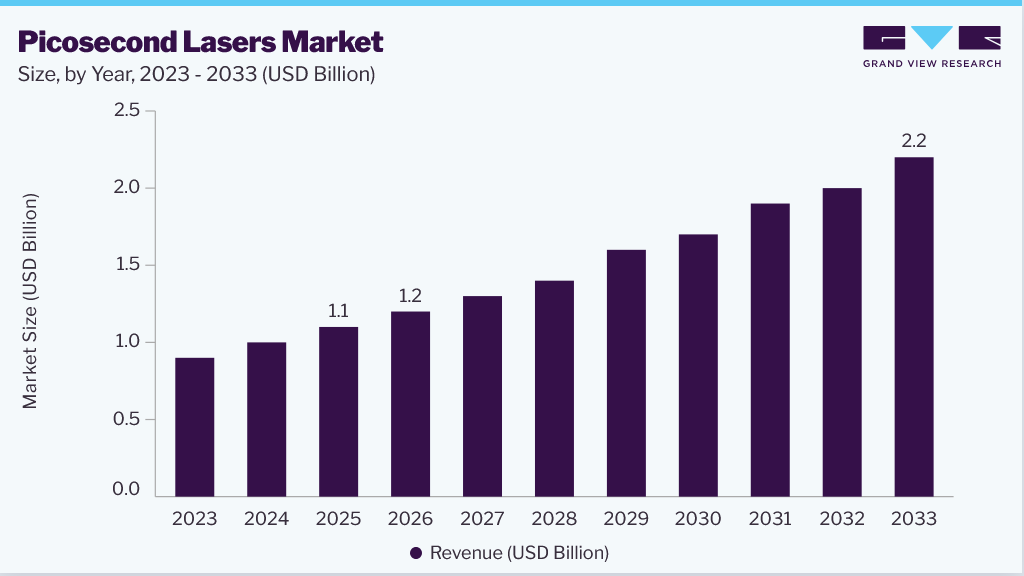 Source: Grand View Research, IR Documents, Primary Interviews, Paid DatabasesTo learn more about this report,
 Download Free Sample Report
 The growing number of tattoo removal procedures is expected to drive market growth. The prevalence of “tattoo regret” in millennials propels the need for picosecond lasers. The increasing recognition of picosecond lasers to treat various dermatological conditions and the integration of different laser types in a single product aid the market growth of picosecond lasers. Moreover, market leaders are upgrading their established products to increase their efficiency and treat various dermatological conditions.
Analyst Perspective
The picosecond lasers market is transforming from an aesthetic-centric niche segment to a broad dermatology and medical aesthetics domain owing to increasing demand for minimally invasive, high-precision treatment solutions for tattoo removal and pigmentation correction. Increasing clinician demand for shorter treatment time, less frequent sessions, and safer results compared to conventional laser devices will drive growth.
Most manufacturers are moving toward the development of multi-wavelength and sophisticated platforms to increase the breadth of treatment applications in dermatology. High device costs and stringent regulatory issues serve as the primary constraints, particularly in developing economies.
Technology Insights
The ND: YAG segment dominated the picosecond laser industry with a revenue share of 63.0% in 2025. ND: YAG or neodymium-doped yttrium aluminum garnet crystal emits 532 nm and 1064nm lasers, along with a combination of unique wavelengths to treat different dermatological conditions and procedures. For example, ND: YAG picosecond lasers working at 1064-532 nm effectively remove tattoos with minimal or no scarring across skin types and tattoo colors. In addition, these lasers assure fewer sessions with significant visual improvements than those of other laser systems in the market.
The alexandrite segment is estimated to witness the fastest CAGR during the forecast period. The growth of the segment can be attributed to the increasing medical literature supporting the use of alexandrite lasers to treat post-inflammatory hyperpigmentation (PIH). For instance, in January 2025, a randomized evaluator-blinded clinical trial published in Lasers in Medical Science reported that a 755-nm picosecond alexandrite laser system showed comparable efficacy and safety to combined Q-switched and long-pulse ND: YAG lasers in melasma treatment, supporting its growing clinical adoption in pigmentary disorders.
Application Insights
Based on application, Tattoo removal dominated the market with a revenue share of more than 41.0% in 2025 and is estimated to grow at the fastest CAGR during the forecast period. The market for picosecond lasers is segmented into tattoo removal, pigmented lesions, skin rejuvenation, melasma, and others. Picosecond lasers are distinguished as a “gold-standard” laser for removing tattoos of different colors and skin types. The shorter pulse duration offered by picosecond lasers improves their efficacy during the process. Furthermore, tattoo removal was conferred as “1a” according to the level of evidence, thereby confirming its use in the marketplace.
Moreover, the application of pigmented lesions is expected to offer significant growth opportunities during the forecast period. According to the article published in the Korean Society for Laser Medicine and Surgery, a 250-picosecond laser was deemed effective in treating pigmented lesions. Furthermore, the study indicated that using a low-wavelength picosecond laser to treat pigmented lesions offers better results; thereby, manufacturers are anticipated to target their product launch in this wavelength to improve clinical outcomes from a picosecond laser.
End-use Insights
Based on end-use, the picosecond laser market is segmented into dermatology clinics, med spas & aesthetic centers, and others. Med spas & aesthetic centers dominated the market with the largest revenue share of more than 56.0% in 2025. The segment is estimated to grow at the fastest CAGR of xx% during the forecast period. Medical spas offer various benefits for cosmetic procedures such as skin rejuvenation, acne treatment, and others.
Moreover, according to the American Med Spa Association (AMSA), a significant increase in demand has been noticed for minimally invasive treatments such as tattoo removal and skin enhancement. Furthermore, the growing single-ownership trend in the med spas aids the segment growth. For instance, the American Med Spa Association (AmSpa) 2024 Medical Spa State of the Industry Report estimated 81.0% of medical spas in the U.S. were deemed under single ownership, with 67.0% of single-owner practices owned by non-MDs/surgeons.
Regional Insights
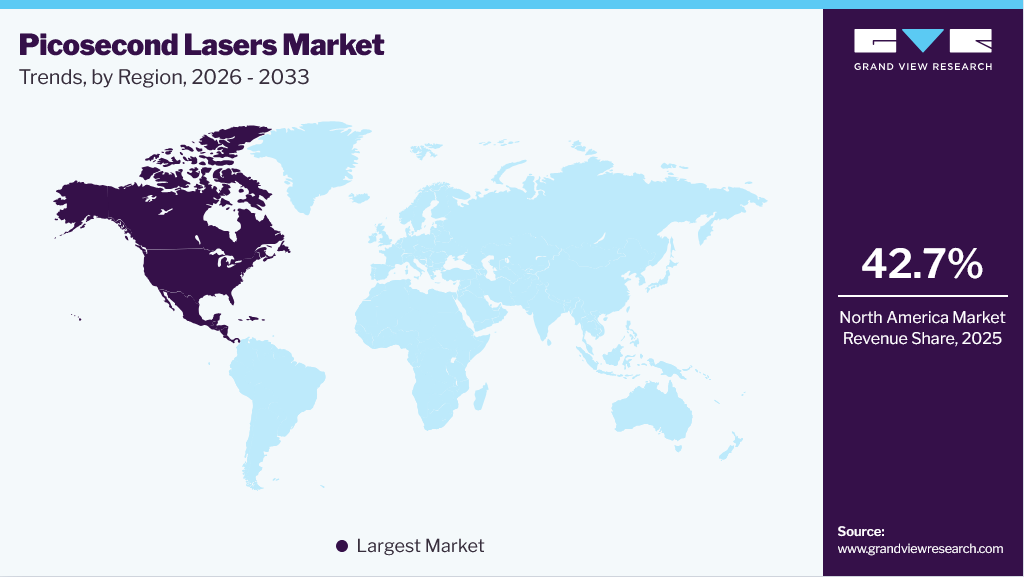
North America dominated the global picosecond laser Industry with a revenue share of 42.7% in 2025. This share is attributed to the high acceptance rate for cosmetic surgeries amongst the population, technological advancements in both surgical and non-surgical techniques, and accessibility and availability of skilled professionals for different dermatological conditions. For instance, according to the American Society of Plastic Surgeons (ASPS), approximately 3,112,056 skin treatment procedures using combination lasers and 3,703,305 skin resurfacing procedures were performed in the U.S. in 2024. Such developments highlight the growth potential of this market.
 To learn more about this report, Download Free Sample Report
 Asia Pacific Picosecond Lasers Market Trends
The Asia Pacific region is expected to witness the fastest CAGR over the forecast period. The growth of the regional market can be attributed to the increasing importance of physical appearance, increasing penetration of social media in lifestyle, and technological advancements. For instance, in 2026, Cynosure Lutronic expanded its presence in APAC through regulatory approvals associated with advanced laser platforms in countries such as China and Japan, reinforcing Asia Pacific as a key growth hub for energy-based aesthetic devices, including picosecond laser technologies.l
Key Picosecond Lasers Market Company Insights
The market is highly competitive with a large number of manufacturers. The market players are focusing on various strategic initiatives such as new product launches, geographical expansions, mergers & acquisitions, collaborations, product upgrades, and partnerships.
Key Picosecond Lasers Companies
The following key companies have been profiled for this study on the picosecond lasers market.
-
Cynosure, LLC.
-
Cutera, Inc.
-
Candela Corporation.
-
Rohrer Aesthetics, Inc.
-
ADDS Group (ADDS Laser)
-
Fotona
-
Cynosure Lutronic
-
El.En. S.p.A.
-
Alma Laser (Sisram Medical)
Recent Developments
-
In January 2024, Quanta System announced the launch of Discovery PICO with VarioPulse Technology, their new picosecond laser device used to remove tattoo and rejuvenate the skin. This is expected to expand its aesthetic lasers portfolio and solidifying its position.
-
In October 2024, Lumibird signed an agreement to acquire the Continuum nanosecond laser product line and service business from Amplitude Laser Group.
Picosecond Lasers Market Report Scope
Report Attribute
Details
Market size in 2025
USD 1.1 billion
Estimated market size in 2026
USD 1.2 billion
Projected market size by 2033
USD 2.2 billion
Growth rate
CAGR of 9.7% from 2026 to 2033
Base year for estimation
2025
Actual data
2021 - 2024
Forecast period
2026 - 2033
Quantitative units
Revenue in USD billion, and CAGR from 2026 to 2033
Report coverage
Revenue forecast, company ranking, competitive landscape, growth factors, and trends
Segments covered
Technology, application, end-use, region
Regional Scope
North America; Europe; Asia Pacific; Latin America; MEA
Country Scope
U.S.; Canada; Germany; UK; France; Italy; Spain; Norway; Denmark; Sweden; China; Japan; India; Australia; Thailand; South Korea; Brazil; Mexico; Argentina; South Africa; Saudi Arabia; UAE; Kuwait
Key companies profiled
Cynosure, LLC.; Cutera, Inc.; Candela Corporation; Rohrer Aesthetics, Inc.; ADDS Group (ADDS Laser); Fotona; Cynosure Lutronic; El.En. S.p.A..; Alma Laser (Sisram Medical)
Customization scope
Free report customization (equivalent up to 8 analysts working days) with purchase. Addition or alteration to country, regional & segment scope.
Pricing and purchase options
Avail of customized purchase options to meet your exact research needs. Explore purchase options
Global Picosecond Lasers Market Report Segmentation
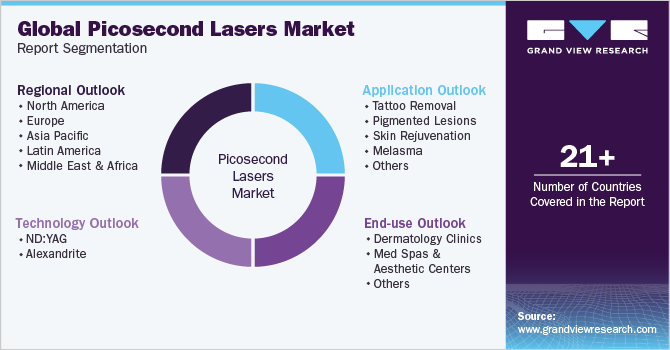
This report forecasts revenue growth at global, regional, and country levels and provides an analysis of the latest industry trends in each of the sub-segments from 2021 to 2033. For this study, Grand View Research has segmented the global picosecond lasers market report based on technology, application, end-use, and region:
 To learn more about this report, Download Free Sample Report
 -
Technology Outlook (Revenue, USD Million, 2021 - 2033)
-
ND:YAG
-
Alexandrite
-
-
Application Outlook (Revenue, USD Million, 2021 - 2033)
-
Tattoo Removal
-
Pigmented Lesions
-
Skin Rejuvenation
-
Melasma
-
Others
-
-
End-use Outlook (Revenue, USD Million, 2021 - 2033)
-
Dermatology Clinics
-
Med spas and Aesthetic Centers
-
Others
-
-
Regional Outlook (Revenue, USD Million, 2021 - 2033)
-
North America
-
U.S.
-
Canada
-
-
Europe
-
UK
-
Germany
-
France
-
Italy
-
Spain
-
Sweden
-
Norway
-
Denmark
-
-
Asia Pacific
-
China
-
Japan
-
India
-
Australia
-
Thailand
-
South Korea
-
-
Latin America
-
Brazil
-
Mexico
-
Argentina
-
-
Middle East and Africa
-
Saudi Arabia
-
South Africa
-
UAE
-
Kuwait
-
-
Frequently Asked Questions About This Report
North America dominated with a revenue share of 47.7% in 2025.
The global picosecond lasers market size was valued at USD 1.1 billion in 2025 and is estimated at USD 1.2 billion for 2026.
The global picosecond lasers market is expected to grow at a CAGR of 9.7% from 2026 to 2033, reaching USD 2.2 billion by 2033.
Key players include Cynosure, LLC.; Cutera, Inc.; Candela Corporation; Rohrer Aesthetics, Inc.; ADDS Group (ADDS Laser); Fotona; Cynosure Lutronic; El.En. S.p.A..; Alma Laser (Sisram Medical)
ND: YAG dominated the picosecond laser market with a share of 63.0% in 2025, while alexandrite is the fastest-growing segment.
About the Author(s)
Medical Devices Research Team
Healthcare · Medical DevicesThis report was authored by the medical devices research team at Grand View Research - comprising two research analysts, one senior research analyst, and one industry expert - with specialized expertise in the medical devices segment of the healthcare industry. All findings are based on proprietary healthcare databases, executive interviews, and regulatory analysis, subject to internal peer review prior to publication.
Last Updated:
Speak to Analyst

Customize this report to your needs - add regions, segments, or data points, with 20% free customization.
Or view our licence options:


ISO 9001:2015 & 27001:2022 Certified
We are GDPR and CCPA compliant! Your transaction & personal information is safe and secure. For more details, please read our privacy policy.


