
- Home
- »
- Petrochemicals
- »
-
Piperylene Market Size, Share & Trends Report, 2026-2033GVR Report cover
![Piperylene Market (2026 - 2033)Report]()
Piperylene Market (2026 - 2033)
Size, Share & Trends Analysis Report By Application (Plastics, Adhesives, Resin), By End-use (Automotive, Packaging, Construction, Consumer Goods, Industrial Manufacturing), By Region, And Segment Forecasts
Market Size, 2025
$1.5BMarket Estimate, 2026
$1.6BMarket Forecast, 2033
$2.2BCAGR, 2026–2033
5.2%Piperylene Market Summary
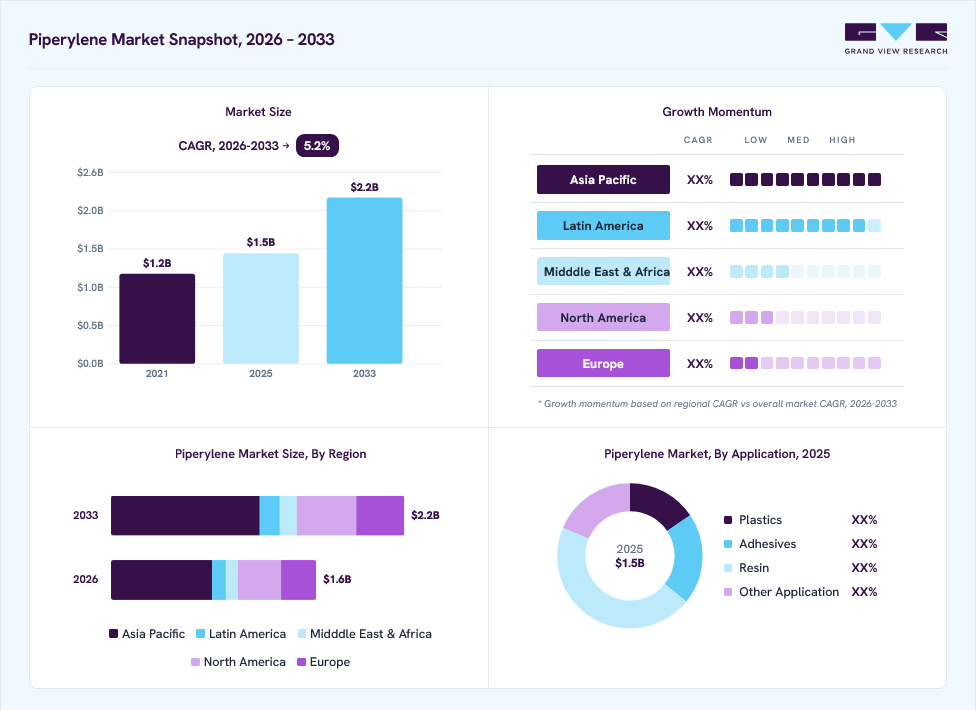
The global piperylene market size was valued at USD 1.5 billion in 2025 and is projected to grow from USD 1.6 billion in 2026 to USD 2.2 billion by 2033, expanding at a CAGR of 5.2% from 2026 to 2033. Asia Pacific dominated the market, accounting for the largest revenue share of 49.1% in 2025. Growing demand for C5-based petroleum resins used in adhesives, tapes, labels, coatings, and road-marking applications is supporting consumption of piperylene as a key feedstock.
Key Market Trends & Insights
- By application: The resin segment held the dominating revenue share of 45.4% in 2025.
- By end-use: The packaging segment held the dominating revenue share of 33.8% in 2025.
Regional Highlights
- Largest regional market: Asia Pacific (49.1% revenue share, 2025)
- By country: China held the largest market share in 2025
Market Size & Forecast
- Market size in 2025: USD 1.5 Billion
- Estimated market size in 2026: USD 1.6 Billion
- Projected market size by 2033: USD 2.2 Billion
- CAGR (2026-2033): 5.2%
The expansion of hot-melt and pressure-sensitive adhesive applications is particularly relevant, as C5 resins provide tack and adhesion properties required across packaging, construction, automotive, and industrial products. This downstream demand is strengthening the linkage between piperylene production and specialty resin manufacturing. The market also presents opportunities through greater utilization of C5 streams and downstream value addition.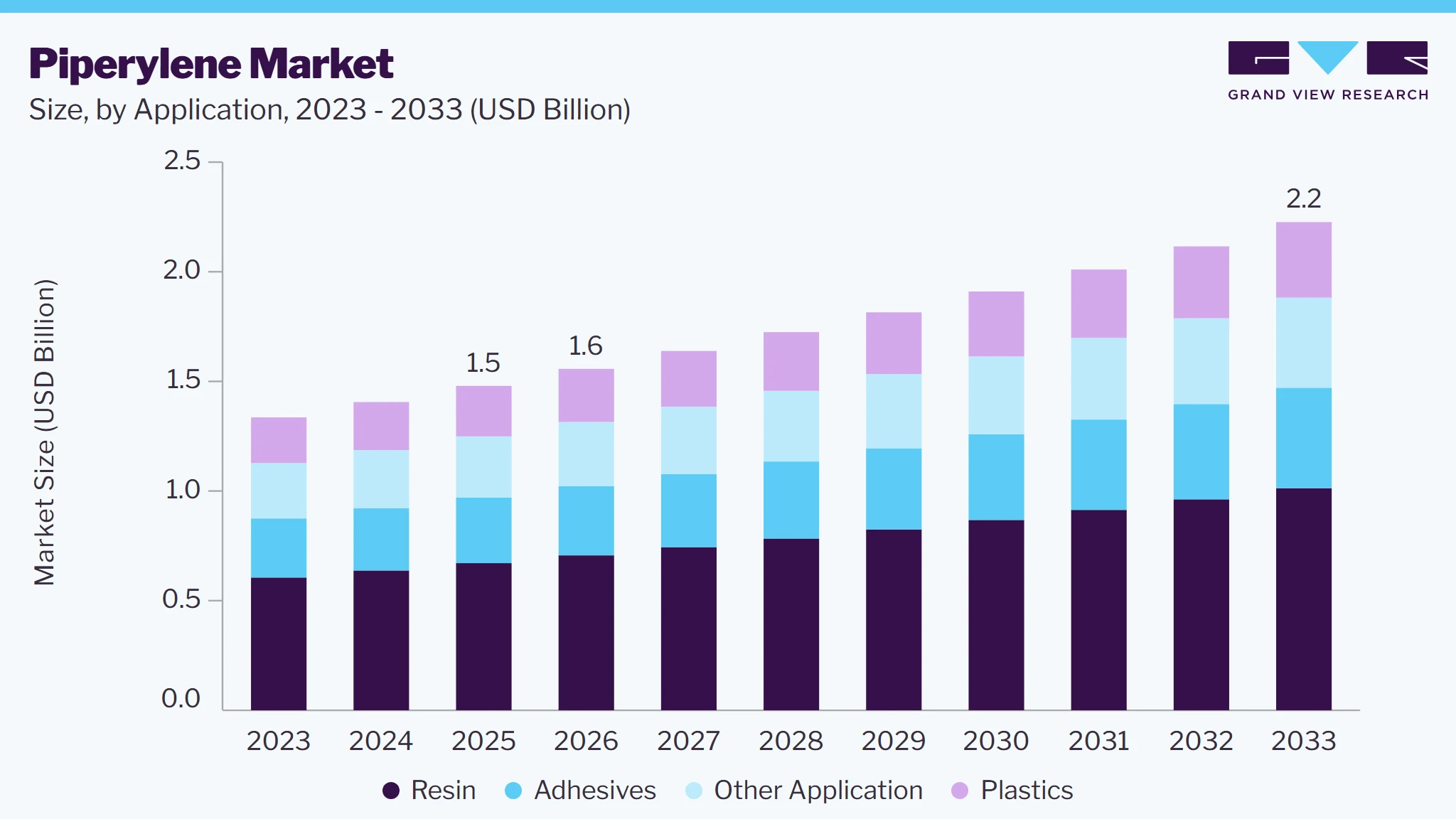
Producers with integrated recovery and fractionation capabilities can separate piperylene from mixed C5 streams and direct it to higher-value applications rather than lower-value outlets. Expansion of C5 processing infrastructure, higher-purity grades, and closer integration with resin manufacturing can therefore improve product economics and create opportunities for suppliers to strengthen their position across the value chain.
Market Dynamics
The market is shaped by the balance between C5 stream availability, downstream conversion economics, regional petrochemical infrastructure, and demand from derivative manufacturers. Supply is influenced by cracker feedstock selection and C5 recovery rates, while consumption depends on the operating conditions of resin, adhesive, coating, and polymer producers. Regional differences in petrochemical integration and downstream manufacturing capacity also create variations in product availability, pricing, and trade flows.
The growing use of high-performance adhesive systems across packaging, automotive components, construction materials, and industrial bonding applications is supporting demand for C5-based tackifying resins. Piperylene-derived resins offer desirable tack, compatibility, and moisture resistance, making them suitable for formulations that require consistent bonding performance.
The shift toward hot-melt and pressure-sensitive adhesive technologies is further supporting consumption of C5-based feedstocks. Increasing requirements for faster processing, reliable adhesion, and efficient manufacturing are encouraging adhesive producers to optimize resin formulations, creating a sustained downstream demand channel for piperylene.
Piperylene production is economically linked to upstream petrochemical operations, making producers sensitive to fluctuations in naphtha, crude oil, natural gas, and energy costs. Changes in these input costs can affect cracker economics and, in turn, influence the availability and cost structure of C5-derived products.
This exposure can create challenges for downstream users that require predictable procurement costs. Significant changes in upstream economics may also alter cracker operating rates or the attractiveness of recovering specific C5 components, introducing uncertainty into piperylene supply planning.
Increasing demand for specialty downstream formulations creates an opportunity for suppliers to develop and commercialize higher-purity and more consistently specified piperylene grades. Tighter control of composition can be valuable for downstream manufacturers seeking predictable polymerization behavior and consistent performance in resin and specialty chemical production.
Producers can capture additional value by moving beyond standard commodity supply toward application-specific grades, technical support, and customized specifications. This approach can strengthen customer retention while creating differentiation in a market where integrated producers otherwise compete largely on feedstock access and production economics.
Market Concentration & Characteristics
The piperylene industry has a moderately concentrated supply structure, with production largely associated with integrated petrochemical companies that recover piperylene from C5 streams generated by steam cracking and related processes. Companies such as LOTTE Chemical, LyondellBasell, Braskem, and other integrated producers combine upstream C5 recovery with downstream processing, creating advantages in feedstock access, production economics, and supply reliability.
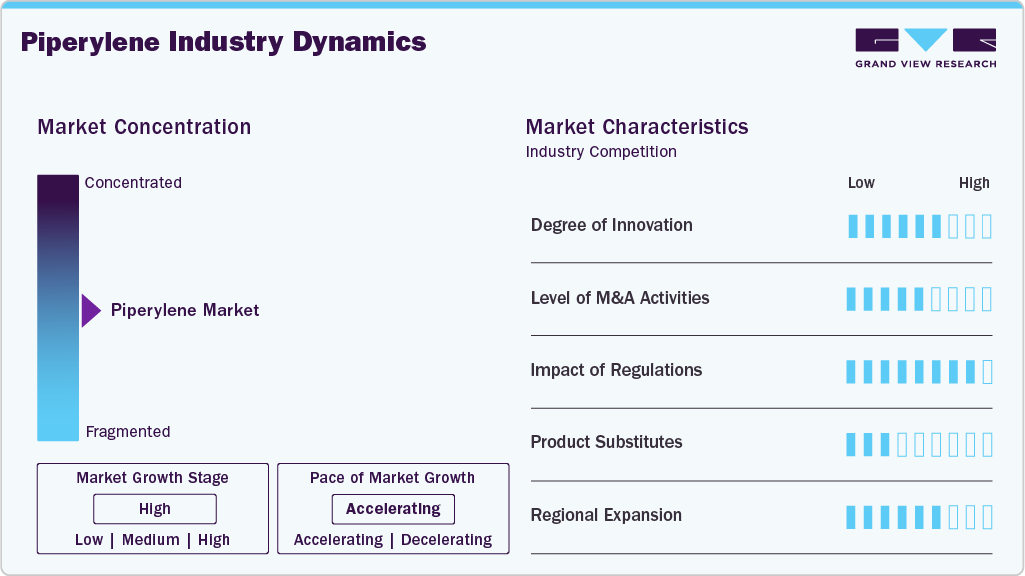
The market is characterized by a strong linkage between upstream cracker operations and downstream hydrocarbon-resin demand, making piperylene availability dependent on C5 stream composition, cracker utilization, and separation capacity. Product specifications also vary by downstream requirements, with producers offering different purity and composition profiles for resin, adhesive, ink, and other applications; this creates a market in which feedstock integration, purification capability, product consistency, and downstream relationships are key competitive differentiators.
Analyst Perspective
The market presents a strategically attractive position within the C5 petrochemical value chain, as producers can enhance value capture by converting C5 streams into higher value piperylene and downstream derivatives. The market's outlook is supported by increasing integration among C5 recovery, purification, and petroleum-resin production, creating opportunities for suppliers with strong access to feedstocks, processing capabilities, and downstream linkages.
Application Insights
The resin segment accounted for 45.4% of the market revenue in 2025, primarily supported by the established use of piperylene in C5 hydrocarbon resin production. These resins are widely incorporated into tackifiers, coatings, printing inks, and rubber formulations, creating a broad downstream consumption base. The diversity of resin applications helps sustain demand for piperylene across multiple industrial product categories.
Adhesives is the fastest-growing form segment, with a CAGR of 5.4% from 2026 to 2033, driven by the increasing use of C5-based tackifiers in pressure-sensitive and hot-melt adhesive formulations. Rising demand for efficient bonding solutions in packaging, labeling, and industrial assembly is encouraging greater utilization of tackifying resins, thereby supporting consumption of piperylene as a key upstream feedstock.
End-use Insights
Packaging accounted for the largest revenue share, at 33.8% in 2025, supported by the extensive use of C5-based resins in pressure-sensitive adhesives, labels, tapes, and flexible packaging applications. Piperylene-derived tackifiers enhance adhesion and processing performance, making them suitable for high-volume packaging formats that require consistent bonding.
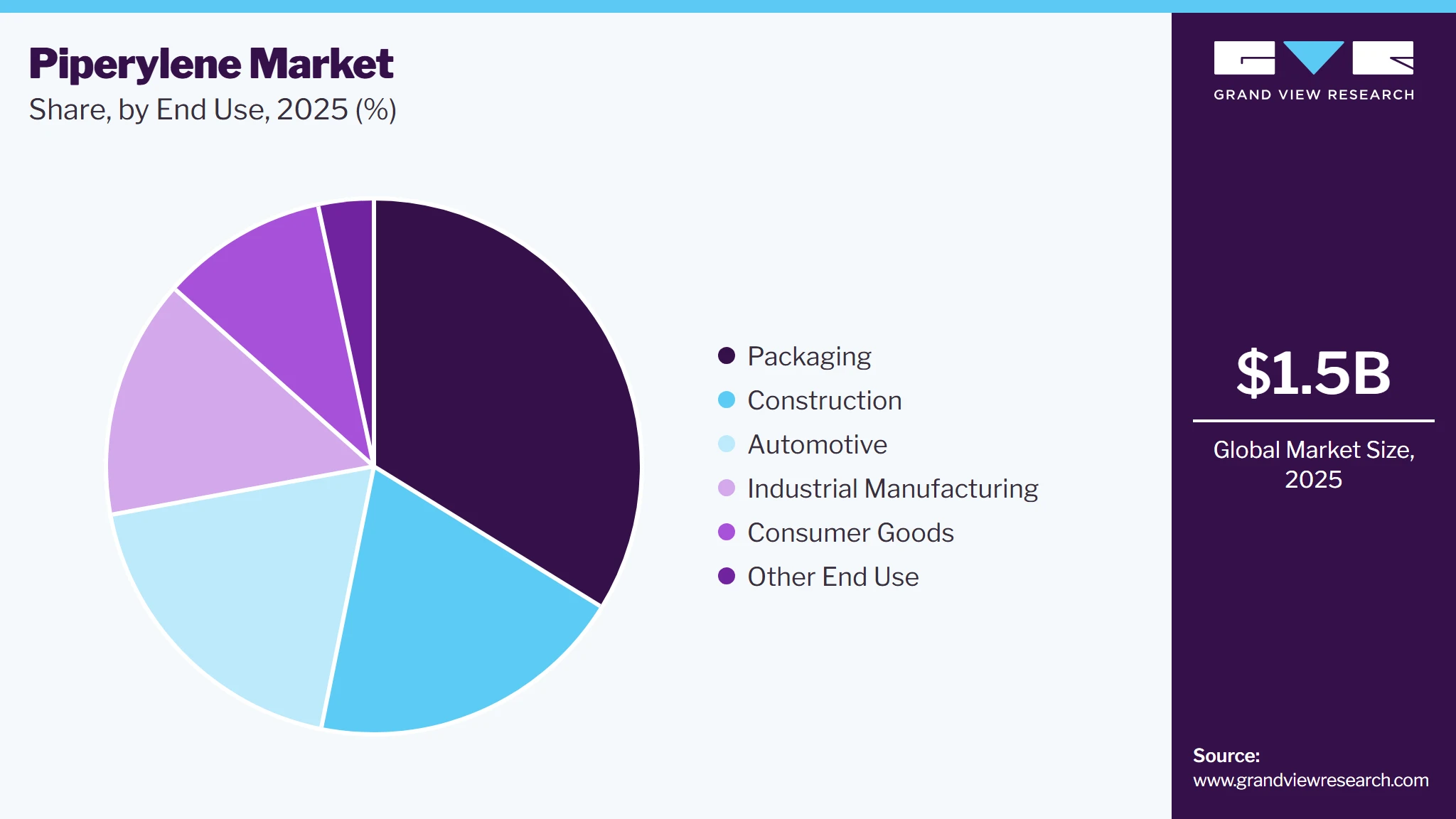
Automotive is projected to grow with a CAGR of 5.3% from 2026 to 2033, driven by the increasing use of adhesive, rubber, coating, and polymer systems in vehicle manufacturing. Piperylene-derived materials support bonding, sealing, surface protection, and formulation performance, thereby creating additional downstream demand as automotive manufacturers adopt lightweight, material-efficient components.
Regional Insights
Asia Pacific piperylene market held the largest revenue share of 49.1% in 2025, due to its large integrated petrochemical base and extensive C5 processing infrastructure. High cracker utilization and the presence of major downstream resin, adhesive, and polymer manufacturers create a strong internal consumption base for piperylene, while established C5 value chains support efficient conversion into higher-value derivatives.

China Piperylene Market Trends
The piperylene market in China demand is supported by its large-scale petroleum resin, adhesive, coatings, and polymer manufacturing industries. Continued development of domestic petrochemical capacity and downstream processing capabilities is strengthening the country's ability to convert C5 feedstocks into value-added products, supporting both domestic consumption and regional supply.
North America Piperylene Market Trends
The piperylene market in North America benefits from a well-developed petrochemical infrastructure and an established hydrocarbon-resin manufacturing base. Access to refinery and cracker-derived C5 streams, combined with demand from adhesives, packaging, automotive, and industrial applications, supports a mature but diversified piperylene consumption ecosystem.
The U.S. piperylene marketis supported by its extensive refining and petrochemical infrastructure, providing access to C5 streams for downstream processing. Demand from hydrocarbon resins, adhesives, coatings, and polymer-related applications provides multiple outlets for piperylene and strengthens the country's position within the regional C5 value chain.
Europe Piperylene Market Trends
The piperylene market in Europe is characterized by established specialty chemical and resin manufacturing capabilities, creating demand for piperylene-derived products across adhesives, coatings, polymers, and industrial formulations. Increasing emphasis on resource efficiency is also encouraging petrochemical producers to extract greater value from available C5 streams.
Latin America Piperylene Market Trends
The piperylene market in Latin America is supported by expanding petrochemical processing and downstream industrial manufacturing, particularly in Brazil. Growing requirements for adhesives, coatings, packaging materials, and resin-based products are creating additional outlets for C5-derived materials.
Middle East & Africa Piperylene Market Trends
The piperylene market in MEA is positioned for rapid expansion as petrochemical producers increase downstream conversion and diversify beyond basic hydrocarbon production. New and expanding chemical manufacturing capabilities can improve access to C5-derived feedstocks and support the development of regional resin, adhesive, and specialty-material value chains.
Key Piperylene Company Insights
Leading piperylene producers are strengthening their competitive position through C5 stream integration, dedicated separation capabilities, and downstream value addition. Companies with integrated petrochemical operations can convert C5 by-products into higher-value piperylene for petroleum resin and other applications, improving feedstock utilization and supply efficiency. LOTTE Chemical, for example, produces piperylene through its C5 processing operations and positions it as a high-value raw material for petroleum resins.
-
China Petroleum & Chemical Corporation (Sinopec) is a major integrated energy and petrochemical producer with extensive upstream, refining, and chemical operations, providing a strong platform for C5 stream recovery and piperylene production. Its Shanghai Petrochemical operations include C5 processing, while the company's integrated structure supports efficient utilization of petrochemical feedstocks and access to downstream markets for resins, plastics, and specialty chemicals. This vertical integration strengthens Sinopec's market position through feedstock availability, processing capabilities, and broad domestic distribution.
-
Formosa Petrochemical is an integrated petrochemical producer in Taiwan with operations covering refining, naphtha cracking, and production of C5 derivatives, including piperylene. Its certified manufacturing activities specifically include piperylene alongside isoprene, dicyclopentadiene, ethylene, propylene, and butadiene, highlighting its integrated C5 product portfolio. The company's access to cracker-derived feedstocks and established petrochemical infrastructure supports its role as an important Asia Pacific supplier of piperylene and related C5 products.
Key Piperylene Companies
The following key companies have been profiled for this study on the piperylene market:
-
China Petroleum & Chemical Corporation (Sinopec)
-
Formosa Petrochemical / Formosa Chemicals & Fibre
-
ZEON Corporation
-
LOTTE Chemical Corporation
-
Eastman Chemical Company
-
LyondellBasell Industries N.V.
-
Mitsui Chemicals, Inc.
-
Braskem S.A.
-
Shandong Yuhuang Chemical Group Co., Ltd.
-
Zibo Luhua Hongjin New Material Group Co., Ltd.
Company Categorization
Operating Strategies
Competitive Edge
Weaknesses
Mature Players: China Petroleum & Chemical Corporation (Sinopec), Formosa Petrochemical / Formosa Chemicals & Fibre, ZEON Corporation, LOTTE Chemical Corporation, Eastman Chemical Company, LyondellBasell Industries N.V., Mitsui Chemicals, Inc., and Braskem S.A.
- Focus on integrated C5 recovery, fractionation, purification, and downstream conversion, while leveraging existing petrochemical infrastructure and established customer networks. Companies such as ZEON emphasize comprehensive utilization of C5 fractions, while LOTTE has converted C5 streams into higher-value products, including piperylene.
- Feedstock integration, production scale, technical expertise, established distribution networks, and downstream linkages provide stronger control over supply and product quality. Braskem, for example, markets piperylene globally for hydrocarbon-resin production serving adhesives, inks, plastics, and rubber applications.
- Large integrated structures can create higher operating complexity and capital intensity, while exposure to upstream cracker economics can affect piperylene availability and margins. Product portfolios are also often broader than piperylene, potentially reducing strategic focus on this relatively specialized C5 product.
Emerging Players: Shandong Yuhuang Chemical Group Co., Ltd. and Zibo Luhua Hongjin New Material Group Co., Ltd.
- Concentrate on regional C5 processing and downstream resin-oriented applications, using proximity to Chinese petrochemical and manufacturing clusters to develop supply relationships and compete on availability and cost.
- Regional feedstock access, proximity to downstream resin manufacturers, competitive manufacturing costs, and shorter supply chains can provide an advantage in the Chinese market.
- Compared with multinational integrated producers, these companies generally have more limited geographic reach, brand recognition, international distribution, and technology depth, increasing dependence on regional demand and local C5 market conditions.
Piperylene Market Report Scope
Report Attribute
Details
Market size in 2025
USD 1.5 billion
Estimated market size in 2026
USD 1.6 billion
Projected market size by 2033
USD 2.2 billion
Growth rate
CAGR of 5.2% from 2026 to 2033
Historical data
2021 – 2025
Forecast period
2026 – 2033
Quantitative units
Revenue in USD billion, volume in kilotons, and CAGR from 2026 to 2033
Report coverage
Revenue forecast, volume forecast, company ranking, competitive landscape, growth factors, and trends
Segments covered
Application, end-use, region
Country scope
U.S.; Canada; Mexico; Germany; UK; France; Italy; Spain; China; India; Japan; South Korea; Brazil; Argentina; Saudi Arabia; South Africa
Key companies profiled
China Petroleum & Chemical Corporation (Sinopec); Formosa Petrochemical/Formosa Chemicals & Fibre; ZEON Corporation; LOTTE Chemical Corporation; Eastman Chemical Company; LyondellBasell Industries N.V.; Mitsui Chemicals, Inc.; Braskem S.A. Ltd; Shandong Yuhuang Chemical Group Co., Ltd.; Zibo Luhua Hongjin New Material Group Co., Ltd.
Customization scope
Free report customization (equivalent up to 8 analysts’ working days) with purchase. Addition or alteration to country, regional & segment scope.
Pricing and purchase options
Avail customized purchase options to meet your exact research needs. Explore purchase options
Global Piperylene Market Report Segmentation
This report forecasts volume & revenue growth at regional and country levels and provides an analysis of the latest industry trends in each of the sub-segments from 2021 to 2033. For this study, Grand View Research has segmented the global piperylene market report based on application, end-use, and region:
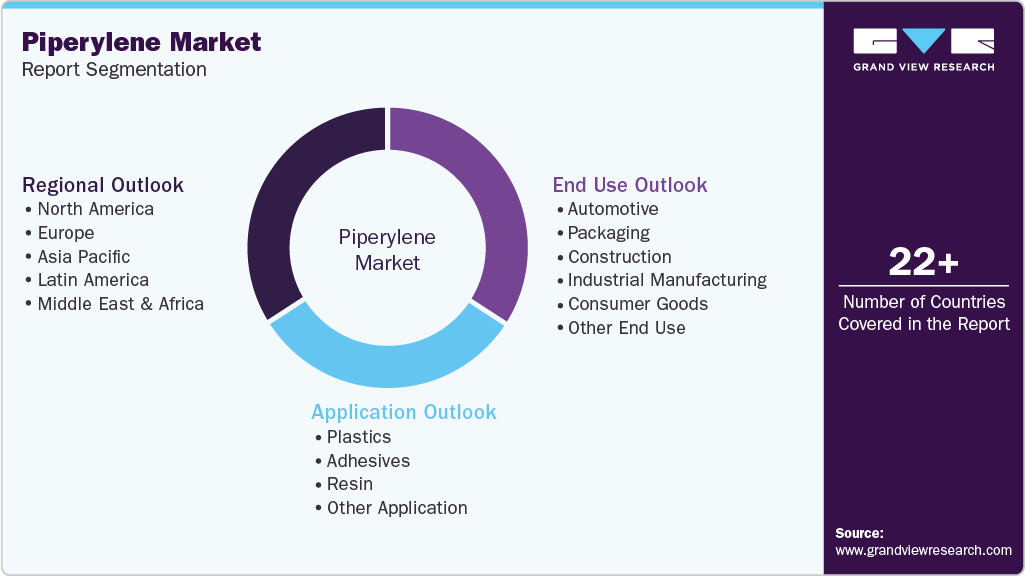
-
Application Outlook (Volume, Kilotons; Revenue, USD Billion, 2021 - 2033)
-
Plastics
-
Adhesives
-
Resin
-
Other Application
-
-
End-use Outlook (Volume, Kilotons; Revenue, USD Billion, 2021 - 2033)
-
Automotive
-
Packaging
-
Construction
-
Industrial Manufacturing
-
Consumer Goods
-
Other End Use
-
-
Region Outlook (Volume, Kilotons; Revenue, USD Billion, 2021 - 2033)
-
North America
-
U.S.
-
Canada
-
Mexico
-
-
Europe
-
Germany
-
UK
-
France
-
Italy
-
Spain
-
-
Asia Pacific
-
China
-
India
-
Japan
-
South Korea
-
-
Latin America
-
Brazil
-
Argentina
-
-
Middle East & Africa
-
Saudi Arabia
-
South Africa
-
-
Research Methodology
The piperylene market figures in this report are based on a proven research process that combines executive interviews with secondary research from proprietary databases, company filings, and recognized regulatory and institutional sources. Market size is built through value-chain sizing—reconciling supply-side and demand-side estimates—and triangulated with bottom-up and top-down approaches. Every estimate passes multiple levels of expert validation before publication, with each piperylene segment quantified using the revenue-capture definitions in the table below.
Segment Definition
Segment – Application
Revenue capture definition
Plastics
Revenue generated from piperylene consumed as a feedstock or formulation component in plastic and polymer production, including applications where it contributes to polymerization, modification, or performance enhancement.
Adhesives
Revenue derived from piperylene used in adhesive formulations, particularly as a raw material for tackifying resins that provide adhesion, tack, and bonding performance.
Resin
Revenue generated from piperylene used in the production of hydrocarbon and specialty resins, including C5-based resins used as tackifiers, modifiers, and performance-enhancing components.
Other Application
Revenue generated from piperylene consumption in applications outside plastics, adhesives, and resins, including specialty chemicals and other downstream chemical formulations.
Segment – End Use
Revenue capture definition
Automotive
Revenue associated with piperylene consumed in automotive-related materials and components, including adhesives, sealants, coatings, rubber compounds, and polymer-based products used across vehicles.
Packaging
Revenue generated from piperylene used in packaging materials and converting applications, particularly through adhesives, polymer products, coatings, and resin-based formulations used for flexible and rigid packaging.
Construction
Revenue attributed to piperylene consumption in construction-related products, including adhesives, sealants, coatings, roofing materials, and polymer-modified materials.
Industrial Manufacturing
Revenue generated from piperylene used in industrial products and manufacturing processes, including specialty resins, adhesives, coatings, rubber products, and other polymer-based materials.
Consumer Goods
Revenue associated with piperylene consumption in consumer-oriented products incorporating adhesives, polymers, resins, coatings, and other downstream materials.
Other End Use
Revenue generated from piperylene consumption across end-use industries not specifically classified under automotive, packaging, construction, industrial manufacturing, or consumer goods.
Estimation Model
Layer No.
Layer Name
Key Question
Description
01
Global Production Baseline
What is the global volume of piperylene produced?
Establishes the 2025 global piperylene production baseline in metric tons, using petrochemical production data, company disclosures, refinery/cracker capacity information, trade statistics, and other primary industry sources.
02
Country Production Assessment
How much piperylene is produced in each country?
Develops country-level piperylene production estimates by assessing refinery and steam-cracker operations, C5 hydrocarbon output, company production capacities, trade flows, and national petrochemical statistics.
03
Application Allocation
How is piperylene consumption distributed across applications?
Allocates global piperylene consumption across plastics, adhesives, resins, and other applications, based on downstream production volumes, C5 derivative utilization, company product portfolios, and application-specific demand patterns.
04
End-Use Allocation
How is piperylene demand distributed across end-use industries?
Further allocates application-level demand across automotive, packaging, construction, industrial manufacturing, consumer goods, and other end uses, considering the consumption of piperylene-derived resins, adhesives, polymers, and related downstream materials.
Delivered Customizations
This report has been delivered with the following In-depth customizations
Client Request
Customization Delivered
Value Adds
Cross-Segmentation Analysis
The analysis assessed the relationship between plastics, adhesives, resins, and other applications across automotive, packaging, construction, industrial manufacturing, consumer goods, and other end-use industries, identifying how piperylene demand flows through key downstream applications.
Provides visibility into high-value application–end-use combinations and demand pockets, supporting product prioritization, capacity planning, downstream opportunity identification, and strategic market positioning.
Competitive Benchmarking
Leading piperylene manufacturers were benchmarked based on production capacity, product portfolio, feedstock integration, manufacturing footprint, geographic presence, downstream integration, distribution capabilities, customer industries, sustainability initiatives, and recent strategic developments.
Helps identify competitive strengths, production advantages, integration levels, portfolio gaps, and strategic positioning opportunities, supports competitive differentiation, partnership assessment, capacity planning, and market-entry decisions.
Opportunity Assessment
Growth opportunities were assessed across plastics, adhesives, resins, and other applications, with additional evaluation of demand across automotive, packaging, construction, industrial manufacturing, consumer goods, and other end uses.
Supports identification of priority growth applications, emerging demand pockets, attractive end-use industries, and investment opportunities, enabling informed decisions on capacity expansion, product development, customer targeting, and geographic expansion.
Frequently Asked Questions About This Report
The piperylene market size was USD 1.5 billion in 2025 and is expected to reach 1.6 billion by 2026.
Asia Pacific held the largest revenue share of 49.1% in 2025, due to its large integrated petrochemical base and extensive C5 processing infrastructure. High cracker utilization and the presence of major downstream resin, adhesive, and polymer manufacturers create a strong internal consumption base for piperylene, while established C5 value chains support efficient conversion into higher-value derivatives.
Based on end use, packaging dominated with a share of 33.8% in 2025.
Adhesives is fastest growing segment with revenue CAGR of 5.4% during forecast period.
Packaging is fastest growing segment with revenue CAGR of 5.5% during forecast period.
The piperylene market is anticipated to grow at a CAGR of 5.2% from 2026 to 2033 and projected to reach 2.2 billion by 2033.
Based on application, resin dominated with a share of 45.4% in 2025.
Growing demand for C5-based petroleum resins used in adhesives, tapes, labels, coatings, and road-marking applications is supporting consumption of piperylene as a key feedstock. The expansion of hot-melt and pressure-sensitive adhesive applications is particularly relevant, as C5 resins provide tack and adhesion properties required across packaging, construction, automotive, and industrial products. This downstream demand is strengthening the linkage between piperylene production and specialty resin manufacturing.
Key players include China Petroleum & Chemical Corporation (Sinopec); Formosa Petrochemical / Formosa Chemicals & Fibre; ZEON Corporation; LOTTE Chemical Corporation; Eastman Chemical Company; LyondellBasell Industries N.V.; Mitsui Chemicals, Inc.; Braskem S.A. Ltd; Shandong Yuhuang Chemical Group Co., Ltd.; Zibo Luhua Hongjin New Material Group Co., Ltd.
About the Author(s)
Petrochemicals Research Team
Bulk Chemicals · PetrochemicalsThis report was authored by the petrochemicals research team at Grand View Research - comprising two research analysts, one senior research analyst, and one industry expert - with specialized expertise in the petrochemicals segment of the bulk chemicals industry. All findings are based on proprietary bulk chemicals databases, executive interviews, and regulatory analysis, subject to internal peer review prior to publication.
Last Updated:
Speak to Analyst


Customize this report to your needs — add regions, segments, or data points, with 20% free customization.
Or view our licence options:


ISO 9001:2015 & 27001:2022 Certified
We are GDPR and CCPA compliant! Your transaction & personal information is safe and secure. For more details, please read our privacy policy.


