
- Home
- »
- Personal Care & Cosmetics
- »
-
Plastic-free Detergent Market Size, Share Report, 2026-2033GVR Report cover
![Plastic-free Detergent Market (2026 - 2033)Report]()
Plastic-free Detergent Market (2026 - 2033)
Size, Share & Trends Analysis Report By Form (Liquid Detergents, Powder Detergents), By Ingredient (Plant-based surfactants, Enzyme-based formulations, Biodegradable formulations), By End-use, By Region, And Segment Forecasts
Market Size, 2025
$12.6BMarket Estimate, 2026
$13.3BMarket Forecast, 2033
$21.3BCAGR, 2026–2033
7.0%Plastic-free Detergent Market Summary
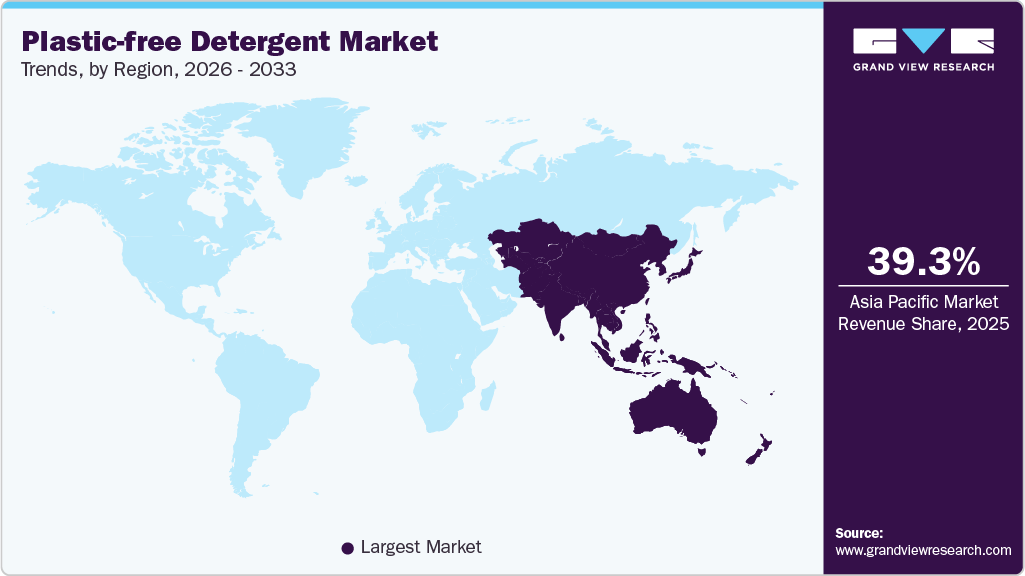
The global plastic-free detergent market size was valued at USD 12.6 billion in 2025 and is projected to grow from USD 13.3 billion in 2026 to USD 21.3 billion by 2033, at a CAGR of 7.0% from 2026 to 2033. The market in Asia Pacific dominated with a revenue share of 39.3% in 2025, driven by rising consumer awareness of environmental sustainability and growing concern over plastic waste from household products. Increasing regulatory pressure on single-use plastics, along with the expansion of eco-conscious retail and e-commerce channels, is encouraging manufacturers to introduce plastic-free packaging and low-impact detergent formulations, supporting steady market growth.

Key Market Trends & Insights
- By form: Liquid detergents segment held the largest market share of 56.0% in 2025.
- By ingredient: Plant-based surfactants segment held the largest market share of 36.7% in 2025.
- By end-use: Residential segment held the largest market share of 71.6% in 2025.
Regional Highlights
- Largest regional market: Asia Pacific (39.3% revenue share, 2025)
- By country: China held the largest market share in 2025
Market Size & Forecast
- Market size in 2025: USD 12.6 Billion
- Estimated market size in 2026: USD 13.3 Billion
- Projected market size by 2033: USD 21.3 Billion
- CAGR (2026-2033): 7.0%
Another key driver for the plastic-free detergent market is continuous innovation in concentrated and alternative detergent formats, such as sheets, tablets, and refill systems, which reduce packaging volume and logistics costs. These formats improve convenience and storage efficiency while aligning with sustainability goals, making plastic-free detergents more commercially attractive to both consumers and manufacturers.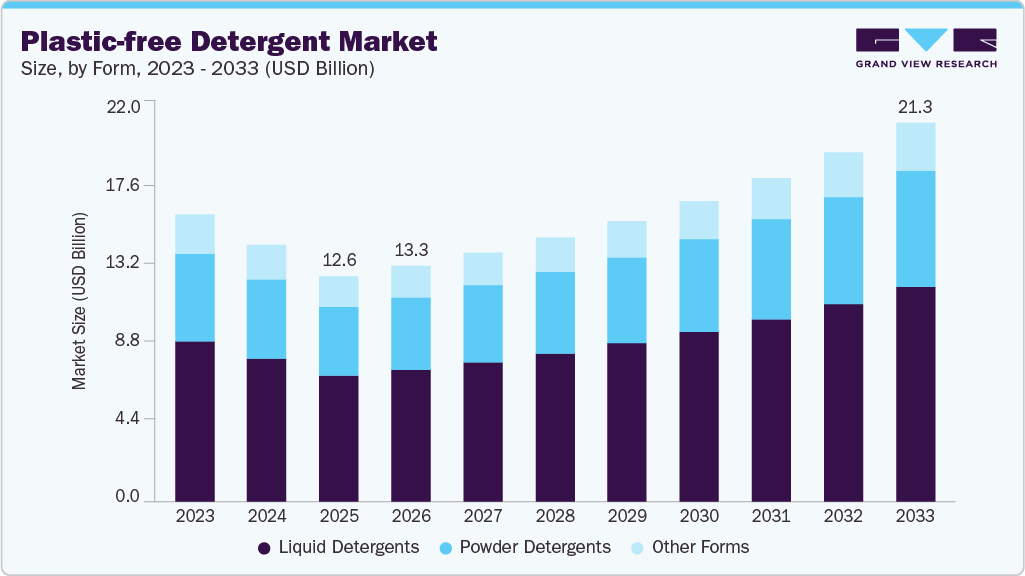
One key opportunity in the plastic-free detergent market lies in expanding penetration across emerging economies, where urbanization and environmental awareness are steadily increasing. As modern retail and e-commerce channels grow, manufacturers can introduce affordable plastic-free formats and localized product offerings, unlocking new demand beyond mature markets.
Market Concentration & Characteristics
The plastic-free detergent market shows moderate concentration, with established multinational FMCG players competing alongside specialized eco-focused brands. Large companies benefit from scale, distribution reach, and regulatory expertise, while smaller players compete through innovation in plastic-free formats and sustainability positioning.
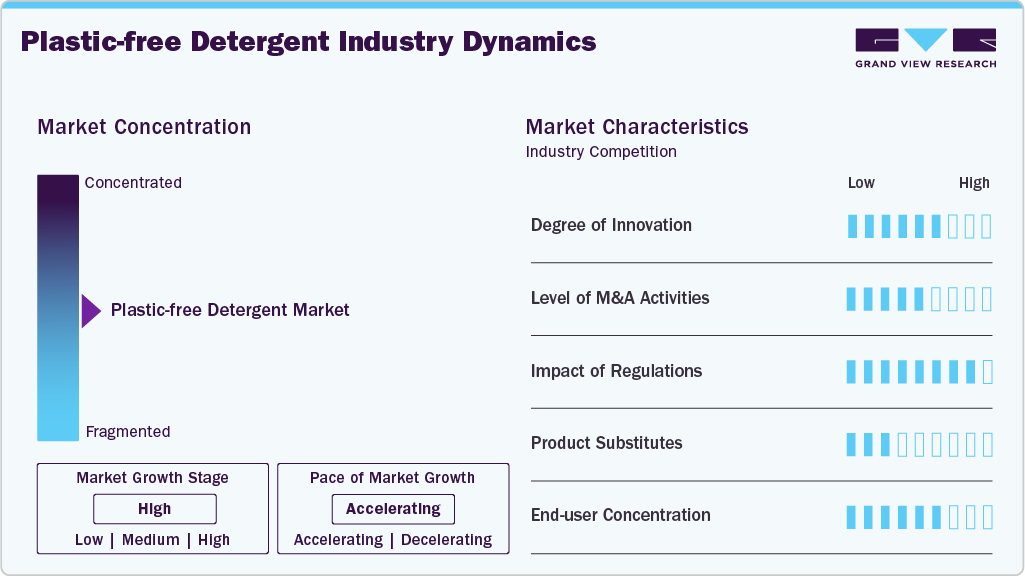
Market characteristics are innovation- and sustainability-driven, with competition focused on biodegradable formulations, reduced packaging, and alternative delivery formats such as sheets and refills. Brand credibility, certifications, and compliance with environmental regulations are key factors shaping competitive advantage.
Form Insights
Liquid detergents hold a dominant position in the global plastic-free detergent market with revenue share of 56.0% in 2025, due to their ability to support concentrated, high-performance formulations that require lower material usage per wash. This efficiency reduces packaging demand and optimizes transportation economics, making liquid formats commercially scalable for plastic-free transitions.
Powder detergents are witnessing strong growth in the global plastic-free detergent market with revenue CAGR of 7.0% during forecast period, as they naturally align with non-plastic packaging formats such as paperboard cartons and bulk dispensers. Their low moisture content enables stable formulations without plastic liners, supporting cost-efficient scalability for manufacturers pursuing plastic-free portfolios.
Ingredient Insights
Plant-based surfactants dominate the ingredient segment of the global plastic-free detergent market with revenue share of 36.7% in 2025, as they directly address regulatory pressure and consumer demand for biodegradable, non-toxic cleaning solutions. Their compatibility with renewable sourcing and low aquatic toxicity profiles makes them the preferred choice for brands positioning products around clean-label and sustainability credentials.
Enzyme-based formulations are the fastest growing ingredient segment with revenue CAGR of 7.3% during forecast period, because they deliver high cleaning efficiency at lower wash temperatures. This performance advantage supports energy savings and reduced environmental impact, aligning strongly with sustainability goals embedded in plastic-free detergent strategies.
End-use Insights
The residential segment dominates the global plastic-free detergent market with revenue share of 71.6% in 2025, due to high household penetration and frequent repeat usage cycles. Growing consumer awareness around plastic waste reduction and eco-friendly home care products is driving consistent demand for plastic-free detergent formats across daily laundry and dishwashing applications.
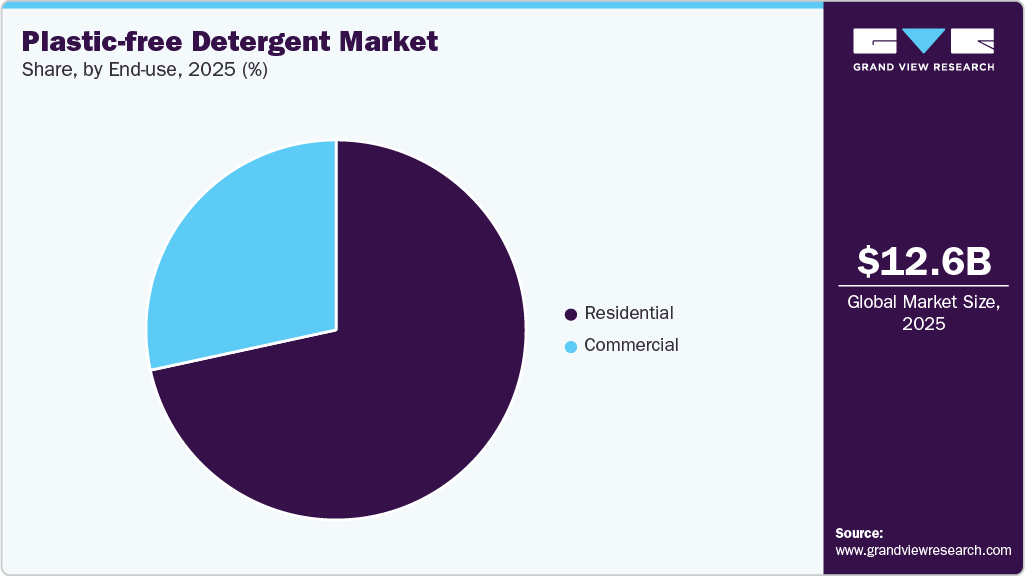
The commercial segment is the fastest growing segment with revenue CAGR of 7.4% during forecast period, because hotels, hospitals, and institutional laundries increasingly adopt plastic-free detergents to meet corporate sustainability targets. Bulk purchasing and centralized procurement models accelerate volume uptake, driving rapid market expansion in this segment.
Regional Insights
Asia Pacific dominated the plastic-free detergent market with revenue share of 39.3% in 2025. Asia Pacific market benefits from structural shifts such as urban growth and expanding middle-class populations, which are changing purchasing behavior toward premium and environmentally responsible products. Rising digital commerce and increased availability of sustainable detergent options through local and global brands are reinforcing adoption across both developed and emerging economies.
China’s market development is supported by demographic and behavioral changes, particularly among younger urban consumers who are increasingly conscious of product safety and environmental impact. The dominance of e-commerce platforms enables fast scaling of plastic-free detergent offerings, especially in major metropolitan and tier-2 cities.
North America Plastic-free Detergent Market Trends
In North America, demand for plastic-free detergents is shaped by a well-informed consumer base that increasingly prioritizes sustainability in everyday household purchases. The presence of strong retail networks, advanced e-commerce infrastructure, and active participation by leading brands in sustainable innovation continues to support market expansion across the region.
U.S. Plastic-free Detergent Market Trends
The U.S. market is characterized by rapid uptake of sustainable household products driven by lifestyle changes and heightened focus on plastic waste reduction. Strong brand presence, subscription-based sales models, and digital-first distribution channels are further accelerating adoption of plastic-free detergent formats.
Europe Plastic-free Detergent Market Trends
Europe’s plastic-free detergent market is strongly influenced by regulatory discipline and long-standing environmental commitments. Tight controls on packaging waste and chemical usage, combined with high consumer acceptance of refill systems and eco-labeled products, are pushing manufacturers to accelerate the transition toward low-plastic and zero-waste detergent formats.
Germany continues to lead in sustainable detergent adoption due to a deeply embedded environmental culture and strict compliance standards. High demand for certified, biodegradable, and refill-based detergents encourages continuous innovation and reinforces the country’s role as a benchmark market for plastic-free household care products.
Middle East & Africa Plastic-free Detergent Market Trends
Across the Middle East & Africa, adoption of plastic-free detergents is gaining momentum in urban and institutional segments rather than mass retail. Sustainability initiatives in hospitality, commercial laundering, and residential developments alongside water-efficiency considerations are gradually creating demand for concentrated and low-impact detergent solutions.
Latin America Plastic-free Detergent Market Trends
In Latin America, growth in plastic-free detergents is closely linked to improving retail penetration and evolving consumer attitudes toward environmental responsibility. Urban consumers are showing greater willingness to adopt eco-friendly detergents that balance performance, affordability, and reduced packaging waste.
Key Plastic-free Detergent Company Insights
Seventh Generation is a leading player in the plastic-free detergent market, recognized for its strong focus on plant-based formulations, biodegradable ingredients, and reduced-plastic packaging solutions. The company leverages Unilever’s global manufacturing and distribution capabilities to scale sustainable laundry detergents across North America and Europe. Its emphasis on transparency, environmental compliance, and low-impact formulations positions the brand well to capture growing demand for plastic-free and eco-conscious household care products.
Ecover is a pioneer in the plastic-free detergent market, known for its early adoption of plant- and mineral-based detergent formulations and innovative sustainable packaging initiatives. Backed by S.C. Johnson, the company benefits from robust manufacturing infrastructure while maintaining a strong sustainability-led brand identity. Ecover’s focus on refill systems, biodegradable formulations, and circular economy practices supports its competitive position in the global plastic-free and environmentally responsible detergent segment.
Key Plastic-free Detergent Companies:
The following key companies have been profiled for this study on the plastic-free detergent market.
- Seventh Generation
- Ecover
- Earth Breeze, Inc.
- Tru Earth
- Dropps
- Biokleen
- Method Products
- ECOS
- Unilever
- Procter & Gamble (P&G)
Recent Developments
- In January 2026, Clean Cult announced the nationwide launch of its laundry detergent sheets across all Costco regions in the U.S. and on Costco.com, marking a major retail expansion for plastic-free laundry sheets. The product is positioned to meet rising demand for convenient, sustainable detergent alternatives to traditional liquid or powdered formats.
Plastic-free Detergent Market Report Scope
Report Attribute
Details
Market size in 2025
USD 12.6 billion
Estimated market size in 2026
USD 13.3 billion
Projected market size by 2033
USD 21.3 billion
Growth rate
CAGR of 7.0% from 2026 to 2033
Base year for estimation
2025
Historical data
2018 - 2024
Forecast period
2026 - 2033
Quantitative units
Revenue in USD million/billion, volume in kilotons, and CAGR from 2026 to 2033
Report coverage
Revenue forecast, volume forecast, company ranking, competitive landscape, growth factors, and trends
Segments covered
Form, ingredient, end use, and region
Regional scope
North America; Europe; Asia Pacific; Middle East & Africa; Latin America
Country scope
U.S.; Canada; Mexico; Germany; UK; France; Italy; Spain; China; India; Japan; South Korea; Brazil; Argentina; South Africa; Saudi Arabia
Key companies profiled
Seventh Generation; Ecover; Earth Breeze, Inc.; Tru Earth; Dropps; Biokleen; Method Products; ECOS; Unilever; Procter & Gamble (P&G)
Customization scope
Free report customization (equivalent up to 8 analysts’ working days) with purchase. Addition or alteration to country, regional & segment scope.
Pricing and purchase options
Avail customized purchase options to meet your exact research needs. Explore purchase options
Global Plastic-free Detergent Market Report Segmentation
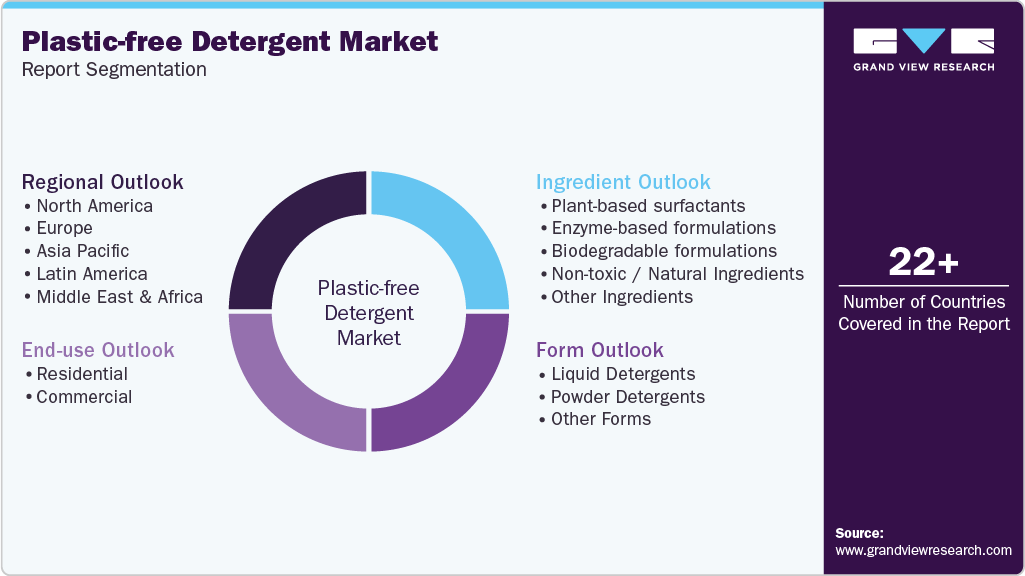
This report forecasts volume & revenue growth at global, regional, and country levels and provides an analysis of the latest industry trends in each of the sub-segments from 2018 to 2033. For this study, Grand View Research has segmented the global plastic-free detergent market report based on form, ingredient, end-use, and region:
-
Form Outlook (Volume, Kilotons; Revenue, USD Billion, 2018 - 2033)
-
Liquid Detergents
-
Powder Detergents
-
Other Forms
-
-
Ingredient Outlook (Volume, Kilotons; Revenue, USD Billion, 2018 - 2033)
-
Plant-based surfactants
-
Enzyme-based formulations
-
Biodegradable formulations
-
Non-toxic / Natural Ingredients
-
Other Ingredients
-
-
End-use Outlook (Volume, Kilotons; Revenue, USD Billion, 2018 - 2033)
-
Residential
-
Commercial
-
-
Regional Outlook (Volume, Kilotons; Revenue, USD Billion, 2018 - 2033)
-
North America
-
U.S.
-
Canada
-
Mexico
-
-
Europe
-
Germany
-
UK
-
France
-
Italy
-
Spain
-
-
Asia Pacific
-
China
-
India
-
Japan
-
South Korea
-
-
Latin America
-
Brazil
-
Argentina
-
-
Middle East & Africa
-
Saudi Arabia
-
South Africa
-
-
Frequently Asked Questions About This Report
The plant-based surfactants segment led with a 36.7% revenue share in 2025, while the enzyme-based formulations segment is the fastest-growing.
The residential segment led with a 71.6% revenue share in 2025, while the commercial segment is the fastest-growing.
Asia Pacific dominated with a 39.3% revenue share in 2025.
The global plastic-free detergent market size was estimated at USD 12.7 billion in 2025 and is expected to reach USD 13.3 billion in 2026.
Liquid detergents hold a dominant position in the global plastic-free detergent market with revenue share of 56.0% in 2025, due to their ability to support concentrated, high-performance formulations that require lower material usage per wash. This efficiency reduces packaging demand and optimizes transportation economics, making liquid formats commercially scalable for plastic-free transitions.
Some of the key players operating in the plastic-free detergent market include Seventh Generation, Ecover, Earth Breeze, Inc., Tru Earth, Dropps, Biokleen, Method Products, ECOS, Unilever, Procter & Gamble (P&G)
The plastic-free detergent market is primarily driven by rising consumer awareness of environmental sustainability and growing concern over plastic waste from household products. Increasing regulatory pressure on single-use plastics, along with the expansion of eco-conscious retail and e-commerce channels, is encouraging manufacturers to introduce plastic-free packaging and low-impact detergent formulations, supporting steady market growth.
The global plastic-free detergent market is expected to grow at a compound annual growth rate of 7.0% from 2026 to 2033 to reach USD 21.3 billion by 2033.
About the Author(s)
Personal Care & Cosmetics Research Team
Bulk Chemicals · Personal Care & CosmeticsThis report was authored by the personal care & cosmetics research team at Grand View Research - comprising two research analysts, one senior research analyst, and one industry expert - with specialized expertise in the personal care & cosmetics segment of the bulk chemicals industry. All findings are based on proprietary bulk chemicals databases, executive interviews, and regulatory analysis, subject to internal peer review prior to publication.
Last Updated:
Speak to Analyst


Customize this report to your needs — add regions, segments, or data points, with 20% free customization.
Or view our licence options:


ISO 9001:2015 & 27001:2022 Certified
We are GDPR and CCPA compliant! Your transaction & personal information is safe and secure. For more details, please read our privacy policy.


