
- Home
- »
- Plastics, Polymers & Resins
- »
-
Polysulfone Membranes Market Size & Share Report, 2033GVR Report cover
![Polysulfone Membranes Market (2026 - 2033)Report]()
Polysulfone Membranes Market (2026 - 2033)
Size, Share & Trends Analysis Report By Membrane Material (Polysulfone blends, Polyethersulfone, Polysulfone), By End Use (Water & Wastewater Treatment, Pharmaceutical & Biotechnology, Hemodialysis), By Region, And Segment Forecasts
Market Size, 2025
$1.5BMarket Estimate, 2026
$1.6BMarket Forecast, 2033
$2.3BCAGR, 2026–2033
5.2%Polysulfone Membranes Market Summary
The global polysulfone membranes market size was valued at USD 1.5 billion in 2025 and is projected to grow from USD 1.6 billion in 2026 to USD 2.3 billion by 2033, at a CAGR of 5.2% from 2026 to 2033. Asia Pacific dominated the market, accounting for the largest revenue share of 56.1% in 2025. The industry is driven by growing demand for high-performance membrane separation across water treatment, pharmaceuticals, food and beverage, biotechnology, and industrial processing applications.

Key Market Trends & Insights
- By membrane material: The polyethersulfone (PES/PESU) segment is anticipated to grow at the fastest CAGR of 6.5% from 2026 to 2033.
- By end use: The pharmaceutical & biotechnology segment is expected to grow at the fastest CAGR of 6.3% from 2026 to 2033.
Regional Highlights
- Largest regional market: Asia Pacific (56.1% revenue share, 2025)
- By country: China held the largest regional share in 2025
Market Size & Forecast
- Market Size in 2025: USD 1.5 billion
- Estimated Market Size in 2026: USD 1.6 billion
- Projected Market Size in 2033: USD 2.3 billion
- CAGR (2026 - 2033): 5.2%
Polysulfone membranes offer chemical resistance, thermal stability, mechanical strength, and efficient filtration performance. Advancements in membrane fabrication, surface modification, and pore structure optimization are improving selectivity and durability, while increasing focus on water purification, process efficiency, and advanced separation technologies accelerates adoption. Technological advancements in membrane fabrication, surface modification, pore structure control, and coating technologies are emerging as a key trend in the industry. Manufacturers are increasingly developing optimized polysulfone, polyethersulfone, and polysulfone blend membranes that improve filtration efficiency, chemical resistance, thermal stability, permeability, and fouling resistance. Innovations in membrane engineering and manufacturing are further expanding suitability across water treatment, pharmaceuticals, biotechnology, hemodialysis, and industrial process filtration applications.
Growing demand for high-performance, durable, and efficient separation technologies is a major driver for the industry. Polysulfone membranes provide strong mechanical properties, chemical resistance, thermal stability, and controlled filtration performance across water and wastewater treatment, pharmaceutical and biotechnology processing, hemodialysis, food and beverage processing, and industrial applications. Increasing investments in water purification infrastructure, healthcare technologies, and advanced filtration systems are further accelerating market development.
Market Dynamics
Expanding adoption of advanced water treatment and membrane-based separation technologies presents a significant opportunity for the industry. Increasing focus on improving water quality, reducing treatment costs, and enhancing process efficiency is creating opportunities for polysulfone and polyethersulfone membranes. Manufacturers are developing high-flux, low-fouling, and application-specific membrane structures that improve separation performance and service life, supporting broader adoption across municipal, industrial, pharmaceutical, and biotechnology applications.
Biomedical and healthcare applications are emerging as a key application segment for the industry, supported by their extensive use in hemodialysis filters for blood purification, medical device sterilization, and plasma separation. Polysulfone membranes provide high biocompatibility, chemical resistance, thermal stability, and controlled pore structures, enabling efficient separation and filtration in demanding medical processes. Their reliable performance supports growing adoption across dialysis equipment and specialized healthcare filtration systems.
Increasing demand for advanced blood purification, medical filtration, and separation technologies is further accelerating the adoption of polysulfone membranes across biomedical applications. Their combination of mechanical strength, permeability, biocompatibility, and sterilization resistance supports efficient processing in hemodialysis and plasma separation. Growing healthcare expenditure, rising prevalence of kidney-related conditions, and increasing use of membrane-based medical technologies are further creating opportunities for polysulfone membranes in healthcare applications.
UV degradation is emerging as a key restraint for the industry, driven by prolonged exposure to ultraviolet radiation that can trigger photo-oxidative degradation of aromatic polymer chains. This degradation can alter membrane structure and reduce mechanical integrity, permeability, stability, and long-term outdoor weathering performance. The limitation can restrict polysulfone membrane suitability in applications involving sustained UV exposure and increase the need for protective measures, specialized formulations, or alternative membrane materials.
Water treatment and wastewater reuse present a significant opportunity for the market, driven by rising water scarcity and growing deployment of polysulfone ultrafiltration membranes as pretreatment for reverse osmosis and municipal purification. Stricter environmental compliance is increasing demand for wastewater recovery across the textile, pharmaceutical, and dairy industries. Advancements in antifouling surface modifications, including zwitterionic and nano-silica-blended polysulfone surfaces, can reduce organic fouling and chemical cleaning cycles, supporting wider adoption.
Market Concentration & Characteristics
The industry exhibits fragmentation, with key players dominating the industry landscape. Major companies such as Fresenius Medical Care, Asahi Kasei Medical, Toray Medical / Toray Industries, B. Braun, Medica S.p.A., Kuraray, UNISOL Membrane Technology, Mar Cor Purification, TOMAC Corporation, ZIG SHENG Industrial and others play a significant role in shaping the market dynamics. These leading players often drive innovation in the market by introducing new products, technologies, and materials to meet the industry's evolving demands.
The degree of innovation in the industry is moderate to high, driven by advances in membrane fabrication, pore structure control, surface modification, and polymer formulation. Companies including Syensqo, Asahi Kasei Medical, Fresenius Medical Care, Toray Medical, and Medica are developing or commercializing polysulfone and polyethersulfone membranes emphasizing permeability, biocompatibility, selectivity, and fouling resistance. These developments support applications across hemodialysis, water purification, bioprocessing, and industrial filtration.
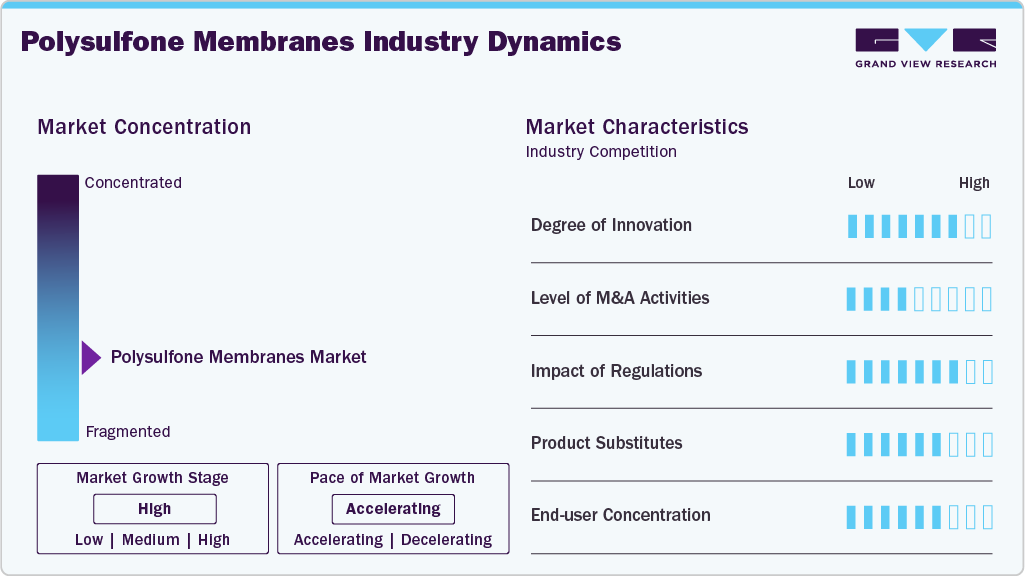
Product differentiation and performance-enhancement initiatives are shaping competitive positioning, with manufacturers focusing on tailored pore structures, high-flux membranes, antifouling surfaces, and application-specific formulations. Asahi Kasei Medical offers high-flux and vitamin E-interactive polysulfone membranes, while Fresenius has developed nano-controlled membrane structures and hydrophilic surface technologies. BARC and Medica demonstrate further development of polysulfone ultrafiltration solutions for domestic, industrial, and water purification applications, strengthening product diversity and expanding adoption.
Analyst Perspective
The industry is expected to transition from conventional volume-driven filtration demand toward a more value-oriented, technology-driven growth phase over the next 5-10 years. Demand will favor high-performance hollow-fiber and advanced ultrafiltration membranes offering controlled pore structures, improved hydrophilicity, fouling resistance, biocompatibility, and longer service life. Sustainability will gain importance as membrane producers adopt bio-based, mass-balance, recycled, and circular polysulfone feedstocks while addressing regulatory requirements and lifecycle impacts. Competitive advantage will increasingly depend on integrated polymer and membrane manufacturing, application-specific engineering, proprietary surface modification technologies, geographic production capabilities, and strategic partnerships with healthcare, water-treatment, and industrial customers.
Membrane Material Insights
The polysulfone (PSU) segment dominated the market, accounting for 45.5% revenue share in 2025. PSU is widely used in microfiltration and ultrafiltration membranes for water and wastewater treatment, as well as food and beverage processing and pharmaceutical applications. Its ability to maintain performance under varying pH and operating conditions supports broad industrial use.
The polyethersulfone (PES/PESU) segment is expected to expand at a 6.5% CAGR over the forecast period. The segment is driven by increasing adoption of polyethersulfone (PES/PESU) membranes across water treatment, wastewater filtration, hemodialysis, and industrial separation applications, supported by their high thermal and chemical resistance, mechanical stability, and filtration performance. PES membranes enable controlled permeability and high selectivity, while advances in surface modification, additive blending, and membrane fabrication are improving hydrophilicity and fouling resistance, supporting broader adoption across demanding filtration applications.
End Use Insights
The water & wastewater treatment segment led the market, accounting for 39.3% of revenue in 2025. The segment is driven by increasing adoption of polysulfone membranes for ultrafiltration, microfiltration, municipal purification, and industrial wastewater recovery. Polysulfone provides mechanical strength, chemical stability, and ease of modification, supporting efficient removal of suspended solids, microorganisms, pollutants, and contaminants. Growing water scarcity, wastewater reuse requirements, and environmental regulations are further supporting demand, while antifouling and nanomaterial modifications enhance permeability and filtration performance.
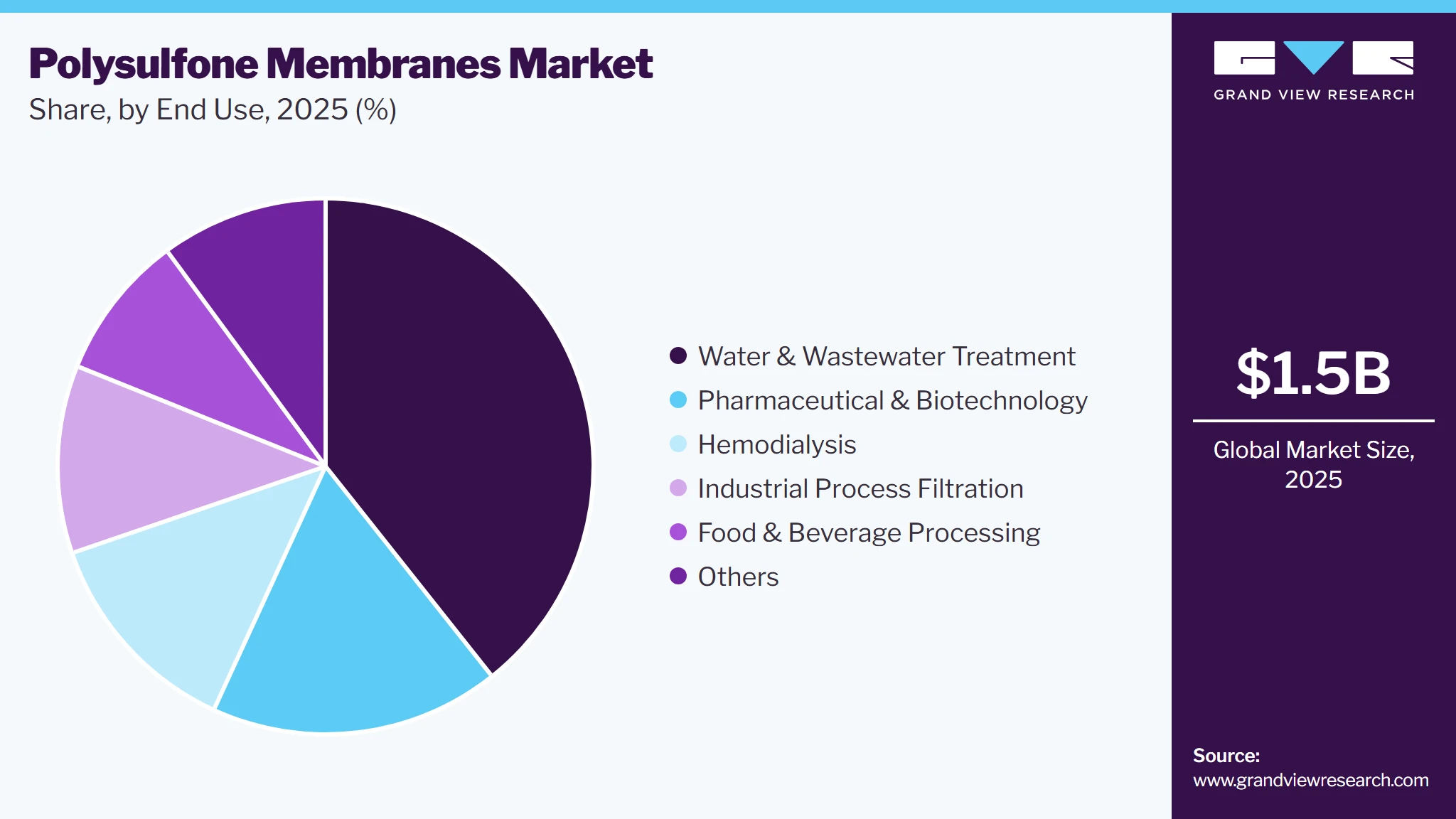
The pharmaceutical & biotechnology segment is expected to grow at the fastest CAGR of 6.3% over the forecast period. The segment is driven by increasing adoption of polysulfone membranes for ultrafiltration, protein purification, concentration, buffer exchange, and bioprocessing applications. Polysulfone and polyethersulfone membranes provide chemical stability, mechanical strength, and controlled separation performance, supporting efficient processing of biopharmaceutical products. Growing demand for scalable downstream processing, continuous biomanufacturing, and advanced therapeutic production is further supporting adoption, while surface modifications improve hydrophilicity and reduce protein fouling.
Regional Insights
The Asia Pacific polysulfone membranes market held the largest revenue share of 56.1% in 2025 and is also expected to grow at the fastest CAGR of 5.7% over the forecast period. Rapid industrialization, expanding pharmaceutical and biotechnology manufacturing, and growing water treatment requirements are supporting the growth of the market across the Asia Pacific.

The China polysulfone membranes market is driven byincreasing investment, which is driving demand for membranes in water purification, wastewater treatment, bioprocessing, and hemodialysis. Expanding biologics production, rising healthcare infrastructure, and stricter water quality requirements are further accelerating regional adoption of polysulfone and polyethersulfone membranes.
The polysulfone membranes market in India is expanding steadily, supported by rising demand for advanced filtration across water treatment, pharmaceutical, biotechnology, and healthcare applications. Increasing investments in water purification, wastewater treatment, and pharmaceutical manufacturing are driving the adoption of polysulfone and polyethersulfone membranes. Medical applications, particularly hemodialysis, represent a major demand area, while growing healthcare infrastructure and pharmaceutical membrane filtration requirements are further strengthening market development.
North America Polysulfone Membranes Market Trends
The polysulfone membranes market inNorth America is supported by strong demand for advanced filtration across healthcare, pharmaceutical, biotechnology, water treatment, and industrial applications. The region’s established medical device and bioprocessing infrastructure, along with widespread adoption of synthetic membranes in hemodialysis, is driving demand for polysulfone and polyethersulfone materials. Growing investments in water purification, pharmaceutical manufacturing, and high-performance filtration are further strengthening regional demand.
U.S. Polysulfone Membranes Market Trends
The polysulfone membranes market in theU.S. represents a major contributor to regional growth, supported by extensive healthcare, pharmaceutical, biotechnology, and water treatment capabilities. Rising utilization of polysulfone membranes in hemodialysis, sterile filtration, biopharmaceutical processing, and wastewater treatment is accelerating demand. Strong emphasis on membrane performance, biocompatibility, fouling resistance, and advanced filtration technologies is further encouraging manufacturers to develop high-flux, modified, and application-specific membrane solutions for demanding healthcare and industrial applications.
Europe Polysulfone Membranes Market Trends
The polysulfone membranes market inEurope is expanding due to increasing adoption across water treatment, pharmaceutical, biotechnology, healthcare, food and beverage, and industrial filtration applications. Stringent environmental standards, growing water reuse requirements, and expanding biopharmaceutical manufacturing are supporting demand for high-performance polysulfone and polyethersulfone membranes. Increasing investments in membrane technology, advanced filtration systems, and healthcare infrastructure are further strengthening regional market development, particularly across Germany, France, the UK, Italy, and Spain.
Latin America Polysulfone Membranes Market Trends
The polysulfone membranes market in Central & South America is expanding due to increasing adoption across water treatment, pharmaceutical, biotechnology, food and beverage, and industrial filtration applications. Growing water scarcity, wastewater reuse requirements, and stricter environmental standards are driving demand for polysulfone and polyethersulfone membranes. Increasing investments in pharmaceutical manufacturing and advanced filtration systems are further supporting regional market development, particularly in Brazil, Chile, Argentina, and Colombia.
Middle East and Africa Polysulfone Membranes Market Trends
The polysulfone membranes market in the Middle East and Africais expanding due to increasing adoption across water treatment, healthcare, pharmaceutical, biotechnology, and industrial filtration applications. Rising desalination and wastewater reuse requirements, healthcare infrastructure development, and pharmaceutical manufacturing investments are driving demand for polysulfone and polyethersulfone membranes. Increasing focus on water security and advanced filtration technologies is further strengthening regional market development, particularly across Saudi Arabia, the UAE, and South Africa.
Key Polysulfone Membranes Companies Insights
Some of the key players operating in the market include Asahi Kasei Medical and Toray Medical / Toray Industries.
-
Asahi Kasei Medical participates through its portfolio of high-flux polysulfone dialysis membranes, including APS, REXEED, and ViE series. The company emphasizes high permeability, biocompatibility, selective solute removal, and enhanced anticoagulation performance for hemodialysis applications. Its membrane technologies incorporate specialized microporous structures and hydrophilic surface treatments, supporting efficient blood purification and expanding applications across advanced dialysis and critical-care filtration.
-
Toray Medical and Toray Industries participate through its dialysis portfolio, including Toraysulfone polysulfone membrane hemodialyzers. The companies emphasize biocompatibility, high permeability, solute removal, and ultrafiltration performance, supported by advanced membrane structures and polymer technology. Toraysulfone products are used in hemodialysis and hemodiafiltration, while continued membrane development strengthens Toray’s position in blood purification and advanced healthcare filtration applications.
TOMAC Corporation and ZIG SHENG Industrial are some of the emerging participants in the polysulfone membranes industry.
-
TOMAC Corporation participates through its flat-sheet membrane portfolio, offering polysulfone and polyethersulfone membranes for ultrafiltration, microfiltration, and related separation applications. The company emphasizes tailored membrane development, in-house casting and drying systems, and application-specific performance optimization. Its polysulfone membranes support reverse osmosis, wastewater recovery, food and beverage processing, and glucose clarification, while customized designs improve flux, filtration efficiency, and process performance.
-
ZIG SHENG Industrial participates through its ZISECO hollow fiber membrane portfolio, offering polysulfone membranes for household drinking water filtration, industrial wastewater treatment, and mobile bioreactor systems. The company emphasizes hydrophilic membrane structures, high flux, chlorine resistance, uniform pore sizes, and extended service life. Its polysulfone membranes support contaminant removal and water purification, while advanced asymmetric structures strengthen filtration efficiency across water treatment applications.
Key Polysulfone Membranes Companies
The following key companies have been profiled for this study on the polysulfone membranes market.
-
Fresenius Medical Care
-
Asahi Kasei Medical
-
Toray Medical / Toray Industries
-
B. Braun
-
Medica S.p.A.
-
Kuraray
-
UNISOL Membrane Technology
-
Mar Cor Purification
-
TOMAC Corporation
-
ZIG SHENG Industrial
Competitive Benchmarking
Operating Strategies
Competitive Edge
Weakness
Mature Players: Fresenius Medical Care, Asahi Kasei Medical, Toray Medical / Toray Industries, B. Braun, Kuraray, Medica S.p.A.
- Strong focus on expanding polysulfone and polyethersulfone membrane portfolios for hemodialysis, blood purification, pharmaceutical processing, and advanced filtration applications.
- Continuous investment in membrane structure, polymer formulation, surface modification, permeability, biocompatibility, and solute-removal performance.
- Expansion through established healthcare distribution networks, dialysis equipment portfolios, technical expertise, and application-specific membrane technologies.
- Established brands, manufacturing capabilities, clinical expertise, and broad healthcare portfolios provide strong positioning in membrane-based filtration.
- Strong product differentiation through high-flux membranes, asymmetric structures, controlled molecular-weight cut-offs, biocompatibility, and enhanced filtration performance.
- Asahi Kasei Medical, Toray Medical, Fresenius Medical Care, and B. Braun have established polysulfone-based dialyzer offerings, strengthening their position in hemodialysis and blood purification.
- Significant investment in polymer processing, hollow-fiber spinning, membrane fabrication, sterilization, and quality-control systems can increase manufacturing costs.
- Maintaining consistent pore structure, permeability, mechanical strength, and biocompatibility requires stringent process controls and product qualification.
- Dependence on highly regulated healthcare applications can increase development, validation, and commercialization requirements.
Emerging Players: UNISOL Membrane Technology, Mar Cor Purification, TOMAC Corporation
- Focus on specialized polysulfone and polyethersulfone membrane systems for ultrafiltration, microfiltration, water treatment, wastewater recovery, and industrial separation applications.
- Continuous development of customized membrane chemistries, molecular-weight cut-offs, pore structures, support materials, and application-specific filtration solutions.
- Expansion through customized manufacturing, technical support, specialized membrane portfolios, and water-treatment applications. UNISOL offers polysulfone flat-sheet membranes across filtration applications, while TOMAC develops polymeric flat-sheet membranes for specialized separations.
- Specialized membrane portfolios and customized filtration solutions provide differentiation in industrial and water-treatment applications.
- Flexible product development enables niche suppliers to address specific filtration requirements involving chemical resistance, thermal stability, pore size, flux, and fouling characteristics.
- UNISOL’s broad polymer and filtration-level portfolio and TOMAC’s application-specific polysulfone solutions strengthen positioning in customized membrane filtration.
- Comparatively narrower product portfolios, manufacturing scale, geographic reach, and healthcare exposure can limit competitiveness against large diversified membrane and dialysis manufacturers.
- Dependence on specialized applications and customized orders can increase sensitivity to customer demand fluctuations and production economics.
- Maintaining consistent membrane performance across customized formulations and different filtration requirements can require additional development and quality-control resources.
Recent Developments
-
In October 2025, Syensqo introduced a proprietary chemical recycling technology for PSU, PPSU, and PESU, enabling the depolymerization of post-industrial and post-consumer sulfone polymers into purified monomers for reuse. The initiative strengthened Syensqo’s circular materials capabilities, particularly for polysulfone applications, while supporting the development of lower-carbon membrane materials and enabling recycled feedstock integration across water treatment, filtration, and other high-performance membrane applications.
-
In March 2026, BASF expanded its Ultrason portfolio with Ultrason P 3010 BMB, a biomass-balanced PPSU containing 20% attributed bio-circular feedstock, targeting water and sanitary, medical, hydrogen, and electrical and electronics applications. The new material strengthens BASF’s sustainable polyarylethersulfone portfolio, supports the transition toward lower-carbon feedstocks, and expands the availability of sustainable high-performance polymers for filtration, membrane systems, and other demanding applications.
Polysulfone Membranes Market Report Scope
Report Attribute
Details
Market size in 2025
USD 1.5 billion
Estimated market size in 2026
USD 1.6 billion
Projected market size by 2033
USD 2.3 billion
Growth rate
CAGR of 5.2% from 2026 to 2033
Historical data
2021 - 2025
Forecast period
2026 - 2033
Quantitative units
Volume in tons; revenue in USD billion, and CAGR from 2026 to 2033
Report coverage
Volume & revenue forecast, competitive landscape, growth factors, and trends
Segments covered
Membrane material, end use, region
Regional scope
North America; Europe; Asia Pacific; Latin America; Middle East & Africa
Country scope
U.S.; Canada; Mexico; Germany; UK; France; Italy; Spain; China; India; Japan; South Korea; Australia; Brazil; Argentina; Saudi Arabia; UAE; South Africa
Key companies profiled
Fresenius Medical Care; Asahi Kasei Medical; Toray Medical/Toray Industries; B. Braun; Medica S.p.A.; Kuraray; UNISOL Membrane Technology; Mar Cor Purification; TOMAC Corporation; ZIG SHENG Industrial
Customization scope
Free report customization (equivalent to up to 8 analyst working days) with purchase. Addition or alteration to country, regional & segment scope
Pricing and purchase options
Avail customized purchase options to meet your exact research needs. Explore purchase options
Global Polysulfone Membranes Market Report Segmentation
This report forecasts volume & revenue growth at the global, regional, and country levels and provides an analysis of the latest industry trends across sub-segments from 2021 to 2033. For this study, Grand View Research has segmented the global polysulfone membranes market report based on membrane material, end use, and region:

-
Membrane Material Outlook (Volume, Kilotons; Revenue, USD Billion, 2021 - 2033)
-
Polysulfone blends
-
Polyethersulfone (PES/PESU)
-
Polysulfone (PSU)
-
-
End Use Outlook (Volume, Kilotons; Revenue, USD Billion, 2021 - 2033)
-
Water & wastewater treatment
-
Pharmaceutical & biotechnology
-
Hemodialysis
-
Food & beverage processing
-
Industrial process filtration
-
Others
-
-
Regional Outlook (Volume, Kilotons; Revenue, USD Billion, 2021 - 2033)
-
North America
-
U.S.
-
Canada
-
Mexico
-
-
Europe
-
Germany
-
UK
-
France
-
Italy
-
Spain
-
-
Asia Pacific
-
China
-
India
-
Japan
-
South Korea
-
Australia
-
-
Latin America
-
Brazil
-
Argentina
-
-
Middle East & Africa
-
Saudi Arabia
-
UAE
-
South Africa
-
-
Research Methodology
The polysulfone market figures in this report are based on a proven research process that combines executive interviews with secondary research from proprietary databases, company filings, and recognized regulatory and institutional sources. Market size is built through value-chain sizing-reconciling supply-side and demand-side estimates-and triangulated with bottom-up and top-down approaches. Every estimate passes multiple levels of expert validation before publication, with each polysulfone segment quantified using the revenue-capture definitions in the table below.
Segment Definition
Segment - Membrane Material
Revenue capture definition
Polysulfone blends
Revenue is captured through polysulfone blend membranes used in applications requiring enhanced mechanical strength, chemical resistance, thermal stability, hydrophilicity, and fouling resistance across water treatment, pharmaceutical processing, hemodialysis, industrial filtration, and specialized separation applications.
Polyethersulfone (PES/PESU)
Revenue is generated through polyethersulfone membranes used in applications requiring high chemical resistance, thermal stability, controlled pore structure, mechanical durability, and reliable filtration performance across water and wastewater treatment, pharmaceutical and biotechnology processing, food and beverage, and industrial applications.
Polysulfone (PSU)
Revenue is captured through polysulfone membranes used in applications requiring high mechanical strength, chemical resistance, thermal stability, dimensional stability, and consistent filtration performance across water treatment, hemodialysis, pharmaceutical processing, industrial filtration, and other demanding applications.
Segment - End-use
Revenue capture definition
Water & wastewater treatment
Revenue is generated through polysulfone membranes used for ultrafiltration, microfiltration, and related separation processes requiring high contaminant removal, chemical resistance, durability, and consistent performance across municipal water treatment, industrial wastewater treatment, desalination pretreatment, and water reuse applications.
Pharmaceutical & biotechnology
Revenue is captured through polysulfone membranes used for sterile filtration, bioprocessing, clarification, concentration, and purification applications requiring high purity, low extractables, chemical compatibility, and reliable separation performance across pharmaceutical manufacturing and biotechnology processes.
Hemodialysis
Revenue is generated through polysulfone membranes used in dialyzers requiring controlled pore structure, biocompatibility, high permeability, selective solute removal, mechanical strength, and consistent filtration performance for blood purification and renal replacement therapy applications.
Food & beverage processing
Revenue is captured through polysulfone membranes used for clarification, concentration, separation, and purification of food and beverage streams requiring chemical resistance, durability, hygienic processing, and consistent filtration performance across dairy, beverages, brewing, and other food-processing applications.
Industrial process filtration
Revenue is generated through polysulfone membranes used for process-water treatment, chemical separation, solvent filtration, clarification, and concentration, requiring high chemical resistance, thermal stability, mechanical durability, and extended service life across chemical processing, electronics, power generation, and other industrial applications.
Others
Revenue comes from polysulfone membranes used across laboratory filtration, medical devices, semiconductor processing, electronics, specialty chemical processing, and other specialized applications requiring high-performance separation, chemical resistance, thermal stability, and controlled membrane characteristics.
Estimation Model
Layer Name
Key Question
Description
Top-Down Polysulfone Membranes Demand Assessment Layer
What defines overall market demand?
This layer establishes global demand for polysulfone membranes across polysulfone blends, polyethersulfone (PES/PESU), and polysulfone (PSU) materials used in water and wastewater treatment, pharmaceutical and biotechnology, hemodialysis, food and beverage processing, industrial process filtration, and other membrane applications.
End-Use Demand Validation Layer
Where is demand concentrated?
This layer maps demand across water and wastewater treatment, pharmaceutical and biotechnology, hemodialysis, food and beverage processing, industrial process filtration, and other applications based on requirements for chemical resistance, thermal stability, mechanical strength, biocompatibility, controlled pore structure, fouling resistance, filtration efficiency, durability, and consistent separation performance.
Consumption-to-Revenue Conversion Layer
How is demand monetized?
This layer converts membrane consumption and filtration capacity into revenue using membrane material, membrane configuration, pore size, membrane area, filtration performance, membrane grade, product specifications, production costs, regional pricing, distribution margins, application requirements, order volumes, replacement cycles, and purchasing patterns across membrane manufacturers, filtration-system suppliers, healthcare companies, water-treatment providers, industrial processors, and end users.
Regional Demand Verification Layer
Where is demand validated?
This layer validates demand across North America, Europe, Asia Pacific, Latin America, and Middle East & Africa using water and wastewater treatment investment, pharmaceutical and biotechnology production, dialysis patient populations, food and beverage processing activity, industrial manufacturing, healthcare infrastructure, membrane manufacturing capacity, environmental regulations, water reuse initiatives, and adoption of advanced filtration technologies.
Delivered Customizations
This report has been delivered with the following In-depth customizations
Client Request
Customization Delivered
Value Adds
Regional segmentation
Detailed market assessment across North America, Europe, Asia Pacific, Latin America, and Middle East & Africa, with country-level analysis for key markets such as the U.S., Germany, China, Japan, India, South Korea, Brazil, Saudi Arabia, and UAE.
Identifies regional demand centers, growth pockets, production hubs, healthcare infrastructure, water-treatment investment, and regional market attractiveness.
Competitive benchmarking
Benchmarking of major participants including Fresenius Medical Care, Asahi Kasei Medical, Toray Medical / Toray Industries, B. Braun, Medica, Kuraray, UNISOL Membrane Technology, Mar Cor Purification, TOMAC Corporation, and ZIG SHENG Industrial, based on product portfolio, membrane technology, application exposure, geographic presence, manufacturing capabilities, innovation, partnerships, and strategic initiatives.
Provides a structured view of competitive positioning, technology differentiation, portfolio strengths, geographic advantages, and whitespace opportunities.
Opportunity assessment
Evaluation of opportunities across municipal and industrial water treatment, hemodialysis, pharmaceutical and bioprocess filtration, food & beverage processing, chemical processing, and emerging high-performance filtration applications, including sustainable polysulfone materials, recycled feedstocks, surface modification, anti-fouling technologies, and advanced hollow-fiber designs.
Prioritizes high-potential application and regional opportunities, identifies technology-driven growth areas, and supports market-entry, investment, product-development, and expansion strategies.
Frequently Asked Questions About This Report
The polysulfone membranes market was estimated at around USD 1.5 billion in the year 2025 and is expected to reach around USD 1.6 billion in 2026.
The polysulfone membranes market is expected to grow at a compound annual growth rate of 5.2% from 2026 to 2033 to reach around USD 2.3 billion by 2033.
Which membrane material segment accounted for the largest share of the polysulfone membranes market?The polysulfone blends in the Polysulfone Membranes industry led the plastics in the Polysulfone Membranes membrane material market in 2025. Growing demand for high-performance filtration, coupled with advances in membrane blending and surface modification, is accelerating polysulfone blends adoption across water treatment, healthcare, and industrial applications.
The key players in the Polysulfone Membranes market are Fresenius Medical Care, Asahi Kasei Medical, Toray Medical / Toray Industries, B. Braun, Medica S.p.A., Kuraray, UNISOL Membrane Technology, Mar Cor Purification, TOMAC Corporation, and ZIG SHENG Industrial.
The market is driven by rising demand for advanced membrane separation across water treatment, pharmaceuticals, food and beverage, biotechnology, and industrial processing. Polysulfone membranes provide chemical resistance, thermal stability, mechanical strength, and efficient filtration, while fabrication and surface modification advances enhance performance and durability.
The Asia Pacific Polysulfone Membranes market accounted for the largest share of 56.1% market size in 2025.
Based on end-use, the water & wastewater treatment segment accounted for the largest share of 39.3% market size in 2025. Growing water scarcity, stricter wastewater regulations, and expanding water reuse are accelerating polysulfone membrane adoption across municipal and industrial treatment applications.
About the Author(s)
Plastics, Polymers & Resins Research Team
Bulk Chemicals · Plastics, Polymers & ResinsThis report was authored by the plastics, polymers & resins research team at Grand View Research - comprising two research analysts, one senior research analyst, and one industry expert - with specialized expertise in the plastics, polymers & resins segment of the bulk chemicals industry. All findings are based on proprietary bulk chemicals databases, executive interviews, and regulatory analysis, subject to internal peer review prior to publication.
Last Updated:
Speak to Analyst


Customize this report to your needs — add regions, segments, or data points, with 20% free customization.
Or view our licence options:


ISO 9001:2015 & 27001:2022 Certified
We are GDPR and CCPA compliant! Your transaction & personal information is safe and secure. For more details, please read our privacy policy.


