
- Home
- »
- Advanced Interior Materials
- »
-
Portable Air Compressor Market Size Report, 2026-2033GVR Report cover

Portable Air Compressor Market (2026 - 2033)
Size, Share & Trends Analysis Report By Product (Reciprocating, Rotary), By Operating Mode (Electric, Internal Combustion Engine), By Lubrication, By Power Range, By End-use, By Region, And Segment Forecasts
Market Size, 2025
$11.1BMarket Estimate, 2026
$11.6BMarket Forecast, 2033
$16.4BCAGR, 2026–2033
5.1%Portable Air Compressor Market Summary
The global portable air compressor market size was valued at USD 11.1 billion in 2025 and is projected to grow from USD 11.6 billion in 2026 to USD 16.4 billion by 2033, at a CAGR of 5.1% from 2026 to 2033. Asia Pacific dominated the market, accounting for a revenue share of 42.8% in 2025. The global portable air compressor market is primarily driven by increasing industrialization and construction activities, particularly in developing regions.
 Source: Grand View Research, IR Documents, Primary Interviews, Paid DatabasesTo learn more about this report,
 Download Free Sample Report
Key Market Trends & Insights
- By product: Rotary/screw segment led the market with the largest revenue share of 66.7% in 2025.
- By operating mode: Internal combustion engine segment led the market with the largest revenue share of 62.9% in 2025.
- By lubrication: Oil filled segment led the market with the largest revenue share of 73.1% in 2025.
- By power range: 51-250 kW segment led the market with the largest revenue share of 38.0% in 2025.
- By end use: Automotive segment led the market with the largest revenue share of 22.0% in 2025.
Regional Highlights
- Largest regional market: Asia Pacific (42.8%, revenue share, 2025)
- By country: China held the largest share in the Asia Pacific region in 2025.
Market Size & Forecast
- Market size in 2025: USD 11.1 Billion
- Estimated market size in 2026: USD 11.6 Billion
- Projected market size by 2033: USD 16.4 Billion
- CAGR (2026-2033): 5.1%
Prism AI by Grand View Research Free to tryAsk a question about the portable air compressor marketTry asking✓Every figure cited from GVR research Prefer the report? Download free sample →These compressors are widely used in construction, mining, and manufacturing due to their mobility and efficiency. Growing investments in infrastructure development and expansion of oil and gas exploration are significant contributors to market expansion.
 To learn more about this report, Download Free Sample Report
Additionally, the surge in DIY activities and home improvement trends boosts demand for compact, user-friendly air compressors. Portable compressors are also gaining traction in the automotive sector for tasks like tire inflation and spray painting. Environmental regulations promoting the use of electric and oil-free compressors support the shift toward sustainable solutions.
Market Dynamics
The portable air compressor market is shaped by sustained investment in construction, infrastructure, mining, oil & gas, and industrial maintenance activities that require mobile and dependable compressed air solutions. Product innovation centered on fuel efficiency, lower emissions, reduced noise levels, and digital monitoring capabilities is strengthening equipment adoption across commercial and industrial applications. Market growth is constrained by high acquisition and maintenance costs, along with volatility in raw material prices that affects manufacturing expenses. Long-term opportunities are supported by expanding equipment rental services, the introduction of battery-powered and hybrid portable compressors, and industrial development across emerging economies.
The expansion of construction, infrastructure, mining, and industrial development projects is driving demand for portable air compressors worldwide. These industries require reliable and mobile compressed air solutions for applications such as drilling, demolition, sandblasting, and equipment maintenance at remote job sites. Government investments in transportation, energy, and urban development projects are further supporting equipment deployment. As project activity increases across both developed and emerging economies, demand for high-performance portable air compressors continues to grow.
The portable air compressor market faces challenges associated with high equipment acquisition costs and ongoing operating expenses. Fuel consumption, routine maintenance, and periodic replacement of components increase the total cost of ownership, particularly for diesel-powered models. Compliance with stringent emission and noise regulations also requires manufacturers to invest in advanced technologies, increasing production costs. These factors can limit equipment adoption among cost-sensitive end users and small contractors.
The transition toward battery-powered, hybrid, and digitally connected portable air compressors is creating new growth opportunities for manufacturers. End users are increasingly seeking equipment that offers lower emissions, reduced operating costs, and improved energy efficiency while complying with environmental regulations. The integration of IoT-based remote monitoring, predictive maintenance, and fleet management capabilities is enhancing equipment utilization and operational reliability. As industries prioritize sustainable and intelligent equipment solutions, demand for next-generation portable air compressors is expected to expand steadily.
Market Concentration & Characteristics
The global portable air compressor market is moderately fragmented, with a mix of several large multinational corporations and numerous smaller regional players. While key companies hold significant market shares through innovation and strong distribution networks, many local manufacturers cater to niche markets. This diversity fosters competitive pricing and varied product offerings, making the market dynamic but not highly concentrated.
The portable air compressor market experiences steady innovation focused on improving efficiency, portability, and noise reduction. Manufacturers are developing advanced models with better energy-saving technologies, lightweight materials, and smart features like remote monitoring. Innovations in electric and oil-free compressors cater to environmental concerns and user convenience, driving competitive differentiation in the market.
 To learn more about this report, Download Free Sample Report
Mergers and acquisitions in the portable air compressor market are moderate, mainly driven by companies seeking to expand their product portfolios and geographic reach. Larger players often acquire smaller firms to gain access to niche technologies or emerging markets. Strategic partnerships and acquisitions help firms strengthen their supply chains and accelerate innovation cycles.
Regulatory standards related to emissions, noise levels, and energy efficiency significantly influence the portable air compressor market. Governments worldwide are enforcing stricter environmental norms, prompting manufacturers to develop cleaner, quieter, and more energy-efficient compressors. Compliance with such regulations increases production costs but also encourages technological advancements and sustainable product development.
Product Type Insights
Based on product, the rotary/screw segment led the market with the largest revenue share of 66.7% in 2025, increasing demand for higher efficiency, continuous operation, and quieter performance in industrial applications. Advances in rotary compressor technology, including oil-free and electric models, are expanding their adoption across sectors seeking energy-efficient and low-noise solutions.
However, reciprocating compressors are the fastest-growing segment, driven by due to their simple design, cost-effectiveness, and suitability for low to medium pressure applications commonly required in construction and automotive sectors. Their portability and ease of maintenance make them the preferred choice for many end-users.
Operation Mode Insights
Based on operating mode, the internal combustion engine segment led the market with the largest revenue share of 62.9% in 2025, owing to its superior power and mobility. They are highly favored in industries such as construction, mining, and oil & gas, where reliable operation in remote or off-grid locations is critical. Their ability to run for extended hours without dependency on external power sources makes them indispensable for heavy-duty tasks. However, these compressors typically generate more noise and emissions, which has prompted manufacturers to improve engine efficiency and reduce environmental impact.
Electric portable air compressors represent a significant growing segment, driven by stricter environmental regulations and the global push toward sustainability. Advances in battery technology have enabled longer runtimes and greater portability, making electric models suitable for indoor use, workshops, and urban construction sites where noise and emissions are major concerns. Additionally, electric compressors require less maintenance and offer quieter operation, enhancing workplace safety and user comfort.
Lubrication Insights
Based on lubrication, the oil filled segment led the market with the largest revenue share of 73.1% in 2025 due to their durability, reliable performance, and ability to handle heavy-duty applications. They provide effective lubrication that reduces wear and tear, extending the compressor’s lifespan. These compressors are widely used in industrial and construction sectors where continuous and high-pressure operation is required, making them a trusted choice for demanding environments.
Oil-free compressors are the fastest-growing segment, driven by increasing demand for clean, low-maintenance, and environmentally friendly solutions. They are especially preferred in sensitive applications such as food processing, healthcare, and electronics manufacturing, where contamination from oil is unacceptable. Technological advancements have improved the durability and efficiency of oil-free models, encouraging their adoption across a broader range of industries focused on sustainability and hygiene.
Power Range Insights
Based on power range, the 51-250 kW segment led the market with the largest revenue share of 38.0% in 2025, owing to its versatile applications across industries like mining, construction, and oil & gas. These units offer an optimal balance between power and portability, making them ideal for mid-sized projects. Their efficiency in fuel consumption and lower maintenance requirements add to their popularity. Additionally, technological advancements have enhanced their performance in rugged environments, driving widespread adoption.
The 251-500 kW power range is a significant growing segment, driven by rising demand for high-capacity solutions in heavy-duty applications. Sectors such as infrastructure development, large-scale mining, and energy projects require robust compressors with greater output. The global push toward infrastructure modernization is increasing the deployment of high-power units. Moreover, innovations in mobility and energy efficiency are making these larger compressors more accessible and cost-effective.
End Use Insights
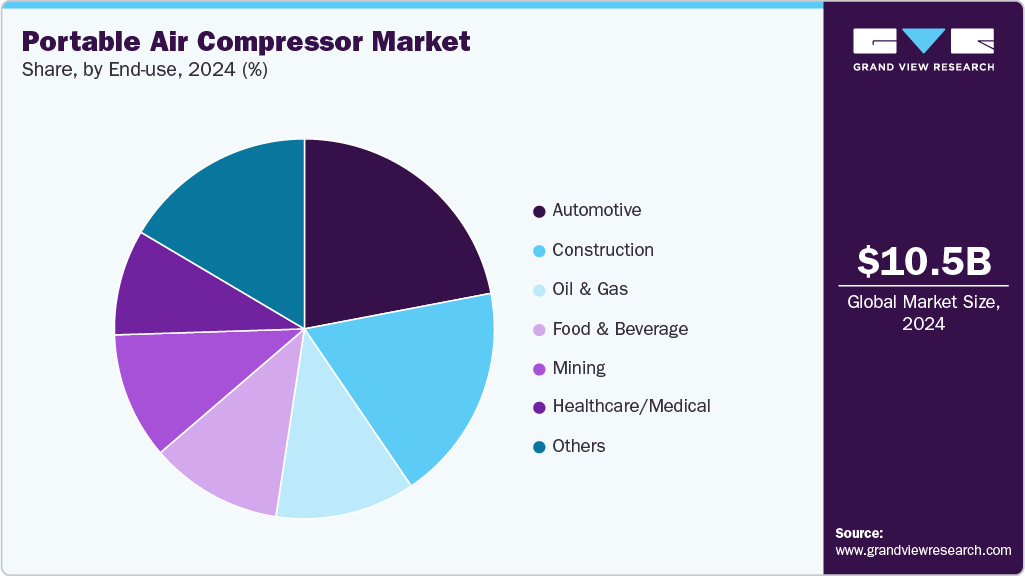
Based on end use, the automotive segment led the market with the largest revenue share of 22.0% in 2025 due to its continuous use in assembly lines, painting, tire inflation, and pneumatic tools. Growing vehicle production, especially in emerging economies, sustains steady demand. These compressors enhance efficiency and productivity in automotive manufacturing processes. Additionally, aftermarket services and maintenance activities further boost their usage in the sector.
 To learn more about this report, Download Free Sample Report
The mining industry is witnessing the fastest growth due to increasing mineral exploration and extraction activities worldwide. Portable air compressors are essential for powering drilling equipment and ventilation systems in remote mining locations. Rising demand for minerals, driven by energy transition and electronics manufacturing, is fueling market expansion. The need for rugged, high-performance compressors in harsh environments accelerates adoption in this sector.
Regional Insights
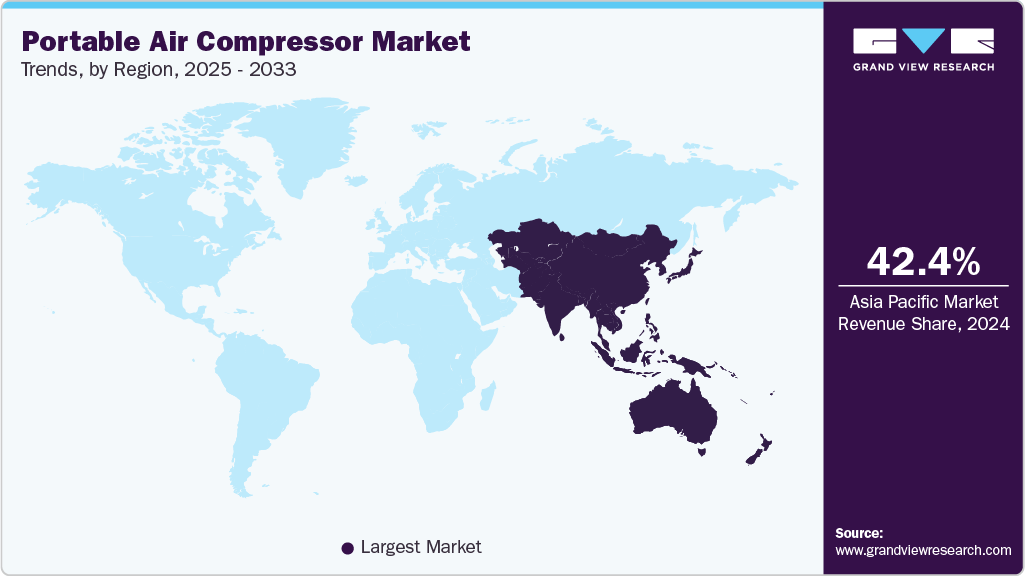
Asia Pacific dominated the portable air compressor market with the largest revenue share of 42.8% in 2025, driven by rapid industrialization, urbanization, and infrastructure development across countries like China, India, and Southeast Asia. Expanding construction activities, growing manufacturing industries, and increasing investments in oil & gas exploration contribute to strong market growth. The rising disposable incomes and growing adoption of advanced technologies in emerging economies further accelerate demand in this region.
 To learn more about this report, Download Free Sample Report
The portable air compressor market in China held the largest share in the Asia Pacific region in 2025. China portable air compressor market held the largest revenue share in the Asia Pacific marketowing to its vast industrial base, extensive infrastructure projects, and rapid urbanization. The country’s booming construction, manufacturing, and mining sectors drive strong demand for portable compressors. Additionally, government initiatives focused on modernizing industry and improving energy efficiency promote the adoption of advanced, environmentally friendly compressor technologies.
India portable air compressor market is propelled by accelerating industrialization, infrastructure development, and expanding automotive and construction sectors. Rising government investments in smart cities and renewable energy projects create new opportunities for portable air compressor adoption. Moreover, increasing awareness about energy efficiency and stricter environmental regulations support the growth of electric and oil-free compressors in India’s market.
North America Portable Air Compressor Market Trends
North America portable air compressor market witnessed continuous growth at a CAGR of 4.2% of the market in 2024. Due to its well-established industrial base, advanced infrastructure, and high adoption of cutting-edge technologies. The region’s strong construction, automotive, and oil & gas sectors, combined with strict regulatory standards, drive demand for high-quality, efficient portable compressors. Additionally, North America’s focus on innovation and sustainability supports widespread use of electric and oil-free models.
U.S. Portable Air Compressor Market Trends
The U.S. portable air compressor market holds the largest share of the global market driven by its large industrial base, advanced infrastructure, and high demand from sectors like construction, automotive, and oil & gas. The U.S. market benefits from stringent environmental regulations that encourage the adoption of energy-efficient and low-emission compressors.
Canada portable air compressor market is the growing market within North America, driven by increasing investments in mining, oil & gas exploration, and renewable energy projects. The growing focus on sustainable and quieter compressor technologies, coupled with government incentives for green energy, boosts the adoption of electric and oil-free portable compressors. Thank you for reaching out.
Europe Portable Air Compressor Market Trends
Europe portable air compressor market holds a significant share in the market due to stringent regulations on noise and emissions, which encourage the use of electric and oil-free compressors. The region’s strong automotive, manufacturing, and healthcare sectors drive steady demand. Investment in renewable energy and green technologies further supports the adoption of environmentally friendly compressor solutions.
Germany portable air compressor market holds a dominant position in the European market due to its strong industrial manufacturing base, particularly in automotive, engineering, and machinery sectors. The country’s focus on precision engineering and stringent environmental regulations drives demand for high-quality, energy-efficient compressors.
UK portable air compressor market is driven by increasing construction activities, healthcare sector expansion, and rising investments in renewable energy projects. The UK’s regulatory emphasis on reducing emissions and noise pollution accelerates the shift towards electric and oil-free compressors.
Middle East & Africa Portable Air Compressor Market Trends
The Middle East & Africa portable air compressor market is growing rapidly due to expanding urbanization and infrastructure development across the region. Countries are increasingly adopting energy-efficient building practices to reduce energy consumption and comply with environmental standards. The demand for advanced insulation materials is rising, especially in commercial and industrial sectors, as governments emphasize sustainability and green building initiatives to support long-term economic growth.
The UAE portable air compressor market stands out as a key market in the Middle East & Africa region due to its robust infrastructure development, thriving oil & gas industry, and status as a regional trade and logistics hub. Significant investments in large-scale construction projects, smart city initiatives, and energy diversification efforts drive strong demand for portable air compressors.
Latin America Portable Air Compressor Market Trends
Latin America’s portable air compressor market is growing steadily, driven by expanding construction projects and mining activities. Countries like Brazil and Mexico show increasing investments in infrastructure and energy sectors. However, economic volatility and infrastructural challenges can limit growth. Demand for portable compressors that are rugged and easy to maintain is high due to operational conditions.
Brazil portable air compressor market is the leading market in Latin America, driven by its large construction and mining industries as well as expanding oil & gas exploration activities. Infrastructure development projects and urbanization efforts across the country create consistent demand for reliable and portable compressor solutions.
Key Portable Air Compressor Company Insights
Some key players operating in the market include Ingersoll Rand, Atlas Copco, and Husky Cooperation.
-
Atlas Copco is a global leader in the manufacturing of industrial equipment, including portable air compressors. Known for its innovation and commitment to sustainability, the company offers a wide range of energy-efficient and reliable compressor solutions tailored to various industries such as construction, mining, and manufacturing. Atlas Copco emphasizes advanced technology, durability, and user-friendly designs, making it a preferred choice worldwide. Their strong focus on customer service and after-sales support strengthens their market presence.
-
Ingersoll Rand is a prominent player in the portable air compressor market, recognized for its high-quality and durable products designed for industrial and commercial use. The company delivers innovative compressor technologies that prioritize efficiency, low maintenance, and environmental compliance. Serving diverse sectors such as automotive, construction, and oil & gas, Ingersoll Rand continually invests in research and development to enhance product performance and sustainability. Their extensive global distribution network ensures wide accessibility and reliable customer support.
Key Portable Air Compressor Companies
The following key companies have been profiled for this study on the portable air compressor market.
-
Ingersoll Rand
-
Atlas Copco
-
Husky Cooperation
-
Doosan Portable Power
-
Stanley Black & Decker, Inc.
-
Gardner Denver, Inc.
-
Kaeser Kompressoren SE
-
Makita Cooperation
-
Sullair, LLC
-
TEWATT
-
California Air Tools, Inc.
-
Rolair Systems
-
Elgi Compressors USA, Inc.
-
Hitachi
-
Zycon
Competitive Benchmarking
Category
Operating Strategies
Competitive Edge
Weakness
Established Players (e.g., Atlas Copco AB, Ingersoll Rand Inc., Kaeser Kompressoren SE, Sullair, LLC, Chicago Pneumatic, Quincy Compressor LLC)
Focus on energy-efficient, oil-free, and electric portable air compressors through continuous R&D and product innovation.
Expand global presence through acquisitions, distributor networks, and long-term partnerships with industrial and rental customers.
Strong global brands with extensive manufacturing capacity and broad distribution networks.
Comprehensive product portfolios backed by advanced engineering expertise and robust after-sales service.
High manufacturing and R&D investments increase operational costs.
Complex global supply chains and large organizational structures can reduce operational flexibility.
Emerging & Regional Players (e.g., ELGi Equipments Ltd., Doosan Portable Power (DEVELON), Sullivan-Palatek, Inc., TEWATT)
Focus on cost-competitive and application-specific portable air compressors for regional markets.
Strengthen market presence through localized manufacturing, distributor partnerships, and customized product offerings.
Competitive pricing with flexibility to address regional customer requirements.
Faster product customization and strong presence in selected regional markets.
Limited global distribution and lower brand recognition compared to established players.
Smaller manufacturing scale and R&D capabilities restrict global expansion and portfolio diversification.
Recent Developments
-
In March 2025, TEWATT introduced its Stage V Dual-Mode Air Compressor, designed to meet the stringent EU Stage V emission standards. This portable diesel-driven compressor offers a versatile pressure range of up to 21 bar, making it suitable for various applications such as water well drilling, geothermal drilling, and oil & gas exploration. Powered by a Volvo TAD883VE engine, it ensures stable performance even in extreme temperatures and challenging environments.
-
In April 2025, Mann+Hummel significantly enhanced operational efficiency at its U.S. plant by upgrading its compressed air system with ELGi's technology. This overhaul, carried out in collaboration with Patton's Inc., has resulted in annual savings exceeding $160,000 and a reduction of over 2 million kWh in energy consumption. The installation of five ELGi EG-160 rotary screw air compressors, three AR-2350 dryers, and an Airmatics smart control system has eliminated over 20 daily air-related downtimes, leading to improved product quality and reduced resource wastage.
Portable Air Compressor Market Report Scope
Report Attribute
Details
Market size value in 2025
USD 11.1 billion
Market size value in 2026
USD 11.6 billion
Revenue forecast in 2033
USD 16.4 billion
Growth rate
CAGR of 5.1% from 2026 to 2033
Base year for estimation
2025
Historical data
2021 - 2024
Forecast period
2026 - 2033
Quantitative units
Revenue in USD billion and CAGR from 2026 to 2033
Report coverage
Revenue forecast, company ranking, competitive landscape, growth factors, and trends
Segments covered
Product, operation mode, lubrication, power range, end use, region
Regional scope
North America; Europe; Asia Pacific; Latin America; Middle East & Africa
Country scope
U.S.; Canada; Mexico; UK; Germany; France; Spain; Italy; China; Japan; India; Australia; South Korea; Brazil; Argentina; Saudi Arabia; South Africa; UAE
Key companies profiled
Atlas Copco AB; Ingersoll Rand Inc.; Kaeser Kompressoren SE; ELGi Equipments Ltd.; Sullair, LLC; Doosan Portable Power (DEVELON); Chicago Pneumatic; Quincy Compressor LLC; Sullivan-Palatek, Inc.; TEWATT.
Customization scope
Free report customization (equivalent up to 8 analysts' working days) with purchase. Addition or alteration to country, regional & segment scope.
Pricing and purchase options
Avail customized purchase options to meet your exact research needs. Explore purchase options
Global Portable Air Compressor Market Report Segmentation
This report forecasts revenue growth at global, regional, and country levels and provides an analysis of the latest industry trends in each of the sub-segments from 2021 to 2033. For this study, Grand View Research has segmented the global portable air compressor market report based on product, operation mode, lubrication, power range, end use, and region
-
Product Outlook (Revenue, USD Million, 2021 - 2033)
-
Reciprocating
-
Rotary/Screw
-
-
Operation Mode Outlook (Revenue, USD Million, 2021 - 2033)
-
Electric
-
Internal Combustion Engine
-
-
Lubrication Outlook (Revenue, USD Million, 2021 - 2033)
-
Oil Free
-
Ool Filled
-
-
Power Range Channel Outlook (Revenue, USD Million, 2021 - 2033)
-
Up to 20 kW
-
21-50 kW
-
51-250 kW
-
251-500 kW
-
Over 500 kW
-
-
End Use Outlook (Revenue, USD Million, 2021 - 2033)
-
Construction
-
Oil & Gas
-
Minning
-
Automotive
-
Healthcare/Medical
-
Food & Beverage
-
Others
-
-
Regional Outlook (Revenue, USD Million, 2021 - 2033)
-
North America
-
U.S.
-
Canada
-
Mexico
-
-
Europe
-
Germany
-
France
-
Italy
-
Spain
-
UK
-
-
Asia Pacific
-
China
-
India
-
Japan
-
South Korea
-
Australia
-
-
Latin America
-
Brazil
-
Argentina
-
-
Middle East and Africa
-
Saudi Arabia
-
UAE
-
South Africa
-
-
Research Methodology
The portable air compressor market figures in this report are based on a proven research process that combines executive interviews with secondary research from proprietary databases, company filings, and recognized regulatory and institutional sources. Market size is built through value-chain sizing - reconciling supply-side and demand-side estimates - and triangulated with bottom-up and top-down approaches. Every estimate passes multiple levels of expert validation before publication, with each portable air compressor segment quantified using the revenue-capture definitions in the table below.
Segment Definition
Segment - Product
Revenue Capture Definition
Reciprocating
Revenue generated from the sale of portable reciprocating air compressors that use piston-driven compression for intermittent and low- to medium-duty applications across construction, automotive, and maintenance sectors.
Rotary/Screw
Revenue generated from the sale of portable rotary screw air compressors designed for continuous compressed air supply in industrial, mining, infrastructure, and energy applications.
Segment - Operating Mode
Revenue Capture Definition
Electric
Revenue generated from the sale of electrically powered portable air compressors for indoor, commercial, industrial, and emission-sensitive applications requiring low-noise operation.
Internal Combustion Engine
Revenue generated from the sale of portable air compressors powered by diesel or gasoline engines for remote, off-grid, construction, mining, and outdoor industrial applications.
Segment - Lubrication
Revenue Capture Definition
Oil Free
Revenue is generated from the sale of oil-free portable air compressors that provide contaminant-free compressed air for food processing, healthcare, electronics, and laboratory applications.
Oil Filled
Revenue is generated from the sale of oil-filled portable air compressors for construction, manufacturing, mining, and other heavy-duty industrial applications requiring continuous operation.
Segment - Power Range
Revenue Capture Definition
Up to 20 kW
Revenue generated from the sale of portable air compressors with power ratings up to 20 kW for light-duty commercial, residential, and maintenance applications.
21-50 kW
Revenue generated from the sale of portable air compressors with power ratings from 21 kW to 50 kW for medium-duty construction, automotive, and industrial applications.
51-250 kW
Revenue generated from the sale of portable air compressors with power ratings from 51 kW to 250 kW for large-scale construction, mining, manufacturing, and infrastructure projects.
251-500 kW
Revenue generated from the sale of portable air compressors with power ratings from 251 kW to 500 kW for heavy industrial, energy, and high-capacity compressed air applications.
Over 500 kW
Revenue generated from the sale of portable air compressors with power ratings above 500 kW for large-scale mining, oil & gas, power generation, and specialized industrial operations.
End-use Segment
Revenue Capture Definition
Construction
Revenue generated from the sale of portable air compressors used in construction activities, including road building, infrastructure development, demolition, concrete work, pneumatic tool operation, and general construction-site applications.
Oil & Gas
Revenue generated from the sale of portable air compressors used in oil and gas exploration, drilling, well servicing, pipeline construction and maintenance, refinery operations, and other upstream, midstream, and downstream activities.
Mining
Revenue generated from the sale of portable air compressors used in surface and underground mining operations, including drilling, blasting support, rock excavation, mineral extraction, and mine development and maintenance.
Automotive
Revenue generated from the sale of portable air compressors used in automotive manufacturing, vehicle assembly, repair and maintenance workshops, tire servicing, painting, and other vehicle-related applications.
Healthcare/Medical
Revenue generated from the sale of portable air compressors used in healthcare and medical applications, including mobile medical facilities, emergency response units, field hospitals, and medical equipment servicing, where the compressor meets the required air quality and safety standards.
Food & Beverage
Revenue generated from the sale of portable air compressors used in food and beverage processing, packaging, bottling, filling, cleaning, and other production activities requiring compressed air that meets applicable hygiene and air quality standards.
Others
Revenue generated from the sale of portable air compressors used in applications outside the specified segments, including manufacturing, power generation, agriculture, utilities, shipbuilding, and general industrial maintenance.
Estimation Model
Layer Name
Key Question
Description
Portable Compressed Air Demand Layer
Where are portable air compressors required?
Analyze demand across construction, mining, oil & gas, manufacturing, agriculture, utilities, automotive, and other industrial sectors. Assess portable compressed air requirements for powering pneumatic tools, field operations, maintenance activities, drilling, sandblasting, and emergency applications to establish the addressable demand for portable air compressors.
Infrastructure & Industrial Equipment Investment Layer
Where is new equipment demand being created?
Evaluate investments in infrastructure development, construction projects, mining operations, industrial facilities, energy projects, and equipment rental fleets. Assess greenfield projects, fleet expansion, equipment replacement, and industrial modernization initiatives that drive procurement of new portable air compressors.
Product Adoption Layer
Which portable air compressor technologies are being deployed?
Segment demand by product, operation mode, lubrication type, power range, and end-use industry. Apply adoption rates based on mobility requirements, air delivery capacity, fuel type, energy efficiency, operating environment, and application-specific performance needs. Assess the increasing adoption of oil-free, electric, and low-emission portable air compressors to improve operational efficiency and meet environmental regulations.
04. Revenue Generation Layer
How much market revenue is generated?
Estimate annual shipments of portable air compressors by product, operation mode, lubrication type, power range, end-use industry, and region. Quantify revenues generated exclusively from the sale of new portable air compressors supplied to contractors, industrial facilities, equipment rental companies, OEMs, and distributors.
Delivered Customizations
This report has been delivered with the following In-depth customizations
Client Request
Customization Delivered
Value Adds
Competitive Benchmarking
A competitive benchmarking analysis was conducted by evaluating leading portable air compressor manufacturers based on product portfolio, compressor technology, power range, manufacturing footprint, distribution network, strategic initiatives, innovation capabilities, and competitive positioning within the portable air compressor market.
This benchmarking enabled stakeholders to evaluate competitive strengths, identify product and technology differentiation, understand market positioning, and develop effective growth and expansion strategies across key end-use industries.
Regional Segmentation
A comprehensive regional analysis was conducted across major markets, assessing demand trends, industrial development, infrastructure investments, construction and mining activities, manufacturing capabilities, regulatory standards, and the contribution of key countries to the portable air compressor market.
The regional assessment enabled stakeholders to identify high-growth markets, optimize regional expansion strategies, allocate investments efficiently, and align product offerings with local industry requirements and regulatory standards.
Opportunity Assessment
A detailed opportunity assessment was conducted by analyzing emerging technologies, equipment electrification, battery-powered portable air compressors, digital monitoring solutions, rental equipment demand, and expanding applications across construction, mining, utilities, and industrial maintenance.
This assessment enabled stakeholders to identify high-growth investment opportunities, align product development with evolving customer requirements, strengthen innovation strategies, and capitalize on emerging demand for energy-efficient and smart portable air compressor solutions.
Frequently Asked Questions About This Report
Based on operating mode, the internal combustion engine segment led the market with the largest revenue share of 62.9% in 2025
Based on lubrication, the oil filled segment led the market with the largest revenue share of 73.1% in 2025.
Based on product, the rotary/screw segment led the market with the largest revenue share of 66.7% in 2025.
Based on power range, the 51-250 kW segment led the market with the largest revenue share of 38.0% in 2025.
The Asia Pacific portable air compressor dominating the market and accounted for share of 42.8% in 2025 global portable air compressor market, driven by rapid industrialization, urbanization, and infrastructure development across countries like China, India, and Southeast Asia.
Some of the key players operating in the global portable air compressor market include Ingersoll Rand; Atlas Copco; Husky Cooperation; Doosan Portable Power; Stanley Black & Decker, Inc.; Gardner Denver, Inc.; Kaeser Kompressoren SE; Makita Cooperation; Sullair, LLC; TEWATT; California Air Tools, Inc.; Rolair Systems; Elgi Compressors USA, Inc.; Hitachi; Zycon.
The global portable air compressor market is primarily driven by the rising demand for compact, energy-efficient equipment across industries such as construction, automotive, and healthcare. Technological advancements, including the integration of IoT and variable-speed systems, further enhance operational efficiency and sustainability, fueling market growth.
The global portable air compressor market size was valued at USD 11.1 billion in 2025 and is projected to grow from USD 11.6 billion in 2026.
The global portable air compressor market is expected to grow at a CAGR of 5.1% from 2025 to 2033, reaching USD 16.4 billion by 2033.
About the Author(s)
Advanced Interior Materials Research Team
Advanced Materials · Advanced Interior MaterialsThis report was authored by the advanced interior materials research team at Grand View Research - comprising two research analysts, one senior research analyst, and one industry expert - with specialized expertise in the advanced interior materials segment of the advanced materials industry. All findings are based on proprietary advanced materials databases, executive interviews, and regulatory analysis, subject to internal peer review prior to publication.
Last Updated:
Speak to Analyst

Customize this report to your needs - add regions, segments, or data points, with 20% free customization.
Or view our licence options:


ISO 9001:2015 & 27001:2022 Certified
We are GDPR and CCPA compliant! Your transaction & personal information is safe and secure. For more details, please read our privacy policy.


