
- Home
- »
- Advanced Interior Materials
- »
-
Portable Air Conditioners Market Size & Share Report, 2033GVR Report cover

Portable Air Conditioners Market (2026 - 2033)
Size, Share & Trends Analysis Report By Type (Monoblock, Split), By Compressor Technology (Inverter, Non-inverter), By Capacity (Below 8,000 BTU, 8,000-12,000 BTU), By End Use (Residential, Commercial), By Region, And Segment Forecasts
Market Size, 2025
$3.3BMarket Estimate, 2026
$3.5BMarket Forecast, 2033
$5.0BCAGR, 2026–2033
5.4%Portable Air Conditioners Market Summary
The global portable air conditioners market size was valued at USD 3.3 billion in 2025 and is projected to grow from USD 3.5 billion in 2026 to USD 5.0 billion by 2033, at a CAGR of 5.4% from 2026 to 2033. The market in Asia Pacific dominated with a revenue share of 30.2% in 2025. Rising temperatures and more frequent periods of extreme heat are increasing the need for convenient and flexible cooling solutions.
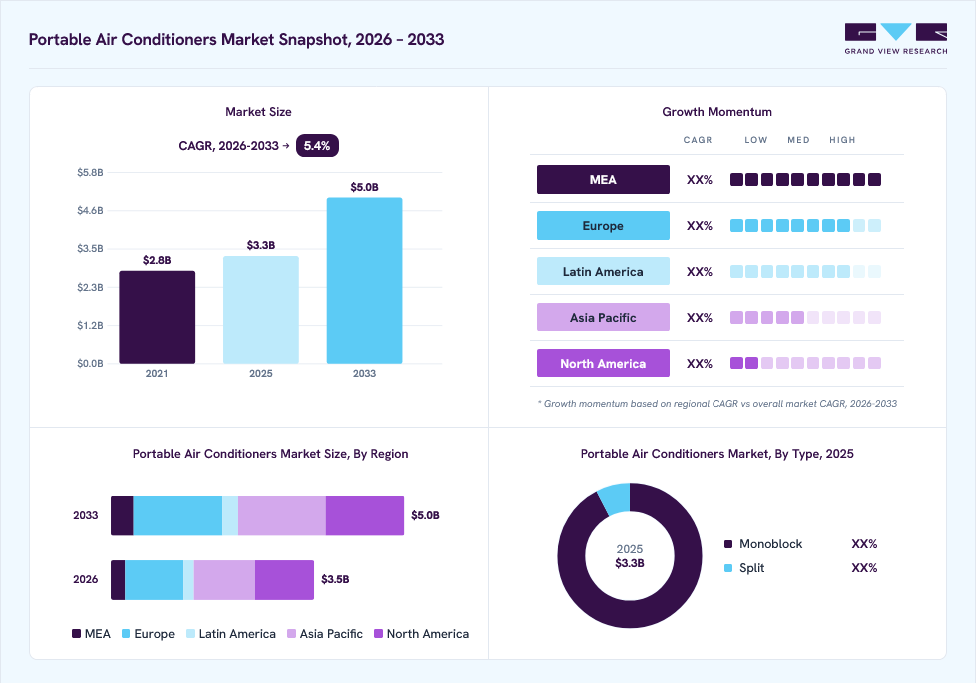 Source: Grand View Research, IR Documents, Primary Interviews, Paid DatabasesTo learn more about this report,
 Download Free Sample Report
Key Market Trends & Insights
- By type: Monoblock segment held the largest revenue share of 92.3% in 2025
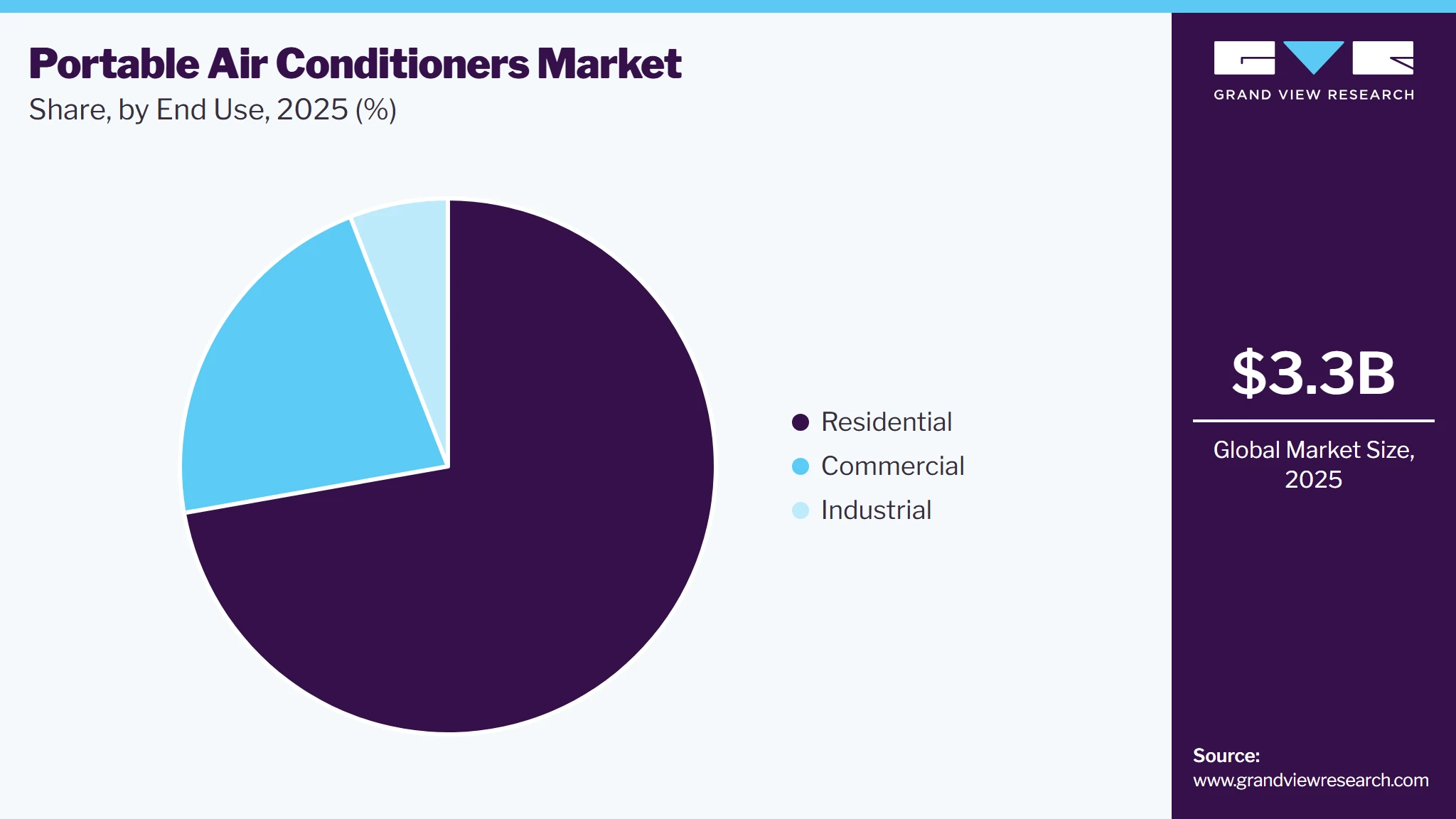
- By end use: Residential segment held the largest revenue share of 72.2% in 2025
- By compressor technology: Non-inverter segment held the largest revenue share of 68.9% in 2025
- By capacity: 8,000-12,000 BTU segment held the largest revenue share of 55.4% in 2025
Regional Highlights
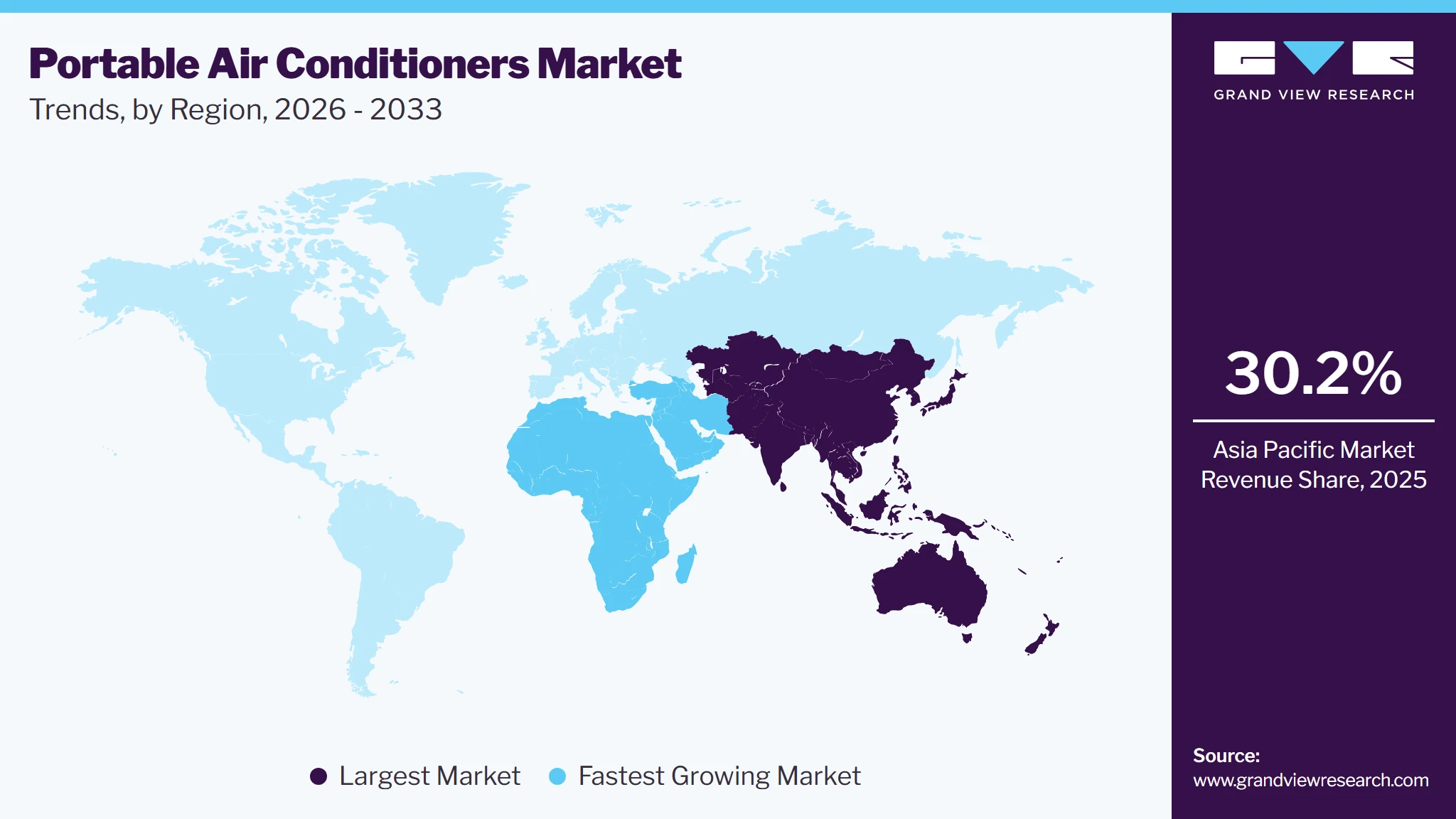
- Largest regional market: Asia Pacific (30.2% revenue share, 2025)
- Fastest-growing regional market: Middle East & Africa (fastest CAGR, 2026-2033)
- By country: China held the largest market share in 2025
Market Size & Forecast
- Market Size in 2025: USD 3.3 Billion
- Estimated Market Size in 2026: USD 3.5 Billion
- Projected Market Size by 2033: USD 5.0 Billion
- CAGR (2026-2033): 5.4%
GVR research-powered AIAsk Prism AI about the portable air conditioners marketGet cited answers from GVR research on market growth, segments, regulations and forecasts.Start with✓ Source-linked answers ✓ Market-specific context ✓ Traceable figuresExplore Prism AI ↗
Portable air conditioners offer targeted cooling without requiring permanent installation, making them suitable for homes, offices, rental properties, and other spaces where conventional air conditioning systems may be difficult to install.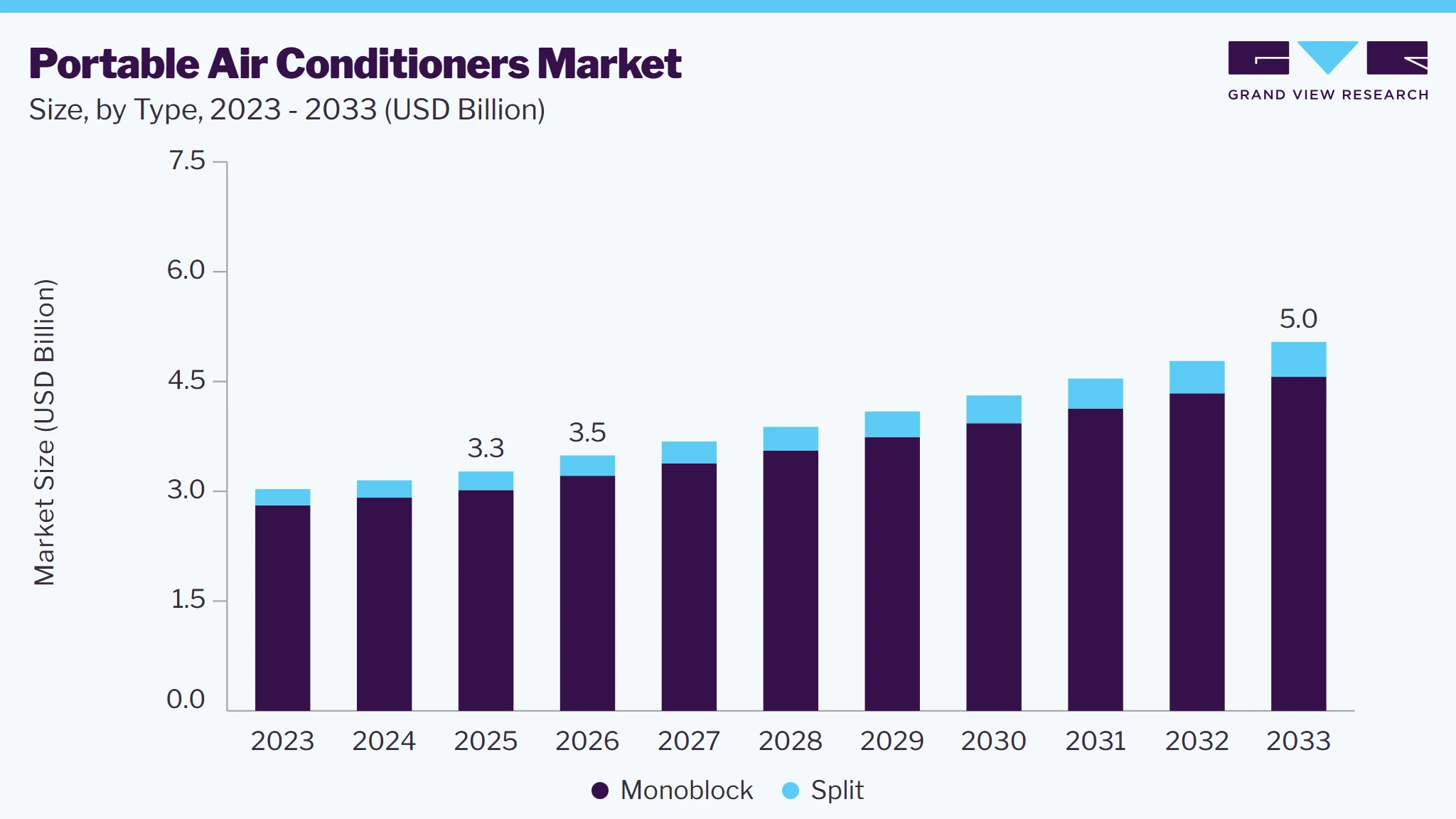 To learn more about this report, Download Free Sample Report
Growing urbanization, compact living spaces, and increasing preference for flexible home appliances are further supporting demand for portable air conditioners. Product advancements, such as inverter compressors, smart connectivity, improved energy efficiency, quieter operation, and better dehumidification capabilities, are making portable units more attractive to consumers. Manufacturers are also introducing compact designs and multifunctional models to address changing consumer preferences and expand their application across residential and commercial settings.
Market Dynamics
The portable air conditioner market is being shaped by rising cooling demand, growing preference for flexible, easily deployable cooling equipment, and technological improvements in energy efficiency and smart functionality. Portable units are particularly suited to rental homes, apartments, offices, and temporary spaces where permanent AC installation may be impractical. At the same time, higher electricity costs, efficiency requirements, and performance limitations compared with fixed systems continue to influence purchasing decisions.
Increasing temperatures and more frequent heatwaves are encouraging consumers and businesses to seek cooling solutions that can be installed quickly and moved between locations. Portable air conditioners provide room-specific cooling without major structural changes, making them suitable for rental properties, smaller apartments, home offices, temporary facilities, and supplemental cooling applications.
The expansion of urban housing and flexible workspaces is further supporting this demand. Consumers living in compact spaces or properties where fixed AC installation is restricted can use portable units as a convenient alternative. Improvements in inverter compressors, smart controls, noise reduction, and compact designs are also increasing the attractiveness of portable systems and broadening their use across residential and commercial settings.
Higher operating energy consumption than fixed air-conditioning systems remains a key restraint to portable AC adoption. The compact design and exhaust-duct configuration can result in efficiency losses, while single-hose models may allow warm air to enter the cooled space. These limitations can increase electricity costs and make portable units less attractive for continuous or large-room cooling.
The shift toward energy-efficient and connected cooling products presents significant growth opportunities for portable AC manufacturers. Inverter compressors, intelligent temperature controls, Wi-Fi connectivity, app-based operation, and improved airflow management can help reduce energy consumption while enhancing user convenience. The adoption of lower-impact refrigerants and improved product designs can further strengthen the market's positioning as consumers and regulators increasingly emphasize energy efficiency and environmental performance.
Market Concentration & Characteristics
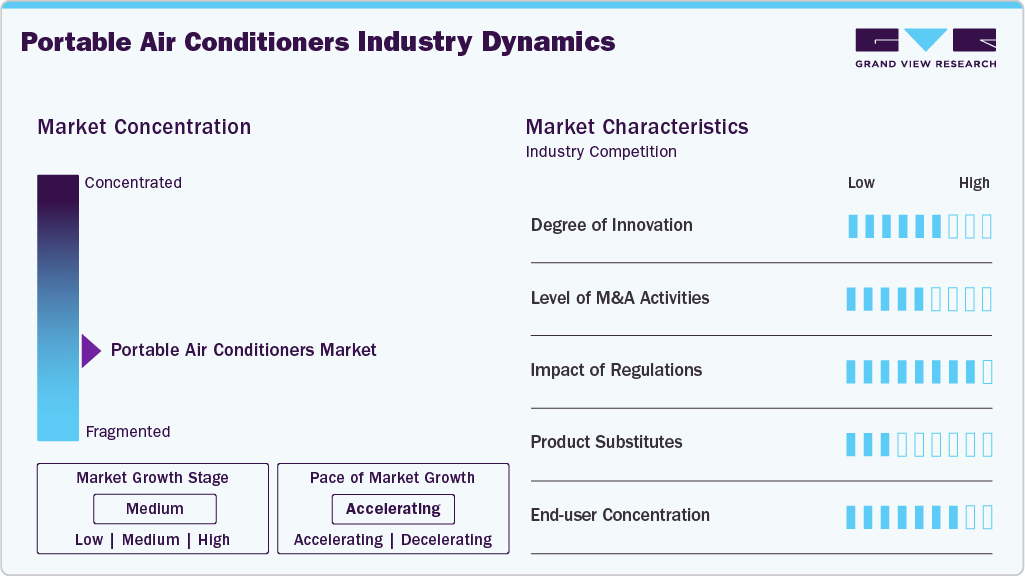
The portable air conditioner market is fragmented, with competition distributed across multinational HVAC manufacturers, home appliance companies, specialized cooling brands, and regional manufacturers. The presence of numerous suppliers across different price ranges and product categories creates a competitive environment with limited dominance by a single company. In addition, OEM and contract manufacturing arrangements lower entry barriers for new brands, further contributing to the fragmented structure of the market.
The portable air conditioner industry has a moderate to high degree of innovation, with manufacturers focusing on improving cooling efficiency, noise reduction, portability, and overall user convenience. Product development increasingly incorporates inverter compressors, smart controls, Wi-Fi connectivity, improved airflow management, and multifunctional cooling and dehumidification features. These innovations help differentiate products in a competitive market while meeting consumer demand for efficient, convenient cooling solutions.
 To learn more about this report, Download Free Sample Report
Regulations have a considerable influence on the portable air conditioner industry, particularly regarding energy efficiency, refrigerants, product performance, and safety standards. Manufacturers need to comply with regional efficiency requirements and testing procedures before products can enter different markets. Increasing environmental requirements are also encouraging the adoption of lower-impact refrigerants and more energy-efficient technologies.
The portable air conditioner market has low to moderate end-user concentration, as demand comes from a wide range of residential and non-residential customers. Portable ACs are used in homes, apartments, offices, retail spaces, temporary facilities, and other locations requiring flexible cooling. This broad customer base limits reliance on a small group of large buyers and supports demand across multiple application areas.
Analyst Perspective
The portable air conditioners market is expected to maintain steady growth as consumers and businesses increasingly seek flexible cooling solutions that require minimal installation and can be deployed across different spaces. Demand is shifting toward energy-efficient, quieter, and smart-enabled products, creating opportunities for manufacturers to differentiate through inverter technology, connected controls, improved airflow, and compact designs. While monoblock and non-inverter systems continue to benefit from affordability and broad availability, faster growth in split, inverter, higher-capacity, and commercial applications indicates a gradual shift toward higher-performance products. Regionally, established markets provide replacement and supplemental cooling opportunities, while emerging markets offer greater potential through urbanization, expanding construction activity, rising cooling needs, and improving access to modern appliances.
Type Insights
The monoblock segment dominated the portable air conditioners industry in 2025, supported by its compact all-in-one construction, ease of installation, and relatively simple plug-and-play operation. These units integrate the major cooling components within a single enclosure, allowing users to move them between rooms without requiring permanent installation. Their suitability for apartments, rental properties, home offices, and temporary cooling applications continues to support their widespread adoption.
The split segment is expected to grow at the fastest CAGR of 8.0% over the forecast period, driven by its ability to provide stronger, more efficient cooling while operating at lower indoor noise levels than conventional monoblock units. Portable split systems are gaining attention in markets where consumers require higher cooling performance but cannot install permanent split ACs, particularly in older buildings and rental properties. Recent product introductions, including portable split systems designed for European homes, are further expanding consumer awareness and application potential.
Compressor Technology Insights
The non-inverter segment dominated the portable air conditioner market in 2025, mainly due to its lower upfront cost, simpler compressor design, and established availability across entry- and mid-range products. Fixed-speed compressors are relatively straightforward to manufacture and operate, cycling between full-capacity and off states, making these units attractive to price-sensitive consumers and users with occasional cooling needs.
The inverter segment is expected to grow at the fastest CAGR of 7.2% over the forecast period, driven by the increasing demand for energy-efficient and quieter cooling solutions. Variable-speed compressors can adjust cooling output according to the room’s cooling load, helping reduce frequent start-stop cycles and maintain more consistent temperatures. Growing awareness of electricity consumption and the broader shift toward high-efficiency air-conditioning technologies are expected to accelerate inverter adoption in portable ACs.
Capacity Insights
The 8,000-12,000 BTU segment dominated the portable air industry market in 2025, supported by its suitability for small to medium-sized rooms, apartments, bedrooms, home offices, and other commonly used indoor spaces. This capacity range offers a balance between cooling performance, unit size, energy consumption, and affordability, making it suitable for a broad range of residential and light commercial applications.
The above 12,000 BTU segment is expected to grow at the fastest CAGR of 7.0% over the forecast period, driven by increasing demand for portable cooling in larger rooms and open-plan spaces. Higher-capacity models are increasingly incorporating dual-hose configurations, inverter compressors, and improved airflow technologies to deliver stronger and more consistent cooling. Growing demand for flexible cooling in larger residential and commercial spaces is expected to further support this segment.
End Use Insights
The residential segment dominated the portable air conditioners market in 2025, driven by rising demand for convenient cooling solutions in homes, apartments, rental properties, and smaller living spaces. Portable ACs are particularly attractive to residential users because they can be installed with minimal structural changes and moved between rooms when required. Rising temperatures, urbanization, and growing preference for flexible home cooling are further supporting residential adoption.
 To learn more about this report, Download Free Sample Report
The commercial segment is expected to grow at the fastest CAGR of 6.7% over the forecast period, driven by increasing adoption across small offices, retail outlets, restaurants, hospitality facilities, and other commercial spaces requiring localized or temporary cooling. Portable systems provide businesses with greater flexibility where permanent HVAC installation is costly, restricted, or impractical. Growing commercial construction and demand for targeted cooling in workspaces are expected to further expand the segment.
Regional Insights
The Asia Pacific portable air conditioners market dominated with the largest revenue share of 30.2% in 2025, driven by high cooling demand across countries with hot and humid climates, particularly in South and Southeast Asia. Rapid urbanization, expanding residential construction, rising household purchasing power, and the growing use of compact appliances in densely populated cities are supporting demand. The region also benefits from a strong appliance manufacturing ecosystem and expanding e-commerce channels, which improve product availability across both developed and emerging markets.
 To learn more about this report, Download Free Sample Report
The China portable air conditioner market dominated Asia Pacific in 2025, driven by its large consumer base, established air-conditioning industry, and extensive manufacturing ecosystem. Rapid urbanization, growing demand for household cooling appliances, and increasing adoption of compact, flexible cooling solutions are driving market growth. The country’s strong domestic supply chain and wide distribution network also enable manufacturers to offer a broad range of portable cooling products across different price segments, strengthening China’s position in the regional market.
The portable air conditioners market in India is expected to register strong growth during the forecast period, supported by expanding residential construction, rising appliance ownership, and increasing demand for cooling equipment. Government data from India’s Ministry of Statistics and Programme Implementation indicate that the country had more than 330 million households in 2025, providing a large potential consumer base for room-cooling products. Growing urban housing, increasing electrification, and the expansion of modern retail and e-commerce are improving access to air-conditioning products, while portable ACs offer an option for households and small businesses where permanent installation is difficult.
North America Portable Air Conditioners Market Trends
North America represents a mature but steadily expanding market, supported by high air-conditioning penetration and strong consumer familiarity with portable cooling products. Demand is particularly supported by rental housing, supplemental room cooling, home offices, and seasonal temperature extremes. Consumers are also showing greater interest in energy-efficient, quieter, and smart-enabled portable models, encouraging product upgrades and replacement demand.
U.S. Portable Air Conditioners Market Trends
The U.S. remained a major market for portable air conditioner, supported by strong cooling requirements and rising temperatures. According to the U.S. EIA, air conditioning accounted for about 19% of electricity consumption in U.S. homes, equivalent to 254 billion kWh, highlighting the significant role of cooling in residential energy use. Also, NOAA reported that the U.S. annual average temperature reached 54.6°F in 2025, 2.6°F above the 20th-century average, making 2025 the fourth-warmest year in the country's 131-year record. In addition, the U.S. Department of Energy introduced specific energy-efficiency standards for portable ACs, with compliance required from January 10, 2025, supporting the shift toward more efficient portable cooling technologies.
Europe Portable Air Conditioners Market Trends
The Europe portable air conditioners industry is witnessing increasing adoption as hotter summers and recurring heatwaves raise awareness of the need for residential cooling. Portable systems offer a practical option for older buildings and rental properties where permanent air-conditioning installation can be difficult or expensive. Demand is also shifting toward more efficient and environmentally preferable models as consumers become more conscious of energy use and the impacts of refrigerants.
The Germany portable air conditioners market dominated Europe in 2025, driven by substantial residential and commercial construction activity. Recent data from Germany’s Federal Statistical Office show that Germany recorded 21,775 dwelling permits in March 2026, while the value of permitted construction work reached approximately USD 11.4 billion during the month. This continued construction activity is creating additional opportunities for flexible cooling solutions across apartments, offices, retail facilities, and other buildings where permanent air-conditioning installation may not always be practical.
The portable air conditioners market in the UK is expected to register strong growth during the forecast period, driven by increasing construction activity across commercial and industrial facilities. According to the UK Office for National Statistics, construction new orders increased 9.8% in Q3 2025, while total construction new orders reached £71.7 billion (approximately USD 97.5 billion) in 2024. Private commercial new work increased 18.8%, creating additional demand potential for flexible cooling equipment across offices, retail spaces, hospitality facilities, and other commercial establishments.
Middle East & Africa Portable Air Conditioners Market Trends
The Middle East & Africa portable air conditioners industry is expected to grow at the fastest CAGR over the forecast period, driven by intense heat and rising demand for flexible cooling across residential, commercial, hospitality, and temporary facilities. Rapid development of buildings, tourism infrastructure, retail spaces, and industrial facilities is creating additional applications for portable cooling equipment. In Africa, improving urban infrastructure and rising access to modern household appliances are gradually expanding the addressable consumer base.
The Saudi Arabia portable air conditioners market is a key area in Middle East & Africa, supported by ongoing residential development and demand from diverse housing types. GASTAT’s Housing Statistics Publication 2025, released in May 2026, provides updated data on occupied dwellings and household housing characteristics across the Kingdom. In addition, building activity continues to drive demand for flexible cooling solutions, with 5,056 building permits issued in May 2026, including both residential and non-residential developments. These factors create opportunities for portable ACs in apartments, villas, offices, retail facilities, and other spaces where flexible cooling is advantageous.
Latin America Portable Air Conditioners Market Trends
The Latin America portable air conditioners industry is expected to experience continued growth as rising temperatures, urban expansion, improving household purchasing power, and increasing access to modern cooling appliances create favorable conditions. Demand is particularly supported by residential users seeking affordable and flexible cooling options, while commercial activity in retail, hospitality, and small businesses provides additional opportunities. Expanding distribution and online retail channels are also making portable AC products more accessible across the region.
The Brazil portable air conditioners market is supported by its large residential base, urbanization, and increasing need for convenient cooling solutions. Growing adoption of air-conditioning equipment across homes, small businesses, retail spaces, and hospitality facilities is creating additional opportunities for portable systems. Their ease of installation, mobility, and suitability for spaces where permanent AC systems are difficult to install are also driving demand, particularly in urban areas and smaller commercial establishments.
Key Portable Air Conditioners Company Insights
Some of the key players operating in the market include The Midea Group, LG Electronics, and Haier Group.
-
Midea Group is a global technology and manufacturing company with a broad presence across consumer appliances, smart home solutions, building technologies, industrial systems, robotics, energy, and healthcare. Established in 1968, the company has developed an extensive international operating network, supported by multiple research and development centers and manufacturing facilities. Its broad product portfolio and focus on technological development have helped Midea establish a strong position across global markets.
-
LG Electronics consumer electronics company with a diverse portfolio spanning home appliances, air solutions, entertainment products, computing devices, and smart technologies. In India, the company offers a broad range of air-conditioning and home appliance products, supported by its focus on connected technologies and product innovation. LG continues to strengthen its presence across consumer and business markets through its extensive product portfolio and established brand network.
Key Portable Air Conditioners Companies
The following key companies have been profiled for this study of the portable air conditioners market.
-
Midea Group
-
LG Electronics
-
Haier Group
-
De’Longhi S.p.A.
-
Carrier
-
Electrolux AB
-
Whirlpool Corporation
-
Danby Products Ltd.
-
Daikin Industries, Ltd.
-
Honeywell International Inc.
-
Gree Electric Appliances Inc.
-
Hisense Group
-
NewAir
-
Whynter LLC
-
Olimpia Splendid S.p.A.
Competitive Benchmarking
Category
Operating Strategies
Competitive Edge
Weakness
Established Players (e.g., Midea Group; LG Electronics; Haier Group; Carrier; Electrolux AB)
- Expand portable AC portfolios across different capacities, configurations, and technology types to address residential and commercial cooling requirements.
- Invest in inverter technology, smart connectivity, energy efficiency, quieter operation, and environmentally preferable refrigerants.
- Utilize established manufacturing, retail, e-commerce, and distribution networks to strengthen presence across major markets.
- Strong brand recognition and established customer relationships across multiple geographic markets.
- Broad HVAC and appliance portfolios supported by substantial R&D and manufacturing capabilities.
- Strong distribution reach enables these companies to serve different price points and end-use applications.
- Large-scale operations and broader product portfolios can limit their ability to respond as quickly to niche portable-AC requirements.
- Higher R&D, manufacturing, and compliance costs can reduce pricing flexibility.
- Competition from specialized portable-AC brands can be stronger in focused product niches.
Emerging & Regional Players (e.g., Danby Products Ltd.; Hisense Group; NewAir; Whynter LLC; Olimpia Splendid S.p.A.)
- Focus on portable AC-specific products, specialized cooling applications, and selected regional markets.
- Use online retail and targeted distribution channels to reach consumers without requiring extensive physical networks.
- Differentiate through compact designs, dual-hose configurations, higher-capacity models, competitive pricing, and specialized features.
- Greater flexibility allows these companies to respond quickly to changing consumer preferences and niche cooling requirements.
- More focused product portfolios can support specialization in portable and room-cooling solutions.
- Competitive pricing and differentiated product features can help them gain share in specific regional or consumer segments.
- Smaller geographic and distribution footprints compared with multinational HVAC manufacturers.
- Limited economies of scale may result in higher production and procurement costs.
- Greater exposure to seasonal demand fluctuations and supply-chain constraints.
Recent Developments
-
In July 2026, LG Electronics is strengthening its international HVAC operations by expanding its network of training centers in major markets. The company is increasing hands-on technical training for distributors, installers, and HVAC professionals to improve product installation and technical expertise. Its HVAC Academy network now spans around 70 facilities across more than 40 countries.
-
In May 2026, De’Longhi introduced the Pinguino GentleJet Inverter, a portable air conditioner combining cooling, fan, and dehumidification functions. The 13,000 BTU/h unit is designed to cool rooms of up to approximately 54 m² while maintaining quieter operation.
Portable Air Conditioners Market Report Scope
Report Attribute
Details
Market size in 2025
USD 3.3 billion
Estimated market size in 2026
USD 3.5 billion
Projected market size by 2033
USD 5.0 billion
Growth rate
CAGR of 5.4% from 2026 to 2033
Historical data
2021 - 2024
Forecast period
2026 - 2033
Quantitative units
Revenue in USD billion and CAGR from 2026 to 2033
Report coverage
Revenue forecast, company ranking, competitive landscape, growth factors, and trends
Segments covered
Type, compressor technology, capacity, end use, and region
Regional scope
North America; Europe; Asia Pacific; Latin America; Middle East & Africa
Country scope
U.S.; Canada; Mexico; UK; Germany; France; Spain; Italy; China; Japan; India; Australia; South Korea; Brazil; Argentina; Saudi Arabia; South Africa; UAE
Key companies profiled
Midea Group; LG Electronics; Haier Group; De’Longhi S.p.A.; Carrier; Electrolux AB; Whirlpool Corporation; Danby Products Ltd.; Daikin Industries, Ltd.; Honeywell International Inc.; Gree Electric Appliances Inc.; Hisense Group; NewAir; Whynter LLC; Olimpia Splendid S.p.A.
Customization scope
Free report customization (equivalent up to 8 analysts working days) with purchase. Addition or alteration to country, regional & segment scope.
Pricing and purchase options
Avail customized purchase options to meet your exact research needs. Explore purchase options
Global Portable Air Conditioners Market Report Segmentation
This report forecasts revenue growth at the global, regional & country levels and provides an analysis of the latest industry trends in each of the sub-segments from 2021 to 2033. For this study, Grand View Research has segmented the global portable air conditioners market report based on type, compressor technology, capacity, end use, and region:
-
Type Outlook (Revenue, USD Billion, 2021 - 2033)
-
Monoblock
-
Single Hose
-
Dual Hose
-
-
Split
-
-
Compressor Technology Outlook (Revenue, USD Billion, 2021 - 2033)
-
Inverter
-
Non-inverter
-
-
Capacity Outlook (Revenue, USD Billion, 2021 - 2033)
-
Below 8,000 BTU
-
8,000-12,000 BTU
-
Above 12,000 BTU
-
-
End Use Outlook (Revenue, USD Billion, 2021 - 2033)
-
Residential
-
Commercial
-
Industrial
-
-
Regional Outlook (Revenue, USD Billion, 2021 - 2033)
-
North America
-
U.S.
-
Canada
-
Mexico
-
-
Europe
-
Germany
-
France
-
Italy
-
Spain
-
UK
-
-
Asia Pacific
-
China
-
India
-
Japan
-
South Korea
-
Australia
-
-
Latin America
-
-
Brazil
-
Argentina
-
-
Middle East and Africa
-
Saudi Arabia
-
South Africa
-
UAE
-
-
Research Methodology
The portable air conditioners market figures in this report are based on a proven research process that combines executive interviews with secondary research from proprietary databases, company filings, and recognized regulatory and institutional sources. Market size is built through value-chain sizing-reconciling supply-side and demand-side estimates-and triangulated with bottom-up and top-down approaches. Every estimate passes multiple levels of expert validation before publication, with each portable air conditioners segment quantified using the revenue-capture definitions in the table below.
Segment Definition
Compressor Technology
Revenue Capture Definition
Inverter
Revenue generated from the sale of portable air conditioners equipped with variable-speed inverter compressor technology that adjusts cooling output according to demand.
Non-inverter
Revenue generated from the sale of portable air conditioners using fixed-speed compressors that operate through periodic start-and-stop cycles.
Capacity
Revenue Capture Definition
Below 8,000 BTU
Revenue generated from the sale of portable air conditioners with cooling capacities below 8,000 BTU, generally designed for smaller rooms and localized cooling applications.
8,000-12,000 BTU
Revenue generated from the sale of portable air conditioners with cooling capacities ranging from 8,000 to 12,000 BTU, primarily serving small- to medium-sized spaces.
Above 12,000 BTU
Revenue generated from the sale of portable air conditioners with cooling capacities exceeding 12,000 BTU, intended for larger rooms and higher cooling-load applications.
Type
Revenue Capture Definition
Monoblock
Revenue generated from the sale of portable air conditioners in which all major cooling components are integrated into a single indoor unit, including single-hose and dual-hose configurations.
Split
Revenue generated from the sale of portable split air-conditioning systems consisting of separate indoor and outdoor units designed for flexible installation and cooling.
End Use
Revenue Capture Definition
Residential
Revenue generated from the sale of portable air conditioners for household applications, including homes, apartments, rental properties, bedrooms, and home offices.
Commercial
Revenue generated from the sale of portable air conditioners for commercial applications, including offices, retail stores, restaurants, hotels, and other business establishments.
Industrial
Revenue generated from the sale of portable air conditioners for industrial applications, including manufacturing facilities, warehouses, workshops, and other industrial spaces requiring localized cooling.
Estimation Model
Layer Name
Key Question
Description
Demand Assessment
What is the underlying demand for portable air conditioners?
Assess cooling requirements across residential, commercial, and industrial applications based on climate conditions, urbanization, housing characteristics, building activity, and demand for flexible cooling solutions.
Market Segmentation
How is demand distributed across product segments?
Estimate demand across type, compressor technology, capacity, and end-use segments, including monoblock, split, inverter, non-inverter, different BTU ranges, and residential, commercial, and industrial applications.
Volume Assessment
What are the expected unit sales across markets?
Estimate portable air conditioner unit volumes across major product categories, end-use applications, and geographic markets using industry demand, shipment trends, company disclosures, and market penetration indicators.
Revenue
What is the total market revenue?
Aggregate revenue generated from portable air conditioner sales across all product segments, end-use categories, and geographic markets to determine the overall market size.
Delivered Customizations
This report has been delivered with the following In-depth customizations
Client Request
Customization Delivered Value Adds Regional Segmentation
Delivered comprehensive regional and country-level analysis covering North America, Europe, Asia Pacific, Latin America, and Middle East & Africa, with market assessment across key countries and sub-regions. The analysis also identifies dominant and high-growth regions and countries.
Provides a broader understanding of geographic demand patterns, regional growth potential, and the factors influencing portable air conditioner adoption across developed and emerging markets.
Competitive Benchmarking
Delivered a comprehensive competitive landscape covering major global, established, emerging, and regional participants in the portable air conditioner industry. The assessment includes company profiles, product positioning, operating strategies, competitive advantages, and potential weaknesses.
Enables comparison of competitive positioning across different types of market participants and highlights how companies differentiate through product portfolios, technology, geographic reach, distribution capabilities, and innovation.
Opportunity Assessment
Delivered a detailed opportunity assessment across type, compressor technology, capacity, end use, and geographic markets, identifying dominant segments, fastest-growing segments, key market drivers, restraints, and emerging areas of opportunity.
Helps identify the most attractive areas for future growth by linking market opportunities with changing cooling requirements, technological advancements, consumer preferences, commercial applications, and regional development trends.
Frequently Asked Questions About This Report
The non-inverter segment accounted for the largest share, representing 68.9% of market revenue in 2025. Its lower initial cost, established availability, and suitability for intermittent cooling requirements supported its leading position.
The 8,000-12,000 BTU segment held the largest share at 55.4% in 2025, reflecting its suitability for commonly used residential and small commercial spaces and its balance between cooling performance, portability, and operating requirements.
Some of the key players operating in the global portable air conditioners market include The Midea Group; LG Electronics; Haier Group; De’Longhi S.p.A.; Carrier; Electrolux AB; Whirlpool Corporation; Danby Products Ltd.; Daikin Industries, Ltd.; Honeywell International Inc.; Gree Electric Appliances Inc.; Hisense Group; NewAir; Whynter LLC; Olimpia Splendid S.p.A.
The global portable air conditioners market size was valued at USD 3.3 billion in 2025 and is estimated at USD 3.5 billion for 2026.
The global portable air conditioners market is expected to grow at a CAGR of 5.4% from 2026 to 2033, reaching USD 5.0 billion by 2033.
Asia Pacific was the largest regional market, accounting for 30.2% of global revenue in 2025. Its leading position is supported by a large consumer base, urbanization, increasing cooling requirements, expanding appliance adoption, and a strong regional manufacturing ecosystem.
The monoblock segment dominated the market, accounting for a 92.3% revenue share in 2025, supported by its compact design, simple installation, mobility, and broad availability across residential and commercial applications.
The residential segment led the market with a 72.2% revenue share in 2025, driven by demand for convenient cooling in homes, apartments, rental properties, and other residential spaces where permanent AC installation may be difficult or unnecessary.
The global portable air conditioners market is primarily driven by rising demand for flexible and easily deployable cooling solutions, increasing urbanization, and growing adoption in apartments, rental properties, home offices, and small commercial spaces. Technological improvements such as inverter compressors, smart connectivity, improved energy efficiency, quieter operation, and compact designs are further enhancing product appeal.
About the Author(s)
Advanced Interior Materials Research Team
Advanced Materials · Advanced Interior MaterialsThis report was authored by the advanced interior materials research team at Grand View Research - comprising two research analysts, one senior research analyst, and one industry expert - with specialized expertise in the advanced interior materials segment of the advanced materials industry. All findings are based on proprietary advanced materials databases, executive interviews, and regulatory analysis, subject to internal peer review prior to publication.
Last Updated:
Speak to Analyst

Customize this report to your needs - add regions, segments, or data points, with 20% free customization.
Or view our licence options:


ISO 9001:2015 & 27001:2022 Certified
We are GDPR and CCPA compliant! Your transaction & personal information is safe and secure. For more details, please read our privacy policy.


