
- Home
- »
- Advanced Interior Materials
- »
-
Pottery Ceramics Market Size And Share Report, 2026-2033GVR Report cover

Pottery Ceramics Market (2026 - 2033)
Size, Share & Trends Analysis Report By Product (Tableware, Art Ware), By Region (North America, Europe, Asia Pacific, Latin America, Middle East & Africa), And Segment Forecasts
Market Size, 2025
$12.3BMarket Estimate, 2026
$12.7BMarket Forecast, 2033
$17.3BCAGR, 2026–2033
4.5%Pottery Ceramics Market Summary
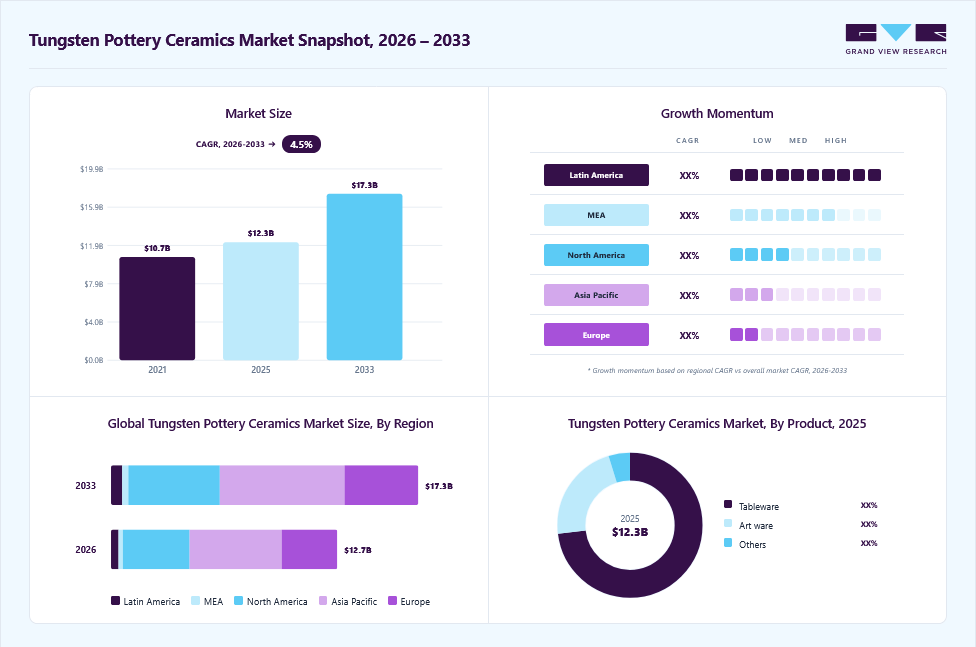
The global pottery ceramics market size was valued at USD 12.3 billion in 2025 and is projected to grow from USD 12.7 billion in 2026 to USD 17.3 billion by 2033, growing at a CAGR of 4.5% from 2026 to 2033. Asia Pacific dominated the market, accounting for the largest share of 40.6% in 2025. The growth is primarily driven by increasing investments in the construction and renovation of hotels and restaurants, which are fueling demand for aesthetically appealing and functional ceramic products.
 Source: Grand View Research, IR Documents, Primary Interviews, Paid DatabasesTo learn more about this report,
 Download Free Sample Report
 Key Market Trends & Insights
- By product: Tableware segment dominated the market, with a revenue share of 73.0% in 2025.
Regional Highlights
- Largest regional market: Asia Pacific (40.6% revenue share, 2025)
- By country: China held the largest market share in 2025.
Market Size & Forecast
- Market size in 2025: USD 12.3 Billion
- Estimated market size in 2026: USD 12.7 Billion
- Projected market size by 2033: USD 17.3 Billion
- CAGR (2026-2033): 4.5%
Three ways to get this report
Buy it, customize it, or ask a question.Ask an Analyst
Analyst response in 1 business day
- AccessReport author, directly
- Reply timeWithin 1 working day
- No sales callDirect answer only
- FormatEmail reply
- CostFree, no cost
Get the Full Report
What the study covers
- FormatsPDF · Excel · Dashboard
- Timeline2026–2033 annual, 2025 base
- Coverage20+ countries, 5 regions
- Companies10+ key players profiled
Customize the Report
20% free customization
- IncludeCountries, segments, points
- TailorTo your product definition
- ExtendDeeper competitor detail
- OrA fully bespoke study
- Turnaround5–10 working days
Additionally, rising consumer preference for handcrafted and artisanal pottery, especially in premium hospitality and dining settings, along with growing emphasis on sustainability and eco-friendly materials, further supports market expansion. Factors such as customer satisfaction and brand loyalty have encouraged hotel and restaurant owners to enhance their interiors and create aesthetically pleasing environments. This has led to a rise in the consumption of pottery ceramics such as tableware and artware, which add an elegant and sophisticated touch to their spaces. Additionally, growing investment in new residential construction is prompting consumers to spend more on decorative items like vases, pots, and crockery to enhance the aesthetic appeal of their homes, further driving demand for pottery ceramics.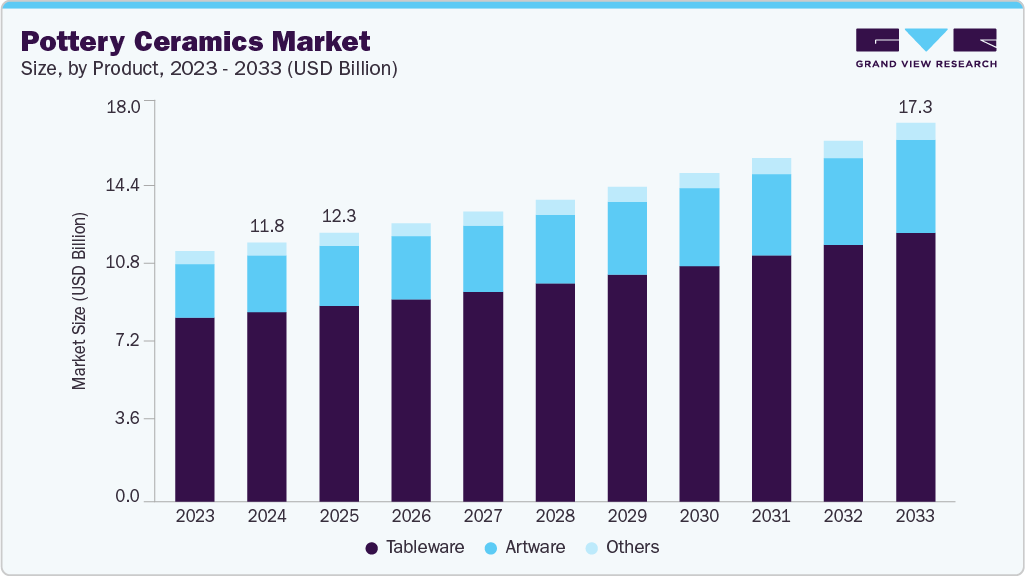 To learn more about this report, Download Free Sample Report
 Furthermore, while the industry is witnessing steady growth driven by rising demand in the hospitality and residential sectors, it faces significant challenges from the availability of substitute materials. Alternatives such as metals, plastics, and glass are widely used due to their higher durability, lower cost, and resistance to breakage, particularly in environments where practicality and long-term performance are essential. These materials are especially favored in high-traffic settings like commercial kitchens, cafeterias, and mass housing projects.
As a result, consumer preferences may shift away from pottery ceramics, especially when budget constraints or functionality take precedence over aesthetics. Although pottery ceramics offer a unique artisanal and decorative appeal, substitute products' competitive pricing and functional advantages continue to limit their broader adoption. The availability of cost-effective alternatives is a key restraint that could impact the long-term growth potential of the global pottery ceramics market.
Market Dynamics
The market is experiencing steady growth due to increasing demand from residential construction, commercial infrastructure development, urbanization, and rising consumer preference for aesthetically appealing and durable ceramic products. Growing investments in housing projects, hospitality establishments, retail spaces, and public infrastructure are driving the adoption of pottery ceramics across both functional and decorative applications. Changing consumer lifestyles, increasing disposable incomes, and the growing popularity of handcrafted and artisanal ceramic products are supporting market expansion. Rapid urban development across Asia Pacific, the Middle East, and Latin America is further contributing to market growth by increasing demand for ceramic tableware, decorative items, sanitary ware, tiles, and specialty pottery products.
The expanding construction industry and rising demand for interior decoration products are major factors driving the market. Pottery ceramics are widely used in residential and commercial buildings for decorative applications, wall and floor tiles, sanitaryware, and architectural embellishments due to their durability, design flexibility, and aesthetic appeal. The growing trend of home renovation and interior remodeling has further increased the demand for ceramic products that enhance visual appeal while offering long service life.
Furthermore, the hospitality sector, including hotels, resorts, restaurants, and cafés, increasingly utilizes pottery ceramics in tableware, decorative installations, and architectural elements to create distinctive customer experiences. Rising tourism activities and investments in premium hospitality infrastructure are generating additional demand for high-quality ceramic products. As urbanization and infrastructure development continue globally, the consumption of pottery ceramics is expected to remain strong throughout the forecast period.
Fluctuations in the prices of key raw materials such as clay, feldspar, kaolin, silica, and glazing materials pose a significant challenge to the market. Manufacturing pottery and ceramics is an energy-intensive process requiring high-temperature firing, making producers highly sensitive to changes in fuel and electricity costs. Rising energy prices can substantially increase production expenses and impact profit margins, particularly for small and medium-sized manufacturers.
Growing consumer preference for handcrafted, customized, and environmentally sustainable products presents a significant growth opportunity for the market. Consumers are increasingly seeking unique ceramic products that combine functionality with artistic value, driving demand for artisanal pottery, designer tableware, decorative ceramics, and luxury home décor items. The growing popularity of personalized and limited-edition ceramic products is encouraging manufacturers and artisans to expand their product portfolios. In addition, increasing awareness regarding sustainability is promoting the adoption of eco-friendly manufacturing practices and natural raw materials in ceramic production. The expansion of e-commerce platforms is enabling manufacturers and independent artisans to reach wider customer bases across domestic and international markets. As demand for premium lifestyle products and sustainable home décor solutions continues to grow, the market is expected to witness substantial opportunities during the forecast period.
Analyst Perspective
The pottery ceramics market is benefiting from growing consumer interest in handcrafted, aesthetically distinctive, and sustainable products, particularly across home décor, tableware, and gifting applications. Demand is being supported by rising spending on lifestyle products, the expansion of the hospitality sector, and increasing preference for artisanal ceramics that offer uniqueness over mass-produced alternatives. While manufacturers continue to face pressure from volatile raw material and energy costs, the market outlook remains favorable as premiumization trends, e-commerce penetration, and demand for customized ceramic products continue to gain momentum globally.
Product Insights
Based on product, the tableware segment led the market with the largest revenue share of 73.0% in 2025. Tableware’s non-porous nature and resistance to odor, grease, and bacteria make it ideal for fine dining establishments, where hygiene and presentation are critical. Chefs strongly prefer white ceramic bowls and plates over glass alternatives, as they enhance the visual appeal of food. The growing demand for premium ceramic tableware in hotels and restaurants prompts manufacturers to increase production. For instance, in 2024, Churchill China (UK) Ltd. advanced its expansion plans at the Stoke-on-Trent factory to cater to rising orders from luxury hospitality clients across Europe and Asia.
The artware segment is projected to grow fastest during the forecast period. Artware includes vases, sculptures, and pots, which are widely used by the global hospitality industry to enhance the aesthetic value of their interiors. In 2024, the growing trend of thematic decor in boutique hotels and resorts and luxury property staging by real estate developers significantly contributed to increased demand for handcrafted ceramic artware. Developers of high-end apartments and villas increasingly incorporate bespoke ceramic art pieces to attract premium buyers who value artistic and cultural touches in their living spaces.
The other product segment, including ceramic roof tiles and holders, also retained its importance in 2024. Ceramic roof tiles are being increasingly adopted in construction due to their durability, thermal efficiency, and resistance to harsh weather. Their heavy thermal mass helps regulate room temperature, making them an energy-efficient solution in residential and commercial buildings. The construction industry's shift toward sustainable and long-lasting materials has further propelled the use of ceramic-based building components, especially in regions experiencing rising temperatures and stricter building codes.
Regional Insights
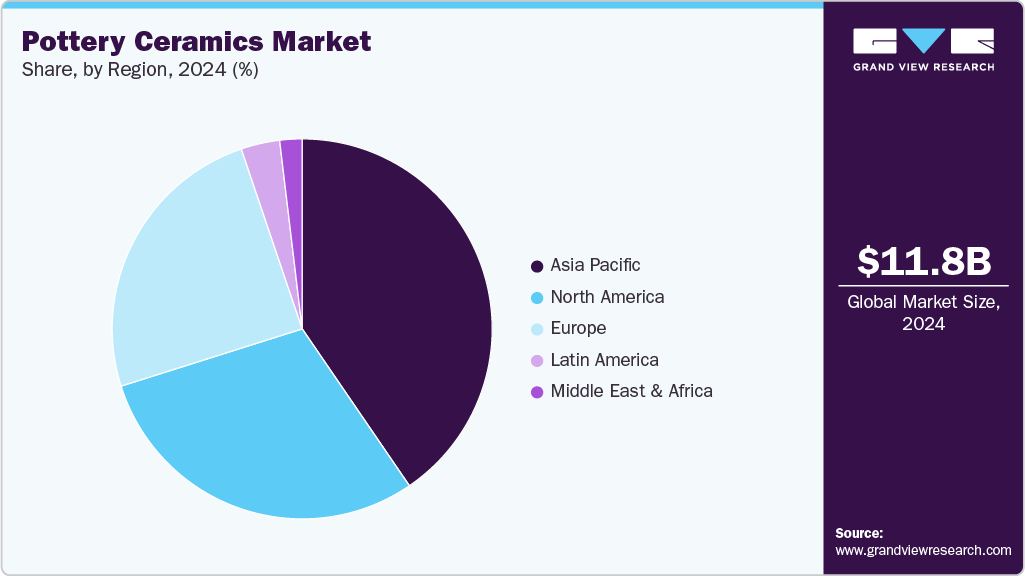
North America pottery ceramics market continues to grow steadily, supported by rising demand in hospitality, interior décor, and real estate development sectors. With consumers emphasizing home aesthetics and personalized décor, the region's demand for tableware and artware has increased. Hotels, restaurants, and boutique accommodations are investing in ceramic products to enhance their ambiance and dining experiences. Moreover, the growing appreciation for handcrafted and locally produced ceramics and sustainability trends encourages traditional pottery and modern ceramic brands to expand their product lines. E-commerce growth and home improvement trends contribute to wider market accessibility and consumer interest.
 To learn more about this report, Download Free Sample Report
 U.S. Pottery Ceramics Market Trends
The pottery ceramics market in the U.S. is primarily driven by premium hospitality chains, home décor retailers, and affluent consumers seeking unique, artisanal products. The country has witnessed strong adoption of ceramic tableware in fine dining and specialty restaurants, where chefs prefer white, minimalistic ceramic plates and bowls to enhance food presentation. In addition, the rise in home renovations and luxury real estate projects is fueling demand for decorative ceramics such as vases, sculptures, and planters. Domestic manufacturers are expanding to meet this demand with a focus on sustainable production methods and eco-friendly materials to align with shifting consumer values. The U.S. market also benefits from design trends influenced by European and Japanese aesthetics, favoring clean lines, natural finishes, and artisanal quality.
Asia Pacific Pottery Ceramics Market Trends
Asia Pacific dominated the pottery ceramics market with the largest revenue share of 40.6% in 2025. The pottery ceramics market in Asia Pacific is driven by urbanization, rising disposable incomes, and expanding tourism infrastructure. Countries like China, India, Japan, and Thailand are seeing increased demand for ceramic tableware and décor in luxury hotels, high-end restaurants, and new residential developments. The traditional and cultural relevance of pottery in countries like India and China also continues to support market growth. Moreover, a large manufacturing base enables cost-effective production, making Asia Pacific a major exporter of pottery ceramics globally. The rise in modern retail formats and e-commerce contributes to the widespread availability of decorative and functional ceramics among middle- and high-income consumers.
China Pottery Ceramics Market Trends
China dominated the Asia Pacific market with a revenue share of 38.8% in 2025.
Europe Pottery Ceramics Market Trends
The pottery ceramics market in Europe remains a mature and design-conscious market, with a strong emphasis on craftsmanship, sustainability, and aesthetic value. Countries such as Germany, Italy, France, and the UK have well-established pottery traditions and are home to premium ceramic brands catering to local and international markets. The demand for sustainable and eco-friendly home décor products and growing minimalist and Nordic interior design trends drive ceramic tableware and artware use in residential and hospitality sectors. European consumers value artisanal and ethically produced ceramics, while governments and institutions support small and medium pottery enterprises through cultural and innovation grants. This alignment of tradition with modern consumer values keeps Europe at the forefront of design-led pottery ceramic trends.
Key Pottery Ceramics Companies Insights
Key players operating in the pottery ceramics market are undertaking various initiatives to strengthen their presence and increase the reach of their products and services. Strategies such as expansion activities and partnerships are key in propelling the market growth.
Key Pottery Ceramics Companies:
The following key companies have been profiled for this study on the pottery ceramics market.
-
American Art Clay Co., Inc. (AMACO)
-
Bhoomi Pottery
-
Bluematchbox Potters Supplies Ltd
-
CCGNZ Group Limited
-
Clay-King
-
Dick Blick Holdings Inc.
-
Laguna Clay Company
-
Sajo Ceramics
-
Sheffield Pottery Inc.
-
Sounding Stone
Competitive Benchmarking
Category
Operating Strategies
Competitive Edge
Weakness
Established Players (e.g., American Art Clay Co., Inc. (AMACO), Dick Blick Holdings Inc., Laguna Clay Company, Sheffield Pottery Inc.)
- Primarily engaged in the large-scale manufacturing and distribution of pottery ceramics, ceramic raw materials, glazes, kiln equipment, and pottery supplies.
- Focus on strengthening market presence through product diversification, manufacturing efficiency, and extensive distribution networks.
- Continuously invest in product innovation, advanced ceramic technologies, and customer engagement initiatives.
- Cater to a broad customer base, including households, educational institutions, professional artists, ceramic studios, and commercial users.
- Strong brand recognition and long-standing industry experience.
- Extensive distribution capabilities and established relationships with customers and suppliers.
- Ability to offer a comprehensive range of ceramic products and materials across multiple market segments.
- Benefit from scale advantages, technical expertise, and stable financial resources.
- High operational and production costs associated with manufacturing, logistics, and inventory management.
- Vulnerable to fluctuations in raw material prices and energy costs.
- May face limitations in rapidly adapting to emerging niche trends and customized product demand.
- Increasing competitive pressure from regional and low-cost manufacturers.
Emerging & Regional Players (e.g., Bhoomi Pottery, Bluematchbox Potters Supplies Ltd, CCGNZ Group Limited, Clay-King, Sajo Ceramics, Sounding Stone)
- Focus on regional markets and specialized pottery ceramic products, including handcrafted and customized offerings.
- Emphasize product differentiation through unique designs, artisanal craftsmanship, and customer-specific solutions.
- Utilize online sales channels, local partnerships, and direct-to-consumer strategies to expand market reach.
- Target niche applications within home décor, gifting, hospitality, and artistic ceramics.
- Greater flexibility in responding to changing consumer preferences and design trends.
- Strong capability to provide customized and small-batch ceramic products.
- Ability to build strong customer loyalty through craftsmanship and personalized offerings.
- Faster decision-making and product development processes due to lean organizational structures.
- Limited production capacity and geographic reach compared to larger industry participants.
- Dependence on regional demand patterns and specific customer segments.
- Lower bargaining power in raw material procurement and distribution networks.
- Resource constraints may limit expansion, marketing activities, and large-scale investments.
Recent Developments
-
In March 2024, American Art Clay Co. (AMACO) launched its new “Supernova” crystalline glaze. This food-safe product quickly gained popularity among studio potters and educators for its vibrant surface effects and ease of use. The release strengthened AMACO’s position in the decorative ceramics segment and reinforced its commitment to glaze innovation.
-
In April 2024, Laguna Clay Company was recognized in multiple global ceramics industry reports as a leading supplier of clay bodies and glaze materials, driven by consistent demand from art schools and studio potters across North America. The company maintained its market leadership by expanding its distribution partnerships and increasing the supply of specialty clays for artisan pottery production.
-
In January 2024, Dick Blick Holdings Inc. (Blick Art Materials) expanded its ceramic product portfolio by launching new pottery starter kits and introducing exclusive clay and glaze bundles targeted at educational institutions and beginner potters. This initiative aligned with its broader strategy to support hands-on art education and enhance accessibility to ceramic materials.
-
In February 2024, Bhoomi Pottery partnered with IGA Galleria to co-host the Pune Potters’ Market 2024, showcasing handcrafted ceramic artware by over 40 Indian studio potters. The event highlighted Bhoomi’s leadership in sustainable pottery and its dedication to promoting artisanal craftsmanship in domestic and international markets.
Pottery Ceramics Market Report Scope
Report Attribute
Details
Market definition
The market size represents the revenue generated from the sale of ceramic products made from clay and other mineral-based materials. The market includes tableware, artware, and other pottery ceramic products used across various applications.
Market size in 2025
USD 12.3 billion
Estimated market size in 2026
USD 12.7 billion
Projected market size by 2033
USD 17.3 billion
Growth rate
CAGR of 4.5% from 2026 to 2033
Base year for estimation
2025
Historical data
2021 - 2024
Forecast period
2026 - 2033
Quantitative units
Revenue in USD million, and CAGR from 2026 to 2033
Report coverage
Revenue forecast, company ranking, competitive landscape, growth factors, and trends
Segments covered
Product, region
Regional scope
North America; Europe; Asia Pacific; Latin America; Middle East & Africa
Country scope
U.S.; Canada; Mexico; Germany; UK; France; Spain; Turkey; China; Japan; India; Brazil; GCC
Key companies profiled
American Art Clay Co. (AMACO); Bhoomi Pottery; Bluematchbox Potters Supplies Ltd; CCGNZ Group Limited; Clay-King; Dick Blick Holdings Inc. (Blick Art Materials); Laguna Clay Company; Sajo Ceramics; Sheffield Pottery Inc.; Sounding Stone
Customization scope
Free report customization (equivalent up to 8 analysts' working days) with purchase-addition or alteration to country, regional & segment scope.
Pricing and purchase options
Avail customized purchase options to meet your exact research needs. Explore purchase options
Global Pottery Ceramics Market Report Segmentation
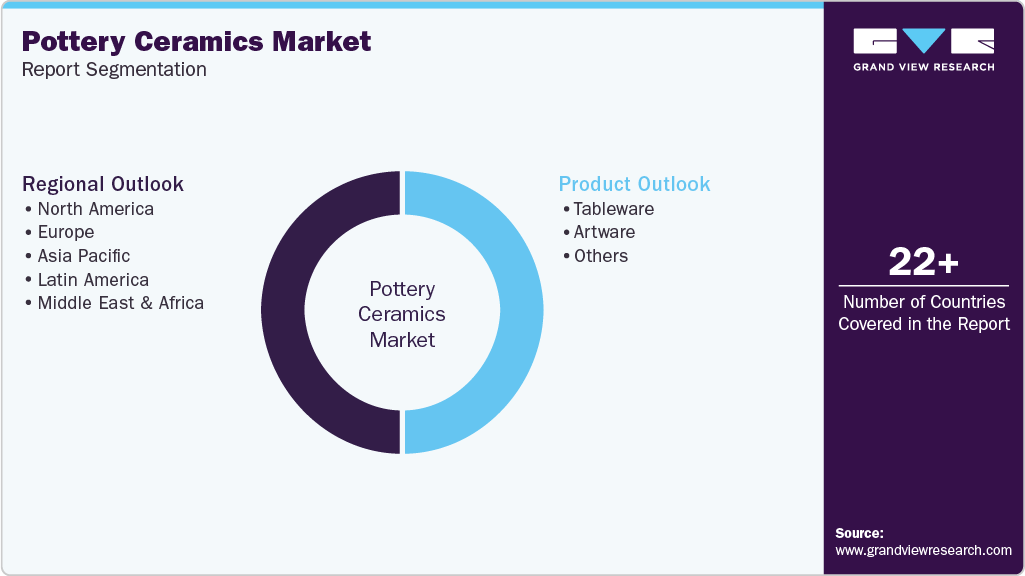
This report forecasts revenue growth at the global, regional, and country levels and analyzes the latest trends in each sub-segment from 2021 to 2033. For this study, Grand View Research has segmented the global pottery ceramics market report based on product and region.
 To learn more about this report, Download Free Sample Report
 -
Product Outlook (Revenue, USD Billion, 2021 - 2033)
-
Tableware
-
Artware
-
Others
-
-
Regional Outlook (Revenue, USD Billion, 2021 - 2033)
-
North America
-
U.S.
-
Canada
-
Mexico
-
-
Europe
-
Germany
-
UK
-
France
-
Spain
-
Turkey
-
-
Asia Pacific
-
China
-
India
-
Japan
-
-
Latin America
-
Brazil
-
-
Middle East & Africa
-
GCC
-
-
Research Methodology
The pottery ceramics market figures in this report are based on a proven research process that combines executive interviews with secondary research from proprietary databases, company filings, and recognized regulatory and institutional sources. Market size is built through value-chain sizing - reconciling supply-side and demand-side estimates - and triangulated with bottom-up and top-down approaches. Every estimate passes multiple levels of expert validation before publication, with each pottery ceramics segment quantified using the revenue-capture definitions in the table below.
Segment Definition
Product
Revenue Capture Definition
Tableware
This segment includes pottery ceramic products used for serving, dining, food presentation, and household applications. Revenue is generated from the sale of ceramic plates, bowls, cups, mugs, saucers, serving dishes, platters, and related tableware products supplied to residential consumers, restaurants, hotels, cafés, catering services, and institutional establishments.
Art ware
This segment comprises pottery ceramics manufactured primarily for decorative, artistic, and ornamental purposes. Revenue is derived from the sale of ceramic sculptures, figurines, vases, decorative vessels, wall art, handcrafted pottery, collectible ceramics, and designer ceramic products used in homes, commercial spaces, hospitality establishments, galleries, and cultural institutions.
Others
This segment includes pottery ceramic products not categorized under tableware or art ware, such as ceramic planters, garden pottery, utility ware, storage containers, gift items, religious and ceremonial ceramics, educational pottery products, and specialty handcrafted ceramic articles. Revenue is generated from sales across residential, commercial, landscaping, institutional, and niche application markets.
Estimation Model
Layer Name
Key Question
Description
Consumer Demand Base Layer
What forms the demand base?
Identify pottery ceramics demand generated from household consumption, hospitality establishments, restaurants, cafés, commercial spaces, interior decoration projects, gifting applications, and cultural or artistic uses. Assess demand across tableware, art ware, decorative ceramics, garden pottery, and utility ware applications. Analyze the influence of urbanization, changing consumer lifestyles, disposable income growth, and home décor trends on overall market demand. This layer establishes the total addressable demand for pottery ceramics globally.
Raw Material Supply & Manufacturing Layer
Where are pottery ceramics produced and supplied from?
Estimate the availability and supply of pottery ceramics based on raw materials such as clay, kaolin, feldspar, silica, and other ceramic minerals. Analyze regional manufacturing capacities, artisan production clusters, industrial ceramic facilities, supply chain networks, import-export activities, and distribution channels. Evaluate the role of manufacturers, craft producers, wholesalers, and retailers in supplying pottery ceramics to end-use markets.
Application Consumption Intensity Layer
How much pottery ceramics are consumed?
Analyze pottery ceramics consumption intensity across tableware, art ware, decorative products, garden pottery, hospitality products, and specialty ceramic applications. Evaluate purchasing frequency, replacement cycles, product durability, consumer preferences, seasonal demand patterns, and adoption rates across residential and commercial sectors. Consumption intensity varies based on income levels, cultural traditions, tourism activity, design trends, and end-user requirements.
Revenue Layer
How is market revenue generated?
Market revenue is quantified through the production and sale of pottery ceramic products across residential, commercial, hospitality, institutional, and decorative applications. Revenue generation is influenced by product type, craftsmanship, design complexity, material quality, manufacturing costs, distribution channels, and regional demand dynamics. Growth in home décor spending, hospitality infrastructure, premium handcrafted ceramics, e-commerce penetration, and consumer preference for aesthetic and sustainable products drives overall market value.
Delivered Customizations
This report has been delivered with the following In-depth customization
CLIENT REQUEST
CUSTOMIZATION DELIVERED
VALUE ADDS
Import-Export & Trade Analysis
Analysis of global trade flows, major exporting and importing countries, trade balances, sourcing patterns, and international market opportunities for pottery ceramics.
Supported export market identification, sourcing decisions, and international business expansion planning.
Regional Demand Assessment
Detailed evaluation of pottery ceramics demand across North America, Europe, Asia Pacific, Latin America, and the Middle East & Africa. Included country-level consumption trends, growth drivers, cultural influences, and end-use demand patterns.
Enabled identification of high-growth regional markets, supported geographic expansion strategies, and highlighted region-specific demand opportunities.
Opportunity Assessment
Identification of opportunities across premium ceramics, handcrafted pottery, sustainable products, customized offerings, hospitality applications, and online retail channels.
Assisted in prioritizing investment areas and identifying high-potential revenue opportunities within the market.
Frequently Asked Questions About This Report
Asia Pacific dominated the market with a revenue share of 40.6% in 2025.
The expanding hospitality and tourism industry drives the pottery ceramics market, where hotels, restaurants, and resorts increasingly seek aesthetically appealing ceramic tableware and décor to enhance guest experiences.
Tableware segment led the market with the largest revenue share of 73.0% in 2025.
The pottery ceramics market size was estimated at USD 12.3 billion in 2025 and is expected to reach USD 12.7 billion in 2026.
The pottery ceramics market is expected to grow at a compound annual growth rate of 4.5% from 2026 to 2033 to reach USD 17.3 billion by 2033.
Some of the key vendors in the global pottery ceramics market are American Art Clay Co. (AMACO), Bhoomi Pottery, Bluematchbox Potters Supplies Ltd, CCGNZ Group Limited, Clay-King, Dick Blick Holdings Inc. (Blick Art Materials), Laguna Clay Company, Sajo Ceramics, Sheffield Pottery Inc., and Sounding Stone, among others.
About the Author(s)
Advanced Interior Materials Research Team
Advanced Materials · Advanced Interior MaterialsThis report was authored by the advanced interior materials research team at Grand View Research - comprising two research analysts, one senior research analyst, and one industry expert - with specialized expertise in the advanced interior materials segment of the advanced materials industry. All findings are based on proprietary advanced materials databases, executive interviews, and regulatory analysis, subject to internal peer review prior to publication.
Last Updated:
Speak to Analyst

Customize this report to your needs - add regions, segments, or data points, with 20% free customization.
Or view our licence options:


ISO 9001:2015 & 27001:2022 Certified
We are GDPR and CCPA compliant! Your transaction & personal information is safe and secure. For more details, please read our privacy policy.


