
- Home
- »
- Animal Feed and Feed Additives
- »
-
Poultry Feed Market Size, Share & Trends Report 2026-2033GVR Report cover

Poultry Feed Market (2026 - 2033)
Size, Share & Trends Analysis Report By Livestock (Layers, Broilers, Turkeys), By Additives (Antibiotics, Vitamins, Amino Acid, Feed Enzymes, Feed Acidifiers), By Region, And Segment Forecasts
Market Size, 2025
$238.9BMarket Estimate, 2026
$250.6BMarket Forecast, 2033
$356.4BCAGR, 2026–2033
5.2%Poultry Feed Market Summary
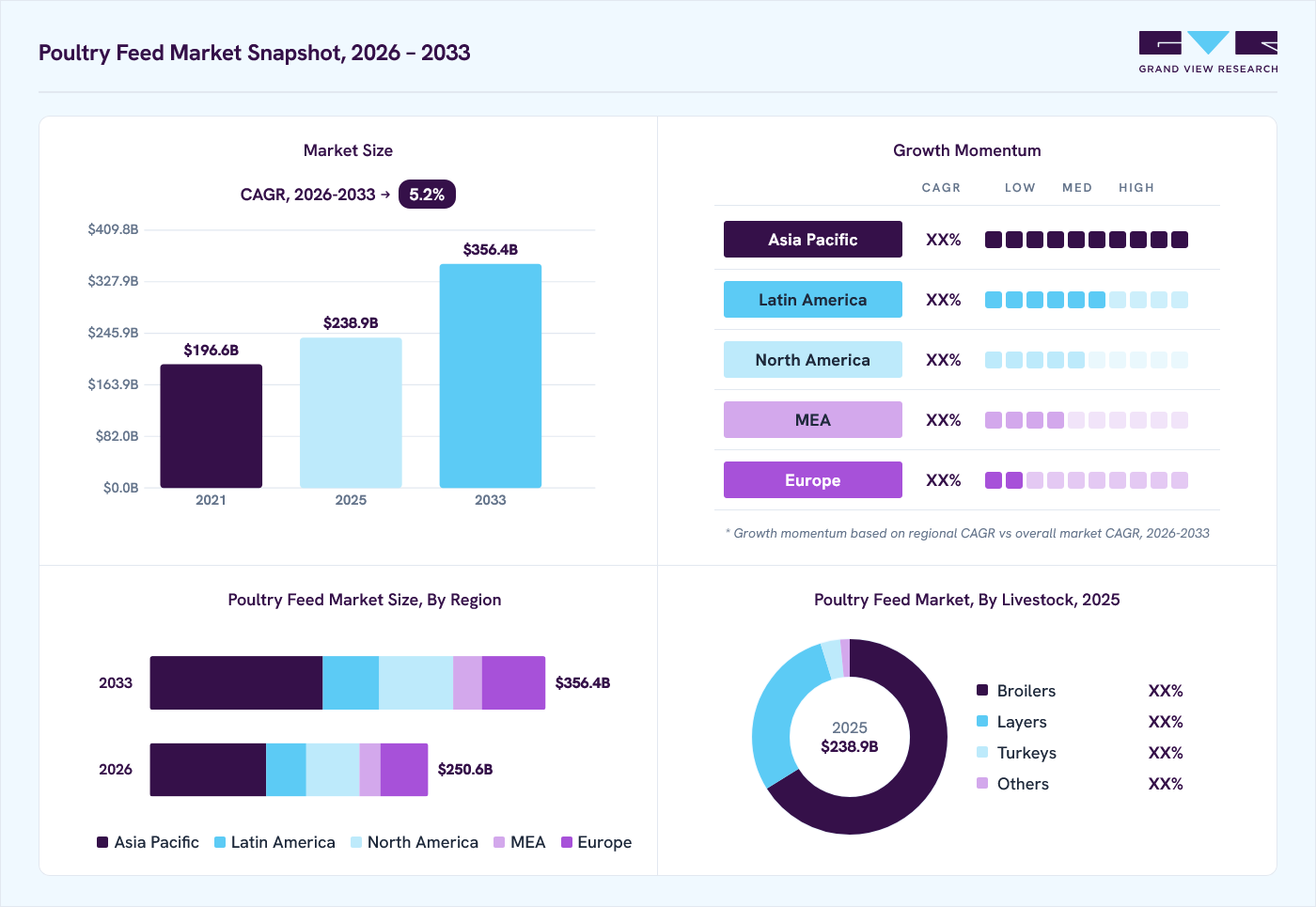
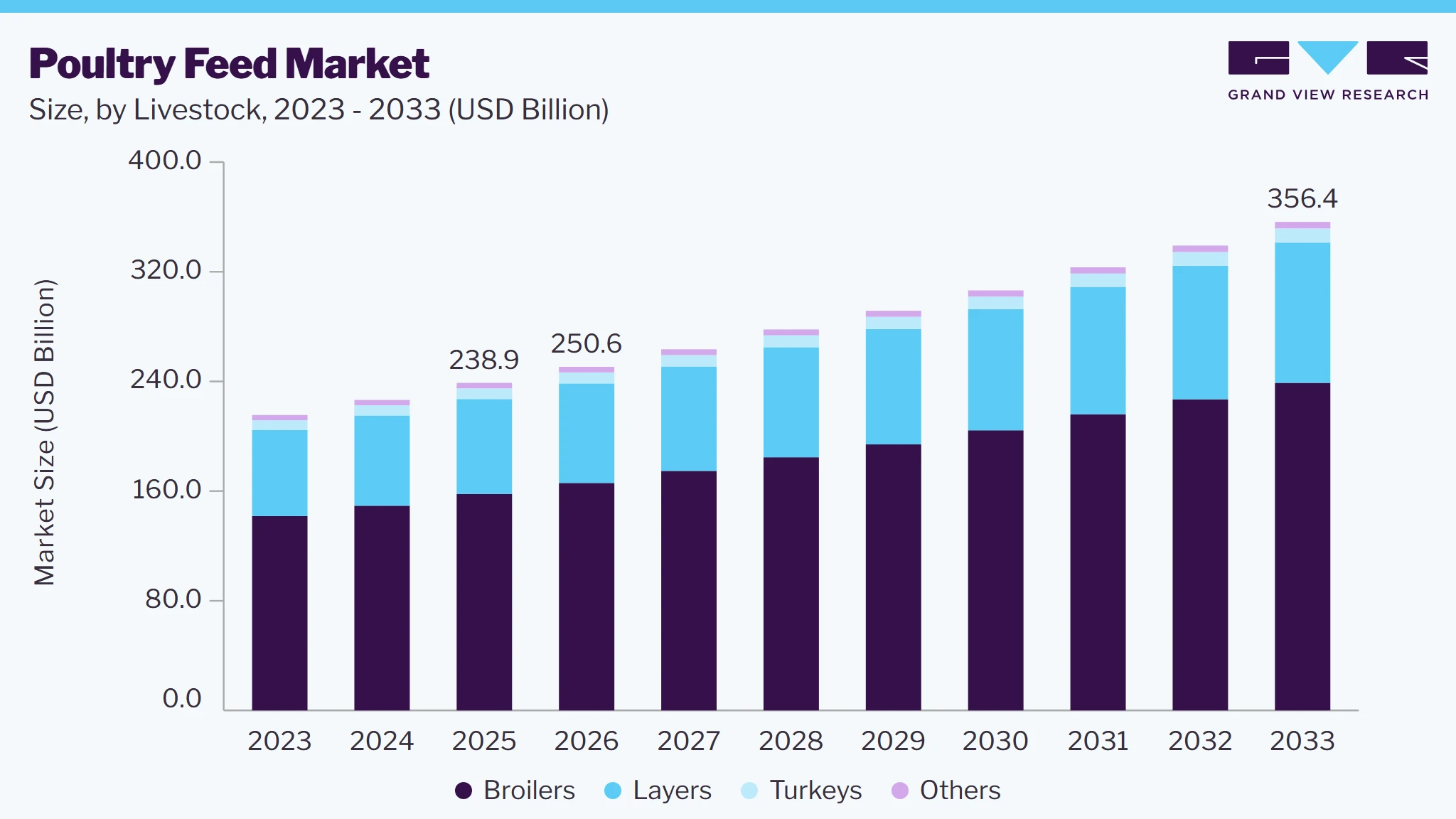
The global poultry feed market size was valued at USD 238.9 billion in 2025 and is projected to grow from USD 250.6 billion in 2026 to USD 356.4 billion by 2033, at a CAGR of 5.2% from 2026 to 2033.Asia Pacific dominated the poultry feed market with the highest revenue share of 41.6% in 2025. The demand can primarily be attributed to the increasing poultry farming to cater to the rising demand for chicken meat and eggs globally.
 Source: Grand View Research, IR Documents, Primary Interviews, Paid DatabasesTo learn more about this report,
 Download Free Sample Report
Key Market Trends & Insights
- By livestock: Broilers segment held the largest market share of 66.1% in 2025.
- By additives: Amino acids segment held the largest market share of 36.4% in 2025.
Regional Highlights
- Largest regional market: Asia Pacific (41.6% revenue share, 2025)
- By country: China held the largest market share in 2025.
Market Size & Forecast
- Market size in 2025: USD 238.9 Billion
- Estimated market size in 2026: USD 250.6 Billion
- Projected market size by 2033: USD 356.4 Billion
- CAGR (2026-2033): 5.2%
Prism AI by Grand View Research Free to tryAsk a question about the poultry feed market✓Every figure cited from GVR research Prefer the report? Download free sample →Poultry is considered as one of the most economical sources of protein owing to which poultry products such as egg and meat are consistently witnessing growth in demand. According to the United States Department of Agriculture (USDA), the global production of chicken meat, with a growth of 2%, is likely to reach 97.8 million tons in 2019.
 To learn more about this report, Download Free Sample Report
Demand for poultry products heavily depends upon the population and income factor. Packaged poultry feed is expected to witness higher growth rates as compared to traditional poultry feed, which, in turn, is anticipated to provide new opportunities for industry participants.
Quality and the price of feed products emerged as one of the most significant factors in this market owing to which suppliers are playing a critical role in the poultry feed industry. To keep the prices in manageable proportion, poultry feed producers are likely to increase their presence in raw material production, which is further projected to change the procurement strategies in the market.
The industry is highly competitive owing to the presence of numerous market players striving to manufacture products suitable for use in multiple applications. High competition in the market is pushing manufacturers to produce innovative products. The competition in the market is particularly intense among big players such as Cargill, Archer Daniels, Midland, Kemin Industries, and Lallemand, Inc.
Market Dynamics
The poultry feed market is driven by rising global poultry meat and egg consumption, increasing demand for high-quality animal protein, and the ongoing shift toward commercial poultry farming. Feed manufacturers are focusing on nutritionally balanced formulations enriched with amino acids, enzymes, probiotics, and other functional additives to improve feed conversion efficiency, bird health, and production performance. However, fluctuations in raw material prices, particularly corn and soybean meals, continue to impact production costs and profit margins. At the same time, growing emphasis on sustainable feed ingredients, precision nutrition, and antibiotic-free poultry production is creating new growth opportunities for market participants.
The increasing consumption of poultry meat and eggs, supported by population growth, urbanization, and rising disposable incomes, is a primary factor driving the poultry feed market. Poultry remains one of the most affordable and efficient sources of animal protein, prompting producers to expand commercial farming operations to meet growing consumer demand. This expansion has led to higher consumption of compound feed designed to optimize bird growth, feed conversion efficiency, and overall productivity.
In response, feed manufacturers are investing in advanced formulations incorporating amino acids, enzymes, probiotics, vitamins, and minerals to enhance flock performance and improve production efficiency. Growing emphasis on disease prevention, antibiotic-free production, and sustainable poultry farming is further increasing demand for specialized feed solutions. As poultry production becomes increasingly intensive and technology-driven, the need for high-performance feed is expected to remain a key growth driver for the poultry feed market.
Price fluctuations in key feed ingredients, particularly corn, soybean meal, wheat, and other protein sources, remain a significant restraint for the poultry feed market. Feed manufacturers are highly dependent on agricultural commodities, making production costs vulnerable to changes in crop yields, adverse weather conditions, geopolitical disruptions, trade restrictions, and supply chain uncertainties. These fluctuations reduce pricing stability and create challenges in maintaining consistent profit margins.
Rising input costs also increase the overall cost of poultry production, placing financial pressure on farmers, especially small and medium-scale producers. While manufacturers may attempt to pass higher costs to customers, competitive market conditions often limit pricing flexibility. Consequently, sustained raw material price volatility can affect feed demand, reduce profitability across the value chain, and constrain market growth.
The increasing focus on precision nutrition and sustainable poultry production presents a significant growth opportunity for the poultry feed market. Producers are increasingly adopting scientifically formulated feed tailored to the nutritional requirements of different poultry species and growth stages to improve feed efficiency, bird health, and production performance. This trend is driving demand for value-added feed products incorporating functional ingredients, alternative proteins, enzymes, probiotics, and organic additives.
Growing regulatory emphasis on reducing antibiotic use and improving environmental sustainability is encouraging innovation in feed formulations and ingredient sourcing. Feed manufacturers are investing in sustainable raw materials, digital feed management technologies, and low-emission production practices to meet evolving industry requirements. These developments are expected to create new revenue opportunities while supporting long-term market expansion across both developed and emerging poultry-producing regions.
Analyst Perspective
The poultry feed market is expected to maintain steady growth, supported by increasing global demand for poultry meat and eggs, rising commercialization of poultry farming, and greater emphasis on feed efficiency and animal health. Market participants are prioritizing innovation in feed formulations, functional additives, and sustainable ingredients to improve production performance while addressing evolving regulatory and consumer requirements. Continued investments in precision nutrition, alternative feed ingredients, and integrated feed manufacturing are expected to strengthen long-term market competitiveness and create new growth opportunities across both developed and emerging markets.
Livestock Insights
By livestock, broilers held a dominant position, contributing 66.1% of total revenue in 2025. Increasing demand for chicken meat owing to protein content emerged as a significant driving factor for the segment growth. Broilers are specifically raised for meat production.
Increasing demand for chicken meat owing to the presence of protein-rich content at low cost is triggering the growth of broilers farming. Proper nutrition is one of the most important factors in broilers farming. Broiler requires 13 vitamins, one essential fatty acid, 13 amino acids, 14-16 minerals, and a source of energy for balanced nutrition.
In 2018, layers segment, with approximately 30% volume share, emerged as the second-largest segment in the global poultry feed market. Layers are primarily reared for egg production. Increasing population across the globe is creating a high demand for food and energy sources, which is increasing the production of layer globally.
Increasing per capita egg consumption and growth in the global population are the major demand drivers for the growth of the layers segment. The U.S., Mexico, and Canada emerged as significant markets owing to the higher ratio of egg consumption, presence of various raw materials for feed, and consumer’s preference for poultry products.
Additive Insights
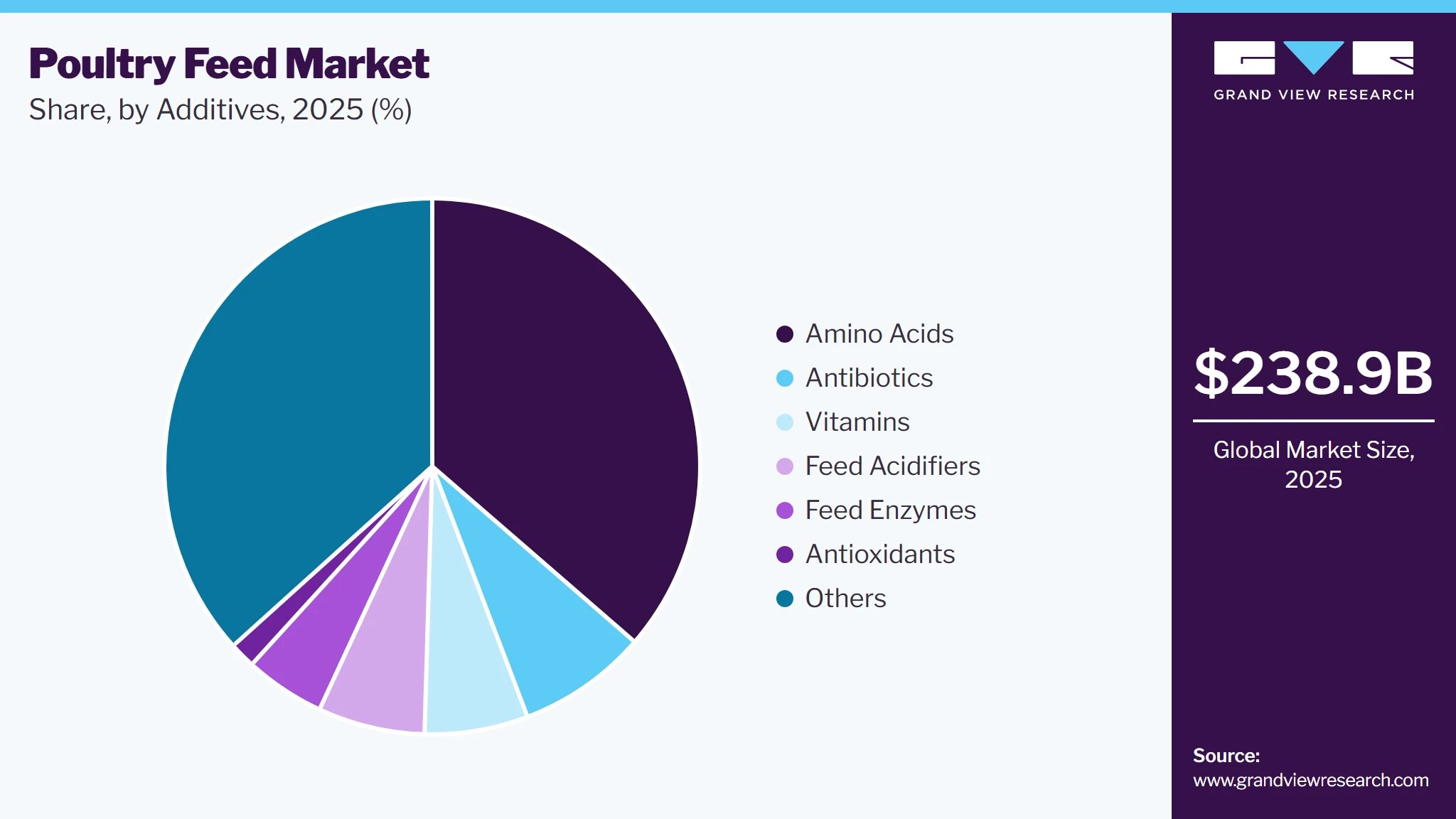
Amino acids segment accounted for the largest revenue of 36.4% in 2025 and is estimated to witness a remarkable growth rate over the coming years. The amino acid is considered as one of the most important sources of protein and, therefore, highly required in poultry nutrition. Due to high protein content, amino acid helps reduce the inclusion level of soybean meal in a monogastric animal’s diet.
 To learn more about this report, Download Free Sample Report
Vitamins are a group of organic compounds required in small quantities for feed. Vitamins are used to regulate normal body functions, reproduction, and growth, which makes them an important additive. They can be broadly categorized into two different groups, namely water-soluble and fat-soluble vitamins.
Ethoxyquin is one of the majorly used synthetic antioxidants. It is also one of the economic antioxidants and has high preservative capabilities owing to which it is used in canned pet foods. However, the demand for such antioxidant has decreased in the recent past owing to negative consumer perceptions and side effects regarding synthetic antioxidants.
Regional Insights
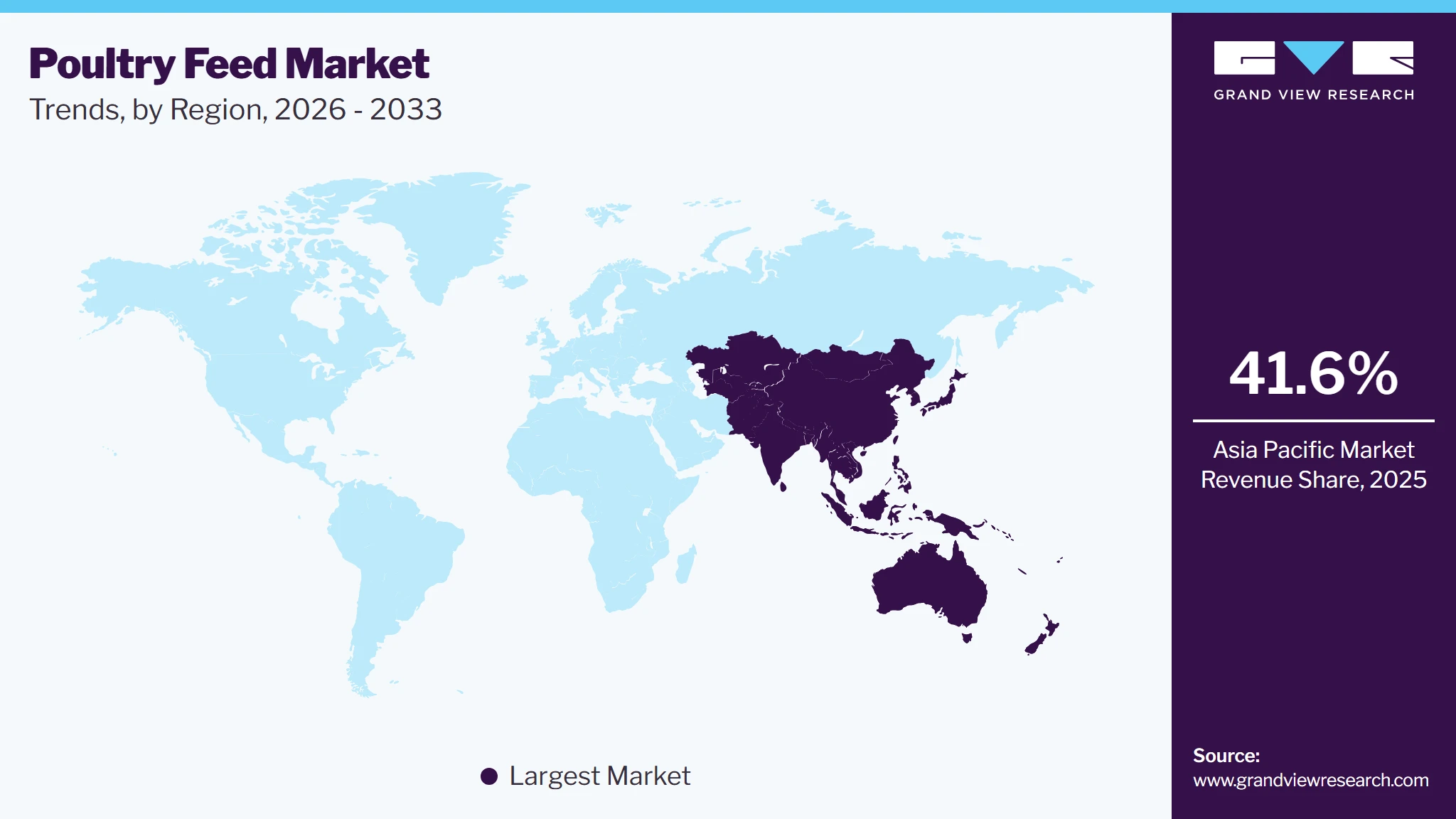
Asia Pacific dominated the poultry feed market with the highest revenue share of 41.6% in 2025. China dominated the Asia Pacific poultry feed market in 2025. The presence of a huge population and increasing disposable incomes are likely to trigger the market growth at the fastest rate in Asia Pacific. Asia Pacific led by emerging economies such as China, India, and Malaysia has a competitive edge over other regions on account of the abundant availability of low-cost labor and agricultural land. The region is likely to advance at the fastest rate, in terms of both volume and revenue, over the forecast period owing to the huge population and increasing disposable incomes of consumers.
 To learn more about this report, Download Free Sample Report
In the U.S., nearly thirty-five companies (federally inspected) are engaged in raising and processing of chicken. These companies are vertically integrated throughout the poultry value chain, which helps them ensure the quality of the product. The European poultry feed industry is driven by innovation and highly regulated.
Also, conventionally, the European market has been highly regulated in terms of human health and well-being as well as the environment. This results in regular changes in the guidelines for feed additives in terms of bans and restrictions. Increasing broiler production in Europe and consumers’ preference for poultry products owing to their economic prices in comparison to other substitutes are likely to develop the market across the region over the forecast period. Spain emerged as a major demand driver for the European market.
Key Companies & Market Share Insights
Royal DSM N.V.; Alltech Inc.; Novus International Inc.; Evonik Industries; Kent Nutrition Group, Inc.; and BASF are some of the companies present in the industry. Poultry feed manufacturers aim to achieve optimum business growth and establish a strong market position through the implementation of various strategies such as acquisitions, joint ventures, production capacity expansions, new product launches, promotion of key product brands, and significant investments in the research & development.
Emerging regional players or new entrants, especially in developing countries, are likely to have increased opportunities to enter the market. Rising establishment of government initiatives and ascending foreign investments in the developing agricultural sector, mainly in China and India, are expected to boost the market growth over the forecast period.
Key Poultry Feed Companies
The following key companies have been profiled for this study on the poultry feed market
-
Royal DSM N.V.
-
Alltech Inc.
-
Novus International Inc.
-
Evonik Industries
-
Kent Nutrition Group, Inc
-
BASF
Competitive Benchmarking
Category
Operating Strategies
Competitive Edge
Weakness
Established Players (Royal DSM N.V.; Alltech Inc.; Novus International Inc.; Evonik Industries; BASF)
- Focus on global expansion through continuous R&D, strategic acquisitions, advanced feed additive development, sustainability initiatives, digital nutrition solutions, and integrated manufacturing capabilities. These companies leverage broad distribution networks and long-term partnerships with commercial feed manufacturers and integrated poultry producers.
- Strong global presence, diversified product portfolios, robust financial resources, advanced research capabilities, established customer relationships, and well-developed manufacturing and supply chain infrastructure provide significant competitive advantages.
- Large organizational structures can reduce operational agility, while premium product pricing and high dependence on global raw material markets may affect competitiveness in price-sensitive regions.
Emerging Players (Kent Nutrition Group, Inc.)
- Focuses on regional expansion, customized poultry nutrition solutions, customer-centric technical support, and strengthening relationships with local feed manufacturers and poultry producers. The company emphasizes operational efficiency and targeted product development to expand its market presence.
- Strong regional brand recognition, flexible product offerings, close customer engagement, and the ability to respond quickly to local market requirements enable effective competition within regional markets.
- Limited international presence, comparatively smaller production capacity, and lower R&D investment restrict the ability to compete with multinational industry leaders on a global scale.
Poultry Feed Market Report Scope
Report Attribute
Details
Market size in 2025
USD 238.9 billion
Estimated market size in 2026
USD 250.6 billion
Projected market size by 2033
USD 356.4 billion
Growth rate
CAGR of 5.2% from 2026 to 2033
Base year for estimation
2025
Historical data
2021 - 2024
Forecast period
2026 - 2033
Quantitative units
Revenue in USD billion and CAGR from 2026 to 2033
Report coverage
Revenue forecast, company ranking, competitive landscape, growth factors, and trends
Segments covered
Livestock, additives, region
Regional scope
North America; Europe; Asia Pacific; Latin America; MEA
Country scope
U.S., Canada, Mexico, Germany, U.K., France, China, India, Japan, Brazil, Argentina, South Africa
Key companies profiled
Royal DSM N.V.; Alltech Inc.; Novus International Inc.; Evonik Industries; Kent Nutrition Group, Inc.; and BASF
Customization scope
Free report customization (equivalent up to 8 analysts' working days) with purchase. Addition or alteration to country, regional & segment scope.
Pricing and purchase options
Avail customized purchase options to meet your exact research needs. Explore purchase options
Global Poultry Feed Market Report Segmentation
This report forecasts revenue growth at the global, regional, and country levels and provides an analysis of the industry trends in each of the sub-segments from 2021 to 2033. For the purpose of this study, Grand View Research has segmented the global poultry feed market report on the basis of livestock, additives, and region:
-
Livestock Outlook (Volume, Kilotons; Revenue, USD Million, 2021 - 2033)
-
Layers
-
Broilers
-
Turkeys
-
Others
-
-
Additives Outlook (Volume, Kilotons; Revenue, USD Million, 2021 - 2033)
-
Antibiotics
-
Vitamins
-
Antioxidants
-
Amino Acid
-
Feed Enzymes
-
Feed Acidifiers
-
Others
-
-
Regional Outlook (Volume, Kilotons; Revenue, USD Million, 2021 - 2033)
-
North America
-
The U.S.
-
Canada
-
Mexico
-
-
Europe
-
Germany
-
U.K.
-
France
-
Italy
-
Spain
-
-
Asia Pacific
-
China
-
India
-
Japan
-
Indonesia
-
Vietnam
-
-
Central & South America
-
Brazil
-
Argentina
-
-
Middle East & Africa
-
South Africa
-
-
Research Methodology
The poultry feed market figures in this report are based on a proven research process that combines executive interviews with secondary research from proprietary databases, company filings, and recognized regulatory and institutional sources. Market size is built through value-chain sizing - reconciling supply-side and demand-side estimates - and triangulated with bottom-up and top-down approaches. Every estimate passes multiple levels of expert validation before publication, with each poultry feed segment quantified using the revenue-capture definitions in the table below.
Segment Definition
Segment - Livestock
Revenue capture definition
Layers
Revenue is generated from feed products specifically formulated for layer hens to enhance egg production, shell strength, and overall bird health. The segment includes complete feed, concentrates, and nutritional formulations supplied throughout the laying cycle. Market revenue is captured from the commercial sale and consumption of layer feed across integrated and independent poultry farms.
Broilers
Revenue is generated from feed formulations designed for broiler chickens to maximize growth performance, feed conversion efficiency, and meat yield. The segment covers starter, grower, and finisher feeds used throughout the broiler production cycle. Market estimates include revenue derived from feed supplied to commercial broiler producers and integrated poultry operations.
Turkey
Revenue is generated from nutritionally balanced feed developed for turkey production across breeding and grow-out stages. The segment includes specialized feed formulations that support weight gain, health, and production efficiency. Revenue capture reflects commercial sales of turkey feed used in industrial and contract farming operations.
Others
Revenue is generated from feed formulated for other poultry species, including ducks, geese, quails, breeder birds, and game birds. The segment includes species-specific feed products designed to meet varying nutritional requirements. Market revenue is calculated from commercial feed sales across diversified poultry production systems.
Segment - Additives
Revenue capture definition
Antibiotics
Revenue is generated from antibiotic feed additives incorporated into poultry feed to support disease control and flock health where regulatory approval exists. The segment includes antimicrobial products supplied to commercial feed manufacturers and poultry producers. Market estimates capture revenue from the sale of antibiotic-based feed additives across the poultry industry.
Vitamins
Revenue is generated from vitamin additives incorporated into poultry feed to improve metabolism, immunity, growth, and reproductive performance. The segment includes vitamin premixes and individual vitamin formulations used across all poultry production stages. Revenue is captured from commercial sales of vitamin-enriched feed ingredients supplied to feed manufacturers.
Antioxidants
Revenue is generated from antioxidant additives that preserve feed quality by preventing oxidation of fats and nutrients during storage. The segment includes both natural and synthetic antioxidant formulations used in compound poultry feed. Market revenue reflects commercial demand from feed manufacturers seeking to enhance feed stability and shelf life.
Amino Acid
Revenue is generated from amino acid additives used to optimize protein utilization, improve feed efficiency, and enhance poultry growth performance. The segment includes products such as lysine, methionine, threonine, and tryptophan incorporated into feed formulations. Market estimates capture commercial sales of amino acids supplied to the poultry feed industry.
Feed Enzymes
Revenue is generated from enzyme additives that improve nutrient digestibility and maximize feed conversion efficiency in poultry production. The segment includes phytase, xylanase, protease, and other specialty enzymes used in commercial feed. Revenue is calculated from enzyme sales to compound feed manufacturers and integrated poultry producers.
Feed Acidifiers
Revenue is generated from acidifier additives used to improve gut health, nutrient absorption, and microbial balance in poultry feed. The segment includes organic acids and acid blends incorporated into commercial feed formulations. Market revenue reflects increasing adoption of acidifiers as performance-enhancing feed ingredients in poultry production.
Others
Revenue is generated from other feed additives, including probiotics, prebiotics, minerals, pigments, preservatives, flavors, mycotoxin binders, and specialty nutritional ingredients. These products are incorporated to improve feed quality, bird health, and production efficiency. Revenue capture includes commercial sales of all feed additives not classified under the major categories above.
Estimation Model
Layer Name
Key Question
Description
Parent Market Assessment
What is the size of the global animal feed market and the share attributable to poultry feed?
The estimation begins by assessing the global animal feed market and determining the proportion represented by poultry feed based on livestock production, feed consumption patterns, and industry demand.
Livestock Analysis
How is poultry feed demand distributed across poultry types?
The poultry feed market is segmented into layers, broilers, turkey, and other poultry species based on commercial feed consumption, production volumes, and farming intensity across regions.
Feed Additives Analysis
What is the contribution of different feed additive categories?
Market revenue is allocated across antibiotics, vitamins, antioxidants, amino acids, feed enzymes, feed acidifiers, and other additives based on inclusion rates, adoption trends, and pricing.
Regional Demand Assessment
Which regions contribute the highest poultry feed consumption?
Regional market estimates are developed using poultry population, commercial farming penetration, feed production capacity, meat and egg consumption, and feed manufacturing activities.
Delivered Customizations
This report has been delivered with the following In-depth customizations
Client Request
Customization Delivered
Value Adds
Regional Segmentation
A comprehensive regional assessment of the poultry feed market was conducted across North America, Europe, Asia Pacific, Latin America, and Middle East & Africa. The study evaluated country-level demand for feed used in layers, broilers, turkey, and other poultry species while examining the adoption of key feed additives, including antibiotics, vitamins, antioxidants, amino acids, feed enzymes, and feed acidifiers. Regional poultry production trends, commercial farming practices, and feed manufacturing capacities were also assessed.
Provides deeper visibility into regional feed demand, livestock production patterns, and additive consumption trends. Supports market prioritization, regional expansion planning, and targeted sales strategies across high-growth poultry-producing countries.
Competitive Benchmarking
Leading poultry feed manufacturers were benchmarked based on feed portfolio, additive integration capabilities, production capacity, geographic presence, R&D investments, distribution network, sustainability initiatives, and strategic developments. The assessment also evaluated their positioning across commercial poultry nutrition and specialty feed solutions.
Helps identify competitive strengths, technology leadership, and market positioning gaps. Facilitates strategic differentiation, partnership evaluation, and long-term business planning.
Opportunity Assessment
Emerging growth opportunities were assessed across precision poultry nutrition, antibiotic-free feed formulations, specialty amino acids, enzyme-based feed solutions, and functional additives that improve feed efficiency and animal health. The analysis also examined opportunities arising from the modernization of commercial poultry farming and increasing demand for high-quality animal protein.
Enables identification of high-growth product segments and future investment opportunities. Supports innovation planning, portfolio diversification, and long-term growth strategies aligned with evolving poultry production practices.
Frequently Asked Questions About This Report
The global poultry feed market size was estimated at USD 182.1 billion in 2019 and is expected to reach USD 189.0 billion in 2020.
The global poultry feed market is expected to grow at a compound annual growth rate of 4.5% from 2019 to 2025 to reach USD 238.9 billion by 2025.
Asia Pacific dominated the poultry feed market with a share of 36.7% in 2019. This is attributable to rising poultry farming to cater to the rising demand for chicken meat and eggs globally.
Some key players operating in the poultry feed market include Royal DSM N.V.; Alltech Inc.; Novus International Inc.; Evonik Industries; Kent Nutrition Group, Inc.; and BASF.
Key factors that are driving the market growth include increasing demand for eggs and poultry meat as poultry is considered as one of the most economical sources of protein.
About the Author(s)
Animal Feed and Feed Additives Research Team
Specialty & Chemicals · Animal Feed and Feed AdditivesThis report was authored by the animal feed and feed additives research team at Grand View Research - comprising two research analysts, one senior research analyst, and one industry expert - with specialized expertise in the animal feed and feed additives segment of the specialty & chemicals industry. All findings are based on proprietary specialty & chemicals databases, executive interviews, and regulatory analysis, subject to internal peer review prior to publication.
Last Updated:
Speak to Analyst

Customize this report to your needs - add regions, segments, or data points, with 20% free customization.
Or view our licence options:


ISO 9001:2015 & 27001:2022 Certified
We are GDPR and CCPA compliant! Your transaction & personal information is safe and secure. For more details, please read our privacy policy.


