
- Home
- »
- Power Distribution
- »
-
Power Grid Modernization Market Size Report, 2026-2033GVR Report cover
![Power Grid Modernization Market (2026 - 2033)Report]()
Power Grid Modernization Market (2026 - 2033)
Size, Share & Trends Analysis Report By Grid Level (Transmission, Distribution), By Component (Hardware, Software, Services), By End Use, By Region, And Segment Forecasts
Market Size, 2025
$94.2BMarket Estimate, 2026
$98.5BMarket Forecast, 2033
$145.2BCAGR, 2026–2033
5.7%Power Grid Modernization Market Summary
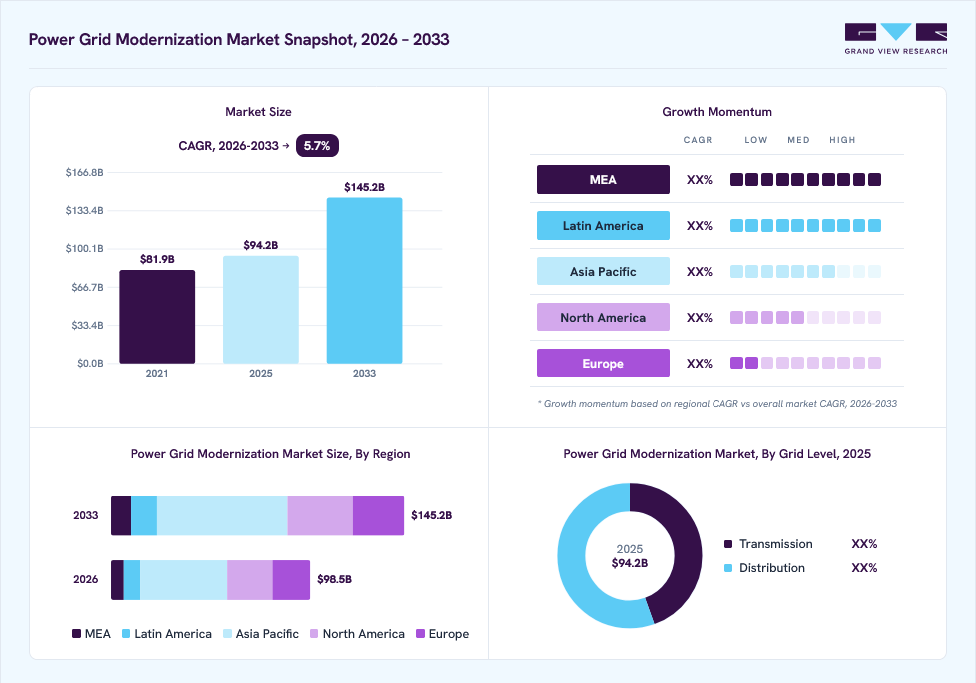
The global power grid modernization market size was valued at USD 94.2 billion in 2025 and is projected to grow from USD 98.5 billion in 2026 to USD 145.2 billion by 2033, at a CAGR of 5.7% from 2026 to 2033. Asia Pacific dominated the market, accounting for the largest revenue share of 43.5% in 2025. Market growth is driven by rising electricity demand, the integration of renewable energy, grid resilience requirements, and the need for more flexible and reliable power networks.
Key Market Trends & Insights
- By grid level: Distribution segment held the largest revenue share of 55.6% in 2025
- By component: Hardware segment held the largest revenue share of 61.7% in 2025
- By end use: Electric utilities segment held the largest revenue share of 69.6% in 2025
Regional Highlights
- Largest regional market: Asia Pacific (43.5% revenue share, 2025)
- Fastest-growing regional market: Middle East & Africa (fastest CAGR, 2026-2033)
- By country: China is expected to grow at a 47.2% CAGR from 2026 to 2033
Market Size & Forecast
- Market Size in 2025: USD 94.2 Billion
- Estimated Market Size in 2026: USD 98.5 Billion
- Projected Market Size by 2033: USD 145.2 Billion
- CAGR (2026-2033): 5.7%
The power grid modernization industry involves upgrading aging transmission and distribution infrastructure with advanced equipment, automation, digital monitoring, and energy-management technologies.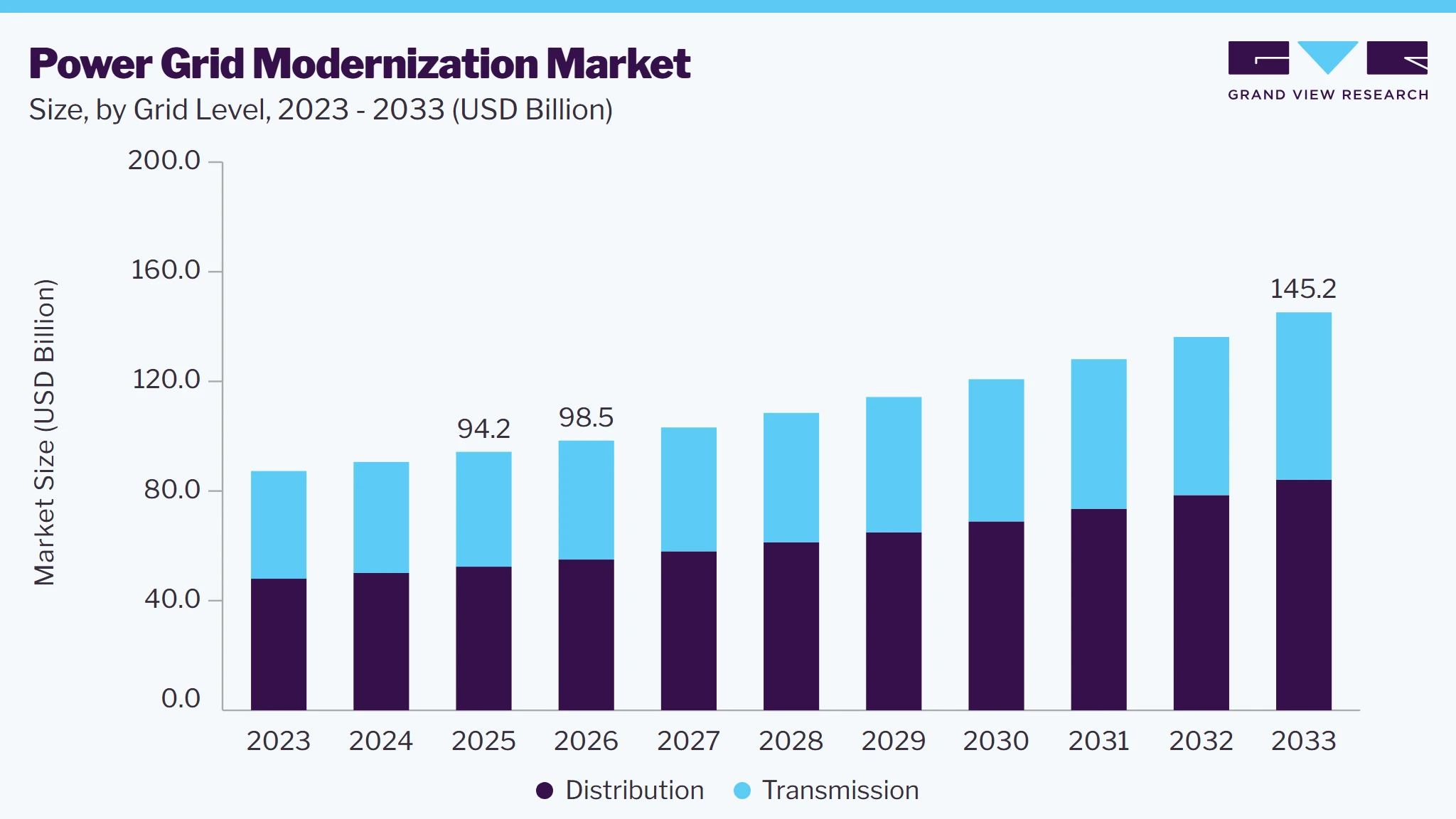
Market Dynamics
The power grid modernization market is expanding as utilities upgrade aging infrastructure and respond to rising electricity demand. Increasing renewable energy generation and electrification are creating demand for stronger and more flexible grid infrastructure. Growing investments in grid automation, digital monitoring, and advanced equipment are supporting market growth. Extreme weather events and the need for better grid reliability are also encouraging modernization projects. High investment costs, supply chain constraints, and complex regulatory processes can limit the pace of upgrades. Advances in grid technologies, energy storage, and digital solutions are creating new opportunities for market expansion.
Rising electricity demand is putting increasing pressure on existing power grid infrastructure. The growth of data centers, electric vehicles, industrial facilities, heat pumps, and other electrified applications is creating higher electricity loads. Many transmission and distribution networks require upgrades to handle these new loads safely and reliably. Utilities are investing in new substations, transformers, transmission lines, grid automation, and advanced monitoring systems to increase network capacity. This growing need to expand and strengthen electricity networks is a major driver of the power grid modernization market.
In March 2026, the U.S. Department of Energy announced an approximately USD 1.9 billion funding opportunity to support critical grid infrastructure upgrades. The program focuses on increasing transmission capacity through projects such as reconductoring and the use of advanced transmission technologies. These investments aim to improve grid capacity, reliability, efficiency, and resilience as electricity demand continues to rise. The initiative also supports the modernization of existing infrastructure rather than relying only on new transmission construction. This development highlights the growing focus on grid upgrades to meet changing electricity demand.
High upfront investment costs can slow the modernization of power grids, especially in developing markets. Upgrading substations, transformers, transmission lines, and digital systems requires significant capital. Rising prices and long lead times for key grid components can further delay projects. Utilities may also face limited access to financing and difficulties in recovering modernization costs through electricity tariffs. These financial and supply chain challenges can reduce the pace of grid modernization projects. Complex permitting processes and regulatory delays can further extend project timelines and increase overall costs.
Grid-enhancing technologies are creating new business opportunities in the power grid modernization market. Technologies such as dynamic line rating, dynamic transformer rating, advanced power-flow control, and topology optimization can increase the capacity of existing grids. These solutions can help utilities manage congestion without waiting for large new transmission projects to be completed. The IEA estimates that such technologies could unlock 450-700 GW of grid capacity globally for projects currently facing connection delays. This creates opportunities for technology providers, grid equipment companies, and digital solution providers.
Analyst Perspective
The power grid modernization market is expected to expand as rising electricity demand, the integration of renewables, and grid congestion increase the need for network upgrades. Grid-enhancing technologies, AI-driven grid management, digital twins, and advanced monitoring are emerging as key trends that can improve existing grid capacity without relying only on new infrastructure. Growing demand from data centers and electrification is likely to further accelerate investments in transmission and distribution infrastructure. Overall, the market is shifting from conventional infrastructure replacement toward digital, flexible, and data-driven grid modernization.
Grid Level Insights
The distribution segment dominated the power grid modernization industry, accounting for the largest revenue share of 55.6% in 2025, driven by increasing investments in upgrading aging distribution infrastructure, improving grid reliability, and integrating distributed renewable energy resources. Utilities are increasingly deploying smart meters, distribution automation, advanced monitoring systems, and digital grid technologies to reduce power losses and improve operational efficiency. The growing electrification of transportation, buildings, and industrial applications is further increasing the need for modern and flexible distribution networks.
The transmission segment is anticipated to register the second-fastest CAGR of 5.0% for the forecast period, driven by increasing investments in expanding and upgrading high-voltage transmission infrastructure. Growing renewable power generation, rising electricity demand, and the need to connect new generation capacity to consumption centers are increasing the need for modern transmission networks. Utilities and grid operators are also investing in advanced monitoring, automation, and digital technologies to improve grid reliability, manage congestion, and enhance the integration of variable renewable energy.
Component Insights
The hardware segment dominated the power grid modernization market, accounting for the largest revenue share of 61.7% in 2025, supported by substantial investments in physical grid infrastructure required to modernize aging transmission and distribution networks. Demand for transformers, switchgear, smart meters, sensors, grid automation equipment, and other hardware is increasing as utilities upgrade grid capacity, improve reliability, and integrate renewable energy resources. The need to replace aging assets and deploy advanced monitoring and control equipment is further driving hardware sales across modern power networks.
The software segment is anticipated to grow at the fastest CAGR of 6.5% during the forecast period. This growth is driven by the growing digitalization and automation of power grids. Utilities and grid operators are increasingly adopting advanced grid management systems, analytics, monitoring platforms, and predictive maintenance software to improve operational efficiency and grid reliability. The integration of renewable energy, distributed energy resources, smart meters, and real-time data is further increasing demand for software-based solutions.
End Use Insights
The electric utilities segment dominated the power grid modernization industry, accounting for the largest revenue share of 69.6% in 2025. The dominance of this segment is supported by substantial investments in upgrading aging grid infrastructure, expanding transmission and distribution networks, and improving grid reliability and resilience. Electric utilities are also increasing spending on smart grid technologies, automation, advanced monitoring systems, and digital solutions to integrate renewable energy and manage growing electricity demand.
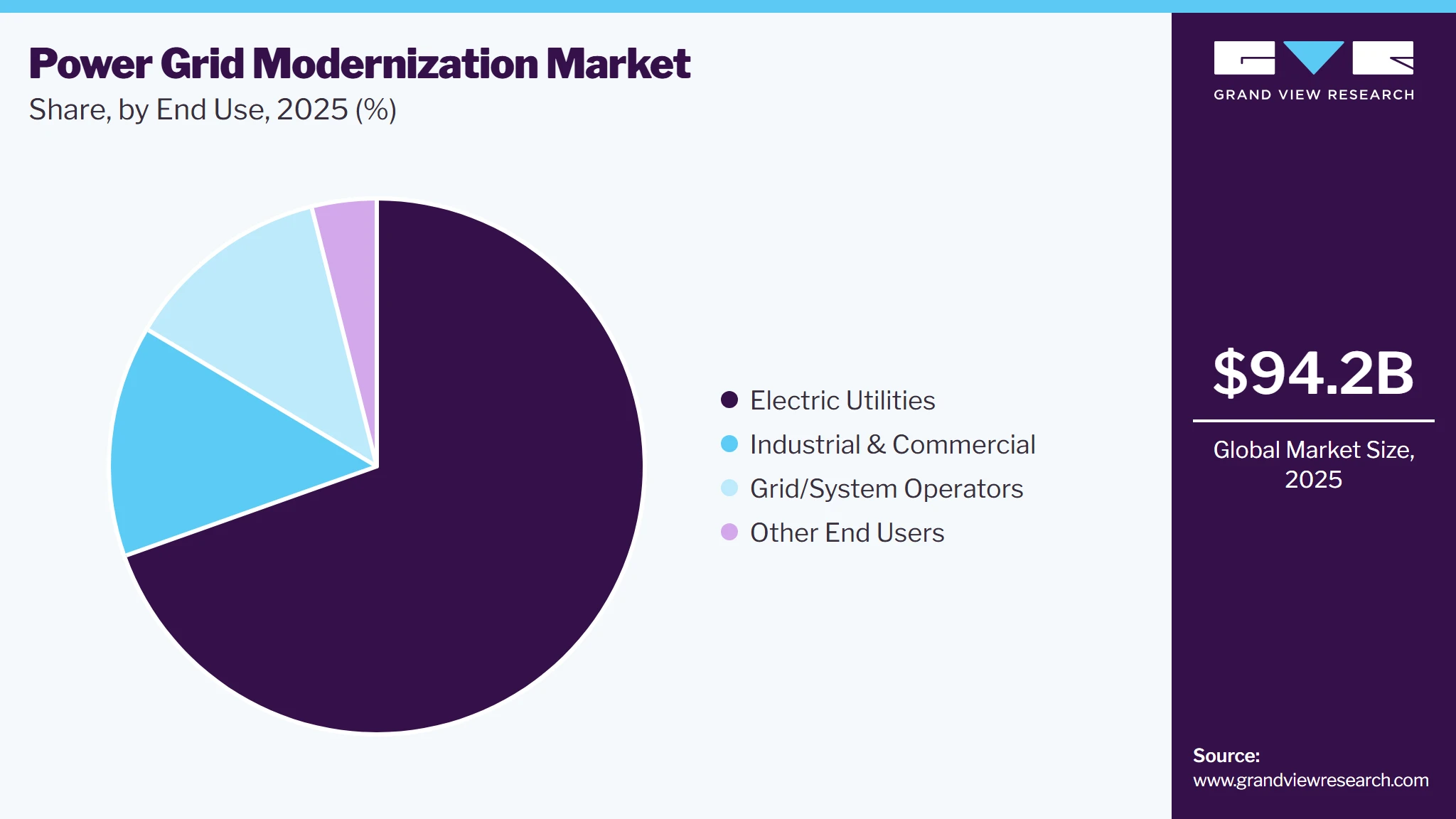
The industrial & commercial segment is expected to grow at the fastest CAGR of 6.4% during the forecast period, driven by rising electricity demand and the growing need for reliable, efficient, and resilient power infrastructure. Industrial and commercial facilities are increasingly adopting smart grid technologies, distributed energy resources, energy management systems, and advanced monitoring solutions to optimize power consumption and reduce operational costs. The expansion of electrification and integration of on-site renewable energy are further supporting demand for grid modernization solutions in this segment.
Regional Insights
The Asia Pacific power grid modernization market held the largest global revenue share of 43.5% in 2025, supported by rising electricity demand, rapid urbanization, and increasing renewable energy deployment. The region is seeing higher investments in transmission networks, substations, distribution infrastructure, grid automation, and digital monitoring systems. Growing electrification and renewable power integration are also increasing the need for flexible and reliable grid infrastructure. In 2026, the region continued to see large-scale investments in power grid upgrades, with China announcing plans to invest about USD 574 billion in grid infrastructure during 2026-2030. This investment is expected to support demand for advanced grid equipment, automation technologies, and digital grid solutions.

The growth of the China power grid modernization market is driven by rising electricity demand, the integration of renewable energy, and increasing investments in transmission and distribution infrastructure. The modernization of aging grid assets is creating demand for smart substations, grid automation, digital monitoring, and advanced control systems. The expansion of renewable power capacity is further increasing the need for flexible and reliable grid infrastructure capable of managing variable power generation. In addition, investments in digital technologies and intelligent grid management are supporting improvements in grid efficiency, reliability, and resilience.
Europe Power Grid Modernization Market Trends
The Europe power grid modernization industry is expanding as aging electricity networks face rising demand and rapid renewable energy integration. Governments and utilities are increasing investments in transmission and distribution infrastructure to improve grid reliability, flexibility, and resilience. Grid digitalization, smart substations, advanced monitoring, and grid-enhancing technologies are emerging as key trends across the region. The expansion of electric vehicles, data centers, and renewable power generation is creating additional pressure on existing grid capacity. These developments are expected to create opportunities for grid equipment, automation, digital solutions, and infrastructure providers.
North America Power Grid Modernization Market Trends
The North America power grid modernization industry is expanding as utilities modernize aging transmission and distribution infrastructure to support rising electricity demand and improve grid reliability. Data centers, electrification, renewable energy integration, and extreme weather are increasing the need for stronger and more flexible networks. Utilities are investing in substations, transmission lines, grid automation, and advanced monitoring technologies. In March 2026, FirstEnergy announced plans to invest USD 950 million in transmission upgrades across Ohio and Pennsylvania, including modernizing equipment, rebuilding older transmission lines, and enhancing substations. This investment highlights the growing focus on grid modernization to meet rising power demand and strengthen network reliability.
U.S. Power Grid Modernization Market Trends
The U.S. power grid modernization industry is expanding as aging infrastructure faces rising electricity demand from data centers, industrial facilities, electric vehicles, and renewable energy projects. Utilities are investing in transmission upgrades, substations, transformers, grid automation, advanced metering, and digital monitoring systems to improve reliability and resilience. The increasing use of AI and data centers is further creating pressure to expand grid capacity and modernize existing networks.
Latin America Power Grid Modernization Market Trends
The Latin America power grid modernization industry is supported by the need to modernize aging electricity infrastructure, improve grid reliability, and integrate growing renewable power generation. Increasing investments in transmission and distribution networks are driving demand for automation, digital monitoring, advanced control systems, and smart substations. For instance, in 2025, the European Investment Bank provided an approximately USD 340 million green loan to Neoenergia Coelba to expand and modernize the electricity distribution network in Bahia, including new connections and automation equipment.
Middle East & Africa Power Grid Modernization Market Trends
The Middle East & Africa power grid modernization industry is expected to grow at the fastest CAGR of 6.8% during the forecast period, supported by rising electricity demand, rapid deployment of renewable energy, and increasing investment in transmission and distribution infrastructure. Growing electrification, grid reliability requirements, and the need to integrate large-scale solar and other renewable projects are encouraging utilities to adopt digital monitoring, automation, smart substations, and advanced grid-management technologies. According to IEA, power-sector investment in the Middle East reached USD 44 billion in 2024 and is projected to increase by 50% by 2035, with renewable and nuclear power expected to attract a growing share of investment.
Key Companies & Market Share Insights
Some of the key players operating in the global power grid modernization market include ABB and Siemens Energy.
-
ABB Ltd. is a major technology provider in the power grid modernization industry, offering solutions for grid automation, digital substations, power distribution, electrification, and grid management. The company provides technologies such as intelligent substations, protection and control systems, grid automation solutions, and digital platforms that help utilities improve grid reliability, efficiency, and operational visibility. ABB is also focusing on technologies that support renewable-energy integration, distributed energy resources, and the modernization of aging grid infrastructure. Its broad electrification portfolio, digital capabilities, and global presence position the company as a key participant in the evolving market.
-
Siemens Energy is a prominent technology and infrastructure provider in the power grid modernization market, offering solutions for transmission, distribution, grid stability, and digital grid management. The company provides high-voltage transmission systems, substations, grid automation, protection and control technologies, and solutions designed to improve the flexibility and resilience of power networks. Siemens Energy is increasingly focusing on technologies that enable renewable-energy integration, grid expansion, and digitalization of electricity infrastructure. Its extensive grid technology portfolio, engineering capabilities, and global project experience position the company as a key participant in the modernization of power networks.
Key Power Grid Modernization Companies
The following key companies have been profiled for this study on the power grid modernization market.
-
ABB
-
Eaton
-
Fluentgrid
-
GE Vernova
-
Hitachi Energy
-
Mitsubishi Electric
-
S&C Electric Company
-
Schneider Electric
-
Siemens Energy
-
Toshiba Energy Systems & Solutions
Competitive Benchmarking
Category
Operating Strategies
Competitive Edge
Weakness
Established Players (ABB, Eaton, GE Vernova, Hitachi Energy, Mitsubishi Electric, Schneider Electric, Siemens Energy, Toshiba Energy Systems & Solutions)
- Leverage extensive product portfolios, global manufacturing networks, and established utility relationships to deliver integrated grid modernization solutions across transmission and distribution networks.
- Invest in grid automation, digital substations, AI-enabled monitoring, and advanced control technologies to improve grid reliability, efficiency, and renewable-energy integration.
- Expand strategic partnerships with utilities, technology providers, and energy companies to support large-scale grid modernization projects and strengthen market presence.
- Leverage strong global brands, extensive utility relationships, and established project execution capabilities to secure large-scale grid modernization contracts.
- Offer comprehensive portfolios spanning grid equipment, automation, digital substations, protection, control, and grid-management solutions.
- Utilize strong R&D capabilities and global service networks to deliver advanced and reliable modernization solutions.
- Maintain relatively higher cost structures due to large-scale operations, extensive infrastructure, and complex project requirements.
- Face longer decision-making and implementation cycles due to large organizational structures and complex utility procurement processes.
- May have limited flexibility in addressing smaller or highly customized modernization projects.
Emerging Players (Fluentgrid, S&C Electric Company )
- Focus on specialized grid automation, distribution management, and digital solutions to address specific modernization requirements of utilities and grid operators.
- Invest in scalable, flexible, and innovative technologies to improve grid visibility, resilience, and operational efficiency while competing with larger established vendors.
- Develop partnerships with utilities, system integrators, and technology companies to expand project opportunities, strengthen capabilities, and accelerate market penetration.
- Offer specialized and flexible grid modernization solutions that can be tailored to specific utility and distribution-grid requirements.
- Enable faster deployment and customization compared with broader, large-scale solutions offered by established players.
- Focus on innovative digital and grid-edge technologies to address emerging requirements such as grid visibility, automation, and resilience.
- Have smaller global footprints, limited financial resources, and fewer established relationships with major utilities.
- Maintain narrower product portfolios, limiting their ability to provide complete end-to-end grid modernization solutions.
- Face challenges in scaling operations and providing extensive international service and support.
Recent Developments
-
In June 2026, Schneider Electric highlighted the growing need for grid modernization and expansion across Europe to support renewable-energy integration, electrification, and rising electricity demand. The company noted that more than 40% of Europe’s distribution grids are over 40 years old, while more than 1,700 GW of renewable and hybrid projects are awaiting grid connection. Schneider Electric emphasized digitalization, automation, smart grid management, demand response, and grid flexibility as key solutions to improve grid capacity and reliability. The company also highlighted the need for increased investment in transmission and distribution infrastructure to accommodate electric vehicles, heat pumps, renewable generation, and data-center demand.
Power Grid Modernization Market Report Scope
Report Attribute
Details
Market Definition
The Global Power Grid Modernization Market comprises the revenues generated from the sale of hardware, software, and related services used to modernize existing electricity transmission and distribution infrastructure.
Market size in 2025
USD 94.2 billion
Estimated market size in 2026
USD 98.5 billion
Projected market size by 2033
USD 145.2 billion
Growth Rate
CAGR of 5.7% from 2026 to 2033
Base year for estimation
2025
Historical data
2021 - 2024
Forecast period
2026 - 2033
Quantitative Units
Revenue in USD million/billion and CAGR from 2026 to 2033
Report coverage
Revenue forecast, competitive landscape, growth factors, and trends
Segments covered
Grid level, component, end use, and region
Regional scope
North America; Europe; Asia Pacific; Latin America; Middle East & Africa
Country scope
U.S.; Canada; Mexico; Germany; UK; France; Italy; Spain; China; India; Japan; South Korea; Australia; Brazil; Argentina; UAE; Saudi Arabia; South Africa
Key companies profiled
ABB; Eaton; Fluentgrid; GE Vernova; Hitachi Energy; Mitsubishi Electric; S&C Electric Company; Schneider Electric; Siemens Energy; Toshiba Energy Systems & Solutions
Customization scope
Free report customization (equivalent up to 8 analysts working days) with purchase. Addition or alteration to country, regional & segment scope.
Pricing and purchase options
Avail customized purchase options to meet your exact research needs. Explore purchase options
Global Power Grid Modernization Market Report Segmentation
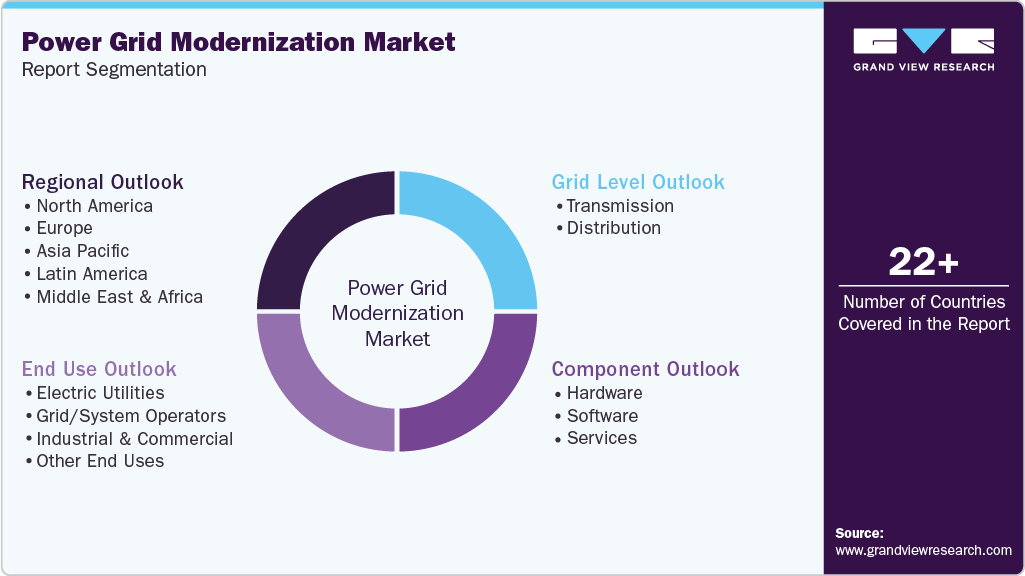
This report forecasts revenue growth at the global, regional, and country levels and provides an analysis of the latest industry trends in each of the sub-segments from 2021 to 2033. For this study, Grand View Research has segmented the global power grid modernization market report based on grid level, component, end use, and region:
-
Grid Level Outlook (Revenue, USD Million/Billion, 2021 - 2033)
-
Transmission
-
Distribution
-
-
Component Outlook (Revenue, USD Million/Billion, 2021 - 2033)
-
Hardware
-
Software
-
Services
-
-
End Use Outlook (Revenue, USD Million/Billion, 2021 - 2033)
-
Electric Utilities
-
Grid/System Operators
-
Industrial & Commercial
-
Other End Uses
-
-
Regional Outlook (Revenue, USD Million/Billion, 2021 - 2033)
-
North America
-
U.S.
-
Canada
-
Mexico
-
-
Europe
-
Germany
-
UK
-
France
-
Italy
-
Spain
-
-
Asia Pacific
-
China
-
India
-
Japan
-
South Korea
-
Australia
-
-
Latin America
-
Brazil
-
Argentina
-
-
Middle East & Africa
-
Saudi Arabia
-
UAE
-
South Africa
-
-
Research Methodology
The power grid modernization market figures in this report are based on a proven research process that combines executive interviews with secondary research from proprietary databases, company filings, and recognized regulatory and institutional sources. Market size is built through value-chain sizing-reconciling supply-side and demand-side estimates-and triangulated with bottom-up and top-down approaches. Every estimate passes multiple levels of expert validation before publication, with each power grid modernization segment quantified using the revenue-capture definitions in the table below.
Segment Definition
Segment - Grid Level
Revenue capture definition
Transmission
Includes revenue generated from the sale of hardware, software, and services used to modernize electricity transmission networks, including high-voltage equipment, monitoring, automation, and control solutions.
Distribution
Covers revenue generated from the sale of hardware, software, and services used to modernize electricity distribution networks, including smart meters, automation equipment, monitoring systems, and grid management technologies.
Segment - Component
Revenue capture definition
Hardware
Includes revenue generated from the sale of physical grid modernization equipment, including transformers, switchgear, smart meters, sensors, automation equipment, and monitoring devices.
Software
Covers revenue generated from the sale or licensing of grid modernization software, including grid management, monitoring, analytics, asset management, and automation solutions.
Services
Captures revenue generated from the sale of grid modernization services, including installation, integration, engineering, maintenance, consulting, and implementation services.
Segment - End use
Revenue capture definition
Electric Utilities
Includes revenue generated from the sale of grid modernization solutions to electric utilities for upgrading and managing transmission and distribution infrastructure.
Grid/System Operators
Covers revenue generated from the sale of grid modernization solutions to grid and system operators for monitoring, controlling, balancing, and managing electricity networks.
Industrial & Commercial
Captures revenue generated from the sale of grid modernization solutions to industrial and commercial facilities for improving power reliability, efficiency, connectivity, and energy management.
Other End Uses
Includes revenue generated from the sale of grid modernization solutions to other end users, including government facilities, public-sector entities, transportation infrastructure, and specialized electricity consumers.
Estimation Model
Layer Name
Key Question
Description
Grid Level Layer
Which grid levels contribute to market demand?
Assess demand across transmission and distribution grids. Analyze modernization requirements based on aging infrastructure, renewable energy integration, grid expansion, electrification, reliability, and the need for advanced monitoring and control capabilities.
Component Layer
Which components contribute to market demand?
Evaluate demand across hardware, software, and services. Assess sales of grid modernization hardware, grid management and analytics software, and related modernization services based on digitalization, automation, asset management, cybersecurity, and grid resilience requirements.
End use Layer
Which end users drive demand for grid modernization solutions?
Assess demand across electric utilities, grid/system operators, industrial & commercial users, and other end uses. Analyze adoption based on electricity demand growth, renewable energy integration, reliability requirements, electrification, distributed energy resources, and investments in intelligent and resilient power networks.
Revenue Layer
How is market revenue generated?
Market revenue is quantified only through the sale of power grid modernization products, software, and services across transmission and distribution networks and to different end users. Revenue is influenced by grid upgrade investments, aging infrastructure replacement, digitalization, renewable energy integration, electrification, automation, grid resilience, and regulatory requirements.
Delivered Customizations
This report has been delivered with the following In-depth customizations
Client Request
Customization Delivered
Value Adds
Cross-Segmentation Analysis
A detailed assessment was conducted to evaluate the adoption of transmission and distribution grid modernization solutions across all end-use segments, including electric utilities, grid/system operators, industrial & commercial users, and other end uses. The analysis compared modernization requirements, investment priorities, grid reliability needs, renewable energy integration, automation, and digitalization across each grid level-end-use combination.
Enabled identification of the most attractive grid level-end-use combinations, supporting targeted market entry, customer prioritization, investment planning, and identification of high-growth opportunities across transmission and distribution networks.
Component-Level Opportunity Assessment
Market analysis was performed across hardware, software, and services, evaluating demand for grid modernization technologies based on aging infrastructure, automation, digitalization, asset management, grid resilience, cybersecurity, and renewable energy integration.
Enabled identification of the most attractive component opportunities based on market demand, technology adoption, investment intensity, and long-term modernization requirements.
Regional Opportunity Assessment
Country-level analysis was conducted to assess power grid modernization opportunities based on grid investment plans, renewable energy targets, electrification, aging infrastructure, regulatory initiatives, digitalization programs, and grid resilience requirements across key regions.
Identified high-growth countries and regions with strong grid investment pipelines, modernization programs, renewable integration requirements, and favorable opportunities for technology and solution providers.
Frequently Asked Questions About This Report
The global power grid modernization market size was estimated at USD 94.2 billion in 2025 and is expected to reach USD 98.5 billion in 2026.
The global power grid modernization market is expected to grow at a CAGR of 5.7% from 2026 to 2033 to reach USD 145.2 billion by 2033.
The key factors driving the power grid modernization market include aging grid infrastructure, rising electricity demand, renewable energy integration, electrification, and the need for greater grid reliability and resilience.
The Asia Pacific region dominated the power grid modernization market with a revenue share of 43.5% in 2025.
China dominated the Asia Pacific region market with a revenue share of 47.2% in 2025.
Middle East and Africa is anticipated to register the fastest CAGR of 6.8% over the forecast period.
Based on grid level, the distribution segment accounted for largest revenue share of 55.6% in 2025.
Based on end-use, the electric utilities segment accounted for largest revenue share of 69.6% in 2025.
The key players operating in the power grid modernization market are ABB, Eaton, Fluentgrid, GE Vernova, Hitachi Energy, Mitsubishi Electric, S&C Electric Company, Schneider Electric, Siemens Energy, Toshiba Energy Systems & Solutions, and others.
About the Author(s)
Power Distribution Research Team
Energy & Power · Power DistributionThis report was authored by the power distribution research team at Grand View Research - comprising two research analysts, one senior research analyst, and one industry expert - with specialized expertise in the power distribution segment of the energy & power industry. All findings are based on proprietary energy & power databases, executive interviews, and regulatory analysis, subject to internal peer review prior to publication.
Last Updated:
Speak to Analyst


Customize this report to your needs — add regions, segments, or data points, with 20% free customization.
Or view our licence options:


ISO 9001:2015 & 27001:2022 Certified
We are GDPR and CCPA compliant! Your transaction & personal information is safe and secure. For more details, please read our privacy policy.


