
- Home
- »
- Electronic Devices
- »
-
Power Quality Equipment Market Size Report, 2026-2033GVR Report cover

Power Quality Equipment Market (2026 - 2033)
Size, Share & Trends Analysis Report By Equipment (Power Quality Meters, Surge Protection Devices, Harmonic Filters), By Phase (Single Phase, Three Phase), By End Use, By Region, And Segment Forecasts
Market Size, 2025
$35.7BMarket Estimate, 2026
$37.8BMarket Forecast, 2033
$59.1BCAGR, 2026–2033
6.6%Power Quality Equipment Market Summary
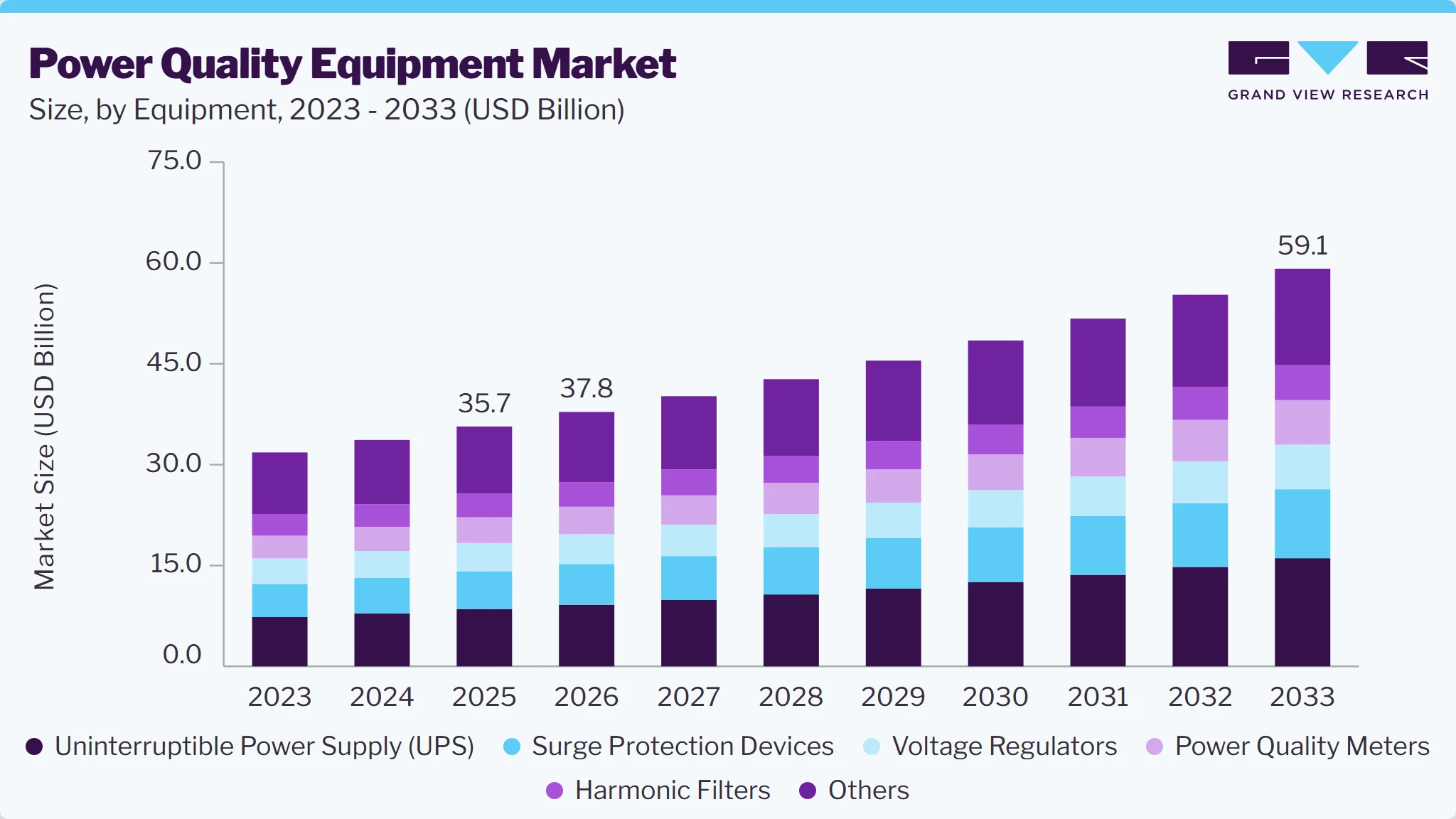
The global power quality equipment market size was valued at USD 35.7 billion in 2025 and is projected to grow from USD 37.8 billion in 2026 to USD 59.1 billion by 2033, at a CAGR of 6.6% from 2026 to 2033. Asia Pacific dominated the market, accounting for a revenue share of 37.1% in 2025. The market growth is driven by the increasing demand for reliable and uninterrupted power supply across various industries.
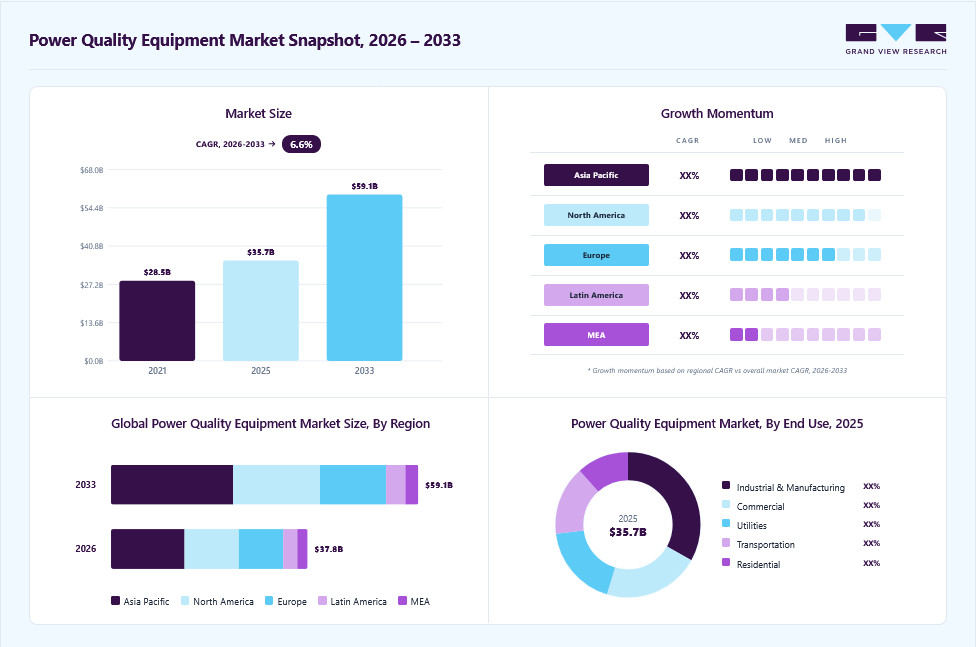 Source: Grand View Research, IR Documents, Primary Interviews, Paid DatabasesTo learn more about this report,
 Download Free Sample Report
Key Market Trends & Insights
- By equipment: Uninterruptible power supply (UPS) segment dominated the market, with a revenue share of 23.8% in 2025.
- By phase: Three phase segment held the largest market share of 60.7% in 2025.
- By end use: Industrial & manufacturing segment held the largest revenue share in 2025.
Regional Highlights
- Largest regional market: Asia Pacific (37.1% revenue share, 2025)
- By country: The China held the largest revenue share in the Asia Pacific.
Market Size & Forecast
- Market size in 2025: USD 35.7 Billion
- Estimated market size in 2026: USD 37.8 Billion
- Projected market size by 2033: USD 59.1 Billion
- CAGR (2026-2033): 6.6%
Prism AI by Grand View Research Free to tryAsk a question about the power quality equipment marketTry asking✓Every figure cited from GVR research Prefer the report? Download free sample →
The rising incidence of power outages and voltage fluctuations, particularly in developing regions, underscores the need for effective power quality solutions. Additionally, the growing adoption of sensitive electronic devices and equipment, which require high power quality standards to function optimally, is propelling market growth.The power quality equipment market is witnessing significant advancements in technology, which are enhancing the efficiency and functionality of these systems. One notable trend is the integration of Internet of Things (IoT) technology, which enables real-time monitoring and control of power quality. This allows for proactive maintenance and quick response to power disturbances, thereby minimizing downtime and operational costs. IoT-enabled power quality equipment can also provide valuable data analytics, helping organizations optimize their energy usage and improve overall power management.
 To learn more about this report, Download Free Sample Report
Another key technological trend is the development of smart grids, which are designed to enhance the reliability and efficiency of electricity distribution. Smart grids incorporate advanced power quality equipment that can dynamically respond to changes in power demand and supply. These systems can identify and isolate faults, reroute power, and balance loads to ensure a stable and high-quality power supply. The integration of renewable energy sources into smart grids also necessitates advanced power quality solutions to manage the variable nature of these energy sources and ensure consistent power delivery.
The market presents numerous opportunities for growth, particularly in emerging economies where industrialization and urbanization are rapidly increasing. The expansion of data centers, telecommunications infrastructure, and renewable energy projects in these regions is driving the demand for reliable power quality solutions. Additionally, advancements in technology and increasing awareness about the importance of power quality are creating new avenues for market expansion. Companies that can offer innovative and cost-effective solutions tailored to the specific needs of these growing markets are well-positioned to capitalize on these opportunities.
However, the high initial investment costs and maintenance expenses can deter small and medium-sized enterprises from adopting these solutions thereby, posing as challenges for market growth. Additionally, the complexity of integrating advanced power quality equipment with existing infrastructure can pose technical challenges. There is also a need for skilled personnel to manage and maintain these systems, which can be a constraint in regions with limited technical expertise. Moreover, the rapid pace of technological advancements means that companies must continuously innovate to stay competitive, which can be a significant challenge in terms of research and development costs.
Market Dynamics
The power quality equipment market is experiencing steady growth, driven by rising electricity consumption, increasing industrial automation, expanding data center infrastructure, and growing reliance on sensitive electronic equipment. Power disturbances such as voltage fluctuations, harmonics, power surges, and outages can significantly impact operational continuity and equipment performance, prompting organizations to invest in advanced power quality solutions. Technological advancements in digital monitoring, intelligent power management systems, and smart grid infrastructure are enhancing the effectiveness of power quality equipment.
Modern businesses and industrial operations are increasingly dependent on sensitive electronic equipment, automation systems, data centers, telecommunications infrastructure, and digital technologies that require a stable, uninterrupted power supply. Even minor power disturbances, such as voltage sags, harmonic distortion, transient surges, and short-duration outages, can cause equipment malfunctions, data loss, production downtime, and significant financial losses. The rapid growth of digital transformation initiatives, cloud computing environments, and connected industrial systems has heightened the importance of maintaining high power quality standards across electrical networks.
Power quality equipment addresses these challenges by monitoring, regulating, and protecting electrical systems against various power disturbances. Solutions such as UPS systems, harmonic filters, surge protection devices, voltage regulators, and power quality meters help ensure continuous operations, protect critical equipment, and improve system reliability. These technologies enable organizations to minimize downtime, reduce maintenance costs, and enhance operational efficiency. As digital infrastructure investments continue to rise globally, the demand for power quality equipment is expected to grow substantially.
The significant upfront investment required for equipment procurement, installation, system integration, and ongoing maintenance is restraining the growth of the market. Advanced power quality solutions often require substantial capital expenditure, particularly in large industrial facilities, utilities, data centers, and critical infrastructure environments where multiple power protection systems must be deployed. In addition, integration with existing electrical infrastructure may necessitate engineering modifications, specialized installation expertise, and periodic system upgrades.
The impact of this restraint is particularly noticeable among small and medium-sized enterprises, commercial establishments, and organizations operating in cost-sensitive markets. Developing economies may face additional challenges due to budget constraints, aging electrical infrastructure, and limited awareness of the benefits of power quality management. Therefore, some end users may delay investments or adopt only basic protection solutions, slowing overall market penetration and limiting growth opportunities in certain regions and customer segments.
The increasing deployment of smart grid infrastructure and renewable energy systems presents a significant opportunity for the Power Quality Equipment market. Renewable energy sources such as solar and wind power introduce variability and intermittency into electrical networks, creating challenges related to voltage regulation, harmonics, power fluctuations, and grid stability. Utilities and grid operators are increasingly investing in advanced power quality solutions to ensure reliable integration of distributed energy resources while maintaining overall network performance.
Power quality equipment plays a critical role in supporting modern grid architectures by enabling real-time monitoring, voltage stabilization, harmonic mitigation, and power flow optimization. Vendors offering intelligent power quality monitoring systems, digital power management platforms, and advanced grid-support technologies are well-positioned to benefit from this trend. As global investments in renewable energy, microgrids, electric vehicle charging infrastructure, and smart grid modernization continue to accelerate, demand for sophisticated power quality solutions is expected to increase significantly.
Analyst Perspective
The power quality equipment market is benefiting from the increasing digitization of industries, expansion of critical infrastructure, and growing demand for reliable electricity across modern economies. Organizations are investing in advanced power protection and monitoring solutions to safeguard sensitive equipment, reduce operational disruptions, and support energy efficiency initiatives. Emerging technologies such as smart power monitoring, IoT-enabled diagnostics, predictive maintenance, and AI-driven energy management are reshaping the competitive landscape and enhancing equipment capabilities. Market participants are increasingly focusing on integrated power management platforms that combine monitoring, protection, and analytics functionalities.
Equipment Insights
Based on equipment, the uninterruptible power supply (UPS) segment led the market with the largest revenue share of 23.8% in 2025, owing to its widespread use in guaranteeing continuous power supply. The segment growth is further propelled by the growing demand for UPS in data centers, hospitals, and other critical infrastructure requiring uninterrupted power supply.
The surge protection devices segment is expected to grow rapidly during the forecast period. Surge protection devices are essential for protecting electrical systems from voltage spikes. The segment is expected to grow due to the rising need to safeguard electronic gadgets in homes and workplaces. In addition, rising awareness about the protection of sensitive electronic equipment and increasing instances of voltage surges due to lightning and power outages is expected to fuel the segment growth.
Phase Insights
Based on phase, the three phase segment led the market with the largest revenue share of 60.7% in 2025. Three phase power quality equipment is predominantly used in large commercial and industrial applications due to their higher power capacity and efficiency. Growing industrialization is anticipated to propel the demand for three phase power quality equipment as it provides greater power stability for large-scale operations.
The single phase segment is anticipated to grow substantially throughout the projection period. The growth can be attributed to the growing demand for power quality equipment for residential and light commercial use. Another factor fueling the segment growth is ease of installation of single phase equipment and lower cost compared to three-phase systems.
End Use Insights
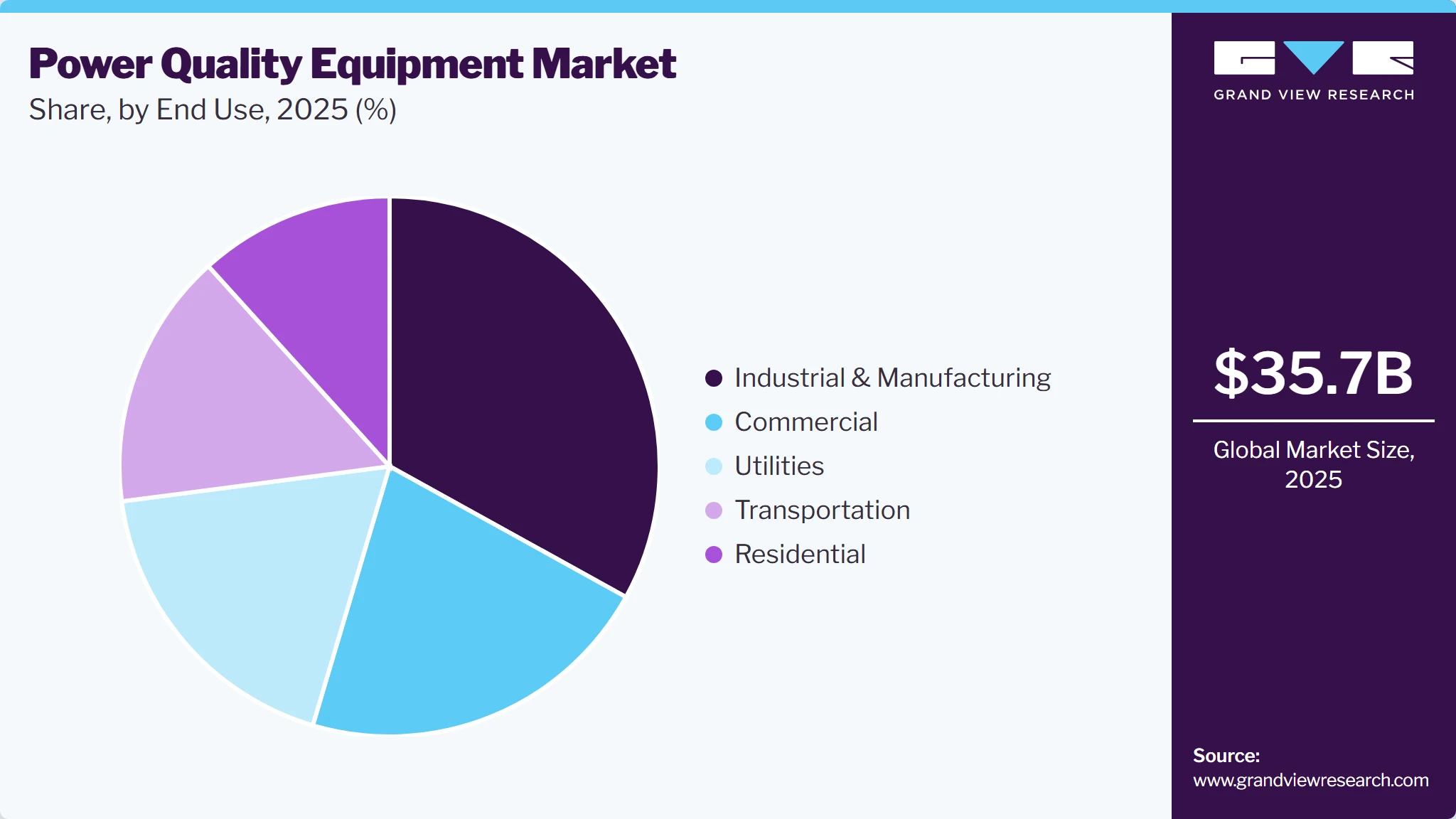
Based on end use, the industrial & manufacturing segment led the market with the largest revenue share of 33.0% in 2025. The growth of the segment can be attributed to rapid industrialization, increasing automation, and stringent power quality standards. As industries adopt advanced automation and IoT technologies, the demand for reliable and efficient power quality solutions is escalating to prevent costly downtime and equipment damage. Significant investments in industrial infrastructure, coupled with the need for uninterrupted and stable power supply in manufacturing processes, are further propelling this segment's expansion.
 To learn more about this report, Download Free Sample Report
The commercial segment is expected to grow significantly during the forecast period driven by the demand for reliable power in offices, data centers, and retail establishments. As businesses increasingly rely on digital infrastructure and automation, the need for uninterrupted and high-quality power supply has become paramount to ensure smooth operations and safeguard sensitive electronic equipment. Additionally, the growing trend of smart buildings and energy-efficient commercial spaces is bolstering investments in power quality equipment, positioning the commercial segment as a critical driver of market growth.
Regional Insights
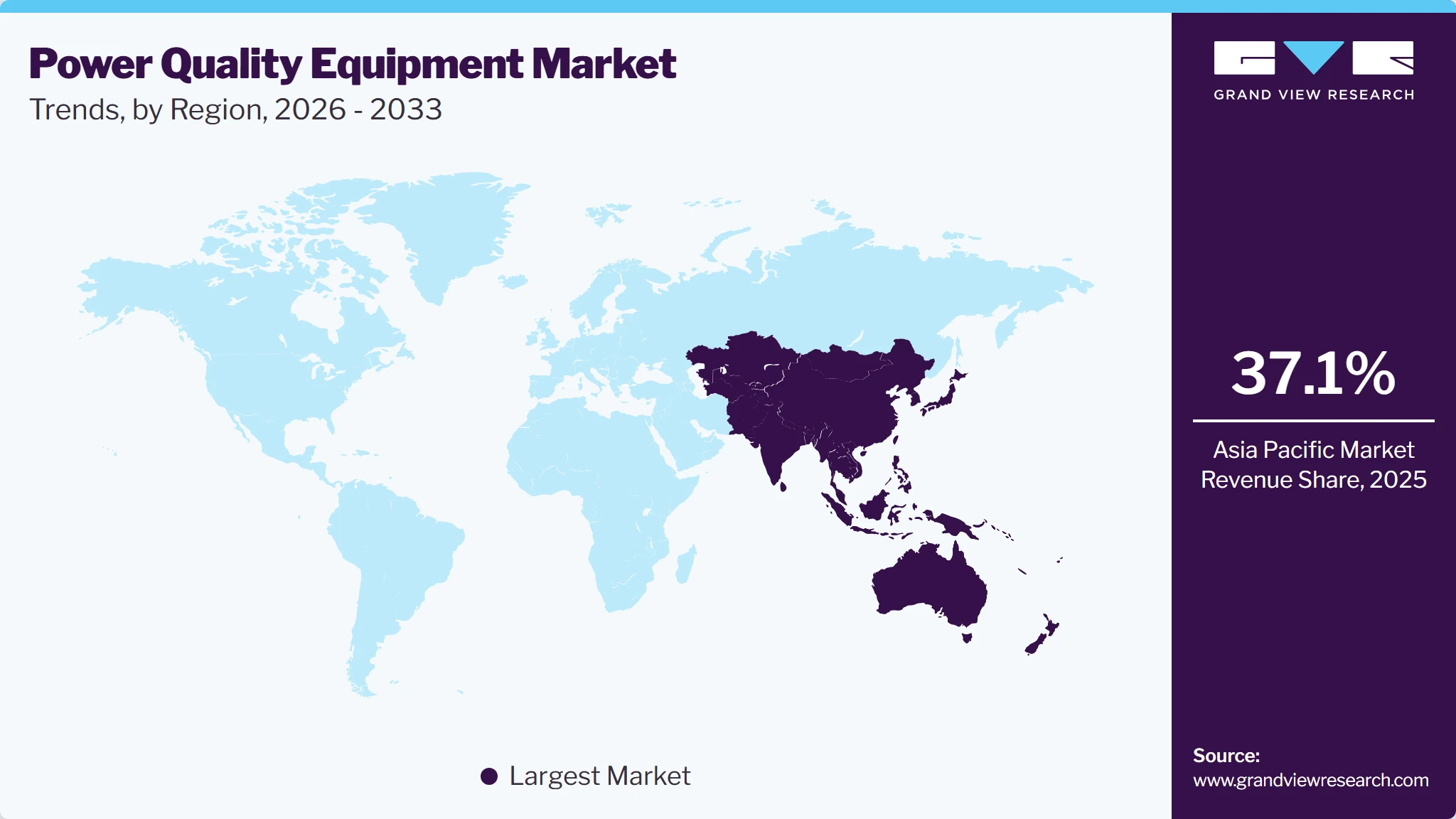
Asia Pacific dominated the global power quality equipment market with the largest revenue share of 37.1% in 2025. The regional market is witnessing rapid industrialization and urbanization, driving the demand for power quality equipment. Countries such as China and India are investing heavily in infrastructure development and smart grid technologies. The rising investment is expected to enhance the deployment of power quality equipment to ensure a reliable power supply and improve grid resilience. Additionally, the increasing use of sensitive electronic devices in industrial and commercial applications is boosting the demand for power quality solutions in the region.
 To learn more about this report, Download Free Sample Report
China Power Quality Equipment Market Trends
China power quality equipment held the largest revenue share in the Asia Pacific.
North America Power Quality Equipment Market Trends
The power quality equipment market in North America is driven by the increasing demand for reliable power in data centers and the IT sector. The region is witnessing significant investments in smart grid technologies, which are expected to enhance the demand for advanced power quality equipment to ensure efficient power distribution and minimize disruptions.
The U.S. power quality equipment market is experiencing robust growth, primarily due to the rising number of industrial and commercial establishments. The increasing penetration of renewable energy sources, such as solar and wind, is also contributing to the demand for power quality solutions.
Europe Power Quality Equipment Market Trends
The power quality equipment market in Europe growth is driven by the increasing integration of renewable energy sources across the region. Countries such as Germany, Spain, and Denmark are leading the charge in increasing their renewable energy capacity. In 2023, renewable energy sources accounted for 46% of Germany's total electricity consumption. The intermittent nature of renewable energy sources such as wind and solar necessitates advanced power quality solutions to manage grid stability, voltage regulation, and frequency control, ensuring a reliable and consistent power supply.
Key Power Quality Equipment Company Insights
Key players are focusing on several strategic initiatives, including new product development, partnerships & collaborations, and geographic expansion to gain a competitive advantage over their rivals. In January 2023, Schneider Electric S.E., a global leader in energy management and automation's digital transformation, launched the Easy UPS 3-Phase Modular. This durable UPS is engineered to safeguard critical loads. Available in capacities ranging from 50 to 250 kW with an N+1 scalable configuration, the EcoStruxure architecture is supported by the Easy UPS 3-Phase Modular, enabling remote monitoring services.
Key Power Quality Equipment Companies:
The following key companies have been profiled for this study on the power quality equipment market.
- Eaton Corporation
- ABB Ltd.
- Siemens
- General Electric Company
- Honeywell International, Inc.
- Leviton Manufacturing Co., Inc.
- Emerson Electric Co.
- Schneider Electric S.E.
- Legrand
- Piller Power Systems.
Competitive Benchmarking
Category
Operating Strategies
Competitive Edge
Weakness
Established Players (Eaton Corporation, ABB Ltd., Siemens)
- Focus on comprehensive power management portfolios, smart grid integration, digital energy management platforms, industrial automation, global distribution networks, and strategic acquisitions.
- These companies emphasize end-to-end power quality solutions across multiple industries and geographies.
- Strong global presence, extensive product portfolios, advanced R&D capabilities, broad customer bases, established distribution channels, and deep expertise in power management and electrical infrastructure.
- Higher product costs, complex organizational structures, longer sales cycles, and dependence on industrial and utility capital expenditure trends.
Emerging Players (Leviton Manufacturing Co., Inc., Piller Power Systems)
- Focus on specialized power protection solutions, UPS technologies, niche application expertise, customized system design, and targeted expansion in critical power infrastructure markets.
- These companies emphasize product reliability, application-specific performance, and customer-focused engineering support.
- Strong specialization in specific power quality segments, flexible solution customization, high technical expertise, and strong reputations within targeted markets.
- Smaller global footprint, narrower product portfolios, lower market visibility, and more limited resources compared to multinational industry leaders.
Power Quality Equipment Market Report Scope
Report Attribute
Details
Market size in 2025
USD 35.7 billion
Estimated market size in 2026
USD 37.8 billion
Projected market size by 2033
USD 59.1 billion
Growth rate
CAGR of 6.6% from 2026 to 2033
Base year for estimation
2025
Historical data
2021 - 2024
Forecast period
2026 - 2033
Quantitative units
Revenue in USD million/billion and CAGR from 2026 to 2033
Report coverage
Revenue forecast, company ranking, competitive landscape, growth factors, and trends
Segments covered
Equipment, phase, end use, region
Regional scope
North America; Europe; Asia Pacific; Latin America; MEA
Country scope
U.S.; Canada; Mexico; U.K.; Germany; France; China; Japan; India; Australia; South Korea; Brazil; Saudi Arabia; UAE; South Africa
Key companies profiled
Eaton Corporation; ABB Ltd.; Siemens; General Electric Company; Honeywell International, Inc.; Leviton Manufacturing Co., Inc.; Emerson Electric Co.; Schneider Electric S.E.; Legrand; Piller Power Systems.
Customization scope
Free report customization (equivalent up to 8 analysts' working days) with purchase. Addition or alteration to country, regional & segment scope.
Pricing and purchase options
Avail customized purchase options to meet your exact research needs. Explore purchase options
Global Power Quality Equipment Market Report Segmentation
The report forecasts revenue growth at global, regional, and country levels and provides an analysis of the latest industry trends in each of the sub-segments from 2021 to 2033. For this study, Grand View Research has segmented the power quality equipment market report based on equipment, phase, end use, and region:
-
Equipment Outlook (Revenue, USD Million, 2021 - 2033)
-
Power Quality Meters
-
Surge Protection Devices
-
Harmonic Filters
-
Voltage Regulators
-
Uninterruptable Power Supply (UPS)
-
Others
-
-
Phase Outlook (Revenue, USD Million, 2021 - 2033)
-
Single Phase
-
Three Phase
-
-
End Use Outlook (Revenue, USD Million, 2021 - 2033)
-
Residential
-
Commercial
-
Industrial & Manufacturing
-
Utilities
-
Transportation
-
-
Regional Outlook (Revenue, USD Million, 2021 - 2033)
-
North America
-
U.S.
-
Canada
-
Mexico
-
-
Europe
-
Germany
-
UK
-
France
-
-
Asia Pacific
-
China
-
India
-
Japan
-
South Korea
-
Australia
-
-
Latin America
-
Brazil
-
-
Middle East & Africa (MEA)
-
UAE
-
Kingdom of Saudi Arabia (KSA)
-
South Africa
-
-
Research Methodology
The power quality equipment market figures in this report are based on a proven research process that combines executive interviews with secondary research from proprietary databases, company filings, and recognized regulatory and institutional sources. Market size is built through value-chain sizing - reconciling supply-side and demand-side estimates - and triangulated with bottom-up and top-down approaches. Every estimate passes multiple levels of expert validation before publication, with each power quality equipment segment quantified using the revenue-capture definitions in the table below.
Segment Definition
Segment - Equipment
Revenue capture definition
Power Quality Meters
Revenue generated from sales of power monitoring devices, energy analyzers, network analyzers, digital meters, software platforms, communication modules, calibration services, and monitoring subscriptions.
Surge Protection Devices
Revenue generated from surge suppressors, transient voltage surge protection systems, panel-mounted protectors, and industrial surge protection equipment.
Harmonic Filters
Revenue generated from passive harmonic filters, active harmonic filters, and hybrid filtering systems.
Voltage Regulators
Revenue generated from automatic voltage regulators, electronic voltage stabilization systems, and industrial voltage control equipment.
Uninterruptable Power Supply (UPS)
Revenue generated from UPS hardware systems, battery backup units, modular UPS platforms, and software management systems.
Others
The others segment includes power conditioners, isolation transformers, static VAR compensators, dynamic voltage restorers, and capacitor banks.
Segment - Phase
Revenue capture definition
Single Phase
Power quality equipment designed for single-phase electrical systems commonly used in residential buildings, small commercial establishments, offices, retail facilities, and light-duty applications requiring power monitoring and protection.
Three Phase
Power quality equipment designed for three-phase electrical systems utilized in industrial facilities, utilities, large commercial buildings, manufacturing plants, data centers, and heavy-duty applications requiring higher power capacity and advanced power management capabilities.
Segment - End Use
Revenue capture definition
Residential
Deployment of power quality equipment within homes, apartments, and residential complexes to protect appliances, consumer electronics, home automation systems, and distributed energy resources from power disturbances.
Commercial
Utilization of power quality solutions in offices, retail establishments, educational institutions, healthcare facilities, hotels, and commercial buildings to ensure operational continuity and equipment protection.
Industrial & Manufacturing
Application of power quality equipment in manufacturing facilities, processing plants, industrial automation systems, and production environments to maintain operational reliability and minimize downtime.
Utilities
Deployment of power quality solutions by electricity generation, transmission, and distribution companies to improve grid stability, manage power disturbances, support renewable energy integration, and enhance network performance.
Transportation
Use of power quality equipment across rail systems, airports, ports, electric vehicle charging infrastructure, and transportation networks to ensure stable power supply and reliable operation of critical systems.
Estimation Model
Layer Name
Key Question
Description
Electrical Infrastructure & Power Consumption Layer
What is the total addressable market for power quality equipment?
This layer evaluates global electricity consumption, installed electrical infrastructure, industrial power demand, commercial facility development, utility investments, and digital infrastructure expansion. It assesses sectors that require stable and high-quality electrical power. These factors establish the foundational demand environment for power quality equipment.
Power Quality Risk & Equipment Adoption Layer
What proportion of facilities require power quality management solutions?
This layer measures adoption rates of power quality monitoring, voltage regulation, surge protection, harmonic mitigation, and UPS systems across end-use sectors. It evaluates the prevalence of power disturbances, reliability requirements, and infrastructure modernization initiatives. Industry-specific adoption trends are incorporated into the analysis.
Equipment & End-Use Demand Layer
Which equipment categories and industries generate demand?
This layer analyzes demand across power quality meters, harmonic filters, surge protection devices, voltage regulators, UPS systems, and other power quality solutions. It assesses deployment across residential, commercial, industrial, utility, and transportation sectors. Application-specific operational requirements and investment priorities are considered.
Revenue Monetization Layer
How is market value generated?
This layer estimates revenue generated from equipment sales, software platforms, engineering services, installation projects, maintenance contracts, monitoring services, upgrades, and replacement cycles. Revenue contributions from manufacturers, distributors, service providers, and system integrators are aggregated.
Delivered Customizations
This report has been delivered with the following In-depth customizations
Client Request
Customization Delivered
Value Adds
Cross-Segmentation Analysis for the Power Quality Equipment Market
Criss-cross market analysis by equipment, phase, and end use
Demand and adoption assessment across key segments
Segment attractiveness and growth potential benchmarking
Identified high-potential market segments
Supported targeted product positioning and marketing strategy
Improved customer and segment prioritization
Regional Power Quality Equipment Market Opportunity Assessment
Country/region-wise market sizing and forecasts
Analysis of demand, adoption trends, and regulatory landscape
Identification of high-growth regions and investment hotspots
Identified region-specific growth opportunities
Supported expansion and go-to-market strategy
Enabled informed regional investment decisions
Competitive Benchmarking and Strategic Positioning in the Power Quality Equipment Market
Benchmarking of key competitors across products, pricing, partnerships, and innovation
Comparative assessment of market share, capabilities, and strategies
Analysis of competitive strengths, gaps, and differentiation areas
Identified competitive white spaces and growth gaps
Supported strategic positioning and differentiation
Enabled data-driven competitive strategy development
Frequently Asked Questions About This Report
Asia Pacific dominant with a 37.1% market share in 2025.
India is expected to grow at the fastest CAGR over the forecast period in the Asia Pacific power quality equipment market.
The uninterruptible power supply (UPS) segment lead with the 23.8% revenue share in 2025, while surge protection devices segment is expected to grow at a significant CAGR over the forecast period.
The three phase segment held the largest revenue share in 2025, while single phase represents significant growing area.
The industrial & manufacturing held the largest revenue share (33.0)% revenue share in 2025, while commercial segment is expected to grow at a significant CAGR over the forecast period.
The global power quality equipment market size was valued at USD 35.7 billion in 2025 and is expected to reach USD 37.8 billion in 2026.
The global power quality equipment market is expected to grow at a compound annual growth rate of 6.6% from 2026 to 2033 to reach USD 59.1 billion by 2033.
Increasing dependence on sensitive electronic and digital infrastructure is driving growth of the market.
Some key players operating in the power quality equipment market include Eaton Corporation; ABB Ltd.; Siemens; General Electric Company; Honeywell International, Inc.; Leviton Manufacturing Co., Inc.; Emerson Electric Co.; Schneider Electric S.E.; Legrand; Piller Power Systems.
About the Author(s)
Electronic Devices Research Team
Semiconductors & Electronics · Electronic DevicesThis report was authored by the electronic devices research team at Grand View Research - comprising two research analysts, one senior research analyst, and one industry expert - with specialized expertise in the electronic devices segment of the semiconductors & electronics industry. All findings are based on proprietary semiconductors & electronics databases, executive interviews, and regulatory analysis, subject to internal peer review prior to publication.
Last Updated:
Speak to Analyst

Customize this report to your needs - add regions, segments, or data points, with 20% free customization.
Or view our licence options:


ISO 9001:2015 & 27001:2022 Certified
We are GDPR and CCPA compliant! Your transaction & personal information is safe and secure. For more details, please read our privacy policy.


