
- Home
- »
- Advanced Interior Materials
- »
-
Prefabricated Construction Materials Market Report, 2033GVR Report cover

Prefabricated Construction Materials Market (2026 - 2033)
Size, Share & Trends Analysis Report By Material (Concrete & Cement-based Materials, Steel & Ferrous Materials, Wood & Engineered Wood), By Building Type, By Region, And Segment Forecasts
Market Size, 2025
$90.2BMarket Estimate, 2026
$95.6BMarket Forecast, 2033
$151.2BCAGR, 2026–2033
6.8%Prefabricated Construction Materials Market Summary
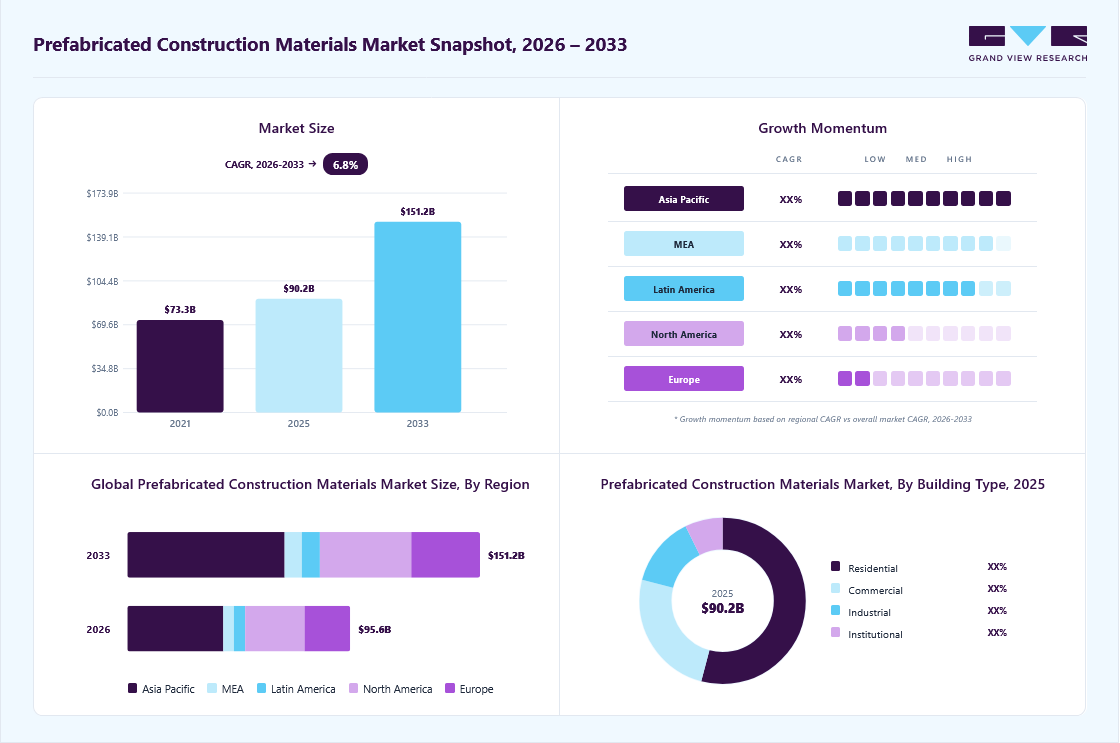
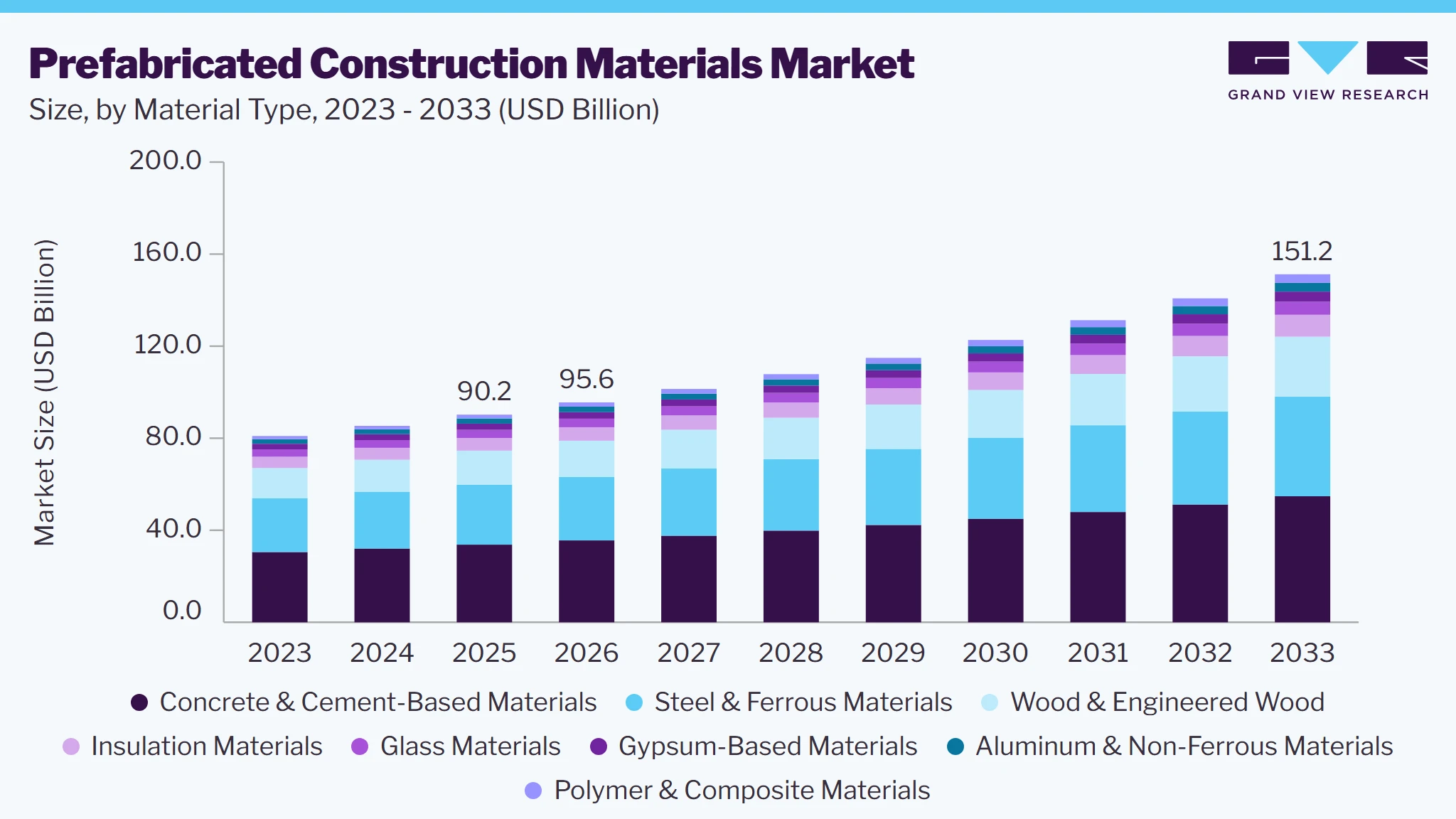
The global prefabricated construction materials market size was valued at USD 90.2 billion in 2025 and is projected to grow from USD 95.6 billion in 2026 to USD 151.2 billion by 2033, at a CAGR of 6.8% from 2026 to 2033. Asia Pacific dominated the market, accounting for a revenue share of 42.8% in 2025. The industry is expanding as construction companies, developers, and infrastructure operators seek faster project execution, better material utilization, and consistent building quality.
 Source: Grand View Research, IR Documents, Primary Interviews, Paid DatabasesTo learn more about this report,
 Download Free Sample Report
 Key Market Trends & Insights
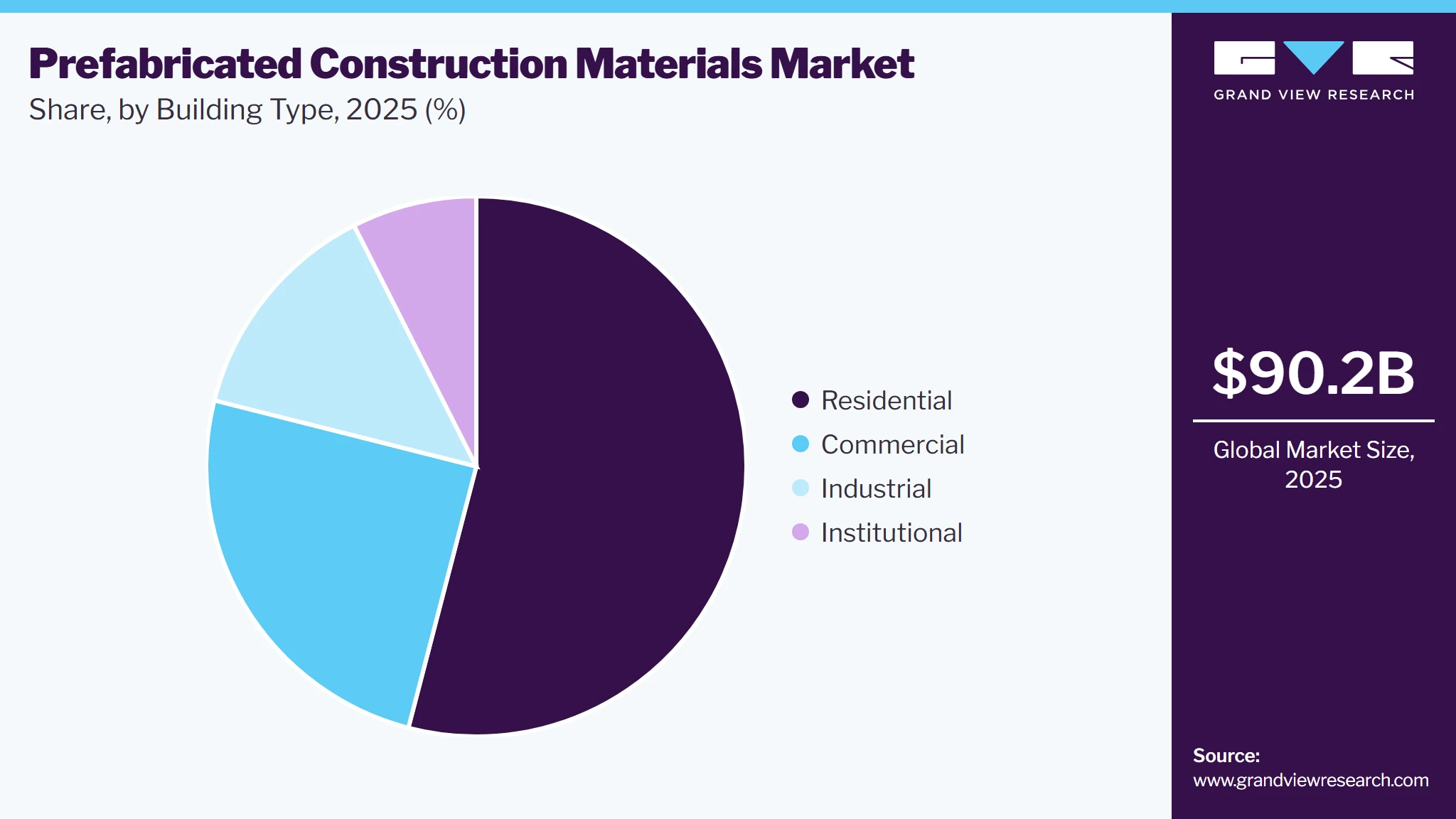
- By building type: Residential segment held the highest revenue share of 54.0% in 2025.
- By material: Concrete & cement-based materials segment dominated the market with a revenue share of 37.4% in 2025.
Regional Highlights
- Largest regional market: Asia Pacific (42.8% revenue share, 2025)
- By country: China held the largest share in 2025
Market Size & Forecast
- Market Size in 2025: USD 90.2 Billion
- Estimated Market Size in 2026: USD 95.6 Billion
- Projected Market Size by 2033: USD 151.2 Billion
- CAGR (2026-2033): 6.8%
Three ways to get this report
Buy it, customize it, or ask a question.Ask an Analyst
A direct answer, usually in 1 working day
- AccessReport author, directly
- Reply timeWithin 1 working day
- No sales callDirect answer only
- FormatEmail reply
- CostFree, no cost
Get the Full Report
What the study covers
- FormatsPDF · Excel · Dashboard
- Timeline2026–2033 annual, 2025 base
- Coverage20+ countries, 5 regions
- Companies10+ key players profiled
Customize the Report
20% free customization
- IncludeCountries, segments, points
- TailorTo your product definition
- ExtendDeeper competitor detail
- OrA fully bespoke study
- Turnaround5–10 working days
Prefabricated materials support off-site manufacturing of building components, including structural systems, wall panels, flooring systems, roofing components, and modular building elements. Growing urbanization, housing shortages, commercial construction, and infrastructure development are increasing demand for construction solutions that reduce on-site work and improve project coordination.
 To learn more about this report, Download Free Sample Report
 Expansion of the construction industry remains a major factor driving demand for prefabricated construction materials. Developers seek to control labor costs, reduce construction delays, and improve project delivery schedules. Prefabricated materials allow manufacturers to produce components in controlled factory environments, supporting consistent dimensions, standardized quality, and more efficient material handling. Demand is also increasing in high-density urban areas, where limited construction space and labor availability encourage the use of off-site manufacturing.
Manufacturers are developing lightweight structural components, insulated panels, engineered wood systems, precast concrete elements, and modular building solutions to meet changing construction requirements. Improvements in computer-aided design, building information modeling, automated manufacturing, and digital project coordination are supporting more accurate production and installation of prefabricated components. The integration of energy-efficient insulation, recycled materials, and low-carbon manufacturing processes is also gaining attention as construction companies seek to reduce environmental impact. Increasing use of standardized components, design flexibility, and factory-controlled production is expanding the application of prefabricated materials beyond traditional construction projects.
Market Dynamics
The industry is influenced by construction expansion, demand for faster project completion, labor availability, material costs, sustainability requirements, and technological improvements in manufacturing. While prefabrication can improve construction efficiency and quality control, transportation requirements, design limitations, and initial manufacturing investments affect adoption across different projects. Market growth also depends on the availability of suitable manufacturing facilities, skilled installation teams, and regulatory acceptance of prefabricated building systems.
Construction companies and developers are adopting prefabricated materials to reduce the time required for building component production and on-site installation. Traditional construction methods often involve multiple activities at the project site, including material preparation, cutting, assembly, and finishing. Prefabricated components shift several of these activities to controlled manufacturing facilities, allowing construction teams to perform site preparation and component production in parallel. This approach can improve project scheduling, reduce material handling requirements, and support more predictable construction timelines.
The demand for faster construction is particularly relevant in residential housing, commercial buildings, warehouses, healthcare facilities, and institutional projects. Developers face pressure to complete projects within planned budgets and schedules while managing labor shortages and increasing construction complexity. Prefabricated materials support standardized production and repeatable installation processes, which can improve workforce productivity and reduce certain on-site activities. As construction companies focus on project efficiency and cost control, prefabricated components are gaining acceptance as an alternative to labor-intensive construction methods.
Prefabricated construction materials require investment in manufacturing facilities, specialized equipment, design systems, quality-control processes, and transportation infrastructure. Manufacturers must also manage production planning and inventory to ensure that components reach construction sites at the required time. Large or heavy prefabricated elements can increase transportation and handling costs, particularly when projects are located far from manufacturing facilities. These costs can reduce the financial benefits of prefabrication in small-scale projects or locations with limited manufacturing capacity. In addition, customized components may require additional engineering and production time, limiting the cost advantages of standardized manufacturing.
The increasing adoption of modular buildings and sustainable construction methods is creating opportunities for prefabricated material manufacturers to expand their product portfolios. Demand for modular housing, prefabricated healthcare facilities, temporary buildings, and energy-efficient commercial structures is encouraging manufacturers to develop components that combine faster installation with improved thermal performance and material efficiency. Manufacturers can also expand into lightweight systems, low-carbon concrete, engineered timber, insulated panels, and recycled-material construction products. Regional manufacturing facilities and partnerships with developers, contractors, and building system providers can further support market penetration by reducing transportation costs and improving access to local construction projects.
Market Concentration & Characteristics
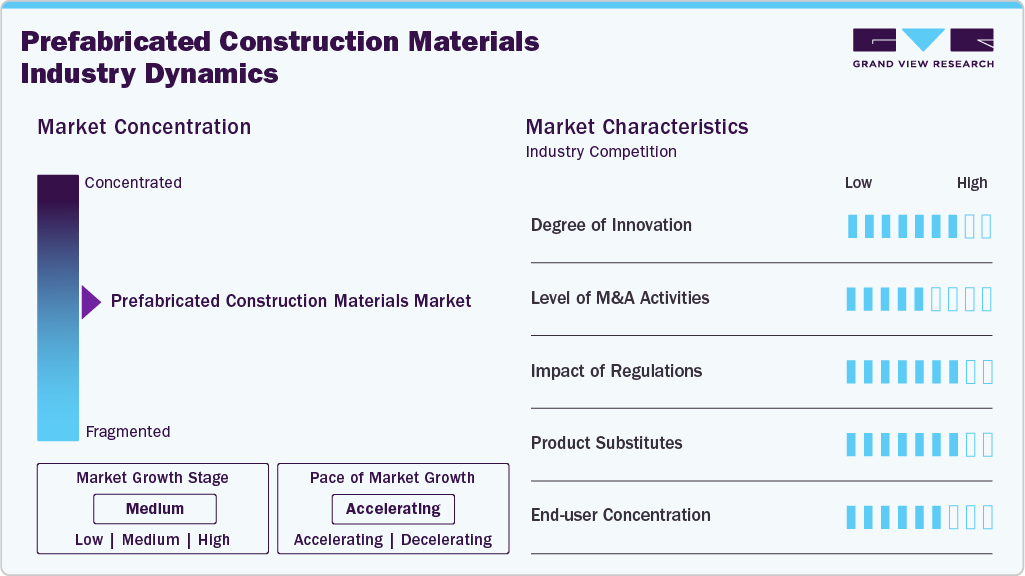
The industry includes large construction material manufacturers, specialized prefabricated component producers, modular building companies, and regional suppliers. The market remains differentiated by material type, manufacturing capabilities, product customization, project scale, and geographic presence. Large participants benefit from established production facilities, broad distribution networks, engineering capabilities, and relationships with construction contractors.
 To learn more about this report, Download Free Sample Report
 Mid-sized and regional manufacturers compete through specialized products, faster delivery, local market knowledge, and customized solutions. The market structure varies across product categories, with standardized construction components generally supporting greater production scale, while customized modular systems require stronger engineering and project management capabilities. Manufacturing investment, technical expertise, quality certifications, and compliance with building standards influence entry barriers.
Traditional on-site construction materials and construction methods represent the primary substitutes for prefabricated construction materials. Concrete, bricks, conventional steel framing, timber, and other materials can be used in building construction without extensive off-site component manufacturing. Customers may select traditional methods when projects require high customization, local materials are readily available, or transportation costs make prefabricated components less economical. Conventional construction also benefits from established contractor networks and familiarity with local building practices.
Analyst Perspective
The market is moving toward greater industrialization as developers and contractors seek to improve construction efficiency, manage labor requirements, and deliver projects within tighter schedules. Product manufacturers that combine standardized production with design flexibility, material efficiency, and reliable installation support can strengthen their position across residential, commercial, and infrastructure applications. The expansion of modular construction, sustainable materials, and digital manufacturing is expected to influence product development and competitive strategies across regional markets.
Material Insights
The concrete & cement-based materials segment held the highest revenue share of 37.4% in 2025, supported by the widespread use of precast concrete components in residential, commercial, industrial, and infrastructure projects. Precast walls, slabs, beams, columns, and other cement-based elements offer structural strength, durability, dimensional consistency, and efficient installation. Their suitability for large-scale construction projects, combined with established manufacturing capabilities and contractor familiarity, supports demand across major regions. The segment also benefits from infrastructure development, urban housing construction, and the increasing use of factory-manufactured concrete components to improve construction efficiency and quality control.
The polymer & composite materials segment is expected to grow at a CAGR of 10.6% over the forecast period, as construction companies seek lightweight, durable, and specialized building materials. Polymer-based panels, fiber-reinforced polymer components, composite façade systems, and other advanced materials offer advantages such as corrosion resistance, reduced weight, design flexibility, and lower maintenance requirements in suitable applications. Demand is supported by the development of modular buildings, prefabricated façades, insulation systems, and construction components requiring improved material performance.
Building Type Insights
The residential segment held the highest revenue share of 54.0% in 2025, supported by housing development, urbanization, population growth, and the need for efficient construction solutions. Prefabricated materials are being used in single-family homes, multifamily housing, apartments, and modular residential buildings to reduce construction time and improve material consistency. Developers and contractors benefit from standardized building components, reduced on-site labor requirements, and improved project coordination.
 To learn more about this report, Download Free Sample Report
 The commercial segment is expected to grow at a CAGR of 7.5% over the forecast period, as businesses and developers increase investments in offices, retail buildings, hotels, warehouses, and other commercial facilities. Prefabricated construction materials support faster project execution, standardized building assembly, and efficient installation, which can help manage construction schedules and labor requirements. Demand for modular commercial buildings, prefabricated façade systems, structural components, and insulated panels is increasing across projects that require flexibility and consistent construction quality.
Regional Insights
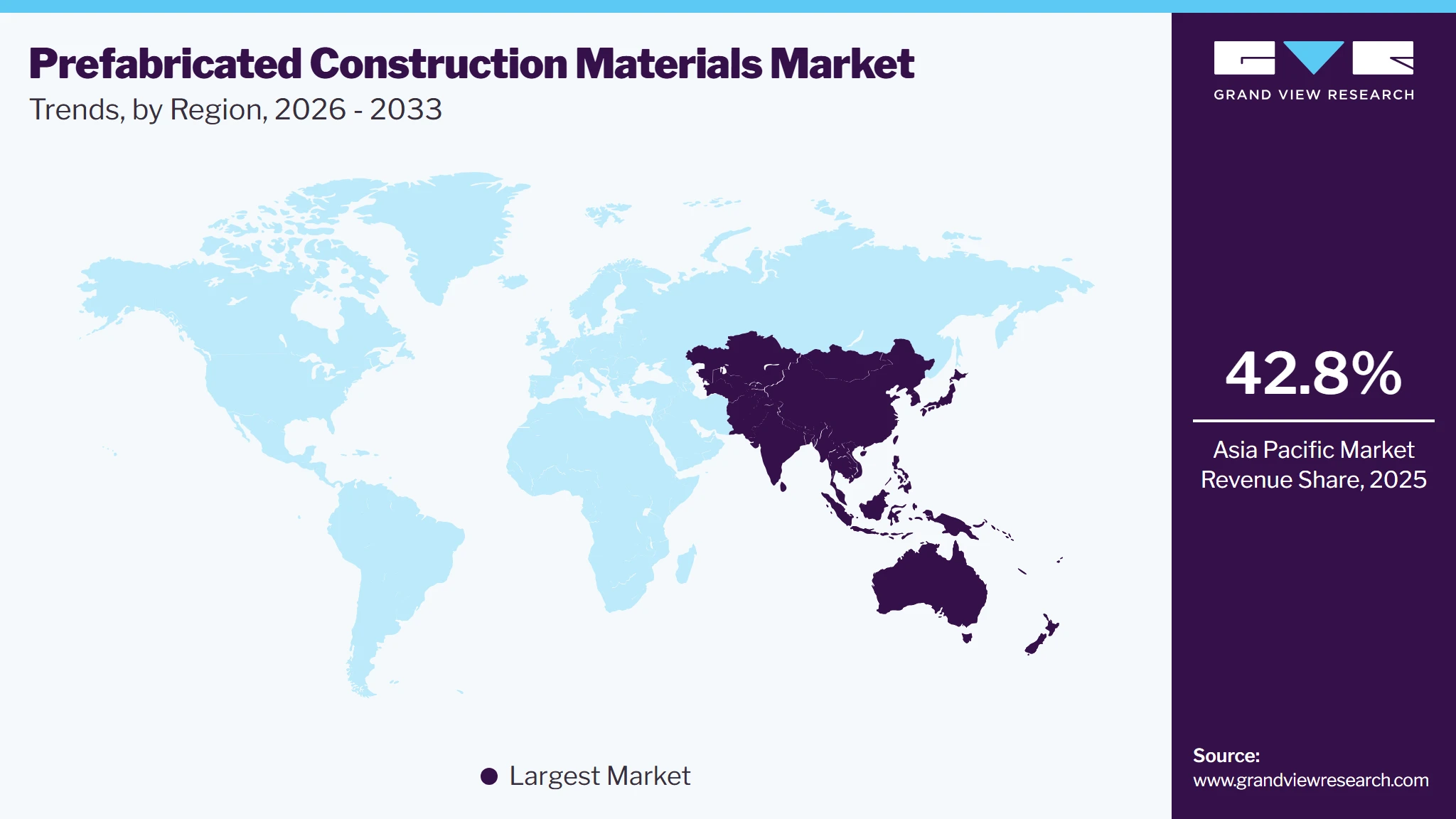
The Asia Pacific prefabricated construction materials market dominated and accounted for the largest revenue share of 42.8% in 2025. The market is also expected to grow at the fastest CAGR over the forecast period due to urbanization, housing development, infrastructure investment, and expansion of commercial and industrial facilities. Countries across the region are adopting prefabricated components to address construction labor requirements, improve project delivery, and support large-scale building programs. Residential housing, commercial buildings, industrial facilities, and public infrastructure are important application areas.
 To learn more about this report, Download Free Sample Report
 The prefabricated construction materials market in China is supported by large-scale residential construction, infrastructure development, industrial facilities, and urban redevelopment. The country has developed extensive manufacturing capabilities for precast concrete components, steel structures, modular building systems, and other construction materials. Government policies supporting industrialized construction, building efficiency, and prefabricated building adoption have encouraged manufacturers and developers to expand the use of off-site construction methods.
North America Prefabricated Construction Materials Market Trends
The prefabricated construction materials market in North America is supported by demand from warehouses, healthcare facilities, and industrial construction. Developers and contractors are adopting prefabricated materials to improve construction scheduling and manage project costs. The region has established manufacturers of modular building systems, engineered wood products, structural steel components, precast concrete, and insulated building panels. Demand for single-family housing, multifamily buildings, data centers, and logistics facilities supports the use of prefabricated components.
U.S. Prefabricated Construction Materials Market Trends
The prefabricated construction materials market in the U.S. is driven by housing demand, commercial development, industrial facilities, infrastructure investment, and the need to improve construction productivity. Labor shortages and project scheduling challenges encourage contractors and developers to consider off-site manufacturing solutions. Demand from warehouses, healthcare facilities, educational buildings, and data center construction also supports the market. Building code compliance, transportation requirements, local permitting, and installation capabilities influence the suitability of prefabricated systems.
Europe Prefabricated Construction Materials Market Trends
The prefabricated construction materials market in Europe is experiencing growth due to renovation activities, sustainability targets, and construction labor constraints. The region has established markets for precast concrete, engineered timber, modular housing, insulated panels, and energy-efficient building systems. Environmental requirements and building performance standards encourage manufacturers to improve material efficiency, insulation, and production processes. Renovation of older buildings is also creating demand for prefabricated façades, wall systems, roofing components, and other building elements.
The Germany prefabricated construction materials market is supported by engineered timber, precast concrete, modular building systems, and industrialized housing solutions. The country’s focus on building energy efficiency and sustainable construction encourages the use of insulated panels, energy-efficient façades, and high-performance building components. Manufacturers benefit from engineering capabilities, advanced production systems, and established construction supply chains. Prefabricated timber structures and modular building systems are gaining attention in projects that require reduced construction time and efficient material use.
Central and South America Prefabricated Construction Materials Market Trends
The prefabricated construction materials market in Central & South America is supported by the need for affordable and efficient building solutions, particularly in urban areas experiencing population growth. Prefabricated concrete components, steel structures, modular buildings, and construction panels are used in residential, commercial, and infrastructure applications. Local manufacturing capabilities and transportation networks influence the adoption of prefabricated materials across countries.
Middle East & Africa Prefabricated Construction Materials Market Trends
The prefabricated construction materials market in the Middle East & Africa is growing as the region has a rising demand for construction solutions that support rapid project execution in large-scale development programs. In Africa, housing shortages, urbanization, and infrastructure needs drive demand for cost-effective, efficient building systems. Precast concrete, steel structures, insulated panels, and modular building components are important product categories.
Key Prefabricated Construction Materials Company Insights
Some of the key players operating in the prefabricated construction materials market include Kingspan Group and Saint-Gobain.
-
Kingspan Group is a global building materials company specializing in high-performance insulation, insulated panels, and energy-efficient building envelope solutions. Its products support prefabricated construction by improving thermal performance, durability, and installation efficiency across residential, commercial, and industrial buildings.
-
Saint-Gobain is a leading building materials manufacturer offering a diversified portfolio of gypsum products, insulation materials, glass, and construction systems. The company supports prefabricated construction through lightweight, sustainable, and performance-oriented materials used in walls, ceilings, façades, and interior building applications.
Metecno and Etex are some of the emerging market participants in the industry.
-
Metecno specializes in insulated sandwich panels and prefabricated building envelope systems for industrial, commercial, and agricultural structures. Its solutions combine insulation, structural performance, and rapid installation, making them suitable for warehouses, cold storage facilities, factories, and modular buildings.
-
Etex is a global building materials company focused on lightweight construction solutions, including gypsum-based boards, fiber-cement products, and modular building systems. Its products support prefabricated construction by enabling faster assembly, reduced building weight, improved fire performance, and more efficient material use.
Key Prefabricated Construction Materials Companies
The following key companies have been profiled for this study on the prefabricated construction materials market include.
-
Kingspan Group
-
Saint-Gobain
-
Knauf
-
ROCKWOOL
-
Owens Corning
-
James Hardie Industries
-
Etex
-
Metecno
-
Stora Enso
-
Holcim
Competitive Benchmarking
Category
Operating Strategies
Competitive Edge
Weakness
Established Players: Kingspan Group, Saint-Gobain, Knauf, ROCKWOOL, Owens Corning, James Hardie Industries
- Invest in advanced insulation, panels, boards, and building systems.
- Expand manufacturing capacity and geographic presence.
- Develop application-specific materials and strengthen construction partnerships.
- Established manufacturing infrastructure and technical expertise.
- Diversified portfolios across insulation, gypsum, glass, and fiber-cement materials.
- Strong quality systems, customer relationships, and distribution networks.
- High capital requirements for manufacturing and R&D.
- Lengthy testing, certification, and customer qualification cycles.
- Exposure to raw material, energy, and transportation costs.
Emerging Players: Etex, Metecno, Stora Enso, Holcim
- Focus on specialized panels, engineered wood, concrete, and building systems.
- Expand through partnerships with contractors, developers, and distributors.
- Prioritize material optimization, sustainability, and customized solutions.
- Specialized portfolios address targeted construction requirements.
- Technical capabilities support differentiation through strength, insulation, and durability.
- Flexible product development for niche and customized applications.
- Narrower portfolios in selected prefabricated material categories.
- Dependence on specific construction applications and regional markets.
- Production scale and compliance costs can limit price competitiveness.
Recent Developments
-
In March 2025, Kingspan Group launched PowerPanel 2.0, an integrated photovoltaic solution combining its QuadCore insulated panel with advanced solar technology. The system received FM Approval to FM 4478, supporting Kingspan’s strategy of combining insulated building envelope systems with renewable energy technologies.
-
In October 2025, Holcim announced a binding agreement to acquire Xella, a European provider of walling systems, for an enterprise value of approximately €1.85 billion. Xella’s portfolio includes Ytong and Hebel autoclaved aerated concrete modular systems, Silka calcium silicate elements, and Multipor mineral insulation. The acquisition was intended to strengthen Holcim’s presence in sustainable walling, modular construction, insulation, and energy-efficient building solutions.
Prefabricated Construction Materials Market Report Scope
Report Attribute
Details
Market size in 2025
USD 90.2 billion
Estimated market size in 2026
USD 95.6 billion
Projected market size by 2033
USD 151.2 billion
Growth rate
CAGR of 6.8% from 2026 to 2033
Base year for estimation
2025
Actual estimates/historical data
2021 - 2024
Forecast period
2026 - 2033
Quantitative units
Revenue in USD billion, and CAGR from 2026 to 2033
Report coverage
Revenue forecast, company ranking, competitive landscape, growth factors, and trends
Segments covered
Building type, material, region
Regional scope
North America; Asia Pacific; Europe; Central & South America; Middle East & Africa
Country scope
U.S.; Canada, Mexico; Germany; UK; France; Italy; Spain; China; Japan; India; South Korea; Australia; Brazil; Argentina; Saudi Arabia; UAE; South Africa
Key companies profiled
Kingspan Group; Saint-Gobain; Knauf; ROCKWOOL; Owens Corning; James Hardie Industries; Etex; Metecno; Stora Enso; Holcim
Customization scope
Free report customization (equivalent up to 8 analysts working days) with purchase. Addition or alteration to country, regional & segment scope.
Pricing and purchase options
Avail customized purchase options to meet your exact research needs. Explore purchase options
Global Prefabricated Construction Materials Market Report Segmentation
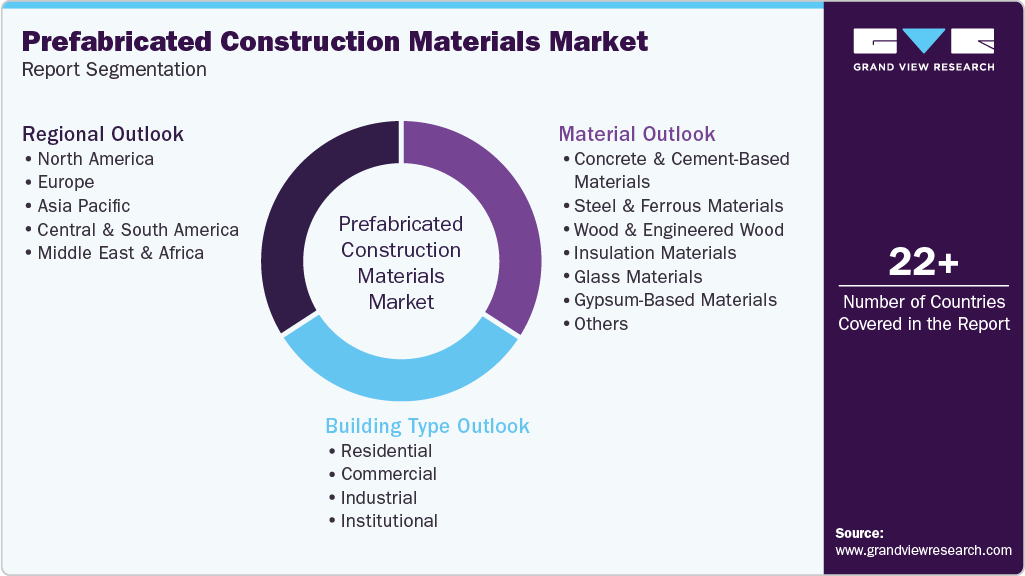
This report forecasts revenue growth at the global, regional & country levels and provides an analysis of the latest industry trends and opportunities in each of the sub-segments from 2021 to 2033. For this study, Grand View Research has segmented the global prefabricated construction materials market report based on material, building type, and region:
 To learn more about this report, Download Free Sample Report
 -
Material Outlook (Revenue, USD Billion, 2021 - 2033)
-
Concrete & Cement-Based Materials
-
Steel & Ferrous Materials
-
Wood & Engineered Wood
-
Insulation Materials
-
Glass Materials
-
Gypsum-Based Materials
-
Aluminum & Non-Ferrous Materials
-
Polymer & Composite Materials
-
-
Building Type Outlook (Revenue, USD Billion, 2021 - 2033)
-
Residential
-
Commercial
-
Industrial
-
Institutional
-
-
Regional Outlook (Revenue, USD Billion, 2021 - 2033)
-
North America
-
U.S.
-
Canada
-
Mexico
-
-
Europe
-
UK
-
Germany
-
France
-
Italy
-
Spain
-
-
Asia Pacific
-
China
-
Japan
-
India
-
South Korea
-
Australia
-
-
Central and South America
-
Brazil
-
Argentina
-
-
Middle East and Africa
-
Saudi Arabia
-
UAE
-
South Africa
-
-
Research Methodology
The prefabricated construction materials market figures in this report are based on a proven research process that combines executive interviews with secondary research from proprietary databases, company filings, and recognized regulatory and institutional sources. Market size is built through value-chain sizing-reconciling supply-side and demand-side estimates-and triangulated with bottom-up and top-down approaches. Every estimate passes multiple levels of expert validation before publication, with each prefabricated construction materials segment quantified using the revenue-capture definitions in the table below.
Segment Definition
Segment - Material
Revenue Capture Definition
Concrete & Cement-Based Materials
Revenue generated from the sale of prefabricated concrete and cement-based construction materials, including precast concrete panels, beams, columns, slabs, walls, foundations, and other factory-manufactured cement-based building components used in residential, commercial, industrial, institutional, and infrastructure construction projects.
Steel & Ferrous Materials
Revenue generated from the sale of prefabricated steel and ferrous construction materials, including structural steel frames, beams, columns, trusses, steel panels, modular steel building components, and other factory-fabricated ferrous systems used in building construction and infrastructure applications requiring high strength, durability, and structural performance.
Wood & Engineered Wood
Revenue generated from the sale of prefabricated wood and engineered wood construction materials, including cross-laminated timber, glulam beams, structural insulated timber panels, timber frames, modular wood components, and other factory-manufactured wood-based building systems used in residential, commercial, institutional, and other construction applications requiring lightweight structures, design flexibility, and sustainable material solutions.
Insulation Materials
Revenue generated from the sale of prefabricated insulation construction materials, including insulated wall panels, structural insulated panels, insulated roofing systems, rigid insulation boards, and other factory-manufactured thermal and acoustic insulation components used in building envelopes, roofs, walls, and other construction applications requiring thermal performance, energy efficiency, and moisture control.
Glass Materials
Revenue generated from the sale of prefabricated glass construction materials, including prefabricated glazing systems, insulated glass units, curtain wall components, glass façade panels, glass partitions, and other factory-manufactured glass building elements used in residential, commercial, institutional, and other construction applications requiring transparency, natural lighting, thermal performance, and architectural design flexibility.
Gypsum-Based Materials
Revenue generated from the sale of prefabricated gypsum-based construction materials, including gypsum wallboards, prefabricated partition systems, gypsum ceiling panels, drywall components, and other factory-manufactured gypsum building elements used in residential, commercial, institutional, and other construction applications requiring interior finishing, fire resistance, acoustic performance, and rapid installation.
Aluminum & Non-Ferrous Materials
Revenue generated from the sale of prefabricated aluminum and other non-ferrous construction materials, including aluminum framing systems, façade components, window and door systems, roofing elements, modular building components, and other factory-manufactured non-ferrous building products used in construction applications requiring lightweight structures, corrosion resistance, durability, and design flexibility.
Polymer & Composite Materials
Revenue generated from the sale of prefabricated polymer and composite construction materials, including fiber-reinforced polymer panels, composite façade systems, polymer-based building panels, composite structural components, and other factory-manufactured polymer and composite building products used in residential, commercial, industrial, and infrastructure applications requiring lightweight construction, durability, corrosion resistance, and specialized performance.
Segment - Building Type
Revenue Capture Definition
Residential
Revenue generated from the sale of prefabricated construction materials used in residential buildings, including single-family homes, multifamily housing, apartments, modular homes, and other residential construction projects requiring faster construction, standardized building components, material efficiency, and cost-effective construction solutions.
Commercial
Revenue generated from the sale of prefabricated construction materials used in commercial buildings, including offices, retail spaces, shopping centers, hotels, restaurants, and other commercial construction projects requiring efficient building assembly, architectural flexibility, reduced construction timelines, and consistent material quality.
Industrial
Revenue generated from the sale of prefabricated construction materials used in industrial facilities, including manufacturing plants, warehouses, logistics centers, distribution facilities, factories, and other industrial construction projects requiring structural strength, large-scale building components, durability, and efficient installation.
Institutional
Revenue generated from the sale of prefabricated construction materials used in institutional buildings, including hospitals, schools, universities, government facilities, public buildings, and other institutional construction projects requiring standardized building systems, quality control, rapid construction, and compliance with applicable safety and performance requirements.
Estimation Model
Layer Name
Key Question
Description
Parent Market Analysis
What is the overall size and growth outlook of the global construction materials, building materials, and prefabricated construction markets?
The estimation begins with the broader construction materials, building materials, structural materials, and prefabricated construction markets. Construction activity, material production, infrastructure investment, residential and non-residential development, and industrialized construction adoption are assessed to establish the addressable market for prefabricated construction materials.
Prefabricated Construction Materials Penetration Analysis
What proportion of the broader construction materials market is represented by prefabricated construction materials across different material types and construction systems?
This layer estimates the penetration of prefabricated construction materials across concrete, steel, wood, composite, and other material types, considering their structural properties, manufacturing processes, construction applications, and adoption. Penetration is further assessed across precast concrete components, structural steel systems, modular panels, engineered timber systems, and other prefabricated construction structures.
Regional & End-use Demand Assessment
Which regions, material types, prefabricated construction systems, and end-use applications contribute the highest demand for prefabricated construction materials?
Demand is assessed across major regions based on construction activity, housing development, infrastructure investment, commercial and industrial construction, building renovation, labor availability, and prefabrication adoption. Application-level demand is evaluated across residential construction, commercial buildings, industrial facilities, infrastructure projects, institutional buildings, renovation & refurbishment, and other construction applications.
Company Revenue Validation & Market Forecasting
How is the final market size validated and forecast across material types, prefabricated construction systems, regions, and end-use applications?
Final estimates are validated using company revenues, production capacities, product portfolios, manufacturing facilities, investments, capacity expansions, and application-specific developments. Bottom-up and top-down approaches are triangulated across company, material type, prefabricated construction system, regional, and end-use application data to generate market estimates and forecasts.
Delivered Customizations
We have successfully delivered the following deep-dive customizations
Client Request
Customization Delivered
Value Adds
Material Type & Structural Performance Assessment
Evaluate precast concrete, steel, wood, composite, and other prefabricated construction materials across structural panels, modular building components, precast elements, engineered timber systems, and other construction structures based on strength, durability, load-bearing capacity, fire resistance, thermal insulation, weight, installation efficiency, and application suitability.
Helps identify the performance advantages, positioning, and application potential of different construction materials and prefabricated systems while highlighting opportunities for lightweight, sustainable, high-performance, and specialty construction material development.
Construction Type & End-use Demand Assessment
Assess demand across new construction, renovation & refurbishment, residential buildings, commercial buildings, industrial facilities, infrastructure projects, and institutional buildings based on construction activity, project requirements, material performance, adoption levels, installation timelines, and substitution potential.
Provides visibility into high-demand and high-growth construction segments and helps identify end-use sectors offering strong opportunities for market expansion, product development, modular construction adoption, and application-specific material innovation.
Competitive Landscape & Manufacturing Capacity Benchmarking
Benchmark key prefabricated construction material manufacturers based on production capacity, material portfolio, manufacturing footprint, technology capabilities, product application coverage, geographic presence, partnerships, investments, and capacity expansion plans.
Provides a clear view of competitive positioning, market concentration, manufacturing capabilities, leading players, strategic strengths, and potential gaps for new investments, partnerships, capacity expansion, or market entry.
Frequently Asked Questions About This Report
The prefabricated construction materials market size was estimated at USD 90.2 billion in 2025 and is expected to reach USD 95.6 billion in 2026.
The prefabricated construction materials market is expected to grow at a compound annual growth rate of 6.8% from 2026 to 2033 to reach USD 151.2 billion by 2033.
The residential segment accounted for the highest revenue share of 54.0% in 2025, driven by increasing demand for cost-efficient and faster construction solutions.
Asia Pacific held the highest revenue market share of 42.8% in 2025, driven by rapid urbanization, infrastructure development, and increasing adoption of prefabricated construction solutions.
Rising construction activity, labor shortages, demand for faster project completion, and growing adoption of sustainable and cost-efficient building solutions are key factors driving the prefabricated construction materials market.
Some key players in the prefabricated construction materials market include Kingspan Group, Saint-Gobain, Knauf, ROCKWOOL, Owens Corning, James Hardie Industries, Etex, Metecno, Holcim, and Stora Enso
The polymer & composite materials segment is the fastest growing material type in the prefabricated construction materials market.
The commercial segment is the fastest growing building type in the prefabricated construction materials market.
The concrete & cement-based materials segment accounted for the largest revenue share of 37.4% in 2025, driven by their widespread use in structural components and precast construction applications.
About the Author(s)
Advanced Interior Materials Research Team
Advanced Materials · Advanced Interior MaterialsThis report was authored by the advanced interior materials research team at Grand View Research - comprising two research analysts, one senior research analyst, and one industry expert - with specialized expertise in the advanced interior materials segment of the advanced materials industry. All findings are based on proprietary advanced materials databases, executive interviews, and regulatory analysis, subject to internal peer review prior to publication.
Last Updated:
Speak to Analyst

Customize this report to your needs - add regions, segments, or data points, with 20% free customization.
Or view our licence options:


ISO 9001:2015 & 27001:2022 Certified
We are GDPR and CCPA compliant! Your transaction & personal information is safe and secure. For more details, please read our privacy policy.


