
- Home
- »
- Consumer F&B
- »
-
Premium Chocolate Market Size & Share Report, 2026-2033GVR Report cover

Premium Chocolate Market (2026 - 2033)
Size, Share & Trends Analysis Report By Product (Dark Chocolate, White Chocolate), By Type (Chocolate Bars, Assortments), By Distribution Channel (Hypermarkets & Supermarkets, Specialty Stores, Grocery Stores), By Region, And Segment Forecasts
Market Size, 2025
$32.9BMarket Estimate, 2026
$34.1BMarket Forecast, 2033
$47.8BCAGR, 2026–2033
4.9%Premium Chocolate Market Summary
The global premium chocolate market size was valued at USD 32.9 billion in 2025 and is projected to grow from USD 34.1 billion in 2026 to USD 47.8 billion by 2033, growing at a CAGR of 4.9% from 2026 to 2033. Europe dominated the premium chocolate market with the largest revenue share of 42.2% in 2025. The major factor propelling the growth of premium product ranges is continuous innovation by manufacturers among products, which pushes the envelope toward various new flavors to attract consumers.
 Source: Grand View Research, IR Documents, Primary Interviews, Paid DatabasesTo learn more about this report,
 Download Free Sample Report
 Key Market Trends & Insights
- By product: Milk chocolate segment led the market with the largest revenue share of 46.7% in 2025.
- By type: Assortments segment led the market with the largest revenue share of 35.7% in 2025.
- By Distribution Channel: Hypermarkets & supermarkets accounted for a revenue share of 35.3% in 2025.
Regional Highlights
- Largest regional market: Europe (42.2% revenue share, 2025)
- Fastest-growing regional market: Asia Pacific (highest CAGR, 2026-2033)
- By country: The U.S. held the largest market share in 2025
Market Size & Forecast
- Market size in 2025: USD 32.9 Billion
- Estimated market size in 2026: USD 34.1 Billion
- Projected market size by 2033: USD 47.8 Billion
- CAGR (2026-2033): 4.9%
Three ways to get this report
Buy it, customize it, or ask a question.Ask an Analyst
Analyst response in 1 business day
- AccessReport author, directly
- Reply timeWithin 1 working day
- No sales callDirect answer only
- FormatEmail reply
- CostFree, no cost
Get the Full Report
What the study covers
- FormatsPDF · Excel · Dashboard
- Timeline2026–2033 annual, 2025 base
- Coverage20+ countries, 5 regions
- Companies10+ key players profiled
Customize the Report
20% free customization
- IncludeCountries, segments, points
- TailorTo your product definition
- ExtendDeeper competitor detail
- OrA fully bespoke study
- Turnaround5–10 working days
Moreover, leading companies are adding a touch of "comfort foods" into their premium ranges, namely, bacon, cereal, or cookie dough. In addition, the incorporation of various flavors in these products, such as a hint of gourmet salt and alcohol, also acts as a booster for the growth of the global market. The demand for premium chocolates is rising due to several key factors, many of which reflect shifting consumer preferences towards higher quality, ethical production, and indulgence. One of the main drivers of this growth is the broader trend of premiumization in food and beverages. Consumers are increasingly willing to pay more for products that offer superior ingredients, artisanal craftsmanship, and unique flavors. Premium chocolates, often made with high-quality cocoa, organic ingredients, and innovative recipes, align with this desire for a more sophisticated and indulgent product experience. This shift toward premium products is also fueled by the growing appreciation for luxury and experiential consumption, where consumers seek not just a product but an experience that satisfies their sensory and emotional needs. To learn more about this report, Download Free Sample Report
 Another significant factor contributing to the rise in demand for premium chocolates is the increasing focus on health-conscious choices. As consumers become more mindful of their diets, many are turning to dark chocolate varieties, which are rich in antioxidants, may support heart health, and are seen as a more healthful alternative to milk chocolate. Premium dark chocolate, typically containing higher cocoa percentages and lower sugar content, appeals to consumers seeking a guilt-free indulgence. In addition, many premium chocolate brands emphasize clean labels, offering products with fewer additives and preservatives, which aligns with the growing preference for natural, minimally processed foods.
Consumers are also becoming more ethically conscious about their purchases, and this has positively impacted the demand for premium chocolates. Many high-end chocolate brands focus on sustainable sourcing and fair-trade certification, ensuring that cocoa farmers are paid fairly and that environmental practices are upheld. As awareness of social and environmental issues grows, consumers are increasingly choosing premium chocolates that reflect their values. This ethical approach, coupled with transparency in sourcing and production, has become a significant selling point for many consumers who wish to make responsible purchasing decisions.
In addition to these factors, luxury gifting has become a major contributor to the rise in premium chocolate consumption. Chocolates have long been a favored gift, and in recent years, there has been a shift towards gifting high-quality artisanal products. Premium chocolates, with their elegant packaging and high-end ingredients, are seen as thoughtful, sophisticated gifts for special occasions like holidays, birthdays, or corporate events. This trend toward gifting, combined with the growing popularity of experiential and emotion-driven purchases, makes premium chocolates an attractive option for consumers looking to treat themselves or others to something indulgent.
Market Dynamics
Premium chocolate products are gaining strong consumer interest as they offer superior quality ingredients, unique flavor profiles, higher cocoa content, and artisanal craftsmanship. These products appeal to consumers seeking indulgent experiences, ethical sourcing, clean-label formulations, and innovative taste combinations. The growing preference for premium confectionery, coupled with rising disposable incomes and increasing demand for gifting and self-indulgence products, is expected to continue driving growth in the premium chocolate market.
The increasing demand for high-quality, indulgent, and experiential food products is significantly driving growth in the premium chocolate market. Urbanization and evolving consumer lifestyles have encouraged consumers to lean more towards premium confectionery products that offer superior taste, higher cocoa content, unique flavors, and artisanal craftsmanship. Consumers are increasingly seeking chocolates made with natural ingredients, ethical sourcing practices, and clean-label formulations. In addition, gifting culture, seasonal celebrations, and the growing popularity of luxury food products have contributed to higher demand for premium chocolates across both developed and emerging markets. Health-conscious consumers are also showing increased interest in dark chocolate products due to their perceived antioxidant benefits and lower sugar content compared to conventional chocolates. Furthermore, continuous product innovation, including exotic ingredients, limited-edition offerings, and premium packaging, is strengthening consumer engagement and supporting market expansion. As consumer preferences continue to shift toward premium experiences and high-quality confectionery products, demand for premium chocolates is expected to grow steadily over the coming years.
Fluctuations in cocoa bean prices and ongoing supply chain disruptions remain major restraints for the premium chocolate market. Cocoa, the primary raw material used in chocolate manufacturing, is highly vulnerable to climatic conditions, crop diseases, geopolitical uncertainties, and changing agricultural policies in major cocoa-producing countries. Adverse weather events and supply shortages can significantly impact cocoa production, resulting in increased raw material costs for manufacturers. Premium chocolate producers are particularly affected as they often rely on high-quality cocoa beans sourced from specific regions to maintain product quality and brand positioning. In addition, rising transportation, packaging, labor, and energy costs have increased overall production expenses across the chocolate value chain. Consumers may become sensitive to higher retail prices during periods of economic uncertainty, potentially limiting demand for premium products. Furthermore, increasing regulatory requirements related to sustainability, traceability, and ethical sourcing can add operational complexities and compliance costs for manufacturers. These factors may pressure profit margins and create challenges for market participants seeking to maintain premium product standards while remaining price competitive.
The growing consumer focus on sustainability, wellness, and product transparency is creating substantial growth opportunities in the premium chocolate market. Consumers are increasingly seeking chocolates that are ethically sourced, environmentally responsible, and produced under fair-trade and sustainable farming practices. This trend is encouraging manufacturers to invest in traceable supply chains, responsible cocoa sourcing programs, and eco-friendly packaging solutions. At the same time, rising health awareness is driving demand for functional premium chocolates enriched with ingredients such as nuts, fruits, probiotics, plant-based proteins, and natural antioxidants. Manufacturers are also expanding their portfolios with organic, vegan, sugar-free, and high-cocoa-content chocolate products to address evolving consumer preferences. The growth of e-commerce platforms and direct-to-consumer sales channels further enhances market opportunities by improving product accessibility and enabling brands to reach a broader consumer base. As consumers increasingly prioritize both indulgence and wellness, the demand for innovative, sustainable, and premium chocolate offerings is expected to create significant long-term growth opportunities for industry participants.
Analyst Perspective
The premium chocolate market benefits from several long-term growth drivers, including rising consumer demand for indulgent experiences, growing preference for high-quality ingredients, and increasing interest in sustainable and ethically sourced products. The key competitive advantage, however, will belong to manufacturers that successfully combine superior taste, premium craftsmanship, responsible sourcing, and continuous product innovation. As consumers increasingly seek both indulgence and authenticity, brands capable of building strong emotional connections and delivering differentiated premium offerings are expected to capture greater market share and command higher pricing power in the years ahead.
Product Insights
Based on product, the milk chocolate segment led the market with the largest revenue share of 46.7% in 2025 and is expected to grow at a CAGR of 4.9% over the forecast period. Consumers are increasingly viewing premium milk chocolate as an affordable luxury, aligning with the rising trend of indulgence in food products. Premium chocolates are perceived as both a treat and a sensory experience, and this has led to higher demand in both developed and emerging markets. Milk chocolate traditionally contains higher sugar and fat content than dark chocolate. The premium category is witnessing a shift towards “healthier” milk chocolate options. Brands are offering products with reduced sugar, organic ingredients, and free-from labels (gluten-free, non-GMO, etc.). This has been driven by the increasing consumer preference for clean-label products and guilt-free indulgence.
The dark premium chocolate segment is expected to grow at a CAGR of 5.5% from 2026 to 2033. Dark chocolate is often marketed as a healthier alternative to milk chocolate due to its higher cocoa content and lower sugar levels. Consumers are increasingly aware of its health benefits, such as being rich in antioxidants, improving heart health, and reducing stress. For instance, brands such as Lindt & Sprüngli have emphasized the health benefits of their premium dark chocolate products through their corporate communications. They have continuously introduced high-cocoa-content dark chocolates, such as their 85% and 90% cocoa bars, which cater to health-conscious consumers.
Distribution Channel Insights
Sales of premium chocolate through hypermarkets & supermarkets accounted for a revenue share of 35.3% in 2025. Hypermarkets and supermarkets offer a one-stop shopping experience, making it convenient for consumers to purchase premium chocolates alongside their regular grocery items. The accessibility of these retail channels allows consumers to easily integrate premium chocolate purchases into their routine shopping trips. Retailers like Walmart and Target have expanded their premium chocolate offerings, providing consumers with the opportunity to try new brands and flavors without needing to visit specialty stores.
Sales of premium chocolate through online stores are expected to grow at a CAGR of 7.9% from 2026 to 2033. The demand for premium chocolates through online stores is primarily driven by convenience, wider selections, and targeted marketing strategies that cater to specific consumer preferences. Retailers like Amazon and specialty online chocolate shops, such as Chococurb, have expanded their offerings to include a variety of premium brands, appealing to consumers seeking quality products that may not be available in local stores.
Type Insights
Based on type, the assortments segment led the market with the largest revenue share of 35.7% in 2025. Consumers increasingly seek variety in their chocolate experiences, and leading brands offer assortments featuring an array of flavors and textures. This trend enhances the appeal of premium chocolate assortments, as they cater to diverse taste preferences. Moreover, brands such as Lindt provide assorted chocolate and truffle boxes that include flavors ranging from classic dark chocolate to unique options like raspberry or hazelnut cream. This variety attracts consumers looking for a comprehensive tasting experience in one package.
 To learn more about this report, Download Free Sample Report
 Chocolate bars are expected to grow with a CAGR of 5.6% from 2026 to 2033. Consumers are becoming more discerning about the quality of ingredients used in chocolate. Premium chocolate bars often emphasize high cocoa content, organic ingredients, and natural flavorings, appealing to health-conscious and quality-focused consumers. Brands such as Green & Black are known for their organic and Fair Trade-certified chocolate bars. By highlighting the use of high-quality ingredients and sustainable sourcing, the brand attracts consumers who prioritize ethical and premium options.
Regional Insights
The North America premium chocolate market is expected to grow at a CAGR of 3.6% from 2026 to 2033. Consumers in North America are increasingly seeking high-quality, ethically sourced ingredients in their chocolate. They prioritize organic, fair-trade, and single-origin cocoa, associating these with superior taste and health benefits. For example, brands such as Lindt and Green & Black highlight their use of ethically sourced, high-percentage cocoa, appealing to conscious consumers. The preference for products without artificial additives also drives the demand for premium, cleaner-label chocolate options, thus supporting the growth of the overall industry.
U.S. Premium Chocolate Market Trends
The premium chocolate market in the U.S. held the largest share in the North America region in 2025. There's growing consumer interest in high-quality, artisanal, and gourmet products as part of a broader trend toward premiumization in food and beverage categories. Consumers are willing to pay more for chocolates made with high-quality ingredients, ethical sourcing, and unique flavors. Also, the increasing awareness of the health benefits of dark chocolate, such as antioxidants and potential cardiovascular benefits, has contributed to its appeal.
Europe Premium Chocolate Market Trends
Europe dominated the premium chocolate market with the largest revenue share of 42.2% in 2025. The increased awareness of the health benefits of premium dark chocolates, which contain essential nutrients and vitamins, is driving the industry in this region. In addition, the consumers in this region are highly health-conscious and choose their products more selectively. Hence, the luxury packaging of such products encourages them to purchase such products during the festive seasons.
 To learn more about this report, Download Free Sample Report
 Asia Pacific Premium Chocolate Market Trends
Asia Pacific premium chocolate market is expected to grow at a CAGR of 7.5% from 2026 to 2033. As disposable incomes rise across countries such as China, India, and Japan, consumers are more inclined to spend on luxury and aspirational products, including premium chocolates. This is particularly evident in the growing middle class, which associates premium brands with quality and status. For instance, Godiva and Lindt have seen significant success in the region by positioning their products as indulgent and exclusive, with boutique stores in urban centers catering to affluent customers.
Key Premium Chocolate Company Insights
The global premium chocolate industry is characterized by numerous well-established and emerging players. Manufacturers in the premium chocolate industry are engaging in a variety of strategic initiatives to keep pace with evolving consumer demand and market trends.
Key Premium Chocolate Companies
The following key companies have been profiled for this study on the premium chocolate market.
-
Chocoladefabriken Lindt & Sprüngli AG
-
Ferrero International S.A.
-
Endangered Species Chocolate
-
The Hershey Company
-
Mondelez International
-
Yildiz Holding Inc.
-
Lake Champlain Chocolate Co.
-
Mars, Inc.
-
CEMOI Group
-
Rococo Chocolates
Competitive Benchmarking
Category
Operating Strategies
Competitive Edge
Weakness
Established Players (Chocoladefabriken Lindt & Sprüngli AG, Ferrero International S.A., The Hershey Company, Mondelez International, Mars, Inc., Yildiz Holding Inc.)
- Expand premium product portfolios through new flavor innovations, seasonal collections, and premium gifting ranges
- Strengthen global distribution networks, direct-to-consumer channels, and sustainability-focused cocoa sourcing programs
- Strong brand recognition, extensive retail presence, and large-scale manufacturing capabilities
- Significant investment capacity for marketing, product innovation, and sustainable sourcing initiatives
- Higher exposure to cocoa price volatility and supply chain disruptions due to large procurement requirements
- Premium product innovation may be slower due to complex organizational structures and extensive product portfolios
Emerging Players (Endangered Species Chocolate, Lake Champlain Chocolate Co., CEMOI Group, Rococo Chocolates)
- Focus on artisanal, organic, ethical, and sustainably sourced chocolate offerings targeting niche consumer segments
- Leverage premium branding, storytelling, e-commerce platforms, and specialty retail partnerships to build customer loyalty
- Strong differentiation through unique flavors, ethical sourcing practices, and handcrafted product positioning
- Greater flexibility to respond to changing consumer preferences and premium confectionery trends
- Limited financial resources and smaller distribution networks compared to multinational chocolate manufacturers
- Lower brand visibility in international markets and greater dependence on specialty retail and online sales channels
Recent Developments
-
In August 2024, Chocoladefabriken Lindt & Sprüngli AG, a premium chocolatier, expanded its Lindor range with the launch of four new flavors: Lindor Dark 70% Mint, Lindor Pistachio, Lindor Tiramisu, and the limited-edition Lindor Irish Cream. These offerings are designed to meet consumer desires for unique and indulgent chocolate experiences.
-
In July 2024, Mars Wrigley, by Mars, Inc., launched Galaxy Jewels gift packs in India to target the premium chocolate gifting market. These gift packs feature unique packaging designed to stand out and embody the brand’s luxurious image. Mars Wrigley plans to aggressively market these products and ensure their availability across modern retail outlets and e-commerce platforms.
Premium Chocolate Market Report Scope
Report Attribute
Details
Market size in 2025
USD 32.9 billion
Estimated market size in 2026
USD 34.1 billion
Projected market size by 2033
USD 47.8 billion
Growth rate
CAGR of 4.9% from 2026 to 2033
Base year for estimation
2025
Historical data
2021 - 2024
Forecast period
2026 - 2033
Quantitative units
Revenue in USD million/billion and CAGR from 2026 to 2033
Report coverage
Revenue forecast, company ranking, competitive landscape, growth factors, and trends
Segments covered
Product, type, distribution channel, region
Regional scope
North America; Europe; Asia Pacific; Middle East & Africa; Central & South America
Country scope
U.S.; Canada; Mexico; Germany; UK; France; Italy; Spain; China; Japan; India; South Korea; Australia & New Zealand; Brazil; UAE; South Africa
Key companies profiled
Chocoladefabriken Lindt & Sprüngli AG; Ferrero International S.A.; Endangered Species Chocolate; The Hershey Company; Mondelez International; Yildiz Holding Inc.; Lake Champlain Chocolate Co.; Mars, Inc.; CEMOI Group; and Rococo Chocolates.
Customization scope
Free report customization (equivalent up to 8 analysts' working days) with purchase. Addition or alteration to country, regional & segment scope.
Pricing and purchase options
Avail customized purchase options to meet your exact research needs. Explore purchase options
Global Premium Chocolate Market Report Segmentation
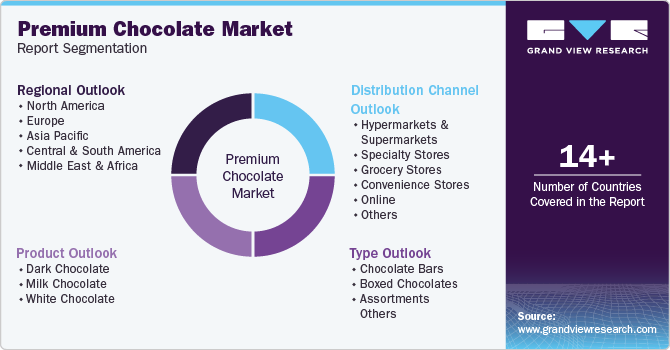
This report forecasts revenue growth at the global, regional, and country levels and provides an analysis of the latest industry trends and opportunities in each of the sub-segments from 2021 to 2033. For this study, Grand View Research has segmented the global premium chocolate market report based on product, type, distribution channel, and region:
 To learn more about this report, Download Free Sample Report
 -
Product Outlook (Revenue, USD Million, 2021 - 2033)
-
Dark Chocolate
-
Milk Chocolate
-
White Chocolate
-
-
Type Outlook (Revenue, USD Million, 2021 - 2033)
-
Chocolate Bars
-
Boxed Chocolates
-
Assortments
-
Others
-
-
Distribution Channel Outlook (Revenue, USD Million, 2021 - 2033)
-
Hypermarkets & Supermarkets
-
Specialty Stores
-
Grocery Stores
-
Convenience Stores
-
Online
-
Others
-
-
Regional Outlook (Revenue, USD Million, 2021 - 2033)
-
North America
-
U.S.
-
Canada
-
Mexico
-
-
Europe
-
Germany
-
UK
-
France
-
Italy
-
Spain
-
-
Asia Pacific
-
China
-
Japan
-
India
-
Australia & New Zealand
-
South Korea
-
-
Central & South America
-
Brazil
-
Argentina
-
-
Middle East & Africa
-
South Africa
-
-
Research Methodology
Segment Definition
Segment - Product
Revenue capture definition
Dark Chocolate
This segment includes the sale of dark chocolate products containing a high percentage of cocoa solids and cocoa butter, with limited milk content. These chocolates are valued for their rich flavor, premium positioning, and perceived health benefits.
Milk Chocolate
This segment includes the sale of milk chocolate products made with cocoa solids, cocoa butter, milk ingredients, and sweeteners. These chocolates are widely consumed due to their creamy texture, sweet taste, and broad consumer appeal.
White Chocolate
This segment includes the sale of white chocolate products made primarily from cocoa butter, milk solids, and sweeteners, without cocoa solids. These chocolates are popular for their smooth texture, creamy flavor, and versatile applications.
Estimation Model
Layer
Key Question
Description
Consumer Base Layer
Who consumes chocolate products?
Identify the population with chocolate consumption habits across target markets. Analyze factors such as chocolate consumption frequency, income levels, gifting culture, urbanization, and premium food preferences to define the potential consumer pool for premium chocolates.
Purchasing Power Layer
Who can afford premium chocolates?
Apply region-specific disposable income levels, affluent and upper-middle-income population data, and modern retail/e-commerce accessibility to the eligible consumer base to estimate the addressable premium chocolate market.
Premium Adoption Layer
Who actively purchases premium chocolates?
Apply premium chocolate penetration rates and consumer preferences for high-quality ingredients, artisanal products, single-origin chocolates, gifting products, and luxury confectionery to convert the addressable population into active premium chocolate buyers.
Monetization Layer
How much revenue is generated?
Multiply active premium chocolate buyers by annual consumption volume and average spending per consumer. Add revenue contributions from gifting occasions, seasonal demand, specialty retail channels, e-commerce platforms, and corporate gifting programs to estimate total market revenue.
Delivered Customizations
This report has been delivered with the following In-depth customizations
CLIENT REQUEST
CUSTOMIZATION DELIVERED
VALUE ADDS
Premiumization, Consumer Preferences & Product Innovation Trends
Conducted a focused analysis of the premium chocolate market covering premiumization trends, dark chocolate demand, clean-label products, artisanal offerings, flavor innovations, gifting patterns, and evolving consumer purchasing behavior.
Helps stakeholders identify high-growth product categories, evaluate changing consumer preferences, and assess opportunities for premium product development and market expansion.
Sustainable Sourcing & Ethical Cocoa Supply Chain Assessment
Evaluated sustainability initiatives, fair-trade certification trends, ethical cocoa sourcing practices, traceability programs, and consumer demand for environmentally responsible chocolate products across key markets.
Provides insights into sustainability-driven purchasing decisions, brand differentiation opportunities, and strategies to strengthen supply chain resilience and corporate responsibility positioning.
E-commerce, Premium Gifting & Market Expansion Opportunity Assessment
Assessed growth opportunities in online chocolate sales, premium gifting segments, luxury packaging innovations, direct-to-consumer channels, and emerging premium chocolate consumption markets.
Supports investment and expansion strategies by identifying attractive distribution channels, untapped consumer segments, and long-term growth opportunities within the global premium chocolate industry.
Frequently Asked Questions About This Report
The global premium chocolate market size was valued at USD 32.9 billion in 2025 and is expected to reach USD 34.1 billion in 2026.
The global premium chocolate market is expected to grow at a CAGR of 4.9% from 2026 to 2033, reaching USD 47.8 billion.
Europe dominated with a 42.2% revenue share in 2025.
Assortment type premium chocolates held the largest revenue share of 35.7% in 2025, while chocolate bars is the fastest growing type.
Hypermarkets & Supermarkets held the largest revenue share in 2025, while online distribution channels are the fastest growing.
Some key players operating in premium chocolate market include Chocoladefabriken Lindt & Sprüngli AG; Ferrero International S.A.; Endangered Species Chocolate; The Hershey Company; Mondelez International; Yildiz Holding Inc.; Lake Champlain Chocolate Co.; Mars, Inc.; CEMOI Group; and Rococo Chocolates.
The major factor propelling the growth of premium product ranges is continuous innovation by manufacturers among products, which pushes the envelope toward various new flavors to attract consumers.
Milk chocolate led with a 46.7% revenue share in 2025, while dark chocolate is the fastest growing segment.
About the Author(s)
Consumer F&B Research Team
Consumer Goods · Consumer F&BThis report was authored by the consumer f&b research team at Grand View Research - comprising two research analysts, one senior research analyst, and one industry expert - with specialized expertise in the consumer f&b segment of the consumer goods industry. All findings are based on proprietary consumer goods databases, executive interviews, and regulatory analysis, subject to internal peer review prior to publication.
Last Updated:
Speak to Analyst

Customize this report to your needs - add regions, segments, or data points, with 20% free customization.
Or view our licence options:


ISO 9001:2015 & 27001:2022 Certified
We are GDPR and CCPA compliant! Your transaction & personal information is safe and secure. For more details, please read our privacy policy.


