
- Home
- »
- Medical Devices
- »
-
Pressure Ulcer Devices Market Size Report, 2026-2033GVR Report cover

Pressure Ulcer Devices Market (2026 - 2033)
Size, Share & Trends Analysis Report By Product (Support Surfaces, Wound Care Devices, Detection & Monitoring Devices), By Clinical Application, By End Use (Hospitals, Homecare Setting), By Region, And Segment Forecasts
Market Size, 2025
$4.7BMarket Estimate, 2026
$4.9BMarket Forecast, 2033
$6.7BCAGR, 2026–2033
4.6%Pressure Ulcer Devices Market Summary
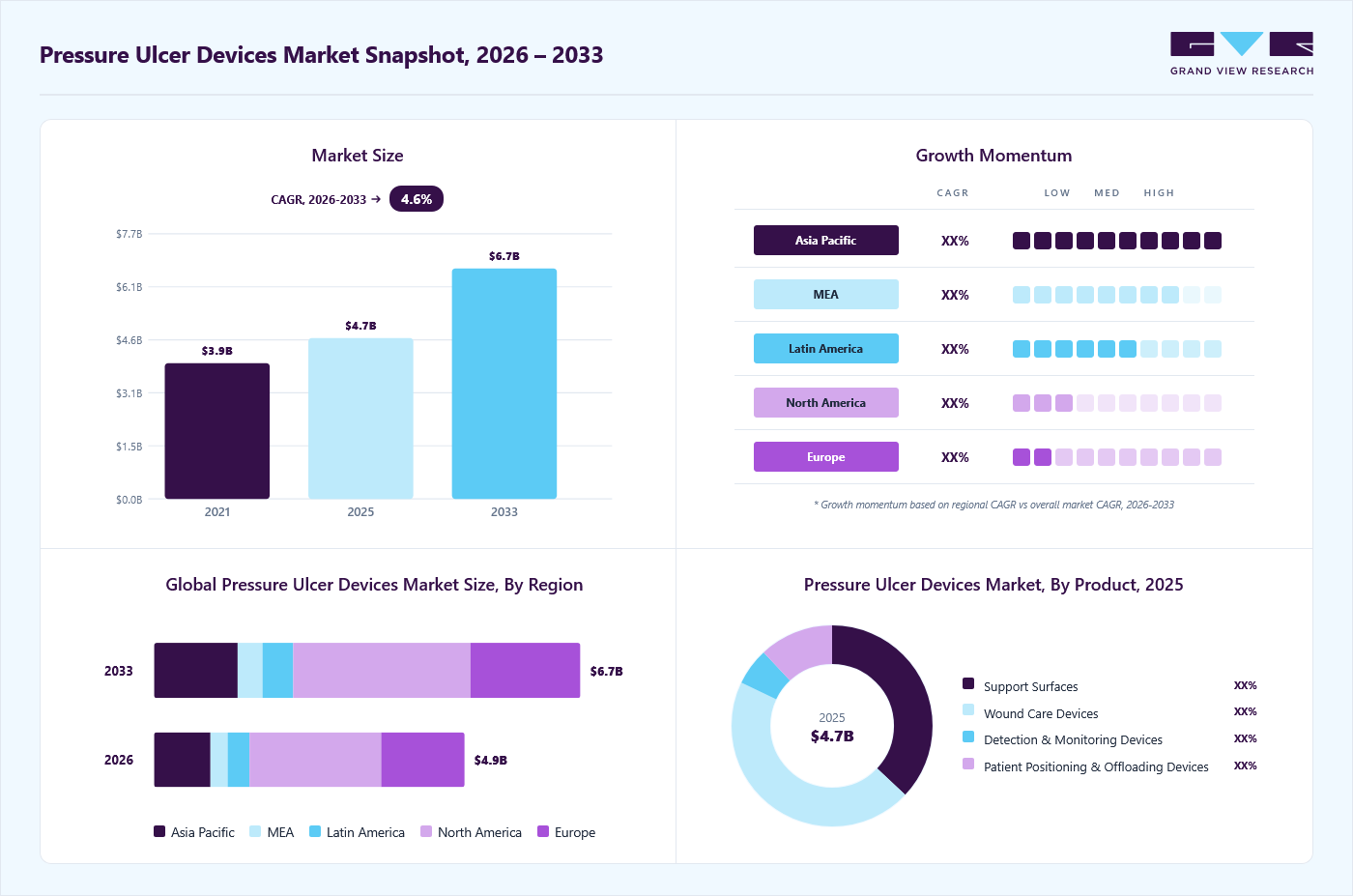
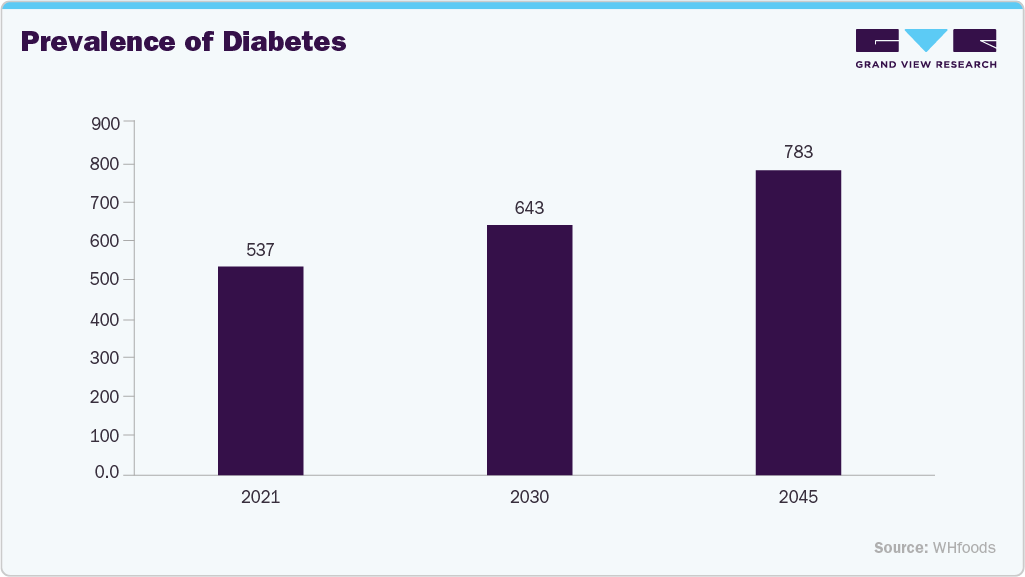
The global pressure ulcer devices market size was valued at USD 4.7 billion in 2025 and is projected to grow from USD 4.9 billion in 2026 to USD 6.7 billion by 2033, at a CAGR of 4.6% from 2026 to 2033. The market in North America dominated with a revenue share of 42.5% in 2025. The pressure ulcer devices industry is primarily driven by the rising prevalence of chronic conditions such as diabetes and limited mobility among the aging population, which increases the risk of pressure injuries.
 Source: Grand View Research, IR Documents, Primary Interviews, Paid DatabasesTo learn more about this report,
 Download Free Sample Report
Key Market Trends & Insights
- By product: Wound care devices segment held the largest market share in 2025.
- By clinical application: Stage III & IV segment held the largest market share in 2025.
- By end use: Hospitals segment held the largest market share in 2025.
Regional Highlights
- Largest regional market: North America (42.5% revenue share, 2025)
- By country: The U.S. held the largest market share in 2025
Market Size & Forecast
- Market size in 2025: USD 4.7 Billion
- Estimated market size in 2026: USD 4.9 Billion
- Projected market size by 2033: USD 6.7 Billion
- CAGR (2026-2033): 4.6%
Three ways to get this report
Buy it, customize it, or ask a question.Ask an Analyst
Analyst response in 1 business day
- AccessReport author, directly
- Reply timeWithin 1 working day
- No sales callDirect answer only
- FormatEmail reply
- CostFree, no cost
Get the Full Report
What the study covers
- FormatsPDF · Excel · Dashboard
- Timeline2026–2033 annual, 2025 base
- Coverage20+ countries, 5 regions
- Companies10+ key players profiled
Customize the Report
20% free customization
- IncludeCountries, segments, points
- TailorTo your product definition
- ExtendDeeper competitor detail
- OrA fully bespoke study
- Turnaround5–10 working days
The increasing prevalence of pressure injuries across hospitals and long-term care settings is significantly driving demand for pressure ulcer devices. As more patients experience reduced mobility and prolonged bed rest, healthcare providers are prioritizing preventive solutions such as support surfaces and repositioning devices. This growing patient burden is accelerating the adoption of advanced pressure ulcer management technologies, thereby boosting market growth.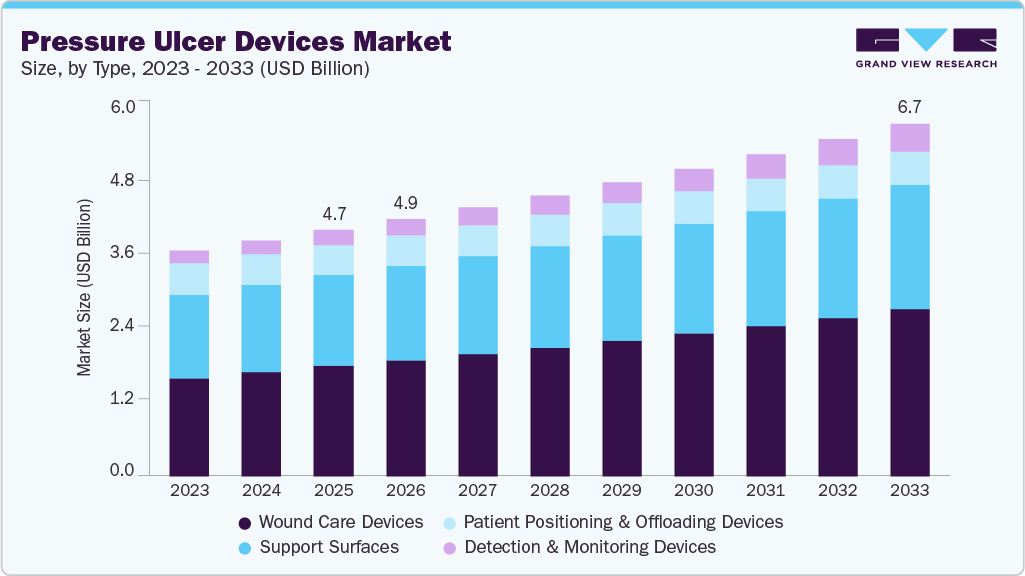 To learn more about this report, Download Free Sample Report
Pressure Ulcer Burden and Economic Impact in the UK
Parameter
Value
Total people affected
Over 700,000
Newly diagnosed cases (annual)
180,000
Average treatment cost per ulcer
USD 1,368,618.75
Daily cost burden
USD 26.19 million per day
Source: Spinal Injuries Association
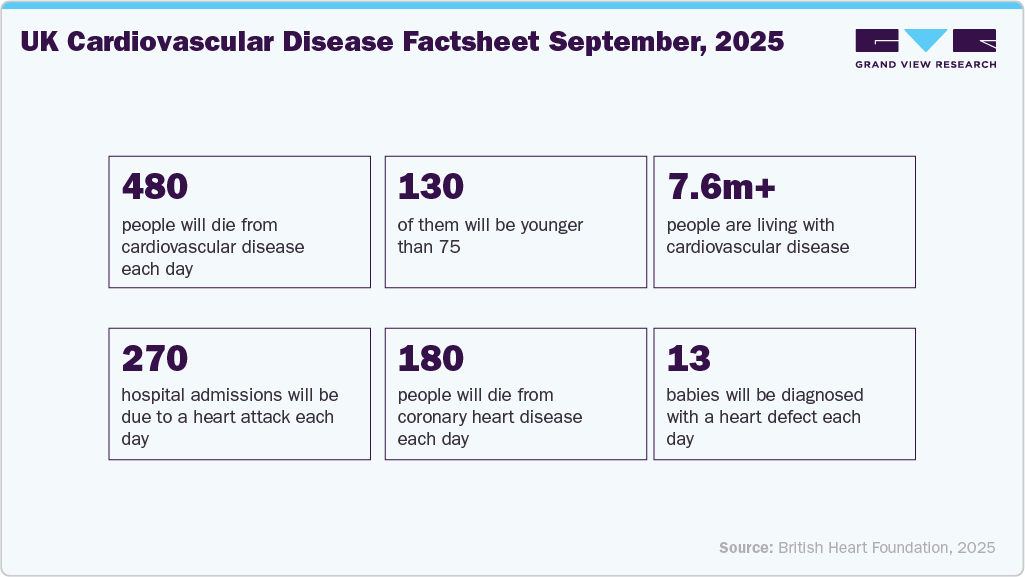
The rising prevalence of chronic diseases such as diabetes mellitus, cardiovascular conditions, and neurological disorders is leading to longer hospitalizations and reduced patient mobility, significantly increasing the risk of pressure injuries. These patients often require intensive care, continuous monitoring, and extended bed rest, which heightens the need for preventive support surfaces and repositioning devices. As a result, healthcare facilities are investing in advanced pressure ulcer prevention and treatment solutions. This growing clinical burden is directly driving demand for pressure ulcer devices.
 To learn more about this report, Download Free Sample Report
 To learn more about this report, Download Free Sample Report
Technological advancements in support surfaces, smart mattresses, and pressure monitoring systems are significantly driving the market by enabling early risk detection and effective pressure redistribution. These innovations improve patient outcomes by enabling real-time monitoring and automated adjustments, thereby reducing the incidence of pressure injuries. As healthcare facilities adopt more advanced and efficient solutions, demand for next-generation pressure ulcer devices continues to grow.
For instance, in March 2025, researchers at Mid Sweden University tested an advanced smart mattress equipped with approximately 1,000 pressure sensors to continuously monitor pressure distribution and detect early signs of pressure ulcers. The system integrates a mobile application that provides real-time data and alerts caregivers when prolonged pressure is detected, enabling timely intervention and prevention. This innovation highlights how IoT-enabled support surfaces and intelligent monitoring systems are transforming pressure ulcer prevention and driving growth in the pressure ulcer devices industry.
The clinical classification of pressure ulcers from Stage I to Stage IV plays a critical role in guiding treatment decisions and device selection, directly influencing market demand. Early-stage ulcers (Stage I and II) emphasize prevention and timely intervention, driving the use of pressure redistribution surfaces, cushions, and monitoring systems to avoid progression. This focus on early detection is increasing the adoption of smart mattresses and sensor-based technologies in healthcare settings.
As ulcers progress to advanced stages (Stages III and IV), the need for more intensive and specialized care increases significantly. These severe cases require advanced support surfaces, wound care products, and long-term management solutions, thereby boosting demand for high-value devices. The clear staging framework also supports standardized care protocols, encouraging healthcare providers to invest in a wide range of pressure ulcer devices across different levels of care.
Classification of Pressure Ulcer Stages
Stage
Description
Key Characteristics
Stage I
Intact skin with non-blanchable redness
Localized redness over bony prominence; skin intact; discoloration may vary in darker skin tones
Stage II
Partial thickness skin loss
Shallow open ulcer with red-pink wound bed; may appear as blister (intact or ruptured)
Stage III
Full thickness tissue loss (no bone exposure)
Subcutaneous fat visible; slough may be present; may include undermining and tunneling
Stage IV
Full thickness tissue loss with exposed structures
Bone, tendon, or muscle exposed; slough or eschar may be present; often includes undermining and tunneling
Source: Convatec
Market Characteristics & Concentration
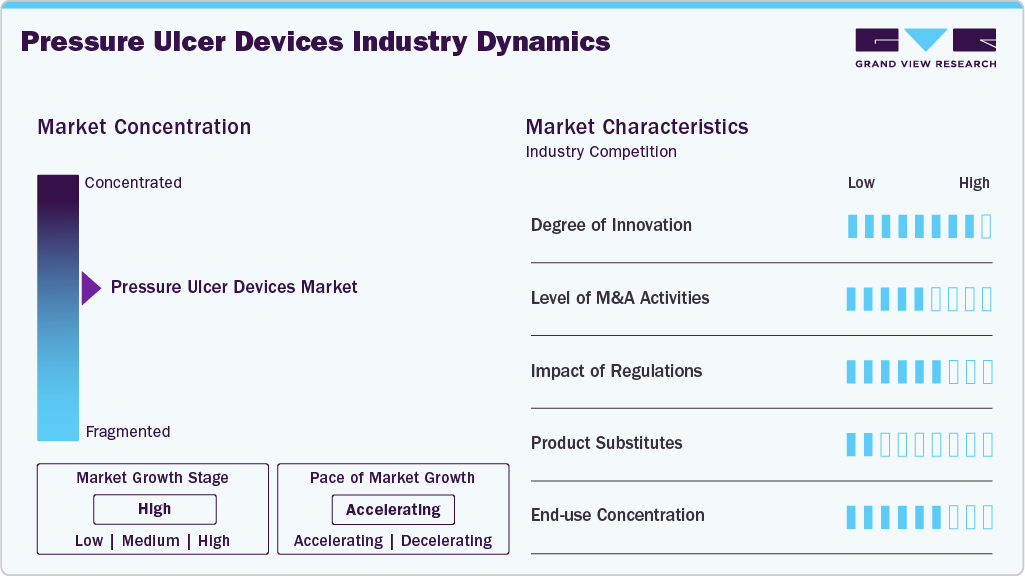
The pressure ulcer devices industry demonstrates a high level of innovation, driven by the integration of digital health technologies, including sensor-based monitoring, smart support surfaces, and AI-enabled pressure redistribution systems. Continuous advancements in materials, ergonomics, and real-time data analytics are improving prevention, early detection, and patient outcomes. These innovations are shifting the market from reactive treatment to proactive, personalized care solutions. For instance, in May 2025, students at the University of North Dakota developed an innovative smart mattress pad embedded with multi-parameter sensors to monitor pressure, temperature, and humidity in real time for early detection of pressure ulcer risk. The system wirelessly transmits data and alerts caregivers, combining pressure redistribution with continuous monitoring to improve prevention outcomes. This advancement reflects strong innovation in the market, driven by integrated sensing technologies and scalable, cost-effective solutions.
“There are about 2.5 million people suffering from pressure ulcers in the U.S. alone,” said team member Samuel Temgoua. “That number will continue to grow as more people get older.”
“I’ve been working as a CNA for the past 3 years - I’ve seen how much pressure injuries can be an issue for the older population,” he said. “So, I figured I would help by being part of the team that is trying to develop a solution for this growing issue.”
The pressure ulcer devices industry exhibits moderate to high levels of merger and acquisitions activity, as companies seek to strengthen product portfolios and expand their geographic reach. Strategic acquisitions such as Remtec’s 2025 acquisition of Pressure Care Management and Direct Healthcare Group’s acquisition of Sumed highlight ongoing consolidation and expansion of capabilities in prevention technologies.
 To learn more about this report, Download Free Sample Report
Regulations play a crucial role in shaping the pressure ulcer devices industry by enforcing strict safety, performance, and quality requirements before products can be commercialized. While compliance with frameworks such as those from the U.S. Food and Drug Administration and the European Commission can increase development timelines and costs, they also ensure reliability and clinical effectiveness. This regulatory pressure encourages manufacturers to innovate and maintain high standards, ultimately supporting long-term market growth and adoption.
The pressure ulcer devices industry exhibits a high end use concentration in hospitals and acute care settings, where the risk of pressure injuries is greatest due to immobility and intensive care needs. These facilities drive the majority of demand for advanced support surfaces and monitoring systems. However, usage is gradually expanding into long-term care and home healthcare as prevention-focused care models gain importance.
Product Insights
Wound care devices led the market in 2025 due to their essential role in both treatment and recovery management. Technologies such as negative-pressure systems and advanced dressings are widely used to promote faster healing and reduce complications, such as infections. The growing number of chronic wound cases, particularly among elderly and immobile patients, has further strengthened demand for these devices. Their effectiveness, ease of use in clinical settings, and continuous innovation have helped this segment maintain a dominant market share.
The detection & monitoring devices segment is expected to be the fastest-growing segment during the forecast period, driven by increased emphasis on early detection and prevention. These devices enable real-time monitoring of pressure points and patient movement, helping clinicians intervene before ulcers develop. Growing adoption of sensor-based technologies, smart wearables, and pressure mapping systems is accelerating demand. In addition, the shift toward data-driven, preventive healthcare is further driving rapid growth in this segment.
Clinical Application Insights
Stage III & IV dominated the market in 2025 and is also expected to grow fastest in the forecast period, driven by the increasing incidence of severe and complex pressure injuries. These advanced stages require intensive treatment, including specialized support surfaces, advanced wound care, and continuous monitoring, leading to higher device utilization. Growing hospitalization rates, aging populations, and chronic disease burden are contributing to more severe cases. As a result, demand for high-value, technologically advanced treatment solutions is accelerating in this segment.
Deep tissue injury (DTI) is emerging as a significant segment due to its severity and rapid progression if left untreated. These injuries often develop beneath intact skin, making early detection challenging and increasing the need for advanced diagnostic and therapeutic devices. The rising prevalence among immobile and critically ill patients has driven demand for specialized support surfaces and monitoring technologies. As awareness and clinical focus on early-stage pressure damage improve, DTI-related device adoption is expected to expand significantly.
End Use Insights
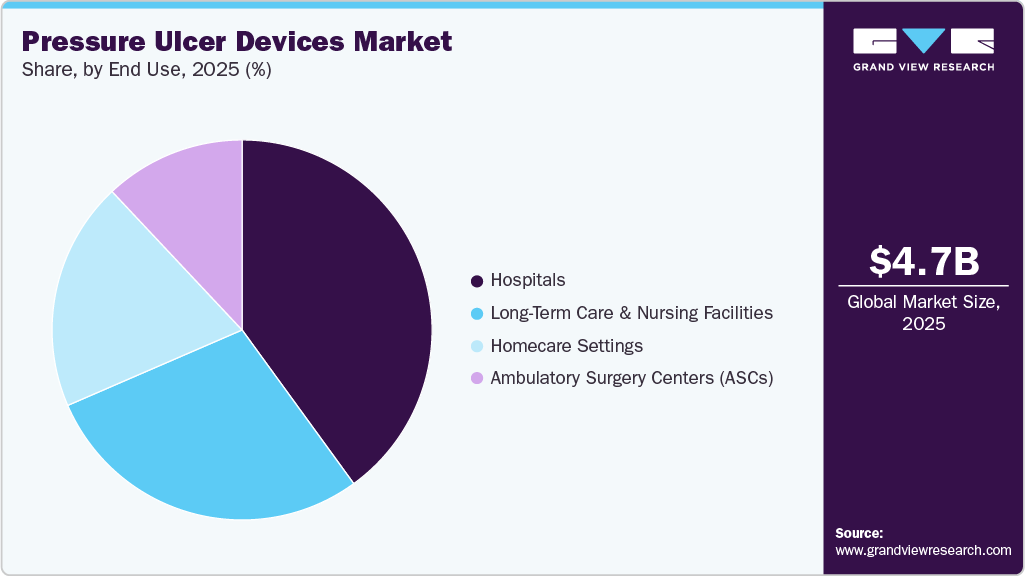
Hospitals dominated the arket in 2025 due to the high volume of patients at risk, particularly in intensive care units and post-surgical settings. The need for continuous monitoring, strict patient safety protocols, and prevention of hospital-acquired pressure injuries drives extensive use of support surfaces and monitoring devices. Hospitals also have greater access to advanced technologies and skilled professionals, which supports higher adoption rates. In addition, longer patient stays and complex care requirements further support their leading market share.
 To learn more about this report, Download Free Sample Report
Homecare settings are expected to be the fastest-growing segment during the forecast period, driven by the shift toward decentralized, patient-centric care. The growing preference for home-based treatment among elderly and chronically ill patients is boosting demand for portable, easy-to-use devices. Advancements in user-friendly support surfaces and remote monitoring technologies are further supporting adoption. In addition, efforts to reduce hospital stays and healthcare costs are accelerating the expansion of pressure ulcer care in home settings.
Regional Insights
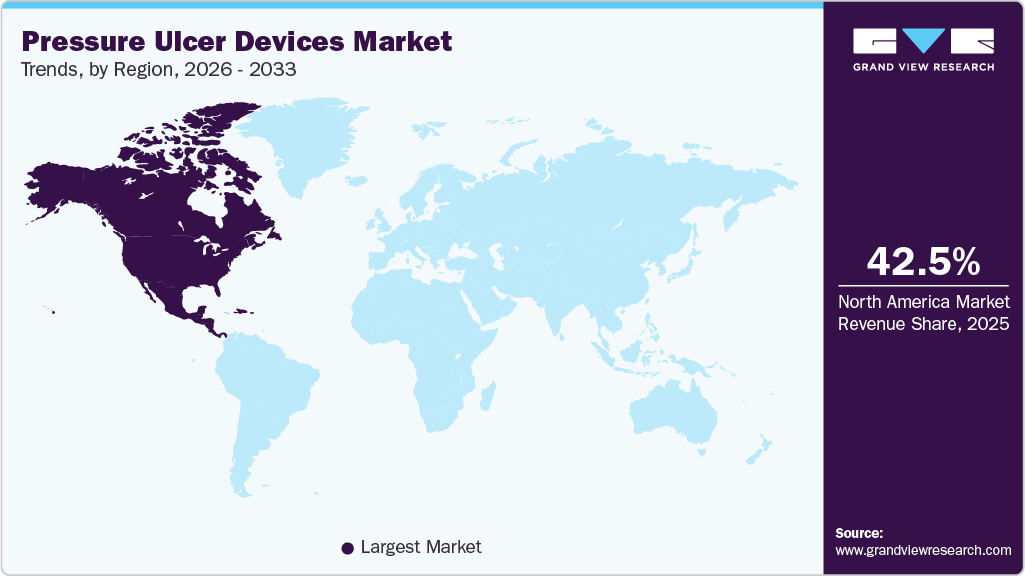
The pressure ulcer devices industry in North America held the largest share and accounted for 42.50% of global revenue in 2025. Driven by strong adoption of advanced prevention technologies, including smart support surfaces and pressure monitoring systems, supported by a well-established healthcare infrastructure. Increasing focus on reducing hospital-acquired pressure injuries and improving patient outcomes is encouraging healthcare providers to invest in early prevention solutions. In addition, the growing burden of chronic diseases and an aging population is further shaping demand across hospitals and long-term care settings.
 To learn more about this report, Download Free Sample Report
U.S. Pressure Ulcer Devices Market Trends
The U.S. pressure ulcer devices industry is witnessing strong adoption of advanced prevention technologies, including smart mattresses, pressure redistribution systems, and real-time monitoring solutions, driven by a focus on reducing hospital-acquired pressure injuries. Regulatory oversight by the U.S. Food and Drug Administration and value-based care models are encouraging early intervention and improved patient outcomes. In addition, the rising prevalence of chronic conditions and an aging population continue to support significant demand across hospitals and long-term care settings.
Europe Pressure Ulcer Devices Market Trends
The Europe pressure ulcer devices industry is experiencing significant growth, driven by increasing emphasis on prevention and early-stage management of pressure injuries across healthcare systems. Adoption of advanced support surfaces and monitoring technologies is increasing, driven by aging populations and rising long-term care needs. In addition, strict quality standards and patient safety initiatives are driving the adoption of more effective, technologically advanced devices across the region.
The UK pressure ulcer devices industry is shaped by a strong emphasis on prevention and cost reduction, as pressure ulcers place a significant financial burden on the National Health Service, costing billions annually and millions per day. The increasing adoption of advanced support surfaces and early detection technologies is driven by the need to reduce hospital stays and improve patient outcomes. In addition, rising awareness that a large proportion of pressure ulcers are preventable is accelerating demand for proactive, technology-driven prevention solutions across healthcare settings.
The France pressure ulcer devices industry is witnessing significant growth, driven by increasing focus on prevention and early intervention in healthcare settings. The adoption of advanced support surfaces, pressure redistribution systems, and monitoring technologies is increasing across hospitals and long-term care facilities. In addition, an aging population and emphasis on improving patient outcomes are supporting continuous demand for innovative pressure ulcer management solutions.
Asia Pacific Pressure Ulcer Devices Market Trends
The Asia Pacific pressure ulcer devices industry is experiencing strong growth driven by improving healthcare infrastructure and increasing awareness of pressure injury prevention in emerging economies. The rising aging population and the higher incidence of chronic conditions are driving demand for advanced support surfaces and monitoring devices. In addition, growing investment in healthcare and expansion of hospital and home care services are supporting wider adoption of these devices across the region.
The China pressure ulcer devices industry is witnessing significant growth, driven by an aging population and the increasing burden of pressure injuries, with studies indicating a growing number of new cases annually and a significant share linked to aging. In addition, increasing hospitalization rates and expansion of long-term care facilities are boosting demand for advanced support surfaces and prevention devices. The market is further supported by improving healthcare infrastructure and a greater focus on early detection and pressure injury management across clinical settings.
Latin America Pressure Ulcer Devices Market Trends
The Latin America pressure ulcer devices industry is growing significantly, driven by increasing awareness of pressure injury prevention and a gradual shift toward improved patient care standards. Expanding hospital infrastructure and rising cases of chronic diseases are supporting demand for pressure redistribution and wound care devices. In addition, the need for cost-effective, preventive solutions is driving wider adoption across healthcare facilities in the region.
MEA Pressure Ulcer Devices Market Trends
The Middle East & Africa pressure ulcer devices industry is experiencing significant growth, supported by increasing healthcare investments and gradual improvements in hospital infrastructure. Rising awareness of pressure injury prevention and a growing burden of chronic and immobility-related conditions are driving demand for support surfaces and wound care devices. In addition, the expansion of private healthcare facilities and focus on better patient outcomes are encouraging wider adoption across the region.
Key Pressure Ulcer Devices Company Insights
The pressure ulcer devices industry is moderately consolidated, with key players focusing on innovation, product differentiation, and strategic partnerships to strengthen their competitive position. Market share is largely held by established companies with broad product portfolios, while emerging players are gaining traction with cost-effective, technologically advanced solutions.
Key Pressure Ulcer Devices Companies:
The following key companies have been profiled for this study on the pressure ulcer devices market.
- SYST'AM
- Ulcer Solutions, LLC
- Stryker
- Baxter (Hillrom)
- Arjo
- LINET
- Invacare Corporation
- Joerns Healthcare
- Savaria
- Smith+Nephew
- Mölnlycke AB
- 3M
Recent Developments
-
In November 2024, Stryker reported clinical findings showing its powered gel-support surface system significantly reduced hospital-acquired pressure injuries (HAPUs/HAPIs) in acute care settings. The study demonstrated that the majority of patients did not develop new pressure ulcers, highlighting strong prevention outcomes. High clinician satisfaction further supported the system’s effectiveness and usability within care bundles.
-
In September 2024, Stryker highlighted clinical evidence demonstrating that advanced ICU bed systems integrated with powered support surfaces significantly reduce hospital-acquired pressure injuries (HAPIs). A hospital study showed a 91.7% reduction in HAPI incidence following implementation of Stryker’s ProCuity beds with pressure redistribution technology, emphasizing the growing role of smart support surfaces in prevention strategies.
-
In June 2023, Baxter International Inc. announced the U.S. launch of its Hillrom Progressa+ ICU bed, designed to enhance patient care and reduce nursing workload in critical care settings. The system incorporates advanced positioning and pressure redistribution features, helping minimize the risk of pressure injuries while improving patient recovery and clinical efficiency.
Pressure Ulcer Devices Market Report Scope
Report Attribute
Details
Market size in 2025
USD 4.7 billion
Estimated market size in 2026
USD 4.9 billion
Projected market size by 2033
USD 6.7 billion
Growth rate
CAGR of 4.6% from 2026 to 2033
Base year for estimation
2025
Historical data
2021 - 2024
Forecast period
2026 - 2033
Quantitative units
Revenue in USD million and CAGR from 2026 to 2033
Report coverage
Revenue forecast, company ranking, competitive landscape, growth factors, and trends
Segments covered
Product, clinical application, end use, region
Regional scope
North America; Europe; Asia Pacific; Latin America; MEA
Country scope
U.S.; Canada; Mexico; Germany; UK; France; Norway; Denmark; Sweden; Spain; China; Japan; India; South Korea; Australia; Brazil; KSA; UAE; South Africa
Key companies profiled
SYST'AM; Ulcer Solutions, LLC; Stryker; Baxter (Hillrom); Arjo; LINET; Invacare Corporation; Joerns Healthcare; Savaria; Smith+Nephew; Mölnlycke AB; 3M
Customization scope
Free report customization (equivalent up to 8 analysts working days) with purchase. Addition or alteration to country, regional & segment scope.
Pricing and purchase options
Avail customized purchase options to meet your exact research needs. Explore purchase options
Global Pressure Ulcer Devices Market Report Segmentation
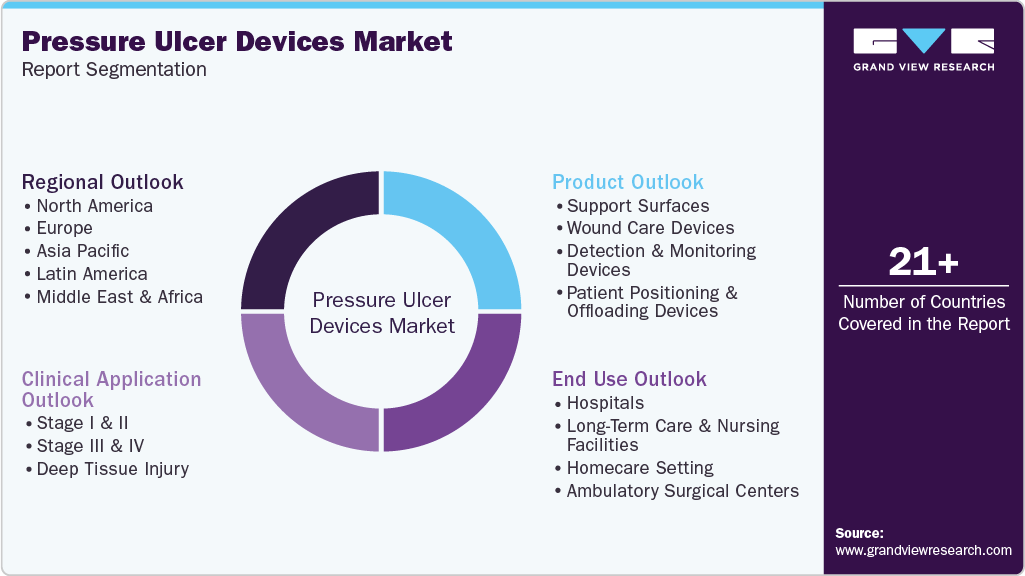
This report forecasts revenue growth at global, regional, and country levels and provides an analysis on the latest industry trends in each of the sub-segments from 2021 to 2033. For this study, Grand View Research has segmented the global pressure ulcer devices market report based on product, clinical application, end use, and region:
 To learn more about this report, Download Free Sample Report
-
Product Outlook (Revenue, USD Million, 2021 - 2033)
-
Support Surfaces
-
Dynamic Support Surfaces
-
Static Support Surfaces
-
-
Wound Care Devices
-
Negative Pressure Wound Therapy (NPWT) Systems
-
Electrical Stimulation Devices
-
Ultrasound Therapy Devices
-
Hyperbaric Oxygen Therapy (HBOT) Systems
-
-
Detection & Monitoring Devices
-
Sub-epidermal moisture (SEM) scanners
-
Pressure mapping systems
-
-
Patient Positioning & Offloading Devices
-
-
Clinical Application Outlook (Revenue, USD Million, 2021 - 2033)
-
Stage I & II
-
Stage III & IV
-
Deep Tissue Injury
-
-
End Use Outlook (Revenue, USD Million, 2021 - 2033)
-
Hospitals
-
Long-Term Care & Nursing Facilities
-
Homecare Setting
-
Ambulatory Surgical Centers
-
-
Regional Outlook (Revenue, USD Million, 2021 - 2033)
-
North America
-
U.S.
-
Canada
-
Mexico
-
-
Europe
-
Germany
-
UK
-
France
-
Italy
-
Spain
-
Sweden
-
Denmark
-
Norway
-
-
Asia Pacific
-
Japan
-
China
-
India
-
Australia
-
South Korea
-
Thailand
-
-
Latin America
-
Brazil
-
Argentina
-
-
Middle East & Africa
-
South Africa
-
Saudi Arabia
-
UAE
-
Kuwait
-
-
Frequently Asked Questions About This Report
Wound care devices segment held the largest revenue share in 2025, while detection & monitoring devices is the fastest-growing product.
The stage III & IV segment held the largest revenue share in 2025, and is the fastest-growing clinical application.
Hospitals segment held the largest revenue share in 2025, while homecare settings is the fastest-growing segment.
The global pressure ulcer devices market size was valued at USD 4.7 billion in 2025 and is estimated at USD 4.9 billion for 2026.
North America dominated the pressure ulcer devices market with a share of 42.5% in 2025. This is attributable to strong adoption of advanced prevention technologies, including smart support surfaces and pressure monitoring systems, supported by a well-established healthcare infrastructure.
Key players include SYST'AM; Ulcer Solutions, LLC; Stryker; Baxter (Hillrom); Arjo; LINET; Invacare Corporation; Joerns Healthcare; Savaria; Smith+Nephew; Mölnlycke AB; 3M.
Key factors that are driving the market growth include the rising prevalence of chronic conditions such as diabetes and limited mobility among the aging population, which increases the risk of pressure injuries. In addition, growing awareness of patient safety, along with hospital protocols aimed at reducing healthcare-associated complications, is boosting the adoption of advanced pressure-relief and wound-care devices.
The global pressure ulcer devices market is expected to grow at a CAGR of 4.6% from 2026 to 2033, reaching USD 6.7 billion by 2033.
About the Author(s)
Medical Devices Research Team
Healthcare · Medical DevicesThis report was authored by the medical devices research team at Grand View Research - comprising two research analysts, one senior research analyst, and one industry expert - with specialized expertise in the medical devices segment of the healthcare industry. All findings are based on proprietary healthcare databases, executive interviews, and regulatory analysis, subject to internal peer review prior to publication.
Last Updated:
Speak to Analyst

Customize this report to your needs - add regions, segments, or data points, with 20% free customization.
Or view our licence options:


ISO 9001:2015 & 27001:2022 Certified
We are GDPR and CCPA compliant! Your transaction & personal information is safe and secure. For more details, please read our privacy policy.


