
- Home
- »
- Paints, Coatings & Printing Inks
- »
-
Printing Inks Market Size, Share & Growth Report, 2021-2028GVR Report cover

Printing Inks Market (2021 - 2028) Size, Share & Trends Analysis Report By Product (Gravure, Flexographic, Lithographic & Digital) By Resin Type (Modified rosin, Modified cellulose, Acrylic & Polyurethane), By Application, And Segment Forecasts
Market Size, 2020
$19.2BMarket Estimate, 2026
$19.6BMarket Forecast, 2028
$23.8BCAGR, 2021–2028
2.8%Printing Inks Market Summary
The global printing inks market size was estimated at USD 19.2 billion in 2020 and is projected to reach USD 23.8 billion by 2028, growing at a CAGR of 2.8% from 2021 to 2028. The market is expected to witness moderate growth over the forecast period.
Key Market Trends & Insights
- Asia Pacific dominated the printing inks market and accounted for the highest revenue share of 35.60% in 2021.
- By product, lithographic segment accounted for a prominent share of the overall market in terms of value in 2020.
- By resin, polyurethane is the fastest-growing resin segment and is expected to account for over 16% of the resin revenue in 2028.
Market Size & Forecast
- 2020 Market Size: USD 19.2 Billion
- 2028 Projected Market Size: USD 23.8 Billion
- CAGR (2021-2028): 2.8%
- Asia Pacific: Largest market in 2020
Three ways to get this report
Buy it, customize it, or ask a question.Ask an Analyst
Analyst response in 1 business day
- AccessReport author, directly
- Reply timeWithin 1 working day
- No sales callDirect answer only
- FormatEmail reply
- CostFree, no cost
Get the Full Report
What the study covers
- FormatsPDF · Excel · Dashboard
- Timeline2021–2028 annual, 2020 base
- Coverage20+ countries, 5 regions
- Companies10+ key players profiled
Customize the Report
20% free customization
- IncludeCountries, segments, points
- TailorTo your product definition
- ExtendDeeper competitor detail
- OrA fully bespoke study
- Turnaround5–10 working days
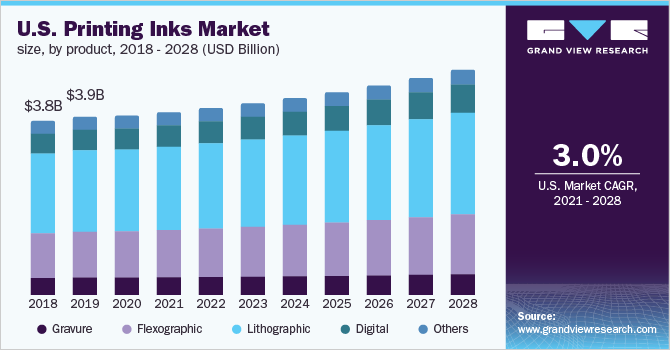
Factors such as the growing end-use industry, including flexible packaging, commercial printing & publishing, packaging labels, have majorly driven this market. The superior properties of the constituents such as pigments, binders, solubilizers, and additives to produce text, design, or images along with rising demand from the packaging sector, commercial printing, and changing consumer preference, these solutions are expected to have unceasing demand in the future.
 Source: Grand View Research, IR Documents, Primary Interviews, Paid DatabasesTo learn more about this report,
 Download Free Sample Report
 The global printing inks market is heading toward major consolidations to increase efficiency, support growth, and achieve more leverage with suppliers and customers. Market consolidation has become a long-term trend, particularly in the western market, with limited organic growth.
However, downward pricing pressure is expected to limit the revenue growth in the printing inks market owing to the slow growth in product pricing caused by high competition within the industry. Moreover, stringent regulatory frameworks such as Federal Food, Drug, and Cosmetic Act and the U.S. Food and Drug Administration are limiting the usage, manufacturing, and distribution of various inorganic solvents and toxic metals. This, in turn, is expected to hamper the market growth over the forecast period.
Apart from crude oil derivative and inorganic pigments, which are major raw materials, the development of economical and non-toxic raw materials such as graphene, carbon, and modified celluloid is the research initiative at the forefront. This market is strongly affected and driven by advancements in technology and processes such as ink-jet products and digital printing.
Market Dynamics
Packaging and labels are among the major application segments of the printing inks market. This growth is attributed to the growing demand for gravure inks, flexographic inks, UV blocking packaging inks, and nano graphic printing inks in flexible packaging and paper packaging printing applications.
Initially, printing inks were mainly used in printing publications for newspapers, magazines, and journals, among others. However, due to rapid urbanization and growing digitalized needs of consumers, the application scope of printing inks has shifted from commercial printing & publication to the packaging industry. In the packaging industry, printing inks are used to print on packaging materials to make the packaging attractive to customers, as it is one of the most powerful ways to promote and market products.
Flexible packaging offers greater options for customized packaging. The demand for flexible packaging is majorly driven by the food & beverage industry, supported by the strong growth in the snacks & confectionery category. Moreover, growing demand for food, on account of the increasing global population, is one of the key trends augmenting the growth of the flexible packaging industry. The booming flexible packaging industry is anticipated to offer huge growth opportunities for the printing inks market.
Volatile organic compounds (VOCs) are required to comply with various statutory regulations and legislations. These organic compounds, which are widely utilized in printing inks for technical applications, are subject to several governmental and federal regulations for controlling VOC emissions and limiting human exposure to toxic substances.
National and international regulatory bodies ensure the legal conformity of VOCs in new application areas, the environmental relevance of VOCs, and raw material safety evaluations based on ecotoxicological and toxicological data. Chemical industry associations, such as the European Chemical Industry Council (CEFIC) and the German Chemical Industry Association, along with other scientific groups, are constantly working on evaluating and developing printing inks with low VOC content for their application in various industrial sectors.
Formaldehyde, d-limonene, toluene, acetone, ethanol, 2-propanol, and hexanal are some of the volatile organic compounds. VOC emissions contribute to both indoor and outdoor air pollution. Since 1998, the Environment Protection Agency (EPA) has been monitoring the use of VOCs in various products, such as printing inks for various industries, such as consumer products and containers.
Printing Inks Market Trends
Initially, printing inks were majorly used in printing publications for newspapers, magazines, and journals. However, due to rapid urbanization and the growing digitalized needs of consumers, the application scope of printing inks has shifted from commercial printing & publication to the packaging industry. In the packaging industry, printing inks are used to print on packaging materials to make the packaging attractive to customers, as it is one of the powerful ways to promote and market products.
Flexible packaging offers better options for customized packaging. The demand for flexible packaging is driven by the food & beverage industry, supported by the strong growth in the snacks & confectionery category. Moreover, the growing demand for food, on account of the increasing global population, is one of the key trends augmenting the growth of the flexible packaging industry. The booming flexible packaging industry is anticipated to offer substantial growth opportunities for the printing inks market.
Furthermore, developments in production technologies, improved packaging practices, and case-ready packaging are anticipated to influence the printing inks market positively. In addition, advancements in processing technologies in the food sector in the U.S. and the European countries are expected to augment the growth of packaged foods industry. This, in turn, is anticipated to fuel the demand for flexible packaging.
The thriving demand for energy-curing inks in printing & packaging applications is another major factor driving the printing inks market growth. The energy-curing inks include UV-cured inks, latex (resin) inks, solvent-UV hybrid inks, and solid inks. These inks are trending globally owing to their superior properties, zero/low volatile organic content (VOC), and growing application scope.
The superior characteristics of energy-curing inks include better bonding qualities and reduced drying time. Furthermore, increased productivity, high performance, environmental benefits, and lower energy costs are the significant factors for the increased usage of ultraviolet and electron beam-curing inks. However, the initial setup costs associated with these inks are higher. Therefore, companies are adopting new technologies to eliminate the high costs. For instance, Flint Group has developed new UV inks such as the Ultraking XCURA label to attain minor levels of energy consumption during the curing process.
UV LED, another type of energy-curing ink, is the latest trend, with many ink manufacturers tackling the challenge of producing technologically advanced inks. UV LED inks require different formulations from those of traditional UV-curing inks. Lower energy costs, heat reduction, environmental friendliness, and versatility are the major factors boosting the demand for UV LED inks in various applications such as membrane switch, graphics, container & ad specialty, textures, and specialty clears.
Product Insights
Lithographic segment accounted for a prominent share of the overall market in terms of value in 2020. The segment is expected to witness substantial growth over the forecast period owing to a combination of high-quality prints and efficiency in large-scale projects. This lithographic process is also suitable for flat media such as cloth, foil, paper, plastic, and flat cardboard.
Gravure printing inks are primarily used for printing photographs; they can be utilized on films, thin papers, metal foils, and paper cups. This process utilizes “liquid inks”. The flexibility of this ink technology allows these print processes to cover various applications in food packaging, tobacco products, and cosmetics on a variety of substrates such as cardboards, papers, plastics, foils, and labels.
Flexographic inks can be utilized on various substrates such as paper, laminates, films, foils, and corrugated boards. These inks are expected to witness prominent growth over the forecast period, supported by their eco-friendly nature and low costs. Also, growing demand for flexible packaging and cardboard printing demand in line with the logistics volume assist the need for flexographic ink in U.S. and European Countries.
Resin insights
Polyurethane is the fastest-growing resin segment and is expected to account for over 16% of the resin revenue in 2028. The composition of the resins is a significant factor for the type of ink produced. Hydrocarbons & modified rosins are used for producing lithographic solvents, polyamides & polyurethanes are used for manufacturing gravure and solvent-based-flexographic products. By resin type, acrylic is the predominantly used raw material for manufacturing solutions owing to its faster drying properties, availability, and cost-effective nature.
The other factors contributing to polyurethane’s faster growth for manufacturing printing solvents include its high tensile and tear strength, bonding potential with types of substrates, corrosion resistance, and hardness flexibility. Its increased usage in the flexible packaging segment and energy curing solution is another factor for its faster growth rate.
Application Insights
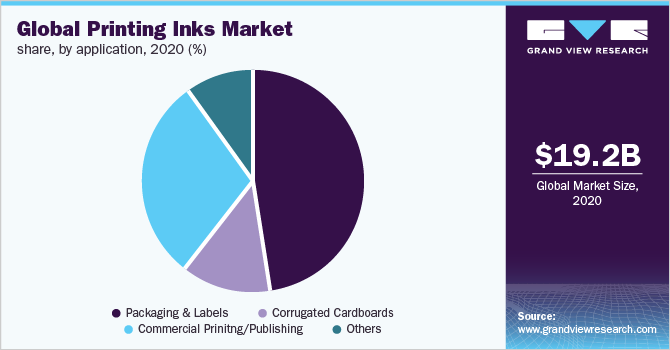
Packaging & labels segment is the largest and fastest ink application segment, which accounts for over 45% of the total segment revenue. The growth of this application has witnessed a flourishing trend in the last five years owing to the growing middle-class population in emerging nations such as India and Thailand, change in consumer preference for the convenience of food packaging & online retailing with extensive internet penetration, and requirement of bio-degradable products.
 To learn more about this report, Download Free Sample Report
 The other applications of inks include commercial printing & publishing which has witnessed a declining trend in many regions due to growing digitalization and the Internet of Things (IoT). The other significant reason for the decline could be the growth in demand for textile prints, ceramic printing, printed electronics and folding cartons, corrugated cardboard in the packaging segment. The trends for these applications vary with region, for instance, ceramic printing is a growing market in China owing to its increased production of ceramic tiles. Moreover, printed electronics has substantial growth opportunities in Thailand due to its growing electronics industry.
Regional Insights
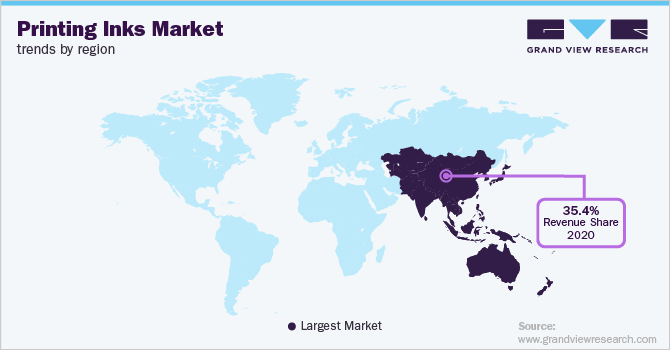
Asia Pacific dominated the printing inks market and accounted for the highest revenue share of 35.60% in 2021. Asia Pacific dominated the global printing inks market in 2021 and is expected to continue its dominance over the forecast period. Rising consumption of packaged food items, coupled with robust growth in the packaging and labeling industry owing to the emergence of various businesses, including the food & beverage industry, consumer goods, health care sector, and e-commerce, has positively impacted market growth in the region.
 To learn more about this report, Download Free Sample Report
 Moreover, a rising preference for flexography inks in flexible packaging applications owing to their ability to be printed on non-absorbent material, faster printing process, and enhanced printing options through a range of colors in various substrates is expected to provide huge growth opportunity for the printing inks market over the forecast period.
The Japanese printing ink market is witnessing gradual shrinkage and a waning customer base due to the increasing digitalization of information. The demand for commercial printing and publishing, particularly in the newspapers and magazines segment, is diminishing, which has negatively impacted the demand for printing inks in the country. However, the market for printing inks in food packaging, corrugated cardboards, and printing on containers is growing significantly, which is expected to drive the demand over the forecast period.
China dominated the Asia Pacific printing inks market in 2021 and is expected to continue its dominance over the forecast period. The rising demand from the packaging industry is expected to be the major factor driving the market demand in the country. In recent years, the packaging industry has witnessed significant growth owing to the rapid growth of e-commerce and the growing demand for international shipping of non-consumer goods in the country.
Printing Inks Market Share Insight
The global ink industry is extremely competitive owing to the presence of vertically integrated key players with technologically advanced solutions & equipment and procurement & distribution channels. The industry has witnessed a strong consolidation period in different regions which include, expansions, mergers, and acquisitions, making the industry highly competitive. Some expansion strategies include Epple Druckfarben Italia S.r.I in Milan, Italy, subsidiary of Epple Druckfarben for superior quality German offset printing inks in Italy and Kansas, U.S. plant which was an expansion strategy of Sakata Inx Corporation. Major market players include
-
Flint Group
-
DIC Corporation
-
Siegwerk Druckfarben AG & Co. KGaA
-
Sakata Inx Corporation
-
T&K TOKA Corporation
-
Dainichiseika Color & Chemicals Mfg. Co., Ltd.
-
DEERS I CO., Ltd.
-
Epple Druckfarben AG
-
TOYO INK SC HOLDINGS CO., LTD.
-
Hubergroup
-
TOKYO PRINTING INK MFG CO., LTD.
Competitive Benchmarking
Operating Strategies
Competitive Edge
Weakness
Mature Players: DIC Corporation, Flint Group, Sakata INX Corporation, Siegwerk Druckfarben AG & Co. KGaA, hubergroup, Toyo Ink SC Holdings Co., Ltd.
Strong focus on sustainable and high-performance printing ink technologies; extensive R&D initiatives for low-VOC, UV-curable, water-based, and packaging inks; strategic acquisitions and partnerships to strengthen regional presence and product portfolio; expansion across flexible packaging, digital printing, and food-safe ink applications; emphasis on innovation, regulatory compliance, and global distribution expansion
Strong global distribution network and manufacturing footprint; diversified product portfolio across packaging, publication, and specialty printing applications; strong technical expertise and innovation capabilities; robust financial strength supporting product development and acquisitions; established relationships with global packaging converters and printing companies
Higher operational and regulatory compliance costs; premium pricing compared to regional manufacturers; slower penetration into localized and low-cost printing markets; dependence on mature packaging and publication printing markets in developed economies
Emerging Players: T&K TOKA Corporation, Dainichiseika Color & Chemicals Mfg. Co., Ltd., DEERSI Co., Ltd., Epple Druckfarben AG, Tokyo Printing Ink MFG Co., Ltd
Strong focus on regional printing and packaging markets; emphasis on customized formulations and specialty inks; aggressive expansion in flexible packaging, label printing, and industrial printing segments; focus on distributor partnerships and cost-competitive product offerings; increasing investments in eco-friendly and application-specific inks
Strong foothold in regional and niche printing markets; flexibility in catering to customized customer requirements; competitive pricing strategies enabling penetration into untapped markets; faster response to regional packaging and printing demand trends; strong small and medium customer base
Limited geographical reach compared to multinational players; lower financial capability for large-scale global expansion; limited investment capacity for advanced digital printing and sustainable ink technologies; dependence on regional demand cycles and distributor networks
Printing Inks Market Report Scope
Report Attribute
Details
Market size value in 2021
USD 19.6 billion
Revenue forecast in 2028
USD 23.8 billion
Growth rate
CAGR of 2.8% from 2021 to 2028
Base year for estimation
2020
Historical data
2016 - 2019
Forecast period
2021 - 2028
Quantitative units
Revenue in USD thousand, volume in thousand liters, and CAGR from 2020 to 2028
Report coverage
Revenue forecast, volume forecast, company ranking, competitive landscape, growth factors, and trends
Segments covered
Product, resin, application, region
Regional scope
North America; Europe; Asia Pacific; Central & South America; Middle East & Africa
Country scope
U.S.; Canada; Mexico; Germany; U.K.; Italy; China; India; Japan; Brazil
Key companies profiled
Flint Group; DIC Corporation; Siegwerk Druckfarben AG & Co. KGaA; Sakata Inx Corporation; T&K TOKA Corporation; Dainichiseika Color & Chemicals Mfg. Co., Ltd.; DEERS I CO., Ltd.; Epple Druckfarben AG; TOYO INK SC HOLDINGS CO., LTD.; Hubergroup; TOKYO PRINTING INK MFG CO., LTD.
Customization scope
Free report customization (equivalent up to 8 analysts working days) with purchase. Addition or alteration to country, regional & segment scope.
Pricing and purchase options
Avail customized purchase options to meet your exact research needs. Explore purchase options
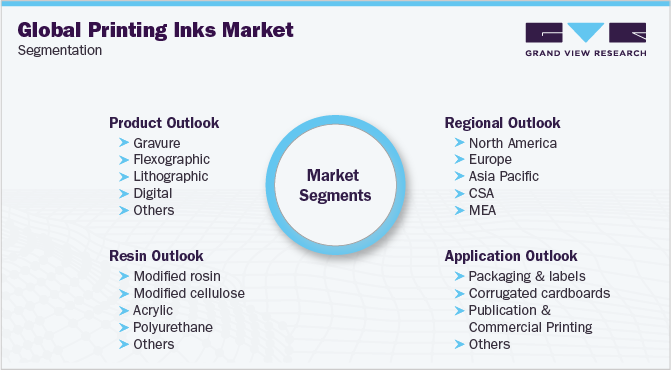
Global Printing Inks Market SegmentationThis report forecasts revenue growth at global, regional & country levels and provides an analysis of the industry trends in each of the sub-segments from 2016 to 2028. For the purpose of this study, Grand View Research has segmented the global printing inks market on the basis of product, resin, application, and region.
 To learn more about this report, Download Free Sample Report
 -
Product Outlook (Revenue, USD Million, 2016 - 2028)
-
Gravure
-
Flexographic
-
Lithographic
-
Digital
-
Others
-
-
Resin Outlook (Revenue, USD Million, 2016 - 2028)
-
Modified rosin
-
Modified cellulose
-
Acrylic
-
Polyurethane
-
Others
-
-
Application Outlook (Revenue, USD Million, 2016 - 2028)
-
Packaging & labels
-
Corrugated cardboards
-
Publication & Commercial Printing
-
Others
-
-
Regional Outlook (Revenue, USD Million, 2016 - 2028)
-
North America
-
The U.S.
-
Canada
-
Mexico
-
-
Europe
-
Germany
-
Italy
-
UK
-
-
Asia Pacific
-
China
-
Japan
-
India
-
-
Central & South America (CSA)
-
Brazil
-
-
Middle East & Africa
-
Delivered Customizations
This report has been delivered with the following In-depth customizations
Client Request
Customization Delivered
Value Adds
Trade Assessment
Comprehensive trade assessment of the global printing inks market (HS Code: 3215), including import-export analysis by country and region, trade volume and value trends, key exporting and importing nations, tariff structures, customs regulations, and supply chain movement analysis. The assessment also evaluates trade flow trends for printing inks across packaging, publishing, commercial printing, textile printing, and digital printing applications, along with analysis of raw material dependency, regional manufacturing hubs, and international trade competitiveness. Additional evaluation includes the impact of geopolitical developments, logistics costs, trade agreements, and sustainability-related regulations influencing the global printing ink trade.
Enable identification of key trade corridors, sourcing dependencies, export opportunities, and regional supply-demand imbalances within the printing inks market. Support procurement planning, distributor identification, localization strategies, and trade risk assessment through enhanced visibility into global trade dynamics, tariff impacts, and regional manufacturing competitiveness.
Opportunity Assessment
Detailed evaluation of emerging growth opportunities across flexible packaging, food & beverage packaging, e-commerce packaging, digital printing, textile printing, UV-curable inks, water-based inks, and sustainable low-VOC printing technologies. The assessment includes analysis of packaging industry expansion, increasing demand for environmentally friendly inks, growth in digital and short-run printing applications, regulatory shifts toward sustainable formulations, and rising adoption of specialty printing technologies. It also highlights high-growth regional markets, evolving end-use demand trends, innovation in bio-based and food-safe inks, and opportunities associated with smart packaging and industrial printing applications.
Enable prioritization of high-growth application areas and emerging investment opportunities across the printing inks value chain. Support strategic planning, product diversification, sustainability positioning, and market expansion initiatives through insights into packaging industry growth, digital printing adoption, environmental regulations, and future demand potential for advanced printing ink technologies.
Pricing Analysis
Detailed pricing analysis for printing inks by resin type, printing technology, formulation type, and application. The assessment includes raw material price trends for pigments, solvents, resins, additives, oils, and specialty chemicals, along with processing costs, regional pricing variations, supply-demand impact analysis, distribution margins, and pricing fluctuations associated with water-based, solvent-based, UV-curable, food-grade, and specialty printing inks. Pricing analysis can also be customized for specific printing technologies, packaging applications, or regional markets, depending on data availability and client requirements.
Support procurement optimization, pricing strategy development, and supplier negotiations through enhanced understanding of printing ink cost structures and regional pricing dynamics. Help identify premium product opportunities, raw material volatility risks, operational cost pressure areas, and regional sourcing advantages across the printing inks value chain.
Frequently Asked Questions About This Report
The global printing inks market size was estimated at USD 19.2 billion in 2020 and is expected to reach USD 19.6 billion in 2021.
The global printing inks market is expected to grow at a compound annual growth rate of 2.8% from 2021 to 2028 to reach USD 23.8 billion by 2028.
Asia Pacific dominated the printing inks market with a share of 35.4% in 2020. This is attributable to the growth of end-use applications coupled with technological printing ink advancements and constant research and development initiatives.
Some key players operating in the printing inks market include Flint Group, DIC Corporation, Siegwerk Druckfarben AG & Co. KGaA, Sakata Inx Corporation, Wikoff Color Corporation and Sun Chemicals.
Key factors that are driving the market growth include printing inks application for food packaging & online retailing, and its application for commercial printing & publishing.
About the Author(s)
Paints, Coatings & Printing Inks Research Team
Bulk Chemicals · Paints, Coatings & Printing InksThis report was authored by the paints, coatings & printing inks research team at Grand View Research - comprising two research analysts, one senior research analyst, and one industry expert - with specialized expertise in the paints, coatings & printing inks segment of the bulk chemicals industry. All findings are based on proprietary bulk chemicals databases, executive interviews, and regulatory analysis, subject to internal peer review prior to publication.
Last Updated:
Speak to Analyst

Customize this report to your needs - add regions, segments, or data points, with 20% free customization.
Or view our licence options:


ISO 9001:2015 & 27001:2022 Certified
We are GDPR and CCPA compliant! Your transaction & personal information is safe and secure. For more details, please read our privacy policy.


