
- Home
- »
- Consumer F&B
- »
-
Private Label Packaged Food Market Size Report 2026-2033GVR Report cover

Private Label Packaged Food Market (2026 - 2033)
Size, Share & Trends Analysis Report By Product (Baked Goods, Savory Snacks, Meals & Soups, Dairy, Confectionery, Ice Cream, Breakfast Cereals, Baby Food), By Distribution Channel, By Region, And Segment Forecasts
Market Size, 2025
$439.0BMarket Estimate, 2026
$464.0BMarket Forecast, 2033
$693.1BCAGR, 2026–2033
5.9%Private Label Packaged Food Market Summary
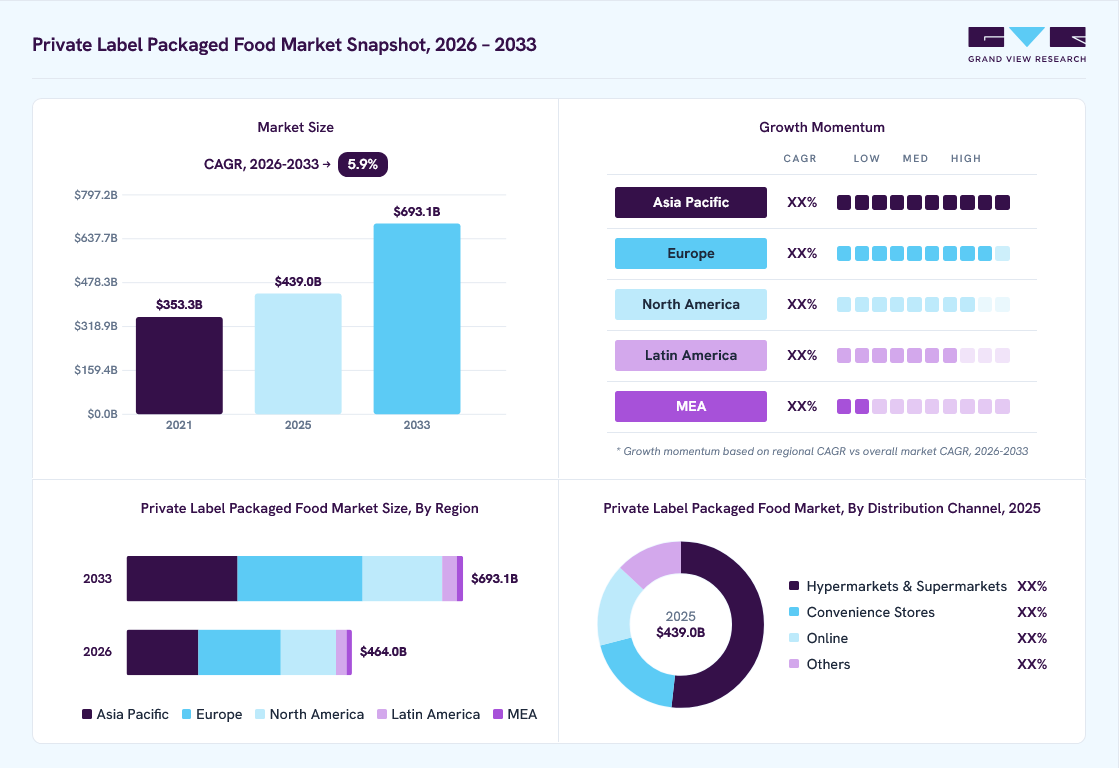
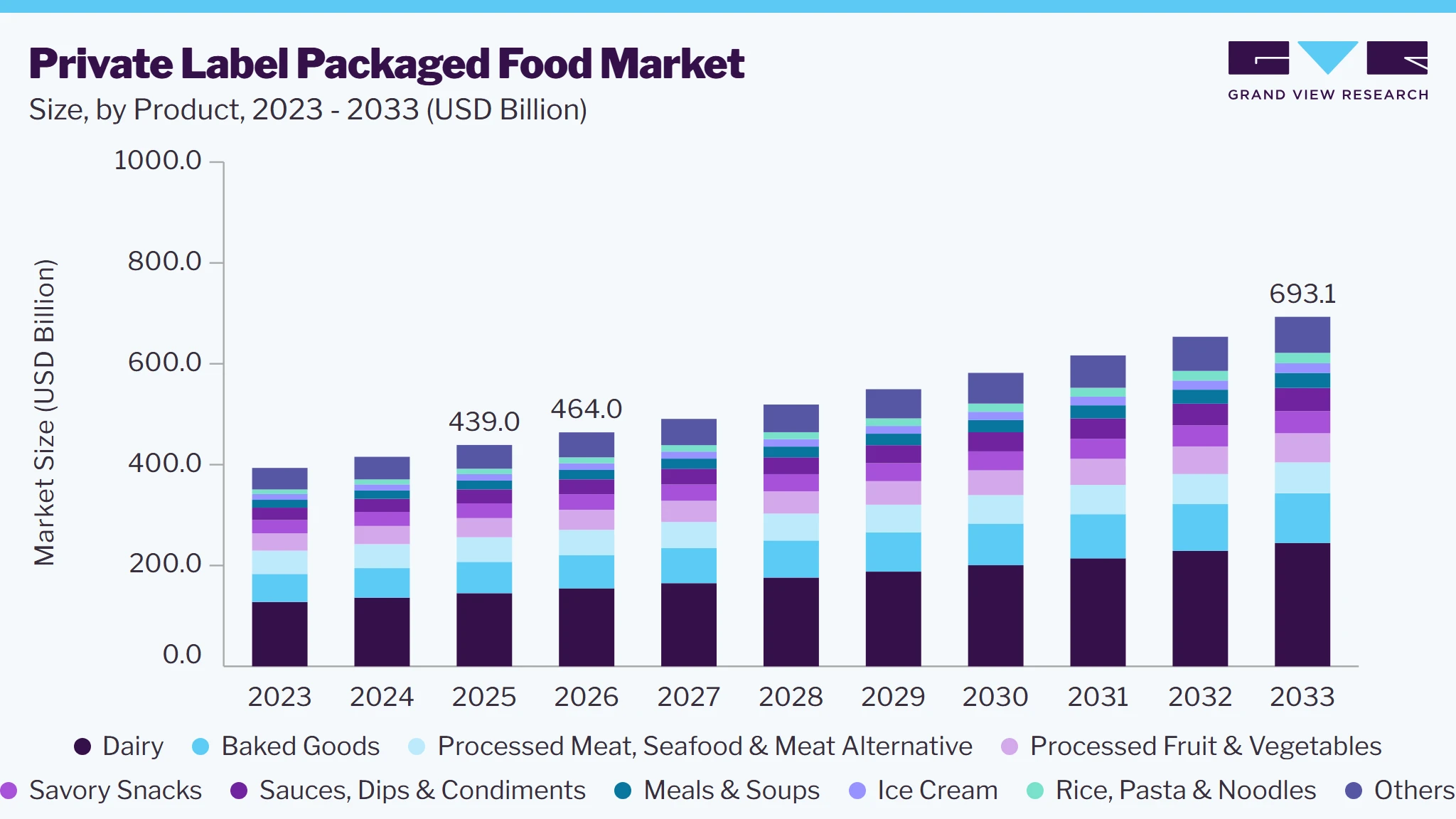
The global private label packaged food market size was valued at USD 439.0 billion in 2025 and is projected to grow from USD 464.0 billion in 2026 to USD 693.1 billion by 2033, at a CAGR of 5.9% from 2026 to 2033. The market in Europe dominated with a revenue share of 36.5% in 2025. Increasing consumer demand for cost-effective yet high-quality food products.
 Source: Grand View Research, IR Documents, Primary Interviews, Paid DatabasesTo learn more about this report,
 Download Free Sample Report
 Key Market Trends & Insights
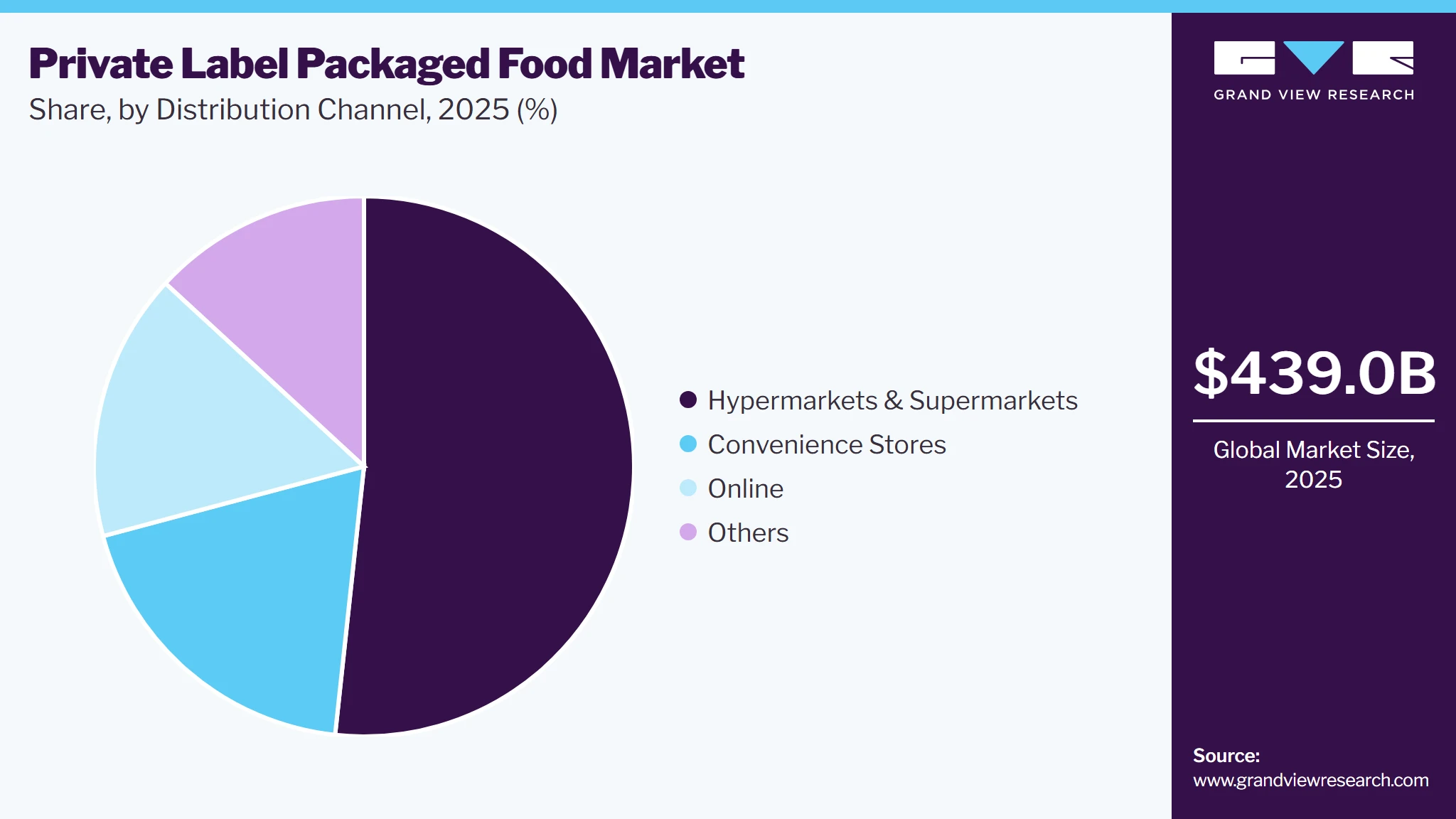
- By distribution channel: Hypermarkets & supermarkets segment held the largest market share of 51.7% in 2025.
- By product: Diary segment held the largest market share of 33.1% in 2025.
Regional Highlights
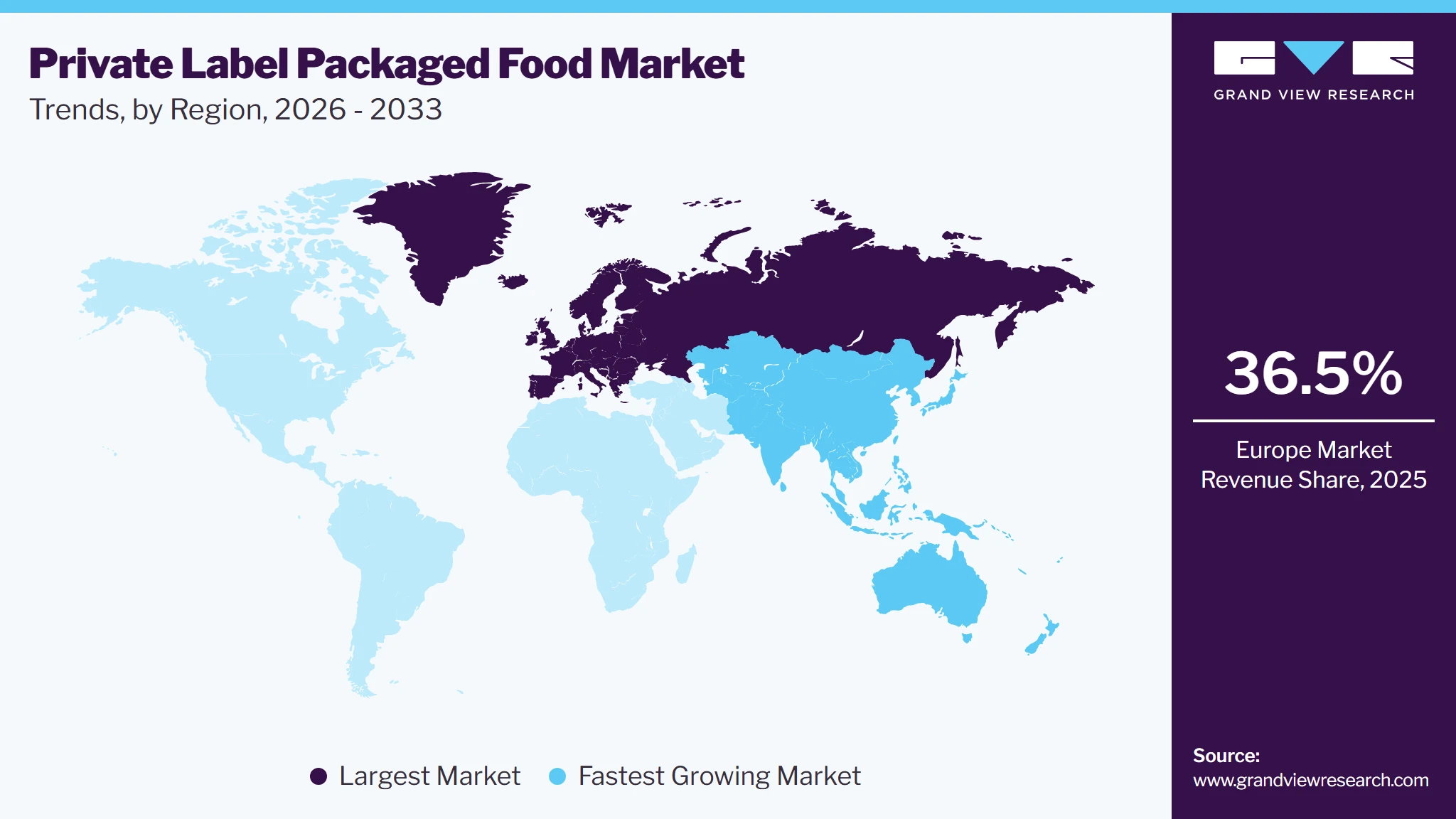
- Largest regional market: Europe (36.5% revenue share, 2025)
- Fastest-growing regional market: Asia Pacific (highest CAGR, 2026-2033)
- By country: Germany held the largest market share in 2025
Market Size & Forecast
- Market size in 2025: USD 439.0 Billion
- Estimated market size in 2026: USD 464.0 Billion
- Projected market size by 2033: USD 693.1 Billion
- CAGR (2026-2033): 5.9%
Three ways to get this report
Buy it, customize it, or ask a question.Ask an Analyst
Analyst response in 1 business day
- AccessReport author, directly
- Reply timeWithin 1 working day
- No sales callDirect answer only
- FormatEmail reply
- CostFree, no cost
Get the Full Report
What the study covers
- FormatsPDF · Excel · Dashboard
- Timeline2026–2033 annual, 2025 base
- Coverage20+ countries, 5 regions
- Companies10+ key players profiled
Customize the Report
20% free customization
- IncludeCountries, segments, points
- TailorTo your product definition
- ExtendDeeper competitor detail
- OrA fully bespoke study
- Turnaround5–10 working days
As consumers become more price-sensitive, especially in the face of economic uncertainties, private label products offer an appealing alternative to national brands. Retailers are responding by investing in their private label offerings, ensuring they meet high standards of quality and taste, which further drives consumer acceptance and loyalty.Consumers are increasingly seeking healthier food options, leading retailers to develop private label products that cater to this demand. This includes organic, gluten-free, vegan, and non-GMO product lines. In addition, sustainability has become a crucial trend, with consumers favoring products that have minimal environmental impact. This trend pushes retailers to adopt eco-friendly packaging and source ingredients responsibly for their private label brands.
 To learn more about this report, Download Free Sample Report
 One significant opportunity lies in expanding the product range to include premium and specialty items. As private labels shed their low-cost, low-quality image, there is potential for retailers to introduce gourmet and artisanal products under their own brands. Furthermore, the rise of e-commerce and online grocery shopping presents an opportunity for private label brands to reach a wider audience. Retailers can leverage their online platforms to promote and distribute private label products, enhancing visibility and accessibility.
Private label products, often known as store brands, typically offer similar quality to national brands but at a lower price point. This price advantage is particularly appealing in times of economic uncertainty or inflation, where consumers become more price-conscious and seek ways to stretch their budgets without compromising on quality. Retailers can sell these products at a lower price because they save on marketing and advertising expenses, passing the savings onto the consumer.
Market Dynamics
Private label packaged foods are experiencing strong market momentum as consumers increasingly seek affordable, quality-driven alternatives to national brands. Retailers are expanding their private label portfolios across categories such as snacks, dairy products, bakery items, ready-to-eat meals, frozen foods, and beverages to strengthen customer loyalty and improve profit margins. Improvements in product quality, packaging innovation, and wider product availability have enhanced consumer confidence in store-owned brands. Additionally, changing purchasing behavior, rising cost-consciousness, and growing demand for value-oriented products are expected to continue supporting growth in the private label packaged foods market.
The rising cost of living and continued pressure on household budgets have significantly increased consumer demand for affordable food products. Private label packaged foods offer a cost-effective alternative to branded products while delivering comparable quality, taste, and nutritional value. As consumers become more price-conscious, particularly during periods of economic uncertainty, many are actively shifting toward retailer-owned brands to manage grocery expenses. This trend has encouraged retailers to expand their private label offerings across a wide range of packaged food categories, supporting market growth.
In addition to affordability, improvements in product quality, packaging standards, and product innovation have strengthened consumer confidence in private label packaged foods. Retailers are investing in premium formulations, healthier ingredients, and category diversification to attract a broader customer base. The growing availability of private label products in supermarkets, hypermarkets, and online retail channels has further increased accessibility and repeat purchases. As consumer perceptions continue to improve and value-driven purchasing behavior remains strong, demand for private label packaged foods is expected to grow steadily over the forecast period.
Despite growing acceptance, private label packaged foods continue to face challenges associated with brand perception and consumer loyalty. Many consumers remain strongly attached to established food brands due to long-term familiarity, perceived product consistency, and marketing influence. In certain product categories, concerns regarding taste, ingredient quality, and product differentiation may discourage switching from branded alternatives. Furthermore, private label products rely heavily on retailer distribution networks, limiting visibility outside specific store formats. These factors can create barriers to market penetration and slow adoption in categories where brand equity plays a significant role in purchasing decisions.
The growing consumer focus on health, wellness, and clean-label nutrition is creating significant opportunities within the private label packaged foods market. Retailers are increasingly introducing products featuring natural ingredients, organic certifications, plant-based formulations, reduced sugar content, and functional nutritional benefits. Demand for convenient yet healthier packaged food options continues to rise among health-conscious consumers seeking both value and quality. Advances in food manufacturing, ingredient sourcing, and packaging technologies are enabling retailers to develop differentiated offerings that compete directly with premium branded products. As consumer preferences continue shifting toward nutritious and sustainable food choices, private label manufacturers are well positioned to expand their presence across multiple packaged food categories.
Analyst Perspective
The private label packaged foods market benefits from a powerful convergence of value-conscious consumer behavior, retailer margin optimization objectives, and growing acceptance of store brands as credible alternatives to national labels. As inflationary pressures and shifting purchasing patterns encourage consumers to seek affordable yet quality food options, retailers are expanding private label offerings across premium, organic, and health-focused categories. The key competitive advantage will belong to retailers that successfully combine pricing competitiveness, product innovation, and consistent quality across multiple food segments, transforming private labels from budget substitutes into trusted consumer brands capable of driving long-term loyalty and sustainable revenue growth.
Product Insights
Based on product, the diary segment led the market with the largest revenue share of 33.1% in 2025. The perceived quality of private label dairy products has significantly improved over the years. Retailers have made substantial investments in ensuring their private label dairy products meet or exceed the quality of national brands. This effort has paid off as consumers have come to trust these products for their consistent quality and value. Dairy products are often sourced locally due to their perishable nature. Retailers can leverage local supply chains to offer fresher products compared to national brands that might have longer distribution channels. This local sourcing not only enhances the freshness and taste of the dairy products but also appeals to consumers who prefer supporting local agriculture. The shorter supply chain also allows retailers to have better control over the quality and pricing of their private label dairy products.
The private label plant-based dairy products segment is expected to grow at the fastest CAGR of 11.2% from 2026 to 2033. The increasing demand for plant-based dairy is a major factor driving the growth of private label plant-based dairy products. Consumers are becoming more health-conscious and environmentally aware, seeking alternatives to traditional dairy products due to concerns about lactose intolerance, animal welfare, and the environmental impact of dairy farming. This shift is reflected in the growing popularity of plant-based milk (such as almond, soy, oat, and cashew milk), yogurt, and cheese. As these preferences become more mainstream, retailers are expanding their private label offerings to meet this demand.
Distribution Channel Insights
Based on distribution channel, the hypermarkets & supermarkets segment led the market with the largest revenue share of 51.7% in 2025. Private label products allow retailers to exert greater control over their product ranges, quality, and supply chains. By sourcing and producing these products under their own brands, retailers can optimize margins and reduce dependence on national brand suppliers. This control not only helps in managing costs but also in maintaining consistent product quality and availability, which enhances customer satisfaction and loyalty.
 To learn more about this report, Download Free Sample Report
 The online segment is expected to grow at the fastest CAGR of 9.5% from 2026 to 2033. Online retail offers unparalleled convenience, allowing consumers to shop for private label packaged food from the comfort of their homes. The ability to browse, compare, and purchase products online without needing to visit physical stores appeals to busy lifestyles. This convenience is particularly beneficial for consumers seeking to avoid the hassle of in-store shopping or those who live in remote areas where access to physical stores might be limited.
Regional Insights
The private label packaged food market in North America held the significant revenue share of 24.6% in 2025. The demand for private label packaged food products in North America has been growing steadily, driven by several interrelated factors that reflect changing consumer preferences, economic conditions, and strategic retailer initiatives. Private label products in North America cover a broad spectrum of categories, from basic staples to gourmet and organic items. Retailers such as Walmart, Aldi, Tesco, Target, and others have been proactive in expanding their private label lines to include health-focused and specialty products, such as gluten-free, non-GMO, and plant-based foods. This wide range of options caters to diverse consumer preferences and dietary needs, making private labels appealing to a broader audience.
U.S. Private Label Packaged Food Market Trends
The private label packaged food market in the U.S. held the largest share in the North America region in 2025. Retailers in the U.S., such as Walmart, Costco, and Kroger, have built strong reputations and customer loyalty. When these trusted retailers offer private label packaged foods, consumers are more likely to purchase them, confident in the quality and value these products represent. Trust in these retail brands translates into trust in their private label offerings, boosting sales and market share.
Europe Private Label Packaged Food Market Trends
Europe dominated the private label packaged food market with the largest revenue share of 36.5% in 2025. European retailers are strategically promoting their private label brands through various marketing and in-store initiatives. These include special promotions, loyalty programs, and prominent shelf placements. By actively marketing their private label products and offering incentives, retailers drive consumer awareness and trial, which can lead to increased adoption and repeat purchases.
 To learn more about this report, Download Free Sample Report
 Asia Pacific Private Label Packaged Food Market Trends
The private label packaged food market in Asia Pacific is expected to grow at the fastest CAGR of 6.4% from 2026 to 2033. The COVID-19 pandemic has significantly influenced the shopping behaviors of consumers within Asian Countries, with many consumers shifting towards more cost-effective and reliable options. Private label products, with their balance of quality and affordability, have become a go-to choice for many households. The pandemic also accelerated the adoption of online grocery shopping, where private labels are often highlighted and recommended.
Key Private Label Packaged Food Company Insights
The global market is characterized by the presence of numerous well-established players such as Walmart, Costco, Kroger, Trader Joe’s, Target, Aldi, Amazon, Albertson Companies, Loblaw Companies Limited and H-E-B. Market players in the private label packaged food industry contend with fierce competition among themselves, particularly those ranked among the top manufacturers with varied form offerings. These companies boast extensive distribution networks that enable them to effectively cater to a broad customer base, spanning both regional and international markets.
Key Private Label Packaged Food Companies:
The following are the leading companies in the private label packaged food market.
- Walmart
- Costco
- Kroger
- Trader Joe’s
- Target
- Aldi
- Amazon
- Albertson Companies
- Loblaw Companies Limited
- H-E-B
Competitive Benchmarkingn
Category
Operating Strategies
Competitive Edge
Weakness
Established Players (Walmart Inc., Costco Wholesale Corporation, Tesco PLC, Carrefour S.A.)
- Expand private label portfolios across premium, organic, and value-based packaged food categories. Strengthen supplier partnerships, optimize sourcing networks, and leverage omnichannel retail distribution.
- Extensive retail presence, strong consumer trust, large-scale procurement capabilities, and superior shelf visibility.
- Ability to offer competitive pricing while maintaining healthy margins.
- High dependence on supplier performance and quality consistency. Limited product differentiation from national brands in certain categories.
Emerging Players (Aldi Group, Lidl Stiftung & Co. KG, Trader Joe's Company, Regional Retail Chains)
- Focus on exclusive private label offerings, clean-label products, innovative packaging, and health-oriented food segments. Utilize targeted promotions and localized product development strategies.
- Greater agility in responding to consumer trends, strong value-for-money positioning, and ability to rapidly introduce niche products.
- Smaller geographic footprint and lower brand recognition compared to global retail leaders.
- Limited bargaining power with suppliers and manufacturers.
Recent Developments
-
In May 2024, Walmart introduced its store-label food brand, Bettergoods, featuring a variety of products such as frozen foods, dairy items, snacks, beverages, pastas, soups, coffee, and chocolate
-
In May 2024, the discount supermarket chain Aldi unveiled a new recyclable wrap for two of its own-label butter products, marking a first for a UK supermarket
Private Label Packaged Food Market Report Scope
Report Attribute
Details
Market size in 2025
USD 439.0 billion
Estimated market size in 2026
USD 464.0 billion
Projected market size by 2033
USD 693.1 billion
Growth rate
CAGR of 5.9% from 2026 to 2033
Base year for estimation
2025
Historical data
2021 - 2024
Forecast period
2026 - 2033
Quantitative units
Revenue in USD million/billion and CAGR from 2026 to 2033
Report coverage
Revenue forecast, company ranking, competitive landscape, growth factors, and trends
Segments covered
Product, distribution channel, region
Regional scope
North America; Europe; Asia Pacific; Latin America; MEA
Country scope
U.S.; Canada; Mexico; Germany; UK; France; Italy; Spain; Norway; Denmark; Sweden; Russia; Iceland; Finland; China; Japan; India; South Korea; Australia; Thailand; Singapore; Brazil; Argentina; Saudi Arabia; South Africa; UAE; Kuwait; Israel
Key companies profiled
Walmart; Costco; Kroger; Trader Joe’s; Target; Aldi; Amazon; Albertson Companies; Loblaw Companies Limited; H-E-B.
Customization scope
Free report customization (equivalent up to 8 analysts' working days) with purchase. Addition or alteration to country, regional & segment scope.
Pricing and purchase options
Avail customized purchase options to meet your exact research needs. Explore purchase options
Global Private Label Packaged Food Market Report Segmentation
This report forecasts revenue growth at the global, regional, and country levels and provides an analysis of the latest industry trends and opportunities in each of the sub-segments from 2021 to 2033. For this study, Grand View Research has segmented the global private label packaged food market report based on product, distribution channel, and region.
-
Product Outlook (Revenue, USD Billion, 2021 - 2033)
-
Baked Goods
-
Savory Snacks
-
Meals & Soups
-
Dairy
-
Confectionery
-
Processed Meat, Seafood & Meat Alternative
-
Sauces, Dips & Condiments
-
Sweet Biscuits, Snack Bars & Fruit Snacks
-
Ice Cream
-
Processed Fruit & Vegetables
-
Breakfast Cereals
-
Rice, Pasta & Noodles
-
Baby Food
-
Sweet Spreads
-
Edible Oils
-
Plant-based Dairy
-
-
Distribution Channel Outlook (Revenue, USD Billion, 2021 - 2033)
-
Hypermarkets & Supermarkets
-
Convenience Stores
-
Online
-
Others
-
-
Regional Outlook (Revenue, USD Billion, 2021 - 2033)
-
North America
-
U.S.
-
Canada
-
Mexico
-
-
Europe
-
UK
-
Germany
-
France
-
Italy
-
Spain
-
-
Asia Pacific
-
China
-
Japan
-
India
-
Australia & New Zealand
-
-
Central & South America
-
Brazil
-
-
Middle East & Africa
-
South Africa
-
-
Research Methodology
The private label packaged food market figures in this report are based on a proven research process that combines executive interviews with secondary research from proprietary databases, company filings, and recognized regulatory and institutional sources. Market size is built through value-chain sizing - reconciling supply-side and demand-side estimates - and triangulated with bottom-up and top-down approaches. Every estimate passes multiple levels of expert validation before publication, with each private label packaged food segment quantified using the revenue-capture definitions in the table below.
Segment Definition
Segment - Product
Revenue capture definition
Baked Goods
This segment includes the sales of private label breads, rolls, cakes, pastries, muffins, cookies, and other bakery products offered under retailer-owned brands. Products are positioned as affordable alternatives to branded bakery items while catering to everyday consumption needs.
Savory Snacks
This segment includes the sales of private label potato chips, tortilla chips, popcorn, pretzels, crackers, nuts, and other savory snack products. Demand is supported by increasing snacking occasions and retailer expansion of value and premium snack portfolios.
Meals & Soups
This segment includes the sales of ready meals, canned soups, instant meals, frozen entrées, and meal kits marketed under private label brands. Products are designed to meet consumer demand for convenience and time-saving food solutions.
Dairy
This segment includes the sales of milk, cheese, butter, yogurt, cream, and other dairy-based products sold through retailer-owned brands. Growth is supported by frequent household consumption and competitive pricing compared to national brands.
Confectionery
This segment includes the sales of chocolates, candies, gums, toffees, and other sugar confectionery products marketed under private label labels. Retailers increasingly offer both value-oriented and premium confectionery options to broaden consumer appeal.
Processed Meat, Seafood & Meat
Alternative
This segment includes the sales of packaged meat products, processed seafood, plant-based meat substitutes, sausages, deli products, and frozen protein offerings. Product innovation and demand for convenient protein sources support category expansion.
Sauces, Dips & Condiments
This segment includes the sales of ketchup, mayonnaise, salad dressings, cooking sauces, dips, mustard, and other condiment products sold under store-owned brands. These products are commonly purchased as household staples and meal accompaniments.
Sweet Biscuits, Snack Bars &
Fruit Snacks
This segment includes the sales of sweet biscuits, cereal bars, granola bars, fruit-based snacks, and other packaged sweet snack products. Consumer preference for convenient on-the-go snacking continues to support demand across this category.
Ice Cream
This segment includes the sales of private label ice creams, frozen desserts, sorbets, and related frozen treat products. Retailers are expanding product varieties through premium flavors, healthier formulations, and family-sized offerings.
Processed Fruit & Vegetables
This segment includes the sales of canned, frozen, dried, and preserved fruits and vegetables marketed through retailer-owned brands. These products provide extended shelf life and convenience for household meal preparation.
Breakfast Cereals
This segment includes the sales of ready-to-eat cereals, granola products, muesli, and hot cereal offerings under private label portfolios. Demand is supported by consumer interest in convenient breakfast solutions and value-focused purchasing.
Rice, Pasta & Noodles
This segment includes the sales of packaged rice, pasta, noodles, and related staple carbohydrate products sold under retailer brands. These products benefit from regular household consumption and strong price competitiveness.
Baby Food
This segment includes the sales of infant formula, purees, cereals, snacks, and other nutrition products developed for babies and toddlers. Retailers focus on quality assurance, nutritional value, and affordability to attract consumers.
Sweet Spreads
This segment includes the sales of jams, jellies, honey-based spreads, chocolate spreads, nut spreads, and other sweet topping products marketed under private label brands. Consumption is driven by breakfast and snack applications.
Edible Oils
This segment includes the sales of vegetable oils, olive oils, sunflower oils, canola oils, and other cooking oil products offered through retailer-owned portfolios. Demand is supported by their essential role in household food preparation.
Plant-based Dairy
This segment includes the sales of dairy alternatives such as almond milk, oat milk, soy milk, plant-based yogurt, and plant-based cream products. Rising interest in vegan, lactose-free, and sustainable diets is supporting category growth.
Segment - Distribution Channel
Revenue Capture Definition
Hypermarkets & Supermarkets
This segment includes the sales of private label packaged food products through large retail chains, grocery supermarkets, and hypermarket formats. These outlets offer extensive product assortments and remain the primary channel for private label purchases.
Convenience Stores
This segment includes the sales of private label packaged foods through neighborhood stores, small-format retail outlets, and convenience chains. Consumer demand is primarily driven by accessibility and quick-purchase requirements.
Online
This segment includes the sales of private label packaged foods through e-commerce platforms, retailer websites, mobile applications, and online grocery delivery services. Growth is supported by increasing digital shopping adoption and home delivery preferences.
Others
This segment includes the sales of private label packaged food products through discount stores, warehouse clubs, specialty food retailers, cash-and-carry outlets, and other alternative retail channels that fall outside the primary distribution classifications.
Estimation Model
Layer Name
Key Question
Description
Consumer Base Layer
Who buys packaged foods?
Identify the total population purchasing packaged food products across retail channels, segmented by income level, household size, and consumption frequency to define the potential customer pool.
Retail Reach Layer
Who has access to private label products?
Apply supermarket, hypermarket, discount store, and e-commerce penetration rates to determine the consumer base with access to retailer-owned packaged food brands.
Adoption Layer
Who actively purchases private label foods?
Apply private label purchase rates, repeat-buying behavior, and category-specific adoption trends to estimate active private label consumers across packaged food segments.
Monetisation Layer
How much revenue is generated?
Multiply active private label consumers by average annual spending on private label packaged foods and retailer-specific sales volumes to calculate total market revenue.
Delivered Customizations
This report has been delivered with the following In-depth customizations
Client Request
Customization Delivered
Value Adds
Private Label Product Penetration & Category Analysis
Conducted a focused analysis of private label packaged foods across dairy products, bakery & confectionery, snacks, frozen foods, beverages, and ready-to-eat meals, evaluating category penetration and retailer brand performance.
Helps stakeholders identify high-growth product categories, assess competitive positioning, and evaluate revenue expansion opportunities.
Consumer Preferences & Premium Private Label Trends
Evaluated consumer purchasing behavior, value-for-money perception, premium private label adoption, clean-label demand, and health-oriented packaged food trends across major markets.
Provides insights into evolving consumer preferences, product differentiation opportunities, and demand forecasting.
Retailer Expansion, Sourcing & Manufacturing Assessment
Assessed retailer-owned brand strategies, contract manufacturing partnerships, sourcing models, distribution networks, and supply chain efficiencies influencing private label growth.
Supports investment and expansion strategies by identifying margin enhancement opportunities, operational advantages, and long-term growth potential.
Frequently Asked Questions About This Report
The global private label packaged food market is expected to grow at a CAGR of 5.9% from 2026 to 2033, reaching USD 693.1 billion by 2033.
The diary segment led with a 33.1% revenue share in 2025.
Europe dominated with a 36.5% revenue share in 2025.
Asia Pacific is the fastest-growing region over the forecast period.
The hypermarkets & supermarkets segment led with a 51.7% revenue share in 2025.
Some key players operating in the private label packaged food market include Walmart, Costco, Kroger, Trader Joe’s, Target, Aldi, Amazon, Albertson Companies, Loblaw Companies Limited, and H-E-B.
Key factors include rising demand for affordable, high-quality packaged food products. Retailers are expanding private label offerings to meet changing consumer preferences and strengthen market competitiveness.
The global private label packaged food market size was valued at USD 439.0 billion in 2025 and is estimated at USD 464.0 billion for 2026.
About the Author(s)
Consumer F&B Research Team
Consumer Goods · Consumer F&BThis report was authored by the consumer f&b research team at Grand View Research - comprising two research analysts, one senior research analyst, and one industry expert - with specialized expertise in the consumer f&b segment of the consumer goods industry. All findings are based on proprietary consumer goods databases, executive interviews, and regulatory analysis, subject to internal peer review prior to publication.
Last Updated:
Speak to Analyst

Customize this report to your needs - add regions, segments, or data points, with 20% free customization.
Or view our licence options:


ISO 9001:2015 & 27001:2022 Certified
We are GDPR and CCPA compliant! Your transaction & personal information is safe and secure. For more details, please read our privacy policy.


