
- Home
- »
- Homecare & Decor
- »
-
Professional Beauty Services Market Size Report, 2026-2033GVR Report cover

Professional Beauty Services Market (2026 - 2033)
Size, Share & Trends Analysis Report By Service (Skin Care, Hair Care, Nail Care, Massage & Spa Services), By End-use (Men, Women), By Region (North America, Europe, Asia Pacific), And Segment Forecasts
Market Size, 2025
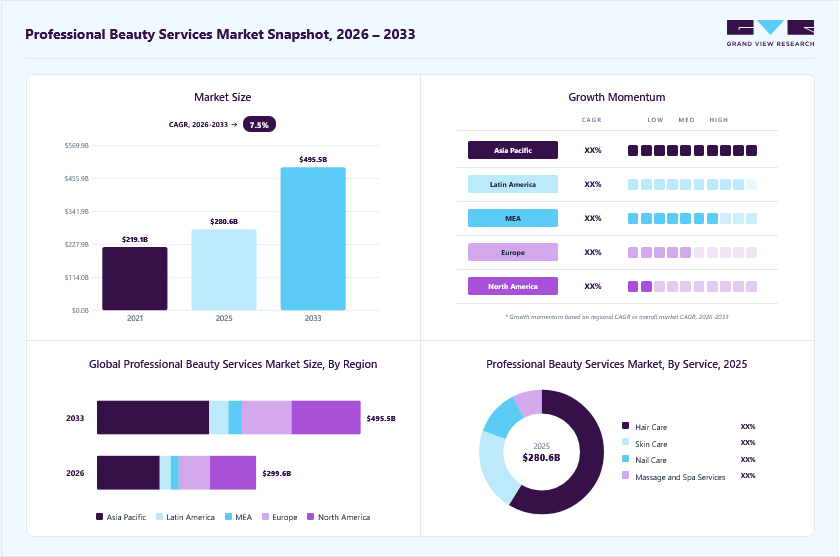
$280.6BMarket Estimate, 2026
$299.6BMarket Forecast, 2033
$495.5BCAGR, 2026–2033
7.5%Professional Beauty Services Market Summary
The global professional beauty services market size was valued at USD 280.6 billion in 2025 and is projected to grow from USD 299.6 billion in 2026 to USD 495.5 billion by 2033, at a CAGR of 7.5% from 2026 to 2033. Asia Pacific dominated the market, accounting for a revenue share of 39.0% in 2025. The market has experienced robust growth in recent years, driven by evolving consumer preferences, increasing disposable incomes, and technological advancements.
 Source: Grand View Research, IR Documents, Primary Interviews, Paid DatabasesTo learn more about this report,
 Download Free Sample Report
Key Market Trends & Insights
- By service: Hair care segment dominated the market, with a revenue share of 58.7% in 2025.
- By end use: Women segment accounted for the largest revenue share of 78.2% in 2025.
Regional Highlights
- Largest regional market: Asia Pacific (39.0% revenue share, 2025)
- By country: The U.S. held the largest market share in 2025.
Market Size & Forecast
- Market size in 2025: USD 280.6 Billion
- Estimated market size in 2026: USD 299.6 Billion
- Projected market size by 2033: USD 495.5 Billion
- CAGR (2026-2033): 7.5%
Three ways to get this report
Buy it, customize it, or ask a question.Ask an Analyst
Analyst response in 1 business day
- AccessReport author, directly
- Reply timeWithin 1 working day
- No sales callDirect answer only
- FormatEmail reply
- CostFree, no cost
Get the Full Report
What the study covers
- FormatsPDF · Excel · Dashboard
- Timeline2026–2033 annual, 2025 base
- Coverage20+ countries, 5 regions
- Companies10+ key players profiled
Customize the Report
20% free customization
- IncludeCountries, segments, points
- TailorTo your product definition
- ExtendDeeper competitor detail
- OrA fully bespoke study
- Turnaround5–10 working days
Consumers, particularly women, are increasingly prioritizing self-care and grooming, leading to higher demand for skincare treatments, hair, and makeup services. This trend is further amplified by the growing influence of social media and digital platforms, where beauty trends and innovations quickly gain popularity, influencing consumer behavior and driving market expansion.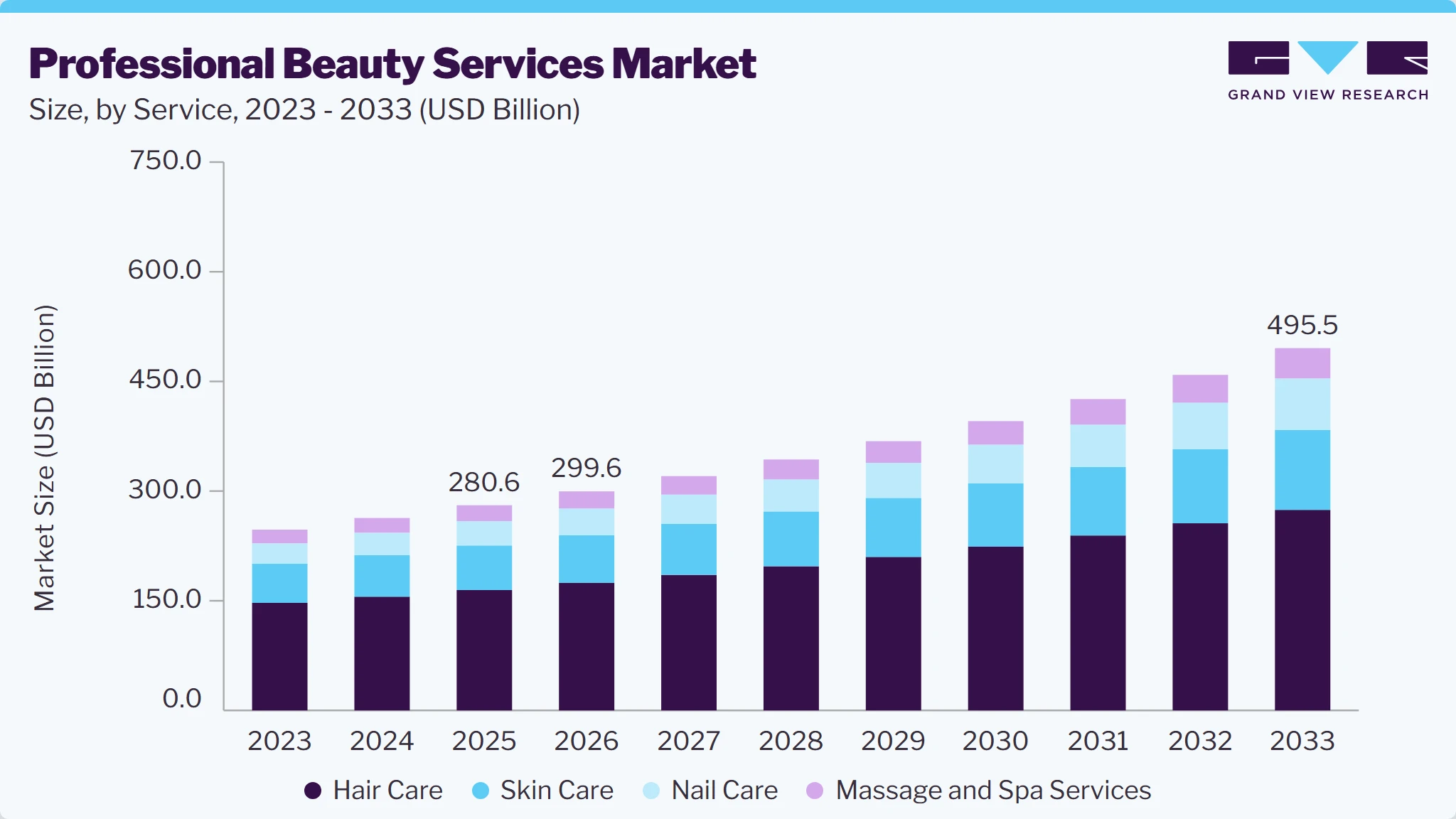 To learn more about this report, Download Free Sample Report
According to statistics published by the Global Wellness Institute, the number of spa establishments worldwide increased from 169,369 in 2019 to 181,175 in 2022. The rising number of spa establishments is a significant driver of growth in the professional beauty services industry. This expansion not only enhances accessibility to spa services for a broader customer base but also elevates the overall industry standards by fostering competition and innovation. As more spas enter the market, they introduce diverse and specialized treatments, catering to varying consumer preferences and needs.
This variety stimulates consumer interest and increases spending on beauty and wellness services. Additionally, the proliferation of spas creates numerous employment opportunities and stimulates economic activity, further solidifying the sector's contribution to the global economy. As a result, the burgeoning number of spa establishments plays a crucial role in propelling the growth and development of the professional beauty services industry.
Technological innovations have significantly reshaped the landscape of professional beauty services, enhancing service delivery and customer engagement. Advanced skincare technologies, such as laser treatments and non-invasive cosmetic procedures, have become more accessible and popular among consumers seeking effective and convenient solutions for skincare concerns. Similarly, digital tools and online booking systems have streamlined operations for beauty salons and spas, improving efficiency and enhancing customer experiences, thereby fostering growth and scalability within the industry.
The rise of wellness and holistic health trends has also contributed to the growth of the professional beauty services market. Consumers are increasingly seeking integrated approaches to beauty and wellness, driving demand for services that promote both aesthetic enhancement and overall well-being. This shift has prompted beauty service providers to expand their offerings to include wellness-focused treatments such as aromatherapy, massage therapies, and personalized nutrition consultations, catering to a more health-conscious clientele.
Demographic trends, such as an aging population and a growing middle class in emerging markets, are further fueling market growth. Aging populations are driving demand for anti-aging treatments and specialized skincare services while rising incomes in emerging markets are expanding the consumer base for luxury beauty services and premium products. Additionally, cultural shifts towards gender inclusivity and male grooming habits are opening new opportunities for beauty service providers to diversify their offerings and capture a broader market segment.
The opening of new salon chains and branches significantly contributes to the growth of the professional beauty services market. In March 2024, Moxie Salon and Beauty Bar LLC, an independent salon franchisor, announced the inauguration of its newest salon in East Brunswick, New Jersey. This strategic expansion into Middlesex County marks a significant step in Moxie Salon's aggressive growth within the hair salon industry. This increased market penetration not only captures new customer segments but also enhances brand visibility and recognition, driving higher foot traffic and sales.
In the coming years, sustainability and ethical considerations are expected to play an increasingly pivotal role in shaping the future of the professional beauty services market. Consumers are becoming more mindful of the environmental impact of beauty products and services, driving demand for sustainable practices, eco-friendly ingredients, and cruelty-free certifications. Beauty service providers that prioritize sustainability and transparency in their operations are likely to gain a competitive edge and appeal to environmentally-conscious consumers, driving innovation and sustainable growth in the industry.
Market Dynamics
The professional beauty services market is experiencing strong growth driven by rising consumer spending on personal grooming, increasing beauty consciousness, and growing demand for specialized aesthetic treatments. Professional beauty services encompass a wide range of offerings, including hair care, skincare, nail care, makeup services, spa treatments, and advanced cosmetic procedures delivered by trained professionals. The influence of social media, beauty influencers, and evolving beauty standards has significantly increased consumer interest in maintaining personal appearance and wellness. In addition, technological advancements in beauty treatments, the expansion of premium salons and spas, and the growing availability of customized beauty solutions are contributing to market expansion.
The growing emphasis on personal appearance and self-care is a major driver of the professional beauty services market. Consumers across various age groups are increasingly investing in beauty and grooming services to enhance confidence, support professional image, and maintain overall well-being. Rising disposable incomes and changing lifestyle preferences have enabled consumers to spend more on premium beauty treatments and regular salon visits.
Furthermore, the widespread influence of social media platforms and digital content has heightened awareness of beauty trends, skincare routines, and aesthetic treatments. Consumers are increasingly seeking professional expertise for services such as hair coloring, facials, anti-aging treatments, nail enhancements, and makeup applications. The growing participation of both men and women in grooming activities, along with increasing demand for personalized beauty experiences, continues to support market growth.
The relatively high cost of professional beauty services remains a significant restraint for the market. Premium salon and spa treatments often require substantial consumer spending, which may limit accessibility among price-sensitive customers, particularly during periods of economic uncertainty. Consumers may reduce discretionary spending on beauty services when faced with financial pressures, affecting market demand.
In addition, the industry faces challenges related to workforce availability, employee retention, and skill development. Delivering high-quality beauty services requires trained professionals with specialized expertise, and shortages of qualified personnel can impact service quality and business growth. Furthermore, rising labor costs, rental expenses, product costs, and regulatory compliance requirements can increase operational expenses for service providers and affect profitability.
The increasing demand for personalized beauty experiences presents substantial opportunities for the professional beauty services market. Consumers are increasingly seeking customized treatments tailored to their individual skin types, hair conditions, beauty goals, and wellness needs. This trend is encouraging service providers to offer personalized consultations, advanced diagnostic tools, and targeted treatment programs.
Technological advancements are also creating new growth opportunities across the industry. Artificial intelligence-based skin analysis, virtual beauty consultations, online appointment scheduling, customer relationship management platforms, and data-driven treatment recommendations are enhancing customer engagement and service efficiency. In addition, growing demand for non-invasive aesthetic procedures, organic beauty treatments, clean beauty products, and wellness-focused services is expanding revenue opportunities for salons, spas, and beauty clinics. The continued growth of digital marketing, e-commerce integration, and beauty subscription programs is expected to further support long-term growth in the professional beauty services market.
Analyst Perspective
The professional beauty services market is growing due to rising consumer spending on personal grooming, self-care, and wellness. Demand for haircare, skincare, nail care, spa, and aesthetic treatments continues to increase, supported by social media influence and personalized beauty trends. Competitive success will depend on delivering superior customer experience, service quality, and brand trust. Companies investing in advanced technologies, skilled professionals, digital convenience, and loyalty programs will be well positioned for long-term growth. The convergence of beauty and wellness is also creating new opportunities for innovation and premium service offerings.
Service Insights
Based on service, the hair care segment led the market with the largest revenue share of 58.7% in 2025. The growing influence of social media and digital platforms has significantly impacted consumer behavior. Beauty trends, hairstyling techniques, and product recommendations quickly gain traction online, driving consumers to seek out professional services to achieve the latest looks. The desire to emulate celebrities and social media influencers has heightened the demand for expert hair care and styling.
In June 2024, Chatters Hair Salon opened its 118th salon at RioCan Colossus Centre in Vaughan, Ontario. This new salon, featuring 14 styling stations with over 70 brands, including Drybar, Curlsmith, Redken, and Moroccanoil, marks a significant expansion in the Ontario region. This move aligns with Chatters' strategic growth plan to meet increasing consumer demand. Embracing its "Beauty Has No Boundaries" philosophy, the salon offers an inclusive service menu with genderless haircuts and services for all customers. This expansion is poised to boost consumer adoption of advanced hair care services by providing greater accessibility to high-quality treatments and products. The new location's extensive service offerings and inclusive approach will attract a diverse customer base, further driving market growth and enhancing the brand's presence in the region.
The demand for nail care services is projected to grow at a CAGR of 8.6% over the forecast period of 2026 to 2033. Advancements in nail care technology and product innovation have expanded the range of services available at salons. This includes long-lasting manicures, gel nails, intricate nail art, and specialized treatments for nail health and maintenance. These advancements not only attract existing customers seeking higher-quality services but also appeal to new demographics looking for innovative beauty solutions.
The rise of social media and digital platforms has amplified trends in nail art and design, driving consumer demand for professional services that can replicate popular styles and techniques. Nail technicians skilled in creating unique designs and using advanced techniques are in high demand among fashion-conscious consumers seeking to showcase their individuality.
End-use Insights
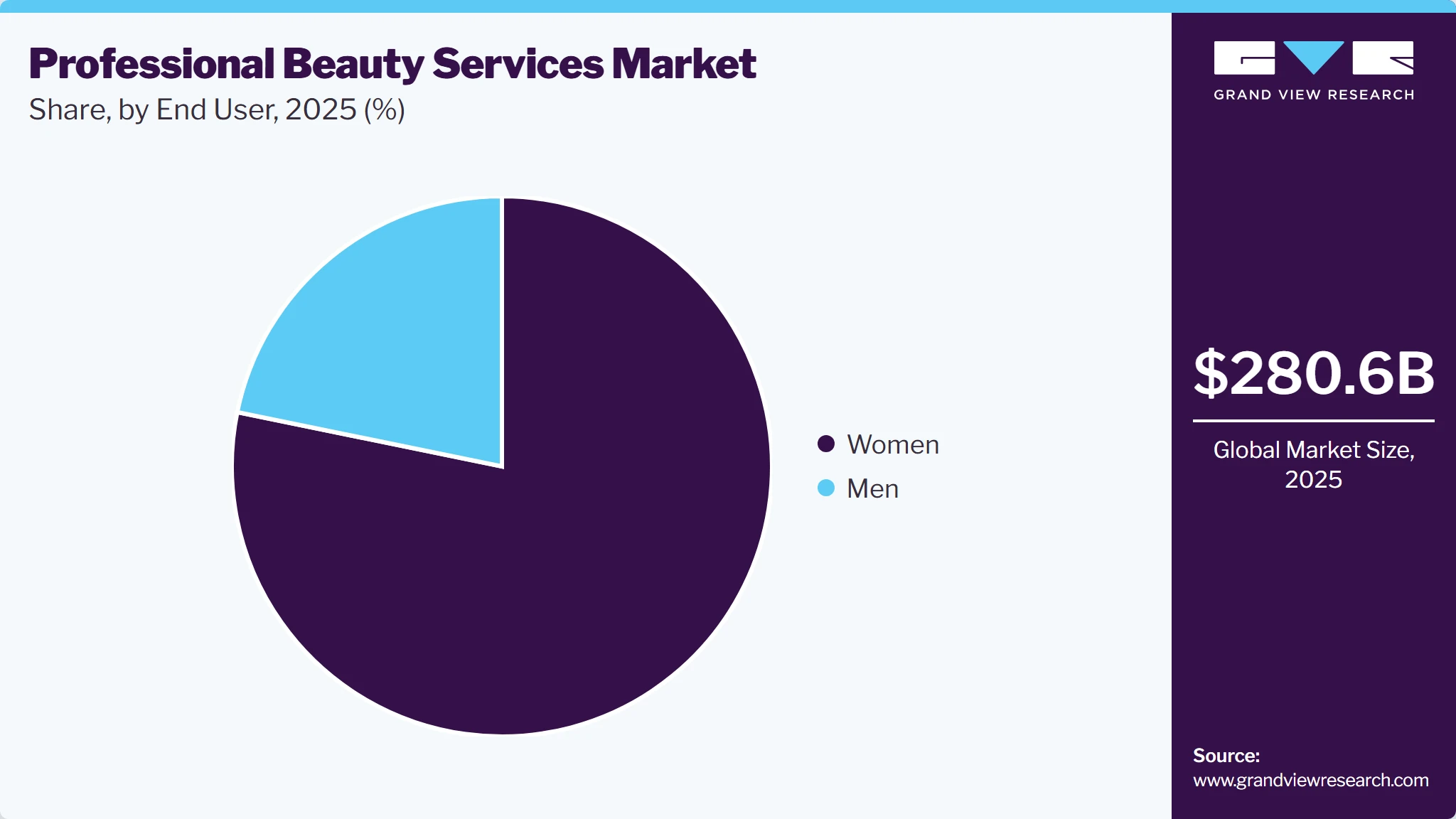
Based on end use, the usage among women is high and led the market with the revenue share of 78.2% in 2025. According to statistics published by the Washington State Department of Corrections, women spend slightly more than men on beauty services and products, with annual expenditures amounting to $3,756 compared to $2,928 for men. This data underscores the significant role that female consumers play in driving demand within the beauty industry.
The higher expenditure by women is a crucial factor contributing to the growth of the professional beauty services industry. This spending behavior not only highlights the substantial market size but also indicates a consistent and growing demand for a wide range of beauty services, from skincare and haircare to cosmetics and wellness treatments. As women continue to prioritize personal grooming and self-care, their spending habits fuel the expansion of salon chains, stimulate innovation in service offerings, and drive overall industry revenue.
 To learn more about this report, Download Free Sample Report
The demand for beauty services among men is projected to grow at a CAGR of 7.9% over the forecast period of 2026-2033. Increasing awareness of personal care, coupled with a growing acceptance of male grooming products and services, is driving this trend. Men are becoming more conscious of their appearance and are investing in skincare, haircare, and grooming products. The expansion of male-targeted services, such as specialized barber shops, men's spas, and dedicated product lines, is also contributing to this growth. As the stigma around male grooming diminishes and societal norms evolve, the men's grooming segment is poised to become a significant contributor to the overall growth of the professional beauty services industry.
Regional Insights
The professional beauty services market of North America held a market share of 30.24% of the global revenue in 2025. The demand is mainly driven on account of increasing disposable incomes, heightened consumer awareness of personal grooming, and a cultural shift towards wellness and self-care. Over the forecast period, sustained economic growth, evolving beauty standards, and demographic trends toward aging populations are expected to fuel continued robust growth in the region.
U.S. Professional Beauty Services Market Trends
The professional beauty services market in the U.S. held the largest share in the North America region in 2025. In the U.S., advancements in hair care technology and products have significantly broadened the scope of services available at professional salons. Innovations like keratin treatments, advanced coloring techniques, and specialized scalp treatments cater to consumers seeking highly effective and durable solutions that are challenging to replicate at home. These technological strides elevate the appeal of professional services by offering superior results and enhancing the overall value proposition, thereby fostering increased patronage and frequent visits to salons.
Asia Pacific Professional Beauty Services Market Trends
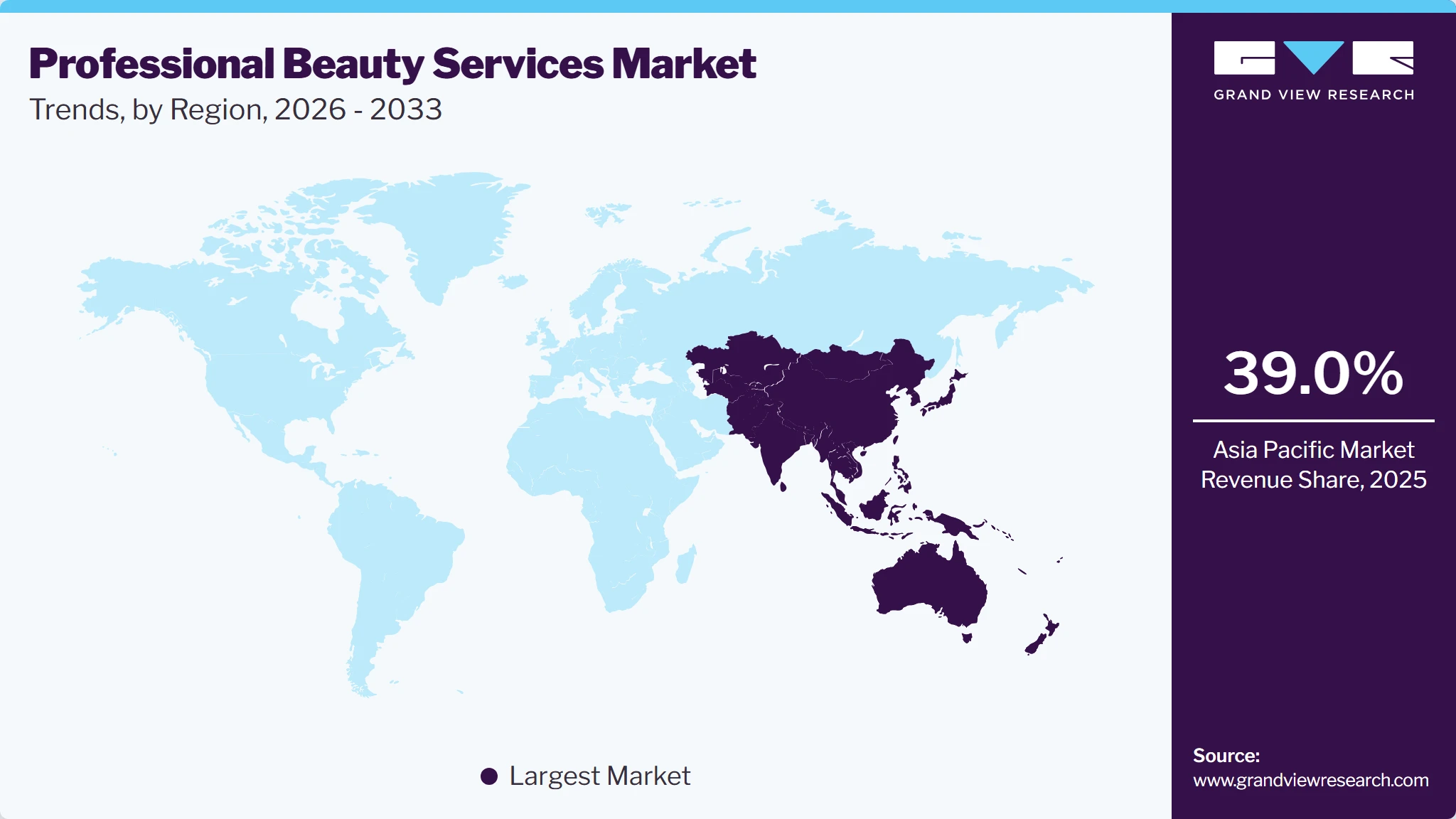
Asia Pacific dominated the professional beauty services market with the largest revenue share of 39.0% in 2025. The influence of social media and celebrity endorsements has heightened beauty consciousness, driving demand for advanced skin care treatments, hair care solutions, and cosmetic procedures offered by service providers. This evolving consumer behavior and expanding market dynamics position Asia Pacific as a significant growth engine within the global market.
 To learn more about this report, Download Free Sample Report
Europe Professional Beauty Services Market Trends
Europe professional beauty services market is projected to grow at a CAGR of 6.4% from 2026 to 2033. According to a survey conducted by MINDBODY, Inc., men in the UK spend an average of £184.46 on hair styling services, while women spend approximately £258.50. This rising expenditure on hair styling and related personal grooming services is anticipated to contribute to market growth across Europe significantly.
Key Professional Beauty Services Company Insights
The competitive matrix of the market is characterized by a dynamic interplay of key players, each striving to differentiate themselves through innovation, quality, and customer engagement. Major competitors in this market include established salon chains, independent beauty service providers, and emerging boutique salons, all vying for market share in an increasingly fragmented industry.
Market leaders leverage their extensive brand recognition, wide service offerings, and significant capital investments to maintain a competitive edge. They often invest heavily in state-of-the-art facilities, advanced technology, and training programs to ensure a consistent and high-quality customer experience.
Key Professional Beauty Services Companies:
The following are the leading companies in the professional beauty services market.
-
Regis Corporation
-
TONI&GUY
-
Franck Provost
-
Revive Nails & Massage Therapy
-
Alluring Nails & Tanning
-
Sally Beauty Holdings
-
Coty Inc.
-
L'Oréal Professionnel (L'Oréal Group)
-
Ulta Beauty, Inc.
-
Fantastic Sams
Competitive Benchmarking
Category
Operating Strategies
Competitive Edge
Weakness
Established Players (Regis Corporation, TONI&GUY, Franck Provost, Sally Beauty Holdings, Coty Inc., L'Oréal Professionnel (L'Oréal Group), Ulta Beauty, Inc., Fantastic Sams)
- Expand salon networks, professional product portfolios, and omnichannel service offerings through franchising, strategic partnerships, and digital booking platforms
- Invest in advanced beauty treatments, stylist training programs, premium product development, and customer loyalty initiatives to strengthen market presence
- Strong brand recognition, extensive salon and retail networks, and access to professional-grade beauty products and services
- Significant financial resources, marketing capabilities, and industry expertise support customer acquisition and retention
- High operational costs related to labor, real estate, and continuous staff training requirements
- Large organizational structures may reduce flexibility in adapting quickly to emerging beauty trends and localized consumer preferences
Emerging Players (Revive Nails & Massage Therapy, Alluring Nails & Tanning)
- Focus on specialized beauty and wellness services, personalized customer experiences, and localized service offerings targeting niche consumer segments
- Leverage social media marketing, online appointment systems, and customer referral programs to drive business growth and brand awareness
- Greater agility in adopting new beauty trends, customizing services, and delivering personalized customer experiences
- Strong local market presence and the ability to build close customer relationships through specialized service offerings
- Limited geographic reach, lower brand visibility, and fewer financial resources compared to large salon chains and beauty conglomerates
- Greater vulnerability to local economic conditions, labor shortages, and increasing competition from larger service providers
Recent Developments
-
In April 2024, the one of the leading luxury Italian salon chain, Luca Piattelli, recently opened its first flagship store in India. Located in the Sardarjung neighborhood of New Delhi, the salon provides an extensive range of services for both men and women. The newly opened salon will offer luxury nail, hair, skin, and spa services.
-
In September 2023, Regis Corporation, one of the leading service providers in the haircare industry, announced its entry into a Master Franchise Agreement with Ravissant Style Private Limited. Under the agreement, Ravissant Style committed to opening a minimum of 100 salons within the initial five years, with plans for further growth through sub-franchising in Northern and Western India. This strategic partnership aimed to redefine the Indian salon market by enhancing customer experiences and setting new industry standards.
Professional Beauty Services Market Report Scope
Report Attribute
Details
Market size in 2025
USD 280.6 billion
Estimated market size in 2026
USD 299.6 billion
Projected market size by 2033
USD 495.5 billion
Growth rate
CAGR of 7.5% from 2026 to 2033
Base year for estimation
2025
Historical data
2021 - 2024
Forecast period
2026 - 2033
Quantitative units
Revenue in USD million/billion and CAGR from 2026 to 2033
Report coverage
Revenue forecast, company ranking, competitive landscape, growth factors, and trends
Segments covered
Service, end use, region
Regional scope
North America; Europe; Asia Pacific; Central & South America; Middle East & Africa
Country scope
U.S.; Canada; Mexico; Germany; UK; France; Italy; Spain; China; Japan; India; South Korea; Australia & New Zealand; Brazil; South Africa
Key companies profiled
Regis Corporation; TONI&GUY; Franck Provost; Revive Nails & Massage Therapy; Alluring Nails & Tanning; Sally Beauty Holdings; Coty Inc.; L'Oréal Professionnel (L'Oréal Group); Ulta Beauty, Inc.; and Fantastic Sams.
Customization scope
Free report customization (equivalent up to 8 analysts' working days) with purchase. Addition or alteration to country, regional & segment scope.
Pricing and purchase options
Avail customized purchase options to meet your exact research needs. Explore purchase options
Global Professional Beauty Services Market Report Segmentation
This report forecasts revenue growth at global, regional & country levels and provides an analysis of the latest trends and opportunities in each of the sub-segments from 2021 to 2033. For the purpose of this study, Grand View Research has segmented the global professional beauty services market report on the basis of service, end-use, and region.
-
Service Outlook (Revenue, USD Billion, 2021 - 2033)
-
Skin Care
-
Facial & Clean-ups
-
Make-up
-
Waxing/ Hair-removal
-
Others
-
-
Hair Care
-
Hair Cut and Styling
-
Hair Coloring and Highlights
-
Hair Spa
-
Others
-
-
Nail Care
-
Manicure
-
Pedicure
-
Fiberglass & Silk Wraps
-
UV Gel Overlays & Extensions
-
Acrylic Overlays & Extensions
-
-
Massage and Spa Services
-
-
End-use Outlook (Revenue, USD Billion, 2021 - 2033)
-
Men
-
Women
-
-
Regional Outlook (Revenue, USD Billion, 2021 - 2033)
-
North America
-
U.S.
-
Canada
-
Mexico
-
-
Europe
-
U.K.
-
Germany
-
France
-
Italy
-
Spain
-
-
Asia Pacific
-
China
-
India
-
Japan
-
Australia & New Zealand
-
South Korea
-
-
Central & South America
-
Brazil
-
-
Middle East & Africa (MEA)
-
South Africa
-
-
Research Methodology
The professional beauty services market figures in this report are based on a proven research process that combines executive interviews with secondary research from proprietary databases, company filings, and recognized regulatory and institutional sources. Market size is built through value-chain sizing - reconciling supply-side and demand-side estimates - and triangulated with bottom-up and top-down approaches. Every estimate passes multiple levels of expert validation before publication, with each professional beauty services segment quantified using the revenue-capture definitions in the table below.
Segment Definition
Segment - Service
Revenue capture definition
Skin Care
This segment includes the sales of professional treatments focused on skin health, cleansing, and rejuvenation.
Hair Care
This segment includes the sales of professional hair cutting, styling, coloring, and treatment services.
Nail Care
This segment includes the sales of manicure, pedicure, nail enhancement, and grooming services.
Massage and Spa Services
This segment includes the sales of therapeutic massage, relaxation, and wellness spa treatments.
Estimation Model
Layer Name
Key Question
Description
Beauty & Personal Care Consumer Layer
Who seeks beauty and personal grooming services?
Identify consumers interested in personal grooming, skincare, haircare, cosmetics, wellness, and appearance enhancement. Analyze beauty consumption lifestyle trends, disposable income levels, and self-adoption patterns to define the potential consumer pool for professional beauty services.
Service Accessibility Layer
Who can access professional beauty service providers?
Apply region-specific availability of beauty salons, spas, skincare clinics, nail salons, cosmetic service centers, and mobile beauty services to the eligible consumer base. Consider urbanization, service density, and affordability to estimate the addressable professional beauty services market.
Service Adoption Layer
Who actively purchases professional beauty services?
Apply adoption rates among consumers seeking hair styling, skincare treatments, nail care, makeup services, spa treatments, and other beauty services. Factor in demand from working professionals, millennials, Gen Z consumers, bridal clients, and wellness-focused individuals to convert the addressable market into active service users.
Monetisation Layer
How much revenue is generated?
Multiply active beauty service users by average annual visit frequency and spending per customer. Add revenue contributions from hair salons, spas, skincare clinics, nail salons, cosmetic treatment centers, premium beauty packages, memberships, and value-added services to estimate total market revenue.
Delivered Customizations
This report has been delivered with the following In-depth customizations
Client Request
Customization Delivered
Value Adds
Consumer Beauty Trends & Service Preference Analysis
Conducted a focused analysis of professional beauty service demand across hair care, skincare, nail care, makeup services, spa treatments, and aesthetic grooming solutions, covering changing beauty standards, self-care trends, premium service adoption, and personalized beauty experiences.
Helps stakeholders identify high-growth service categories, evaluate evolving consumer preferences, and assess commercialization opportunities across salon, spa, and beauty clinic segments.
Premiumization, Personalization & Wellness Trends
Evaluated adoption trends for organic and clean beauty treatments, advanced skincare services, customized beauty solutions, wellness-focused spa therapies, and technology-enabled beauty consultations, including consumer spending behavior, beauty consciousness, and demand for premium experiences.
Provides insights into emerging beauty and wellness trends, unmet consumer needs, and commercially attractive service offerings to support service innovation, customer retention, and brand differentiation strategies.
Salon Network Expansion, Digital Booking & Market Opportunity Assessment
Assessed demand across beauty salons, spas, wellness centers, cosmetic clinics, hotel salons, and on-demand beauty service platforms, along with trends in online appointment booking, membership programs, AI-powered beauty analysis, service bundling, and franchise expansion models.
Supports investment and expansion strategies by identifying high-potential customer channels, evaluating technology adoption opportunities, and strengthening long-term growth prospects in the global professional beauty services industry.
Frequently Asked Questions About This Report
The global professional beauty services market size was valued at USD 280.6 billion in 2025 and is estimated at USD 299.6 billion in 2026.
The global professional beauty services market is expected to grow at a CAGR of 7.5% from 2025 to 2033 to reach USD 495.5 billion by 2033.
Hair care segment dominated the market, with a revenue share of 58.7% in 2025.
Some of the key players operating in the professional beauty services market include Regis Corporation; TONI&GUY; Franck Provost; Revive Nails & Massage Therapy; Alluring Nails & Tanning; Sally Beauty Holdings; Coty Inc.; L'Oréal Professionnel (L'Oréal Group); Ulta Beauty, Inc.; and Fantastic Sams.
Key factors driving the growth of the professional beauty services market are rising consumer spending on personal grooming, increasing beauty consciousness, and growing demand for specialized aesthetic treatments.
Asia Pacific dominated the professional beauty services market with the largest revenue share of 39.0% in 2025.
Women segment accounted for the largest revenue share of 78.2% in 2025.
About the Author(s)
Homecare & Decor Research Team
Consumer Goods · Homecare & DecorThis report was authored by the homecare & decor research team at Grand View Research - comprising two research analysts, one senior research analyst, and one industry expert - with specialized expertise in the homecare & decor segment of the consumer goods industry. All findings are based on proprietary consumer goods databases, executive interviews, and regulatory analysis, subject to internal peer review prior to publication.
Last Updated:
Speak to Analyst

Customize this report to your needs - add regions, segments, or data points, with 20% free customization.
Or view our licence options:


ISO 9001:2015 & 27001:2022 Certified
We are GDPR and CCPA compliant! Your transaction & personal information is safe and secure. For more details, please read our privacy policy.


