
- Home
- »
- Specialty & Chemicals
- »
-
Pulp & Paper Enzymes Market Size And Share Report, 2033GVR Report cover
![Pulp & Paper Enzymes Market (2026 - 2033)Report]()
Pulp & Paper Enzymes Market (2026 - 2033)
Size, Share & Trends Analysis Report By Product (Xylanases, Cellulases), By Application (Pulp Bleaching/Biobleaching, Deinking), By End Use, By Region, And Segment Forecasts
Market Size, 2025
$351.6MMarket Estimate, 2026
$369.6MMarket Forecast, 2033
$550.8MCAGR, 2026–2033
5.9%Pulp & Paper Enzymes Market Summary
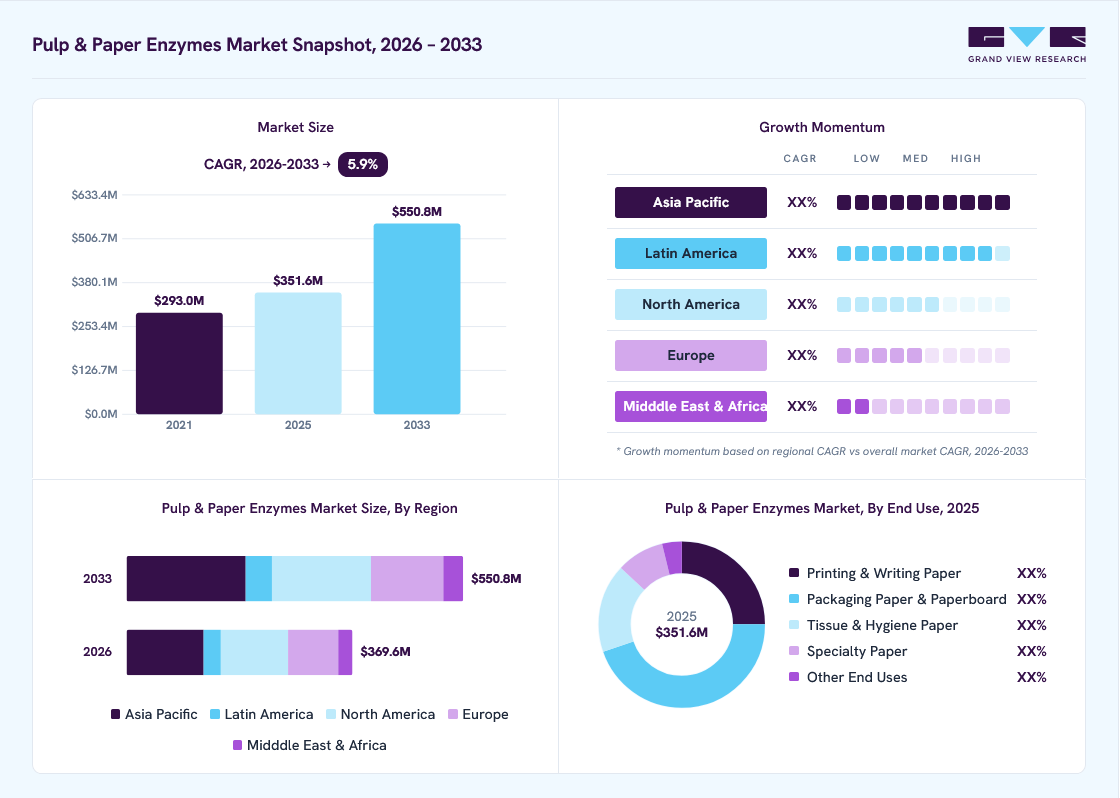
The global pulp & paper enzymes market size was valued at USD 351.6 million in 2025 and is projected to grow from USD 369.6 million in 2026 to USD 550.8 million by 2033, at a CAGR of 5.9% from 2026 to 2033. Asia Pacific dominated the market, accounting for the largest revenue share of 33.9% in 2025. Market growth is driven by expanding battery manufacturing, rising electric vehicle adoption, and increasing demand for nickel compounds in electroplating, catalysts, electronics, ceramics, and specialty chemical applications.
Key Market Trends & Insights
- By product: The xylanases held the largest revenue share of 33.6% in 2025.
- By application: The pulp bleaching/biobleaching segment dominated the market with a revenue share of 38.9% in 2025.
- By end use: The tissue & hygiene paper is expected to grow the fastest CAGR of 6.5% from 2026 to 2033.
Regional Highlights
- Largest region: Asia Pacific (33.9%, revenue share, 2025)
- Fastest-growing region: Latin America (highest CAGR, 2026-2033)
Market Size & Forecast
- Market size in 2025: USD 351.6 Million
- Estimated market size in 2026: USD 369.6 Million
- Projected market size by 2033: USD 550.8 Million
- CAGR (2026-2033): 5.9%
Three ways to get this report
Buy it, customize it, or ask a question.Ask an Analyst
A direct answer, usually in 1 working day
- AccessReport author, directly
- Reply timeWithin 1 working day
- No sales callDirect answer only
- FormatEmail reply
- CostFree, no cost
Get the Full Report
What the study covers
- FormatsPDF · Excel · Dashboard
- Timeline2026–2033 annual, 2025 base
- Coverage20+ countries, 5 regions
- Companies10+ key players profiled
Customize the Report
20% free customization
- IncludeCountries, segments, points
- TailorTo your product definition
- ExtendDeeper competitor detail
- OrA fully bespoke study
- Turnaround5–10 working days
Market growth is supported by rising demand for sustainable and efficient processing solutions across pulp production, papermaking, bleaching, deinking, and fiber modification. Enzymes such as cellulases, xylanases, laccases, lipases, amylases, and pectinases are increasingly used to improve fiber quality, enhance bleaching efficiency, reduce chemical consumption, control pitch and stickies, and improve paper properties. Growing emphasis on reducing the environmental footprint of pulp and paper manufacturing is encouraging mills to adopt enzyme-based technologies as alternatives or supplements to conventional chemical treatments.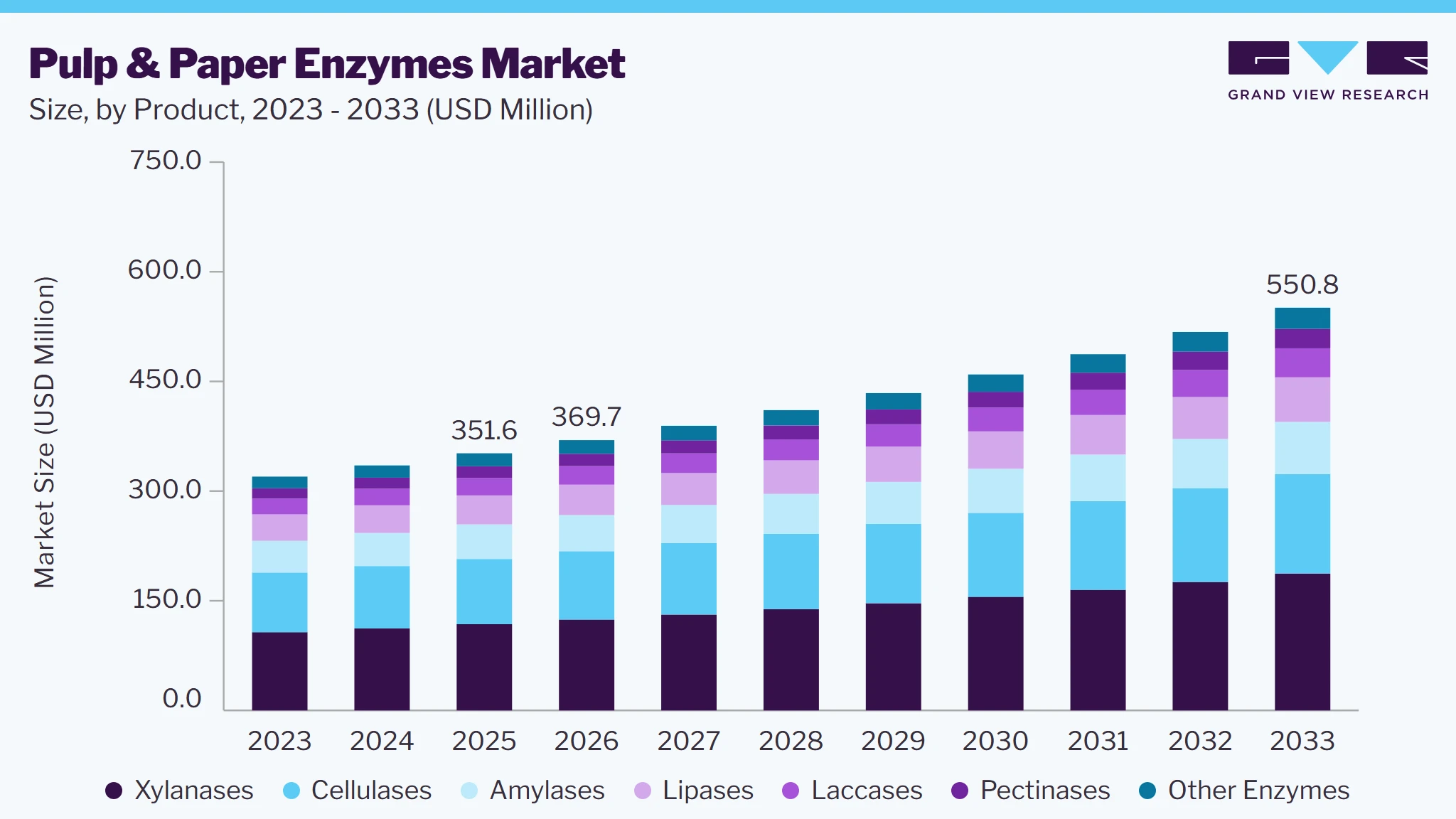
Market Dynamics
The market is shaped by pulp production volumes, paper and packaging output, recycled fiber utilization, mill process configurations, enzyme availability, and developments in industrial biotechnology. Demand varies by application, with cellulases, xylanases, laccases, lipases, amylases, and other enzyme classes meeting specific requirements in pulping, bleaching, refining, deinking, pitch control, fiber modification, and wastewater treatment.
Adoption is also influenced by enzyme activity, operating temperature, and pH, dosage requirements, pulp characteristics, treatment duration, and compatibility with existing mill infrastructure. Advances in enzyme engineering are enabling suppliers to improve catalytic efficiency and develop formulations suited to increasingly specialized mill processes.
Expansion of global paper, tissue, board, and packaging production is generating greater demand for process-efficiency solutions, including enzymes. Rising consumption of corrugated packaging, cartons, hygiene papers, and specialty paper products is increasing production requirements across pulp and paper mills.
Enzymes support specific manufacturing stages by improving fiber processing, refining efficiency, bleaching performance, and paper quality. Their ability to enhance selected production parameters without serving as the primary structural component of the finished product supports their integration into high-volume manufacturing processes.
The performance of the enzyme formulation depends heavily on the characteristics of the pulp and the operating conditions of individual mills. Variations in fiber composition, furnish quality, temperature, pH, residence time, and chemical conditions can affect enzyme effectiveness.
This application sensitivity can require laboratory testing, mill-scale trials, dosage optimization, and process adjustments before commercial deployment. Such technical requirements can lengthen adoption cycles and create barriers for mills seeking standardized solutions that can be implemented with minimal operational modification.
Growing utilization of recovered paper is creating opportunities for enzymes designed specifically for recycled-fiber processing. Recovered furnish can contain inks, coatings, adhesives, stickies, and other contaminants that influence pulp cleanliness, drainage, fiber strength, and machine efficiency.
Specialized enzymes can target contaminants or modify fiber characteristics during deinking and recycling processes. Increasing efforts to process lower-quality recovered materials into usable pulp could expand the addressable application base for enzyme manufacturers developing solutions tailored to different grades and compositions of recycled feedstock.
Market Concentration & Characteristics
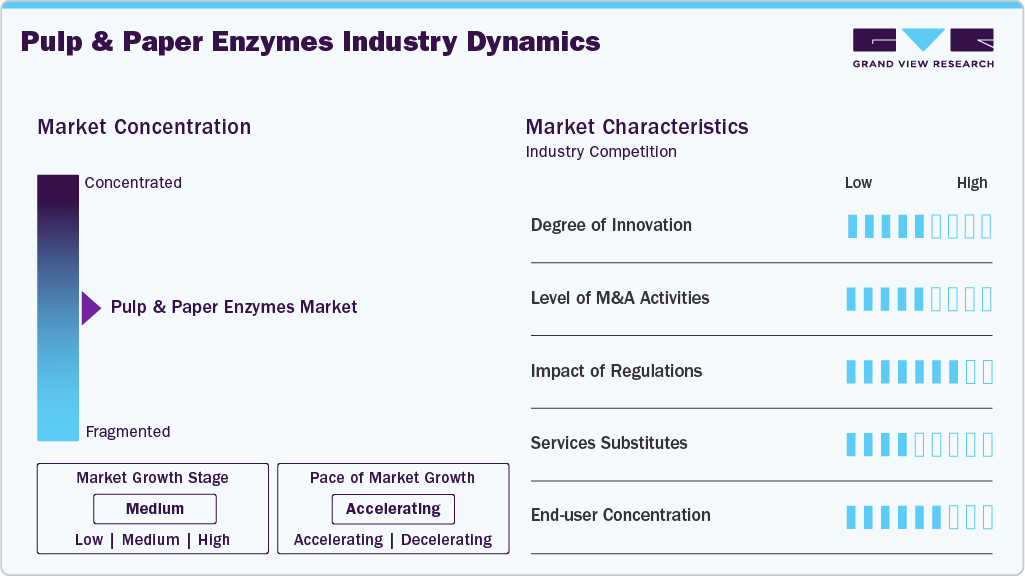
The pulp & paper enzymes industry consists of multinational enzyme producers, specialty biotechnology companies, chemical suppliers, and regional manufacturers. Leading participants generally compete through proprietary enzyme technologies, extensive application expertise, established mill relationships, and broad product portfolios, while smaller suppliers can differentiate through customized formulations and niche applications.
The competitive environment is characterized by product specialization rather than commoditization. Key selection criteria include enzyme performance, formulation stability, dosage efficiency, compatibility with mill conditions, technical support, and total process economics. Intellectual property, research capabilities, application-development expertise, and the ability to customize formulations provide important competitive advantages. Supplier relationships are often strengthened through technical trials, on-site process optimization, and application-specific product development. As a result, competition extends beyond product pricing to include formulation expertise, customer support, validation capabilities, and the ability to deliver consistent performance on a commercial scale.
Leading companies are strengthening their market positions through product development, improvements in enzyme formulations, application-specific solutions, and expanded technical support capabilities. Manufacturers are focusing on developing enzymes with higher activity, improved stability, lower dosage requirements, and greater compatibility with diverse pulp and paper processing conditions. Companies are also expanding collaborations with pulp and paper mills to conduct application trials, optimize enzyme dosage, and develop solutions tailored to specific requirements, including bleaching, deinking, refining, fiber modification, pitch control, and wastewater treatment.
Analyst Perspective
The market is expected to maintain a positive growth trajectory, supported by increasing paper and packaging production, rising utilization of recycled fiber, and growing adoption of enzyme-based processing technologies. Demand is expected to remain strong across applications such as bleaching, deinking, refining, fiber modification, pitch control, and wastewater treatment, as pulp and paper manufacturers seek to improve process performance and meet evolving production requirements. From a competitive perspective, enzyme activity, formulation stability, dosage efficiency, process compatibility, and technical support are becoming important differentiators, encouraging manufacturers to invest in enzyme development, application-specific formulations, and collaboration with pulp and paper mills to optimize process performance.
Product Insights
The xylanases dominated the market, accounting for 33.6% of total revenue in 2025. Its leading position is supported by the broad use of xylanase-based solutions in pulp bleaching, biobleaching, fiber modification, and refining processes. Xylanases help improve pulp brightness and processing efficiency by facilitating the breakdown of hemicellulose, making them an important enzyme class for mills seeking to optimize bleaching performance and pulp quality.
The pectinases segment is expected to expand at a CAGR of 6.7% during the forecast period. Growth is supported by the increasing use of pectinase-based solutions in fiber treatment and pulp processing, particularly where the removal or modification of pectic substances can improve fiber characteristics and downstream process performance. Rising demand for process optimization and greater use of enzyme-assisted treatments is expected to drive adoption in selected pulp and paper applications.
End Use Insights
Packaging paper & paperboard dominated the application segment, accounting for 44.7% of revenue in 2025. High production volumes of corrugated packaging, cartons, and paperboard products provide a substantial application base for pulp and paper enzymes. The diverse processing requirements associated with these grades, including starch treatment, refining, and contaminant management, support the continued use of enzymes.
Tissue & hygiene paper is expected to grow at a CAGR of 6.5% during the forecast period. The expansion of tissue rolls, towels, napkins, and other hygiene-related paper products is increasing the need for technologies that help manufacturers achieve the required softness, strength, and formation characteristics. Enzymes can be incorporated at selected stages of fiber preparation to support these product-specific performance requirements.
Application Insights
The pulp bleaching/biobleaching segment dominated the market, accounting for 38.9% of total revenue in 2025. Enzymes used in this application can facilitate lignin modification and improve the effectiveness of subsequent bleaching stages. Their incorporation into bleaching sequences enables mills to adjust treatment conditions while maintaining the required brightness characteristics of pulp.
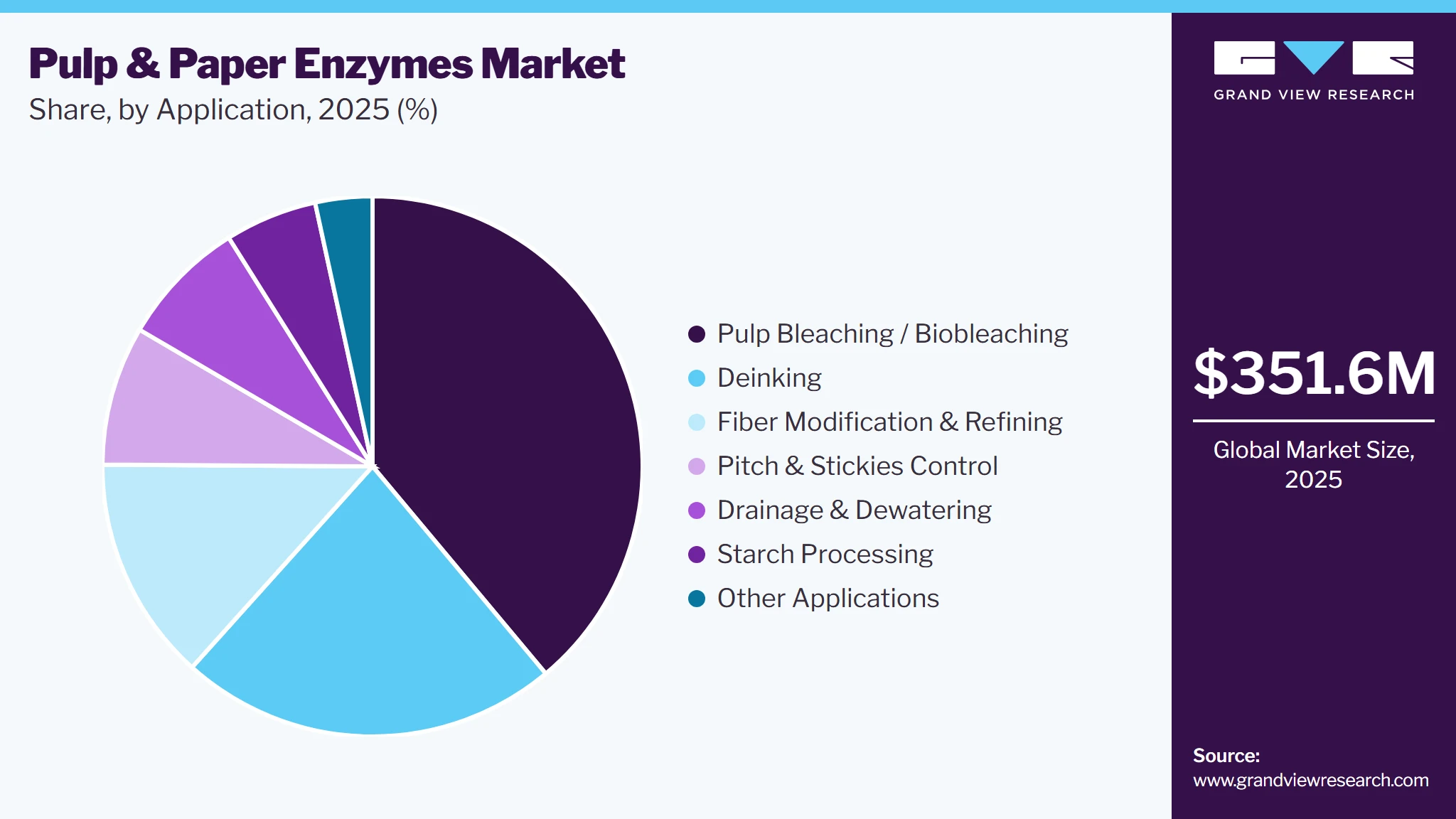
The pitch & stickies control segment is expected to register the fastest growth, expanding at a CAGR of 6.6% during the forecast period. Rising contamination from hydrophobic substances, adhesives, and other deposits is increasing the need for targeted control measures within paper machines. Enzymatic treatments can break down or modify these materials, helping reduce deposit accumulation and associated cleaning requirements.
Regional Insights
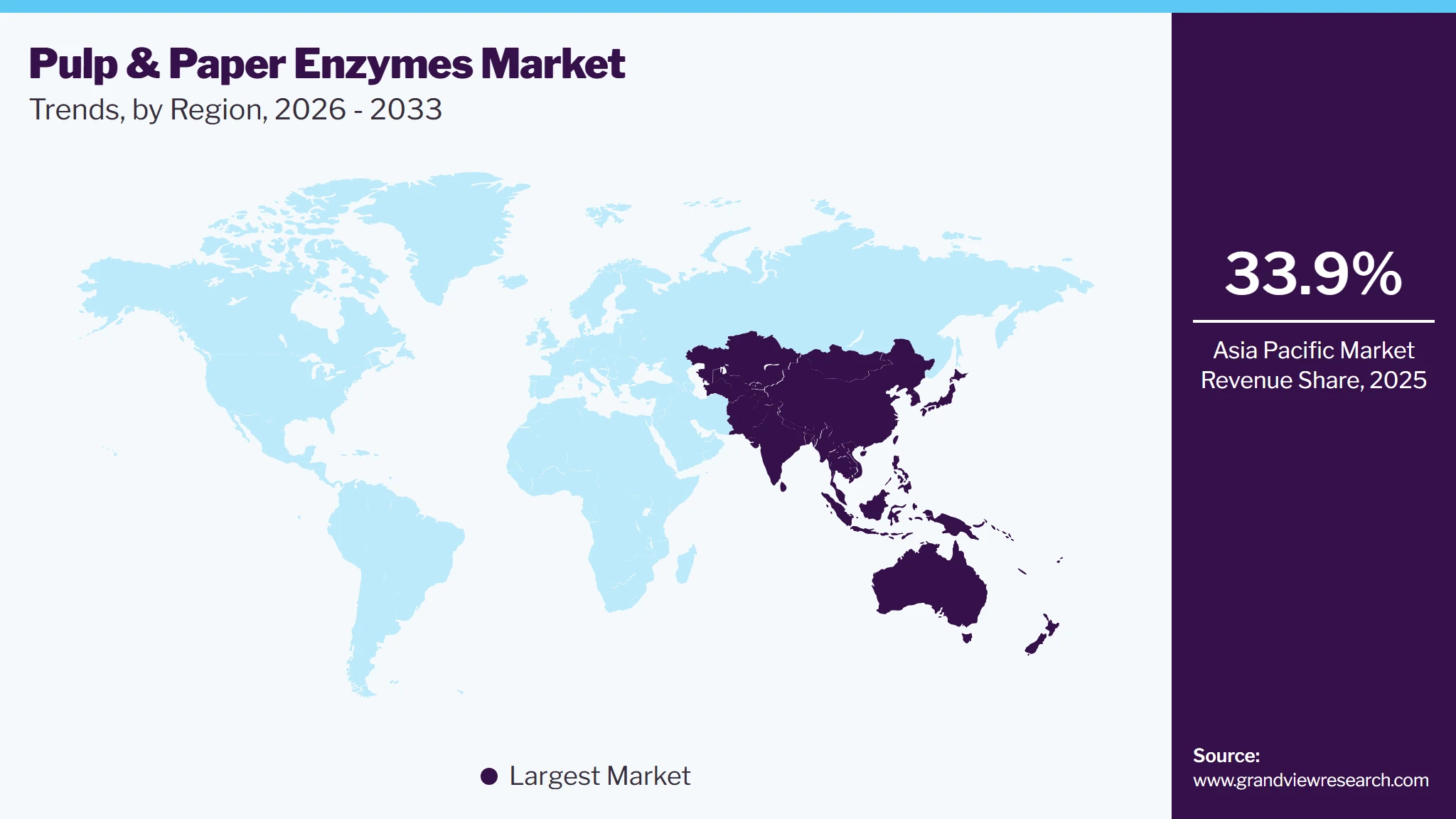
Asia Pacific dominated the market by 33.9% revenue share in 2025. The region's leadership is supported by its extensive paper manufacturing ecosystem and strong output of packaging grades, printing papers, and tissue products. China, Japan, India, and Southeast Asian countries contribute significantly to regional consumption, while expanding mill capacities and technological upgrades are creating a broad customer base for enzyme suppliers.
China Pulp & Paper Enzymes Market Trends
The pulp & paper enzymes market in China has a substantial demand due to the scale of its containerboard, corrugated paper, and paperboard industries. The country's extensive manufacturing network generates significant demand for technologies that address starch characteristics, furnish preparation, and machine deposits. Increasing technical sophistication among domestic producers is also shifting purchasing preferences toward higher-performance specialty solutions.
North America Pulp & Paper Enzymes Market Trends
The pulp & paper enzymes market in North America is supported by its established recovered-paper collection and processing infrastructure. A mature secondary-fiber ecosystem creates opportunities for enzymes to address inks, adhesives, stickies, and other contaminants introduced during recycling. The presence of technically advanced mills also enables suppliers to conduct controlled trials and demonstrate application-specific performance before commercial adoption.
The U.S. pulp & paper enzymes market benefits from a broad mix of packaging, tissue, printing, writing, and specialty paper manufacturing. Expansion in parcel shipments and consumer goods distribution is strengthening demand for corrugated packaging materials, while tissue consumption provides a separate source of demand for enzymes. This diversified product mix reduces dependence on a single paper grade and supports applications across multiple manufacturing processes.
Europe Pulp & Paper Enzymes Market Trends
The pulp & paper enzymes market in Europe is closely associated with the region's circularity objectives and environmental standards. Producers are seeking alternatives that can reduce reliance on intensive chemical treatments and improve resource utilization within mills. Regulations and sustainability targets concerning water, effluents, energy use, and chemical inputs are therefore influencing investment decisions and accelerating interest in biological processing methods.
Latin America Pulp & Paper Enzymes Market Trends
The pulp & paper enzymes market in Latin America has a competitive advantage stems from its extensive forestry resources and favorable conditions for plantation-based pulp production. Brazil is particularly important because of its large eucalyptus pulp industry and export-oriented manufacturing structure. The development of additional pulp capacity and integrated forestry operations is creating opportunities for enzyme suppliers serving high-volume kraft pulp production.
Middle East & Africa Pulp & Paper Enzymes Market Trends
The pulp & paper enzymes market in MEA is being shaped by rising domestic consumption of tissue, hygiene products, and packaging materials. Population growth and urban development are increasing demand for everyday paper-based products, while local manufacturing initiatives aim to reduce reliance on imported grades. These structural changes are gradually creating a larger customer base for process technologies used by regional paper producers.
Key Pulp & Paper Enzymes Company Insights
Companies operating in the market are strengthening their competitive positions through product portfolio expansion, enzyme formulation development, application-specific product development, strategic collaborations, and investments in biotechnology capabilities. Leading manufacturers focus on improving enzyme activity, formulation stability, dosage efficiency, process compatibility, and supply reliability while expanding their solutions across pulp bleaching, deinking, refining, fiber modification, pitch control, and wastewater treatment. Growing demand for sustainable and efficient paper manufacturing is also encouraging companies to collaborate with pulp and paper mills, conduct application trials, and develop customized enzyme solutions suited to specific mill operating conditions.
-
BASF is a market participant, offering enzyme-based and biotechnology solutions that support various stages of pulp and paper production. The company focuses on developing solutions that improve process efficiency, pulp quality, bleaching performance, and resource utilization. Its expertise in chemical and biotechnology applications, combined with its global technical and commercial presence, supports its market position. BASF's ability to develop application-oriented solutions and to work with industrial customers strengthens its competitive position in pulp processing and paper manufacturing.
-
AB Enzymes is a market participant, specializing in the development and supply of industrial enzyme solutions for pulp and paper processing. The company offers enzyme technologies for applications such as pulp bleaching, fiber modification, deinking, refining, and paper production. Its focus on enzyme performance, process efficiency, formulation development, and application-specific solutions enables it to address the technical requirements of pulp and paper manufacturers. The company's enzyme expertise and focus on solutions tailored to individual processing conditions support its competitive position in the market.
Key Pulp & Paper Enzymes Companies
The following key companies have been profiled for the study on the pulp & paper enzymes market.
-
BASF
-
AB Enzymes
-
ABF Ingredients
-
Novozymes A/S,
-
Noor Enzymes
-
Tex Biosciences
-
Alfanzyme
-
Infinita Biotech Private Limited
-
Advanced Enzyme Technologies
-
Buckman
Competitive Benchmarking
Operating Strategies
Competitive Edge
Weaknesses
Mature Players: BASF, AB Enzymes, ABF Ingredients, Novozymes A/S (Novonesis), Buckman
- Expand enzyme portfolios across pulp bleaching, deinking, refining, fiber modification, pitch control, and paper processing applications.
- Invest in enzyme engineering, formulation optimization, and biotechnology R&D to improve activity, stability, and performance under diverse mill conditions.
- Strengthen technical collaborations with pulp and paper manufacturers to conduct mill trials and develop application-specific enzyme solutions.
- Expand global production and distribution capabilities to provide consistent product availability and technical support across major pulp and paper-producing regions.
- Extensive R&D and biotechnology capabilities support the development of specialized enzyme formulations for complex processing requirements.
- Established relationships with large pulp and paper manufacturers provide access to major customers and facilitate long-term commercial adoption.
- Broad enzyme portfolios enable participation across multiple processing stages rather than dependence on a single application.
- Global manufacturing, distribution, and technical-service networks support international market coverage and customer assistance.
- Strong financial and organizational resources enable continued investment in enzyme development, application testing, and production technologies.
- Large multinational operating structures can result in longer development and commercialization cycles for highly customized applications.
- Extensive R&D and technical-service infrastructure can increase operating and product-development costs.
- Broad product portfolios may require significant resources to maintain application-specific expertise across different pulp types and mill processes.
- Dependence on large industrial customers can expose suppliers to lengthy qualification processes and extended purchasing cycles.
Emerging Players: Noor Enzymes, Tex Biosciences, Alfanzyme, Infinita Biotech Private Limited, Advanced Enzyme Technologies
- Expand specialized enzyme portfolios targeting pulp bleaching, deinking, fiber treatment, refining, and other niche paper-processing applications.
- Focus on customized formulations and dosage optimization to address specific operating conditions of individual mills.
- Strengthening domestic and regional distribution networks to improve customer reach and shorten delivery timelines.
- Develop collaborations with pulp and paper manufacturers, distributors, and industrial biotechnology partners to accelerate application validation and market penetration.
- Greater flexibility enables faster adaptation to customer-specific formulation, dosage, and application requirements.
- Regional presence can support closer customer engagement and more responsive technical assistance.
- Specialized portfolios allow emerging suppliers to concentrate resources on selected high-value enzyme applications.
- Leaner organizational structures can facilitate quicker commercial decisions and product modifications.
- Competitive pricing can support penetration among mills seeking cost-effective alternatives to established suppliers.
- Smaller production and distribution networks can limit their ability to serve large multinational pulp and paper groups across multiple regions.
- More limited R&D resources may constrain the development of highly specialized or next-generation enzyme technologies.
- Lower brand recognition compared with established global enzyme suppliers can make qualification with major paper manufacturers more challenging.
- Limited technical-service infrastructure in some markets can restrict large-scale application support and on-site process optimization.
Recent Developments
- In August 2024, AB Enzymes entered into a strategic distribution agreement with APC Group to expand the availability of its pulp & paper enzyme solutions across China, India, most of Southeast Asia, and the Middle East. Under the agreement, APC Group received exclusive distribution rights for AB Enzymes' products in these markets. The partnership is intended to improve regional customer access to enzyme-based solutions while leveraging APC Group's established market presence and expertise in pulp and paper applications.
Pulp & Paper Enzymes Market Report Scope
Report Attribute
Details
Market Definition
The market comprises specialized biological enzymes, including xylanases, cellulases, amylases, lipases, laccases, and pectinases, used to optimize pulp and paper manufacturing processes.
These enzymes are used in bleaching, deinking, fiber modification, refining, pitch and stickies control, drainage, and starch processing to produce various paper and paperboard grades.Market size in 2025
USD 351.6 million
Estimated market size in 2026
USD 369.6 million
Projected market size by 2033
USD 550.8 million
Growth rate
CAGR of 5.9% from 2026 to 2033
Historical data
2021 - 2025
Forecast period
2026 - 2033
Quantitative units
Volume in kilotons, revenue in USD million, and CAGR from 2026 to 2033
Report coverage
Revenue forecast, company ranking, competitive landscape, growth factors, and trends
Segments covered
Product, application, end use, region
Regional scope
North America, Europe, Asia Pacific, Latin America, Middle East & Africa
Country scope
U.S.; Canada; Mexico; Germany; UK; France; Italy; Spain; China; India; Japan; South Korea; Brazil; Argentina; Saudi Arabia; South Africa
Key companies profiled
BASF; AB Enzymes; ABF Ingredients; Novozymes A/S; Noor Enzymes; Tex Biosciences; Alfanzyme; Infinita Biotech Private Limited; Advanced Enzyme Technologies; Buckman
Customization scope
Free report customization (equivalent up to 8 analysts’ working days) with purchase. Addition or alteration to country, regional & segment scope.
Pricing and purchase options
Avail customized purchase options to meet your exact research needs. Explore purchase options
Global Pulp & Paper Enzymes Market Report Segmentation
This report forecasts revenue growth at regional levels and provides an analysis of the latest industry trends in each of the sub-segments from 2021 to 2033. For this study, Grand View Research has segmented the global pulp & paper enzymes market report based on product, application, end use, and region:
-
Product Outlook (Volume, Kilotons; Revenue, USD Million, 2021 - 2033)
-
Xylanases
-
Cellulases
-
Amylases
-
Lipases
-
Laccases
-
Pectinases
-
Other Enzymes
-
-
Application Outlook (Volume, Kilotons; Revenue, USD Million, 2021 - 2033)
-
Pulp Bleaching/Biobleaching
-
Deinking
-
Fiber Modification & Refining
-
Pitch & Stickies Control
-
Drainage & Dewatering
-
Starch Processing
-
Other Applications
-
-
End Use Outlook (Volume, Kilotons; Revenue, USD Million, 2021 - 2033)
-
Printing & Writing Paper
-
Packaging Paper & Paperboard
-
Tissue & Hygiene Paper
-
Specialty Paper
-
Other End Uses
-
-
Region Outlook (Volume, Kilotons; Revenue, USD Million, 2021 - 2033)
-
North America
-
U.S.
-
Canada
-
Mexico
-
-
Europe
-
Germany
-
UK
-
France
-
Italy
-
Spain
-
-
Asia Pacific
-
China
-
India
-
Japan
-
South Korea
-
-
Latin America
-
Brazil
-
Argentina
-
-
Middle East & Africa
-
Saudi Arabia
-
South Africa
-
-
Research Methodology
The pulp & paper enzymes market figures in this report are based on a proven research process that combines executive interviews with secondary research from proprietary databases, company filings, and recognized regulatory and institutional sources. Market size is built through value-chain sizing - reconciling supply-side and demand-side estimates - and triangulated with bottom-up and top-down approaches. Every estimate passes multiple levels of expert validation before publication, with each pulp & paper enzymes segment quantified using the revenue-capture definitions in the table below.
Segment Definition
Segment - Product
Revenue capture definition
Xylanases
Revenue is generated from the sale of xylanase-based enzyme solutions used primarily in pulp bleaching, biobleaching, fiber modification, and refining. Demand is influenced by pulp production volumes, requirements for improved bleaching efficiency, and the adoption of enzyme-assisted processing.
Cellulases
Market revenues arise from cellulase-based solutions used for fiber modification, refining, deinking, and improving the processing characteristics of pulp and recycled fibers. Demand is influenced by recycled fiber utilization, paper quality requirements, and mill-level process optimization.
Amylases
Revenue is generated from amylase-based enzyme solutions used primarily in starch processing for papermaking, including viscosity control and starch modification. Demand is influenced by paper production volumes, starch consumption, and requirements for consistent coating and paper strength performance.
Lipases
Sales are generated from lipase-based solutions used for pitch and deposit control in pulp and paper manufacturing. Demand is supported by the need to manage hydrophobic contaminants, improve machine cleanliness, reduce operational disruptions, and maintain stable production.
Laccases
Revenue is derived from laccase-based enzyme solutions used in pulp bleaching, biobleaching, lignin modification, and related fiber-treatment processes. Demand varies according to requirements for lignin removal, pulp brightness, and alternative biological approaches to conventional processing.
Pectinases
Revenue is generated from pectinase-based solutions used to modify and remove pectic substances from plant-based fibers during pulp processing. Demand is influenced by the characteristics of the raw material, fiber treatment requirements, and the need to improve downstream processing performance.
Other Enzymes
Market revenues arise from other enzyme types, including mannanases, esterases, glucanases, and specialized enzyme blends, used for targeted applications such as bleaching, deinking, fiber treatment, deposit control, and process optimization. Demand is influenced by specific mill requirements and the development of customized enzyme formulations.
Segment - Application
Revenue capture definition
Pulp Bleaching/Biobleaching
Sales are generated from enzyme solutions used to facilitate lignin modification, improve pulp brightness, enhance bleaching efficiency, and support lower-intensity chemical bleaching processes. Revenue is influenced by pulp production, bleaching requirements, and mill efforts to optimize bleaching performance.
Deinking
Market revenues arise from enzymes used to assist the removal or modification of inks, coatings, adhesives, and other contaminants from recovered paper fibers. Demand is influenced by recycled paper production, recovered-fiber quality, and requirements for cleaner deinked pulp.
Fiber Modification & Refining
Revenue is captured from enzymes applied to modify fiber surfaces and improve refining performance, fiber development, bonding characteristics, and paper properties. Demand is influenced by requirements for refining optimization, fiber quality, and production efficiency.
Pitch & Stickies Control
Sales are generated from enzyme solutions designed to break down, modify, or control pitch, stickies, and other deposit-forming substances in pulp and paper systems. Revenue growth is supported by the need to maintain machine cleanliness, minimize deposit-related disruptions, and improve operating stability.
Drainage & Dewatering
Revenue is derived from enzyme-based solutions that influence fiber and contaminant characteristics to support drainage and dewatering performance during papermaking. Demand is influenced by machine productivity, water-management requirements, and efforts to improve process efficiency.
Starch Processing
Market revenues arise from enzymes used to modify starch properties for papermaking applications, including viscosity adjustment, starch cooking, and preparation of starch systems used in paper strength and surface treatment. Demand is linked to starch consumption and requirements for consistent paper-processing performance.
Other Applications
Revenue is generated from enzyme solutions used in additional pulp and paper processes, including wastewater treatment, contaminant management, fiber treatment, and specialized paper-production operations. Demand is influenced by individual mill requirements and the adoption of biological solutions for targeted process challenges.
Segment - End Use
Revenue capture definition
Printing & Writing Paper
Revenue is generated from enzyme solutions used to improve pulp processing, fiber characteristics, bleaching, and paper-quality parameters required for printing and writing grades.
Packaging Paper & Paperboard
Market revenues arise from enzymes used in the production and processing of packaging grades, including solutions supporting recycled-fiber treatment, refining, bleaching, and deposit control.
Tissue & Hygiene Paper
Revenue is captured from enzyme applications that support fiber processing, refining, bleaching, and quality optimization for tissue and hygiene paper production.
Specialty Paper
Sales are generated from application-specific enzyme solutions used to meet specialized requirements related to fiber characteristics, surface properties, processing performance, and product quality.
Other End Uses
Revenue is derived from enzyme solutions used across additional paper and fiber-based products, including industrial papers, technical grades, and other specialized pulp and paper applications.
Estimation Model
Layer No.
Layer Name
Key Question
Description
01
Raw Material & Production Layer
What forms does the supply base take?
Examine the production of pulp & paper enzymes from biological feedstocks and microbial sources, including bacteria, fungi, fermentation substrates, nutrients, and other inputs used in enzyme production. The assessment covers microbial strain selection, fermentation, enzyme extraction, purification, stabilization, formulation, quality control, production capacity, manufacturing technology, storage, and distribution. It also evaluates raw-material availability, fermentation costs, energy requirements, production yields, technological capabilities, and capacity expansion that influence enzyme activity, formulation consistency, production economics, and supply reliability.
02
Form Adoption Layer
Where is pulp & paper enzymes utilized?
Evaluate the adoption of pulp & paper enzymes across major processing applications, including pulp bleaching and biobleaching, deinking, fiber modification and refining, pitch and stickies control, drainage and dewatering, starch processing, and other specialized mill operations. The assessment considers the suitability of different enzyme types for specific process conditions and examines adoption according to pulp type, paper grade, recycled-fiber content, mill configuration, and desired process outcomes.
03
Consumption Intensity Layer
How much pulp & paper enzymes is consumed?
Assess enzyme consumption across major pulp and paper processing applications based on production volumes, enzyme dosage, treatment frequency, pulp characteristics, and operating conditions. The analysis considers enzyme requirements per unit of pulp or paper production, application-specific dosage levels, mill capacity, recycled-fiber utilization, process intensity, and the frequency of enzyme treatment to estimate consumption volumes across key applications and regions.
04
Revenue Layer
How is market revenue generated?
Market revenue is generated through the production and sale of xylanases, cellulases, amylases, lipases, laccases, pectinases, and other enzyme formulations used in pulp and paper processing. Revenue realization is influenced by enzyme activity, formulation concentration, dosage requirements, degree of customization, application complexity, production costs, customer specifications, technical-service requirements, contract structures, and regional pricing conditions. Higher-value application-specific formulations and customized enzyme solutions can command greater revenue realization than standardized products.
Delivered Customizations
This report has been delivered with the following In-depth customizations
Client Request
Customization Delivered
Value Adds
Cross-segmentation
The assessment provides detailed cross-segmentation of the pulp & paper enzymes industry across product, application, and end use. The analysis covers xylanases, cellulases, amylases, lipases, laccases, pectinases, and other enzymes, with further assessment across pulp bleaching/bio bleaching, deinking, fiber modification & refining, pitch & stickies control, drainage & dewatering, starch processing, and other applications.
Enables identification of high-growth opportunities across specific product-application-end-use combinations. Supports product development, application targeting, production planning, and market-entry strategies by highlighting enzyme-specific demand patterns, application requirements, consumption intensity, and growth potential.
Opportunity Assessment
Detailed evaluation of growth opportunities arising from increasing paper and packaging production, rising recycled-fiber utilization, adoption of biological processing technologies, expansion of deinking activities, demand for process optimization, and development of application-specific enzyme formulations. The assessment also covers opportunities associated with enzyme engineering, customized formulations, mill-level process optimization, and expansion into emerging pulp and paper applications.
Enables identification of attractive opportunities across the pulp & paper enzymes value chain, from enzyme development and production to application-level deployment. Supports decisions related to formulation development, R&D investment, application expansion, regional market entry, technical partnerships, and customer targeting by identifying high-potential applications and evolving mill requirements.
Competitive Benchmarking
Comparative assessment of leading enzyme manufacturers based on product portfolios, enzyme types, application coverage, formulation capabilities, production footprint, geographic presence, R&D capabilities, technical expertise, customization capabilities, distribution networks, and strategic initiatives. The benchmarking evaluates product performance, application specialization, technical support, production capabilities, and market positioning across major pulp and paper applications.
Supports benchmarking against key pulp & paper enzyme suppliers while identifying opportunities to strengthen product differentiation, formulation performance, application coverage, technical capabilities, and customer relationships. The analysis assists strategic decisions concerning product development, R&D investment, application diversification, regional expansion, technical collaborations, and long-term competitive positioning.
Frequently Asked Questions About This Report
The pulp & paper enzymes market size was estimated at USD 351.6 million in 2025 and is expected to reach USD 369.6 million in 2026.
The pulp & paper enzymes market is expected to grow at a compound annual growth rate of 5.9% from 2026 to 2033 to reach USD 550.8 million by 2033.
By application, pulp bleaching / biobleaching dominated the market with a 38.9% revenue share in 2025. Its leading position is attributed to the use of enzymes for lignin modification and enhancement of pulp brightness during bleaching operations.
Key players include BASF, AB Enzymes, ABF Ingredients, Novozymes A/S, Noor Enzymes, Tex Biosciences, Alfanzyme, Infinita Biotech Private Limited, Advanced Enzyme Technologies, Buckman. Their competitive positions are supported by specialized enzyme portfolios, formulation development, technical expertise, and application-specific solutions.
Increasing paper and packaging production is a major market driver, as rising output of paperboard, corrugated materials, tissue, and other paper grades expands the volume of manufacturing operations requiring specialized processing solutions. Growing production requirements are therefore creating a broader application base for pulp and paper enzymes.
Asia Pacific dominated the global pulp & paper enzymes market, accounting for 33.9% of revenue in 2025. The region's leading position is supported by its concentration of large-scale pulp and paper manufacturing facilities and substantial output across packaging, paperboard, tissue, and other grades.
The xylanases held the largest revenue share of 33.6% in 2025.
Tissue & hygiene paper is expected to grow fastest at a CAGR of 6.5% during the forecast period. Rising consumption of tissues, towels, napkins, and hygiene-related paper products is creating greater requirements for specialized fiber-processing solutions.
About the Author(s)
Specialty & Chemicals Research Team
Research · Specialty & ChemicalsThis report was authored by the specialty & chemicals research team at Grand View Research - comprising two research analysts, one senior research analyst, and one industry expert - with specialized expertise in the specialty & chemicals segment of the research industry. All findings are based on proprietary research databases, executive interviews, and regulatory analysis, subject to internal peer review prior to publication.
Last Updated:
Speak to Analyst


Customize this report to your needs - add regions, segments, or data points, with 20% free customization.
Or view our licence options:


ISO 9001:2015 & 27001:2022 Certified
We are GDPR and CCPA compliant! Your transaction & personal information is safe and secure. For more details, please read our privacy policy.


