
- Home
- »
- Advanced Interior Materials
- »
-
Pump Jack Market Size, Share & Trends Report, 2026-2033GVR Report cover
![Pump Jack Market (2026 - 2033)Report]()
Pump Jack Market (2026 - 2033)
Size, Share & Trends Analysis Report By Well (Vertical Well, Horizontal Well), By Weight (Less Than 100,000 lbs, 100,000 lbs to 300,000 lbs), By Application (Onshore, Offshore), By Region, And Segment Forecasts
Market Size, 2025
$3.7BMarket Estimate, 2026
$3.9BMarket Forecast, 2033
$5.7BCAGR, 2026–2033
5.7%Pump Jack Market Summary
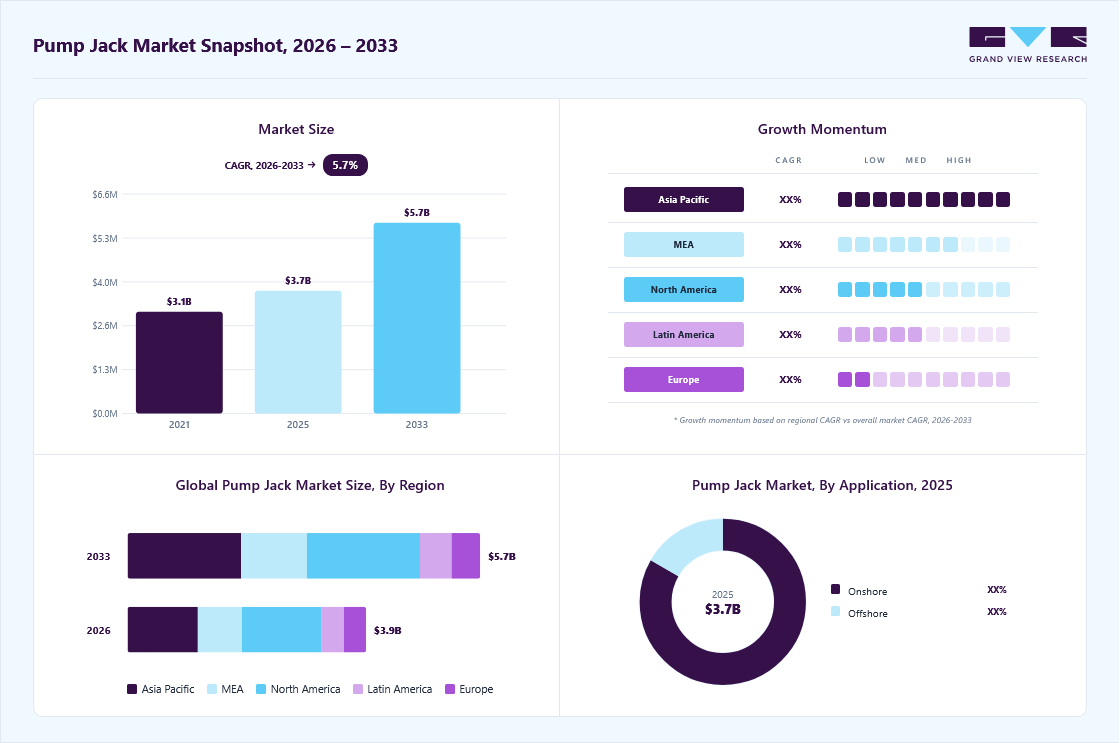
The global pump jack market size was valued at USD 3.7 billion in 2025 and is projected to grow from USD 3.9 billion in 2026 to USD 5.7 billion by 2033, at a CAGR of 5.7% from 2026 to 2033. The market in North America dominated with a revenue share of 33.7% in 2025. The market growth is driven by the sustained need for efficient oil extraction from mature and low-pressure wells where natural reservoir energy is limited.
Key Market Trends & Insights
- By well: Vertical wells segment held the largest market share in 2025.
- By weight: 100,000 lbs to 300,000 lbs segment held the largest market share of 48.5% in 2025.
- By application: Onshore segment held the largest market share of 83.2% in 2025.
Regional Highlights
- Largest regional market: North America (33.7% revenue share, 2025)
- Fastest-growing regional market: Asia Pacific (highest CAGR, 2026-2033)
- By country: U.S. held the largest market share in 2025
Market Size & Forecast
- Market size in 2025: USD 3.7 Billion
- Estimated market size in 2026: USD 3.9 Billion
- Projected market size by 2033: USD 5.7 Billion
- CAGR (2026-2033): 5.7%
Rising energy consumption and ongoing production activities in established onshore fields are supporting the adoption of artificial lift systems such as pump jacks. Aging oil fields across key regions are requiring enhanced recovery techniques, thereby increasing demand for reliable, cost-effective pumping solutions. Continuous advancements in equipment durability, automation, and monitoring technologies are further improving operational efficiency and supporting market growth.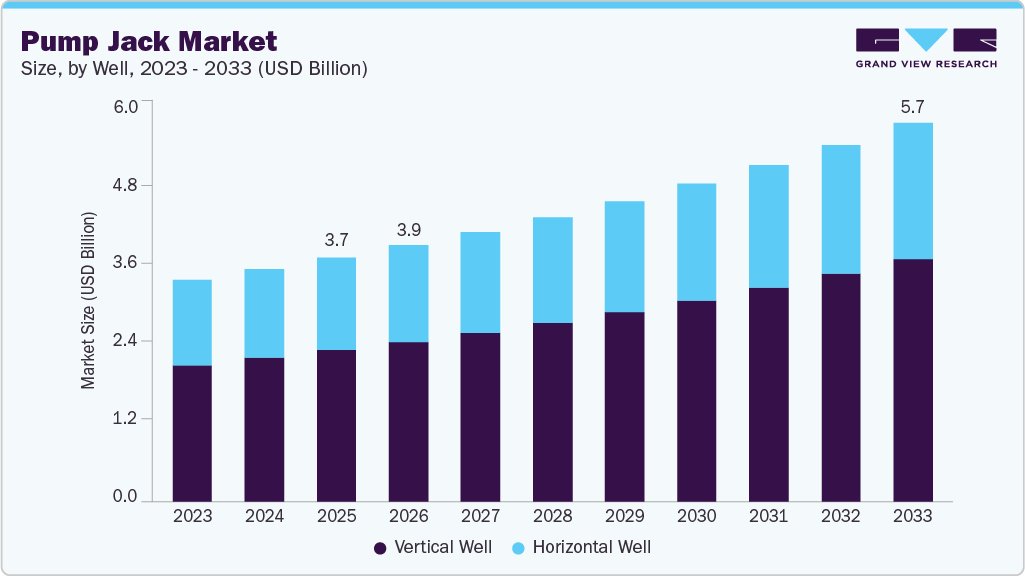
The global pump jack industry’s growth is driven by the sustained requirement for efficient oil extraction from mature and low-pressure wells, where natural reservoir energy is no longer sufficient to maintain production. A significant share of global onshore oil output comes from aging fields, prompting operators to focus on boosting recovery rates and extending the productive life of existing assets. In regions such as North America, the Middle East, and Asia Pacific, the continued reliance on conventional oil reserves is supporting steady demand for artificial lift systems. Pump jacks are widely adopted due to their cost efficiency, mechanical reliability, and suitability for long-term deployment in low-output and stripper wells, where maintaining economic viability is critical.
Market Concentration & Characteristics
The pump jack market exhibits a concentrated structure, with a limited number of established manufacturers accounting for a significant share of global supply, while regional and niche players address localized requirements. Major companies compete on the basis of engineering capabilities, product reliability, and strong service networks, while long-term contracts and operator preference for proven equipment contribute to a stable competitive environment. Entry barriers remain relatively high due to the need for technical expertise, capital-intensive manufacturing, and demonstrated field performance, which restricts the pace of new entrants.
The industry is closely tied to mature and late-life oilfields, where pump jacks are essential for sustaining production from declining reservoirs. Demand is primarily linked to ongoing well operations, maintenance cycles, and output optimization rather than new exploration activities, resulting in relatively steady demand patterns. The widespread adoption of standardized beam pump systems highlights the industry’s reliance on established and dependable technologies that can be deployed across a wide range of geological conditions with minimal complexity.
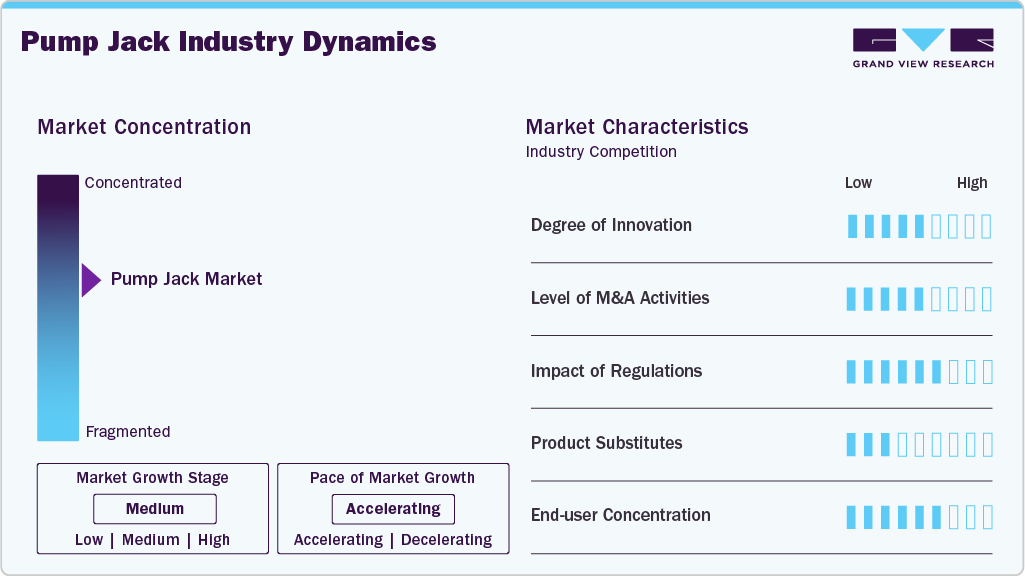
Digital monitoring systems, automated controls, and data-driven analysis are enabling more precise management of pumping operations, improving efficiency and reducing unplanned downtime. Improvements in material quality and mechanical design are enhancing resistance to wear and environmental stress, supporting longer service life in challenging conditions. A greater focus on energy optimization and cost control is also influencing purchasing decisions, as operators prioritize solutions that deliver consistent output at lower operational expenditure.
Drivers, Opportunities & Restraints
The pump jack market is driven by the ongoing need to sustain oil production from mature, low-pressure wells where natural reservoir energy has declined. A significant portion of onshore oil output continues to depend on such wells, making artificial lift systems essential for maintaining stable production levels. Established oil-producing regions rely heavily on pump jacks due to their mechanical reliability, cost efficiency, and suitability for long-term operation in low-yield conditions. Continued upstream activities focused on maintaining output from existing assets are reinforcing steady demand for these systems.
The integration of automation, remote monitoring, and advanced control systems is enabling operators to optimize pumping performance and improve overall productivity. Modernization of legacy equipment and the adoption of digital solutions are creating opportunities for enhanced system efficiency and better asset management. Expanding oilfield development in emerging regions, along with a growing focus on maximizing recovery rates, is further driving the adoption of upgraded, technologically advanced pump jack systems.
The pump jack industry faces constraints imposed by external economic and operational factors that can affect investment decisions. Volatility in crude oil prices often leads to fluctuations in capital expenditure, affecting equipment deployment and replacement cycles. The gradual shift toward alternative energy sources may reduce long-term reliance on conventional oil production. Technical limitations also exist, as pump jacks may not be the most efficient solution for deeper or high-capacity wells where other artificial lift methods are more suitable. In addition, ongoing maintenance requirements and exposure to harsh operating environments can increase operational costs, posing challenges for some end users.
Well Insights
Vertical wells accounted for the largest revenue share of the pump jack market in 2025, driven by their widespread presence in mature onshore oilfields. These wells are commonly found in aging reservoirs where natural pressure has declined, making artificial lift systems essential for continued production. Pump jacks are well-suited for vertical wells because of their simple design, ease of installation, and efficient operation at low-to-moderate depths. The large installed base of such wells, along with ongoing maintenance and replacement needs, continues to generate consistent demand and revenue for pump jack systems.
The horizontal wells segment is expected to grow at a 5.0% CAGR during forecast period. This growth is primarily associated with unconventional oil extraction and advanced drilling practices. These wells are designed to maximize reservoir contact and improve production rates, often relying on alternative artificial lift technologies better suited for complex flow dynamics. However, in certain cases where production declines over time, pump jacks may still be used for late-stage operations. The growth of horizontal drilling is creating a gradual shift in oilfield practices, though its direct contribution to pump jack demand remains limited compared to traditional vertical well applications.
Weight Insights
The 100,000 lbs to 300,000 lbs segment led the pump jack industry, holding 48.5% revenue share in 2025, primarily due to its broad applicability across conventional onshore oil wells. These units offer an optimal balance between lifting capacity and operational efficiency, making them suitable for medium-depth wells with moderate production requirements. Their widespread adoption in established oilfields, along with a substantial installed base, supports consistent demand for maintenance, refurbishment, and replacement. The reliability and adaptability of this weight range make it a preferred choice for operators aiming to maintain stable production while managing operational costs.
The less than 100,000 lbs segment is projected to register the fastest CAGR over the forecast period, supported by increasing focus on marginal and low-output wells. These pump jacks are designed for lighter-duty applications, offering advantages such as lower capital investment, reduced energy consumption, and ease of installation. Their suitability for stripper wells and small-scale operations is driving adoption, particularly in regions where operators are prioritizing cost-efficient extraction from declining reservoirs. The growing emphasis on optimizing production from aging assets is expected to further accelerate demand in this segment.
Application Insights
Onshore applications account for the largest revenue share of 83.2% in 2025, supported by the extensive presence of mature oilfields and the continued reliance on conventional production methods. A significant number of land-based wells require artificial lift systems to maintain output as reservoir pressure declines over time. Pump jacks are widely deployed in these environments due to their cost efficiency, ease of maintenance, and suitability for long-term operation in low- to moderate-production wells. The large installed base of onshore wells, along with ongoing servicing and equipment replacement needs, ensures steady demand and revenue generation within this segment.
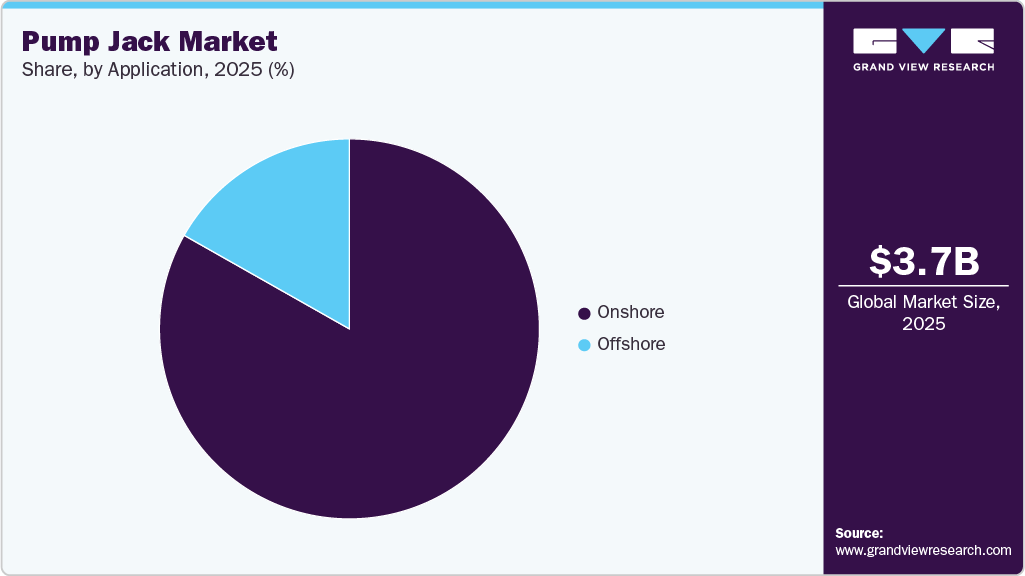
Offshore applications represent a comparatively limited segment for pump jacks, as offshore operations typically rely on alternative lifting technologies better suited to complex well conditions and higher production volumes. Space constraints, environmental factors, and higher operational demands in offshore settings reduce the feasibility of conventional pump jack systems. However, in select shallow-water or platform-based operations with declining output, there may be niche use cases for simplified mechanical lifting solutions. Overall, offshore demand remains restricted, with growth largely dependent on specific operational requirements rather than widespread adoption.
Regional Insights
North America dominated the pump jack market in 2025, supported by a large base of mature onshore oilfields and well-established production infrastructure. The region has a significant number of aging wells where natural reservoir pressure has declined, making artificial lift systems essential for sustaining output. Pump jacks are widely used across these fields due to their operational reliability, relatively low maintenance requirements, and cost-effective performance over long production cycles. The continued focus on maximizing recovery from existing assets, rather than relying solely on new drilling, supports steady, sustained demand in the region.

U.S. Pump Jack Market Trends
The U.S. is the dominant contributor within the North America pump jack industry, driven by extensive oil production from mature basins such as the Permian and other inland shale and conventional fields. A large share of production comes from low-yield and stripper wells, where pump jacks remain the preferred lifting solution due to their simplicity and economic viability. Operators in the country are increasingly integrating monitoring systems and automation tools to improve well performance and reduce downtime, reflecting a gradual shift toward more efficient field management practices. Strong oilfield service capabilities and continuous optimization of aging wells further reinforce the country’s leadership in pump jack deployment.
Asia Pacific Pump Jack Market Trends
Asia Pacific is fastest growing region in the pump jack industry, expected to grow at a 7.1% CAGR during the forecast period. The market is expected to grow due to increasing oil and gas exploration and production activities across countries such as China and India. Rising energy demand is encouraging the development of onshore oilfields, where pump jacks are widely used for crude extraction. Expansion of mature oilfield operations and continued investment in energy infrastructure are supporting the steady installation of pump jack systems across the region.
The pump jack market in China is growing, driven by its extensive onshore oilfields and continued reliance on conventional crude oil production. A large proportion of output comes from mature and declining reservoirs, particularly in basins operated by major state-owned enterprises, where artificial lift systems are essential to sustain production levels. Pump jacks are widely deployed in these environments due to their suitability for low-pressure wells and cost-efficient operation over long production cycles.
The India pump jack market is steadily expanding, supported by rising energy demand and continued focus on maximizing domestic crude oil production. Onshore fields, particularly in older basins, rely on artificial lift systems to maintain output as reservoir pressure declines. The adoption of pump jacks is influenced by their relatively low operating cost, ease of maintenance, and ability to function effectively in marginal wells.
Europe Pump Jack Market Trends
The Europe pump jacks industry is expected to witness moderate growth during the forecast period, driven by the continued operation of mature onshore oilfields in countries such as Germany, Italy, Russia, and the UK. Efforts to maintain production from existing reserves require reliable artificial lift systems. Ongoing maintenance, equipment replacement, and efficiency improvements in aging oilfield infrastructure support steady demand for pump jack systems across the region.
The Germany pump jack market is expected to witness gradual growth over the forecast period, driven by continued operation and maintenance of mature onshore oilfields. Although oil production levels are moderate, ongoing efforts to maintain domestic energy output support the replacement and servicing of existing pump jack units. Investments in efficient extraction equipment and field upgrades contribute to steady demand within the country’s established oil production infrastructure.
The pump jack market in the UK is expected to grow during the forecast period. The Ongoing activity in mature oilfields, particularly in onshore locations supporting broader energy production, is fueling the market in the UK. Maintenance and refurbishment of aging extraction equipment encourages the use of updated pump jack systems. Continued focus on maximizing output from existing reserves supports consistent demand for reliable pumping solutions across operational oilfield sites.
Latin America Pump Jack Market Trends
The Latin America pump jack industry is expected to grow over the forecast period, driven by the continued development of onshore oilfields in countries such as Brazil, Argentina, and Colombia. Many mature oilfields in the region rely on artificial lift systems to maintain production levels. Increasing investment in field redevelopment and enhanced oil recovery activities supports steady demand for pump jack installations and replacement units across established oil-producing areas.
The pump jack market in Brazil is witnessing steady development, driven by its strong dependence on onshore oil production and the continued operation of mature and marginal wells. A significant portion of crude oil output is derived from fields where reservoir pressure has declined, creating sustained demand for artificial lift systems to maintain production continuity. Pump jacks are widely adopted in these conditions due to their reliability, operational simplicity, and suitability for long-term deployment in low-output wells.
Middle East & Africa Pump Jack Market Trends
The Middle East and Africa pump jack industry’s growth is driven by strong dependence on onshore oil production and the continuous operation of mature and aging reservoirs. A large portion of crude output in the region comes from conventional wells, where declining reservoir pressure requires artificial lift systems to sustain production. Pump jacks are widely deployed due to their mechanical durability, ability to operate in harsh environmental conditions, and suitability for low- to moderate-output wells.
The Saudi Arabia pump jack market is expected to grow during the forecast period, driven by ongoing development and maintenance of mature onshore oilfields. Efforts to sustain production levels from existing reservoirs require reliable artificial lift systems, including pump jacks. Continued investment in oilfield optimization and infrastructure upgrades supports demand for equipment replacement and efficient crude extraction technologies across operational sites.
Key Pump Jack Company Insights
Some of the key players operating in the global pump jack market include Lufkin Industries, Liberty Lift Solutions LLC, and Drake Manufacturing.
-
Lufkin Industries is a U.S.-based manufacturer specializing in artificial lift equipment, particularly pump jacks used in onshore oil and gas production. The company provides surface pumping units, automation systems, and field services that support efficient crude oil extraction. Its equipment is widely used in mature oilfields to maintain production levels and improve operational reliability across oil-producing regions.
-
Liberty Lift Solutions LLC is a U.S.-based company that manufactures and services artificial lift systems, including pump jacks and related components. The company focuses on equipment repair, refurbishment, and manufacturing services that support oilfield operations. Its offerings help operators maintain existing pumping infrastructure, extend equipment life, and ensure consistent performance in onshore oil production environments.
Key Pump Jack Companies:
The following key companies have been profiled for this study on the pump jack market.
- Lufkin Industries
- SLB
- Liberty Lift Solutions LLC
- Shengji Group
- Shenyu
- Cook Pump Company
- E&H Manufacturing
- Drake Manufacturing
- Puyang Zhongshi Group Co., Ltd
- Werner Co.
- Young’s Welding, Inc
- Jiangsu Eddie Environmental Technology Co., Ltd
- Weatherford International
- Redhead Artificial Lift Ltd
- Calroc Industries
Recent Developments
-
In March 2025, ADNOC and SLB launched an AI-powered Production System Optimization (AiPSO) platform to improve upstream productivity and decision-making. Initially deployed across eight fields, the system will expand to 25 onshore and offshore fields by 2027, supporting improved production efficiency and operational performance.
-
In April 2024, SLB. and ChampionX announced an agreement for SLB to acquire ChampionX in an all-stock transaction. The acquisition of ChampionX. will strengthen SLB's position in the production space, with a focus on production chemicals, artificial lift, or technologies, or pump jacks. The combined portfolios of SLB and ChampionX are expected to drive customer value through industry expertise, digital integration, enhanced equipment life, and production optimization.
Pump Jack Market Report Scope
Report Attribute
Details
Market size in 2025
USD 3.7 billion
Estimated market size in 2026
USD 3.9 billion
Projected market size by 2033
USD 5.7 billion
Growth rate
CAGR of 5.7% from 2026 to 2033
Base year for estimation
2025
Historical data
2021 - 2024
Forecast period
2026 - 2033
Quantitative units
Revenue in USD million/billion and CAGR from 2026 to 2033
Report coverage
Revenue forecast, company market position analysis, competitive landscape, growth factors, and trends
Segments covered
Well, weight, application, region
Regional scope
North America; Europe; Asia Pacific; Latin America; Middle East & Africa
Country Scope
U.S.; Canada; Mexico; UK; Germany; France; Spain; Italy; China; Japan; India; Australia; South Korea; Brazil; Argentina; Saudi Arabia; South Africa; UAE
Key companies profiled
Lufkin Industries; SLB; Liberty Lift Solutions LLC; Shengji Group; Shenyu; Cook Pump Company; E&H Manufacturing; Drake Manufacturing; Puyang Zhongshi Group Co., Ltd; Werner Co.; Young’s Welding, Inc.; Jiangsu Eddie Environmental Technology Co., Ltd; Weatherford International; Redhead Artificial Lift Ltd; Calroc Industries
Customization scope
Free report customization (equivalent up to 8 analysts working days) with purchase. Addition or alteration to country, regional & segment scope.
Pricing and purchase options
Avail customized purchase options to meet your exact research needs. Explore purchase options
Global Pump Jack Market Report Segmentation
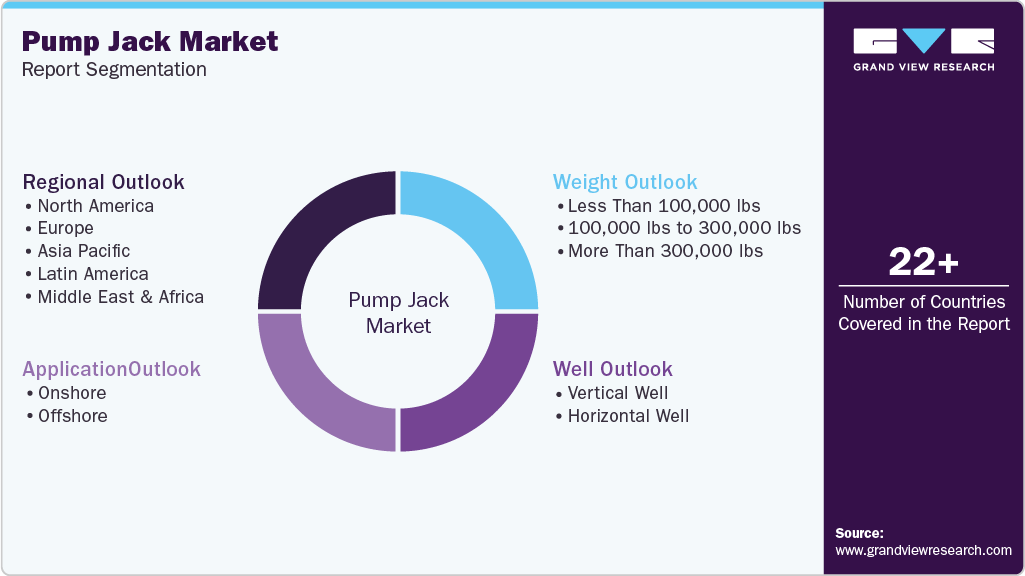
This report forecasts revenue growth at the global, regional, and country levels and provides an analysis of the latest industry trends in each of the sub-segments from 2021 to 2033. For this study, Grand View Research has segmented the global pump jack market report based on well, weight, application, and region:
-
Well Outlook (Revenue; USD Million, 2021 - 2033)
-
Vertical Well
-
Horizontal Well
-
-
Weight Outlook (Revenue; USD Million, 2021 - 2033)
-
Less Than 100,000 lbs
-
100,000 lbs to 300,000 lbs
-
More Than 300,000 lbs
-
-
Application Outlook (Revenue; USD Million, 2021 - 2033)
-
Onshore
-
Offshore
-
-
Regional Outlook (Revenue; USD Million, 2021 - 2033)
-
North America
-
U.S.
-
Canada
-
Mexico
-
-
Europe
-
UK
-
Germany
-
France
-
Italy
-
Spain
-
-
Asia Pacific
-
Japan
-
China
-
India
-
Australia
-
South Korea
-
-
Latin America
-
Brazil
-
Argentina
-
-
Middle East & Africa
-
South Africa
-
Saudi Arabia
-
UAE
-
-
Frequently Asked Questions About This Report
Key factors driving the pump jack market include increasing production from mature oilfields, rising demand for artificial lift systems to maintain crude output, and ongoing development of onshore oil and gas reserves. Replacement of aging equipment and investments in oilfield optimization projects also support steady demand for reliable pump jack installations.
The vertical wells segment held the largest revenue share in 2025.
The 100,000 lbs to 300,000 lbs segment led with a 48.5% revenue share in 2025, while the less than 100,000 lbs segment is the fastest-growing.
The onshore segment led with a 83.2% revenue share in 2025.
Key players include Lufkin Industries; SLB; Liberty Lift Solutions LLC; Shengji Group; Shenyu; Cook Pump Company; E&H Manufacturing; Drake Manufacturing; Puyang Zhongshi Group Co., Ltd; Werner Co.; Young’s Welding, Inc.; Jiangsu Eddie Environmental Technology Co., Ltd; Weatherford International; Redhead Artificial Lift Ltd; Calroc Industries
The global pump jack market size was valued at USD 3.7 billion in 2025 and is estimated at USD 3.9 billion for 2026.
The global pump jack market is expected to grow at a CAGR of 5.7% from 2026 to 2033, reaching USD 5.7 billion by 2033.
North America dominated with a 33.7% revenue share in 2025.
Asia Pacific is the fastest-growing region over the forecast period.
About the Author(s)
Advanced Interior Materials Research Team
Advanced Materials · Advanced Interior MaterialsThis report was authored by the advanced interior materials research team at Grand View Research - comprising two research analysts, one senior research analyst, and one industry expert - with specialized expertise in the advanced interior materials segment of the advanced materials industry. All findings are based on proprietary advanced materials databases, executive interviews, and regulatory analysis, subject to internal peer review prior to publication.
Last Updated:
Speak to Analyst


Customize this report to your needs — add regions, segments, or data points, with 20% free customization.
Or view our licence options:


ISO 9001:2015 & 27001:2022 Certified
We are GDPR and CCPA compliant! Your transaction & personal information is safe and secure. For more details, please read our privacy policy.


