
- Home
- »
- Communication Services
- »
-
Push-to-talk Market Size, Growth Report, 2026-2033GVR Report cover

Push-to-talk Market (2026 - 2033)
Size, Share & Trends Analysis Report By Offering (Hardware, Solution, Services), By Network (Cellular, Land Mobile Radio), By Enterprise Size (Large, SMEs), By Vertical (Energy & Utility), By Region, And Segment Forecasts
Market Size, 2025
$625.4MMarket Estimate, 2026
$655.8MMarket Forecast, 2033
$912.6MCAGR, 2026–2033
4.6%Push-to-talk Market Summary
The global push-to-talk market size was valued at USD 625.4 million in 2025 and is projected to grow from USD 655.8 million in 2026 to USD 912.6 million in 2033, at a CAGR of 4.6% from 2026 to 2033. North America dominated with a revenue share of more than 30.0% in 2025. The increasing demand for instant communication solutions across various industries is propelling the push-to-talk (PTT) market growth.
Key Market Trends & Insights
- By offerings: The hardware segment held the largest market share of more than 45.0% in 2025.
- By network: The land mobile radio (LMR) segment held the largest market share of more than 58.0% in 2025.
- By enterprise size: The large enterprises segment held the largest market share of more than 62.0% in 2025.
- By vertical: The public safety and security segment held the largest market share of more than 26.0% in 2025.
Regional Insights
- Largest regional market: North America (Approximately 30.0% revenue share, 2025)
- Fastest-growing regional market: Asia Pacific (highest CAGR, 2026-2033)
Market Size & Forecast
- Market size in 2025: USD 625.4 Million
- Estimated market size in 2026: USD 655.8 Million
- Projected market size by 2033: USD 912.6 Million
- CAGR (2026-2033): 4.6%
Three ways to get this report
Buy it, customize it, or ask a question.Ask an Analyst
Analyst response in 1 business day
- AccessReport author, directly
- Reply timeWithin 1 working day
- No sales callDirect answer only
- FormatEmail reply
- CostFree, no cost
Get the Full Report
What the study covers
- FormatsPDF · Excel · Dashboard
- Timeline2026–2033 annual, 2025 base
- Coverage20+ countries, 5 regions
- Companies10+ key players profiled
Customize the Report
20% free customization
- IncludeCountries, segments, points
- TailorTo your product definition
- ExtendDeeper competitor detail
- OrA fully bespoke study
- Turnaround5–10 working days
In sectors, such as public safety, construction, and transportation, where real-time communication is critical, PTT technology offers a reliable and efficient means of coordination. The need for enhanced communication capabilities in the era of remote work and globalized supply chains further accentuates this demand. Moreover, the adoption of smartphones and other mobile devices is another significant driver for the PTT market. These devices have become ubiquitous in both professional and personal settings.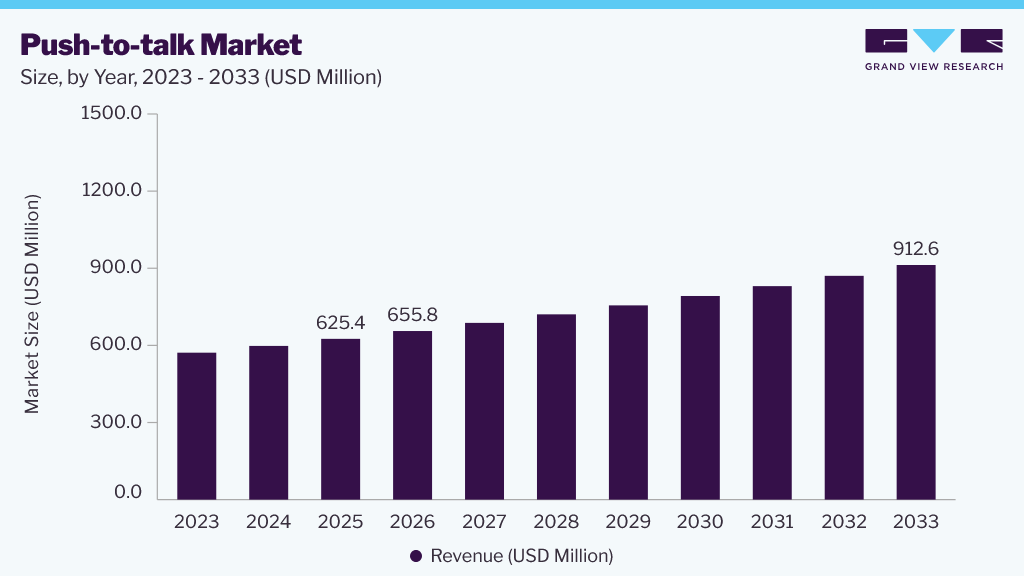 Source: Grand View Research, IR Documents, Primary Interviews, Paid DatabasesTo learn more about this report,
 Download Free Sample Report
 The market experiences a significant boost driven by heightened demand in the realm of public safety and emergency response. Government agencies, law enforcement, and first responders now heavily depend on PTT systems to efficiently coordinate during critical situations. These PTT systems have proven invaluable by providing a swift and dependable mode of communication. Furthermore, they are constantly undergoing enhancements to cater to the specific and evolving requirements of these essential sectors. The market is witnessing substantial growth as hybrid communication solutions gain prominence. PTT systems that seamlessly integrate with pre-existing communication networks and platforms are increasingly appealing to businesses and organizations.
These solutions offer the advantage of unified communication across various channels, bolstering flexibility and interoperability, which are key driving factors in the market. This adaptability aligns well with the evolving communication needs of modern enterprises. One notable restraint in the market is the security and privacy concerns associated with real-time communication. As PTT systems often transmit sensitive and confidential information, ensuring data privacy and safeguarding against potential security breaches is paramount. To overcome this challenge, PTT service providers can implement robust encryption mechanisms and adhere to stringent security standards. Regular security audits and updates to address vulnerabilities are also essential. Moreover, educating end-users about best practices for maintaining security and privacy can play a crucial role in mitigating this restraint.
Analyst Perspective
The push-to-talk market is experiencing steady growth, driven by increasing organizational demand for real time communication and increasing adoption of cloud-based PPT. Companies and public safety agencies are increasingly using PPT systems in logistics management, security operations and emergency workflows. The growing popularity of broad band land mobile radio (LMR) is further supporting market growth. As demand for efficient mission-critical communications solutions continues to rise, companies that focus on product innovation, features diversification, AI-enabled PPT system, and application diversification will be well-positioned to capitalize on long-term growth opportunities.
Offering Insights
The hardware segment dominated the market in 2025 and accounted for a revenue share of more than 45.0%. PTT devices reliant on hardware have established a solid and enduring position in the market, providing a dependable and well-recognized communication solution to industries, such as public safety, construction, and transportation. These devices are meticulously engineered, built to be resilient, and tailored to meet specific operational requirements, guaranteeing their durability in challenging conditions and their reliability during mission-critical tasks. Moreover, the hardware segment has consistently evolved, integrating advanced features such as better battery life, durability, and enhanced security. For instance, in June 2026, HMD Secure, Qualcomm Technologies Inc., and STREAMWIDE collaborated to launch NR Sidelink-powered device-to-device communications to first responders and critical infrastructure teams operating beyond the network coverage.
The solution segment is expected to grow at a significant rate over the forecast period. The solution segment is experiencing substantial growth due to its adaptability and advanced functionalities. PTT solutions offer a diverse range of features that cater to the evolving needs of businesses and organizations. They can be implemented on various devices, including smartphones, tablets, and computers, providing flexibility in communication. Moreover, these solutions often incorporate advanced technologies, such as cloud-based communication, ensuring that users can communicate seamlessly, even across large distances.
Network Insights
The land mobile radio (LMR) segment dominated the market in 2025 and accounted for a revenue share of more than 58.0%. The dominance of the LMR segment can be attributed to its long-standing reliability and proven track record. LMR systems have been a stalwart in mission-critical communication for industries, such as public safety, utilities, and transportation. The inherent strength of LMR lies in its ability to provide seamless, wide-area coverage, ensuring that first responders and essential workers can communicate effectively, even in remote or disaster-stricken areas. The reliability of LMR technology during emergencies or crises has solidified its position as a primary choice for many critical industries. For instance, in March 2026, Motorola Solutions Canada Networks Inc., a subsidiary of Motorola Solutions, entered a definitive agreement to acquire the land mobile radio network services business from Bell Mobility, the wireless subsidiary of Bell Canada and BCE Inc.
The cellular or PoC segment is expected to grow at a significant rate over the forecast period. The cellular or PoC segment is experiencing remarkable growth due to the convergence of mobile communication technology and the increasing need for instant and efficient communication. PoC leverages cellular networks, providing a broader and more flexible coverage area compared to traditional LMR systems. This allows various industries, including logistics, construction, and field services, to benefit from real-time communication without geographical limitations. In addition, the versatility and cost-effectiveness of cellular-based PTT solutions make them an attractive choice, particularly for small and medium-sized enterprises seeking reliable communication tools without significant infrastructure investments.
Vertical Insights
The public safety & security segment dominated the market in 2025 and accounted for a revenue share of more than 26.0%. Public safety agencies, such as police, fire departments, and emergency responders, rely heavily on PTT systems to ensure swift and efficient coordination during crises and emergencies. These systems have evolved to provide features, such as real-time location tracking, multimedia messaging, and interoperability, enabling seamless collaboration between different agencies and jurisdictions. The need for effective communication in high-stress situations and the continuous enhancements in PTT technology to meet these requirements make it a cornerstone for the public safety and security sector. In addition, stringent regulations and standards often mandate the use of reliable PTT systems in this domain, further solidifying its dominance in the market. For instance, in May 2026, L3HARRIS launched the XL Converge 300P, the first portable radio system to which deliver both 5G and Non-Terrestrial Network (NTN) connectivity in single device. It emerges as a groundbreaking feature that enhances the mission-critical communication of public-safety, federal and critical infrastructure teams.
The government & defense segment is expected to grow at a significant rate over the forecast period. With national security and confidentiality at the core of their operations, these organizations are turning to advanced PTT solutions to meet their communication needs. PTT technology offers military personnel and government officials a reliable means of real-time communication, enabling them to coordinate and share vital information swiftly, whether in combat situations, disaster response, or day-to-day operations. The ability of PTT systems to work in remote or challenging environments further contributes to their adoption. As cybersecurity and data integrity become paramount concerns, the PTT market is experiencing a surge in solutions that offer end-to-end encryption and advanced security features to safeguard sensitive government and defense communications.
Enterprise Size Insights
The large enterprises segment accounted for the maximum market share in 2025 and reported a revenue share of more than 60.0%. Large organizations, often operating across vast geographical areas or multiple locations, rely on seamless and instant communication to enhance productivity and maintain operational efficiency. They have adopted PTT solutions that can connect a dispersed workforce, ensuring real-time coordination and faster decision-making. Furthermore, these enterprises often require customized PTT systems that can be integrated with their existing infrastructure, enabling smoother communication across various departments and teams. As a result, large enterprises have emerged as a driving force in the PTT market, leveraging these solutions to streamline their operations, improve safety measures, and maintain a competitive edge in their respective industries.
The small & medium enterprises (SMEs) segment is expected to grow at a significant rate over the forecast period. SMEs often require cost-effective yet efficient communication solutions that enable them to compete effectively and respond swiftly to customer needs. PTT technology provides these businesses with an affordable and reliable method for instant team communication, facilitating improved customer service and operational coordination. Moreover, PTT systems are increasingly user-friendly and scalable, making them accessible and adaptable to the specific requirements of SMEs. As these businesses expand or diversify, PTT solutions can easily accommodate such growth, making them an attractive choice for SMEs looking to enhance their communication capabilities without significant infrastructure investments.
Regional Insights
North America dominated the market in 2025 and accounted for a revenue share of more than 30.0%. The region is home to a large number of key players and technology innovators, leading to the development and adoption of cutting-edge PTT solutions. Moreover, North America's extensive public safety and law enforcement agencies, combined with a well-established industrial and transportation sector, demand efficient communication tools for various applications. The focus on enhancing emergency response and ensuring secure communication for first responders and government agencies has driven the PTT market in this region.
 To learn more about this report, Download Free Sample Report
 Asia Pacific Push-to-talk Market Trends
Asia Pacific region is expected to grow significantly over the forecast period. The key driving force behind the remarkable growth in the Asia Pacific region is the rapid expansion of commercial and industrial activities throughout the region. This surge in economic and business operations has accentuated the demand for swift and effective communication systems. Industries, such as construction, manufacturing, and logistics, in particular, are increasingly embracing PTT solutions to optimize their processes and bolster the safety of their workforce. Furthermore, the advent of advanced telecommunications infrastructure, including the widespread adoption of 4G and 5G networks, has fostered a fertile environment for PTT technologies.
Key Push-to-talk Market Company Insights
The competitive landscape is characterized by intense rivalry among key players, contending for market share. Established companies, such as Motorola Solutions, AT&T, and Verizon Communications, have a solid foothold in the market, backed by a wide range of PTT solutions and established client bases. These market leaders compete through continuous product innovation and strategic partnerships. Furthermore, the market is witnessing the emergence of nimble and innovative startups, such as Zello and Voxer, which offer novel communication solutions tailored to the changing needs of industries.
Collaborations, mergers, and acquisitions play a crucial role in reshaping the market landscape. In September 2025, Motorola Solutions and Nokia announced a strategic collaboration to provide a next-generation, containerized, tactical communications network solution for UK defense agencies.
Key Push-to-talk Market Companies
The following key companies have been profiled for this study on the push-to-talk market.
-
AT&T, Inc.
-
Verizon Communications, Inc.
-
Motorola Solutions, Inc.
-
T-Mobile USA, Inc.
-
Sonim Technologies, Inc.
-
AINA Wireless
-
Hytera Communications Corporation Limited
-
Iridium Communications
-
Voxer
-
Bell Canada
Recent Developments
-
In February 2026, Iridium Communications Inc., a leading provider of global voice, data, and positioning, navigation, and timing (PNT) satellite services launched the Iridium 9604, a compact, three-in-one IoT module that integrates Iridium Short Burst Data (SBD) satellite service, LTE-M cellular connectivity, and GNSS positioning into a single platform. By combining these features in one device, the Iridium 9604 reduces solution complexity, lowers costs, and accelerates time to market, making dual-mode IoT connectivity viable for price-sensitive, high-volume deployments.
-
In January 2026, NEXA (formerly Social Mobile) acquired Sonim Technologies (“Sonim”), the US-based leader in ultra-rugged, mission-critical communication devices for enterprise, government and public safety markets. The acquisition is a key milestone in NEXA’s strategy to expand its leadership in purpose-built enterprise mobility solutions and deliver innovative, scalable offerings to customers worldwide.
Push-to-talk Market Report Scope
Report Attribute
Details
Market size in 2025
USD 625.4 million
Estimated market size in 2026
USD 655.8 million
Projected market size by 2033
USD 912.6 million
Growth rate
CAGR of 4.6% from 2026 to 2033
Base year for estimation
2025
Actual data
2021 - 2024
Forecast period
2026 - 2033
Quantitative units
Revenue in USD million, and CAGR from 2026 to 2033
Report coverage
Revenue forecast, company ranking, competitive landscape, growth factors, and trends
Segments covered
Offering, network, enterprise size, vertical, and region
Regional scope
North America; Europe; Asia Pacific; Latin America; Middle East & Africa
Country scope
U.S.; Canada; UK; Germany; France; China; India; Japan; South Korea; Australia; Brazil; Mexico; Kingdom of Saudi Arabia (KSA); UAE; South Africa
Key companies profiled
AT&T, Inc.; Verizon Communications, Inc.; Motorola Solutions, Inc.; T-Mobile USA, Inc.; Sonim Technologies, Inc.; AINA Wireless; Hytera Communication Corporation Limited; Iridium Communications; Voxer; Bell Canada
Customization scope
Free report customization (equivalent up to 8 analysts working days) with purchase. Addition or alteration to country, regional & segment scope.
Pricing and purchase options
Avail of customized purchase options to meet your exact research needs. Explore purchase options
Global Push-to-talk Market Report Segmentation
This report forecasts revenue growth at global, regional, and country levels and provides an analysis of the latest industry trends and opportunities in each of the sub-segments from 2021 to 2033. For this study, Grand View Research has segmented the global push-to-talk market report based on offering, network, enterprise size, vertical, and region:
-
Offering Outlook (Revenue, USD Million, 2021 - 2033)
-
Hardware
-
Solution
-
Carrier Integrated PTT Solutions
-
Over the Top PTT Solution
-
Mission-critical PTT Solution
-
-
Services
-
Consulting
-
Implementation
-
Support And Maintenance
-
-
-
Network Outlook (Revenue, USD Million, 2021 - 2033)
-
Cellular or PoC
-
Land Mobile Radio (LMR)
-
-
Enterprise Size Outlook (Revenue, USD Million, 2021 - 2033)
-
Large Enterprises
-
Small & Medium Enterprises (SMEs)
-
-
Vertical Outlook (Revenue, USD Million, 2021 - 2033)
-
Public Safety & Security
-
Government & Defense
-
Transportation & Logistics
-
Travel & Hospitality
-
Energy & Utility
-
Others
-
-
Regional Outlook (Revenue, USD Million, 2021 - 2033)
-
North America
-
U.S.
-
Canada
-
-
Europe
-
UK
-
Germany
-
France
-
-
Asia Pacific
-
China
-
India
-
Japan
-
South Korea
-
Australia
-
-
Latin America
-
Brazil
-
Mexico
-
-
Middle East & Africa
-
Kingdom of Saudi Arabia (KSA)
-
UAE
-
South Africa
-
-
Frequently Asked Questions About This Report
Some of the key players are AT&T, Inc., Verizon Communications, Inc., Motorola Solutions, Inc., T-Mobile USA, Inc., Sonim Technologies, Inc., AINA Wireless, Hytera Communications Corporation Limited, Iridium Communications, Voxer, and Bell Canada.
The growth of the market can be attributed to the increasing demand for efficient and quick communication in various sectors, such as public safety, transportation, and construction industries. Additionally, advancements in push to talk technology, such as integrating push to talk solutions with unified communication platforms, have further propelled the growth of this market.
The global push-to-talk market size was estimated at USD 625.4 million in 2025 and is expected to reach USD 655.8 million by 2026.
The global push-to-talk market is expected to grow at a compound annual growth rate of 4.6% from 2026 to 2033 and is expected to reach USD 912.6 million by 2033.
The hardware segment dominated the market with a share of 45.0% in 2025. The segment growth can be attributed to the development of multi-functional devices that offer enhanced durability and integrated features to meet the diverse needs of industries such as public safety, transportation, and logistics.
About the Author(s)
Communication Services Research Team
Technology · Communication ServicesThis report was authored by the communication services research team at Grand View Research - comprising two research analysts, one senior research analyst, and one industry expert - with specialized expertise in the communication services segment of the technology industry. All findings are based on proprietary technology databases, executive interviews, and regulatory analysis, subject to internal peer review prior to publication.
Last Updated:
Speak to Analyst

Customize this report to your needs - add regions, segments, or data points, with 20% free customization.
Or view our licence options:


ISO 9001:2015 & 27001:2022 Certified
We are GDPR and CCPA compliant! Your transaction & personal information is safe and secure. For more details, please read our privacy policy.


