
- Home
- »
- Next Generation Technologies
- »
-
Quantum AI Market Size, Share & Growth Report, 2026-2033GVR Report cover

Quantum AI Market (2026 - 2033)
Size, Share & Trends Analysis Report By Component (Software, Hardware, Services), By Deployment Model (Cloud-Based, On-Premises), By Application, By Region, And Segment Forecasts
Market Size, 2025
$457.2MMarket Estimate, 2026
$612.9MMarket Forecast, 2033
$5,029.4MCAGR, 2026–2033
35.1%Quantum AI Market Summary
The global quantum AI market size was valued at USD 457.2 million in 2025 and is projected to grow from USD 612.9 million in 2026 to USD 5029.4 million by 2033, at a CAGR of 35.1% from 2026 to 2033. The market in North America dominated with a revenue share of 40.1% in 2025. The global market is expanding steadily as enterprises and research institutions increase investment in quantum computing and advanced AI capabilities.
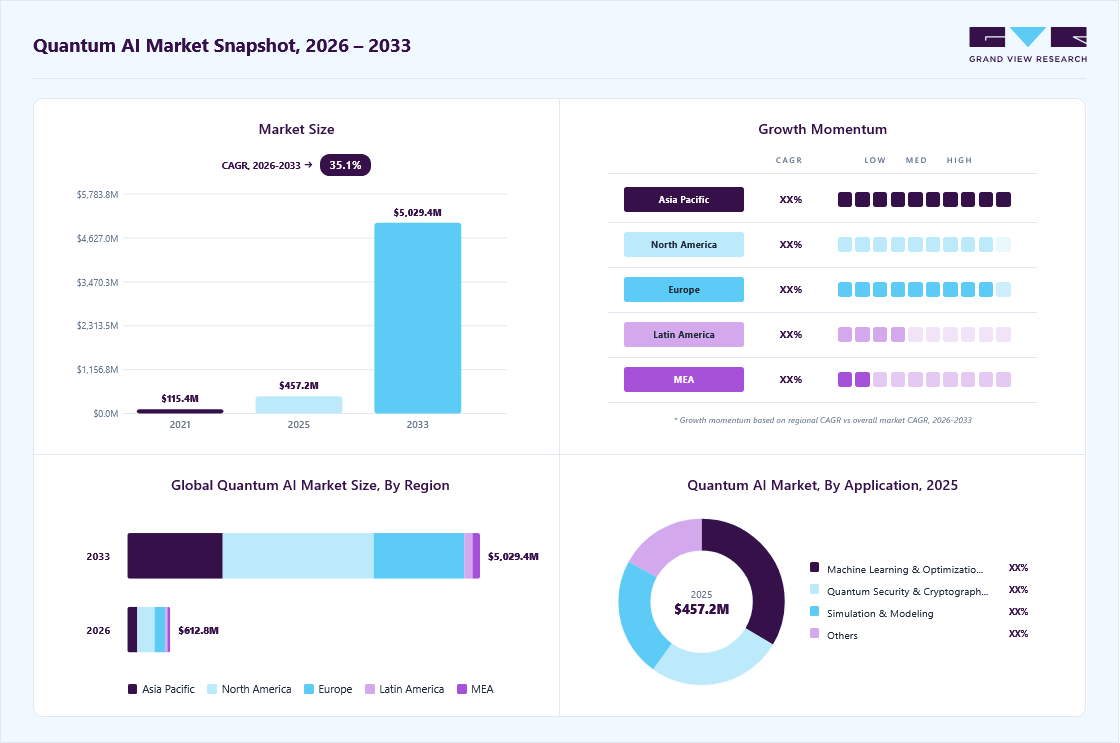 Source: Grand View Research, IR Documents, Primary Interviews, Paid DatabasesTo learn more about this report,
 Download Free Sample Report
 Key Market Trends & Insights
- By component: Hardware segment held the largest market share of 37.3% in 2025.
- By deployment model: On-Premises segment held the largest market share in 2025.
- By application: Machine learning & optimization segment held the largest market share in 2025.
Regional Highlights
- Largest regional market: North America (40.1% revenue share, 2025)
- Fastest-growing regional market: Asia Pacific (highest CAGR, 2026-2033)
- By country: The U.S. held the largest market share in 2025
Market Size & Forecast
- Market size in 2025: USD 457.2 Million
- Estimated market size in 2026: USD 612.9 Million
- Projected market size by 2033: USD 5029.4 Million
- CAGR (2026-2033): 35.1%
Three ways to get this report
Buy it, customize it, or ask a question.Ask an Analyst
Analyst response in 1 business day
- AccessReport author, directly
- Reply timeWithin 1 working day
- No sales callDirect answer only
- FormatEmail reply
- CostFree, no cost
Get the Full Report
What the study covers
- FormatsPDF · Excel · Dashboard
- Timeline2026–2033 annual, 2025 base
- Coverage20+ countries, 5 regions
- Companies10+ key players profiled
Customize the Report
20% free customization
- IncludeCountries, segments, points
- TailorTo your product definition
- ExtendDeeper competitor detail
- OrA fully bespoke study
- Turnaround5–10 working days
Growing interest in addressing complex optimization and simulation challenges is supporting early adoption across research-driven industries. Advances in quantum hardware and algorithm development are improving system reliability and performance. The quantum AI market is growing as access to quantum computing infrastructure is becoming more widespread. Organizations are gradually moving beyond experimental research toward early-stage practical applications. Ongoing improvements in quantum hardware and software are enhancing performance and system reliability. Compatibility with existing AI and classical computing environments is becoming more achievable. Industry collaborations and ecosystem development are supporting advancements in technology. These factors are driving increased interest and investment across multiple industries. For instance, in November 2025, Quantinuum, a U.S.-based quantum computing company, announced the commercial launch of Helios, a high-accuracy, general-purpose quantum computer. The system is designed to enable Generative Quantum AI (GenQAI) through hybrid quantum-classical computing with cloud and on-premises deployment options. To learn more about this report, Download Free Sample Report
 The domestic development of quantum hardware is gaining momentum across multiple regions. Local production of quantum systems is increasing technological capabilities within countries. This progress reduces reliance on foreign quantum technologies and enhances self-sufficiency. Greater availability of domestic hardware improves access for research institutions and enterprises. Regional access to quantum computing resources is becoming more widespread and practical. These developments are helping drive broader adoption of quantum AI applications. For instance, in April 2025, QpiAI, an Indian quantum computing and generative AI company, announced the launch of its first 25-qubit quantum computer, QpiAI Indus, marking a key milestone in India’s quantum computing sector. The system integrates quantum and AI capabilities and is designed to support early commercial applications across sectors such as logistics, finance, materials discovery, and pharmaceuticals.
Advances in qubit technology are significantly impacting the growth of the quantum AI market. Improvements in qubit fidelity are reducing computation errors and increasing the accuracy of quantum operations. Enhanced error correction techniques allow quantum systems to maintain stable performance over longer computations. Scalability advancements are enabling the development of larger quantum processors with more qubits. These improvements are making quantum systems more reliable for complex calculations and simulations. As a result, enterprises are increasingly able to explore practical applications of quantum computing. Higher performance and system stability support broader adoption across industries such as finance, healthcare, and materials science. Continuous research and innovation are driving further enhancements in qubit architecture and connectivity. These technological developments are laying a stronger foundation for the commercial and industrial deployment of quantum AI solutions.
Component Insights
The Hardware segment led the market and accounted for 37.3% of the global revenue in 2025. The hardware segment of the quantum AI market is currently dominant due to the essential role of specialized quantum processors and supporting infrastructure. Significant investments are being made in developing and refining quantum computing hardware, including quantum chips and cryogenic systems, which are crucial for enhanced performance and stability. Major tech companies and research institutions are focusing their efforts on advancing quantum hardware to boost computational power. The complexity and high cost of building and maintaining quantum hardware create substantial barriers to entry, solidifying its leading position in the market. Consequently, advancements in hardware are driving much of the current growth and innovation in the quantum AI sector.
The software segment is predicted to foresee significant growth in the forecast period as innovations in quantum algorithms and applications evolve. Advances in quantum programming languages and development tools are making it easier to create and implement quantum algorithms. As quantum hardware becomes more available, there is a growing demand for software solutions that can effectively utilize this technology. Increased interest in quantum AI applications is driving significant investment in software development, expanding its potential uses and capabilities. This momentum is expected to continue, with software becoming a key driver in realizing the full potential of quantum AI technologies.
Deployment Model Insights
The On-Premises segment accounted for the largest market revenue share in 2025. The On-Premises model leads the market because it provides a high degree of control over IT infrastructure. Organizations can customize their systems extensively to fit specific needs, providing customized solutions that enhance operational efficiency. This model also offers robust security and compliance measures, which are crucial for industries with strict regulatory requirements. The ability to manage hardware and software directly allows for greater oversight and data sovereignty. Despite the significant upfront investment and ongoing maintenance costs, the control and customization benefits make On-Premises solutions a preferred choice for many businesses.
The Cloud-Based segment is predicted to foresee significant growth in the forecast period. The Cloud-Based model is experiencing rapid growth due to its scalability and flexibility. Businesses can easily adjust their resources based on demand, which supports efficient operations and cost management. Cloud solutions also facilitate remote work and collaboration, making them ideal for modern, distributed teams. By reducing the need for extensive in-house infrastructure, cloud services lower total IT costs and provide greater agility. As organizations seek more adaptable and economically feasible solutions, the Cloud-Based model is becoming an increasingly popular choice.
Application Insights
The machine learning & optimization segment accounted for the largest market revenue share in 2025. Machine Learning and Optimization enhance decision-making and operational efficiency across various industries. These technologies utilize vast amounts of data to identify patterns, make predictions, and optimize processes, leading to more informed and effective business strategies. The continuous advancements in algorithms and computational power have expanded their applications, from improving customer experiences to simplifying supply chains. As businesses aim to utilize data for a competitive edge, machine learning and optimization offer essential insights and automation capabilities. Their transformative impact on industries such as finance, healthcare, and manufacturing underscores their dominant role in the current market.
 To learn more about this report, Download Free Sample Report
 The quantum security and cryptography segment is projected to grow significantly over the forecast period due to the increasing integration of AI technologies in vehicles. Quantum Security and Cryptography are experiencing rapid growth as organizations recognize the need to protect sensitive data against emerging threats. With the potential to break traditional encryption methods, quantum computing poses a significant risk, driving the demand for advanced cryptographic solutions. Quantum-resistant algorithms are being developed to safeguard information in a post-quantum world, ensuring that data remains secure even as computational capabilities evolve. The field is expanding as researchers and companies work to stay ahead of potential vulnerabilities and maintain data integrity.
Regional Insights
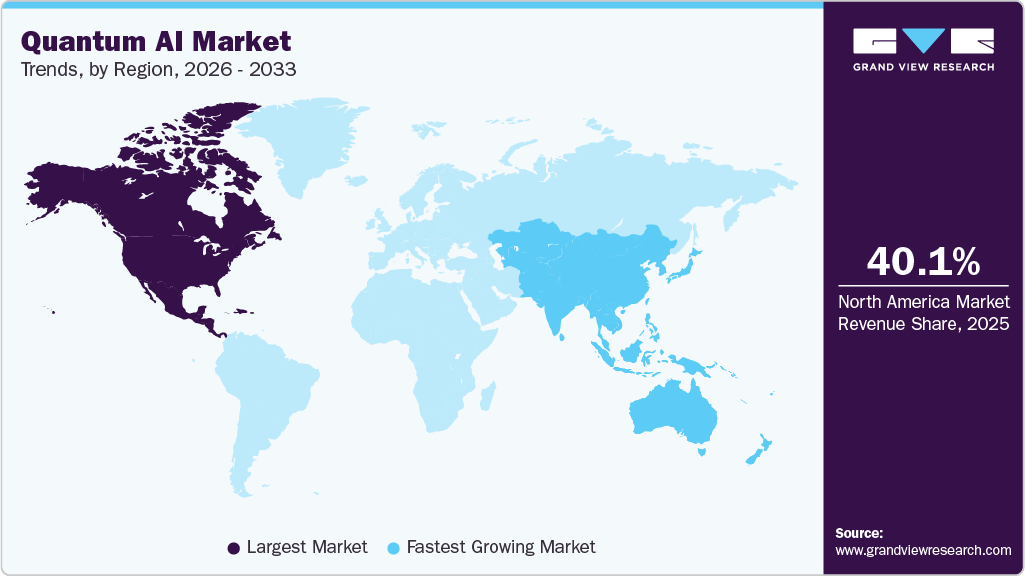
North America dominated the market and accounted for 40.1% share in 2025. In North America, the Quantum AI market is surging due to the region's strong investment in technology infrastructure and research. The presence of major tech companies and leading research institutions drives rapid advancements in quantum computing applications. Robust government funding and initiatives support the development and commercialization of quantum technologies. North America's strategic focus on innovation and its well-established tech ecosystem position it as a global leader in the Quantum AI market.
 To learn more about this report, Download Free Sample Report
 U.S. Quantum AI Market Trends
The U.S. stands out in the Quantum AI market due to its significant technological advancements and extensive government support. The country is home to some of the world’s leading tech companies and research organizations, which are heavily investing in quantum computing. Federal initiatives, such as the National Quantum Initiative Act, shows the strategic importance of quantum technology for national security and economic growth. The U.S. is also a major player in global quantum research collaborations, enhancing its position in the market.
Europe Quantum AI Market Trends
European countries are forming partnerships and consortia to accelerate the development and application of quantum technologies. The European Union's Horizon Europe program and various national research grants play a pivotal role in supporting quantum research. Europe's emphasis on cross-border collaboration and innovation is fostering a dynamic environment for Quantum AI advancements. As European institutions and companies enhance their quantum capabilities, the region is making notable strides in the global Quantum AI arena.
Asia Pacific Quantum AI Trends
Asia Pacific is anticipated to register the fastest CAGR over the forecast period. The Asia Pacific region is rapidly advancing in the Quantum AI market, driven by significant investments from both governmental and private sectors. Countries such as China and Japan are leading in quantum research and development, with extensive funding allocated to technological innovation. Asia-Pacific's focus on integrating quantum technologies across various industries is contributing to its growing influence in the market. The rapid pace of technological adoption and development in the region shows its emerging prominence in the global Quantum AI field.
Key Quantum AI Company Insights
Some of the key companies in the Quantum AI industry include Amazon Web Services, Inc., D-Wave Quantum Inc., Fujitsu, Google LLC, and others. Organizations are focusing on increasing their customer base to gain a competitive edge in the industry. Therefore, key players are taking several strategic initiatives, including mergers and acquisitions, as well as partnerships with other major companies.
-
Amazon Web Services, Inc. is actively advancing in the quantum AI space through its Braket platform, which provides cloud-based access to quantum computers from multiple providers. AWS enables developers and researchers to experiment with hybrid quantum-classical algorithms for optimization, simulation, and machine learning tasks. The platform supports scalable quantum circuit design and execution with integrated classical computing resources. AWS is also investing in partnerships and research collaborations to accelerate the development of quantum algorithms. These efforts are driving broader adoption and innovation in practical quantum AI applications.
-
IBM Corporation is advancing quantum AI through its IBM Quantum initiative, providing cloud-based access to quantum computers and tools for hybrid quantum-classical AI development. The company focuses on improving qubit fidelity, error correction, and scalability to support practical AI applications. IBM offers the Qiskit software framework, enabling developers to design, simulate, and execute quantum algorithms. It also collaborates with enterprises and research institutions to integrate quantum computing with AI workflows. These efforts are driving innovation and adoption of quantum AI solutions across industries.
Key Quantum AI Companies:
The following are the leading companies in the quantum AI market. These companies collectively hold the largest market share and dictate industry trends.
- Amazon Web Services, Inc.
- D-Wave Quantum Inc.
- Fujitsu
- Google LLC
- Hitachi, Ltd.
- IBM Corporation
- Intel Corporation
- Microsoft
- SandboxAQ
- Toshiba Corporation
Recent Developments
-
In July 2024, Zapata Computing Holdings Inc., a U.S.-based software company, has broadened its collaboration with D-Wave Quantum Inc. to expedite the advancement of integrated quantum and generative AI solutions. This collaboration aims to enhance model training efficiency and performance, combining generative AI with quantum optimization to advance enterprise applications and drive sustainability and operational efficiency.
-
In June 2024, SandboxAQ, an enterprise SaaS company in the U.S., launched AQNav. This new multi-domain navigation technology combines AI algorithms, quantum sensors, and Earth's magnetic field to provide an alternative to GPS in cases of interference. This innovation aims to enhance navigation across various industries and has already completed over 200 flight hours and 40 missions on multiple aircraft models.
-
In June 2024, Microsoft introduced two new features for its Azure Quantum Elements platform, Generative Chemistry and Accelerated DFT, to advance research in chemistry and materials science with AI and quantum computing. These updates aim to simplify molecular discovery and speed up quantum mechanical simulations, significantly advancing scientific research and enabling the development of a future quantum supercomputer for complex simulations.
-
In January 2024, International Business Machines Corporation (IBM), a U.S.-based technology company, partnered with Korea Quantum Computing (KQC) to incorporate IBM's quantum computing infrastructure and advanced AI software into South Korea's tech sector. This partnership will enable KQC to access IBM Watsonx for advanced AI model development and deploy IBM's next-generation quantum systems, including an IBM Quantum System Two.
-
In January 2024, Accenture, an IT company in Ireland, and SandboxAQ are partnering to deliver AI and quantum computing solutions to identify and mitigate cybersecurity vulnerabilities, utilizing SandboxAQ's Security Suite for comprehensive cryptographic management. This collaboration aims to help organizations secure data against advanced AI-enabled cyberattacks and emerging quantum computing threats, enhancing their overall cybersecurity posture.
Quantum AI Market Report Scope
Report Attribute
Details
Market size in 2025
USD 457.2 million
Estimated market size in 2026
USD 612.9 million
Projected market size by 2033
USD 5,029.4 million
Growth rate
CAGR of 35.1% from 2026 to 2033
Base year for estimation
2025
Historical data
2021 - 2024
Forecast period
2026 - 2033
Quantitative units
Revenue in USD million/billion and CAGR from 2026 to 2033
Report coverage
Revenue forecast, company ranking, competitive landscape, growth factors, and trends
Segments covered
Component, deployment model, application, region
Regional scope
North America; Europe; Asia Pacific; Latin America; Middle East & Africa
Country scope
U.S.; Canada; Mexico; UK; Germany; France; China; Japan; India; South Korea; Australia; Brazil; KSA; UAE; South Africa
Key companies profiled
Amazon Web Services, Inc.; D-Wave Quantum Inc.; Fujitsu; Google LLC; Hitachi, Ltd.; IBM Corporation; Intel Corporation; Microsoft; SandboxAQ; Toshiba Corporation
Customization scope
Free report customization (equivalent up to 8 analysts working days) with purchase. Addition or alteration to country, regional & segment scope.
Pricing and purchase options
Avail customized purchase options to meet your exact research needs. Explore purchase options
Global Quantum AI Market Report Segmentation
This report forecasts revenue growth at global, regional, and country levels and provides an analysis of the latest industry trends in each of the sub-segments from 2021 to 2033. For this study, Grand View Research has segmented the global Quantum AI market report based on component, deployment model, application and region.
 To learn more about this report, Download Free Sample Report
 -
Component Outlook (Revenue, USD Million, 2021 - 2033)
-
Software
-
Hardware
-
Services
-
-
Deployment Model Outlook (Revenue, USD Million, 2021 - 2033)
-
Cloud-Based
-
On-Premises
-
-
Application Outlook (Revenue, USD Million, 2021 - 2033)
-
Machine Learning & Optimization
-
Quantum Security & Cryptography
-
Simulation & Modeling
-
Others
-
-
Regional Outlook (Revenue, USD Million, 2021 - 2033)
-
North America
-
U.S.
-
Canada
-
Mexico
-
-
Europe
-
UK
-
Germany
-
France
-
-
Asia Pacific
-
China
-
Japan
-
India
-
South Korea
-
Australia
-
-
Latin America
-
Brazil
-
-
Middle East and Africa (MEA)
-
KSA
-
UAE
-
South Africa
-
-
Frequently Asked Questions About This Report
Key factors that are driving the market growth include increasing demand for high-performance computing, advancements in quantum technology, growing applications in various industries, and substantial investments from both private and public sectors.
Asia Pacific is the fastest-growing region over the forecast period.
The hardware segment led with a 37.3% revenue share in 2025.
The On-Premises segment held the largest revenue share in 2025.
Machine learning & optimization segment held the largest revenue share in 2025.
Key players include Amazon Web Services, Inc.; D-Wave Quantum Inc.; Fujitsu; Google LLC; Hitachi, Ltd.; IBM Corporation; Intel Corporation; Microsoft; SandboxAQ; Toshiba Corporation.
The global quantum AI market size was valued at USD 457.2 million in 2025 and is estimated at USD 612.9 million for 2026.
The global quantum AI market is expected to grow at a CAGR of 35.1% from 2026 to 2033, reaching USD 5,029.4 million by 2033.
North America dominated the Quantum AI market with a share of 40.1% in 2025. This is attributable to its advanced technological infrastructure, significant investment in quantum research, and the presence of key industry players driving innovation and development in the region.
About the Author(s)
Next Generation Technologies Research Team
Technology · Next Generation TechnologiesThis report was authored by the next generation technologies research team at Grand View Research - comprising two research analysts, one senior research analyst, and one industry expert - with specialized expertise in the next generation technologies segment of the technology industry. All findings are based on proprietary technology databases, executive interviews, and regulatory analysis, subject to internal peer review prior to publication.
Last Updated:
Speak to Analyst

Customize this report to your needs - add regions, segments, or data points, with 20% free customization.
Or view our licence options:


ISO 9001:2015 & 27001:2022 Certified
We are GDPR and CCPA compliant! Your transaction & personal information is safe and secure. For more details, please read our privacy policy.


