
- Home
- »
- Plastics, Polymers & Resins
- »
-
Quantum Computing Advanced Packaging Market Report 2033GVR Report cover
![Quantum Computing Advanced Packaging Market (2026 - 2033)Report]()
Quantum Computing Advanced Packaging Market (2026 - 2033)
Size, Share & Trends Analysis Report By Qubit Technology (Superconducting Qubits, Trapped-Ion Qubits, Photonic Qubits, Neutral-Atom Qubits), By Advanced Packaging Technology, By Customer Type, By Operating Temperature, By Region, And Segment Forecasts
Market Size, 2025
$91.1MMarket Estimate, 2026
$101.6MMarket Forecast, 2033
$232.4MCAGR, 2026–2033
12.5%Quantum Computing Advanced Packaging Market Summary
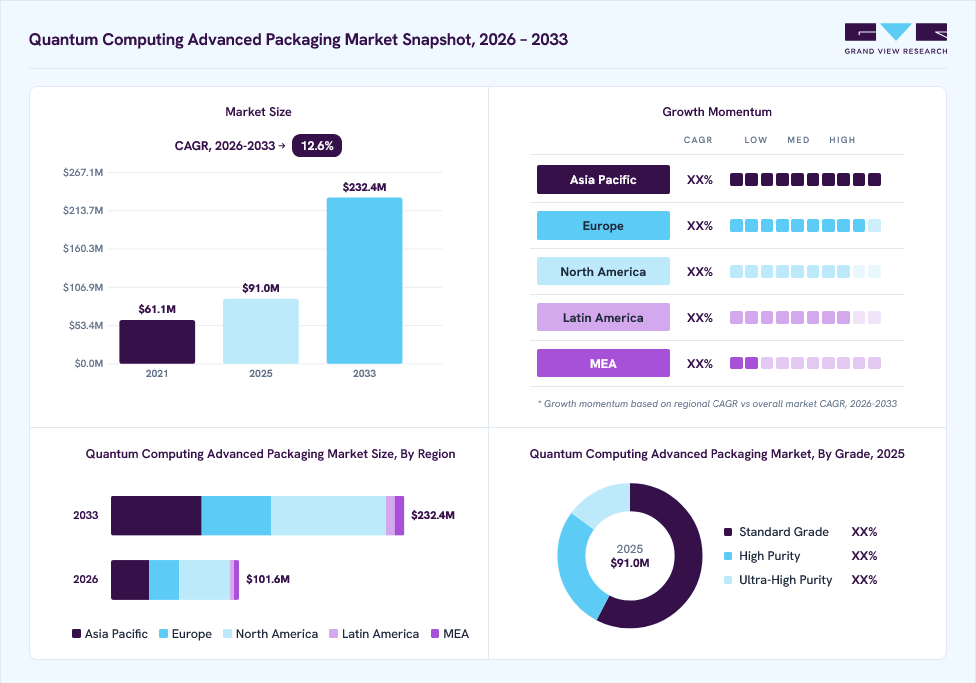
The global quantum computing advanced packaging market size was valued at USD 91.1 million in 2025 and is projected to grow from USD 101.6 million in 2026 to USD 232.4 million by 2033, at a CAGR of 12.5% from 2026 to 2033. North America dominated the market, accounting for the largest revenue share of 39.7% in 2025. The market is primarily driven by the increasing development of high-qubit quantum processors, growing investment in scalable quantum computing architectures, and rising demand for specialized packaging technologies that enable cryogenic operation, high-density interconnects, thermal management, and electromagnetic shielding.
Key Market Trends & Insights
- By customer type: Quantum technology companies segment is anticipated to expand at a CAGR of 13.1% from 2026 to 2033.
- By qubit technology: Topological & Other Qubits segment is forecast to grow at the fastest CAGR of 13.3% from 2026 to 2033.
- By operating temperature: 1–4 K segment is anticipated to expand at the fastest CAGR of 13.1% from 2026 to 2033.
- By advanced packaging technology: Wafer-Level/Fan-Out packaging segment is projected to register the fastest CAGR of 13.1% from 2026 to 2033.
Regional Highlights
- Largest regional market: North America (39.7% revenue share, 2025)
- Fastest-growing regional market: Asia Pacific (highest CAGR, 2026-2033)
- By country: The U.S. held the largest market share in 2025.
Market Size & Forecast
- Market size in 2025: USD 91.1Million
- Estimated market size in 2026: USD 101.6 Million
- Projected market size by 2033: USD 232.4 Million
- CAGR (2026-2033): 12.5%
Three ways to get this report
Buy it, customize it, or ask a question.Get the Full Report
What the study covers
- FormatsPDF · Excel · Dashboard
- Timeline2026–2033 annual, 2025 base
- Coverage20+ countries, 5 regions
- Companies10+ key players profiled
Customize the Report
20% free customization
- IncludeCountries, segments, points
- TailorTo your product definition
- ExtendDeeper competitor detail
- OrA fully bespoke study
- Turnaround5–10 working days
Ask an Analyst
A direct answer, usually in 1 working day
- AccessReport author, directly
- Reply timeWithin 1 working day
- No sales callDirect answer only
- FormatEmail reply
- CostFree, no cost
The quantum computing advanced packaging market is driven by the rapid development of high-qubit quantum processors and the increasing need for scalable hardware architectures. As quantum technology companies, research laboratories, and national laboratories advance superconducting, trapped-ion, photonic, and neutral-atom systems, there is a growing demand for specialized packaging solutions to support dense qubit integration, reliable signal transmission, thermal management, and electromagnetic isolation. Superconducting qubits represented the largest qubit technology segment, accounting for 40.8% of the market in 2025, reflecting the significant packaging requirements associated with cryogenic superconducting processors. Advanced interposers, flip-chip structures, superconducting interconnects, and high-density RF connections are increasingly being adopted to address the complexity of integrating larger numbers of qubits and control interfaces.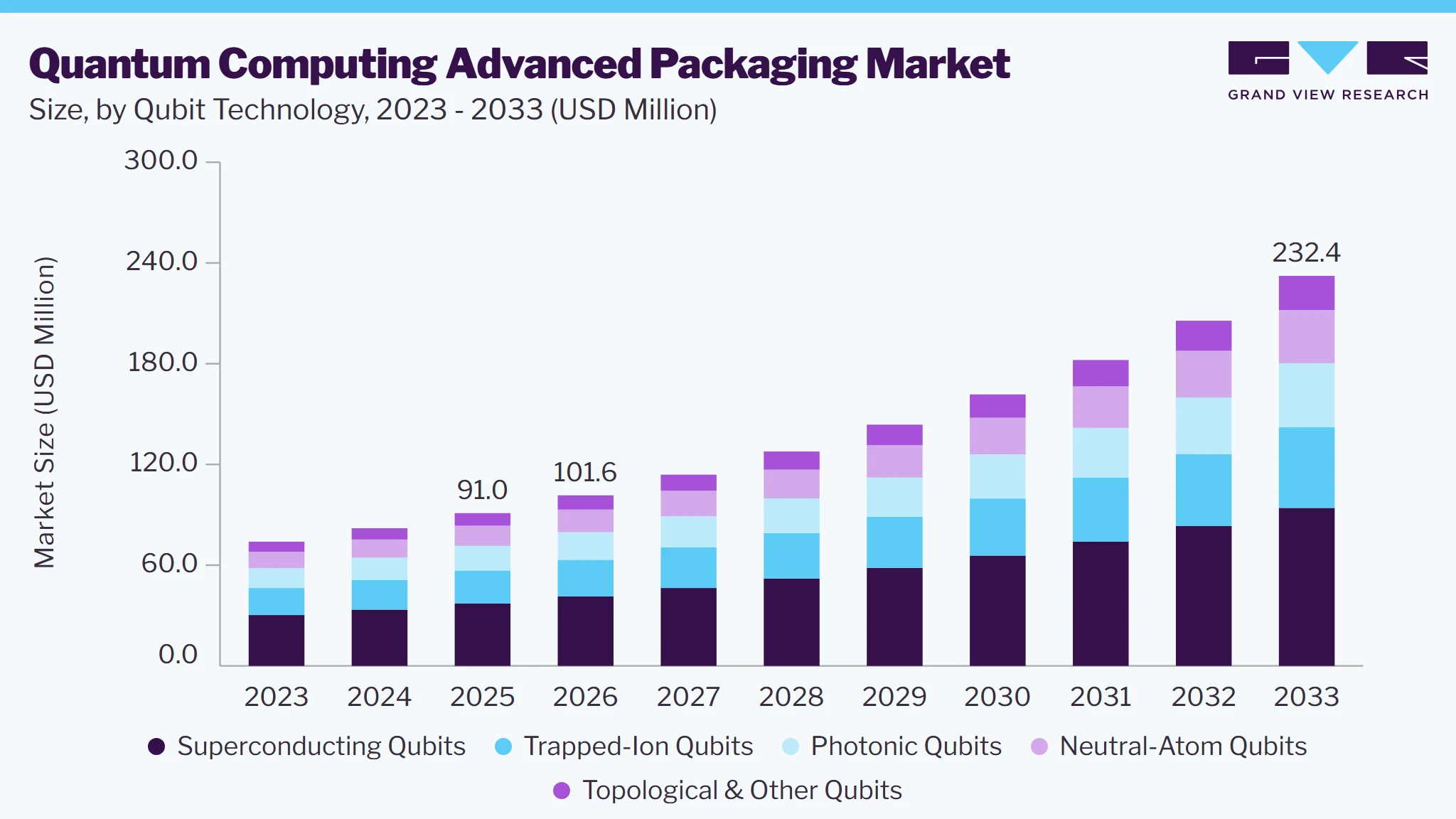
The increasing focus on improving quantum processor performance, scalability, and operating stability is expected to further support market growth in the coming years. Quantum computing architectures require packaging technologies capable of maintaining precise electrical, thermal, and mechanical conditions, particularly for processors operating at millikelvin temperatures. The Millikelvin (<1 K) segment accounted for 44.4% of the market in 2025, highlighting the importance of cryogenic-compatible packaging for superconducting and other low-temperature quantum systems. Growing investments in quantum computing research and the transition from laboratory-scale prototypes toward larger and more commercially deployable quantum processors are encouraging the adoption of 2.5D interposers, 3D die-stacked, multi-chip modules, and other advanced packaging configurations.
Increasing emphasis on scalable integration and advanced semiconductor packaging is also significantly contributing to market expansion. A defining trend in the quantum computing advanced packaging industry is the growing adoption of 2.5D interposer packaging, which accounted for the largest share of 48.5% in 2025, as quantum hardware developers seek higher-density interconnections between quantum processors, control electronics, readout circuits, and supporting components. At the same time, wafer-level and fan-out packaging is projected to register a CAGR of 13.1% during the forecast period, reflecting opportunities for compact integration and scalable quantum hardware manufacturing. Continued development of heterogeneous integration, cryogenic interconnects, chiplet architectures, and advanced bonding technologies is expected to strengthen the market's ability to support higher qubit densities and increasingly complex quantum computing systems.
Market Dynamics
The quantum computing advanced packaging market is emerging as a critical technology segment as quantum processors require specialized packaging architectures to maintain qubit performance, enable high-density interconnects, and support operation at extremely low temperatures. Increasing investment in quantum computing research and development of superconducting and other qubit technologies, and the need for reliable cryogenic signal transmission are accelerating demand for advanced packaging solutions. At the same time, progress in heterogeneous integration, 3D packaging, high-frequency interconnects, and thermal-management technologies is creating opportunities for packaging manufacturers to develop specialized solutions tailored to quantum computing hardware.
The rapid development of quantum processors is driving demand for advanced packaging architectures capable of supporting highly sensitive qubits and their associated control and readout systems. Quantum computing platforms require precise electrical interconnections, low-loss signal pathways, electromagnetic shielding, and effective thermal management, particularly for superconducting quantum systems operating at cryogenic temperatures. As quantum processors move toward higher qubit counts and more complex architectures, conventional semiconductor packaging approaches are increasingly being supplemented by specialized advanced packaging technologies.
Growing investments by technology companies, research institutions, and governments in quantum hardware development are further strengthening the need for scalable packaging solutions. Packaging technologies that enable compact integration of qubits, control electronics, interconnects, and thermal-management components can improve system reliability while reducing signal losses and packaging complexity. This increasing focus on scalable quantum hardware architectures is expected to support long-term demand for advanced packaging solutions.
A major restraint for the quantum computing advanced packaging market is the high complexity and cost of packaging systems designed for cryogenic quantum environments. Quantum processors require specialized materials, precision interconnects, electromagnetic shielding, thermal isolation, and extremely reliable connections to maintain qubit performance. The absence of standardized packaging architectures across different qubit technologies also increases customization requirements, development time, and manufacturing costs, making large-scale commercialization challenging for emerging quantum hardware developers.
A significant opportunity lies in the adoption of 3D and heterogeneous packaging technologies for integrating quantum chips with control electronics, interposers, superconducting interconnects, and thermal-management components. As quantum processors scale to higher qubit densities, advanced packaging can help address wiring congestion, signal losses, heat management, and system footprint constraints. Innovations in wafer-level integration, high-density interconnects, and cryogenic chip-to-chip packaging can therefore enable more compact, scalable, and reliable quantum computing architectures.
Market Concentration & Characteristics
The quantum computing advanced packaging market is characterized by high-precision, low-volume, and technology-intensive manufacturing, as quantum processors require packaging architectures specifically engineered for extreme operating conditions and highly sensitive qubit environments. Unlike conventional semiconductor packaging, quantum packaging must simultaneously address cryogenic thermal management, low-loss electrical interconnects, electromagnetic shielding, signal integrity, and mechanical stability. Packaging designs vary significantly across qubit technologies, including superconducting, trapped-ion, photonic, and spin-based architectures. Key industry participants include IBM, Intel, Quantinuum, and Bluefors, alongside specialized semiconductor packaging, cryogenic technology, and research-oriented suppliers. Manufacturers and technology developers are increasingly focusing on modular packaging, high-density interconnects, wafer-level integration, and scalable architectures to support the transition from laboratory prototypes toward larger and more commercially viable quantum systems.
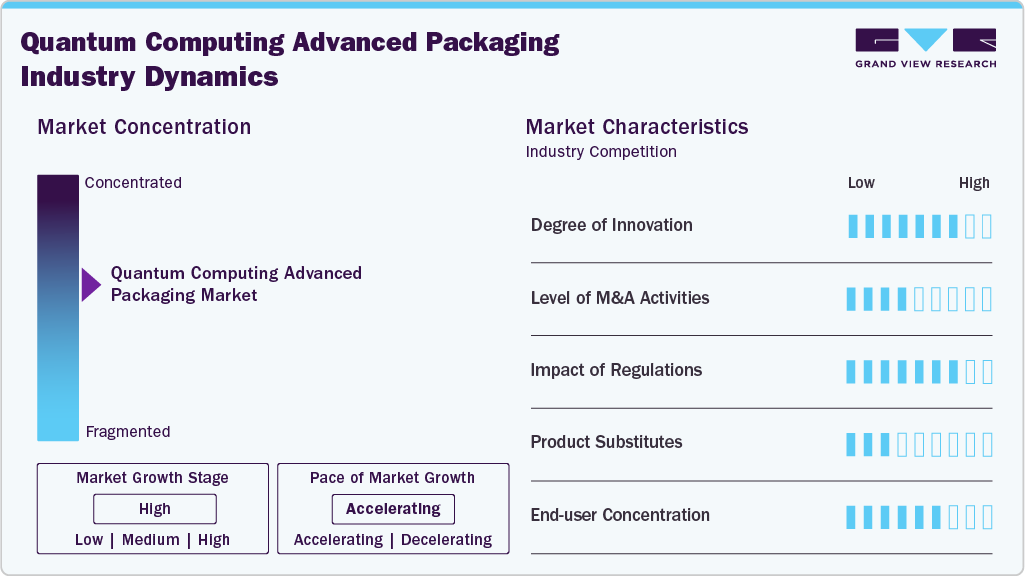
A defining characteristic of the market is its strong dependence on specialized materials and cryogenic-compatible components rather than standardized packaging materials used in conventional electronics. Ceramic and silicon substrates, superconducting materials, low-loss dielectrics, copper and other conductive interconnect materials, as well as specialized thermal interfaces are used to meet stringent quantum hardware requirements. The industry is also moving toward 3D integration, chip-to-chip interconnects, interposers, and heterogeneous integration to address wiring bottlenecks as qubit counts increase. Packaging development is closely linked to advances in quantum processor architecture, dilution refrigeration, control electronics, and quantum error-correction systems. As a result, collaboration among quantum computing companies, semiconductor manufacturers, packaging specialists, and research institutions remains a defining feature of the market, with scalability, thermal efficiency, signal fidelity, and reliability serving as major technology-development priorities
Analyst Perspective
The global quantum computing advanced packaging market has evolved from highly customized laboratory packaging toward sophisticated, scalable solutions capable of supporting increasingly complex quantum processors. Early development focused primarily on basic device protection, cryogenic compatibility, and signal connectivity, while current solutions increasingly emphasize high-density interconnects, 2.5D and 3D integration, flip-chip bonding, chiplet architectures, thermal management, and electromagnetic shielding. Looking ahead, market growth is expected to be driven by the need to scale qubit counts, reduce wiring and signal losses, integrate quantum and classical electronics more closely, and improve manufacturability. Advanced packaging is therefore becoming a critical enabler of quantum processor performance, reliability, and commercialization, creating strong opportunities for specialized packaging providers, semiconductor manufacturers, and quantum technology companies.
Qubit Technology Insights
The superconducting qubits segment led the quantum computing advanced packaging market with the largest market share of 40.8% in 2025. Superconducting qubits require highly specialized advanced packaging to operate reliably at millikelvin temperatures, including cryogenic interconnects, thermal management, electromagnetic shielding, and high-density signal routing. Their established position in scalable quantum processor development, combined with increasing deployment of multi-chip modules, interposers, and superconducting interconnects, supports their leading share in the advanced packaging market.
Topological & other qubits are expected to grow at the fastest CAGR of 13.3% during the forecast period. Emerging qubit architectures are creating demand for specialized packaging solutions capable of supporting unconventional device structures, heterogeneous integration, dense interconnects, and reliable quantum-classical interfaces. Increasing research and development into next-generation quantum processors is encouraging the development of flexible packaging architectures that can accommodate new qubit designs, advanced bonding approaches, and scalable chip-level integration.
Advanced Packaging Technology Insights
The 2.5D interposer packaging segment led the Quantum Computing Advanced Packaging Market with the largest market share of 48.5% in 2025. Its leading position is driven by the ability to integrate quantum processor dies with interposers and high-density interconnects while maintaining efficient signal routing, thermal management, and electrical performance. In superconducting quantum systems, 2.5D architectures can support complex qubit-to-control connections and enable integration of multiple components within cryogenic environments, making them well suited to the scaling requirements of advanced quantum processors.
Wafer-Level/Fan-Out packaging is expected to grow at the fastest CAGR of 13.1% during the forecast period. Its growth is supported by the increasing need for compact, high-density packaging that can accommodate miniaturized quantum components, shorter interconnect paths, and scalable chip-level integration. Wafer-level and fan-out approaches can also facilitate heterogeneous integration and improved interconnect density, supporting the development of increasingly compact quantum computing architectures while helping address performance and packaging scalability requirements.
Customer Type Insights
The research laboratories & universities segment accounted for the largest market share of 47.2% in 2025 in the quantum computing advanced packaging market. The segment growth is driven by extensive quantum hardware research, prototype development, and experimental scaling activities that require specialized packaging for qubit chips, cryogenic environments, signal routing, thermal management, and electromagnetic shielding. Universities and research laboratories are also major users of advanced packaging technologies because they continuously test emerging qubit architectures and packaging configurations before commercial-scale deployment.
Quantum technology companies are expected to register the fastest CAGR of 13.1% during the forecast period. Their growth is supported by increasing commercialization of quantum processors and greater investment in scalable quantum hardware, which is creating demand for sophisticated packaging solutions that enable high-density interconnects, chip-level integration, cryogenic operation, and improved system reliability. As quantum technology companies move from laboratory prototypes toward larger and more commercially viable systems, the need for scalable and manufacturable advanced packaging is expected to increase.
Operating Temperature Insights
The Millikelvin (<1 K) segment accounted for the largest market share of 44.4% in 2025 in the quantum computing advanced packaging market. Its dominance is driven by the widespread use of superconducting qubits, which operate at extremely low temperatures and require specialized packaging for cryogenic thermal management, low-loss interconnects, electromagnetic shielding, and signal integrity. Advanced packaging helps minimize heat leakage and crosstalk while enabling reliable connections between quantum processors and control/readout systems within dilution-refrigerator environments.
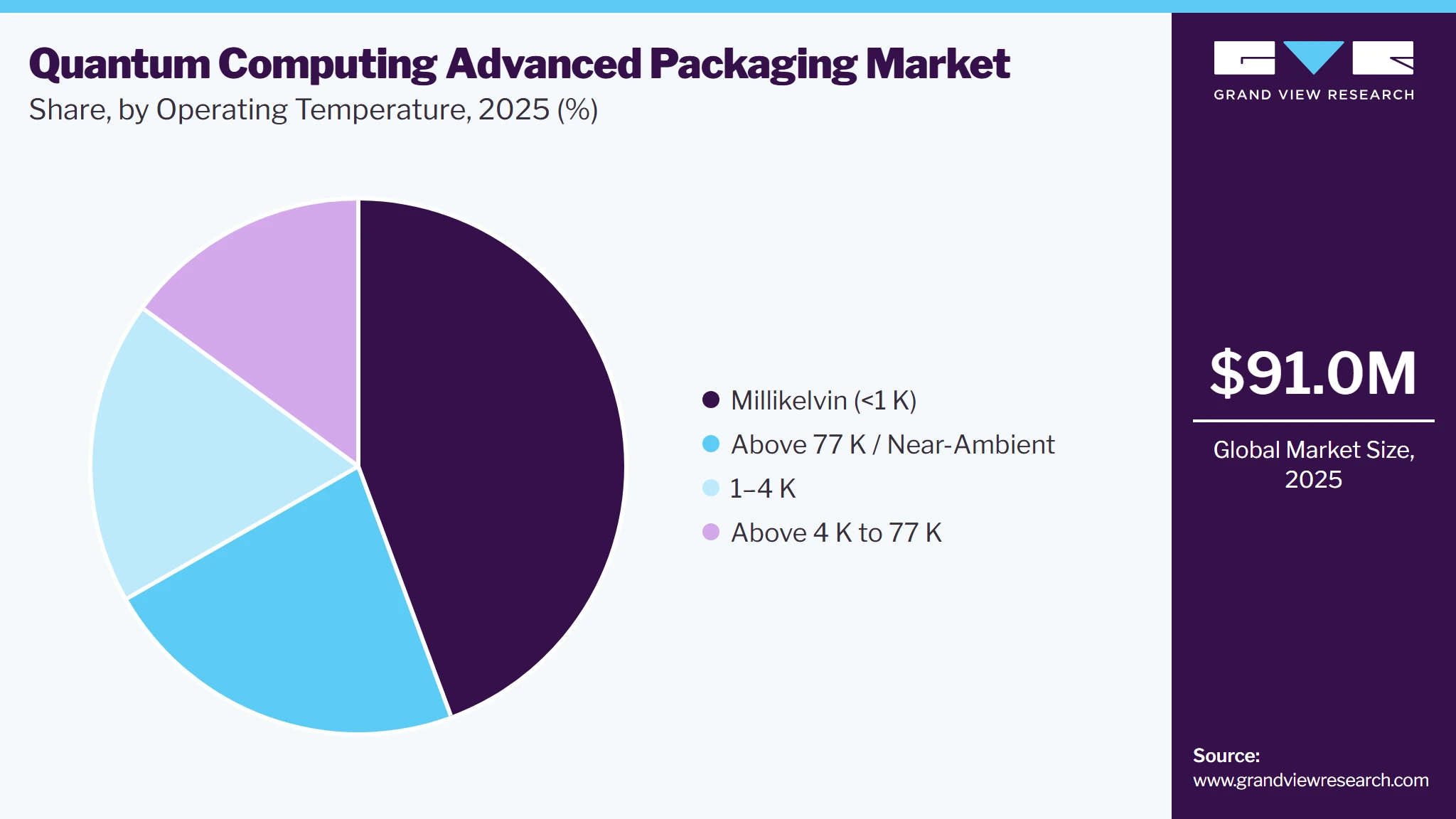
1–4 K is expected to register the fastest CAGR of 13.1% during the forecast period. Growth in this temperature range is supported by increasing efforts to develop quantum systems with more practical cryogenic architectures, including the integration of control electronics and cryogenic interconnects closer to quantum processors. Packaging technologies designed for 1–4 K operation can help reduce wiring complexity, thermal loads, and signal-transfer losses, supporting the development of scalable quantum computing systems and next-generation cryogenic hardware.
Regional Insights
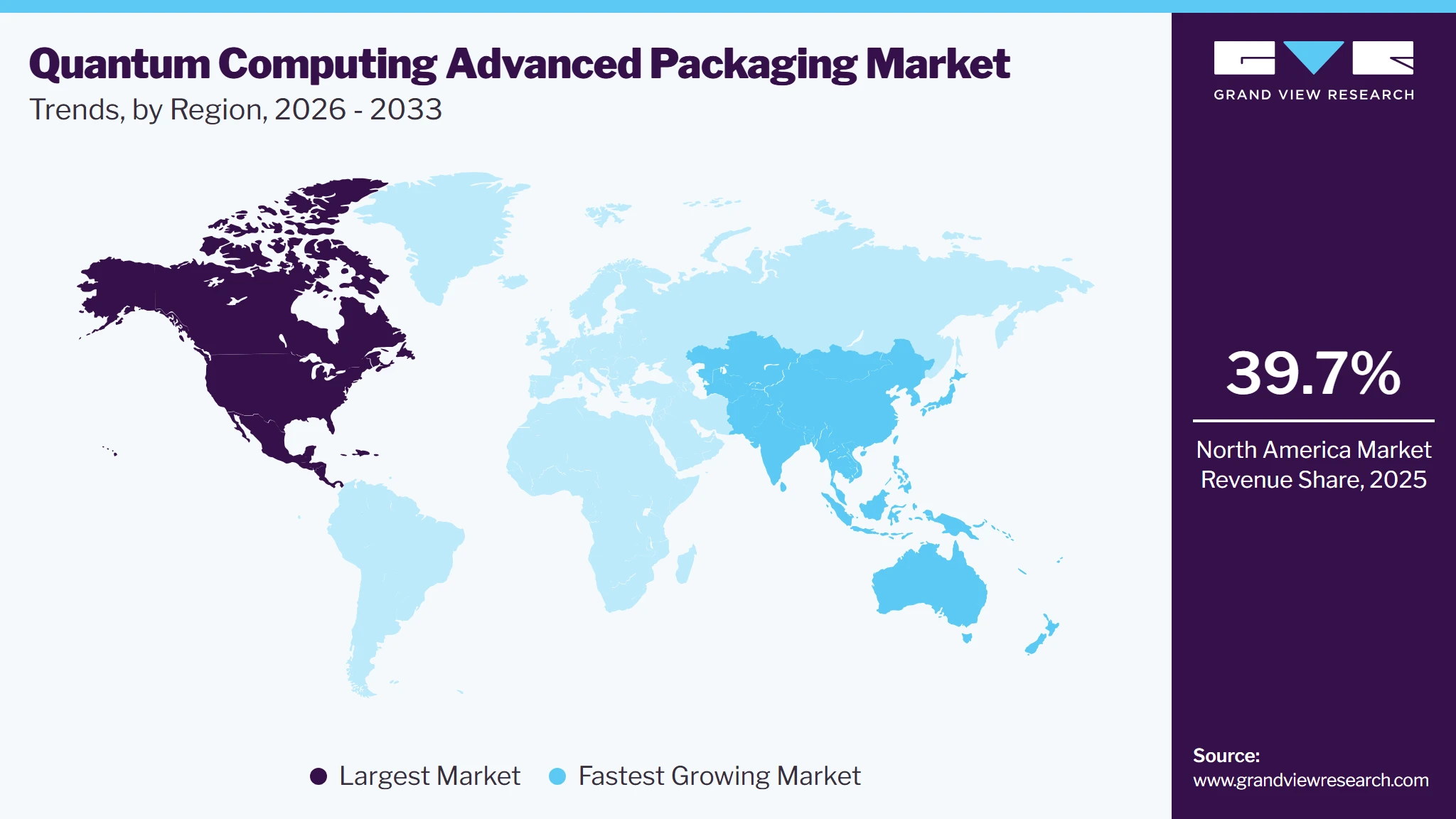
The North America quantum computing advanced packaging market dominated the global market, accounting for the highest share of 39.7% in 2025. Regional leadership is supported by strong quantum computing research, substantial investments in quantum hardware development, and the presence of established technology companies, research institutions, and advanced semiconductor ecosystems. Demand for sophisticated packaging is increasing as quantum processors require cryogenic interconnects, thermal management, electromagnetic shielding, and high-density signal routing. Continued development of scalable quantum architectures and advanced chip integration is expected to reinforce North America's position.
U.S. Quantum Computing Advanced Packaging Market Trends
The U.S. quantum computing advanced packaging market represents the major portion of North American demand, supported by extensive government funding, university-led quantum research, and commercial development of superconducting and other quantum processors. The country's advanced semiconductor and packaging infrastructure enables development of specialized interposers, multi-chip modules, cryogenic connections, and heterogeneous integration technologies. Increasing efforts to transition quantum systems from laboratory prototypes toward scalable computing platforms are expected to sustain demand for advanced packaging solutions.
Europe Quantum Computing Advanced Packaging Market Trends
The Europe quantum computing advanced packaging market is projected to experience steady growth during the forecast period, driven by expanding quantum research programs, semiconductor innovation, and development of next-generation quantum hardware. Increasing attention to scalable qubit architectures is encouraging investments in cryogenic packaging, wafer-level integration, interposers, and advanced interconnect technologies. European initiatives focused on strengthening domestic quantum and semiconductor capabilities are also supporting the development of specialized packaging solutions.
The Germany quantum computing advanced packaging market is supported by its strong semiconductor, engineering, and industrial research base. Growing investments in quantum technologies are encouraging development of sophisticated packaging and interconnect solutions for cryogenic quantum processors. Collaboration between research organizations, universities, and technology companies is expected to support advancements in chip integration, thermal management, and scalable quantum hardware packaging.
The UK quantum computing advanced packaging market is expected to witness consistent expansion, supported by national quantum technology programs and a well-established research ecosystem. The increasing development of quantum processors and supporting control electronics is driving demand for compact packaging, specialized interconnects, and cryogenic integration. The country's focus on commercializing quantum technologies is expected to create additional opportunities for advanced packaging suppliers.
Asia Pacific Quantum Computing Advanced Packaging Market Trends
The Asia Pacific quantum computing advanced packaging market is expected to register the fastest CAGR of 13.1% during the forecast period. Rapid expansion is driven by increasing government funding for quantum computing, growing semiconductor manufacturing capabilities, and rising investments in quantum processors and supporting infrastructure across major economies. The region's established electronics and advanced packaging ecosystem provides a strong foundation for developing high-density interconnects, wafer-level packaging, chiplet integration, and cryogenic packaging solutions. Accelerating the commercialization of quantum technologies is expected to further increase regional demand.
The China quantum computing advanced packaging market is expanding through significant investments in quantum research, domestic semiconductor capabilities, and the development of quantum processors. Increasing emphasis on indigenous quantum hardware is encouraging the development of local packaging, interconnect, and integration technologies. Expansion of research laboratories and technology development programs is expected to support demand for packaging solutions capable of handling high-density connections and specialized thermal requirements.
The India quantum computing advanced packaging market is expected to witness strong growth as national quantum technology initiatives, academic research, and private-sector participation expand. Increasing investments in quantum processors, semiconductor infrastructure, and indigenous hardware development are creating emerging demand for specialized packaging and interconnect solutions. The development of domestic semiconductor and electronics manufacturing capabilities is expected to improve the country's ability to support locally developed quantum computing systems.
Latin America Quantum Computing Advanced Packaging Market Trends
The Latin America quantum computing advanced packaging market is projected to grow gradually as quantum computing research and advanced electronics capabilities develop across the region. Demand remains primarily associated with universities, research institutions, and emerging technology initiatives rather than large-scale commercial quantum hardware manufacturing. Increasing collaboration with international technology providers and research organizations is expected to gradually create opportunities for specialized quantum packaging solutions.
The Brazil quantum computing advanced packaging market represents an emerging opportunity within Latin America, supported by growing academic research and interest in quantum technologies. The development of quantum computing research capabilities and advanced electronics expertise is expected to drive demand for specialized packaging, interconnect, and thermal management technologies. Greater investment in quantum research infrastructure could further strengthen the country's market potential.
The Argentina quantum computing advanced packaging market is expected to develop gradually as research institutions and universities increase their participation in quantum computing research. Growth in quantum technology education, research collaborations, and specialized computing initiatives is creating a foundation for future demand. However, the market remains at an earlier development stage compared with North America, Europe, and the Asia Pacific.
Middle East & Africa Quantum Computing Advanced Packaging Market Trends
The Middle East & Africa quantum computing advanced packaging market is expected to grow moderately during the forecast period, supported by increasing investments in advanced computing, artificial intelligence, semiconductor technologies, and national technology initiatives. Growing interest in establishing high-performance computing and research capabilities is creating opportunities for quantum technology development. As regional institutions expand quantum research and partnerships, demand for specialized packaging and supporting hardware infrastructure is expected to gradually increase.
Key Quantum Computing Advanced Packaging Company Insights
Some key companies in the Quantum Computing Advanced Packaging Market include QuantWare, SCALINQ, YQuantum GmbH, Hqubit System Co., Ltd., D-Wave Quantum Inc., LLC, Oxford Quantum Circuits, GlobalFoundries (GF), Intel Corporation, Quantum Computing Inc., QTREX Quantum Ltd., and SEEQC. The market is characterized by cryogenic packaging innovation, high-density interconnect development, superconducting packaging, heterogeneous integration, thermal management, and the integration of quantum processors with control and readout electronics. Key participants are focusing on scalable packaging architectures, low-loss interconnects, improved signal integrity, and compact quantum hardware designs to support increasing qubit densities and the commercialization of quantum computing systems.
-
QuantWare develops superconducting quantum processors and scalable quantum hardware solutions, with its technology ecosystem supporting advanced packaging requirements for high-density qubit integration, signal routing, and cryogenic operation. Its focus on scalable quantum processor architectures drives demand for packaging approaches that support larger, more interconnected quantum chips.
-
SCALINQ specializes in quantum hardware and cryogenic technologies, including solutions designed around the integration and control of superconducting quantum processors. Its activities contribute to the development of advanced packaging approaches involving cryogenic interconnects, thermal management, and reliable quantum-classical signal connections.
Key Quantum Computing Advanced Packaging Companies:
The following key companies have been profiled for this study on the quantum computing advanced packaging market.
-
QuantWare
-
SCALINQ
-
YQuantum® GmbH
-
Hqubit System Co.,Ltd.
-
D-Wave Quantum Inc
-
OxfordQuantumCircuits
-
GlobalFoundries (GF)
-
Intel Corporation
-
Quantum Computing Inc
-
QTREX Quantum Ltd.
-
SEEQC
Company Categorization
Category
Operating Strategies
Competitive Edge
Weakness
Established Players (D-Wave Quantum Inc.; LLC; Oxford Quantum Circuits; GlobalFoundries (GF); Intel Corporation; SEEQC)
Focus on scalable quantum processor development, cryogenic packaging, high-density interconnects, advanced chip integration, and quantum-classical control systems.
Strong R&D capabilities, semiconductor expertise, established manufacturing infrastructure, and experience in superconducting and cryogenic technologies support advanced packaging development and system scalability.
High development costs, complex cryogenic requirements, long commercialization cycles, and challenges in scaling reliable qubit architectures can limit profitability and expansion.
Emerging Players (QuantWare; SCALINQ; YQuantum® GmbH; Hqubit System Co., Ltd.; Quantum Computing Inc.; QTREX Quantum Ltd.)
Concentrate on specialized quantum packaging, cryogenic components, interconnect solutions, QPU integration, and compact hardware architectures tailored to emerging quantum systems.
High specialization, flexible customization, rapid innovation, and focus on quantum-specific packaging requirements enable these companies to address niche and evolving applications.
Smaller production scale, limited global distribution, lower financial resources, and dependence on the adoption of emerging quantum architectures may restrict market penetration.
Recent Development:
-
In May 2026, GlobalFoundries launched Quantum Technology Solutions, a dedicated business focused on scaling quantum manufacturing. The initiative combines QPU fabrication, cryogenic control and readout ICs, advanced packaging, and superconducting interconnects, strengthening the semiconductor industry's role in large-scale quantum hardware production.
-
In May 2026, QuantWare raised USD 178 million to accelerate the development and industrial-scale manufacturing of quantum processors. The company highlighted its VIO™ architecture, foundry services, and chiplet packaging, supporting scalable QPU integration and higher-density quantum processor architectures.
Quantum Computing Advanced Packaging Market Report Scope
Report Attribute
Details
Market size in 2025
USD 91.1 million
Estimated market size in 2026
USD 101.6 million
Projected market size by 2033
USD 232.4 million
Growth rate
CAGR of 12.5%from 2026 to 2033
Base year for estimation
2025
Historical data
2021 – 2024
Forecast period
2026 – 2033
Quantitative units
Revenue in USD Million/Billion and CAGR from 2026 to 2033
Report coverage
Revenue forecast, company ranking, competitive landscape, growth factors, and trends
Segments covered
Qubit technology, advanced packaging technology, customer type, operating temperature, and region
Regional Scope
North America; Europe; Asia Pacific; Latin America; Middle East & Africa
Country Scope
U.S.; Canada; Mexico; Germany; France; UK; Italy; Spain; China; India; Japan; South Korea; Australia; Brazil; Argentina; Saudi Arabia; UAE; South Africa
Key companies profiled
QuantWare; SCALINQ; YQuantum® GmbH; Hqubit System Co.,Ltd.; D-Wave Quantum Inc; OxfordQuantumCircuits, GlobalFoundries (GF); Intel Corporation; Quantum Computing Inc; QTREX Quantum Ltd.; SEEQC
Customization scope
Free report customization (equivalent up to 8 analysts working days) with purchase. Addition or alteration to country, regional & segment scope.
Pricing and purchase options
Avail of customized purchase options to meet your exact research needs. Explore purchase options
Global Quantum Computing Advanced Packaging Market Report Segmentation
This report forecasts revenue growth at the regional, and country levels and provides an analysis on the latest industry trends and opportunities in each of the sub-segments from 2021 to 2033. For the purpose of this study, Grand View Research has segmented the global quantum computing advanced packaging market report on the basis of qubit technology, advanced packaging technology, customer type, operating temperature, and region:
-
Qubit Technology Outlook (Revenue, USD Million, 2021 – 2033)
-
Superconducting Qubits
-
Trapped-Ion Qubits
-
Photonic Qubits
-
Neutral-Atom Qubits
-
Topological & Other Qubits
-
-
Advanced Packaging Technology Outlook (Revenue, USD Million, 2021 – 2033)
-
2.5D Interposer Packaging
-
3D / Die-Stacked Packaging
-
Flip-Chip Packaging
-
Multi-Chip Module (MCM) Packaging
-
Wafer-Level / Fan-Out Packaging
-
Other Advanced Packaging
-
-
Customer Type Outlook (Revenue, USD Million, 2021 – 2033)
-
Research Laboratories & Universities
-
Quantum Technology Companies
-
Government & National Laboratories
-
-
Operating Temperature Outlook (Revenue, USD Million, 2021 - 2033)
-
Millikelvin (<1 K)
-
1–4 K
-
Above 4 K to 77 K
-
Above 77 K / Near-Ambient
-
-
Regional Outlook (Revenue, USD Million, 2021 - 2033)
-
North America
-
U.S.
-
Canada
-
Mexico
-
-
Europe
-
Germany
-
France
-
UK
-
Italy
-
Spain
-
-
Asia Pacific
-
China
-
India
-
Japan
-
South Korea
-
Australia
-
-
Latin America
-
Brazil
-
Argentina
-
-
Middle East & Africa
-
Saudi Arabia
-
UAE
-
South Africa
-
-
Research Methodology
The quantum computing advanced packaging market figures in this report are based on a proven research process that combines executive interviews with secondary research from proprietary databases, company filings, and recognized regulatory and institutional sources. Market size is built through value-chain sizing—reconciling supply-side and demand-side estimates—and triangulated with bottom-up and top-down approaches. Every estimate passes multiple levels of expert validation before publication, with each quantum computing advanced packaging segment quantified using the revenue-capture definitions in the table below.
Segment Definition
Segment – Qubit Technology Type
Revenue capture definition
Superconducting Qubits
Revenue generated from advanced packaging solutions used for superconducting quantum processors, including cryogenic packages, high-density interconnects, superconducting connections, thermal management structures, electromagnetic shielding, and chip-to-chip integration required for reliable operation at millikelvin temperatures.
Trapped-Ion Qubits
Revenue generated from advanced packaging solutions used in trapped-ion quantum systems, including ion-trap chip packaging, electrical and optical interconnects, vacuum-compatible structures, thermal management, and integration components supporting trapped-ion processors and control systems.
Photonic Qubits
Revenue generated from advanced packaging solutions for photonic quantum processors, including optical packaging, fiber-to-chip coupling, photonic interconnects, silicon photonics integration, optical alignment, and packaging of quantum photonic circuits and related control components.
Neutral-Atom Qubits
Revenue generated from packaging and integration solutions used in neutral-atom quantum systems, including optical interfaces, vacuum-compatible components, control and readout interconnects, thermal-management structures, and compact integration platforms supporting neutral-atom processors.
Topological & Other Qubits
Revenue generated from specialized advanced packaging solutions developed for emerging qubit architectures, including heterogeneous integration, customized interconnects, cryogenic or specialized environmental packaging, chip-level integration, and other packaging technologies required for experimental and next-generation quantum processors.
Segment – Advanced Packaging Technology
Revenue capture definition
.5D Interposer Packaging
Revenue generated from advanced packaging solutions that integrate quantum processor dies with silicon or other interposer substrates, enabling high-density interconnects, efficient signal routing, thermal management, and integration of quantum and control components.
3D / Die-Stacked Packaging
Revenue generated from vertically integrated packaging solutions that stack quantum processor dies, control electronics, memory, or supporting components to reduce footprint, shorten interconnect distances, and improve system-level integration.
Flip-Chip Packaging
Revenue generated from flip-chip packaging solutions used to directly connect quantum processor chips with substrates or supporting circuits through bumps or microbumps, providing compact interconnections, improved signal integrity, and efficient thermal transfer.
Multi-Chip Module (MCM) Packaging
Revenue generated from packaging solutions that integrate multiple quantum dies, control chips, interconnect components, and supporting electronics within a single module to enable modular and scalable quantum computing architectures.
Wafer-Level / Fan-Out Packaging
Revenue generated from wafer-level and fan-out packaging solutions used to achieve compact quantum device integration, high interconnect density, shorter signal paths, and scalable chip-level manufacturing for quantum processors and photonic components.
Other Advanced Packaging
Revenue generated from other specialized quantum packaging technologies, including hybrid bonding, direct bonding, chiplet-based packaging, cryogenic packaging, photonic packaging, and customized integration solutions supporting emerging quantum computing architectures.
Segment – Customer Type
Revenue capture definition
Research Laboratories & Universities
Revenue generated from advanced quantum packaging solutions supplied to universities and research laboratories for quantum processor development, experimental qubit architectures, cryogenic testing, prototype fabrication, interconnect development, and quantum hardware research.
Quantum Technology Companies
Revenue generated from advanced packaging solutions purchased by commercial quantum computing companies for QPU integration, scalable processor development, cryogenic packaging, high-density interconnects, chip integration, and production of quantum computing systems.
Government & National Laboratories
Revenue generated from quantum packaging technologies supplied to government-funded research centers and national laboratories for quantum computing programs, advanced processor development, cryogenic infrastructure, experimental systems, and large-scale quantum technology initiatives.
Segment – Operating Temperature
Revenue capture definition
Millikelvin (<1 K)
Revenue generated from advanced packaging solutions designed for quantum processors operating below 1 K, including cryogenic packaging, thermal isolation, superconducting interconnects, electromagnetic shielding, and low-loss signal connections.
1–4 K
Revenue generated from packaging solutions supporting quantum processors and cryogenic control electronics operating between 1 and 4 K, including thermal management, high-density interconnects, signal routing, and cryogenic component integration.
Above 4 K to 77 K
Revenue generated from advanced packaging used for quantum control, readout, photonic, and supporting electronic components operating at temperatures above 4 K and up to 77 K, including cryogenic electronics integration, interconnects, and thermal-management structures.
Above 77 K / Near-Ambient
Revenue generated from packaging solutions for quantum system components operating above 77 K or near ambient temperatures, including control electronics, photonic components, interfaces, power-management devices, and supporting hardware requiring conventional or specialized advanced packaging.
Estimation Model
Layer No.
Layer Name
Key Question
Description
01
Qubit Technology Layer
Which qubit architectures drive packaging demand?
Estimate packaging demand from major quantum architectures, including superconducting, trapped-ion, photonic, neutral-atom, and topological & other qubits, based on their requirements for cryogenic operation, optical interfaces, high-density interconnects, electromagnetic shielding, and thermal management.
02
Advanced Packaging Technology Layer
How are quantum components packaged?
Assess adoption of 2.5D interposer, 3D/die-stacked, flip-chip, multi-chip module (MCM), wafer-level/fan-out, and other advanced packaging technologies according to requirements for signal integrity, compact integration, scalable interconnects, and quantum-classical component integration.
03
Customer & Application Layer
Who generates packaging demand?
Evaluate consumption of advanced quantum packaging solutions by research laboratories & universities, quantum technology companies, and government & national laboratories for QPU development, prototype fabrication, cryogenic testing, processor scaling, and commercial quantum computing systems.
04
Revenue Layer
How is revenue generated?
Revenue is generated through the sale of quantum processor packages, cryogenic packaging, interposers, chiplet and multi-chip modules, flip-chip/hybrid-bonded assemblies, superconducting interconnects, electromagnetic shielding, thermal-management structures, and specialized QPU integration solutions used in quantum computing systems.
Delivered Customizations
This report has been delivered with the following In-depth customizations
Client Request
Customization Delivered
Value Adds
Competitive Benchmarking
Comparative assessment of leading quantum advanced packaging companies based on QPU packaging capabilities, cryogenic integration, 2.5D/3D packaging, flip-chip and hybrid bonding, superconducting interconnects, thermal management, electromagnetic shielding, manufacturing capabilities, and technology partnerships.
Enables evaluation of competitor positioning, technological differentiation, scalability, packaging expertise, and strategic strengths across quantum computing architectures.
Opportunity Assessment
Detailed assessment of growth opportunities across superconducting, trapped-ion, photonic, neutral-atom, and emerging qubit architectures, along with 2.5D interposer, 3D, flip-chip, MCM, chiplet, and wafer-level packaging technologies.
Helps identify high-potential technology areas, unmet packaging requirements, scalability opportunities, and investment priorities driven by increasing qubit density, cryogenic integration, and quantum processor commercialization.
Trade Assessment
Assessment of international trade patterns for quantum processor packaging components, cryogenic interconnects, advanced substrates, semiconductor packaging materials, photonic components, and specialized quantum hardware, including key exporting and importing regions.
Provides insights into cross-border supply chains, component sourcing, manufacturing dependencies, technology availability, and potential trade-related opportunities and constraints affecting the quantum advanced packaging ecosystem.
Frequently Asked Questions About This Report
The quantum computing advanced packaging market is primarily driven by increasing development of high-qubit quantum processors, growing demand for scalable quantum computing architectures, rising adoption of cryogenic packaging, increasing integration of quantum processors with control and readout electronics, and demand for high-density interconnects, thermal management, and electromagnetic shielding.
Asia Pacific is the fastest-growing region in the quantum computing advanced packaging market, with a CAGR of 13.1% over the forecast period.
The quantum technology companies segment is the fastest-growing customer type in the quantum computing advanced packaging market, with a CAGR of 13.1% from 2026 to 2033.
The superconducting qubits segment led the quantum computing advanced packaging market with a 40.8% revenue share in 2025.
The Millikelvin (<1 K) segment led the quantum computing advanced packaging market with a 44.4% revenue share in 2025.
The global quantum computing advanced packaging market size was valued at USD 91.1 million in 2025 and is estimated at USD 101.6 million in 2026.
The global quantum computing advanced packaging market is expected to grow at a CAGR of 12.5% from 2026 to 2033, reaching USD 232.4 million by 2033.
North America dominated the quantum computing advanced packaging market with a 39.7% revenue share in 2025.
Key players in the quantum computing advanced packaging market include CEA-Leti, QuantWare, SCALINQ, YQuantum, HQUBIT System, D-Wave Quantum, Oxford Quantum Circuits (OQC), GlobalFoundries, Intel, Qifrost, and Kelvin Quantum.
About the Author(s)
Plastics, Polymers & Resins Research Team
Bulk Chemicals · Plastics, Polymers & ResinsThis report was authored by the plastics, polymers & resins research team at Grand View Research - comprising two research analysts, one senior research analyst, and one industry expert - with specialized expertise in the plastics, polymers & resins segment of the bulk chemicals industry. All findings are based on proprietary bulk chemicals databases, executive interviews, and regulatory analysis, subject to internal peer review prior to publication.
Last Updated:
Speak to Analyst


Customize this report to your needs - add regions, segments, or data points, with 20% free customization.
Or view our licence options:


ISO 9001:2015 & 27001:2022 Certified
We are GDPR and CCPA compliant! Your transaction & personal information is safe and secure. For more details, please read our privacy policy.


