
- Home
- »
- Advanced Interior Materials
- »
-
Quartz Market Size, Share And Trends Report, 2026-2033GVR Report cover

Quartz Market (2026 - 2033)
Size, Share & Trends Analysis Report By Grade (Quartz Surface/Slab, High Purity Quartz), By Application (Building & Construction, Electronics & Semiconductor), By Region (North America, Europe, Asia Pacific), And Segment Forecasts
Market Size, 2025
$12.2BMarket Estimate, 2026
$12.6BMarket Forecast, 2033
$16.8BCAGR, 2026–2033
4.2%Quartz Market Summary
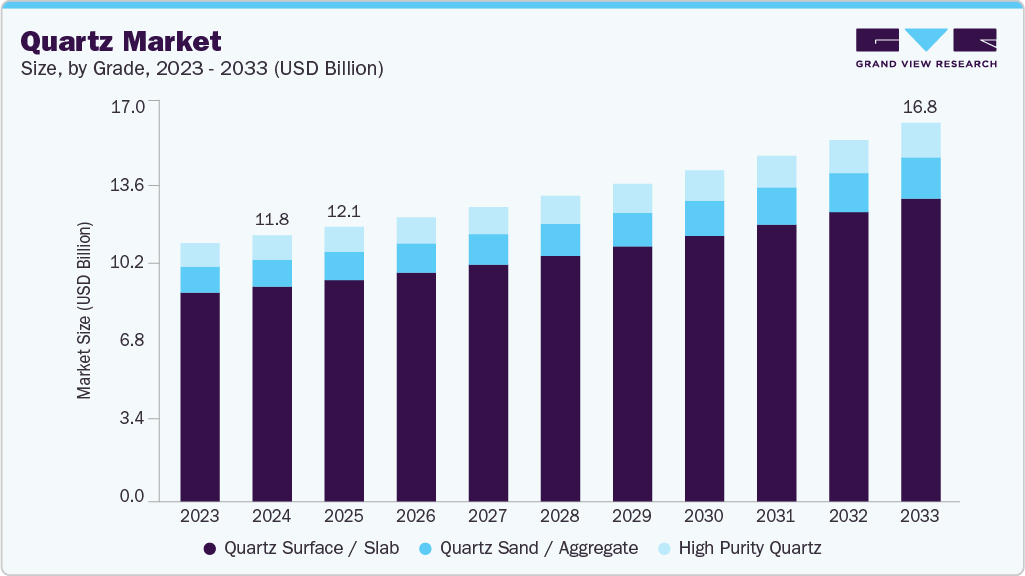
The global quartz market size was valued at USD 12.2 billion in 2025 and is projected to grow from USD 12.6 billion in 2026 to USD 16.8 billion by 2033, at a CAGR of 4.2% from 2026 to 2033. Asia Pacific market dominated, with a revenue share of 52.4% in 2025. The market is experiencing robust growth, primarily fueled by the relentless expansion of the building and construction industry worldwide.
 Source: Grand View Research, IR Documents, Primary Interviews, Paid DatabasesTo learn more about this report,
 Download Free Sample Report
Key Market Trends & Insights
- By grade: Quartz surface/ slab segment led the market with the largest revenue share of 80.5% in 2025.
- By application: Building & construction segment led the market with the largest revenue share of 84.2% in 2025.
Regional Highlights
- Largest regional market: Asia Pacific (52.4% revenue share, 2025)
- By country: China held the largest market share in 2025.
Market Size & Forecasts
- Market size in 2025: USD 12.2 Billion
- Estimated market size in 2026: USD 12.6 Billion
- Projected market size by 2033: USD 16.8 Billion
- CAGR (2026–2033): 4.2%
Prism AI by Grand View Research Free to tryAsk a question about the quartz marketTry asking✓Every figure cited from GVR research Prefer the report? Download free sample →
Quartz, particularly in its engineered form, has become a material of choice for countertops, flooring, and wall cladding due to its superior performance characteristics. Its non-porous surface makes it highly resistant to staining and bacterial growth, a significant advantage over natural stone like marble. Furthermore, its exceptional durability and scratch resistance ensure longevity, making it a cost-effective investment for both residential and commercial projects. As urbanization continues, especially in emerging economies, and investment in new residential and infrastructure projects rises, the demand for high-quality, durable, and aesthetically versatile surfacing materials like quartz is projected to surge in tandem.The post-pandemic era has heightened awareness of cleanliness, and the non-porous nature of engineered quartz directly addresses this concern, making it a popular choice for kitchens and bathrooms. Aesthetically, advancements in manufacturing technology allow quartz slabs to mimic the look of high-end natural stones, such as marble and granite, but with greater consistency and a wider array of color and pattern options. This versatility allows designers and homeowners to achieve a luxury look without the associated maintenance hassles, such as the need for regular sealing. The combination of visual appeal and practical benefits positions quartz as a premium yet practical solution for modern interiors.
 To learn more about this report, Download Free Sample Report
Continuous improvements in production techniques have led to higher efficiency, reduced waste, and the ability to create slabs with more complex and realistic veining patterns. Furthermore, research and development have led to the creation of new product variants, including ultra-compact quartz surfaces that offer even greater resistance to heat, impact, and UV radiation, expanding their application to outdoor kitchens and facades. The development of thinner, lighter slabs also opens up new possibilities for vertical applications and furniture, broadening the market scope beyond traditional countertops. These innovations not only enhance product performance but also help manufacturers differentiate their offerings in a competitive landscape.
Rising disposable incomes, particularly in the Asia-Pacific region, are enabling more consumers to invest in home renovation and premium building materials. The burgeoning middle class is increasingly willing to spend on products that offer a combination of quality, durability, and aesthetic value, a niche that quartz fills perfectly. Simultaneously, the global trend of urbanization leads to the construction of new housing units and commercial spaces, all of which require interior finishes. This sustained economic development and population shift create a fertile ground for the continued adoption of quartz surfaces across various applications.
Market Dynamics
The rapid expansion of the semiconductor and electronics industry is a major growth driver for the quartz market. High purity quartz is an essential raw material used in the production of semiconductor wafers, quartz crucibles, tubes, and other components required for integrated circuits, photovoltaic cells, and advanced electronic devices. As global demand for smartphones, laptops, artificial intelligence hardware, data centers, electric vehicles, and 5G communication infrastructure continues to increase, semiconductor manufacturers are expanding production capacities, driving higher consumption of high purity quartz. Its exceptional thermal stability, chemical resistance, and low impurity levels make it indispensable in precision manufacturing processes where product quality and performance are critical.
The increasing demand for semiconductors is a significant growth driver for the quartz market, as high-purity quartz is an essential material used throughout semiconductor manufacturing. It is utilized to produce quartz crucibles, tubes, boats, and other processing equipment that can withstand extremely high temperatures and corrosive environments during silicon wafer fabrication. The rapid growth of consumer electronics, artificial intelligence, cloud computing, data centers, electric vehicles, and advanced communication technologies has accelerated semiconductor production, creating sustained demand for high-quality quartz materials.
Governments and private companies are investing heavily in expanding semiconductor manufacturing capacity to strengthen domestic chip production and improve supply chain resilience. New fabrication plants being established across Asia Pacific, North America, and Europe are increasing the consumption of high-purity quartz used in wafer processing and crystal growth applications. As semiconductor devices become more advanced and require higher manufacturing precision, demand for ultra-pure quartz with exceptional thermal stability and minimal impurities is expected to continue rising, supporting long-term growth of the global quartz market.
The limited availability of high purity quartz deposits is a key restraint for the quartz market, as only a small number of natural deposits possess the exceptionally low impurity levels required for semiconductor, solar photovoltaic, and advanced electronics applications. Extracting and processing these deposits into ultra-high purity quartz requires sophisticated purification technologies and significant capital investment, increasing production costs and limiting supply. The concentration of high quality deposits in a few geographic regions also creates supply chain risks and price volatility, making it challenging for manufacturers to secure a stable supply of premium quartz for high value industrial applications.
Growing investment in semiconductor manufacturing facilities presents a significant opportunity for the quartz market, as high-purity quartz is a critical material used in wafer fabrication, crystal growth, and other chip production processes. Governments and leading semiconductor companies are investing billions of dollars to establish new fabrication plants and expand existing production capacity in regions such as the Asia Pacific, North America, and Europe to strengthen supply chain resilience and meet rising global demand for advanced chips. These investments are expected to increase consumption of ultra-high-purity quartz for crucibles, tubes, and precision-processing equipment, creating long-term growth opportunities for quartz producers and suppliers.
Analyst Perspective
The quartz market is expected to experience steady long-term growth, driven by rising demand from the semiconductor, electronics, construction, and renewable energy industries. High-purity quartz has become a strategically important material for semiconductor fabrication, photovoltaic cell production, and optical applications due to its exceptional thermal stability, chemical purity, and resistance to extreme processing conditions. At the same time, engineered quartz surfaces continue to see strong demand across residential and commercial construction projects due to their durability, low maintenance, and aesthetic appeal.
Grade Insights
Based on grade, quartz surface/slab segment led the market with the largest revenue share of 80.5% in 2025. The quartz surface and slab segment is experiencing strong momentum due to rising demand from residential and commercial construction. Modern housing projects, premium apartments, and renovation activities are increasingly centered around durable, aesthetically consistent materials for kitchens, bathrooms, and interior spaces. Quartz slabs offer superior scratch resistance, long service life, and uniform patterns that appeal to both homeowners and architects.
The quartz sand and aggregate segment is gaining traction as construction, glass manufacturing, and foundry operations expand across major economies. Builders rely on high-quality quartz sand for concrete formulations, mortars, and specialty aggregates that enhance strength, thermal stability, and overall structural performance. Growing infrastructure investment in highways, commercial buildings, and industrial facilities is elevating the need for consistent silica-based aggregates that can support heavy-load applications.
Application Insights
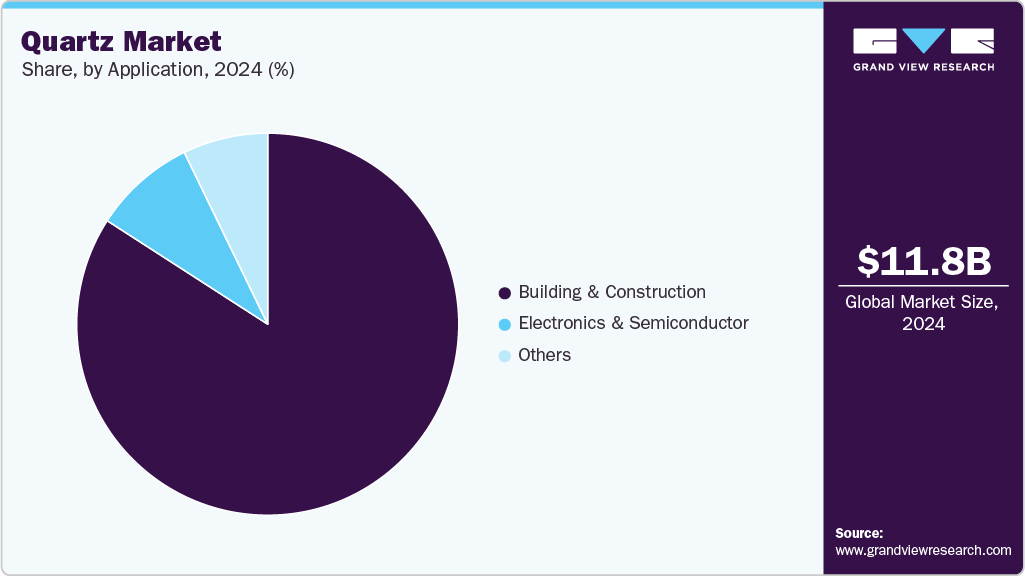
Based on application, building & construction segment led the market with the largest revenue share of 84.2% in 2025. The building and construction segment benefits from rapid urban expansion, large-scale infrastructure development, and sustained residential upgrades across both mature and emerging economies. Quartz materials are widely used in flooring, wall cladding, countertops, roofing granules, and decorative architectural elements because they offer reliable hardness, visual uniformity, and strong weather resistance. Developers choose engineered quartz slabs for kitchens and bathrooms due to their low maintenance requirements and long service life. For instance, in November 2025, Artelye introduced its latest quartz countertops, highlighting the growing preference for engineered stones due to their exceptional durability and longevity. Quartz countertops are praised for their high resistance to stains, scratches, and humidity, making them an ideal choice for high-traffic areas like kitchens and bathrooms.
 To learn more about this report, Download Free Sample Report
The electronics and semiconductor segment is expanding steadily as high-purity quartz becomes indispensable for advanced manufacturing processes. Semiconductor fabrication requires ultra-low impurity quartz for crucibles, tubes, and components used in wafer production, diffusion, etching, and crystal growth. The rising complexity of integrated circuits and the push toward smaller node technologies demand materials that can withstand extreme temperatures while maintaining chemical stability, which strengthens the role of high-purity quartz.
Regional Insights
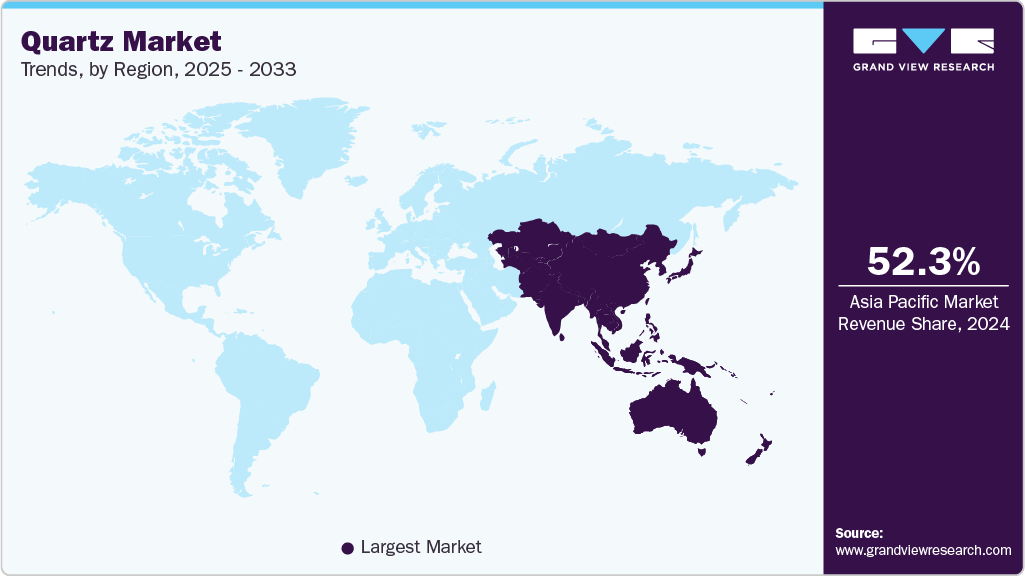
Asia Pacific dominated the quartz market with the largest revenue share of 52.4% in 2025. The market in the Asia Pacific is rapidly expanding due to recent discoveries of new quartz deposits in India, China, and parts of Southeast Asia. These discoveries have improved the availability of raw materials, reduced sourcing risks, and encouraged investments in advanced beneficiation technologies. For instance, in April 2025, China announced a significant discovery of high-purity quartz resources. This strategic move aims to reduce the country's dependency on foreign supplies of this essential material. According to Energy Connects, this discovery could rival the output of a major U.S. mine, emphasizing the geopolitical implications of quartz supply chains.
 To learn more about this report, Download Free Sample Report
China Quartz Market Trends
The quartz market in the China held the largest share in the Asia Pacific region in 2025.
North America Quartz Market Trends
The quartz market in North America is primarily driven by a robust resurgence in residential and commercial construction and remodeling activity. As one of the most popular materials for countertops, quartz benefits directly from trends in kitchen and bathroom renovations, which represent significant portions of home improvement expenditure. The material's durability, non-porous nature, and low maintenance requirements make it a highly attractive alternative to natural stone like granite and marble.
The U.S. quartz market is advancing through strong momentum in high-tech industries. Expanding semiconductor fabrication capacity, higher adoption of advanced chip manufacturing nodes, and a rise in solar photovoltaic installations are pushing up consumption of high-purity quartz used in crucibles, wafers, and precision optical components. For instance, in September 2025, the U.S. government intensified pressure on Taiwan to relocate semiconductor production, demanding that 50% of the U.S. chip supply chain needs be met domestically to bolster national security amid over-reliance on TSMC.
Europe Quartz Market Trends
The quartz market in Europe is powerfully driven by the region's strong cultural emphasis on sustainability and circular economy principles. This has led manufacturers to innovate with eco-friendly production lines and products that directly appeal to environmentally conscious consumers and comply with strict EU regulations. For instance, Compac, a Spanish company, has developed quartz surfaces that incorporate up to 25% recycled materials, including post-industrial glass and mirror waste.
Latin America Quartz Market Trends
The quartz market in Latin America is rising due to expanding construction activity and a growing preference for durable interior materials. Rapid urban development in countries such as Brazil, Mexico, and Colombia is creating demand for engineered quartz surfaces used in residential and commercial projects. Developers and homeowners are choosing quartz for its long service life, visual consistency, and lower maintenance needs, which supports steady consumption across countertops, flooring, and decorative applications.
Key Quartz Company Insights
Some of the key players operating in the market include Australian Silica Quartz Group Ltd, Sibelco, and others.
-
Australian Silica Quartz Group Ltd is an Australian mineral exploration and development company that focuses on high-grade quartz and silica sand resources. The company operates multiple projects across Western Australia and Queensland, where it targets hard-rock quartz deposits as well as premium silica sand bodies. Its strategic shift from bauxite exploration toward silica has enabled it to concentrate capital and technical expertise on high-purity quartz potential. ASQ continues to work on upgrading its natural silica feedstock to achieve the high-purity levels needed for advanced industrial applications.
-
Sibelco is a global industrial minerals company with a long legacy of supplying high-quality mineral solutions. With operations across multiple continents, the company manages an extensive portfolio of minerals that serve construction, manufacturing, technology, and consumer industries. Among its mineral offerings, quartz stands out as one of its most important product families, supported by large-scale mining, processing expertise, and a global production network.
Key Quartz Companies
The following key companies have been profiled for this study on the quartz market.
-
Australian Silica Quartz Group Ltd
-
Creswick Quartz Pty Ltd
-
HPQ Materials
-
Imerys
-
Jiangsu Pacific Quartz Co., Ltd
-
Momentive Technologies
-
Nordic Mining ASA
-
Russian Quartz LLC
-
Sibelco
-
The Quartz Corporation
Competitive Benchmarking
Category
Operating Strategies
Competitive Edge
Weakness
Established Players (e.g. Imerys, Jiangsu Pacific Quartz Co., Ltd.)
- Mature participants in the quartz market primarily focus on vertically integrated operations encompassing quartz mining, beneficiation, purification, processing, and global distribution.
- These companies emphasize securing long term access to high purity quartz deposits while investing in advanced processing technologies to produce quartz products for semiconductor, solar photovoltaic, electronics, engineered stone, glass, and industrial applications.
- Established players possess significant competitive advantages through ownership of premium quartz deposits, advanced purification technologies, and extensive processing infrastructure.
- Their ability to consistently manufacture high purity quartz products with extremely low impurity levels enables them to meet the demanding specifications of semiconductor, photovoltaic, and optical industries.
- Despite their strong market positions, mature players face challenges related to the limited availability of high purity quartz deposits and increasing mining costs.
- Developing and operating premium quartz mines requires substantial investments in exploration, beneficiation, purification, environmental management, and supporting infrastructure.
Emerging & Regional Players (e.g., Australian Silica Quartz Group Ltd)
- Emerging participants in the quartz market generally focus on developing new quartz deposits, expanding regional processing capabilities, and producing specialized high value quartz products.
- Rather than competing directly with established producers on production volume, these companies target niche applications involving high purity quartz, engineered stone, specialty glass, and advanced industrial minerals.
- Emerging companies benefit from operational flexibility and the ability to establish mining and processing facilities using modern mineral processing technologies without extensive legacy infrastructure.
- Their operations often incorporate advanced automation, energy efficient processing systems, and precision quality monitoring, enabling improved productivity and product quality.
- Emerging participants face significant challenges related to limited ownership of high purity quartz deposits, lower production capacity, and restricted financial resources.
- Access to premium quartz reserves is limited globally, making it difficult for new entrants to compete with established producers that control high quality mineral resources.
Recent Development
-
In August 2025, U.S.-based countertop giant Cambria announced a strategic consolidation, moving its Canadian production operations to a new, state-of-the-art factory in Minnesota. This "reshoring" initiative, as reported by the Star Tribune, highlights a pivotal trend in the market, driven by the need for greater supply chain control and operational efficiency amidst a challenging global industry landscape.
Quartz Market Report Scope
Report Attribute
Details
Market definition
The market size represents the total revenue generated globally from the sale of pure quartz products within a specific year.
Market size in 2025
USD 12.2 billion
Estimated market size in 2026
USD 12.6 billion
Projected market size by 2033
USD 16.8 billion
Growth rate
CAGR of 4.2% from 2026 to 2033
Base year for estimation
2025
Historical data
2021 - 2024
Forecast period
2026 - 2033
Quantitative units
Revenue in USD million, volume in kilotons and CAGR from 2026 to 2033
Report coverage
Revenue forecast, volume forecast, company ranking, competitive landscape, growth factors, and trends
Segments covered
Grade, application, region.
Regional scope
North America; Europe; Asia Pacific; Latin America; Middle East & Africa
Country scope
U.S., Canada, Mexico, Germany, UK, France, India, China, Japan, Brazil, Saudi Arabia, UAE
Key companies profiled
Australian Silica Quartz Group Ltd; Creswick Quartz Pty Ltd; HPQ Materials; Imerys; Jiangsu Pacific Quartz Co., Ltd; Momentive Technologies; Nordic Mining ASA; Russian Quartz LLC; Sibelco; The Quartz Corporation
Customization scope
Free report customization (equivalent up to 8 analysts' working days) with purchase. Addition or alteration to country, regional & segment scope.
Pricing and purchase options
Avail customized purchase options to meet your exact research needs. Explore purchase options
Global Quartz Market Report Segmentation
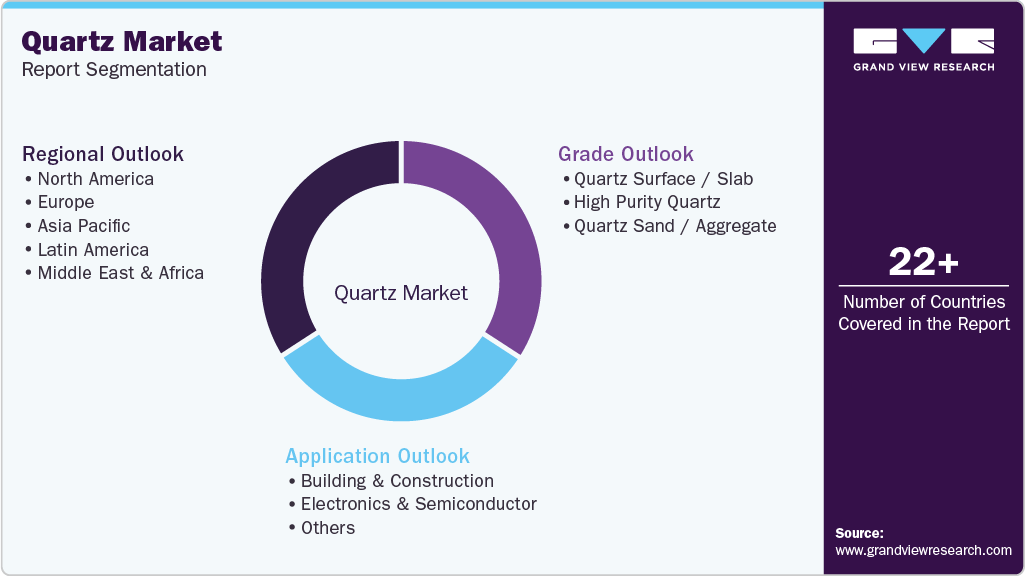
This report forecasts revenue and volume growth at global, regional, and country levels and provides an analysis of the latest industry trends in each of the sub-segments from 2021 to 2033. For this study, Grand View Research has segmented the global quartz market report based on grade, application, and region:
 To learn more about this report, Download Free Sample Report
-
Grade Outlook (Volume, Tons; Revenue, USD Million, 2021 - 2033)
-
Quartz Surface / Slab
-
High Purity Quartz
-
Quartz Sand / Aggregate
-
-
Application Outlook (Volume, Tons; Revenue, USD Million, 2021 - 2033)
-
Building & Construction
-
Electronics & Semiconductor
-
Others
-
-
Regional Outlook (Volume, Tons; Revenue, USD Million, 2021 - 2033)
-
North America
-
U.S.
-
Canada
-
Mexico
-
-
Europe
-
Germany
-
UK
-
France
-
-
Asia Pacific
-
China
-
Japan
-
India
-
-
Latin America
-
Brazil
-
-
Middle East & Africa
-
South Africa
-
Saudi Arabia
-
-
Research Methodology
The quartz market figures in this report are based on a proven research process that combines executive interviews with secondary research from proprietary databases, company filings, and recognized regulatory and institutional sources. Market size is built through value-chain sizing-reconciling supply-side and demand-side estimates-and triangulated with bottom-up and top-down approaches. Every estimate passes multiple levels of expert validation before publication, with each quartz segment quantified using the revenue-capture definitions in the table below.
Segment Definition
Grade
Revenue Capture Definition
Quartz Surface / Slab
The quartz surface or slab segment captures revenue generated from engineered quartz slabs manufactured using natural quartz combined with resins and pigments for residential and commercial surface applications. These products are widely used for countertops, flooring, wall cladding, and interior surfaces due to their durability, stain resistance, and aesthetic appeal.
High Purity Quartz
The high purity quartz segment represents revenue generated from quartz containing exceptionally low impurity levels, primarily used in semiconductor manufacturing, photovoltaic cells, optical fibers, and high performance lighting applications. This grade is valued for its superior chemical purity, thermal stability, and electrical insulation properties.
Quartz Sand / Aggregate
The quartz sand or aggregate segment includes revenue generated from naturally processed quartz used in glass manufacturing, foundry casting, construction materials, water filtration, abrasives, and industrial fillers. Its high silica content, hardness, and chemical stability make it suitable for a broad range of industrial applications.
Application
Revenue Capture Definition
Building & Construction
The building and construction segment captures revenue generated from quartz used in engineered stone surfaces, flooring, wall cladding, concrete, glass, ceramics, and other construction materials. Quartz is valued for its hardness, durability, chemical resistance, and aesthetic appeal, making it a preferred material for residential, commercial, and infrastructure projects.
Electronics & Semiconductor
The electronics and semiconductor segment represents revenue generated from high purity quartz used in semiconductor wafers, crucibles, photovoltaic cells, optical fibers, quartz glass, and precision electronic components. Its exceptional purity, thermal stability, and electrical insulation properties are critical for advanced manufacturing processes.
Others
The others segment includes revenue generated from quartz used in industries such as foundry, chemicals, water treatment, oil and gas, abrasives, paints and coatings, ceramics, and healthcare. These applications utilize quartz for its high silica content, mechanical strength, and chemical inertness across a wide range of industrial processes.
Estimation Model
Layer Name
Key Question
Description
Industrial & Manufacturing Demand Base Layer
What forms the demand base?
Identify global demand from major end use industries including building & construction, electronics & semiconductors, solar energy, glass manufacturing, foundries, ceramics, and engineered stone production. Assess industrial output, construction activity, semiconductor fabrication, and renewable energy investments to establish the total addressable demand for quartz.
Quartz Application Penetration Layer
Where is quartz utilized?
Estimate the penetration of quartz across key applications including engineered quartz surfaces, high purity quartz for semiconductor and photovoltaic applications, quartz glass, foundry sand, ceramics, fillers, and specialty industrial products. Analyze the adoption of quartz across different industries and regions based on technological and manufacturing requirements.
Quartz Consumption Intensity Layer
How much quartz is consumed?
Analyze quartz consumption intensity based on construction activity, semiconductor wafer production, solar photovoltaic manufacturing, glass production, and industrial processing. Evaluate the utilization of quartz sand, high purity quartz, quartz slabs, and other processed quartz products according to purity requirements and application specifications. Consumption intensity varies according to manufacturing technology, product quality standards, and regional industrial growth.
Revenue Layer
How is market revenue generated?
Market revenue is quantified through sale of quartz products including quartz sand, high purity quartz, engineered quartz slabs, quartz crystals, and specialty quartz materials. Revenue generation is driven by demand from construction, electronics & semiconductors, solar energy, glass manufacturing, foundries, and industrial applications. Market value is influenced by quartz purity, processing technology, product grade, mining output, and regional supply demand dynamics.
Delivered Customizations
This report has been delivered with the following In-depth customizations
Client Request
Customization Delivered
Value Adds
Regional Segmentation
Detailed regional analysis of the quartz market across North America, Europe, Asia Pacific, Latin America, and Middle East & Africa. Included evaluation of quartz mining activities, processing capacities, high purity quartz production, semiconductor manufacturing, solar photovoltaic installations, construction activity, glass manufacturing, and government initiatives supporting critical mineral development.
Identified key mining regions, processing hubs, and high growth demand centers. Enabled strategic expansion planning based on semiconductor investments, solar energy deployment, and industrial mineral demand. Supported regional demand forecasting and supply chain optimization.
Competitive Benchmarking
Benchmarking analysis of leading quartz mining companies, processors, and high purity quartz manufacturers based on product portfolio, processing technology, purity capabilities, geographic footprint, sustainability initiatives, research and development investments, distribution network, and strategic partnerships. Included comparison of global producers serving semiconductor, solar, glass, and construction industries.
Assisted in evaluating competitive positioning, technological strengths, and market leadership opportunities. Supported competitive intelligence, partnership assessments, acquisition evaluations, and strategic differentiation initiatives.
Opportunity Assessment
Identification of high growth opportunities across semiconductor fabrication, photovoltaic cell manufacturing, engineered stone production, advanced glass manufacturing, optical fiber production, electronics, and high performance industrial applications.
Enabled prioritization of high return growth segments and emerging regional opportunities. Supported long term investment planning, mining and processing capacity expansion, product innovation, and strategic business development initiatives aligned with global digitalization and energy transition trends.
Frequently Asked Questions About This Report
Asia Pacific market dominated, with a revenue share of 52.4% in 2025.
Quartz surface/ slab segment led the market with the largest revenue share of 80.5% in 2025.
Building & construction segment led the market with the largest revenue share of 84.2% in 2025.
Some of the key players of the global gemstone market are Australian Silica Quartz Group Ltd, Creswick Quartz Pty Ltd, HPQ Materials, Imerys, Jiangsu Pacific Quartz Co., Ltd, Momentive Technologies, Nordic Mining ASA, Russian Quartz LLC, Sibelco, The Quartz Corporation, and others.
The quartz market size was estimated at USD 12.2 billion in 2025 and is expected to reach USD 12.6 billion in 2026.
The quartz market is expected to grow at a CAGR of 4.2% from 2026 to 2033, reaching USD 16.8 billion by 2033.
The key factor driving the growth of the global quartz market is the rising demand from electronics and semiconductor manufacturing, as quartz materials support precise wafer processing, improve thermal stability during chip fabrication, and enable high-purity components required for advanced device architectures.
About the Author(s)
Advanced Interior Materials Research Team
Advanced Materials · Advanced Interior MaterialsThis report was authored by the advanced interior materials research team at Grand View Research - comprising two research analysts, one senior research analyst, and one industry expert - with specialized expertise in the advanced interior materials segment of the advanced materials industry. All findings are based on proprietary advanced materials databases, executive interviews, and regulatory analysis, subject to internal peer review prior to publication.
Last Updated:
Speak to Analyst

Customize this report to your needs - add regions, segments, or data points, with 20% free customization.
Or view our licence options:


ISO 9001:2015 & 27001:2022 Certified
We are GDPR and CCPA compliant! Your transaction & personal information is safe and secure. For more details, please read our privacy policy.


