
- Home
- »
- Plastics, Polymers & Resins
- »
-
Radiation-Resistant Polymers Market Size Report, 2026-2033GVR Report cover
![Radiation-Resistant Polymers Market (2026 - 2033)Report]()
Radiation-Resistant Polymers Market (2026 - 2033)
Size, Share & Trends Analysis Report By Polymer Type (Polyimide, Polyether Ether Ketone, Polytetrafluoroethylene), By End Use (Nuclear power, Aerospace & space, Electronics & semiconductors), By Region, And Segment Forecasts
Market Size, 2025
$530.2MMarket Estimate, 2026
$572.0MMarket Forecast, 2033
$983.2MCAGR, 2026–2033
8.0%Radiation-Resistant Polymers Market Summary
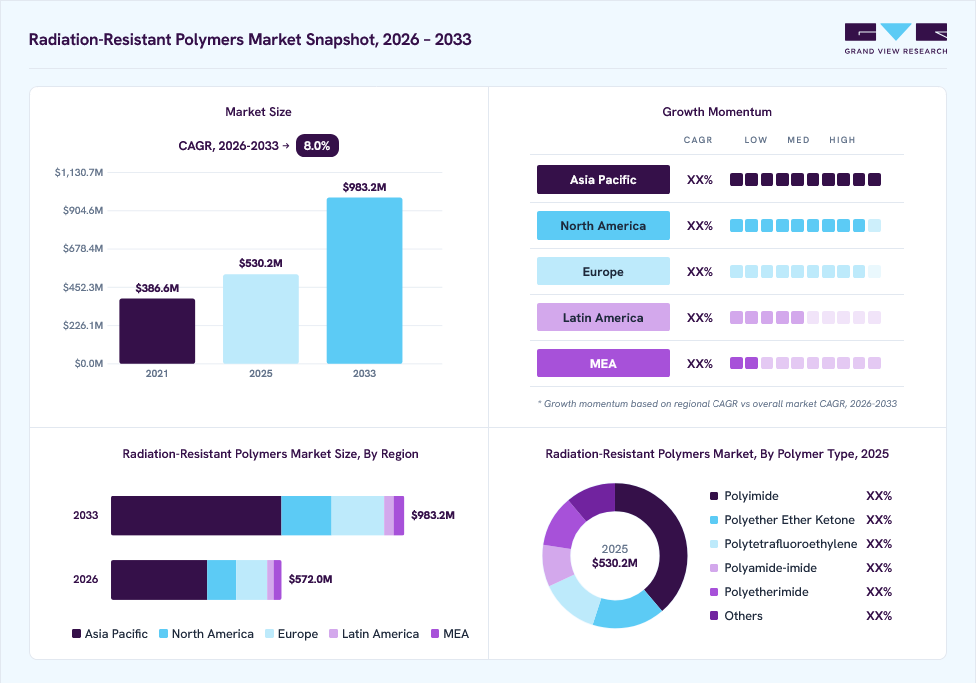
The global radiation-resistant polymers market size was valued at USD 530.2 million in 2025 and is projected to grow from USD 572.0 million to USD 983.2 million by 2033, at a CAGR of 8.0% from 2026 to 2033. The market is driven by growing demand for radiation-resistant materials across nuclear power, aerospace & space, electronics & semiconductors, medical & healthcare, and defense end-uses. These polymers offer superior durability, thermal stability, electrical insulation, and long-term performance under radiation exposure.
Key Market Trends & Insights
- By polymer type: Polyether ether ketone segment is anticipated to grow at a CAGR of 9.3% in the polymer type segment.
- By end use: Aerospace & space segment is expected to grow at a 9.1% CAGR in revenue from 2026 to 2033.
Regional Highlights
- Largest regional market: Asia Pacific (56.1% revenue share, 2025)
- Fastest-growing regional market: Asia Pacific (highest CAGR, 2026-2033)
- By country: India held the largest market share in 2025.
Market Size & Forecast
- Market Size in 2025: USD 530.2 Million
- Estimated market size in 2026: USD 572.0 Million
- Projected Market Size by 2033: USD 983.2 Million
- CAGR (2026-2033): 8.0%
Technological advancements in polymer science and radiation-resistant material development are emerging as a key trend in the radiation-resistant polymers market. Manufacturers are increasingly developing high-performance polymers, radiation-stable formulations, and advanced processing technologies that enhance thermal stability, dimensional retention, electrical insulation, and long-term durability. Innovations in polymer modification and material engineering are further improving performance, enabling radiation-resistant polymers to address demanding applications across nuclear power, aerospace, electronics, and healthcare.
Growing demand for high-performance materials capable of withstanding harsh radiation environments is a major driver for the radiation-resistant polymers market. These materials provide desirable characteristics, including radiation stability, mechanical strength, chemical resistance, thermal resistance, and electrical insulation, supporting applications across nuclear reactors, spacecraft, semiconductor equipment, medical devices, and defense systems. Rising investments in nuclear energy, space exploration, advanced electronics, and high-reliability infrastructure are further accelerating adoption.
Expanding deployment of advanced technologies in high-radiation environments presents a significant opportunity for the radiation-resistant polymers market. Increasing requirements for lightweight, durable, and reliable materials are creating opportunities across aerospace & space, electronics & semiconductors, medical & healthcare, and defense applications. As industries prioritize extended service life, operational reliability, and reduced maintenance requirements, demand is rising for specialized polymers capable of maintaining performance under prolonged radiation exposure.
Market Dynamics
Nuclear power and energy facilities are emerging as a key application segment for the radiation-resistant polymers market, driven by demand for materials capable of maintaining performance under prolonged radiation exposure. Radiation-resistant polymers are increasingly used in waste containment seals, sensor cable jackets, and radiation-hardened structural components inside nuclear facilities, supporting operational reliability, electrical insulation, and long-term durability in demanding environments.
Increasing investments in nuclear power generation, reactor modernization, and facility safety are further accelerating demand for radiation-resistant polymers. Operators are increasingly seeking lightweight, durable, and high-performance materials that withstand radiation, thermal stress, and harsh operating conditions. Expansion of nuclear infrastructure, supported by energy security objectives and rising low-carbon power requirements, is creating favorable conditions for wider adoption of radiation-resistant polymer solutions.
Material degradation is emerging as a key restraint for the radiation-resistant polymers market, driven by prolonged exposure to high levels of ionizing radiation that can cause polymer chain scission, cross-linking, and oxidation. These degradation mechanisms can accelerate embrittlement, reduce mechanical strength, and compromise dimensional stability over time. The resulting performance deterioration can increase replacement and maintenance requirements, limit material selection, and create challenges for applications requiring long-term reliability under intense radiation exposure.
Medical sterilization applications present a significant opportunity for the radiation-resistant polymers market, driven by growing demand for single-use medical equipment processed through high-energy electron beam (E-beam) and gamma sterilization. Manufacturers are increasingly developing polymers that maintain mechanical strength, flexibility, dimensional stability, and functional performance without degrading or becoming brittle during sterilization. Rising adoption of disposable medical gear and stringent sterilization requirements are creating favorable conditions for broader adoption across healthcare applications.
Market Concentration & Characteristics
The market growth stage is medium, and growth is accelerating. The market exhibits slight fragmentation, with key players dominating the industry landscape. Major companies such as Victrex, Evonik Industries, Syensqo, SABIC, DuPont, UBE Corporation, Toray Industries, Kaneka Corporation, PI Advanced Materials, Chemours, and others play a significant role in shaping the market dynamics. These leading players often drive innovation in the market by introducing new products, technologies, and materials to meet the industry's evolving demands.
The degree of innovation in the radiation-resistant polymers market is high, driven by advances in polymer chemistry, material modification, and radiation-processing technologies. Manufacturers are developing high-performance polymers, blends, and stabilized formulations that improve resistance to chain scission, oxidation, embrittlement, and loss of mechanical properties. Advances in E-beam and X-ray sterilization are also expanding material options for medical applications, while controlled radiation processing enables polymer crosslinking, grafting, and functionalization. These innovations improve durability, reliability, and application suitability across nuclear, aerospace, electronics, and healthcare sectors.
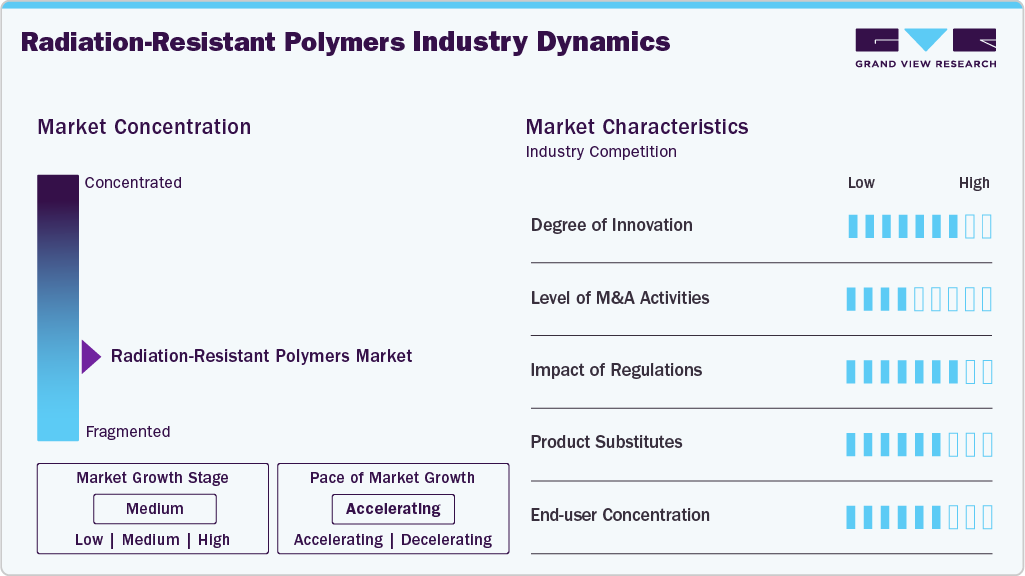
Product substitutes such as metals, ceramics, glass, concrete, and fiber-reinforced composites can limit demand for radiation-resistant polymers in applications requiring high radiation tolerance, thermal stability, and structural strength. Metals and ceramic materials offer strong radiation resistance and high-temperature performance, while concrete and glass remain widely used for radiation shielding. However, their higher weight, processing complexity, or brittleness can restrict use in lightweight applications, allowing radiation-resistant polymers to retain advantages in aerospace, electronics, medical devices, and specialized nuclear components.
Analyst Perspective
Over the next 5-10 years, the radiation-resistant polymers market will transition from niche specialty adoption toward innovation-led, application-specific growth. Primary demand will stem from nuclear power, aerospace, space, electronics, medical, and defense applications. Key materials-including PEEK, polyimide, PTFE, PAI, and PEI-will drive development focused on enhanced radiation tolerance, thermal stability, low outgassing, and mechanical reliability. Buyers will prioritize long service life, rigorous qualification, light weighting, and supply security over initial material costs. Consequently, market leaders will differentiate through proprietary formulations, integrated manufacturing, technical partnerships, and extensive application expertise. However, high production expenses, stringent testing standards, raw material volatility, and competition from metals or ceramics will continue to pressure margins. Ultimately, material selection will increasingly favor sustainability and lifecycle efficiency, driven by the environmental and economic benefits of extended component durability.
Polymer Type Insights
The polyimide segment dominated the market across polymer type segmentation in terms of revenue, accounting for 38.7% market share in 2025, and is forecast to grow at an 8.6% CAGR from 2026 to 2033. The segment is driven by increasing demand from electronics and semiconductor applications, where components require materials that maintain electrical insulation, thermal stability, and dimensional integrity under radiation exposure. Polyimide offers high-temperature resistance, mechanical strength, and reliable dielectric performance, making it suitable for semiconductor equipment, electronic insulation, flexible circuits, and radiation-exposed components. Growing semiconductor manufacturing, advanced electronics development, and increasing use of high-performance materials are supporting broader adoption of polyimide-based radiation-resistant solutions.
The polyether ether ketone segment is expected to expand at a 9.3% CAGR in the radiation-resistant polymers market over the forecast period. The PEEK segment is being driven by growing demand from medical and healthcare applications, where materials require high radiation resistance, mechanical strength, chemical stability, and dimensional stability. PEEK can withstand demanding sterilization processes, including gamma and electron-beam radiation, while maintaining functional performance. Its combination of durability, lightweight properties, and biocompatibility supports adoption in surgical instruments, medical devices, implants, and other healthcare components requiring reliable long-term performance.
End Use Insights
The nuclear power segment led the market by end-use, accounting for 39.3% of revenue in 2025, and is projected to grow at an 8.6% CAGR from 2026 to 2033. The nuclear power segment is being driven by rising electricity demand from industrial growth, electric vehicles, and power-intensive data centers, increasing the need for reliable, continuous, high-output energy generation. As nuclear capacity expands and existing facilities are modernized, demand is increasing for radiation-resistant polymers used in cable insulation, seals, sensor components, and structural applications. These materials provide durability, thermal stability, and radiation resistance, supporting safe and reliable nuclear plant operations.
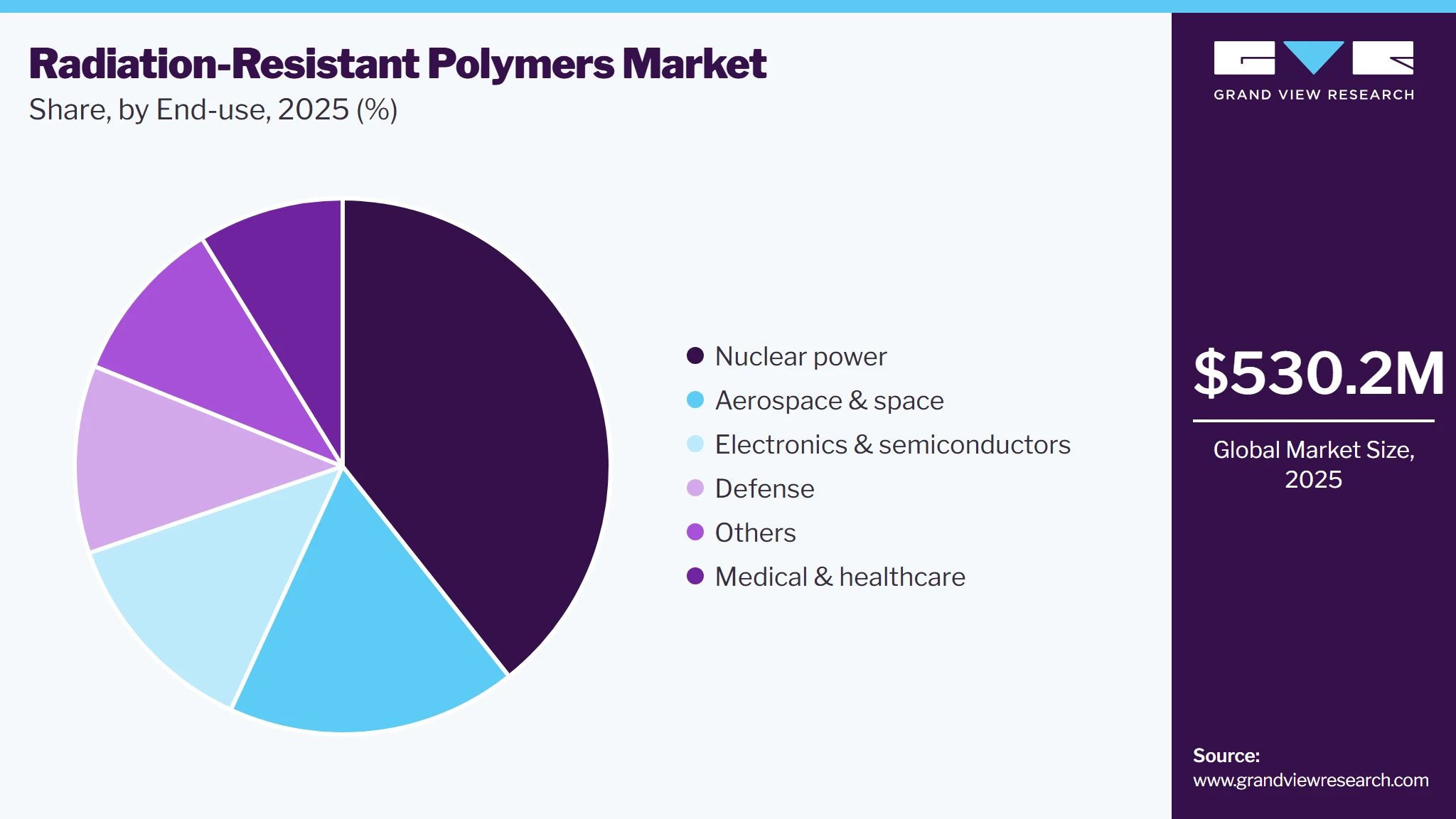
The aerospace & space segment is expected to grow at the fastest CAGR of 9.1% over the forecast period. The aerospace & space segment is being driven by rising defense and national security spending, as heightened geopolitical tensions increase investments in advanced avionics, hypersonic systems, and unmanned vehicles. These applications require lightweight materials that can maintain mechanical, thermal, and electrical performance under radiation and extreme operating conditions. Radiation-resistant polymers support reliable insulation, connectors, electronic components, and structural applications, enabling improved durability and operational reliability across military aerospace and space systems.
Regional Insights
The Asia Pacific radiation-resistant polymers industry held the largest revenue share of 56.1% in 2025. The region is expected to grow at a CAGR of 8.5% over the forecast period. Rapid expansion of nuclear power, aerospace & space, electronics & semiconductors, and medical & healthcare industries is supporting the growth of the radiation-resistant polymers market across Asia Pacific. Increasing investments in nuclear energy infrastructure, semiconductor manufacturing, advanced electronics, and space programs are driving demand for lightweight, durable, and radiation-stable materials. Growing defense spending and healthcare modernization are further accelerating regional adoption, while continued advances in high-performance polymer formulations and processing technologies are strengthening market development.

India’s market for radiation-resistant polymers is expanding steadily, supported by rising demand from nuclear power, aerospace & space, electronics & semiconductors, and medical & healthcare applications. Growing investments in nuclear energy infrastructure, space programs, semiconductor manufacturing, and advanced healthcare systems are strengthening the adoption of durable, radiation-stable materials. Increasing defense spending, modernization of critical infrastructure, and expansion of domestic high-performance polymer manufacturing capabilities are further encouraging market growth across the country.
North America Radiation-Resistant Polymers Market Trends
North America is a key growth region for the radiation-resistant polymers market, supported by strong demand from nuclear power, aerospace & space, electronics & semiconductors, and medical & healthcare applications. The region’s focus on advanced materials, operational safety, and high-performance technologies is driving adoption of lightweight, durable, and radiation-stable polymer solutions. Growing investments in nuclear infrastructure, space programs, semiconductor manufacturing, and defense systems are further strengthening regional market development.
The U.S. represents a major contributor to regional growth, supported by its established nuclear, aerospace, electronics, and healthcare industries. Rising utilization of radiation-resistant polymers in reactor components, aerospace electronics, medical devices, and semiconductor equipment is accelerating demand. Strong emphasis on technological advancement, energy security, defense modernization, and high-reliability materials is further encouraging manufacturers to develop advanced polymer solutions for demanding applications.
Europe Radiation-Resistant Polymers Market Trends
Europe’s radiation-resistant polymers market is expanding due to increasing adoption of advanced materials across nuclear power, aerospace & space, electronics & semiconductors, and medical & healthcare applications. Demand is rising for lightweight, durable, and radiation-stable materials that support reactor operations, space systems, electronic components, and medical equipment. Additionally, investments in nuclear energy, defense modernization, semiconductor manufacturing, and healthcare technologies, supported by stringent safety requirements and advanced material standards, are encouraging broader adoption across the region.
Central & South America Radiation-Resistant Polymers Market Trends
Growing nuclear energy development, aerospace activities, electronics manufacturing, and healthcare investments are driving demand for radiation-resistant polymers across Central & South America. These materials are increasingly used in reactor components, aerospace systems, electronic equipment, medical devices, and protective applications due to their radiation stability, durability, and thermal performance. Increasing investments in energy infrastructure, defense modernization, and healthcare facilities are further supporting market growth, while growing emphasis on reliable high-performance materials continues to encourage regional adoption.
Middle East and Africa Radiation-Resistant Polymers Market Trends
The Middle East & Africa radiation-resistant polymers market is expanding due to increasing investments in nuclear power, aerospace & defense, electronics, and healthcare infrastructure. Growing demand for lightweight, durable, and radiation-stable materials is supporting their use in reactor components, aerospace systems, electronic equipment, medical devices, and protective applications. In addition, investments in nuclear energy development, defense modernization, advanced healthcare facilities, and industrial technologies are encouraging broader adoption of radiation-resistant polymers across the region.
Key Radiation-Resistant Polymers Company Insights
Some of the key players operating in the market include Victrex and Evonik Industries
-
Victrex participates in the radiation-resistant polymers market through its high-performance PEEK and PAEK-based polymer solutions designed for demanding aerospace, energy, electronics, industrial, and medical applications. Supported by advanced polymer engineering and application development capabilities, the company provides lightweight, durable, chemically resistant, thermally stable, and high-strength materials that support reliability in extreme environments. Its PEEK portfolio enables applications requiring long service life, electrical insulation, low outgassing, and consistent performance across critical end uses.
-
Evonik Industries participates in the radiation-resistant polymers market through its VESTAKEEP PEEK portfolio designed for demanding medical, aerospace, semiconductor, automotive, and industrial applications. Supported by extensive high-performance polymer expertise, the company provides materials offering high radiation resistance, thermal stability, chemical resistance, dimensional stability, and mechanical strength. These properties support long-lasting, lightweight, and reliable components across applications requiring consistent performance under radiation and other extreme operating conditions.
PI Advanced Materials and Chemours are some of the emerging participants in the radiation-resistant polymers market.
-
PI Advanced Materials participates in the radiation-resistant polymers market through its polyimide film, varnish, and powder & mold solutions designed for aerospace, electronics, semiconductor, automotive, and industrial applications. Supported by advanced polyimide synthesis and processing capabilities, the company provides high-performance materials offering thermal stability, electrical insulation, dimensional stability, mechanical strength, and radiation resistance, supporting demand for reliable polymer solutions across demanding applications.
-
Chemours participates in the radiation-resistant polymers market through its Teflon™ fluoropolymer portfolio, including PTFE, PFA, FEP, and Tefzel ETFE solutions designed for aerospace, electronics, semiconductor, energy, and industrial applications. Supported by advanced fluoropolymer technology and material development capabilities, the company provides high-performance materials offering radiation resistance, thermal stability, chemical resistance, electrical insulation, and durability, supporting reliable polymer solutions across demanding applications.
Key Radiation-Resistant Polymers Companies
The following key companies have been profiled for this study on the radiation-resistant polymers market.
-
Victrex
-
Evonik Industries
-
Syensqo
-
SABIC
-
DuPont
-
UBE Corporation
-
Toray Industries
-
Kaneka Corporation
-
PI Advanced Materials
-
Chemours
Competitive Benchmarking
Operating Strategies
Competitive Edge
Weakness
Mature Players: Victrex, Evonik Industries, Syensqo, SABIC, DuPont, UBE Corporation, Toray Industries, Kaneka Corporation
- Extensive focus on high-performance polymers, including PEEK, polyimide, PEI, and specialty fluoropolymers, designed for nuclear power, aerospace & space, electronics & semiconductors, medical & healthcare, and defense applications.
- Continuous investment in polymer innovation, radiation resistance, thermal stability, mechanical strength, electrical insulation, chemical resistance, and advanced processing technologies to improve material performance under demanding radiation environments.
- Expansion through global customer relationships, technical partnerships, application development, customized material solutions, and established manufacturing and distribution networks across critical end-use industries.
- Strong expertise in high-performance polymers, specialty resins, polyimides, PEEK, fluoropolymers, and engineering materials with established radiation-resistant properties.
- Established brands, customer relationships, technical capabilities, and global commercial networks provide strong market access across nuclear, aerospace, electronics, medical, and defense applications.
- Broad product portfolios and end-use expertise enable customized, lightweight, durable, thermally stable, and electrically insulating polymer solutions for demanding radiation environments.
- High-performance radiation-resistant polymers can involve higher material, manufacturing, and processing costs compared with conventional polymers and alternative materials such as metals and ceramics.
- Dependence on nuclear power, aerospace, electronics, semiconductor, medical, and defense industries exposes companies to cyclical capital investment, project delays, and changing regulatory requirements.
- Increasing performance requirements, radiation qualification standards, raw material costs, and competition from advanced ceramics, metals, composites, and alternative high-performance polymers can increase R&D, testing, qualification, and commercialization costs.
Emerging Players: PI Advanced Materials, Chemours
- Focus on polyimide films, fluoropolymers, PTFE, PFA, FEP, ETFE, specialty resins, and high-performance polymer solutions for aerospace, electronics, semiconductor, nuclear, medical, energy, and industrial applications.
- Continuous investment in radiation resistance, thermal stability, electrical insulation, chemical resistance, mechanical strength, dimensional stability, and advanced polymer processing technologies.
- Expansion across specialized applications through material innovation, application development, technical partnerships, customized solutions, and established customer relationships.
- Strong expertise in polyimide materials, fluoropolymers, specialty resins, and advanced polymer technologies supports applications requiring reliable performance under radiation and extreme operating conditions.
- Differentiated solutions combining radiation resistance, thermal performance, electrical insulation, chemical stability, durability, and lightweight properties provide access to specialized end-use applications.
- Specialized capabilities across electronics, aerospace, semiconductor, medical, energy, and industrial applications support market diversification and customer reach.
- Specialized product portfolios and application-focused solutions may limit exposure across broader radiation-resistant polymer applications compared with diversified high-performance polymer manufacturers.
- Radiation-resistant polymer formulations can involve higher development, testing, qualification, and production costs compared with conventional polymers and alternative materials.
- Competition from established high-performance polymer manufacturers, advanced ceramics, metals, and composite materials may increase pricing and differentiation pressures, particularly in cost-sensitive applications.
Recent Developments
-
In December 2023, Arkema completed the acquisition of a 54% controlling stake in PI Advanced Materials for an enterprise value of USD 839.7 million, strengthening its portfolio of ultra-high-performance polymers. The transaction expands Arkema’s capabilities in polyimide films, which offer high thermal stability, electrical insulation, and durability under demanding conditions, supporting the development of advanced polymer solutions for radiation-resistant applications across aerospace, space, electronics, and other high-performance end-uses.
-
In May 2025, SIBUR developed a new radiation-resistant polypropylene grade for medical test tubes, containers, and other healthcare products subjected to radiation sterilization. The material maintained mechanical strength, transparency, and color after exposure to radiation doses 40% higher than standard levels, demonstrating enhanced performance under sterilization conditions and supporting the broader adoption of radiation-resistant polypropylene solutions across medical and healthcare applications.
Radiation-Resistant Polymers Market Report Scope
Report Attribute
Details
Market size in 2025
USD 530.2 million
Estimated market size in 2026
USD 572.0 million
Revenue forecast in 2033
USD 983.20 million
Growth rate
CAGR of 8.0% from 2026 to 2033
Historical data
2021 - 2025
Forecast period
2026 - 2033
Quantitative units
Revenue in USD million/billion, volume in tons, and CAGR from 2026 to 2033
Report coverage
Revenue & volume forecast, competitive landscape, growth factors, and trends
Segments covered
Polymer type, end use, and region
Regional scope
North America; Europe; Asia Pacific; Central & South America; Middle East & Africa
Country scope
U.S.; Canada; Mexico; Europe; Germany; UK; France; Italy; Spain; China; India; Japan; South Korea; Australia; Brazil; Argentina; Saudi Arabia; UAE; South Africa
Key companies profiled
Victrex; Evonik Industries; Syensqo; SABIC; DuPont; UBE Corporation; Toray Industries; Kaneka Corporation; PI Advanced Materials; Chemours
Customization scope
Free report customization (equivalent to up to 8 analyst working days) with purchase. Addition or alteration to country, regional & segment scope
Pricing and purchase options
Avail customized purchase options to meet your exact research needs. Explore purchase options
Global Radiation-Resistant Polymers Market Report Segmentation
This report forecasts revenue growth at the global, regional, and country levels and provides an analysis of the latest industry trends across sub-segments from 2021 to 2033. For this study, Grand View Research has segmented the global radiation-resistant polymers market report based on polymer type, end use, and region:

-
Polymer Type Outlook (Volume, Tons; Revenue, USD Million, 2021 - 2033)
-
Polyimide
-
Polyether Ether Ketone
-
Polytetrafluoroethylene
-
Polyamide-imide
-
Polyetherimide
-
Others
-
-
End Use Outlook (Volume, Tons; Revenue, USD Million, 2021 - 2033)
-
Nuclear power
-
Aerospace & space
-
Electronics & semiconductors
-
Medical & healthcare
-
Defense
-
Others
-
-
Regional Outlook (Volume, Tons; Revenue, USD Million, 2021 - 2033)
-
North America
-
U.S.
-
Canada
-
Mexico
-
-
Europe
-
Germany
-
UK
-
France
-
Italy
-
Spain
-
-
Asia Pacific
-
China
-
India
-
Japan
-
South Korea
-
Australia
-
-
Central & South America
-
Brazil
-
Argentina
-
-
Middle East & Africa
-
Saudi Arabia
-
UAE
-
South Africa
-
-
Research Methodology
The radiation-resistant polymers market figures in this report are based on a proven research process that combines executive interviews with secondary research from proprietary databases, company filings, and recognized regulatory and institutional sources. Market size is built through value-chain sizing-reconciling supply-side and demand-side estimates-and triangulated with bottom-up and top-down approaches. Every estimate passes multiple levels of expert validation before publication, with each radiation-resistant polymers segment quantified using the revenue-capture definitions in the table below.
Segment Definition
Polymer Type
Revenue capture definition
Polyimide (PI)
Revenue is captured through polyimide films, coatings, resins, and components used in aerospace, electronics, nuclear, medical, and defense applications requiring radiation resistance, thermal stability, electrical insulation, and dimensional stability.
Polyether Ether Ketone (PEEK)
Revenue is generated through PEEK materials used in nuclear components, aerospace systems, medical devices, electronics, and defense applications requiring radiation resistance, mechanical strength, chemical stability, and high-temperature performance.
Polytetrafluoroethylene (PTFE)
Revenue is captured through PTFE materials used in seals, insulation, gaskets, cables, and specialized components requiring radiation resistance, chemical inertness, low friction, electrical insulation, and reliable performance under demanding operating conditions.
Polyamide-imide (PAI)
Revenue is generated through PAI materials used in electrical, aerospace, industrial, and nuclear components requiring radiation resistance, high-temperature stability, mechanical strength, wear resistance, and dimensional stability under demanding operating conditions.
Polyetherimide (PEI)
Revenue is captured through PEI materials used in aerospace, electronics, medical, nuclear, and industrial components requiring radiation resistance, thermal stability, mechanical strength, electrical insulation, and dimensional stability.
Others
Revenue comes from other radiation-resistant polymers, including PPS, PPSU, PEKK, fluoropolymers, and specialty engineering polymers used across nuclear, aerospace, electronics, medical, and defense applications requiring specialized performance.
End-use
Revenue capture definition
Nuclear Power
Revenue is generated through radiation-resistant polymers used in waste containment seals, sensor cable jackets, insulation, connectors, and structural components requiring long-term radiation, thermal, and chemical resistance within nuclear facilities.
Aerospace & Space
Revenue is captured through radiation-resistant polymers used in spacecraft components, cable insulation, electronic systems, seals, and structural applications requiring lightweight performance, radiation resistance, thermal stability, and low outgassing.
Electronics & Semiconductors
Revenue is generated through radiation-resistant polymers used in semiconductor equipment, electronic insulation, connectors, sensors, and components requiring electrical stability, dimensional retention, thermal resistance, and reliable performance under radiation exposure.
Medical & Healthcare
Revenue is captured through radiation-resistant polymers used in single-use medical devices, test tubes, containers, equipment components, and sterilizable products requiring strength, transparency, flexibility, and resistance to gamma and E-beam sterilization.
Defense
Revenue is generated through radiation-resistant polymers used in defense electronics, sensors, cable systems, protective components, and specialized equipment requiring durability, electrical insulation, thermal stability, and reliable performance under radiation exposure.
Others
Revenue comes from radiation-resistant polymers used in particle accelerators, research equipment, industrial processing, energy systems, and specialized applications requiring radiation tolerance, durability, thermal stability, and long-term material performance.
Estimation Model
Layer No.
Layer Name
Key Question
Description
1
Top-Down Radiation-Resistant Polymers Demand Assessment Layer
What defines market boundaries?
This layer establishes global demand for radiation-resistant polymers across nuclear power, aerospace & space, electronics & semiconductors, medical & healthcare, defense, and other specialized end-uses.
2
End-Use Demand Validation Layer
Where is demand generated?
This layer maps demand across nuclear, aerospace, electronics, medical, defense, and other applications based on radiation exposure, thermal stability, mechanical strength, electrical insulation, durability, and material-performance requirements.
3
Consumption-to-Revenue Conversion Layer
Who captures market revenue?
This layer converts polymer consumption and application volumes into revenue using material utilization rates, polymer specifications, processing requirements, pricing differences, and demand patterns across manufacturers, compounders, distributors, and downstream users.
4
Regional Demand Verification Layer
How are assumptions validated?
This layer validates demand across North America, Europe, Asia Pacific, Central & South America, and Middle East & Africa using nuclear investments, aerospace programs, semiconductor manufacturing, healthcare demand, defense spending, production capacity, and regulatory frameworks.
Delivered Customizations
This report has been delivered with the following In-depth customizations
Client Request
Customization Delivered
Value Adds
Regional segmentation
Market analyzed across North America, Europe, Asia Pacific, Latin America, and the Middle East & Africa, with assessment of regional demand, industrial activity, nuclear infrastructure, aerospace programs, semiconductor manufacturing, healthcare applications, and investment trends.
Identifies high-potential regions, regional demand patterns, and growth opportunities for radiation-resistant polymer suppliers.
Cross-segmentation
Market cross-segmented by polymer type, application, and end-use industry, including PI, PEEK, PTFE, PAI, PEI, nuclear power & energy, aerospace & space, electronics & semiconductors, medical & healthcare, and defense.
Provides granular visibility into demand concentration, high-growth niches, material substitution patterns, and application-specific opportunities.
Opportunity assessment
Opportunities evaluated across nuclear power expansion, aerospace & space programs, semiconductor manufacturing, medical sterilization, defense applications, and advanced electronics, with emphasis on high-performance polymers such as PEEK and polyimides.
Identifies attractive application segments, emerging demand pockets, technology-driven opportunities, and areas with potential for capacity expansion and product innovation.
Frequently Asked Questions About This Report
The market is expected to grow at a CAGR of 8.0% from 2026 to 2033.
The polyimide radiation-resistant polymers segment dominated the market across polymer type segmentation in terms of revenue, accounting for 38.7% market share in 2025, and is forecast to grow at an 8.6% CAGR from 2026 to 2033.
The Asia Pacific radiation-resistant polymers industry held the largest revenue share of 56.1% in 2025. The region is expected to grow at a CAGR of 8.5% over the forecast period.
The market is driven by growing demand for radiation-resistant materials across nuclear power, aerospace & space, electronics & semiconductors, medical & healthcare, and defense end-uses.
Major companies such as Victrex, Evonik Industries, Syensqo, SABIC, DuPont, UBE Corporation, Toray Industries, Kaneka Corporation, PI Advanced Materials, Chemours, and others play a significant role in shaping the market dynamics.
Medical sterilization applications present a significant opportunity for the radiation-resistant polymers market, driven by growing demand for single-use medical equipment processed through high-energy electron beam (E-beam) and gamma sterilization.
Nuclear power and energy facilities are emerging as a key application segment for the radiation-resistant polymers market, driven by demand for materials capable of maintaining performance under prolonged radiation exposure.
The nuclear power segment led the market by end-use, accounting for 39.3% of revenue in 2025, and is projected to grow at an 8.6% CAGR from 2026 to 2033.
The global radiation-resistant polymers market size was valued at USD 530.2 million in 2025 and is projected to reach USD 983.0 million by 2033.
About the Author(s)
Plastics, Polymers & Resins Research Team
Bulk Chemicals · Plastics, Polymers & ResinsThis report was authored by the plastics, polymers & resins research team at Grand View Research - comprising two research analysts, one senior research analyst, and one industry expert - with specialized expertise in the plastics, polymers & resins segment of the bulk chemicals industry. All findings are based on proprietary bulk chemicals databases, executive interviews, and regulatory analysis, subject to internal peer review prior to publication.
Last Updated:
Speak to Analyst


Customize this report to your needs — add regions, segments, or data points, with 20% free customization.
Or view our licence options:


ISO 9001:2015 & 27001:2022 Certified
We are GDPR and CCPA compliant! Your transaction & personal information is safe and secure. For more details, please read our privacy policy.


